What is your name? Do you live up to its meaning or reference in any way? If things are determined for us by a higher power than us, even our name could be said to be a clue, are we living up to it? Are we defying it? Are you really the "strong man of God" and what could that best be if the most useful interpretation is taken? Perhaps a fighter for and defender of justice against oppression? Or do you really spread injustice and work against the good and the best? Is your name then Ironic? What are other meanings you could give your name from other languages or a mixture of languages or based on its look or letters or symbols or sounds? Would you like another name? Why? Why not take it?
Does your name remind people of or refer to a famous character? Are you like them or stories about them from anywhere in the world? Do you live up to their example? Are you ever better?
One interpretation of my real name can be extensively (extending) merciful/compassionate child Divine or of the Divine or from the Divine. Since last names sometimes come first it would be Divine Heart/Core Extensively Extending Mercy/Compassion
https://en.m.wikipedia.org/wiki/Ancient_Egyptian_concept_of_the_soul#Ib_.28heart.29
Additional meanings can be Heart Manifest (of the one who makes manifest) Is Him or Heart Personality Manifest or of the Manifest who makes Manifest.
Other meanings can also include Enemy of the Elephent, a Euphamism for a lion or one who takes on dominating or intimidating individuals or forces or groups, who is cold or of the moon, a calculated attacker though the first component can also mean an elephant as well as a component meaning Of the Mystic Truth or causing to Abandon and leading to Occultation or Eclipse.
That is just the first name and not only that! Part of that same layered potential etymological chain is also the final part of who moves in God as a priest of sacred knowledge of God and the beginning being a slave, dependent, or agent.
So culminating in this etymology with the reminders and ideas of a lion like slave of God who takes on intimidating giants as and like an intimidating giant as their enemy who is of the moon (follower of Shiva or a Lunatic) who is cool like the moon and calculated and cold in their attacks and who moves in God of God as a priest of the sacred knowledge of God.
What a name! Feel free to tell me your name in private or wherever you feel comfortable if you would like me to give it meaning!
Now onto my last name!
Generally known to mean God or The Divine, in other languages it can be broken down into meaning sacred worshipful speech of the left side which refreshes and descends from Thinking (with a reminder of making One of 9 to achieve the Highest) of the Heavens and Earth or Reality and that is only a small part of it!
Name: Your Glory or are you an ironic or sarcastic joke?
Moderator: atreestump
Forum rules
No Abusive Behavior. No Spam. No Porn. No Gore. It's that simple.
No Abusive Behavior. No Spam. No Porn. No Gore. It's that simple.
-
kFoyauextlH

- Posts: 1668
- Joined: Sun Jun 15, 2025 3:53 pm
Re: Name: Your Glory or are you an ironic or sarcastic joke?
I just stumbled on this: https://en.wikipedia.org/wiki/Nominative_determinism?wprov=sfsi1
-
kFoyauextlH
- Posts: 1668
- Joined: Sun Jun 15, 2025 3:53 pm
Re: Name: Your Glory or are you an ironic or sarcastic joke?
Great find! Since what I showed above was all hidden and unknown to me it was amazing to find out how much appropriate seeming meaning was in m name.
"In Ancient Rome the predictive power of a person's name was captured by the Latin proverb "nomen est omen", meaning the name is a sign.[55] This saying is still in use today in English[55] and other languages such as French,[56] German,[57] Italian,[58] Dutch,[59] and Slovenian.[60]
Another aspect of naming was the importance attached to the wider meaning contained in a name. In 17th-century England it was believed that choosing a name for a child should be done carefully. Children should live according to the message contained in, or the meaning of their names.[11] In 1652 William Jenkyn, an English clergyman, argued that first names should be "as a thread tyed about the finger to make us mindful of the errand we came into the world to do for our Master".[12] In 1623, at a time when Puritan names such as Faith, Fortitude and Grace were appearing for the first time, English historian William Camden wrote that names should be chosen with "good and gracious significations", as they might inspire the bearer to good actions.
New Scientist coined the term nominative contradeterminism for people who move away from their name, creating a contradiction between name and occupation."
"In Ancient Rome the predictive power of a person's name was captured by the Latin proverb "nomen est omen", meaning the name is a sign.[55] This saying is still in use today in English[55] and other languages such as French,[56] German,[57] Italian,[58] Dutch,[59] and Slovenian.[60]
Another aspect of naming was the importance attached to the wider meaning contained in a name. In 17th-century England it was believed that choosing a name for a child should be done carefully. Children should live according to the message contained in, or the meaning of their names.[11] In 1652 William Jenkyn, an English clergyman, argued that first names should be "as a thread tyed about the finger to make us mindful of the errand we came into the world to do for our Master".[12] In 1623, at a time when Puritan names such as Faith, Fortitude and Grace were appearing for the first time, English historian William Camden wrote that names should be chosen with "good and gracious significations", as they might inspire the bearer to good actions.
New Scientist coined the term nominative contradeterminism for people who move away from their name, creating a contradiction between name and occupation."
Re: Name: Your Glory or are you an ironic or sarcastic joke?
Glad you found it useful and it's good to see you posting with a free flow.
-
kFoyauextlH
- Posts: 1668
- Joined: Sun Jun 15, 2025 3:53 pm
Re: Name: Your Glory or are you an ironic or sarcastic joke?
Thank you so much! Yeah that was wonderful to see.
https://en.m.wiktionary.org/wiki/%CE%A3%CF%89%CE%BA%CF%81%CE%AC%CF%84%CE%B7%CF%82#Ancient_Greek
https://en.m.wiktionary.org/wiki/%CE%A3%CF%89%CE%BA%CF%81%CE%AC%CF%84%CE%B7%CF%82#Ancient_Greek
-
kFoyauextlH
- Posts: 1668
- Joined: Sun Jun 15, 2025 3:53 pm
Re: Name: Your Glory or are you an ironic or sarcastic joke?
Added in 29 minutes 42 seconds:
I must be racist and prejudiced because the way this guy looks and has his hair and is wagging it all around in my face is really bothering me. He looks like an untamed, wild, idiot.
"
According to Linguist Mario Pei , it is Sardinian
. Now there are some reasons to doubt his conclusions, linguistically. However there is no doubt that Sardinian is the closest in terms of phonology and(depending on the dialect, vocabulary).
However notice where I say, depending on the dialect. Some dialects of Sardinian seem to be further from Latin than some versions of standard Italian. Now Standard Italian is in some ways artificial since it descended from the fourteenth century Tuscan dialect. If you look at modern Tuscan(as a dialect) or even Neapolitan, you will notice that these modern dialects are actually much further from Latin than Standard Italian is.
The other claim you hear a lot is Romanian. The core problem with this claim is that Romanian contains a decent amount(some people exaggerate the amount) of Slavic vocabulary. However there is something to be said about the different forms of nouns that often make words be more similar to Latin given certain declensions. For example, Domnule(Romanian) and Domne(Late Latin, Vocative) versus Domnu(Sardinian). And it must also be said that Romanian, unquestionably, contains many expressions that are from Latin or Old Latin.
The last claim is often Spanish. This one doesn't make much sense to me, Spanish's phonology is further than Romanian, Italian, or Sardinian(especially when you consider the common tendency of Spanish speakers to turn V sounds into B sounds, see ven). Spanish's vocabulary retains some early versions of Latinate verbs, but it also contains tons of Gaulish loan words and some Arabic. It's grammar is pretty standard.
Overall, I would say that Logudorese Sardinian is the closest when it comes to Vocabulary with Standard Italian coming in Second(Romanian being third). In terms of phonology, Sardinian clearly is the closest(Romanian and Modern Italian are nearly identical in this regard). In terms of grammar, Romanian is obviously the closest(All the other Romance languages are virtually the same here).
I have a lot of sympathy for the Romanian position especially because the closer you look, there is a lot of similarities in vocabulary that are not easily picked up unless you know what to look for. And if Romanian took out all their Slavic words and replaced them Romance words(not even Latin words necessarily), it would be easier to understand what they are saying. A lot of people hear the Slavic influence in their Language. And surely it is there, but the vast majority of their language is Latinate and Romance. That's the reason why they can understand Italians, even if Italians cannot understand them.
"
"
u/Spiritual-Turnover82 avatar
Spiritual-Turnover82
•
2y ago
Vocabulary is not the main trait. English has an overwhelming amount of Latin or Latin derived words, but still a Germanic language DUE to GRAMMAR.
Vocablary? All Western languages have guerra, rico/riche But both these to words are Germanic. Hmmmmmm... In Romanian these are Slavic. And these words explain the making of the Romance languages from Latin.
One more thing about vocabulary: the use of Latin by the Catholic Church in the West prompted the introduction of many Latin words. These are cultural borrowings and not directly inherited Latin words and this can be called a relatinization.
Sardinian is a not a language, it is a collection of dialects. Some have c as k, centum/kentum and this is the main reason while (some) Sardinian is considered closest to Latin,
But other phonological aspects are omitted.
Au is o : Aurum > oro, but stil aur in Romanian
Taurus>torro, but still taur in Romanian.
So why preserving k reading in centum is more important than preserving au in aurum, taurus ?
All Western Romance languages have completely lost a very important part of the Latin Grammar> noun declension.
Romanian has kept, albeit reduced, three practical , five formal noun cases .
3
3
u/Spiritual-Turnover82 avatar
Spiritual-Turnover82
•
2y ago
Vocabulary is not the main trait. English has an overwhelming amount of Latin or Latin derived words, but still a Germanic language DUE to GRAMMAR.
Vocablary? All Western languages have guerra, rico/riche But both these to words are Germanic. Hmmmmmm... In Romanian these are Slavic. And these words explain the making of the Romance languages from Latin.
One more thing about vocabulary: the use of Latin by the Catholic Church in the West prompted the introduction of many Latin words. These are cultural borrowings and not directly inherited Latin words and this can be called a relatinization.
Sardinian is a not a language, it is a collection of dialects. Some have c as k, centum/kentum and this is the main reason while (some) Sardinian is considered closest to Latin,
But other phonological aspects are omitted.
Au is o : Aurum > oro, but stil aur in Romanian
Taurus>torro, but still taur in Romanian.
So why preserving k reading in centum is more important than preserving au in aurum, taurus ?
All Western Romance languages have completely lost a very important part of the Latin Grammar> noun declension.
Romanian has kept, albeit reduced, three practical , five formal noun cases .
3
[deleted]
•
4y ago
The last claim is often Spanish. This one doesn't make much sense to me, Spanish's phonology is further than Romanian, Italian, or Sardinian(especially when you consider the common tendency of Spanish speakers to turn V sounds into B sounds, see ven)
Not really.
First, the vowels in Spanish are identical in latin, except that latin has long vowels. Italian has two extra vowels.
The apical latin "S" is retained in Castilian Spanish.
V/B mixup, yes well since the italians are not pronouncing V as they did in latin either, I don't see why that would put Italian over Spanish.
2
[deleted]
•
4y ago
The last claim is often Spanish. This one doesn't make much sense to me, Spanish's phonology is further than Romanian, Italian, or Sardinian(especially when you consider the common tendency of Spanish speakers to turn V sounds into B sounds, see ven)
Not really.
First, the vowels in Spanish are identical in latin, except that latin has long vowels. Italian has two extra vowels.
The apical latin "S" is retained in Castilian Spanish.
V/B mixup, yes well since the italians are not pronouncing V as they did in latin either, I don't see why that would put Italian over Spanish.
"
It might be cool if "deleted" also meant dead.
"
[deleted]
•
7mo ago
Honestly it's mostly people who have not been exposed to Spanish making these claims. Spanish as a whole is a very conservative language and I would say is about the same as Italian in terms of how close it is to latin. The arabic words in Spanish are mostly nouns and many times the latin counterparts still exist. On top of that most of them have fallen out of use outside of Andalusia.
Another really dumb assumption people make is that Latin American varieties of Spanish are very different from peninsular Spanish. They are the same with some slangs and quirks.
I want to also make this clear. The name of the language is Castilian or Spanish. When referring to Spanish from Spain, call it peninsular Spanish. Many countries in Latin America refer to the language directly as Castellano. I know in the English Speaking world its common to say Castilian Spanish but that literally just means Spanish Spanish.
"
"
u/Wichiteglega avatar
Wichiteglega
•
9y ago
I'd say Sardinian . It retains very conservative features not preserved in almost all other languages, such as the 'c' pronounced as /k/ in all positions and many words which have been substituted in other languages, such as 'domus' or 'ianua'.
10
Chrestius
OP •
9y ago
Yeah, that seems to be the concensus. It's cool to see that Sardinian haa kept so many Latin features
3
. It retains very conservative features not preserved in almost all other languages, such as the 'c' pronounced as /k/ in all positions and many words which have been substituted in other languages, such as 'domus' or 'ianua'.
10
Chrestius
OP •
9y ago
Yeah, that seems to be the concensus. It's cool to see that Sardinian haa kept so many Latin features
3
Chrestius
OP •
9y ago
Yeah, that seems to be the concensus. It's cool to see that Sardinian haa kept so many Latin features
3
3
u/Wichiteglega avatar
Wichiteglega
•
9y ago
I'd say Sardinian . It retains very conservative features not preserved in almost all other languages, such as the 'c' pronounced as /k/ in all positions and many words which have been substituted in other languages, such as 'domus' or 'ianua'.
10
Chrestius
OP •
9y ago
Yeah, that seems to be the concensus. It's cool to see that Sardinian haa kept so many Latin features
3
u/TWFM avatar
TWFM
•
9y ago
I'd assume modern Italian is the closest.
3
u/topdeckexactlethal avatar
topdeckexactlethal
•
9y ago
Not exactly modern, but rather dialects. I find my dialect (southern Apulia) to be much closer to latin, in the ethimology of words and in the construct, that actual italian. And other dialects (saw a lot of sardinian in this thread) are even closer.
7
Chrestius
OP •
9y ago
Oh cool! Do children in your region learn the dialect first or do they learn standard Italian?
2
[deleted]
•
9y ago
[deleted]
•
4y ago
Same with Sicilian in my opinion! Glad I wasn't the only one seeing this
1
3
u/topdeckexactlethal avatar
topdeckexactlethal
•
9y ago
Not exactly modern, but rather dialects. I find my dialect (southern Apulia) to be much closer to latin, in the ethimology of words and in the construct, that actual italian. And other dialects (saw a lot of sardinian in this thread) are even closer.
7
Chrestius
OP •
9y ago
Oh cool! Do children in your region learn the dialect first or do they learn standard Italian?
2
[deleted]
•
9y ago
[deleted]
•
4y ago
Same with Sicilian in my opinion! Glad I wasn't the only one seeing this
"
"
[deleted]
•
9y ago
I believe Spanish has taken too much from Arabic for it to contend with Italian. I wouldn't be able to find a source for this, but I remember reading a while ago that Italian had evolved the least from Latin and French had evolved the most. Seemed right to me.
7
u/Commercial-Art-5870 avatar
Commercial-Art-5870
•
1y ago
This is false. 4000 loanwords in a 150,000 word language and no influence on grammar. I'd wonder if the number of loanwords into (admittedly, not everyday, but literary) English from Arabic is in the same order of magnitude
2
[deleted]
•
7mo ago
Not to mention of those 4000 loan words many of them have actually fallen out of use outside of Andalusia. Those 4000 words exist but they exist like an SAT word exists without actually being used. In general the northern languages of Spain like Castilian (Spanish) didn't have a lot of arabic influence. Most of the Arabic words come from Mozarabic dialects (Extinct latin dialects of southern Spain) which later loaned the words to Spanish. As far as I know none of us say As-salamu alaykum ( the mozarabs did).
1
u/Gold-Prior-1373 avatar
Gold-Prior-1373
•
3mo ago
Thats true but i think the main issue is spanish has more sound sheefs like f to h to silent and ct to it to ch
1
7
u/Commercial-Art-5870 avatar
Commercial-Art-5870
•
1y ago
This is false. 4000 loanwords in a 150,000 word language and no influence on grammar. I'd wonder if the number of loanwords into (admittedly, not everyday, but literary) English from Arabic is in the same order of magnitude
2
[deleted]
•
7mo ago
Not to mention of those 4000 loan words many of them have actually fallen out of use outside of Andalusia. Those 4000 words exist but they exist like an SAT word exists without actually being used. In general the northern languages of Spain like Castilian (Spanish) didn't have a lot of arabic influence. Most of the Arabic words come from Mozarabic dialects (Extinct latin dialects of southern Spain) which later loaned the words to Spanish. As far as I know none of us say As-salamu alaykum ( the mozarabs did).
1
2
[deleted]
•
7mo ago
Not to mention of those 4000 loan words many of them have actually fallen out of use outside of Andalusia. Those 4000 words exist but they exist like an SAT word exists without actually being used. In general the northern languages of Spain like Castilian (Spanish) didn't have a lot of arabic influence. Most of the Arabic words come from Mozarabic dialects (Extinct latin dialects of southern Spain) which later loaned the words to Spanish. As far as I know none of us say As-salamu alaykum ( the mozarabs did).
1
[deleted]
•
7mo ago
Not to mention of those 4000 loan words many of them have actually fallen out of use outside of Andalusia. Those 4000 words exist but they exist like an SAT word exists without actually being used. In general the northern languages of Spain like Castilian (Spanish) didn't have a lot of arabic influence. Most of the Arabic words come from Mozarabic dialects (Extinct latin dialects of southern Spain) which later loaned the words to Spanish. As far as I know none of us say As-salamu alaykum ( the mozarabs did).
1
1
u/Commercial-Art-5870 avatar
Commercial-Art-5870
•
1y ago
This is false. 4000 loanwords in a 150,000 word language and no influence on grammar. I'd wonder if the number of loanwords into (admittedly, not everyday, but literary) English from Arabic is in the same order of magnitude
2
[deleted]
•
7mo ago
Not to mention of those 4000 loan words many of them have actually fallen out of use outside of Andalusia. Those 4000 words exist but they exist like an SAT word exists without actually being used. In general the northern languages of Spain like Castilian (Spanish) didn't have a lot of arabic influence. Most of the Arabic words come from Mozarabic dialects (Extinct latin dialects of southern Spain) which later loaned the words to Spanish. As far as I know none of us say As-salamu alaykum ( the mozarabs did).
1
u/Gold-Prior-1373 avatar
Gold-Prior-1373
•
3mo ago
Thats true but i think the main issue is spanish has more sound sheefs like f to h to silent and ct to it to ch
"
"
u/rocketman0739 avatar
rocketman0739
•
9y ago
Everyone's talking about modern languages, but you might want to check out how similar Gaulish is to Latin. Must have made diplomacy in those Gallic campaigns a bit easier.
8
Chrestius
OP •
9y ago
Wow, I never knew that the languages were so similar! This kinda explains how the Romans were able to completely destroy the Gallic Language. It was so easy to jump from Gaulish to Latin that once people learnt one, the other slowly got forgotten.
4
u/Amenemhab avatar
Amenemhab
•
9y ago
That looks way too similar for two languages from different branches. Aren't we just looking at proto-romance here ?
Edit: actually it's only really the "divertimus" thing that I find unlikely.
2
[deleted]
•
2y ago
Could this corroborate the theory of the Italo-Celtic branch of the Indo-European family?
2
8
Chrestius
OP •
9y ago
Wow, I never knew that the languages were so similar! This kinda explains how the Romans were able to completely destroy the Gallic Language. It was so easy to jump from Gaulish to Latin that once people learnt one, the other slowly got forgotten.
4
Chrestius
OP •
9y ago
Wow, I never knew that the languages were so similar! This kinda explains how the Romans were able to completely destroy the Gallic Language. It was so easy to jump from Gaulish to Latin that once people learnt one, the other slowly got forgotten.
4
4
Chrestius
OP •
9y ago
Wow, I never knew that the languages were so similar! This kinda explains how the Romans were able to completely destroy the Gallic Language. It was so easy to jump from Gaulish to Latin that once people learnt one, the other slowly got forgotten.
4
u/Amenemhab avatar
Amenemhab
•
9y ago
That looks way too similar for two languages from different branches. Aren't we just looking at proto-romance here ?
Edit: actually it's only really the "divertimus" thing that I find unlikely.
"
Argh, these people!
"
trivenefica
•
9y ago
If you mean which languages in antiquity were closest to Latin, Faliscan, Latin's closest relative. The romance languages mentioned above are derived (descended) from Latin, and not spoken by the inhabitants of ancient Rome. The language of the Gauls, which would have been Celtic, was thus related to Latin, but somewhat distantly. Latin was part of the italic language family. Other italic languages of note are Oscan and Umbrian. The other italic languages all died out at various points in antiquity after Latin had spread throughout the peninsula.
6
6
trivenefica
•
9y ago
If you mean which languages in antiquity were closest to Latin, Faliscan, Latin's closest relative. The romance languages mentioned above are derived (descended) from Latin, and not spoken by the inhabitants of ancient Rome. The language of the Gauls, which would have been Celtic, was thus related to Latin, but somewhat distantly. Latin was part of the italic language family. Other italic languages of note are Oscan and Umbrian. The other italic languages all died out at various points in antiquity after Latin had spread throughout the peninsula.
6
u/No_Report_3376 avatar
No_Report_3376
•
6mo ago
There's a language in Switzerland called Romansh which I've seen people calling it the closest living relative to Latin
"
https://ianjamesparsley.wordpress.com/2 ... -to-latin/
"
This leaves the other major Iberian languages versus Italian. In terms of the distance from Classical Latin, there is no easy objective way to score Portuguese and Spanish apart. Portuguese maintains some sounds which Spanish has lost, most obviously initial f- in words such as fazer (Latin facere but Spanish hacer) and has also had its vocabulary marginally less influenced by Arabic; conversely, Spanish maintains a much simpler five-vowel system (much more reminiscent of that in Latin) compared to that of Portuguese which has developed significant complexity, and it maintains an [s] sound which is probably closer to that of Golden Age Latin than that of any other major Romance language; arguably, Spanish is also marginally closer grammatically, not having developed personal infinitives or a commonly used future subjunctive (though one does exist technically) which were unknown even in Classical Latin’s more wide-ranging system of verbal suffixes. It is tempting to suggest Spanish is closer given that Portuguese has developed greater phonological complexity; but Spanish had its own consonantal sound shift which made it more distant from Latin in some respects that Portuguese is. Ultimately, this one may be too close to call!
There is little in Italian’s grammatical structure to suggest it is any farther away from Classical Latin than either Iberian language is: strictly speaking, perhaps, the basic present tense indicative verbal paradigm is slightly more distant (Latin/Spanish/Italian: canto/canto/canto, cantas/cantas/canti, cantat/canta/canta, cantamus/cantamos/cantiamo, cantatis/cantáis/cantate, cantant/cantan/cantano) but there are certain other aspects which make it marginally closer (including the infinitive cantare which is identical to Latin; Spanish and Portuguese have cantar). Italian has developed its plural forms differently from the other western Romance languages (Italian casa-case versus Spanish casa-casas ‘house-houses’), but not in a way which makes it any more distant from Classical Latin.
Lexically, Italian is surely closer to Classical Latin, not having had anything like the influence on it that Spanish and even Portuguese had from Arabic. Perhaps more interesting, however, is the influence Italian shares with Latin that the Iberian Languages do not: Latin in the Golden Age period came under considerable influence from Greek, but by that stage it had already spread to Iberia where that influence was more limited. The most obvious example of this is Italian parlare (French parler, Catalan parlar ‘speak’) which is in fact from a Greek borrowing into Latin which occurred after Latin had expanded westwards, meaning it is absent from Portuguese (falar) and Spanish (hablar, formerly fablar) whose forms are derived from the “native” Latin fabulari.
"
P was pronounced like F and Ha, so those words are all related very closely and not great proof if one recognizes that P and F were pronounced the same, then what is the difference between parlare and fa(r)lar(e) really? I think these people are dreaming up the differences and how much it mattered.
"
Phonologically, however, it is clear that Italian is closer to Latin; even its seven-vowel system (Golden Age Latin is now thought to have had only five) ultimately derives from the ancient division between long and short vowel and, more notably, Italian is the only one of the “candidates” to maintain the long consonants which existed in Latin (even if they are not totally aligned; indeed sometimes these even appear as vestiges of previous consonant clusters without even being written, as in a Milano ‘in/to Milan’ pronounced as if with a double -mm-).
Perhaps the most obvious element of this lies in the phonology of vocabulary even when words are cognate across all or most Romance languages. There are exceptions, but in general Italian retains forms which are closer to Latin and, as a consequence, often longer: the most obvious example is the derivation of the word for ‘week’ from the Late Latin septimana; in French this has been sharply reduced to the typically two-syllable word semaine; Spanish and Portuguese have semana (and Catalan has setmana but this is usually similarly pronounced, with a silent -t-); but Italian remains close with settimana, where only the regular evening out of the consonant cluster renders it any different from Latin at all. In fact, we can even see this with borrowings: those Franks lent Latin the word wadaniare which shifted by regular sound shift into the new language as guadaniare (cf guerre/guerra “war’) but over time became just ganhar in Portuguese, ganar in Spanish, guanyar in Catalan and gagner in French (then borrowed “back” into Germanic in the late Middle Ages as English ‘gain’); but this remains guadagnare in Italian.
The fundamental reason for this is as above mentioned: the standard form of Italian is simply based on a version of the language closer to Latin than the standard form of Portuguese, Spanish or Catalan – and French and Romanian were already discounted as candidates for the “closest to Classical Latin” title having diverged from Latin earlier and more dramatically due to different influences. It is this which makes Italian the winner of the contest for most linguists – interestingly, not for geographical reasons but more for temporal ones!
Ultimately, of course, there are two other considerations in this context. One is the role of lesser used languages (most obviously Sardinian, which is regarded with little doubt as the closest modern language phonologically to Latin); and the other is why we feel it matters – that is a psychological as much as a linguistic question!
"
https://ianjamesparsley.wordpress.com/2 ... rd-gender/
"
I wrote a piece recently on how Italian is regarded as the closest major language to Latin, and one way in which this is demonstrated is a peculiar issue with a small group of nouns which are said to have “irregular plurals” but are, in fact, remnants of a third gender.
The Classical Latin of the Golden Age had three genders (as has modern German, among major Western European languages), but in most dialects these had gradually declined to two by around a millennium ago. Broadly speaking (as has nearly happened in German, in fact), masculine and neuter merged so that most nouns which were neuter in Golden Age Latin are masculine in modern Romance languages. This means masculine nouns tend to outnumber feminine by about 3:2 in Portuguese, Spanish, Catalan, French and Italian – hence the advice to learners “if in doubt, guess masculine”.
However, Italian has a particular group of nouns, most often parts of the body, which in most usage behave masculine in the singular but feminine in the plural, with the added oddity of the unique plural ending -a: il braccio/le braccia ‘the arm(s)’; il labbro/le labbra ‘the lip(s)’; l’osso/le ossa ‘the bone(s)’, etc. The most common outside body parts are l’uovo/le uova ‘the egg(s)’ and il paio/le paia ‘the pair(s)’.
Notably, not all of these nouns consistently behave in this way: the “regular” plural bracci, for example, does exist but refers to “arms” of, say, a river or a railway (or in senses such as “wings” of a building); “regular” ossi is used for individual bones, whereas ossa refers to bones of the body (typically thought of collectively).
However, the key point here is that almost all of the nouns in this group do in fact derive from Latin neuters; they are in fact essentially “neuter” nouns, just happening to align masculine in the singular and feminine in the plural (as do any associated adjectives). In fact, in the Tuscan of 1000 years ago (from which Standard Italian is derived) there is clear evidence that there were once rather more nouns in this group, and some dialetti italiani retain further “irregulars” which are, in effect, neuter. (One notable example was the Latin pecus, plural pecora ‘livestock’, whose singular form in modern Italian pecora ‘sheep’ is a back-formation from the plural – this is relevant even in English as it gives us the adjective pecorino.)
For all that, I would not be inclined to describe such nouns as “neuter” in the modern language, as they do behave masculine in the singular and feminine in the plural for all relevant grammatical purposes. Perhaps “irregular alternate gender” (a term which has existed in grammar for many centuries to be clear!) would be a better description.
Nevertheless, they are a clear vestige in modern Italian of what was once a separate neuter gender, and one which was retained rather longer in Tuscan/Italian than in some other dialects/languages derived from Latin.
"
It is pretty weird that I pretty much never see people who look like these YouTube people in real life anywhere ever. No offense, but you look like someone I would see, but these people look so unusual to me. Why do they come off as so weird in the way the way they look and even speak? Were we secretly invaded by aliens pretending to be normal people? They come off as very uncanny.
-
atreestump

- Posts: 921
- Joined: Sun Jun 15, 2025 3:53 pm
Name: Your Glory or are you an ironic or sarcastic joke?
I always thought Romanian was the closest to Latin.
-
kFoyauextlH
- Posts: 1668
- Joined: Sun Jun 15, 2025 3:53 pm
Re: Name: Your Glory or are you an ironic or sarcastic joke?
Yeah, I've heard a few of the different arguments presented. Personally I think that it makes sense that archaisms end up lasting longer in isolated areas, but that those also may never have represented totally normal or standard versions of the language being looked for. Latin is luckily written down, and so it comes down to sounds for most people, though I think cadence would also be an important element to get the flavor and style of the language as it was spoken. Many people speak Latin carefully and slowly, and I really don't think that was likely at all. They should also look into how much information is presented per consonant and within the typical sentences. I like to imagine that Latin was spoken similarly to Italian and certain Sardinian dialects, even Romanian, but with Italian style and flare, which exists throughout the Romance Language World and made it to the Americas also, so with speed, furor, gesturing, and even a good dose of humor and sarcasm, since I think that a lot of the Roman writings seem to be pretty humorous and injected with humor, mockery, and absurdity meant to make people laugh. I think that the pace of certain jokes from Italy and Italians and Italian culture which have made it into memes and TikToks, as well as some early slapstick and "Old World Immigrant Humor" is likely not that different from Ancient Latin buffonery, even based on what they invested quite a bit into, like their arts and crafts.
More than the Latins, I am interested in the other populations, The Etruscans, The Sabines, The Picene, The Samnites, All Umbrians which are connected to the aforementioned Sabines and Samnites, the latter being thought of as an offshoot of the Sabines), Oscan, basically everyone "Other" than the Latins, who supposedly also had different genetics, traditions, and words. The problem is that these people were absorbed and their languages replaced or ignored mostly in the remaining texts, so that parsing elements from the record to credit these other people with can be pretty much just fantasy, but fun for me nonetheless, eapecially to look for and pick up little clues, plus I feel more kinship to these other people in several ways while not being all that fond of the mainstream Roman or Latin culture and contributions, and really it gets worse for me when it becomes the Emperors as the Republic is some of the last before the record becomes increasingly presenting an Imperial picture with only hints of old ethnic affiliations as that was unlikely to be beneficial overall to the government, just like in the U.S.A. or other places where they largely try to ignore things like that until suddenly it comes up again or is used as part of polemics or other rhetorical argumentation tactics.
Also much like the U.S.A., the way certain "others" beyond Italy are described appears propagandistic at times, though I believe that certain clues and references may be present, it would be like thinking that the people we know and are certain now aren't like how mainstream war-mongering government propaganda presents them today are really actually like that or the most extreme things that are claimed of them.
I think the sound changes people talk about are likely true but may also be somewhat exaggerated in dome cases and described as more abrupt than they most likely were, and that something in between or encompassing more of what came later may have existed, at least in certain dialectal promounciations. It is also very likely that efforts to standardize the language and promounciation were far more difficult in the past without some central force that was trained in the same way going around everywhere, like the Church, and they didn't have an official schooling system apparently, so it was all local tutoring, meaning dialectal variants and totally different accents were very likely, just as in the case of the U.K., but possibly even more radical due to how Italy is cut up into difficult to reach areas:
https://en.wikipedia.org/wiki/Geography_of_Italy
https://en.wikipedia.org/wiki/Apennine_Mountains
Just about every group that I'm interested in is inside of or on the right side if the Apennine Mountains, mainly cut off from Rome and the hub of mainstream Latin culture. Later I'm interested in the Lombards, and I think different groups considered Germanic and separated out in writings had long adopted and maintained various Roman archaisms, and also that such passed on through the Eastern Empire and were adopted by groups like the Muslims and Seljuk Turks.
https://www.goodreads.com/book/show/402 ... slamic-law
The Greco-Roman impact on Islam is very much, deliberately in my opinion, de-emphasized and "blackwashed" one could say, to try to heighten an impression of a much more stark divide between West and East, and that even modern academics find their foundation in thoroughly Crusader biased thinking in their approaches and understandings of just how fluidly similar Greco-Roman culture flows all the way past Bactria and Pakistan into Tang China and reaching into Japan through Tang China, so that Greco-Roman artistic influence and religious themes make their way there, as well as in much later groups with Eastern and Southern European backgrounds like the Vikings, but which for political reasons are made into totally artificial symbols for Northern European populations that have practically no ancestral or genetic link to them. The same goes for the way in which Rome was used and is used to this day:
https://en.wikipedia.org/wiki/Roman_salute
"
According to an apocryphal legend, the fascist gesture was based on a customary greeting which was claimed to have been used in ancient Rome.[2] However, no Roman text describes such a gesture, and the Roman works of art that display salutational gestures bear little resemblance to the modern "Roman" salute.[2] The salute had in fact originated more than a millennium later, in Jacques-Louis David's painting The Oath of the Horatii (1784), and it quickly developed a historically inaccurate association with Roman republican and imperial culture. The gesture and its identification with Roman culture were further developed in other neoclassic artworks. In the United States, a similar salute for the Pledge of Allegiance known as the Bellamy salute was created by James B. Upham to accompany the Pledge, written by Francis Bellamy in 1892. The gesture was further elaborated upon in popular culture during the late 19th and early 20th centuries in plays and films that portrayed the salute as an ancient Roman custom. These included the 1914 Italian film Cabiria whose intertitles were written by the nationalist poet Gabriele d'Annunzio. In 1919, d'Annunzio adopted the cinematographically depicted salute as a neo-imperial ritual when he led an occupation of Fiume.
Through d'Annunzio's influence, the gesture soon became part of the rising Italian Fascist movement's symbolic repertoire and began to be gradually adopted by the Fascist regime in 1923. It was additionally adopted by the Nazi Party in Germany in 1926, where it was used with the "Sieg Heil!" chant as part of the Nazi salute, gaining national prominence with the Nazi regime that began in 1933. During the interwar period, the Roman salute was also adopted by other fascist, far right, and ultranationalist movements, including Francoist Spain and Metaxist Greece. The gesture fell out of use after the end of World War II, which included the defeat of the Axis powers that made compulsory use of it. Since then, displaying the salute with a Nazi intent has been a criminal offence in Germany, Austria, Czechia, Slovakia, and Poland. Legal restrictions on its use in Italy are more nuanced and use there has generated controversy.[3][4]
The Roman salute gesture and its variations continue to be used today in neo-fascist, neo-Nazi, and Falangist contexts. Outside of these, it is used officially (and without fascist intents) in Mexico as a civilian, military and political pledge of allegiance, in countries including Portugal, Brazil and Chile only as a military oath, and in Taiwan strictly as an oath of office.[5][6][7]
The modern gesture consists of stiffly extending the right arm frontally and raising it roughly 135 degrees from the body's vertical axis, with the palm of the hand facing down and the fingers stretched out and touching each other. According to a pseudo-historical legend, this salute was based on an ancient Roman custom. However, this description is not found in Roman literature and is never mentioned by ancient Roman historians. Not a single Roman work of art displays a salute of this kind. The gesture of the raised right arm or hand in Roman and other ancient cultures that does exist in surviving literature and art generally had a significantly different function and is never identical with the modern straight-arm salute.[2]
The right hand (Lat. dextera, dextra; Gr. δεξιά – dexia) was commonly used in antiquity in gestures symbolic of a pledge of trust, friendship, or loyalty.[8] For example, Cicero reported that Octavian pledged an oath to Julius Caesar while outstretching his right hand: "Although that youth [the young Caesar Octavian] is powerful and has told Antony off nicely: yet, after all, we must wait to see the end. But what a speech! He swore his oath with the words: 'so may I achieve the honours of my father!', and at the same time he stretched out his right hand in the direction of his statue."[9]
Sculptures commemorating military victories such as those on the Arch of Titus, the Arch of Constantine, or on the Column of Trajan are the best-known examples of raised arms in the art of that period.[10] However, these monuments do not display a single representation of the Roman salute.[10]
The images closest in appearance to a raised arm salute are scenes in Roman sculpture and coins which show an adlocutio, acclamatio, adventus, or profectio.[11] These are occasions when a high-ranking official, such as a general or the emperor, addresses individuals or a group, often soldiers. Unlike modern custom, in which both the leader and the people he addresses raise their arms, most of these scenes show only the senior official raising his hand. Occasionally it is a sign of greeting or benevolence, but usually it is used as an indication of power.[12] An opposite depiction is the salutatio of a diogmites, a military police officer, who raises his right arm to greet his commander during his adventus on a relief from 2nd-century Ephesus.[13]
An example of a salutational gesture of imperial power can be seen in the statue of Augustus of Prima Porta which follows certain guidelines set out by oratory scholars of his day.[14] In Rhetorica ad Herennium the anonymous author states that the orator "will control himself in the entire frame of his body and in the manly angle of his flanks, with the extension of the arm in the impassioned moments of speech, and by drawing in the arm in relaxed moods".[14] Quintilian states in his Institutio Oratoria: "Experts do not permit the hand to be raised above the level of the eyes or lowered beneath the breast; to such a degree is this true that it is considered a fault to direct the hand above the head or lower it to the lower part of the belly. It may be extended to the left within the limits of the shoulder, but beyond that it is not fitting."[14]
"
https://en.wikipedia.org/wiki/Adlocutio
https://en.wikipedia.org/wiki/Acclamatio
https://en.wikipedia.org/wiki/Adventus_(ceremony)
https://en.wikipedia.org/wiki/Profectio
https://en.wikipedia.org/wiki/Bellamy_salute
"
The Bellamy salute is a straightened hand and palm-down salute to the flag of the United States. Created by James B. Upham as the gesture that was to accompany the Pledge of Allegiance of the United States of America, whose text had been written by Francis Bellamy, it was known as the flag salute during the period when it was used, from 1892 to 1942, with the Pledge of Allegiance. Bellamy promoted the salute and thus it was retroactively renamed after him.
"
https://en.wikipedia.org/wiki/Mountza
https://en.wikipedia.org/wiki/List_of_gestures
Gesturing is part of communication and language (formal body language).
https://gregorysaldrete.com/hompage/roman-gestures/
https://www.dictionaryscoop.com/article ... d-gestures
https://en.wikipedia.org/wiki/List_of_gestures
Gestures are likely much more common where and when oral communication through intelligible words is more difficult or inconvenient and it takes on a dimension of liminality, so that both communication and the liminal, the area of the crossroads and boundaries, as well as markets where far flung traders may arrive to cross communicate, and all that is typically connected to Hermes or Mercury or Nabu. Gesturing was likely used by groups and people who were not aware if the people would receive their communications otherwise, to quickly get the message through, so that news regarding the gesture has often traveled further and faster or is otherwise more intelligible to the super-culture or over-culture than particular words which may be specific to dialects and may even lack the same punch when heard by others.
Another interesting area that one can study, which I do, are onomastics and alliances as well as the specific locations and priority given to certain cults and temples in an area and their industries or trades, which all impact each other or seem closely related, so that people might be choosing names that help them out in the area they are from or are related to that area or the religion valued more there or more beneficial to be associated with, and what groups those people or leaders from the area may tend to choose for alliances and in contrast as enemies, and in the case of enemies it can be due to both differences as well as close similiarities between groups, threats to resources that they are both competing for, and wanting to differentiate themselves from their closest and most similar neighbors, but more often there is something likely more serious separating populations near each other, or such social boundaries and walls are claimed, otherwise they become absorbed and mixed, though in other cases and outside group may be trying to artificially differentiate and divide a people:
https://en.wikipedia.org/wiki/Origins_o ... si_and_Twa
One of the aspects of this thread has to do with "personal lore" that one could take their name, among other things like their habits or reputation or ancestry, to refer to things about themselves as if they are a character in a story, and in some cases it also seems that the names people have impact everything from their occupation choices or areas that they choose to study or become interested in, possibly due to hearing their name which could even just sound like something else they end up noticing and focusing in on.
More than the Latins, I am interested in the other populations, The Etruscans, The Sabines, The Picene, The Samnites, All Umbrians which are connected to the aforementioned Sabines and Samnites, the latter being thought of as an offshoot of the Sabines), Oscan, basically everyone "Other" than the Latins, who supposedly also had different genetics, traditions, and words. The problem is that these people were absorbed and their languages replaced or ignored mostly in the remaining texts, so that parsing elements from the record to credit these other people with can be pretty much just fantasy, but fun for me nonetheless, eapecially to look for and pick up little clues, plus I feel more kinship to these other people in several ways while not being all that fond of the mainstream Roman or Latin culture and contributions, and really it gets worse for me when it becomes the Emperors as the Republic is some of the last before the record becomes increasingly presenting an Imperial picture with only hints of old ethnic affiliations as that was unlikely to be beneficial overall to the government, just like in the U.S.A. or other places where they largely try to ignore things like that until suddenly it comes up again or is used as part of polemics or other rhetorical argumentation tactics.
Also much like the U.S.A., the way certain "others" beyond Italy are described appears propagandistic at times, though I believe that certain clues and references may be present, it would be like thinking that the people we know and are certain now aren't like how mainstream war-mongering government propaganda presents them today are really actually like that or the most extreme things that are claimed of them.
I think the sound changes people talk about are likely true but may also be somewhat exaggerated in dome cases and described as more abrupt than they most likely were, and that something in between or encompassing more of what came later may have existed, at least in certain dialectal promounciations. It is also very likely that efforts to standardize the language and promounciation were far more difficult in the past without some central force that was trained in the same way going around everywhere, like the Church, and they didn't have an official schooling system apparently, so it was all local tutoring, meaning dialectal variants and totally different accents were very likely, just as in the case of the U.K., but possibly even more radical due to how Italy is cut up into difficult to reach areas:
https://en.wikipedia.org/wiki/Geography_of_Italy
https://en.wikipedia.org/wiki/Apennine_Mountains
Just about every group that I'm interested in is inside of or on the right side if the Apennine Mountains, mainly cut off from Rome and the hub of mainstream Latin culture. Later I'm interested in the Lombards, and I think different groups considered Germanic and separated out in writings had long adopted and maintained various Roman archaisms, and also that such passed on through the Eastern Empire and were adopted by groups like the Muslims and Seljuk Turks.
https://www.goodreads.com/book/show/402 ... slamic-law
The Greco-Roman impact on Islam is very much, deliberately in my opinion, de-emphasized and "blackwashed" one could say, to try to heighten an impression of a much more stark divide between West and East, and that even modern academics find their foundation in thoroughly Crusader biased thinking in their approaches and understandings of just how fluidly similar Greco-Roman culture flows all the way past Bactria and Pakistan into Tang China and reaching into Japan through Tang China, so that Greco-Roman artistic influence and religious themes make their way there, as well as in much later groups with Eastern and Southern European backgrounds like the Vikings, but which for political reasons are made into totally artificial symbols for Northern European populations that have practically no ancestral or genetic link to them. The same goes for the way in which Rome was used and is used to this day:
https://en.wikipedia.org/wiki/Roman_salute
"
According to an apocryphal legend, the fascist gesture was based on a customary greeting which was claimed to have been used in ancient Rome.[2] However, no Roman text describes such a gesture, and the Roman works of art that display salutational gestures bear little resemblance to the modern "Roman" salute.[2] The salute had in fact originated more than a millennium later, in Jacques-Louis David's painting The Oath of the Horatii (1784), and it quickly developed a historically inaccurate association with Roman republican and imperial culture. The gesture and its identification with Roman culture were further developed in other neoclassic artworks. In the United States, a similar salute for the Pledge of Allegiance known as the Bellamy salute was created by James B. Upham to accompany the Pledge, written by Francis Bellamy in 1892. The gesture was further elaborated upon in popular culture during the late 19th and early 20th centuries in plays and films that portrayed the salute as an ancient Roman custom. These included the 1914 Italian film Cabiria whose intertitles were written by the nationalist poet Gabriele d'Annunzio. In 1919, d'Annunzio adopted the cinematographically depicted salute as a neo-imperial ritual when he led an occupation of Fiume.
Through d'Annunzio's influence, the gesture soon became part of the rising Italian Fascist movement's symbolic repertoire and began to be gradually adopted by the Fascist regime in 1923. It was additionally adopted by the Nazi Party in Germany in 1926, where it was used with the "Sieg Heil!" chant as part of the Nazi salute, gaining national prominence with the Nazi regime that began in 1933. During the interwar period, the Roman salute was also adopted by other fascist, far right, and ultranationalist movements, including Francoist Spain and Metaxist Greece. The gesture fell out of use after the end of World War II, which included the defeat of the Axis powers that made compulsory use of it. Since then, displaying the salute with a Nazi intent has been a criminal offence in Germany, Austria, Czechia, Slovakia, and Poland. Legal restrictions on its use in Italy are more nuanced and use there has generated controversy.[3][4]
The Roman salute gesture and its variations continue to be used today in neo-fascist, neo-Nazi, and Falangist contexts. Outside of these, it is used officially (and without fascist intents) in Mexico as a civilian, military and political pledge of allegiance, in countries including Portugal, Brazil and Chile only as a military oath, and in Taiwan strictly as an oath of office.[5][6][7]
The modern gesture consists of stiffly extending the right arm frontally and raising it roughly 135 degrees from the body's vertical axis, with the palm of the hand facing down and the fingers stretched out and touching each other. According to a pseudo-historical legend, this salute was based on an ancient Roman custom. However, this description is not found in Roman literature and is never mentioned by ancient Roman historians. Not a single Roman work of art displays a salute of this kind. The gesture of the raised right arm or hand in Roman and other ancient cultures that does exist in surviving literature and art generally had a significantly different function and is never identical with the modern straight-arm salute.[2]
The right hand (Lat. dextera, dextra; Gr. δεξιά – dexia) was commonly used in antiquity in gestures symbolic of a pledge of trust, friendship, or loyalty.[8] For example, Cicero reported that Octavian pledged an oath to Julius Caesar while outstretching his right hand: "Although that youth [the young Caesar Octavian] is powerful and has told Antony off nicely: yet, after all, we must wait to see the end. But what a speech! He swore his oath with the words: 'so may I achieve the honours of my father!', and at the same time he stretched out his right hand in the direction of his statue."[9]
Sculptures commemorating military victories such as those on the Arch of Titus, the Arch of Constantine, or on the Column of Trajan are the best-known examples of raised arms in the art of that period.[10] However, these monuments do not display a single representation of the Roman salute.[10]
The images closest in appearance to a raised arm salute are scenes in Roman sculpture and coins which show an adlocutio, acclamatio, adventus, or profectio.[11] These are occasions when a high-ranking official, such as a general or the emperor, addresses individuals or a group, often soldiers. Unlike modern custom, in which both the leader and the people he addresses raise their arms, most of these scenes show only the senior official raising his hand. Occasionally it is a sign of greeting or benevolence, but usually it is used as an indication of power.[12] An opposite depiction is the salutatio of a diogmites, a military police officer, who raises his right arm to greet his commander during his adventus on a relief from 2nd-century Ephesus.[13]
An example of a salutational gesture of imperial power can be seen in the statue of Augustus of Prima Porta which follows certain guidelines set out by oratory scholars of his day.[14] In Rhetorica ad Herennium the anonymous author states that the orator "will control himself in the entire frame of his body and in the manly angle of his flanks, with the extension of the arm in the impassioned moments of speech, and by drawing in the arm in relaxed moods".[14] Quintilian states in his Institutio Oratoria: "Experts do not permit the hand to be raised above the level of the eyes or lowered beneath the breast; to such a degree is this true that it is considered a fault to direct the hand above the head or lower it to the lower part of the belly. It may be extended to the left within the limits of the shoulder, but beyond that it is not fitting."[14]
"
https://en.wikipedia.org/wiki/Adlocutio
https://en.wikipedia.org/wiki/Acclamatio
https://en.wikipedia.org/wiki/Adventus_(ceremony)
https://en.wikipedia.org/wiki/Profectio
https://en.wikipedia.org/wiki/Bellamy_salute
"
The Bellamy salute is a straightened hand and palm-down salute to the flag of the United States. Created by James B. Upham as the gesture that was to accompany the Pledge of Allegiance of the United States of America, whose text had been written by Francis Bellamy, it was known as the flag salute during the period when it was used, from 1892 to 1942, with the Pledge of Allegiance. Bellamy promoted the salute and thus it was retroactively renamed after him.
"
https://en.wikipedia.org/wiki/Mountza
https://en.wikipedia.org/wiki/List_of_gestures
Gesturing is part of communication and language (formal body language).
https://gregorysaldrete.com/hompage/roman-gestures/
https://www.dictionaryscoop.com/article ... d-gestures
https://en.wikipedia.org/wiki/List_of_gestures
Gestures are likely much more common where and when oral communication through intelligible words is more difficult or inconvenient and it takes on a dimension of liminality, so that both communication and the liminal, the area of the crossroads and boundaries, as well as markets where far flung traders may arrive to cross communicate, and all that is typically connected to Hermes or Mercury or Nabu. Gesturing was likely used by groups and people who were not aware if the people would receive their communications otherwise, to quickly get the message through, so that news regarding the gesture has often traveled further and faster or is otherwise more intelligible to the super-culture or over-culture than particular words which may be specific to dialects and may even lack the same punch when heard by others.
Another interesting area that one can study, which I do, are onomastics and alliances as well as the specific locations and priority given to certain cults and temples in an area and their industries or trades, which all impact each other or seem closely related, so that people might be choosing names that help them out in the area they are from or are related to that area or the religion valued more there or more beneficial to be associated with, and what groups those people or leaders from the area may tend to choose for alliances and in contrast as enemies, and in the case of enemies it can be due to both differences as well as close similiarities between groups, threats to resources that they are both competing for, and wanting to differentiate themselves from their closest and most similar neighbors, but more often there is something likely more serious separating populations near each other, or such social boundaries and walls are claimed, otherwise they become absorbed and mixed, though in other cases and outside group may be trying to artificially differentiate and divide a people:
https://en.wikipedia.org/wiki/Origins_o ... si_and_Twa
One of the aspects of this thread has to do with "personal lore" that one could take their name, among other things like their habits or reputation or ancestry, to refer to things about themselves as if they are a character in a story, and in some cases it also seems that the names people have impact everything from their occupation choices or areas that they choose to study or become interested in, possibly due to hearing their name which could even just sound like something else they end up noticing and focusing in on.
-
kFoyauextlH
- Posts: 1668
- Joined: Sun Jun 15, 2025 3:53 pm
Re: Name: Your Glory or are you an ironic or sarcastic joke?
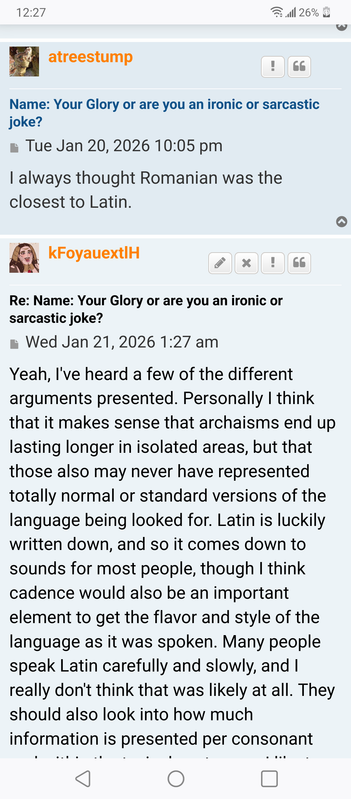
This is how squeezed the text was appearing momentarily:
https://i.postimg.cc/nL9KBygq/1000144159.png
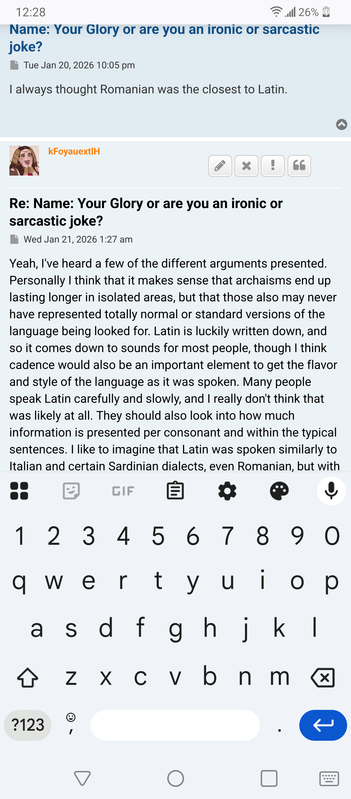
Then it changed by itself into this after a little while, without doing anything while I was still on the same page:
https://i.postimg.cc/TP5jgzFJ/1000144160.png
Even that upload site that I have been using changed just now and made linking more difficult by creating a gallery instead, like why do these things just suddenly change out of the blue so often? It is really annoying, and I think in the case of big websites constantly changing it is that they have people arbitrarily hired who are pressured into justifying their jobs by making constant changes.
Argh! It copy pasted the gallery link twice, now I've corrected it.
https://i.postimg.cc/nL9KBygq/1000144159.png
Then it changed by itself into this after a little while, without doing anything while I was still on the same page:
https://i.postimg.cc/TP5jgzFJ/1000144160.png
Even that upload site that I have been using changed just now and made linking more difficult by creating a gallery instead, like why do these things just suddenly change out of the blue so often? It is really annoying, and I think in the case of big websites constantly changing it is that they have people arbitrarily hired who are pressured into justifying their jobs by making constant changes.
Argh! It copy pasted the gallery link twice, now I've corrected it.
-
kFoyauextlH
- Posts: 1668
- Joined: Sun Jun 15, 2025 3:53 pm