Iuz: Rebel Without A Cause
https://en.m.wikipedia.org/wiki/Al-Harith_ibn_Surayj
https://books.google.ca/books?id=1DleBA ... on&f=false
http://philosophy.stackexchange.com/que ... t-nihilism
https://philosophymajor.wordpress.com/2 ... nietzsche/
https://www.brainpickings.org/2016/06/1 ... the-rebel/
http://www.al-monitor.com/pulse/origina ... ation.html
https://en.m.wikipedia.org/wiki/Rebellion
https://en.m.wikipedia.org/wiki/Deviance_(sociology)
https://en.m.wikipedia.org/wiki/Dissident
https://en.m.wikipedia.org/wiki/Egosynt ... godystonic
https://en.m.wikipedia.org/wiki/Caput_lupinum
http://www.jta.org/1970/06/15/archive/d ... st-zionism
https://www.psychologytoday.com/blog/su ... dolescence
https://books.google.ca/books?id=JhvPnC ... el&f=false
[hr]
Iuz
Moderator: atreestump
Forum rules
No Abusive Behavior. No Spam. No Porn. No Gore. It's that simple.
No Abusive Behavior. No Spam. No Porn. No Gore. It's that simple.
-
kFoyauextlH

- Posts: 1668
- Joined: Sun Jun 15, 2025 3:53 pm
Iuz
Last edited by kFoyauextlH on Fri Sep 26, 2025 1:14 pm, edited 1 time in total.
-
kFoyauextlH
- Posts: 1668
- Joined: Sun Jun 15, 2025 3:53 pm
Re: Iuz: Rebel Without A Cause
https://greyhawk.fandom.com/wiki/Iuz
https://www.greyhawkonline.com/greyhawkwiki/Iuz
"
Iuz was originally a strikingly handsome cambion. In the epic battle that resulted from Graz'zt striking out against Iggwilv in a bid for freedom, Iuz's handsome form was split into two "halves." He can either appear in the form of a gnarled, old human male, or as a bloated, red-skinned demonic figure. In his demonic form, he is seven feet tall, with reddish skin, pointed ears, and long, steely fingers. In his human form, he is barely five feet in height, and can attack with a disgusting spittle that withers all that it touches.
"
https://en.m.wikipedia.org/wiki/Cambion
Added in 4 days 22 hours 20 minutes 11 seconds:
Re: Iuz
Added in 31 minutes 10 seconds:
Re: Iuz
Added in 1 day 23 hours 44 minutes 33 seconds:
Re: Iuz
Added in 20 hours 25 minutes 45 seconds:
Re: Iuz
This is part of the Iuz theme, the "Cambion" meditations, it is not meant to be taken personally. I put that disclaimer because it may seem critical or hostile but that is just part of bringing up the ideas that have to do with the themes and the nature of this thread, it is not meant to represent any position held but an exploration of what is brought up and will be brought up here, and each thread works similarly and should not be taken as a presentation of things I want to defend as representing me, these are just vehicles and rides. I even, while reading, take multiple positions and opposite positions to what I'm writing and reading while going through the process to get as much as possible out of every detail:
So the guy that was brought up recently on the activity page and through this video:
Mentioned a lot of experiences that I can't relate to, but which i've heard a lot of people describe and mention. I try to figure out if it is genetic or what? They talk about thinking a lot and are European, while I don't seem to have jack sh*t going on anywhere "in" me most of the time. I liked some of the things they described but I'm more curious as to what is going on with people. Also how ready people can be to run to these ideas when they seem quite made up and unrelatable for me at least and from the beginning. I also notice that a lot of mentally ill people seem to be attracted to Buddhist meditation, probably because their minds are dealing with lots of intense thinking and emotions. I feel like I try to think just to live, like it would be too easy just to basically die by not thinking anything, since everything feels so quiet, loose, and faint, and I don't want to die.
I don't feel detached from myself or anything.
"
Suzanne Segal had an episode in her 20s that was diagnosed by several psychologists as depersonalization disorder, though Segal herself interpreted it through the lens of Buddhism as a spiritual experience, commonly known as "Satori" or "Samadhi".[84] The song "Is Happiness Just a Word?" by hip hop artist Vinnie Paz describes his struggle with depersonalization disorder. Adam Duritz, of the band Counting Crows, has often spoken about his diagnosis of depersonalization disorder.[85]
One day in 1982, while boarding a bus in Paris, the 27-year-old Segal experienced a sudden shift in her consciousness. She described the experience in her book, Collisions With the Infinite.[4] Segal described this first period of her experience as "witnessing", since she was aware of herself but also critically detached from it.[4] In the years after her break Segal continued to function with seeming normalcy, completing a doctorate in psychology at the Wright Institute.[5] She continued to feel completely depersonalized, literally as if her own name did not refer to anyone.[6] Segal's state of mind terrified her, and she sought advice from California's Buddhist community. Buddhism intentionally cultivates loss of ego and a sense of emptiness and oneness, and spiritual teachers tried to help Segal see her condition positively. Several even congratulated her.[7]
Twelve years after her initial break, Segal dramatically entered another phase of her experience. This sense of cognitive and spiritual oneness remained with Segal for two years, up through the publishing of Collisions in 1996.
Segal's story received attention by many writers and publications. Collisions was reviewed by Yoga Journal magazine in 1997, the reviewer writing, "This frank and engaging account is a fascinating view of the unfolding of a realization without a spiritual practice or intention."[8]
The 2004 book The Biology of Transcendence tried to characterize Segal's state of mind during her second phase of union: "[It was] fusion with 'the vastness' and her discovery that the vastness perceived its universe through her own sensory system, which was at that point the sensory system of the vastness itself ... [she] essentially perceived the universe perceiving itself, but without her, that perception did not exist."[9]
A 2008 graduate dissertation by Arvin Paul used Segal's experience as an example of "Shift/s in the Locus of Identity Upon Initial Awakening", "a shift from the conventional sense of self to the uninvolved witness, and/or allpervasive presence, and/or boundless spaciousness, and/or pure awareness, and/or Being, and/or emptiness/void, and/or the Self, and/or the simple recognition of nonseparateness."[10]
Segal was interviewed for the chapter devoted to her in the 2003 book The Awakening West by Lynn Marie Lumiere and John Lumiere-Wins.[10]
After her initial break, Segal sought to determine what had happened to her and consulted various psychologists and psychiatrists.[11] Though some had no clear explanation for the experience, one labelled it depersonalization disorder,[12] stating "I don't know what else it could be but symptoms of depersonalization". Segal went on to read up on depersonalization, derealization, and dissociation, finding some related to her experience but none were a perfect fit and they ultimately failed to capture the sensation of lacking a self in conjunction with normal, or even improved functioning.[13]
Segal's story was profiled in the 2006 book Feeling Unreal: Depersonalization Disorder and the Loss of the Self by Daphne Simeon and Jeffrey Abugel.[6] It was suggested for a book review in The Journal of the American Psychological Association that rather than representing depersonalization, Segal's experiences may represent a dissociative disorder.[14]
Suzanne spent that fall at her home in Stinson Beach, California. During this period she recovered memories of childhood abuse. Stranger documented this period as a retreat from the earlier spiritual themes that had defined her experience. "As a psychologist, she was well tutored in a possible ramification of childhood abuse—dissociation. Once again, Segal began to perceive things differently, this time from the psychological viewpoint rather than that of transcendent spirituality."[1]
By February 1997, at the age of 42, her physical and mental capabilities began to quickly decline. She entered the hospital on February 27, and doctors discovered a malignant brain tumor, having surgery but refusing chemotherapy or radiation.[1] On March 10 she married her fiancé Steve Kruszynski. After the wedding they traveled to Oklahoma to seek out alternative treatments, but Segal's debilitation returned during the trip and they had to return home, and she entered a coma several days later.[15] She died on the morning of Tuesday, April 1. Members of the spiritual and psychological community went on to debate the significance of her experience. In the afterword to the 1998 edition of Collisions, Bodian gave his personal opinion, "Those of us who were close to Suzanne never doubted the depth or the authenticity of her realization."[15]
"
That was so obnoxious! There are billions of people who have come and gone and had all kinds of experiences and this person is able to turn their farts, brain farts, from a brain problem, into big bucks and so much attention and fame. I've never seen so many darn /s used in a graduate dissertation before, there were 9 in just what was quoted!
Buddhism seems helpful to people with these minds and emotions that are so intense, but why are people so confident that it isn't playing with things in a way that is potentially not helpful or even destructive, at least to some people. Plus, why is there an idea that minds and processes are so similar.
Also, how is this woman, or was this woman, so confident that her experiences should be a certain way that these other experiences were supposedly so abnormal that she is justified writing so much about it all. Who knows if her abuse was even real or if she just made up everything or if her brain problem ws distorting her memories also, even though it seems to make it seem likely that something was going on with her thinking because of the physical issue that was discovered, which seems likely responsible for all of it.
This all seemed so stupid to me on so many levels and how much attention she was getting while others saying anything similar would be spat on and kicked into a muddy ditch.
That "N*z* is Brian Ruhe, who used to meditate and teach meditation, but then became possessed by Ad*lf*s H*stl*r.
"
@aFoxyFox.
0 seconds ago
You guys are not showing enough respect to the bearded child-king of the park!
"
9:00
Added in 1 hour 14 seconds:
Re: Iuz
At 30:00 and closer to 32:00 minutes near the end of the video, you get to see how the people he associates with make him feel.
This is another video with wacky stuff around 30:00 minutes in, like when he goes to get a drink.
Lots of things are mentioned in these videos, including black magic and channeling.
40:00 minutes or around there, it is so funny how he ends up frustrating the guy. The whole thing is like Next Level David Lynch.
I'm one of the few people who know of this guy's existence from so early on and he is a gem of so much creativity.
There are other N*z* fringe characters that I've also encountered and was fascinated by, one of them is called Spiderman and promotes the idea of female murder victims becoming fascistic Kami that he worships in a manner possibly similar to a Chivalric Knight.
Added in 15 minutes 15 seconds:
Re: Iuz
https://www.discoveryuk.com/mysteries/t ... rom-venus/
Added in 1 hour 52 minutes 15 seconds:
Re: Iuz
Added in 1 day 3 hours 51 minutes 37 seconds:
Re: Iuz
What do you think?
"
@roromcgorro2315
2 years ago
Some dude with 10k subs on YouTube was able to do what hundreds of millions dollar Hollywood movies couldn’t get even kind of close to. I’m impressed!!
47K
232
@LokaVision
@LokaVision
2 years ago
There's a reason all of my subscribers came from this video.
Thanks for the compliment
3K
28
@darkcity925
2 years ago (edited)
Midsommar got pretty close. But yeah this is quite well done too.
"
Added in 2 minutes 15 seconds:
Re: Iuz
"
@LokaVision
2 years ago
@monhi64 this was not made with AI, where did you get that information? I did all of this animation manually. It took multiple months of work.
302
5
@LokaVision
2 years ago
@stevoofd I travel for work and also do remote work. Email me for inquiries: loka@lokavision.com
"
Added in 1 minute 50 seconds:
Re: Iuz
"
@abundantharmony
2 years ago
@LokaVision Ever seen the greys on shrooms? I had an OBE once while tripping and I saw 4 short grey "aliens" standing in front of my physical body chillin on the bed.
"
https://www.greyhawkonline.com/greyhawkwiki/Iuz
"
Iuz was originally a strikingly handsome cambion. In the epic battle that resulted from Graz'zt striking out against Iggwilv in a bid for freedom, Iuz's handsome form was split into two "halves." He can either appear in the form of a gnarled, old human male, or as a bloated, red-skinned demonic figure. In his demonic form, he is seven feet tall, with reddish skin, pointed ears, and long, steely fingers. In his human form, he is barely five feet in height, and can attack with a disgusting spittle that withers all that it touches.
"
https://en.m.wikipedia.org/wiki/Cambion
Added in 4 days 22 hours 20 minutes 11 seconds:
Re: Iuz
Added in 31 minutes 10 seconds:
Re: Iuz
Added in 1 day 23 hours 44 minutes 33 seconds:
Re: Iuz
Added in 20 hours 25 minutes 45 seconds:
Re: Iuz
This is part of the Iuz theme, the "Cambion" meditations, it is not meant to be taken personally. I put that disclaimer because it may seem critical or hostile but that is just part of bringing up the ideas that have to do with the themes and the nature of this thread, it is not meant to represent any position held but an exploration of what is brought up and will be brought up here, and each thread works similarly and should not be taken as a presentation of things I want to defend as representing me, these are just vehicles and rides. I even, while reading, take multiple positions and opposite positions to what I'm writing and reading while going through the process to get as much as possible out of every detail:
So the guy that was brought up recently on the activity page and through this video:
Mentioned a lot of experiences that I can't relate to, but which i've heard a lot of people describe and mention. I try to figure out if it is genetic or what? They talk about thinking a lot and are European, while I don't seem to have jack sh*t going on anywhere "in" me most of the time. I liked some of the things they described but I'm more curious as to what is going on with people. Also how ready people can be to run to these ideas when they seem quite made up and unrelatable for me at least and from the beginning. I also notice that a lot of mentally ill people seem to be attracted to Buddhist meditation, probably because their minds are dealing with lots of intense thinking and emotions. I feel like I try to think just to live, like it would be too easy just to basically die by not thinking anything, since everything feels so quiet, loose, and faint, and I don't want to die.
I don't feel detached from myself or anything.
"
Suzanne Segal had an episode in her 20s that was diagnosed by several psychologists as depersonalization disorder, though Segal herself interpreted it through the lens of Buddhism as a spiritual experience, commonly known as "Satori" or "Samadhi".[84] The song "Is Happiness Just a Word?" by hip hop artist Vinnie Paz describes his struggle with depersonalization disorder. Adam Duritz, of the band Counting Crows, has often spoken about his diagnosis of depersonalization disorder.[85]
One day in 1982, while boarding a bus in Paris, the 27-year-old Segal experienced a sudden shift in her consciousness. She described the experience in her book, Collisions With the Infinite.[4] Segal described this first period of her experience as "witnessing", since she was aware of herself but also critically detached from it.[4] In the years after her break Segal continued to function with seeming normalcy, completing a doctorate in psychology at the Wright Institute.[5] She continued to feel completely depersonalized, literally as if her own name did not refer to anyone.[6] Segal's state of mind terrified her, and she sought advice from California's Buddhist community. Buddhism intentionally cultivates loss of ego and a sense of emptiness and oneness, and spiritual teachers tried to help Segal see her condition positively. Several even congratulated her.[7]
Twelve years after her initial break, Segal dramatically entered another phase of her experience. This sense of cognitive and spiritual oneness remained with Segal for two years, up through the publishing of Collisions in 1996.
Segal's story received attention by many writers and publications. Collisions was reviewed by Yoga Journal magazine in 1997, the reviewer writing, "This frank and engaging account is a fascinating view of the unfolding of a realization without a spiritual practice or intention."[8]
The 2004 book The Biology of Transcendence tried to characterize Segal's state of mind during her second phase of union: "[It was] fusion with 'the vastness' and her discovery that the vastness perceived its universe through her own sensory system, which was at that point the sensory system of the vastness itself ... [she] essentially perceived the universe perceiving itself, but without her, that perception did not exist."[9]
A 2008 graduate dissertation by Arvin Paul used Segal's experience as an example of "Shift/s in the Locus of Identity Upon Initial Awakening", "a shift from the conventional sense of self to the uninvolved witness, and/or allpervasive presence, and/or boundless spaciousness, and/or pure awareness, and/or Being, and/or emptiness/void, and/or the Self, and/or the simple recognition of nonseparateness."[10]
Segal was interviewed for the chapter devoted to her in the 2003 book The Awakening West by Lynn Marie Lumiere and John Lumiere-Wins.[10]
After her initial break, Segal sought to determine what had happened to her and consulted various psychologists and psychiatrists.[11] Though some had no clear explanation for the experience, one labelled it depersonalization disorder,[12] stating "I don't know what else it could be but symptoms of depersonalization". Segal went on to read up on depersonalization, derealization, and dissociation, finding some related to her experience but none were a perfect fit and they ultimately failed to capture the sensation of lacking a self in conjunction with normal, or even improved functioning.[13]
Segal's story was profiled in the 2006 book Feeling Unreal: Depersonalization Disorder and the Loss of the Self by Daphne Simeon and Jeffrey Abugel.[6] It was suggested for a book review in The Journal of the American Psychological Association that rather than representing depersonalization, Segal's experiences may represent a dissociative disorder.[14]
Suzanne spent that fall at her home in Stinson Beach, California. During this period she recovered memories of childhood abuse. Stranger documented this period as a retreat from the earlier spiritual themes that had defined her experience. "As a psychologist, she was well tutored in a possible ramification of childhood abuse—dissociation. Once again, Segal began to perceive things differently, this time from the psychological viewpoint rather than that of transcendent spirituality."[1]
By February 1997, at the age of 42, her physical and mental capabilities began to quickly decline. She entered the hospital on February 27, and doctors discovered a malignant brain tumor, having surgery but refusing chemotherapy or radiation.[1] On March 10 she married her fiancé Steve Kruszynski. After the wedding they traveled to Oklahoma to seek out alternative treatments, but Segal's debilitation returned during the trip and they had to return home, and she entered a coma several days later.[15] She died on the morning of Tuesday, April 1. Members of the spiritual and psychological community went on to debate the significance of her experience. In the afterword to the 1998 edition of Collisions, Bodian gave his personal opinion, "Those of us who were close to Suzanne never doubted the depth or the authenticity of her realization."[15]
"
That was so obnoxious! There are billions of people who have come and gone and had all kinds of experiences and this person is able to turn their farts, brain farts, from a brain problem, into big bucks and so much attention and fame. I've never seen so many darn /s used in a graduate dissertation before, there were 9 in just what was quoted!
Buddhism seems helpful to people with these minds and emotions that are so intense, but why are people so confident that it isn't playing with things in a way that is potentially not helpful or even destructive, at least to some people. Plus, why is there an idea that minds and processes are so similar.
Also, how is this woman, or was this woman, so confident that her experiences should be a certain way that these other experiences were supposedly so abnormal that she is justified writing so much about it all. Who knows if her abuse was even real or if she just made up everything or if her brain problem ws distorting her memories also, even though it seems to make it seem likely that something was going on with her thinking because of the physical issue that was discovered, which seems likely responsible for all of it.
This all seemed so stupid to me on so many levels and how much attention she was getting while others saying anything similar would be spat on and kicked into a muddy ditch.
That "N*z* is Brian Ruhe, who used to meditate and teach meditation, but then became possessed by Ad*lf*s H*stl*r.
"
@aFoxyFox.
0 seconds ago
You guys are not showing enough respect to the bearded child-king of the park!
"
9:00
Added in 1 hour 14 seconds:
Re: Iuz
At 30:00 and closer to 32:00 minutes near the end of the video, you get to see how the people he associates with make him feel.
This is another video with wacky stuff around 30:00 minutes in, like when he goes to get a drink.
Lots of things are mentioned in these videos, including black magic and channeling.
40:00 minutes or around there, it is so funny how he ends up frustrating the guy. The whole thing is like Next Level David Lynch.
I'm one of the few people who know of this guy's existence from so early on and he is a gem of so much creativity.
There are other N*z* fringe characters that I've also encountered and was fascinated by, one of them is called Spiderman and promotes the idea of female murder victims becoming fascistic Kami that he worships in a manner possibly similar to a Chivalric Knight.
Added in 15 minutes 15 seconds:
Re: Iuz
https://www.discoveryuk.com/mysteries/t ... rom-venus/
Added in 1 hour 52 minutes 15 seconds:
Re: Iuz
Added in 1 day 3 hours 51 minutes 37 seconds:
Re: Iuz
What do you think?
"
@roromcgorro2315
2 years ago
Some dude with 10k subs on YouTube was able to do what hundreds of millions dollar Hollywood movies couldn’t get even kind of close to. I’m impressed!!
47K
232
@LokaVision
@LokaVision
2 years ago
There's a reason all of my subscribers came from this video.
Thanks for the compliment

3K
28
@darkcity925
2 years ago (edited)
Midsommar got pretty close. But yeah this is quite well done too.
"
Added in 2 minutes 15 seconds:
Re: Iuz
"
@LokaVision
2 years ago
@monhi64 this was not made with AI, where did you get that information? I did all of this animation manually. It took multiple months of work.
302
5
@LokaVision
2 years ago
@stevoofd I travel for work and also do remote work. Email me for inquiries: loka@lokavision.com
"
Added in 1 minute 50 seconds:
Re: Iuz
"
@abundantharmony
2 years ago
@LokaVision Ever seen the greys on shrooms? I had an OBE once while tripping and I saw 4 short grey "aliens" standing in front of my physical body chillin on the bed.
"
-
kFoyauextlH
- Posts: 1668
- Joined: Sun Jun 15, 2025 3:53 pm
Re: Iuz
https://spectator.com/article/milo-yian ... sexuality/
"
Milo agreed, quickly christening it “Gorgoroth the Semen Demon.”
"
https://lovecraft.fandom.com/wiki/Gol-goroth
https://tolkiengateway.net/wiki/Plateau_of_Gorgoroth
https://www.metal-archives.com/bands/Gorgoroth/770
Added in 6 days 2 hours 52 minutes 21 seconds:
Performance is getting really overlooked with the way things are moving and getting prioritized these days.
-
kFoyauextlH
- Posts: 1668
- Joined: Sun Jun 15, 2025 3:53 pm
-
kFoyauextlH
- Posts: 1668
- Joined: Sun Jun 15, 2025 3:53 pm
Re: Iuz
So labor intensive just for that sound at the end, lol.
-
kFoyauextlH
- Posts: 1668
- Joined: Sun Jun 15, 2025 3:53 pm
Re: Iuz
https://thavmapub.com/2019/12/28/a-cath ... ous-names/
https://www.esotericarchives.com/solomon/nameindx.htm
https://en.m.wikipedia.org/wiki/Nova_Express
"
Nova Express is a social commentary on human and machine control of life.
The Nova Mob—
Sammy the Butcher,
Green Tony,
Iron Claws,
The Brown Artist,
Jacky Blue Note,
Limestone John,
Izzy the Push,
Hamburger Mary,
Paddy The Sting,
The Subliminal Kid,
Blue Dinosaur,
Mr. and Mrs. D
—are viruses,
"defined as the three-dimensional coordinate point of a controller"[2] ... "which invade the human body and in the process produce language."[3] These Nova Criminals represent society, culture, and government, and have taken control by the use of word and image. Inspector Lee and the rest of the Nova Police are left fighting for the rest of humanity in the power struggle. "The Nova Police can be compared to apomorphine, a regulating instance that need not continue and has no intention of continuing after its work is done."[4] The police are focused on "first-order addictions of junkies, homosexuals, dissidents, and criminals; if these criminals vanish, the police must create more in order to justify their own survival."[5] The Nova Police depend upon the Nova Criminals for existence; if the criminals cease to exist, so do the police. "They act like apomorphine, the nonaddictive cure for morphine addiction that Burroughs used and then promoted for many years."[6]
Control is the main theme of the novel, and Burroughs attempts to use language to break down the walls of culture, the biggest control machine. He uses Inspector Lee to express his own thoughts about the world.
"The purpose of my writing is to expose and arrest Nova Criminals. In Naked Lunch, Soft Machine and Nova Express I show who they are and what they are doing and what they will do if they are not arrested. [...] With your help we can occupy The Reality Studio and retake their universe of Fear Death and Monopoly."[7] As Burroughs battles with the self, what is human, and what is "reality", he finds that language is the only way to maintain dominance over the "powerful instruments of control", which are the most prevalent enemies of human society.
"
Add h to play Playlist:
ttps://m.youtube.com/watch?v=PwQhXCwA2d4&list=PLrs0mORvEDEk5IauJ35sfQGyGWXvs7bWt&index=1&pp=iAQB8AUB
https://en.m.wikipedia.org/wiki/Edgar_Rice_Burroughs
"
Burroughs strongly supported eugenics and scientific racism. His views held that English nobles made up a particular heritable elite among Anglo-Saxons. Tarzan was meant to reflect this, with him being born to English nobles and then adopted by talking apes (the Mangani).
"
https://en.m.wikipedia.org/wiki/Lost_Highway_(film)
Added in 1 day 5 hours 38 seconds:
https://www.researchgate.net/publicatio ... aked_Lunch
"
In this article, I argue that William S. Burroughs’ novel Naked Lunch engages in a “perverse aesthetics” that is analogous to Timothy Morton’s theory of dark ecology. The novel’s main themes of consumption and control are directly related to the Anthropocene’s twin disasters of global warming and mass extinction, and the trope for addiction, junk, reveals Burroughs’ deep analysis of the political and social forces that attempt to control life, what Burroughs calls biocontrol. By placing the novel’s obsession with hanging/lynching in the context of dark ecology, its critique of racism can also be seen as a critique of speciesism.
"
https://ebsn.eu/scholarship/peer-review ... s-chinese/
"
“No glot . . . C’lom Fliday . . .” William S. Burroughs’ Curious Chinese
Encounters with otherness, through representations ranging from apparently alien creatures to inner demons, are central to William S. Burroughs’ oeuvre, and form part of what makes his work so challenging and resonant. His representations of the Chinese, while often overlooked, stand out in particular, because of their incongruous appearances in unexpected places and contexts, and because they are presented in a mostly positive light. This article places these references in historical, textual, and biographical context while considering their significance in the contemporary context of what Paul Giles terms “American world literature,” and the ‘worlding’ of Beat and proto-Beat literature. Burroughs’ Naked Lunch (1959) presents Chinese characters with a direct connection to drugs, and as such they act as a metaphor for something that is simultaneously attractive and repellent, reflecting Burroughs’ oscillating and often ambivalent attitude towards the foreign Other. Such representations can be seen to destabilize national identities and expose the ambivalent discursive processes of Othering, which arguably renders his works as complex, multi-faceted critiques of contemporaneous US race narratives and neo-colonialism. These representations can also be seen to challenge the notion of a dominant hegemony while highlighting how aspects of Orientalism can be seen through the construction of minority groups. These texts demonstrate Burroughs’ understanding of identity politics and power relations, primarily because they can be seen to parody contemporaneous stereotypes informed by the ‘Yellow Peril’ metaphor (the constructed Western fear of the Eastern Other), in a deliberate attempt to subvert such arbitrary constructions.
"
Here is something like that:
viewtopic.php?p=1488#p1488
Luckily it is under your name here.
What I had in this thread originally I moved to Takhisis:
viewtopic.php?t=412
Added in 5 days 22 hours 31 minutes 13 seconds:
viewtopic.php?t=3
I'm considering making threads in this sub-forum that use creative writing or the production of fiction to bring up "real" themes with what I believe have magical potency, whether one believes in a psychological model or a spiritual one.
Added in 17 minutes 2 seconds:
Added in 50 minutes 33 seconds:
https://www.smithsonianmag.com/smart-ne ... 180987492/
Added in 2 days 2 hours 52 minutes 50 seconds:
https://en.wikipedia.org/wiki/Reception_theory
Added in 6 hours 15 minutes 9 seconds:
Added in 1 day 18 hours 20 minutes 3 seconds:
https://en.wikipedia.org/wiki/Cognitive_philology
Added in 4 minutes 31 seconds:
"
Cognitive
edit
Main article: Cognitive philology
Another branch of philology, cognitive philology, studies written and oral texts. Cognitive philology considers these oral texts as the results of human mental processes. This science compares the results of textual science with the results of experimental research of both psychology and artificial intelligence production systems.
Decipherment
edit
In the case of Bronze Age literature, philology includes the prior decipherment of the language under study. This has notably been the case with the Egyptian, Sumerian, Assyrian, Hittite, Ugaritic, and Luwian languages. Beginning with the famous decipherment and translation of the Rosetta Stone by Jean-François Champollion in 1822, some individuals attempted to decipher the writing systems of the Ancient Near East and Aegean. In the case of Old Persian and Mycenaean Greek, decipherment yielded older records of languages already known from slightly more recent traditions (Middle Persian and Alphabetic Greek).
Work on the ancient languages of the Near East progressed rapidly. In the mid-19th century, Henry Rawlinson and others deciphered the Behistun Inscription, which records the same text in Old Persian, Elamite, and Akkadian, using a variation of cuneiform for each language. The elucidation of cuneiform led to the decipherment of Sumerian. Hittite was deciphered in 1915 by Bedřich Hrozný.
Linear B, a script used in the ancient Aegean, was deciphered in 1952 by Michael Ventris and John Chadwick, who demonstrated that it recorded an early form of Greek, now known as Mycenaean Greek. Linear A, the writing system that records the still-unknown language of the Minoans, resists deciphering, despite many attempts.
Work continues on scripts such as the Maya, with great progress since the initial breakthroughs of the phonetic approach championed by Yuri Knorozov and others in the 1950s. Since the late 20th century, the Maya code has been almost completely deciphered, and the Mayan languages are among the most documented and studied in Mesoamerica. The code is described as a logosyllabic style of writing.
Contention
edit
In English-speaking countries, use of the term "philology" to describe work on languages and works of literature, which had become synonymous with the practices of German scholars, was abandoned as a consequence of anti-German feelings following World War I.[12] Most continental European countries still maintain the term to designate departments, colleges, position titles, and journals. J. R. R. Tolkien opposed the nationalist reaction against philological practices, claiming that "the philological instinct" was "universal as is the use of language".[13][14] In British English usage, and British academia, philology remains largely synonymous with "historical linguistics", while in US English, and US academia, the wider meaning of "study of a language's grammar, history and literary tradition" remains more widespread.[15][16] Based on the harsh critique of Friedrich Nietzsche, some US scholars since the 1980s have viewed philology as responsible for a narrowly scientistic study of language and literature.[12]
Disagreements in the modern day of this branch of study are followed with the likes of how the method is treated among other scholars, as noted by both the philologists R.D Fulk and Leonard Neidorf who have been quoted saying "This field "philology's commitment to falsification renders it "at odds with what many literary scholars believe because the purpose of philology is to narrow the range of possible interpretations rather than to treat all reasonable ones as equal".[17] This use of falsification can be seen in the debate surrounding the etymology of the Old English character Unferth from the heroic epic poem Beowulf.
James Turner further disagrees with how the use of the term is dismissed in the academic world, stating that due to its branding as a "simpleminded approach to their subject"[18] the term has become unknown to college-educated students, furthering the stereotypes of "scrutiny of ancient Greek or Roman texts of a nit-picking classicist" and only the "technical research into languages and families".[19]
"
Added in 3 hours 31 minutes 48 seconds:
https://www.google.com/url?sa=t&source= ... i=89978449
Inside Language
Added in 2 minutes 24 seconds:
"
Tolkien's views on language, though never published as a formalised theory, were in some aspects rather 'heretic' (to use Tom Shippey's term) and seemed to fly into the face of 'established' linguistic theory — most notably his conception of
'native (hereditary) language'
and, related to it, the idea of
'linguistic aesthetic'
and
'phonetic fitness'
. Unfortunately, this aspect of Tolkien's linguistic work has, as yet, not received the attention it deserves. This is remedied by Ross Smith's study that investigates the question of Tolkien's position on language vis-a-vis the then (and even now) dominant tenet(s) in some depth.
Inside Language is now available in it's second edition.
The entire text has been thoroughly revised and a detailed index has been added. In addition, new material has been incorporated and a number of passages have been reworked in search of greater consistency. The result is a second edition which builds on the strengths of the first to achieve a more robust and coherent work.
"
Added in 9 minutes 11 seconds:
"
Tolkien believed that people had a genetic predilection towards the language of their ancestors. Is there any evidence to support this?
In JRR Tolkien's 1955 lecture titled "English and Welsh", Tolkien distinguishes between what he calls a "native language", a language one has a genetic predilection towards, and a "cradle-tongue", the language one has grown-up speaking.
For example, from Wikipedia:
'He [Tolkien] considered the West Midlands dialect of Middle English to be his own "native language", and, as he wrote to W. H. Auden in 1955, "I am a West-midlander by blood (and took to early west-midland Middle English as a known tongue as soon as I set eyes on it)."'
I'm not a linguist, but at first glance, this doesn't sound correct, given that language changes naturally over time. That said, I'm wondering if there is any research that supports the notion of a heritable predilection towards a certain language.
"
https://www.quora.com/Are-people-geneti ... -ancestors
https://co-geeking.com/category/speaking-in-tongues/
https://philoloblog.blogspot.com/2016/0 ... g.html?m=1
https://www.google.com/url?sa=t&source= ... i=89978449
Added in 8 minutes 43 seconds:
"
Tolkien's Theory of Hereditary Language
"Cradle-tongue" vs. "Native Language": Tolkien distinguished between the "cradle-tongue" (the language one grows up speaking) and the "native language" (the one an individual is predisposed to by blood and ancestry).
Aesthetic Pleasure: He believed individuals had an inherent linguistic "sound-taste" (lámatyávë in Quenya) that would make them feel a deep, "unexplored desire" for their ancestral language, even if they had never formally learned it.
Personal Experience: Tolkien himself, a philologist who specialized in Old and Middle English, felt a strong, immediate connection to the Mercian dialect of Middle English, which he considered his "native language" by blood, despite it not being his cradle-tongtongue. He wrote, "I am a West-midlander by blood (and took to early west-midland Middle English as a known tongue as soon as I set eyes on it)".
Welsh and Sindarin: Tolkien also had a profound aesthetic appreciation for Welsh and used its phonology and grammar (e.g., consonant mutations) to develop his Elvish language Sindarin. He argued that English speakers might feel a dormant, inherent liking for Welsh because it was the language of Britain before English arrived, linking land, history, and language in an ancestral way.
The Role in Middle-earth
This concept played a key role in the linguistic realism of his legendarium:
Linguistic Mapping: In The Lord of the Rings, the language of the Rohirrim is represented by Old English because Tolkien intended the fictional Rohirric to be related to the "Common Speech" (represented by Modern English) in a similar way that Old English is historically related to Modern English.
Innate Recognition: The hobbit Merry Brandybuck is noted to feel his heart leap at the sound of the Rohirric songs, even though he cannot understand the words, suggesting an underlying, inherited affinity with the related tongue of his people's ancestors.
Tolkien's views on an inherited, "hereditary" language were a "heresy" in the established linguistics of his day, which generally held that the link between sound and meaning is arbitrary and that language is primarily a cultural, not genetic, inheritance. However, this unique philosophy was a central driver of his life's work in creating his fictional languages and the world around them.
"
Added in 4 minutes 10 seconds:
https://www.ancient-origins.net/ancient ... rld-001343
Added in 14 minutes 12 seconds:
Added in 16 hours 16 minutes 48 seconds:
https://en.wikipedia.org/wiki/Dothraki_language
https://en.wikipedia.org/wiki/David_J._Peterson
https://en.wikipedia.org/wiki/Conlangin ... ng_Tongues
https://en.wikipedia.org/wiki/List_of_language_creators
https://en.wikipedia.org/wiki/Languages ... by_Tolkien
https://en.wikipedia.org/wiki/Constructed_language
https://en.wikipedia.org/wiki/Construct ... ngflag.svg
"
The Conlang Flag, a symbol of language construction created by subscribers to the CONLANG mailing list, which represents the Tower of Babel against a rising sun
"
https://images.bigbadtoystore.com/image ... 6ccd29.jpg
https://m.media-amazon.com/images/I/711 ... _QL80_.jpg
https://encrypted-tbn0.gstatic.com/imag ... 9hnjMOaw&s
https://encrypted-tbn0.gstatic.com/imag ... XJubD&s=10
The structure.
https://en.wikipedia.org/wiki/Step_pyramid
"
In the year 2023, archeologists discovered a 3,400 year old step-pyramid in Kazakhstan, that were used as tombs as well as for religious ceremonies. These pyramids and structures showed ties to the Andronovo culture.[19]
"
https://archaeologymag.com/2023/11/pyra ... azakhstan/
https://archaeologymag.com/wp-content/u ... stan-1.jpg
https://www.livescience.com/archaeology ... ian-steppe
https://archaeologymag.com/2023/08/bron ... azakhstan/
https://www.thearchaeologist.org/blog/a ... kazakhstan
https://en.wikipedia.org/wiki/Begazy_Dandybai_Mausolea
"
u/GlobalImportance5295 avatar
GlobalImportance5295
•
13h ago
Ab / Ap was always an obvious one to me. indra is even called Apsujit https://www.wisdomlib.org/definition/apsujit
a serpent named "Taimata" is found in atharvaveda https://ancientvoice.wikidot.com/avs:taimata
1
"
"
Sanskrit dictionary
[«previous (A) next»] — Apsujit in Sanskrit glossary
Apsujit (अप्सुजित्):—[=apsu-jit] [from apsu] mfn. vanquishing among the waters or in the region of the clouds (Name of Indra), [Ṛg-veda]
Source: Cologne Digital Sanskrit Dictionaries: Monier-Williams Sanskrit-English Dictionary
Apsujit (अप्सुजित्):—[tatpurusha compound] m. (-t) (ved.) Conquering (the demons) in the intermediate region, in the region between heaven and earth, an epithet of Indra (Sāyaṇa: antarikṣe vartamānānāmasurāṇāṃ jetā); another interpretation of Sāyaṇa, ‘conquering for the sake of water (scil. Vṛtra)’, is less probable, in the Ṛg-or Sāmav. verse: vajraṃ ca vṛṣaṇaṃ bharatsamapsujit (Sāy.: apsujit . udakārthaṃ vṛtrasya jetā yadvā āpa ityantarikṣanāma . antarikṣehināmakasya jetā; comp. his explanation of apsuvāh). E. apsu (loc. plur. of ap) and jit.
"
"
avs.5.13 Of the All conquering serpent s wrath, of the fierce rage of Black, and Brown, Taimata, and Apodaka.
"
https://en.wikipedia.org/wiki/Tower_of_Babel
https://en.wikipedia.org/wiki/Enmerkar_ ... _of_Aratta
"
He is furthermore to recite the "Incantation of Nudimmud", a hymn imploring Enki to restore (or in some translations, to disrupt) the linguistic unity of the inhabited regions, named as Shubur, Hamazi, Sumer, Uri-ki (the region around Akkad), and the Martu land:
On that day when there is no snake, when there is no scorpion, when there is no hyena, when there is no lion, when there is neither dog nor wolf, when there is thus neither fear nor trembling, man has no rival! At such a time, may the lands of Shubur and Hamazi, the many-tongued, and Sumer, the great mountain of the me of magnificence, and Akkad, the land possessing all that is befitting, and the Martu land, resting in security – the whole universe, the well-guarded people – may they all address Enlil together in a single language! For at that time, for the ambitious lords, for the ambitious princes, for the ambitious kings – Enki, the lord of abundance and of steadfast decisions, the wise and knowing lord of the Land, the expert of the gods, chosen for wisdom, the lord of Eridug, shall change the speech in their mouths, as many as he had placed there, and so the speech of mankind is truly one.[3]
The messenger arrives in Aratta, reciting this message to the king, and asks him for a reply to take to his lord Enmerkar, whom he calls "the scion of him with the glistening beard, whom his stalwart cow gave birth to in the mountain of the shining me, who was reared on the soil of Aratta, who was given suck at the udder of the good cow, who is suited for office in Kulaba."
The king of Aratta replies that submission to Uruk is out of the question, because Inanna herself had chosen him to his office and power. But the herald then reveals that Inanna has been installed as queen at E-ana and has even promised Enmerkar to make Aratta bow to Uruk.
Devastated by this news, the lord of Aratta finally gives his response: he is more than prepared for a military contest with Uruk, whom he considers no match for his might; however he will submit, on the sole conditions that Enmerkar send him a vast amount of barley grain, and that Inanna convince him that she has forsaken Aratta and confirm her allegiance to Uruk.
The herald returns to Enmerkar bearing this reply, and the next day Enmerkar actually sends the barley to Aratta, along with the herald and another demand to send even more precious stones.
The lord of Aratta, in a fit of pride, refuses and instead asks Enmerkar to deliver to him these precious stones himself. Upon hearing this, Enmerkar spends ten years preparing an ornate sceptre, then sends it to Aratta with his messenger. This frightens the lord of Aratta, who now sees that Inanna has indeed forsaken him, but he instead proposes to arrange a one-on-one combat between two champions of the two cities, to determine the outcome of the still-diplomatic conflict with Enmerkar. The king of Uruk responds by accepting this challenge, while increasing his demands for the people of Aratta to make a significant offering for the E-ana and the abzu, or face destruction and dispersal. To relieve the herald who, beleaguered, can no longer remember all the messages with which he is charged, Enmerkar then resorts to an invention: writing on tablets. The herald again traverses the "seven mountains" to Aratta, with the tablets, and when the king of Aratta tries to read the message, Ishkur, the storm-god, causes a great rain to produce wild wheat and chickpeas that are then brought to the king. Seeing this, the king declares that Inanna has not forsaken the primacy of Aratta after all, and summons his champion.
The remainder of the text has many lacunae- (line text losses), and the following events are unclear, but the tablet seems to end with Enmerkar triumphant, possibly installed by Inanna on the throne of Aratta, and with the people of Aratta delivering the tribute to E-ana, and providing the materials to build the Apsû.
A sequel text, Enmerkar and En-suhgir-ana, seems to continue the epic.
"
https://en.wikipedia.org/wiki/Enmerkar_ ... suhgir-ana
Added in 4 minutes 10 seconds:
https://new-indology.blogspot.com/2015/ ... g.html?m=1
Added in 3 minutes 2 seconds:
https://heritageofjapan.wordpress.com/f ... ern-japan/
https://japanesemythology.wordpress.com ... e-history/
Added in 16 minutes 51 seconds:
https://hms.harvard.edu/news/treasure-trove
Added in 2 minutes 43 seconds:
https://www.reddit.com/answers/f3bb37ad ... source=PDP
"
Skip to main content
How language shapes our perception of reality
Open App
Go to Reddit Answers
How language shapes our perception of reality
How language shapes our perception of reality
r/askphilosophy icon r/science icon r/languagelearning icon
Sources: r/askphilosophy, r/science, r/languagelearning +3 more
Language plays a significant role in shaping our perception of reality, though the extent and nature of this influence are subjects of ongoing debate and research. Here's a succinct guide based on the opinions and insights shared by redditors:
The Sapir-Whorf Hypothesis
The Sapir-Whorf hypothesis suggests that the language we speak can influence how we think and perceive the world. It has two main interpretations:
Weak Version: This version posits that language influences thought to some degree, which is widely accepted. "The weak interpretation however, which says that language influences language to some degree, is widely agreed upon."
For example, people who speak languages with more discerning terms for color variations can identify them faster. "The 'weak' version shows some evidence, but it is minor: people who speak certain languages that have more discerning terms for color variation on certain colors can identify them faster then those who can't, and the like."
Strong Version: This version suggests that language determines or limits thought, which is largely rejected. "The strong interpretation is generally regarded as false, meaning that language does not determine thought."
An infamous claim that the Hopi people thought about time differently due to their language was eventually found to be false. "There was an (in)famous claim that the Hopi (I believe) thought about time differently because of their language... This was eventually found to be false."
Language and Time Perception
Different languages can lead to different ways of conceptualizing and even perceiving time:
Influence on Perception: Studies show that language can shape how the brain perceives time. "Language shapes how the brain perceives time - people who speak two languages fluently think about time differently depending on the language context in which they are estimating the duration of events."
For instance, Swedish speakers are misled by stimulus length, while Spanish speakers are misled by stimulus size/quantity when reproducing duration. "Contrary to the universalist account, we found language-specific interference in a duration reproduction task... Swedish speakers were misled by stimulus length, and Spanish speakers were misled by stimulus size/quantity."
Cultural vs. Linguistic Influence: Some argue that the differences in time perception are more cultural than linguistic. "How much of this is cultural? When I'm speaking in German, I'm thinking like a German (well, somewhat). When I'm speaking Portuguese, I'm thinking like a Brazilian (easier than like a German)."
Language and General Thought/Culture
Language can also influence how people think and interact with their culture:
Framing the World: Languages can offer different types of "windows" to frame the world. "I feel languages give different types of windows to frame the world differently. The concept I remember most vividly is how English forced me to be constantly aware of people's gender for the first time ever, and I deeply hated that."
Cultural Intertwining: Language and culture are deeply intertwined, with culture often influencing language more than the other way around. "Culture and language are very intertwined. Usually culture influences language more than the other way around, but language definitely influences culture to some extent."
Personal Experience: Learning a new language can open up new perspectives and information. "Absolutely, in multiple ways, some good and some depressing. ... You can imagine that learning Russian really opened up a lot of new information for me to absorb."
Subreddits for Further Exploration
To dive deeper into how language shapes our perception of reality, consider asking in these subreddits:
r/linguistics
r/askphilosophy
r/languagelearning
r/science
Generated from these posts:
1 r/askphilosophy
Does language influence our perception of reality, or does our perception of reality influence language? Or both?
128
·
40
2 r/science
Language shapes how the brain perceives time - people who speak two languages fluently think about time differently depending on the language context in which they are estimating the duration of events. The finding is reported in the ‘Journal of Experimental Psychology: General’.
4.9K
·
153
3 r/languagelearning
Language's impact on thinking: Do you feel your target language changes your perception of the world?
18
·
21
4 r/linguistics
How influential is language on culture?
0
·
13
5 r/asklinguistics
Does the language we speak influence how we think?
6
·
24
6 r/linguistics
Studies on the effects of grammatical gender on perception
214
·
41
r/linguistics - Studies on the effects of grammatical gender on perception
7 r/languagelearning
Can thinking in another language change the way you think?
12
·
31
r/languagelearning - Can thinking in another language change the way you think?
8 r/linguistics
Language alters our experience of time
57
·
6
r/linguistics - Language alters our experience of time
9 r/relationship_advice
How far can language influence on perception of yourself?
2
·
2
Is this answer helpful?
Related
Reddit Answers are AI-generated from redditors’ posts and comments and may not be accurate.
30 questions left this week. for more.
"
Added in 1 hour 27 minutes :
"
A mtDNA study, published in 2018 in the journal American Journal of Physical Anthropology, compared both ancient and modern samples from Tuscany, from the Prehistory, Etruscan age, Roman age, Renaissance, and Present-day, and concluded that the Etruscans appear as a local population, intermediate between the prehistoric and the other samples, placing in the temporal network between the Eneolithic Age and the Roman Age.[74] A very large mtDNA study from 2013 indicates, based on maternally-inherited DNA from 30 bone samples taken from tombs dating from the eight century to the first century BC from Tuscany and Lazio, that the Etruscans were a native population. The ancient (30 Etruscans, 27 Medieval Tuscans) and modern DNA sequences (370 Tuscans) show that the Etruscans can be considered ancestral to Medieval and, especially in the subpopulations from Casentino and Volterra, of modern Tuscans.[69] These results are largely in line with a previous genetic study from 2004 based on mitochondrial DNA (mtDNA) from 28 bone samples taken from tombs dating from the seventh century to the third century BC from Veneto, Tuscany, Lazio and Campania.[131] This study found that the ancient DNA extracted from the Etruscan remains had some affinities with modern European populations including Germans, English people from Cornwall, and Tuscans in Italy.[131]
"
"
The study suggested a distant, shared ancestral link, but this specific finding was later met with criticism regarding potential DNA degradation or contamination in the ancient samples.
"
https://en.wikipedia.org/wiki/Etruscan_origins
"
A 2020 analysis of maternal haplogroups from ancient and modern samples in the central Italian region of Umbria finds a substantial genetic similarity among modern Umbrians and the area's pre-Roman inhabitants, and evidence of substantial genetic continuity in the region from pre-Roman times to the present. Both modern and ancient Umbrians were found to have high rates of mtDNA haplogroups U4 and U5a, and an overrepresentation of J (at roughly 30%). The study also found that, "local genetic continuities are further attested to by six terminal branches (H1e1, J1c3, J2b1, U2e2a, U8b1b1 and K1a4a)" also shared by ancient and modern Umbrians.[5]
"
https://www.eupedia.com/europe/Haplogro ... tml#J2b2a2
"
Both J2b1 and J2b2-L283 are also found at high frequency in Greece and in regions that used to be part of the ancient Greek world (Ionia, Magna Graecia). However they are almost absent from Crete (where J2a1 lineages are dominant). J2b was also not found among Neolithic Anatolian or European farmers, and is absent from central Anatolia. This suggests that J2b was not associated with the Neolithic Greeks nor with the Minoan civilisation, but may well have come to Greece with the Mycenaeans, who also appear to have been pushed out of the Steppe by the advance of the Srubna culture. As a result, both the Illyrians and the Mycenaeans (and possibly the Albanians) would be descended from Middle to Late Bronze Age Steppe migrants to the Southeast Europe, in a migration that was particularly rich in J2b lineages from the Middle Volga region. That would explain why it has been so hard to identify R1a or R1b lineages that could be of Illyrian or Mycenaean origin. The only variety of R1b that is found at reasonably high frequencies in Southeast Europe, and particularly in Greece, is R1b-Z2103, the branch found in the eastern Yamna culture, including the Volga-Ural region.
"
https://en.wikipedia.org/wiki/Y-DNA_hap ... South_Asia
"
The major paternal lineages of South Asian populations, represented by Y chromosomes, are haplogroups R1a1, R2, H, L, and J2,[5] as well as O-M175 in some parts (northeastern region) of the Indian subcontinent.[6] Haplogroup R is the most observed Y-chromosome DNA haplogroup among the populations of South Asia,[4] followed by H, L, and J, in the listed order.[4] These four haplogroups together constitute nearly 80% of all male Y-chromosome DNA haplogroups found in various populations of the region.[4]
The Y-chromosome DNA Haplogroups R1a1, R2, L, and J2, which are found in higher frequencies among various populations of the Indian subcontinent, are also observed among various populations of Europe, Central Asia, and Middle East.[7]
Some researchers have argued that Y-DNA Haplogroup R1a1 (M17) is of autochthonous South Asian origin.[8] However, proposals for a Eurasian Steppe origin for R1a1 are also quite common and supported by several more recent studies.[9] The spread of R1a1 in Indian subcontinent is associated with Indo-Aryan migrations into the region from South Central Asia that occurred around 3,500–4,000 years before present. The R1a-Z93 paternal genetic in Romani people was also discovered.[10] Indian-Brahmin origin of paternal haplogroup R1a1*.[11]
The Haplogroup R2 is mainly restricted to various populations of South Asia, in addition to some populations of South Central Asia, Middle East, Asia Minor and the Caucasus where it is observed in low frequencies.[12] R2 has higher frequency among the speakers of the Indo-Aryan languages as compared to Dravidian speakers of South India.[8]
The Haplogroup H (also known as the "Indian marker"[4]), which is a direct descendant of the Upper Paleolithic Eurasian Haplogroup HIJK, is mostly restricted to South Asian populations of the Indian subcontinent,[4] in addition to some populations of South Central Asia and eastern Iranian Plateau, where it is found in low frequencies.[5] It originated somewhere in the Middle East or South Central Asia and travelled to South Asia and adjoining areas of the eastern Iranian Plateau around 40,000–50,000 years before present.[4]
The Haplogroup L, which is thought to have originated near Pamir Mountains of present-day Tajikistan in South Central Asia,[4] travelled throughout Indian subcontinent during the Neolithic period, and it is associated with the spread of the Bronze Age Indus Valley Civilisation (IVC) in South Asia, which existed around 3,300–5,300 years before present.[4] It is also observed among many populations of the Iranian Plateau. The spread of the Haplogroup J2 from Iranian Plateau into Indian subcontinent also occurred during the Neolithic period, alongside L.[4]
The Haplogroup O-M175, which is a major haplogroup observed among the populations of East and Southeast Asia, is found largely restricted among the Tibeto-Burman and Austroasiatic speakers largely restricted to the Himalayan, northeastern and east-central regions of South Asia.[6]
"
https://en.wikipedia.org/wiki/Indo-Aryan_languages
https://en.wikipedia.org/wiki/Indo-Iranian_languages
"
The largest Indo-Iranian language is the Hindustani language (which later on split into Hindi and Urdu).[9]
"
"
The Proto-Indo-Iranian-speakers are generally associated with the Sintashta culture,[17][18][19] which is thought to represent an eastward migration of peoples from the Corded Ware culture,[20][21][22][23] which, in turn, is believed to represent an earlier westward migration of Yamnaya-related people from the Pontic–Caspian steppe zone into the territory of late Neolithic European cultures, possibly bringing with them the Proto-Indo-European language.[24][25] However, the exact genetic relationship between the Yamnaya culture, Corded Ware culture and Sinthasta culture remains unclear.[26][27]
The earliest known chariots have been found in Sintashta burials, and the culture is considered a strong candidate for the origin of the technology, which spread throughout the Old World and played an important role in ancient warfare.[28][29][30][31] There is almost a general consensus among scholars that the Andronovo culture, the successor of Sintasha culture, was an Indo-Iranian culture.[32][17] Currently, only two sub-cultures are considered as part of Andronovo culture: Alakul and Fëdorovo cultures.[33] The Andronovo culture is considered as an "Indo-Iranic dialect continuum", with a later split between Iranian and Indo-Aryan languages.[34] However, according to Hiebert, an expansion of the Bactria–Margiana Archaeological Complex (BMAC) into Iran and the margin of the Indus Valley is "the best candidate for an archaeological correlate of the introduction of Indo-Iranian speakers to Iran and South Asia",[35] despite the absence of the characteristic timber graves of the steppe in the Near East,[36] or south of the region between Kopet Dag and Pamir-Karakorum.[37] J. P. Mallory acknowledges the difficulties of making a case for expansions from Andronovo to northern India, and that attempts to link the Indo-Aryans to such sites as the Beshkent and Vakhsh cultures "only gets the Indo-Iranian to Central Asia, but not as far as the seats of the Medes, Persians or Indo-Aryans". He has developed the Kulturkugel (lit. 'the culture bullet') model that has the Indo-Iranians taking over cultural traits of BMAC, but preserving their language and religion while moving into Iran and India.[39][35]
"
https://en.wikipedia.org/wiki/Sintashta_culture
Added in 37 minutes 38 seconds:
https://en.wikipedia.org/wiki/Pashto
"
However, a remarkably large number of words are unique to Pashto.[89][90]
"
"
The native language of Afrighid Khwarazm was Old Khwarazmian, written an indigenous script derived from Aramaic, which had been imported by the Achaemenid Empire (550–330 BC) during their rule over Khwarazm.[14] According to the 10th-century Arab traveller Ahmad ibn Fadlan, the language sounded "like the chattering of starlings."[9]
"
"
Unfortunately, the manuscripts that have also come down have also suffered some corruption due to scribal errors,[1] since the Khwarezmian names were incomprehensible for most non-natives. Al-Biruni himself utilizes the extra letters of Khwarezmian which were not used in Arabic writings.
More is known about the dynasty in the Islamic era after the beginning of the 8th century and their conversion to Islam.
Name of the rulers given by the native Khwarezmian speaker Al-Biruni, and modern scholars.[1][15]
Coin of Bravik, also named Fravik, 7th century, Khwarazm
Coin of Sawashfan.
Coin of Azkajwar-Abdallah
Afrig (died 4th century)
Baghra
Biwarsar I (r. 3rd quarter of the 4th century)
Kawi
Biwarsar II
Sahhasak
Askajamuk I
Azkajwar I
Sahr I
Shaush
Hamgari
Buzgar
Arsamuh (r. during the time of the prophet Muhammad, around 600)
Sahr II
Sabri
Azkajwar II (r. late 7th century — 712)
Khusrau (r. 712)
Askajamuk II (r. 712–?)
Sawashfan (8th century)
Torkasbatha
Azkajwar-Abdallah (r. after 762/before 787 – 820s)
Mansur ibn Abdallah
Eraq ibn Mansur
Muhammad ibn Eraq (died 10th century)
Abu Sa'id Ahmad
Abu 'Abdallah Muhammad (r. 967–995, the year he was killed)
"
"
The Greater Yuezhi initially migrated northwest into the Ili Valley (on the modern borders of China and Kazakhstan), where they reportedly displaced elements of the Sakas. They were driven from the Ili Valley by the Wusun and migrated southward to Sogdia and later settled in Bactria. The Greater Yuezhi have consequently often been identified with peoples mentioned in classical European sources as having overrun the Greco-Bactrian Kingdom, like the Tókharoi[d] and Asii.[e] During the 1st century BC, one of the five major Greater Yuezhi tribes in Bactria, the Kushanas,[f] began to subsume the other tribes and neighbouring peoples. The subsequent Kushan Empire, at its peak in the 3rd century AD, stretched from Turfan in the Tarim Basin in the north to Pataliputra on the Gangetic plain of India in the south. The Kushanas played an important role in the development of trade on the Silk Road and the introduction of Buddhism to China.
The Lesser Yuezhi migrated southward to the edge of the Tibetan Plateau. Some are reported to have settled among the Qiang people in Qinghai, and to have been involved in the Liang Province Rebellion (184–221 AD) against the Eastern Han dynasty. Another group of Yuezhi is said to have founded the city state of Cumuḍa (now known as Kumul and Hami) in the eastern Tarim. A fourth group of Lesser Yuezhi may have become part of the Jie people of Shanxi, who established the Later Zhao state of the 4th century AD (although this remains controversial).
Many scholars believe that the Yuezhi were an Indo-European people.[14][15]
"
"
Three pre-Han texts mention peoples who appear to be the Yuezhi, albeit under slightly different names.[19]
The philosophical tract Guanzi (73, 78, 80 and 81) mentions nomadic pastoralists known as the Yúzhī[g] or Niúzhī,[h] who supplied jade to the Chinese.[20][19] (The Guanzi is now generally believed to have been compiled around 26 BC, based on older texts, including some from the Qi state era of the 11th to 3rd centuries BC. Most scholars no longer attribute its primary authorship to Guan Zhong, a Qi official in the 7th century BC.[21]) The export of jade from the Tarim Basin, since at least the late 2nd millennium BC, is well-documented archaeologically. For example, hundreds of jade pieces found in the Tomb of Fu Hao (c. 1200 BC) originated from the Khotan area, on the southern rim of the Tarim Basin.[22] According to the Guanzi, the Yúzhī/Niúzhī, unlike the neighbouring Xiongnu, did not engage in conflict with nearby Chinese states.
The epic novel Tale of King Mu, Son of Heaven (early 4th century BC) also mentions a plain of Yúzhī to the northwest of the Zhou lands.[19]
Chapter 59 of the Yi Zhou Shu (probably dating from the 4th to 1st century BC) refers to a Yúzhī[j] people living to the northwest of the Zhou domain and offering horses as tribute. A late supplement contains the name Yuèdī,[k] which may be a misspelling of the name Yuèzhī[l] found in later texts.[19]
In the 1st century BC, Sima Qian – widely regarded as the founder of Chinese historiography – describes how the Qin dynasty (221–206 BC) bought jade and highly valued military horses from a people that Sima Qian called the Wūzhī,[m] led by a man named Luo. The Wūzhī traded these goods for Chinese silk, which they then sold on to other neighbours.[23][24] This is probably the first reference to the Yuezhi as a lynchpin in trade on the Silk Road,[25] which in the 3rd century BC began to link Chinese states to Central Asia and, eventually, the Middle East, the Mediterranean and Europe.
"
"
Western Han historian Sima Qian composed an early yet detailed exposition on the Xiongnu in one liezhuan (arrayed account) of his Records of the Grand Historian (c. 100 BC), wherein the Xiongnu were alleged to be descendants of a certain Chunwei, who in turn descended from the "lineage of Lord Xia", a.k.a. Yu the Great.[53][54] Even so, Sima Qian also drew a distinct line between the settled Huaxia people (Han) to the pastoral nomads (Xiongnu), characterizing them as two polar groups in the sense of a civilization versus an uncivilized society: the Hua–Yi distinction.[55] Sima Qian also mentioned Xiongnu's early appearance north of Wild Goose Gate and Dai commanderies before 265 BC, just before the Zhao-Xiongnu War;[56][57] however, sinologist Edwin Pulleyblank (1994) contends that pre-241-BC references to the Xiongnu are anachronistic substitutions for the Hu people instead.[58][59] Sometimes the Xiongnu were distinguished from other nomadic peoples; namely, the Hu people;[60] yet on other occasions, Chinese sources often just classified the Xiongnu as a Hu people, which was a blanket term for nomadic people.[58][61] Even Sima Qian was inconsistent: in the chapter "Hereditary House of Zhao", he considered the Donghu to be the Hu proper,[62][63] yet elsewhere he considered Xiongnu to be also Hu.[64][58]
"
https://en.wikipedia.org/wiki/Yu_the_Great
"
Yu the Great or Yu the Engineer was a legendary king in ancient China who was credited with "the first successful state efforts at flood control",[1] his establishment of the Xia dynasty, which inaugurated dynastic rule in China, and for his upright moral character.[2][3] He figures prominently in the Chinese legend titled "Great Yu Controls the Waters" (大禹治水; Dà Yǔ zhì shuǐ). Yu and other sage-kings of ancient China were lauded for their virtues and morals by Confucius and other Chinese teachers.[4] He is one of the few Chinese monarchs who is posthumously honored with the epithet "the Great".
"
"
Collaborating with Hou Ji, a semi-mythical agricultural master, Yu successfully devised a system of flood controls that were crucial in establishing the prosperity of the Chinese heartland. Instead of directly damming the rivers' flows, Yu constructed a system of irrigation canals which redirected flood water into fields, as well as expending a great effort to dredge the riverbeds.[12] Yu is said to have eaten and slept with the common workers and spent most of his time personally assisting the work of dredging the silty beds of the rivers for the thirteen years the projects took to complete. The dredging and irrigation were successful, and allowed ancient Chinese culture to flourish along the Yellow River, Wei River, and other waterways of the Chinese heartland. The project earned Yu renown throughout Chinese history, and is referred to in Chinese history as "Great Yu Controls the Waters" (大禹治水; Dà Yǔ zhì shuǐ). In particular, Mount Longmen along the Yellow River had a very narrow channel which blocked water from flowing freely east toward the ocean. Yu is said to have brought a large number of workers to open up this channel, which has been known ever since as "Yu's Gateway" (禹門口).[12]
In a retold version of this story as presented in Wang Jia's Shi Yi Ji (4th century AD), Yu is assisted in his work by a yellow dragon and a black turtle (not necessarily related to the Black Tortoise in Chinese mythology).[26] Another local myth says that Yu created the Sanmenxia in the Yellow River by cutting a mountain ridge with a divine battle-axe to control flooding. This is perhaps a reference to a meteorite stone—something hard enough to etch away at the hard bedrock of Mount Longmen.[citation needed]
Traditional stories say that Yu sacrificed a great deal of his body to control the floods. For example, his hands were said to be thickly calloused, and his feet were completely covered with calluses. In one common story, Yu had only been married four days when he was given the task of fighting the flood. He said goodbye to his wife, saying that he did not know when he would return. During the thirteen years of flooding, he passed by his own family's doorstep three times, but each time he did not return inside his own home. The first time he passed, he heard that his wife was in labor. The second time he passed by, his son could already call out to his father. His family urged him to return home, but he said it was impossible as the flood was still going on. The third time Yu was passing by, his son was more than ten years old. Each time, Yu refused to go in the door, saying that as the flood was rendering countless number of people homeless, he could not rest.[23][27]
Yu supposedly killed Gonggong's minister Xiangliu, a nine-headed snake monster.
"
https://en.wikipedia.org/wiki/Xiangliu
"
According to the Classic of Mountains and Seas (Shanhaijing), Xiangliu (Xiangyao) was a minister of the snake-like water deity Gonggong. Xiangliu devastated the ecology everywhere he went. He was so gluttonous that all nine heads would feed at the same meal. Everywhere he rested or breathed upon (or that his tongue touched, depending on the telling) became boggy with poisonously bitter water, devoid of human and animal life. When Gonggong received orders to punish people with floods, Xiangliu was proud to contribute to their troubles.[3] Eventually, Xiangliu was killed, in some versions of the story by Yu the Great, whose other labors included ending the Great Flood of China, in others by Nüwa after he was defeated by Zhurong. The Shanhaijing says his blood stank to the point it was impossible to grow grain in the land it soaked and the area flooded, making it uninhabitable. Eventually Yu had to restrain the waters in a pond, over which the Sky Lords built their pavilions.[4]
Sun Jiayi identified Xiangliu as an eel:
Sun points out that the eel is a most important animal in the flood tales of Formosan aborigines. Ying-lung, who ... made the beds of rivers by waggling his tail in the muddy soil and thus helped Yü to regulate the flood, was a kind of eel, too: Hsiang-liu [Xiangliu] stopped the water with his body; Ying-lung with his tail made it run freely, just as Yü's father Kun stopped the water, while Yü made it run. Kun who, according to legend, was executed for his inability to stop the flood, turned into a "dark fish"; and some texts ... call Kun "The naked one". Both names fit quite well the eel.
— Eberhard (1968: 350–351), parenthetical comments omitted
An oral version of the Xiangliu myth, in which Xiangliu is depicted as a nine-headed serpent responsible for floods and other harm, was collected from Sichuan as late as 1983.
"
https://en.wikipedia.org/wiki/Gonggong
"
Gonggong was credited in various mythological contexts as being responsible for great floods, often in concert with his minister Xiangliu (a.k.a. Xiangyao), who has nine heads and the body of a snake.
Gonggong was ashamed that he lost the fight with Zhurong, the Chinese god of fire, to claim the throne of Heaven. In a fit of rage, he smashed his head against Buzhou Mountain, one of eight pillars holding up the sky, greatly damaging it and causing the sky to tilt towards the northwest and the Earth to shift to the southeast, which caused great floods and suffering. In one account of the myth, Gonggong kills himself in the process and fire comes out of the shattered mountain alongside floods.[4]
"
https://www.esotericarchives.com/solomon/nameindx.htm
https://en.m.wikipedia.org/wiki/Nova_Express
"
Nova Express is a social commentary on human and machine control of life.
The Nova Mob—
Sammy the Butcher,
Green Tony,
Iron Claws,
The Brown Artist,
Jacky Blue Note,
Limestone John,
Izzy the Push,
Hamburger Mary,
Paddy The Sting,
The Subliminal Kid,
Blue Dinosaur,
Mr. and Mrs. D
—are viruses,
"defined as the three-dimensional coordinate point of a controller"[2] ... "which invade the human body and in the process produce language."[3] These Nova Criminals represent society, culture, and government, and have taken control by the use of word and image. Inspector Lee and the rest of the Nova Police are left fighting for the rest of humanity in the power struggle. "The Nova Police can be compared to apomorphine, a regulating instance that need not continue and has no intention of continuing after its work is done."[4] The police are focused on "first-order addictions of junkies, homosexuals, dissidents, and criminals; if these criminals vanish, the police must create more in order to justify their own survival."[5] The Nova Police depend upon the Nova Criminals for existence; if the criminals cease to exist, so do the police. "They act like apomorphine, the nonaddictive cure for morphine addiction that Burroughs used and then promoted for many years."[6]
Control is the main theme of the novel, and Burroughs attempts to use language to break down the walls of culture, the biggest control machine. He uses Inspector Lee to express his own thoughts about the world.
"The purpose of my writing is to expose and arrest Nova Criminals. In Naked Lunch, Soft Machine and Nova Express I show who they are and what they are doing and what they will do if they are not arrested. [...] With your help we can occupy The Reality Studio and retake their universe of Fear Death and Monopoly."[7] As Burroughs battles with the self, what is human, and what is "reality", he finds that language is the only way to maintain dominance over the "powerful instruments of control", which are the most prevalent enemies of human society.
"
Add h to play Playlist:
ttps://m.youtube.com/watch?v=PwQhXCwA2d4&list=PLrs0mORvEDEk5IauJ35sfQGyGWXvs7bWt&index=1&pp=iAQB8AUB
https://en.m.wikipedia.org/wiki/Edgar_Rice_Burroughs
"
Burroughs strongly supported eugenics and scientific racism. His views held that English nobles made up a particular heritable elite among Anglo-Saxons. Tarzan was meant to reflect this, with him being born to English nobles and then adopted by talking apes (the Mangani).
"
https://en.m.wikipedia.org/wiki/Lost_Highway_(film)
Added in 1 day 5 hours 38 seconds:
https://www.researchgate.net/publicatio ... aked_Lunch
"
In this article, I argue that William S. Burroughs’ novel Naked Lunch engages in a “perverse aesthetics” that is analogous to Timothy Morton’s theory of dark ecology. The novel’s main themes of consumption and control are directly related to the Anthropocene’s twin disasters of global warming and mass extinction, and the trope for addiction, junk, reveals Burroughs’ deep analysis of the political and social forces that attempt to control life, what Burroughs calls biocontrol. By placing the novel’s obsession with hanging/lynching in the context of dark ecology, its critique of racism can also be seen as a critique of speciesism.
"
https://ebsn.eu/scholarship/peer-review ... s-chinese/
"
“No glot . . . C’lom Fliday . . .” William S. Burroughs’ Curious Chinese
Encounters with otherness, through representations ranging from apparently alien creatures to inner demons, are central to William S. Burroughs’ oeuvre, and form part of what makes his work so challenging and resonant. His representations of the Chinese, while often overlooked, stand out in particular, because of their incongruous appearances in unexpected places and contexts, and because they are presented in a mostly positive light. This article places these references in historical, textual, and biographical context while considering their significance in the contemporary context of what Paul Giles terms “American world literature,” and the ‘worlding’ of Beat and proto-Beat literature. Burroughs’ Naked Lunch (1959) presents Chinese characters with a direct connection to drugs, and as such they act as a metaphor for something that is simultaneously attractive and repellent, reflecting Burroughs’ oscillating and often ambivalent attitude towards the foreign Other. Such representations can be seen to destabilize national identities and expose the ambivalent discursive processes of Othering, which arguably renders his works as complex, multi-faceted critiques of contemporaneous US race narratives and neo-colonialism. These representations can also be seen to challenge the notion of a dominant hegemony while highlighting how aspects of Orientalism can be seen through the construction of minority groups. These texts demonstrate Burroughs’ understanding of identity politics and power relations, primarily because they can be seen to parody contemporaneous stereotypes informed by the ‘Yellow Peril’ metaphor (the constructed Western fear of the Eastern Other), in a deliberate attempt to subvert such arbitrary constructions.
"
Here is something like that:
viewtopic.php?p=1488#p1488
Luckily it is under your name here.
What I had in this thread originally I moved to Takhisis:
viewtopic.php?t=412
Added in 5 days 22 hours 31 minutes 13 seconds:
viewtopic.php?t=3
I'm considering making threads in this sub-forum that use creative writing or the production of fiction to bring up "real" themes with what I believe have magical potency, whether one believes in a psychological model or a spiritual one.
Added in 17 minutes 2 seconds:
Added in 50 minutes 33 seconds:
https://www.smithsonianmag.com/smart-ne ... 180987492/
Added in 2 days 2 hours 52 minutes 50 seconds:
https://en.wikipedia.org/wiki/Reception_theory
Added in 6 hours 15 minutes 9 seconds:
Added in 1 day 18 hours 20 minutes 3 seconds:
https://en.wikipedia.org/wiki/Cognitive_philology
Added in 4 minutes 31 seconds:
"
Cognitive
edit
Main article: Cognitive philology
Another branch of philology, cognitive philology, studies written and oral texts. Cognitive philology considers these oral texts as the results of human mental processes. This science compares the results of textual science with the results of experimental research of both psychology and artificial intelligence production systems.
Decipherment
edit
In the case of Bronze Age literature, philology includes the prior decipherment of the language under study. This has notably been the case with the Egyptian, Sumerian, Assyrian, Hittite, Ugaritic, and Luwian languages. Beginning with the famous decipherment and translation of the Rosetta Stone by Jean-François Champollion in 1822, some individuals attempted to decipher the writing systems of the Ancient Near East and Aegean. In the case of Old Persian and Mycenaean Greek, decipherment yielded older records of languages already known from slightly more recent traditions (Middle Persian and Alphabetic Greek).
Work on the ancient languages of the Near East progressed rapidly. In the mid-19th century, Henry Rawlinson and others deciphered the Behistun Inscription, which records the same text in Old Persian, Elamite, and Akkadian, using a variation of cuneiform for each language. The elucidation of cuneiform led to the decipherment of Sumerian. Hittite was deciphered in 1915 by Bedřich Hrozný.
Linear B, a script used in the ancient Aegean, was deciphered in 1952 by Michael Ventris and John Chadwick, who demonstrated that it recorded an early form of Greek, now known as Mycenaean Greek. Linear A, the writing system that records the still-unknown language of the Minoans, resists deciphering, despite many attempts.
Work continues on scripts such as the Maya, with great progress since the initial breakthroughs of the phonetic approach championed by Yuri Knorozov and others in the 1950s. Since the late 20th century, the Maya code has been almost completely deciphered, and the Mayan languages are among the most documented and studied in Mesoamerica. The code is described as a logosyllabic style of writing.
Contention
edit
In English-speaking countries, use of the term "philology" to describe work on languages and works of literature, which had become synonymous with the practices of German scholars, was abandoned as a consequence of anti-German feelings following World War I.[12] Most continental European countries still maintain the term to designate departments, colleges, position titles, and journals. J. R. R. Tolkien opposed the nationalist reaction against philological practices, claiming that "the philological instinct" was "universal as is the use of language".[13][14] In British English usage, and British academia, philology remains largely synonymous with "historical linguistics", while in US English, and US academia, the wider meaning of "study of a language's grammar, history and literary tradition" remains more widespread.[15][16] Based on the harsh critique of Friedrich Nietzsche, some US scholars since the 1980s have viewed philology as responsible for a narrowly scientistic study of language and literature.[12]
Disagreements in the modern day of this branch of study are followed with the likes of how the method is treated among other scholars, as noted by both the philologists R.D Fulk and Leonard Neidorf who have been quoted saying "This field "philology's commitment to falsification renders it "at odds with what many literary scholars believe because the purpose of philology is to narrow the range of possible interpretations rather than to treat all reasonable ones as equal".[17] This use of falsification can be seen in the debate surrounding the etymology of the Old English character Unferth from the heroic epic poem Beowulf.
James Turner further disagrees with how the use of the term is dismissed in the academic world, stating that due to its branding as a "simpleminded approach to their subject"[18] the term has become unknown to college-educated students, furthering the stereotypes of "scrutiny of ancient Greek or Roman texts of a nit-picking classicist" and only the "technical research into languages and families".[19]
"
Added in 3 hours 31 minutes 48 seconds:
https://www.google.com/url?sa=t&source= ... i=89978449
Inside Language
Added in 2 minutes 24 seconds:
"
Tolkien's views on language, though never published as a formalised theory, were in some aspects rather 'heretic' (to use Tom Shippey's term) and seemed to fly into the face of 'established' linguistic theory — most notably his conception of
'native (hereditary) language'
and, related to it, the idea of
'linguistic aesthetic'
and
'phonetic fitness'
. Unfortunately, this aspect of Tolkien's linguistic work has, as yet, not received the attention it deserves. This is remedied by Ross Smith's study that investigates the question of Tolkien's position on language vis-a-vis the then (and even now) dominant tenet(s) in some depth.
Inside Language is now available in it's second edition.
The entire text has been thoroughly revised and a detailed index has been added. In addition, new material has been incorporated and a number of passages have been reworked in search of greater consistency. The result is a second edition which builds on the strengths of the first to achieve a more robust and coherent work.
"
Added in 9 minutes 11 seconds:
"
Tolkien believed that people had a genetic predilection towards the language of their ancestors. Is there any evidence to support this?
In JRR Tolkien's 1955 lecture titled "English and Welsh", Tolkien distinguishes between what he calls a "native language", a language one has a genetic predilection towards, and a "cradle-tongue", the language one has grown-up speaking.
For example, from Wikipedia:
'He [Tolkien] considered the West Midlands dialect of Middle English to be his own "native language", and, as he wrote to W. H. Auden in 1955, "I am a West-midlander by blood (and took to early west-midland Middle English as a known tongue as soon as I set eyes on it)."'
I'm not a linguist, but at first glance, this doesn't sound correct, given that language changes naturally over time. That said, I'm wondering if there is any research that supports the notion of a heritable predilection towards a certain language.
"
https://www.quora.com/Are-people-geneti ... -ancestors
https://co-geeking.com/category/speaking-in-tongues/
https://philoloblog.blogspot.com/2016/0 ... g.html?m=1
https://www.google.com/url?sa=t&source= ... i=89978449
Added in 8 minutes 43 seconds:
"
Tolkien's Theory of Hereditary Language
"Cradle-tongue" vs. "Native Language": Tolkien distinguished between the "cradle-tongue" (the language one grows up speaking) and the "native language" (the one an individual is predisposed to by blood and ancestry).
Aesthetic Pleasure: He believed individuals had an inherent linguistic "sound-taste" (lámatyávë in Quenya) that would make them feel a deep, "unexplored desire" for their ancestral language, even if they had never formally learned it.
Personal Experience: Tolkien himself, a philologist who specialized in Old and Middle English, felt a strong, immediate connection to the Mercian dialect of Middle English, which he considered his "native language" by blood, despite it not being his cradle-tongtongue. He wrote, "I am a West-midlander by blood (and took to early west-midland Middle English as a known tongue as soon as I set eyes on it)".
Welsh and Sindarin: Tolkien also had a profound aesthetic appreciation for Welsh and used its phonology and grammar (e.g., consonant mutations) to develop his Elvish language Sindarin. He argued that English speakers might feel a dormant, inherent liking for Welsh because it was the language of Britain before English arrived, linking land, history, and language in an ancestral way.
The Role in Middle-earth
This concept played a key role in the linguistic realism of his legendarium:
Linguistic Mapping: In The Lord of the Rings, the language of the Rohirrim is represented by Old English because Tolkien intended the fictional Rohirric to be related to the "Common Speech" (represented by Modern English) in a similar way that Old English is historically related to Modern English.
Innate Recognition: The hobbit Merry Brandybuck is noted to feel his heart leap at the sound of the Rohirric songs, even though he cannot understand the words, suggesting an underlying, inherited affinity with the related tongue of his people's ancestors.
Tolkien's views on an inherited, "hereditary" language were a "heresy" in the established linguistics of his day, which generally held that the link between sound and meaning is arbitrary and that language is primarily a cultural, not genetic, inheritance. However, this unique philosophy was a central driver of his life's work in creating his fictional languages and the world around them.
"
Added in 4 minutes 10 seconds:
https://www.ancient-origins.net/ancient ... rld-001343
Added in 14 minutes 12 seconds:
Added in 16 hours 16 minutes 48 seconds:
https://en.wikipedia.org/wiki/Dothraki_language
https://en.wikipedia.org/wiki/David_J._Peterson
https://en.wikipedia.org/wiki/Conlangin ... ng_Tongues
https://en.wikipedia.org/wiki/List_of_language_creators
https://en.wikipedia.org/wiki/Languages ... by_Tolkien
https://en.wikipedia.org/wiki/Constructed_language
https://en.wikipedia.org/wiki/Construct ... ngflag.svg

"
The Conlang Flag, a symbol of language construction created by subscribers to the CONLANG mailing list, which represents the Tower of Babel against a rising sun
"
https://images.bigbadtoystore.com/image ... 6ccd29.jpg

https://m.media-amazon.com/images/I/711 ... _QL80_.jpg

https://encrypted-tbn0.gstatic.com/imag ... 9hnjMOaw&s
https://encrypted-tbn0.gstatic.com/imag ... XJubD&s=10
The structure.
https://en.wikipedia.org/wiki/Step_pyramid
"
In the year 2023, archeologists discovered a 3,400 year old step-pyramid in Kazakhstan, that were used as tombs as well as for religious ceremonies. These pyramids and structures showed ties to the Andronovo culture.[19]
"
https://archaeologymag.com/2023/11/pyra ... azakhstan/
https://archaeologymag.com/wp-content/u ... stan-1.jpg
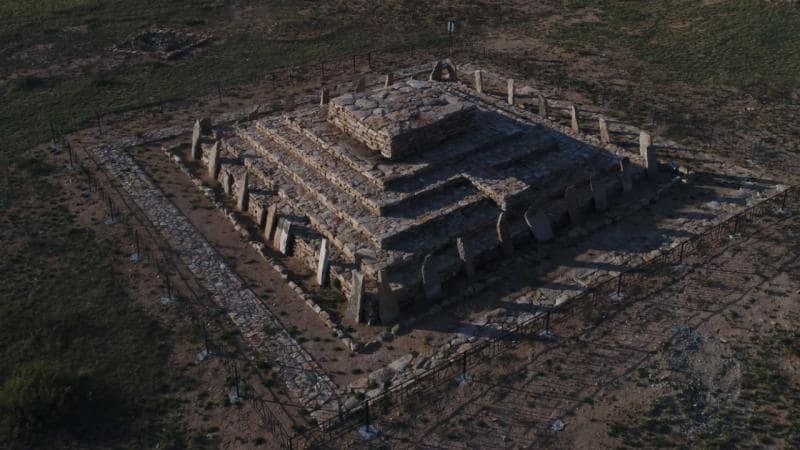
https://www.livescience.com/archaeology ... ian-steppe
https://archaeologymag.com/2023/08/bron ... azakhstan/
https://www.thearchaeologist.org/blog/a ... kazakhstan
https://en.wikipedia.org/wiki/Begazy_Dandybai_Mausolea
"
u/GlobalImportance5295 avatar
GlobalImportance5295
•
13h ago
Ab / Ap was always an obvious one to me. indra is even called Apsujit https://www.wisdomlib.org/definition/apsujit
a serpent named "Taimata" is found in atharvaveda https://ancientvoice.wikidot.com/avs:taimata
1
"
"
Sanskrit dictionary
[«previous (A) next»] — Apsujit in Sanskrit glossary
Apsujit (अप्सुजित्):—[=apsu-jit] [from apsu] mfn. vanquishing among the waters or in the region of the clouds (Name of Indra), [Ṛg-veda]
Source: Cologne Digital Sanskrit Dictionaries: Monier-Williams Sanskrit-English Dictionary
Apsujit (अप्सुजित्):—[tatpurusha compound] m. (-t) (ved.) Conquering (the demons) in the intermediate region, in the region between heaven and earth, an epithet of Indra (Sāyaṇa: antarikṣe vartamānānāmasurāṇāṃ jetā); another interpretation of Sāyaṇa, ‘conquering for the sake of water (scil. Vṛtra)’, is less probable, in the Ṛg-or Sāmav. verse: vajraṃ ca vṛṣaṇaṃ bharatsamapsujit (Sāy.: apsujit . udakārthaṃ vṛtrasya jetā yadvā āpa ityantarikṣanāma . antarikṣehināmakasya jetā; comp. his explanation of apsuvāh). E. apsu (loc. plur. of ap) and jit.
"
"
avs.5.13 Of the All conquering serpent s wrath, of the fierce rage of Black, and Brown, Taimata, and Apodaka.
"
https://en.wikipedia.org/wiki/Tower_of_Babel
https://en.wikipedia.org/wiki/Enmerkar_ ... _of_Aratta
"
He is furthermore to recite the "Incantation of Nudimmud", a hymn imploring Enki to restore (or in some translations, to disrupt) the linguistic unity of the inhabited regions, named as Shubur, Hamazi, Sumer, Uri-ki (the region around Akkad), and the Martu land:
On that day when there is no snake, when there is no scorpion, when there is no hyena, when there is no lion, when there is neither dog nor wolf, when there is thus neither fear nor trembling, man has no rival! At such a time, may the lands of Shubur and Hamazi, the many-tongued, and Sumer, the great mountain of the me of magnificence, and Akkad, the land possessing all that is befitting, and the Martu land, resting in security – the whole universe, the well-guarded people – may they all address Enlil together in a single language! For at that time, for the ambitious lords, for the ambitious princes, for the ambitious kings – Enki, the lord of abundance and of steadfast decisions, the wise and knowing lord of the Land, the expert of the gods, chosen for wisdom, the lord of Eridug, shall change the speech in their mouths, as many as he had placed there, and so the speech of mankind is truly one.[3]
The messenger arrives in Aratta, reciting this message to the king, and asks him for a reply to take to his lord Enmerkar, whom he calls "the scion of him with the glistening beard, whom his stalwart cow gave birth to in the mountain of the shining me, who was reared on the soil of Aratta, who was given suck at the udder of the good cow, who is suited for office in Kulaba."
The king of Aratta replies that submission to Uruk is out of the question, because Inanna herself had chosen him to his office and power. But the herald then reveals that Inanna has been installed as queen at E-ana and has even promised Enmerkar to make Aratta bow to Uruk.
Devastated by this news, the lord of Aratta finally gives his response: he is more than prepared for a military contest with Uruk, whom he considers no match for his might; however he will submit, on the sole conditions that Enmerkar send him a vast amount of barley grain, and that Inanna convince him that she has forsaken Aratta and confirm her allegiance to Uruk.
The herald returns to Enmerkar bearing this reply, and the next day Enmerkar actually sends the barley to Aratta, along with the herald and another demand to send even more precious stones.
The lord of Aratta, in a fit of pride, refuses and instead asks Enmerkar to deliver to him these precious stones himself. Upon hearing this, Enmerkar spends ten years preparing an ornate sceptre, then sends it to Aratta with his messenger. This frightens the lord of Aratta, who now sees that Inanna has indeed forsaken him, but he instead proposes to arrange a one-on-one combat between two champions of the two cities, to determine the outcome of the still-diplomatic conflict with Enmerkar. The king of Uruk responds by accepting this challenge, while increasing his demands for the people of Aratta to make a significant offering for the E-ana and the abzu, or face destruction and dispersal. To relieve the herald who, beleaguered, can no longer remember all the messages with which he is charged, Enmerkar then resorts to an invention: writing on tablets. The herald again traverses the "seven mountains" to Aratta, with the tablets, and when the king of Aratta tries to read the message, Ishkur, the storm-god, causes a great rain to produce wild wheat and chickpeas that are then brought to the king. Seeing this, the king declares that Inanna has not forsaken the primacy of Aratta after all, and summons his champion.
The remainder of the text has many lacunae- (line text losses), and the following events are unclear, but the tablet seems to end with Enmerkar triumphant, possibly installed by Inanna on the throne of Aratta, and with the people of Aratta delivering the tribute to E-ana, and providing the materials to build the Apsû.
A sequel text, Enmerkar and En-suhgir-ana, seems to continue the epic.
"
https://en.wikipedia.org/wiki/Enmerkar_ ... suhgir-ana
Added in 4 minutes 10 seconds:
https://new-indology.blogspot.com/2015/ ... g.html?m=1
Added in 3 minutes 2 seconds:
https://heritageofjapan.wordpress.com/f ... ern-japan/
https://japanesemythology.wordpress.com ... e-history/
Added in 16 minutes 51 seconds:
https://hms.harvard.edu/news/treasure-trove
Added in 2 minutes 43 seconds:
https://www.reddit.com/answers/f3bb37ad ... source=PDP
"
Skip to main content
How language shapes our perception of reality
Open App
Go to Reddit Answers
How language shapes our perception of reality
How language shapes our perception of reality
r/askphilosophy icon r/science icon r/languagelearning icon
Sources: r/askphilosophy, r/science, r/languagelearning +3 more
Language plays a significant role in shaping our perception of reality, though the extent and nature of this influence are subjects of ongoing debate and research. Here's a succinct guide based on the opinions and insights shared by redditors:
The Sapir-Whorf Hypothesis
The Sapir-Whorf hypothesis suggests that the language we speak can influence how we think and perceive the world. It has two main interpretations:
Weak Version: This version posits that language influences thought to some degree, which is widely accepted. "The weak interpretation however, which says that language influences language to some degree, is widely agreed upon."
For example, people who speak languages with more discerning terms for color variations can identify them faster. "The 'weak' version shows some evidence, but it is minor: people who speak certain languages that have more discerning terms for color variation on certain colors can identify them faster then those who can't, and the like."
Strong Version: This version suggests that language determines or limits thought, which is largely rejected. "The strong interpretation is generally regarded as false, meaning that language does not determine thought."
An infamous claim that the Hopi people thought about time differently due to their language was eventually found to be false. "There was an (in)famous claim that the Hopi (I believe) thought about time differently because of their language... This was eventually found to be false."
Language and Time Perception
Different languages can lead to different ways of conceptualizing and even perceiving time:
Influence on Perception: Studies show that language can shape how the brain perceives time. "Language shapes how the brain perceives time - people who speak two languages fluently think about time differently depending on the language context in which they are estimating the duration of events."
For instance, Swedish speakers are misled by stimulus length, while Spanish speakers are misled by stimulus size/quantity when reproducing duration. "Contrary to the universalist account, we found language-specific interference in a duration reproduction task... Swedish speakers were misled by stimulus length, and Spanish speakers were misled by stimulus size/quantity."
Cultural vs. Linguistic Influence: Some argue that the differences in time perception are more cultural than linguistic. "How much of this is cultural? When I'm speaking in German, I'm thinking like a German (well, somewhat). When I'm speaking Portuguese, I'm thinking like a Brazilian (easier than like a German)."
Language and General Thought/Culture
Language can also influence how people think and interact with their culture:
Framing the World: Languages can offer different types of "windows" to frame the world. "I feel languages give different types of windows to frame the world differently. The concept I remember most vividly is how English forced me to be constantly aware of people's gender for the first time ever, and I deeply hated that."
Cultural Intertwining: Language and culture are deeply intertwined, with culture often influencing language more than the other way around. "Culture and language are very intertwined. Usually culture influences language more than the other way around, but language definitely influences culture to some extent."
Personal Experience: Learning a new language can open up new perspectives and information. "Absolutely, in multiple ways, some good and some depressing. ... You can imagine that learning Russian really opened up a lot of new information for me to absorb."
Subreddits for Further Exploration
To dive deeper into how language shapes our perception of reality, consider asking in these subreddits:
r/linguistics
r/askphilosophy
r/languagelearning
r/science
Generated from these posts:
1 r/askphilosophy
Does language influence our perception of reality, or does our perception of reality influence language? Or both?
128
·
40
2 r/science
Language shapes how the brain perceives time - people who speak two languages fluently think about time differently depending on the language context in which they are estimating the duration of events. The finding is reported in the ‘Journal of Experimental Psychology: General’.
4.9K
·
153
3 r/languagelearning
Language's impact on thinking: Do you feel your target language changes your perception of the world?
18
·
21
4 r/linguistics
How influential is language on culture?
0
·
13
5 r/asklinguistics
Does the language we speak influence how we think?
6
·
24
6 r/linguistics
Studies on the effects of grammatical gender on perception
214
·
41
r/linguistics - Studies on the effects of grammatical gender on perception
7 r/languagelearning
Can thinking in another language change the way you think?
12
·
31
r/languagelearning - Can thinking in another language change the way you think?
8 r/linguistics
Language alters our experience of time
57
·
6
r/linguistics - Language alters our experience of time
9 r/relationship_advice
How far can language influence on perception of yourself?
2
·
2
Is this answer helpful?
Related
Reddit Answers are AI-generated from redditors’ posts and comments and may not be accurate.
30 questions left this week. for more.
"
Added in 1 hour 27 minutes :
"
A mtDNA study, published in 2018 in the journal American Journal of Physical Anthropology, compared both ancient and modern samples from Tuscany, from the Prehistory, Etruscan age, Roman age, Renaissance, and Present-day, and concluded that the Etruscans appear as a local population, intermediate between the prehistoric and the other samples, placing in the temporal network between the Eneolithic Age and the Roman Age.[74] A very large mtDNA study from 2013 indicates, based on maternally-inherited DNA from 30 bone samples taken from tombs dating from the eight century to the first century BC from Tuscany and Lazio, that the Etruscans were a native population. The ancient (30 Etruscans, 27 Medieval Tuscans) and modern DNA sequences (370 Tuscans) show that the Etruscans can be considered ancestral to Medieval and, especially in the subpopulations from Casentino and Volterra, of modern Tuscans.[69] These results are largely in line with a previous genetic study from 2004 based on mitochondrial DNA (mtDNA) from 28 bone samples taken from tombs dating from the seventh century to the third century BC from Veneto, Tuscany, Lazio and Campania.[131] This study found that the ancient DNA extracted from the Etruscan remains had some affinities with modern European populations including Germans, English people from Cornwall, and Tuscans in Italy.[131]
"
"
The study suggested a distant, shared ancestral link, but this specific finding was later met with criticism regarding potential DNA degradation or contamination in the ancient samples.
"
https://en.wikipedia.org/wiki/Etruscan_origins
"
A 2020 analysis of maternal haplogroups from ancient and modern samples in the central Italian region of Umbria finds a substantial genetic similarity among modern Umbrians and the area's pre-Roman inhabitants, and evidence of substantial genetic continuity in the region from pre-Roman times to the present. Both modern and ancient Umbrians were found to have high rates of mtDNA haplogroups U4 and U5a, and an overrepresentation of J (at roughly 30%). The study also found that, "local genetic continuities are further attested to by six terminal branches (H1e1, J1c3, J2b1, U2e2a, U8b1b1 and K1a4a)" also shared by ancient and modern Umbrians.[5]
"
https://www.eupedia.com/europe/Haplogro ... tml#J2b2a2
"
Both J2b1 and J2b2-L283 are also found at high frequency in Greece and in regions that used to be part of the ancient Greek world (Ionia, Magna Graecia). However they are almost absent from Crete (where J2a1 lineages are dominant). J2b was also not found among Neolithic Anatolian or European farmers, and is absent from central Anatolia. This suggests that J2b was not associated with the Neolithic Greeks nor with the Minoan civilisation, but may well have come to Greece with the Mycenaeans, who also appear to have been pushed out of the Steppe by the advance of the Srubna culture. As a result, both the Illyrians and the Mycenaeans (and possibly the Albanians) would be descended from Middle to Late Bronze Age Steppe migrants to the Southeast Europe, in a migration that was particularly rich in J2b lineages from the Middle Volga region. That would explain why it has been so hard to identify R1a or R1b lineages that could be of Illyrian or Mycenaean origin. The only variety of R1b that is found at reasonably high frequencies in Southeast Europe, and particularly in Greece, is R1b-Z2103, the branch found in the eastern Yamna culture, including the Volga-Ural region.
"
https://en.wikipedia.org/wiki/Y-DNA_hap ... South_Asia
"
The major paternal lineages of South Asian populations, represented by Y chromosomes, are haplogroups R1a1, R2, H, L, and J2,[5] as well as O-M175 in some parts (northeastern region) of the Indian subcontinent.[6] Haplogroup R is the most observed Y-chromosome DNA haplogroup among the populations of South Asia,[4] followed by H, L, and J, in the listed order.[4] These four haplogroups together constitute nearly 80% of all male Y-chromosome DNA haplogroups found in various populations of the region.[4]
The Y-chromosome DNA Haplogroups R1a1, R2, L, and J2, which are found in higher frequencies among various populations of the Indian subcontinent, are also observed among various populations of Europe, Central Asia, and Middle East.[7]
Some researchers have argued that Y-DNA Haplogroup R1a1 (M17) is of autochthonous South Asian origin.[8] However, proposals for a Eurasian Steppe origin for R1a1 are also quite common and supported by several more recent studies.[9] The spread of R1a1 in Indian subcontinent is associated with Indo-Aryan migrations into the region from South Central Asia that occurred around 3,500–4,000 years before present. The R1a-Z93 paternal genetic in Romani people was also discovered.[10] Indian-Brahmin origin of paternal haplogroup R1a1*.[11]
The Haplogroup R2 is mainly restricted to various populations of South Asia, in addition to some populations of South Central Asia, Middle East, Asia Minor and the Caucasus where it is observed in low frequencies.[12] R2 has higher frequency among the speakers of the Indo-Aryan languages as compared to Dravidian speakers of South India.[8]
The Haplogroup H (also known as the "Indian marker"[4]), which is a direct descendant of the Upper Paleolithic Eurasian Haplogroup HIJK, is mostly restricted to South Asian populations of the Indian subcontinent,[4] in addition to some populations of South Central Asia and eastern Iranian Plateau, where it is found in low frequencies.[5] It originated somewhere in the Middle East or South Central Asia and travelled to South Asia and adjoining areas of the eastern Iranian Plateau around 40,000–50,000 years before present.[4]
The Haplogroup L, which is thought to have originated near Pamir Mountains of present-day Tajikistan in South Central Asia,[4] travelled throughout Indian subcontinent during the Neolithic period, and it is associated with the spread of the Bronze Age Indus Valley Civilisation (IVC) in South Asia, which existed around 3,300–5,300 years before present.[4] It is also observed among many populations of the Iranian Plateau. The spread of the Haplogroup J2 from Iranian Plateau into Indian subcontinent also occurred during the Neolithic period, alongside L.[4]
The Haplogroup O-M175, which is a major haplogroup observed among the populations of East and Southeast Asia, is found largely restricted among the Tibeto-Burman and Austroasiatic speakers largely restricted to the Himalayan, northeastern and east-central regions of South Asia.[6]
"
https://en.wikipedia.org/wiki/Indo-Aryan_languages
https://en.wikipedia.org/wiki/Indo-Iranian_languages
"
The largest Indo-Iranian language is the Hindustani language (which later on split into Hindi and Urdu).[9]
"
"
The Proto-Indo-Iranian-speakers are generally associated with the Sintashta culture,[17][18][19] which is thought to represent an eastward migration of peoples from the Corded Ware culture,[20][21][22][23] which, in turn, is believed to represent an earlier westward migration of Yamnaya-related people from the Pontic–Caspian steppe zone into the territory of late Neolithic European cultures, possibly bringing with them the Proto-Indo-European language.[24][25] However, the exact genetic relationship between the Yamnaya culture, Corded Ware culture and Sinthasta culture remains unclear.[26][27]
The earliest known chariots have been found in Sintashta burials, and the culture is considered a strong candidate for the origin of the technology, which spread throughout the Old World and played an important role in ancient warfare.[28][29][30][31] There is almost a general consensus among scholars that the Andronovo culture, the successor of Sintasha culture, was an Indo-Iranian culture.[32][17] Currently, only two sub-cultures are considered as part of Andronovo culture: Alakul and Fëdorovo cultures.[33] The Andronovo culture is considered as an "Indo-Iranic dialect continuum", with a later split between Iranian and Indo-Aryan languages.[34] However, according to Hiebert, an expansion of the Bactria–Margiana Archaeological Complex (BMAC) into Iran and the margin of the Indus Valley is "the best candidate for an archaeological correlate of the introduction of Indo-Iranian speakers to Iran and South Asia",[35] despite the absence of the characteristic timber graves of the steppe in the Near East,[36] or south of the region between Kopet Dag and Pamir-Karakorum.[37] J. P. Mallory acknowledges the difficulties of making a case for expansions from Andronovo to northern India, and that attempts to link the Indo-Aryans to such sites as the Beshkent and Vakhsh cultures "only gets the Indo-Iranian to Central Asia, but not as far as the seats of the Medes, Persians or Indo-Aryans". He has developed the Kulturkugel (lit. 'the culture bullet') model that has the Indo-Iranians taking over cultural traits of BMAC, but preserving their language and religion while moving into Iran and India.[39][35]
"
https://en.wikipedia.org/wiki/Sintashta_culture
Added in 37 minutes 38 seconds:
https://en.wikipedia.org/wiki/Pashto
"
However, a remarkably large number of words are unique to Pashto.[89][90]
"
"
The native language of Afrighid Khwarazm was Old Khwarazmian, written an indigenous script derived from Aramaic, which had been imported by the Achaemenid Empire (550–330 BC) during their rule over Khwarazm.[14] According to the 10th-century Arab traveller Ahmad ibn Fadlan, the language sounded "like the chattering of starlings."[9]
"
"
Unfortunately, the manuscripts that have also come down have also suffered some corruption due to scribal errors,[1] since the Khwarezmian names were incomprehensible for most non-natives. Al-Biruni himself utilizes the extra letters of Khwarezmian which were not used in Arabic writings.
More is known about the dynasty in the Islamic era after the beginning of the 8th century and their conversion to Islam.
Name of the rulers given by the native Khwarezmian speaker Al-Biruni, and modern scholars.[1][15]
Coin of Bravik, also named Fravik, 7th century, Khwarazm
Coin of Sawashfan.
Coin of Azkajwar-Abdallah
Afrig (died 4th century)
Baghra
Biwarsar I (r. 3rd quarter of the 4th century)
Kawi
Biwarsar II
Sahhasak
Askajamuk I
Azkajwar I
Sahr I
Shaush
Hamgari
Buzgar
Arsamuh (r. during the time of the prophet Muhammad, around 600)
Sahr II
Sabri
Azkajwar II (r. late 7th century — 712)
Khusrau (r. 712)
Askajamuk II (r. 712–?)
Sawashfan (8th century)
Torkasbatha
Azkajwar-Abdallah (r. after 762/before 787 – 820s)
Mansur ibn Abdallah
Eraq ibn Mansur
Muhammad ibn Eraq (died 10th century)
Abu Sa'id Ahmad
Abu 'Abdallah Muhammad (r. 967–995, the year he was killed)
"
"
The Greater Yuezhi initially migrated northwest into the Ili Valley (on the modern borders of China and Kazakhstan), where they reportedly displaced elements of the Sakas. They were driven from the Ili Valley by the Wusun and migrated southward to Sogdia and later settled in Bactria. The Greater Yuezhi have consequently often been identified with peoples mentioned in classical European sources as having overrun the Greco-Bactrian Kingdom, like the Tókharoi[d] and Asii.[e] During the 1st century BC, one of the five major Greater Yuezhi tribes in Bactria, the Kushanas,[f] began to subsume the other tribes and neighbouring peoples. The subsequent Kushan Empire, at its peak in the 3rd century AD, stretched from Turfan in the Tarim Basin in the north to Pataliputra on the Gangetic plain of India in the south. The Kushanas played an important role in the development of trade on the Silk Road and the introduction of Buddhism to China.
The Lesser Yuezhi migrated southward to the edge of the Tibetan Plateau. Some are reported to have settled among the Qiang people in Qinghai, and to have been involved in the Liang Province Rebellion (184–221 AD) against the Eastern Han dynasty. Another group of Yuezhi is said to have founded the city state of Cumuḍa (now known as Kumul and Hami) in the eastern Tarim. A fourth group of Lesser Yuezhi may have become part of the Jie people of Shanxi, who established the Later Zhao state of the 4th century AD (although this remains controversial).
Many scholars believe that the Yuezhi were an Indo-European people.[14][15]
"
"
Three pre-Han texts mention peoples who appear to be the Yuezhi, albeit under slightly different names.[19]
The philosophical tract Guanzi (73, 78, 80 and 81) mentions nomadic pastoralists known as the Yúzhī[g] or Niúzhī,[h] who supplied jade to the Chinese.[20][19] (The Guanzi is now generally believed to have been compiled around 26 BC, based on older texts, including some from the Qi state era of the 11th to 3rd centuries BC. Most scholars no longer attribute its primary authorship to Guan Zhong, a Qi official in the 7th century BC.[21]) The export of jade from the Tarim Basin, since at least the late 2nd millennium BC, is well-documented archaeologically. For example, hundreds of jade pieces found in the Tomb of Fu Hao (c. 1200 BC) originated from the Khotan area, on the southern rim of the Tarim Basin.[22] According to the Guanzi, the Yúzhī/Niúzhī, unlike the neighbouring Xiongnu, did not engage in conflict with nearby Chinese states.
The epic novel Tale of King Mu, Son of Heaven (early 4th century BC) also mentions a plain of Yúzhī to the northwest of the Zhou lands.[19]
Chapter 59 of the Yi Zhou Shu (probably dating from the 4th to 1st century BC) refers to a Yúzhī[j] people living to the northwest of the Zhou domain and offering horses as tribute. A late supplement contains the name Yuèdī,[k] which may be a misspelling of the name Yuèzhī[l] found in later texts.[19]
In the 1st century BC, Sima Qian – widely regarded as the founder of Chinese historiography – describes how the Qin dynasty (221–206 BC) bought jade and highly valued military horses from a people that Sima Qian called the Wūzhī,[m] led by a man named Luo. The Wūzhī traded these goods for Chinese silk, which they then sold on to other neighbours.[23][24] This is probably the first reference to the Yuezhi as a lynchpin in trade on the Silk Road,[25] which in the 3rd century BC began to link Chinese states to Central Asia and, eventually, the Middle East, the Mediterranean and Europe.
"
"
Western Han historian Sima Qian composed an early yet detailed exposition on the Xiongnu in one liezhuan (arrayed account) of his Records of the Grand Historian (c. 100 BC), wherein the Xiongnu were alleged to be descendants of a certain Chunwei, who in turn descended from the "lineage of Lord Xia", a.k.a. Yu the Great.[53][54] Even so, Sima Qian also drew a distinct line between the settled Huaxia people (Han) to the pastoral nomads (Xiongnu), characterizing them as two polar groups in the sense of a civilization versus an uncivilized society: the Hua–Yi distinction.[55] Sima Qian also mentioned Xiongnu's early appearance north of Wild Goose Gate and Dai commanderies before 265 BC, just before the Zhao-Xiongnu War;[56][57] however, sinologist Edwin Pulleyblank (1994) contends that pre-241-BC references to the Xiongnu are anachronistic substitutions for the Hu people instead.[58][59] Sometimes the Xiongnu were distinguished from other nomadic peoples; namely, the Hu people;[60] yet on other occasions, Chinese sources often just classified the Xiongnu as a Hu people, which was a blanket term for nomadic people.[58][61] Even Sima Qian was inconsistent: in the chapter "Hereditary House of Zhao", he considered the Donghu to be the Hu proper,[62][63] yet elsewhere he considered Xiongnu to be also Hu.[64][58]
"
https://en.wikipedia.org/wiki/Yu_the_Great
"
Yu the Great or Yu the Engineer was a legendary king in ancient China who was credited with "the first successful state efforts at flood control",[1] his establishment of the Xia dynasty, which inaugurated dynastic rule in China, and for his upright moral character.[2][3] He figures prominently in the Chinese legend titled "Great Yu Controls the Waters" (大禹治水; Dà Yǔ zhì shuǐ). Yu and other sage-kings of ancient China were lauded for their virtues and morals by Confucius and other Chinese teachers.[4] He is one of the few Chinese monarchs who is posthumously honored with the epithet "the Great".
"
"
Collaborating with Hou Ji, a semi-mythical agricultural master, Yu successfully devised a system of flood controls that were crucial in establishing the prosperity of the Chinese heartland. Instead of directly damming the rivers' flows, Yu constructed a system of irrigation canals which redirected flood water into fields, as well as expending a great effort to dredge the riverbeds.[12] Yu is said to have eaten and slept with the common workers and spent most of his time personally assisting the work of dredging the silty beds of the rivers for the thirteen years the projects took to complete. The dredging and irrigation were successful, and allowed ancient Chinese culture to flourish along the Yellow River, Wei River, and other waterways of the Chinese heartland. The project earned Yu renown throughout Chinese history, and is referred to in Chinese history as "Great Yu Controls the Waters" (大禹治水; Dà Yǔ zhì shuǐ). In particular, Mount Longmen along the Yellow River had a very narrow channel which blocked water from flowing freely east toward the ocean. Yu is said to have brought a large number of workers to open up this channel, which has been known ever since as "Yu's Gateway" (禹門口).[12]
In a retold version of this story as presented in Wang Jia's Shi Yi Ji (4th century AD), Yu is assisted in his work by a yellow dragon and a black turtle (not necessarily related to the Black Tortoise in Chinese mythology).[26] Another local myth says that Yu created the Sanmenxia in the Yellow River by cutting a mountain ridge with a divine battle-axe to control flooding. This is perhaps a reference to a meteorite stone—something hard enough to etch away at the hard bedrock of Mount Longmen.[citation needed]
Traditional stories say that Yu sacrificed a great deal of his body to control the floods. For example, his hands were said to be thickly calloused, and his feet were completely covered with calluses. In one common story, Yu had only been married four days when he was given the task of fighting the flood. He said goodbye to his wife, saying that he did not know when he would return. During the thirteen years of flooding, he passed by his own family's doorstep three times, but each time he did not return inside his own home. The first time he passed, he heard that his wife was in labor. The second time he passed by, his son could already call out to his father. His family urged him to return home, but he said it was impossible as the flood was still going on. The third time Yu was passing by, his son was more than ten years old. Each time, Yu refused to go in the door, saying that as the flood was rendering countless number of people homeless, he could not rest.[23][27]
Yu supposedly killed Gonggong's minister Xiangliu, a nine-headed snake monster.
"
https://en.wikipedia.org/wiki/Xiangliu
"
According to the Classic of Mountains and Seas (Shanhaijing), Xiangliu (Xiangyao) was a minister of the snake-like water deity Gonggong. Xiangliu devastated the ecology everywhere he went. He was so gluttonous that all nine heads would feed at the same meal. Everywhere he rested or breathed upon (or that his tongue touched, depending on the telling) became boggy with poisonously bitter water, devoid of human and animal life. When Gonggong received orders to punish people with floods, Xiangliu was proud to contribute to their troubles.[3] Eventually, Xiangliu was killed, in some versions of the story by Yu the Great, whose other labors included ending the Great Flood of China, in others by Nüwa after he was defeated by Zhurong. The Shanhaijing says his blood stank to the point it was impossible to grow grain in the land it soaked and the area flooded, making it uninhabitable. Eventually Yu had to restrain the waters in a pond, over which the Sky Lords built their pavilions.[4]
Sun Jiayi identified Xiangliu as an eel:
Sun points out that the eel is a most important animal in the flood tales of Formosan aborigines. Ying-lung, who ... made the beds of rivers by waggling his tail in the muddy soil and thus helped Yü to regulate the flood, was a kind of eel, too: Hsiang-liu [Xiangliu] stopped the water with his body; Ying-lung with his tail made it run freely, just as Yü's father Kun stopped the water, while Yü made it run. Kun who, according to legend, was executed for his inability to stop the flood, turned into a "dark fish"; and some texts ... call Kun "The naked one". Both names fit quite well the eel.
— Eberhard (1968: 350–351), parenthetical comments omitted
An oral version of the Xiangliu myth, in which Xiangliu is depicted as a nine-headed serpent responsible for floods and other harm, was collected from Sichuan as late as 1983.
"
https://en.wikipedia.org/wiki/Gonggong
"
Gonggong was credited in various mythological contexts as being responsible for great floods, often in concert with his minister Xiangliu (a.k.a. Xiangyao), who has nine heads and the body of a snake.
Gonggong was ashamed that he lost the fight with Zhurong, the Chinese god of fire, to claim the throne of Heaven. In a fit of rage, he smashed his head against Buzhou Mountain, one of eight pillars holding up the sky, greatly damaging it and causing the sky to tilt towards the northwest and the Earth to shift to the southeast, which caused great floods and suffering. In one account of the myth, Gonggong kills himself in the process and fire comes out of the shattered mountain alongside floods.[4]
"
-
kFoyauextlH
- Posts: 1668
- Joined: Sun Jun 15, 2025 3:53 pm
Re: Iuz
https://en.wikipedia.org/wiki/Phantom_t ... acy_theory
Added in 2 hours 16 minutes 36 seconds:
https://en.wikipedia.org/wiki/Phantom_t ... acy_theory
"
The phantom time conspiracy theory is a pseudohistorical conspiracy theory first asserted by Heribert Illig in 1991. It hypothesizes a conspiracy by the Holy Roman Emperor Otto III and Pope Sylvester II to fabricate the Anno Domini dating system retroactively, in order to place them at the special year of AD 1000, and to rewrite history[1] to legitimize Otto's claim to the Holy Roman Empire. Illig believed that this was achieved through the alteration, misrepresentation and forgery of documentary and physical evidence.[2] According to this scenario, the entire Carolingian period, including the figure of Charlemagne, is a fabrication, with a "phantom time" of 297 years (AD 614–911) added to the Early Middle Ages.
"
"
If Charlemagne and the Carolingian dynasty were fabricated, there would have to be a corresponding fabrication of the history of the rest of Europe during the same era, including Anglo-Saxon England, the Papacy, and the Byzantine Empire. The "phantom time" period also encompasses the life of Muhammad and the Islamic expansion into the areas of the former Western Roman Empire, including the conquest of Visigothic Iberia. This history too would have to be forged or drastically misdated. It would also have to be reconciled with the history of the Tang dynasty of China and its contact with the Islamic world, such as at the Battle of Talas.[3][6]
"
People maybe shouldn't rest on their laurels and actually start from scratch however difficult that mdy be, completely blanking out assumptions and not relying on any prior "built up" knowledge and consensus, but seeing what one might come up with from absolutely nothing:
https://en.wikipedia.org/wiki/Alternate_history
https://en.wikipedia.org/wiki/The_Hindu ... ve_History
"
The book was criticized in India, and in February 2014 it was the subject of litigation in India for "deliberate and malicious acts intended to outrage the feelings of any religious community". As a result of the lawsuit, the book was withdrawn from the Indian market by its Indian publisher, prompting widespread concerns about the state of free speech in India. Twenty months later, the book returned to the Indian market under a different publisher, Speaking Tiger Books.[2]
"
"
While scholarly and popular reviews were by and large positive, it quickly drew much ire in the Indian blogosphere and the internet more generally, following what Taylor calls "a decade of bad blood, flaming, and hurtful personal attacks" following the publication of Kali's Child and several other controversial works.[3]
The book was criticised by Shiksha Bachao Andolan Samithi (Hindi: शिक्षा बचाओ आंदोलन समिति, "Committee for Struggle to Save Education"), founded by Dinanath Batra, arguing that the work was "riddled with heresies"[14] and that the contents are offensive to Hindus.[15] In 2011 he filed a lawsuit under Section 295A of Indian Penal Code, which forbids deliberate and malicious acts intended to outrage the feelings of any religious community,[16] and in February 2014, it was the subject of litigation in India.[17] The book was withdrawn from the Indian market by its Indian publisher,[18][19] Penguin India, who agreed to destroy all the existing copies within six months commencing from February 2014.[16]
There was a Streisand effect on the sales of the book and its sales effectively increased. Some bookstores continued to secretly sell the book, wrapped in brown paper.[20]
The publishers blamed the "British vintage Section 295A of IPC" for withdrawal of the books and felt that it was difficult to maintain international standards of free speech in light of this section.[21] The decision to withdraw the book was widely criticised and certain thinkers felt that Penguin should have defended the case effectively and upheld freedom of expression.[15][18] Widespread concerns were raised about the state of free speech in India.[14][22][23]
According to plaintiff attorney Monika Arora, she merely asked the publisher Penguin to fix errors in the book.[24] Arora says the withdrawal of the book by Penguin India and subsequent republishing under a different publisher was a scheme to avoid addressing factual errors in court.[24]
"
https://en.wikipedia.org/wiki/Streisand_effect
"
The Streisand effect describes a situation where an attempt to hide, remove, or censor information results in the unintended consequence of the effort instead increasing public awareness of the information.
"
"
The term was coined in 2005 by Mike Masnick of Techdirt after Barbra Streisand attempted to suppress the publication of a photograph by Kenneth Adelman showing her clifftop residence in Malibu, taken to document coastal erosion in California.[1][2][3]
In 2003, the American singer and actress Barbra Streisand sued the photographer, Kenneth Adelman, and Pictopia.com for US$50 million for violation of privacy.[4][5][6] The lawsuit sought to remove "Image 3850", an aerial photograph in which Streisand's mansion was visible, from the publicly available California Coastal Records Project of 12,000 California coastline photographs. As the project's goal was to document coastal erosion to influence government policymakers, privacy concerns of homeowners were deemed to be of minor or no importance.[7][8][9][10][11]
The lawsuit was dismissed and Streisand was ordered to pay Adelman's $177,000 legal attorney fees.[4][12][13][14][15] "Image 3850" had been downloaded only six times prior to Streisand's lawsuit, two of those being by Streisand's attorneys;[16] public awareness of the case led to more than 420,000 people visiting the site over the following month.[17]
Two years later, Masnick coined the name when writing about Marco Beach Ocean Resort's takedown notice to urinal.net (a site dedicated to photographs of urinals) over its use of the resort's name.[18][19]
How long is it going to take before lawyers realize that the simple act of trying to repress something they don't like online is likely to make it so that something that most people would never, ever see (like a photo of a urinal in some random beach resort) is now seen by many more people? Let's call it the Streisand Effect.
— Mike Masnick, "Since When Is It Illegal To Just Mention A Trademark Online?", Techdirt (January 5, 2005)[20]
"
https://en.wikipedia.org/wiki/List_of_S ... t_examples
Z and other people bent of eradicating people and other things are hell bent on changing history, reality, and the way people think about them and others.
"
Israel
edit
In May 2009, the Is right-wing nationalist political party Yisrael Beiteinu introduced a bill that would outlaw all commemorations of the expulsion of Palestinians following the 1948 Palestine war, known as "Nakba", with a three-year prison sentence for such acts of remembrance.[46][47] The original bill did not pass, and the controversy surrounding it unintentionally promoted knowledge of the Nakba within Is society.[48][49][50]
"
https://en.wikipedia.org/wiki/Right_to_be_forgotten
https://stardewvalleywiki.com/Dark_Shrine_of_Memory
"
The Dark Shrine of Memory is an altar found in the Witch's Hut. It can be accessed after completing the Goblin Problem quest.
"
https://stardewvalleywiki.com/Henchman
"
“I'm sorry, but I can't let you pass... I'd lose my job.”
— Henchman
The Henchman is a goblin that guards the Witch's Hut inside the Witch's Swamp. Players will encounter him after travelling to the swamp, but cannot pass around him.
Discovering how to get past the Henchman is the objective of the quest Goblin Problem. A lost book at the library reveals that Goblins love Void Mayonnaise, so after being given Void Mayonnaise he'll despawn from the map, allowing the player to pass and enter the Witch's Hut. He is not encountered again after the quest is completed.
"
"
Alexandre Balthazar Laurent Grimod de La Reynière, a lawyer by qualification who acquired fame during the reign of Napoleon for his sensual and public gastronomic lifestyle, rejected the name mayonnaise because the word "is not French". He also rejected the name mahonnaise because Port Mahon "is not known for good food", and thus he preferred bayonnaise, after the city of Bayonne, which "has many innovative gourmands and... produces the best hams in Europe."[34][31] Indeed, the city of Bayonne (sauce à la Bayonnaise) could also have given its name to this type of sauce, by spelling deformation. This form would seem to be confirmed by the fact that there is no written record of the sauce à la mayonnaise before the beginning of the 19th century, long after the capture of the city of Mahón.[35]
"
https://en.wikipedia.org/wiki/Mah%C3%B3n
"
The name's origin is attributed to the Carthaginian general Mago Barca, brother to Hannibal, who is thought to have taken refuge there in 205 BC.[5][6] After the fall of the Western Roman Empire, it became part of the Eastern Roman Empire; it suffered raids from Vikings and Arabs until the Islamic Caliphate of Córdoba conquered it in 903.
Maó was captured in 1287 from the Moors by Alfonso III of Aragon and incorporated into the Kingdom of Majorca, a vassal kingdom of the Crown of Aragon. Its harbour, one of the most strategically important in the western Mediterranean, was refortified.
In 1535, the Ottomans, under Hayreddin Barbarossa, attacked Maó and took 600 captives as slaves back to Algiers, in the Sack of Mahon.[7]
"
https://en.wikipedia.org/wiki/Mago_Barca
"
Mago Barca (Punic: 𐤌𐤂𐤍 𐤁𐤓𐤒, romanized: Magon Barqa;[1] died 202 BC) was a Carthaginian, member of the Barcid family, who played an important role in the Second Punic War, leading forces of Carthage against the Roman Republic in Iberia and northern and central Italy. Mago was the third son of Hamilcar Barca, was the brother of Hannibal and Hasdrubal, and was the brother-in-law of Hasdrubal the Fair.
"
https://en.wikipedia.org/wiki/Mahound
"
The name "Mago(n)" was a common masculine given name among the Carthaginian elite. It meant "Godsent".[2]
The cognomen or epithet BRQ means "thunderbolt" or "shining". It is cognate with the Arabic name Barq and the Hebrew name Barak and equivalent to the Greek Keraunos, which was borne by contemporary commanders.[3] It had been used for Mago's father Hamilcar and is used to distinguish his three sons from others who shared their names.
"
"
Hannibal included Mago among the Carthaginian officers who accompanied him to the Italian Peninsula. Among them were Maharbal, Hanno the Elder, Muttines (Punic: 𐤌𐤕𐤍, MTN)[4] and Carthalo.
Mago fought at the side of Hannibal in the invasion of Italy, and played a key role in many battles.
"
https://en.wikipedia.org/wiki/Hanunu
"
Hamilcar probably landed at Gades in the summer of 237 BC. Whatever direct territorial control Carthage had had in the past in Iberia,[99] this had been mostly lost by this time as Hamilcar was "re-establishing Carthaginian authority in Iberia".[89] Phoenician colonies were strung along the Atlantic and Mediterranean coasts of southwestern Spain and exercised some degree of control over their immediate areas, but only had trading contacts, not direct control, over the tribes of Iberia at that time.[100] Iberian and Celtiberian tribes were not under any unified leadership at this time and were warlike, although some had absorbed varying degrees of Greek and Punic cultural influence.
"
https://en.wikipedia.org/wiki/Ancient_Carthage
"
The name Carthage /ˈkɑːrθɪdʒ/ is the Early Modern anglicisation of Middle French Carthage /kar.taʒ/, from Latin Carthāgō and Karthāgō (cf. Greek Karkhēdōn (Καρχηδών) and Etruscan *Carθaza) from the Punic qrt-ḥdšt, vocalised by Brett Mulligan as Qart-Ḥadašt (Punic: 𐤒𐤓𐤕𐤟𐤇𐤃𐤔𐤕, lit. 'New City').[15][16]
Punic, which is sometimes used synonymously with Carthaginian, derives from the Latin poenus and punicus, based on the Ancient Greek word Φοῖνιξ (Phoinix), pl. Φοίνικες (Phoinikes), an exonym used to describe the Canaanite port towns with which the Greeks traded. Latin later borrowed the Greek term a second time as phoenix, pl. phoenices.[17] Both Punic and Phoenician were used by the Romans and Greeks to refer to Phoenicians across the Mediterranean; modern scholars use the term Punic exclusively for Phoenicians in the western Mediterranean, such as the Carthaginians. Specific Punic groups are often referred to with hyphenated terms, like "Siculo-Punic" for Phoenicians in Sicily or "Sardo-Punic" for those in Sardinia. Ancient Greek authors sometimes referred to the mixed Punic inhabitants of North Africa ('Libya') as 'Liby-Phoenicians'.[18]
It is unclear what term, if any, the Carthaginians used to refer to themselves. The Phoenician homeland in the Levant was natively known as 𐤐𐤕 (Pūt) and its people as the 𐤐𐤍𐤉𐤌 (Pōnnim). Ancient Egyptian accounts suggest the people from the region identified as Kenaani or Kinaani, equivalent to Canaanite.[19] A passage from Augustine has often been interpreted as indicating that the Punic-speakers in North Africa called themselves Chanani (Canaanites),[20] but it has recently been argued that this is a misreading.[21] Numismatic evidence from Sicily shows that some western Phoenicians made use of the term Phoinix.[22]
The name Carthage /ˈkɑːrθɪdʒ/ is the Early Modern anglicisation of Middle French Carthage /kar.taʒ/, from Latin Carthāgō and Karthāgō (cf. Greek Karkhēdōn (Καρχηδών) and Etruscan *Carθaza) from the Punic qrt-ḥdšt, vocalised by Brett Mulligan as Qart-Ḥadašt (Punic: 𐤒𐤓𐤕𐤟𐤇𐤃𐤔𐤕, lit. 'New City').[15][16]
Punic, which is sometimes used synonymously with Carthaginian, derives from the Latin poenus and punicus, based on the Ancient Greek word Φοῖνιξ (Phoinix), pl. Φοίνικες (Phoinikes), an exonym used to describe the Canaanite port towns with which the Greeks traded. Latin later borrowed the Greek term a second time as phoenix, pl. phoenices.[17] Both Punic and Phoenician were used by the Romans and Greeks to refer to Phoenicians across the Mediterranean; modern scholars use the term Punic exclusively for Phoenicians in the western Mediterranean, such as the Carthaginians. Specific Punic groups are often referred to with hyphenated terms, like "Siculo-Punic" for Phoenicians in Sicily or "Sardo-Punic" for those in Sardinia. Ancient Greek authors sometimes referred to the mixed Punic inhabitants of North Africa ('Libya') as 'Liby-Phoenicians'.[18]
It is unclear what term, if any, the Carthaginians used to refer to themselves. The Phoenician homeland in the Levant was natively known as 𐤐𐤕 (Pūt) and its people as the 𐤐𐤍𐤉𐤌 (Pōnnim). Ancient Egyptian accounts suggest the people from the region identified as Kenaani or Kinaani, equivalent to Canaanite.[19] A passage from Augustine has often been interpreted as indicating that the Punic-speakers in North Africa called themselves Chanani (Canaanites),[20] but it has recently been argued that this is a misreading.[21] Numismatic evidence from Sicily shows that some western Phoenicians made use of the term Phoinix.[22]
"
https://en.wikipedia.org/wiki/Phoenix_(mythology)
"
The modern English word phoenix entered the English language from Latin, later reinforced by French. The word first entered the English language by way of a borrowing of Latin phoenīx into Old English (fenix). This borrowing was later reinforced by French influence, which had also borrowed the Latin noun. In time, the word developed specialized use in the English language: For example, the term could refer to an "excellent person" (12th century), a variety of heraldic emblem (15th century), and the name of a constellation (17th century).[5]
The Latin word comes from Greek φοῖνιξ (phoinix).[6] The Greek word is first attested in the Mycenaean Greek po-ni-ke, which probably meant "griffin", though it might have meant "palm tree". That word is probably a borrowing from a West Semitic word for madder, a red dye made from Rubia tinctorum. The word Phoenician appears to be from the same root, meaning "those who work with red dyes". So phoenix might also have meant "the Phoenician bird" or "the purplish-red bird".[7]
"
"
Apart from the Linear B mention above from Mycenaean Greece, the earliest clear mention of the phoenix in ancient Greek literature occurs in a fragment of the Precepts of Chiron, attributed to 8th-century BC Greek poet Hesiod. In the fragment, the wise centaur Chiron tells a young hero Achilles the following:[8]
A chattering crow lives now nine generations of aged men,
but a stag's life is four time a crow's,
and a raven's life makes three stags old,
while the phoenix outlives nine ravens,
but we, the rich-haired Nymphs
daughters of Zeus the aegis-holder,
outlive ten phoenixes.
Thereby describing the phoenix's lifetime as approximately 972 times the length of a human's.
"
"
Classical discourse attributes a potential origin of the phoenix to Ancient Egypt. Herodotus, writing in the 5th century BC, provides the following account of the phoenix:[9]
[The Egyptians] have also another sacred bird called the phoenix which I myself have never seen, except in pictures. Indeed it is a great rarity, even in Egypt, only coming there (according to the accounts of the people of Heliopolis) once in five hundred years, when the old phoenix dies. Its size and appearance, if it is like the pictures, are as follow: The plumage is partly red, partly golden, while the general make and size are almost exactly that of the eagle. They tell a story of what this bird does, which does not seem to me to be credible: that he comes all the way from Arabia, and brings the parent bird, all plastered over with myrrh, to the temple of the Sun, and there buries the body. In order to bring him, they say, he first forms a ball of myrrh as big as he finds that he can carry; then he hollows out the ball and puts his parent inside, after which he covers over the opening with fresh myrrh, and the ball is then of exactly the same weight as at first; so he brings it to Egypt, plastered over as I have said, and deposits it in the temple of the Sun. Such is the story they tell of the doings of this bird.
"
"
In the 14th century, Italian poet Dante Alighieri refers to the phoenix in Canto XXIV of the Divine Comedy's Inferno:
Così per li gran savi si confessa
che la fenice more e poi rinasce,
quando al cinquecentesimo anno appressa;
erba né biado in sua vita non pasce,
ma sol d'incenso lagrime e d'amomo,
e nardo e mirra son l'ultime fasce.
—In the original Italian
Translation:
Even thus by the great sages 'tis confessed
The phoenix dies, and then is born again,
When it approaches its five-hundredth year;
On herb or grain it feeds not in its life,
But only on tears of incense and amomum,
And nard and myrrh are its last winding-sheet.
—In English translation
"
https://en.wikipedia.org/wiki/Magonids
The Mahomids.
"
Leading experts on Carthage have been sceptical as to whether it is even possible to reconstruct the internal history of Carthage,[2] and this needs to be borne in mind in relation to the Magonids. Mago and his successors probably ruled less like kings and more like tyrants or political strongmen.[3] Diodorus, however, describes them as kings according to the law, which implies a legal procedure rather than a naked seizure of power. Similarly, Herodotus tells us that Hamilcar I was "king by valour," implying selection rather than hereditary succession.[4]
In 480 BCE, after Hamilcar I's death, the king lost most of his power to an aristocratic Council of Elders. In 308 BCE, Hannonian Bomilcar attempted a coup d'état to restore the monarch to full power, but failed, so that Carthage became in name as well as in fact a republic.[5][6]
"
"
550 BCE: Mago I takes power.
540 BCE: A Carthaginian-Etruscan alliance had expelled the Greeks from Corsica after the Battle of Alalia.
530 BCE: Mago dies and Hasdrubal I takes power.
Mid 520s BCE: Hasdrubal, along with his brother Hamilcar I, launches an expedition against Sardinia.
510 BCE: Hamilcar I takes power.
509 BCE: Treaty was signed between Carthage and Rome indicating a division of influence and commercial activities. This is the first known source indicating that Carthage had gained control over Sicily and Sardinia, as well as Emporia and the area south of Cape Bon in Africa.
483 BCE: Carthage launches First Sicilian War against Greece in an attempt to gain control of Sicily
480 BCE: Carthage suffers a disastrous loss at Battle of Himera in which Hamilcar is killed, ending the First Sicilian War. Hanno II, also known as Hanno the Navigator, takes power. The Tribunal of 104 is established, severely weakening the power of the Kings. Carthage becomes a republic.
440 BCE: Hanno's reign ends, under whom a large part of Africa was added to Carthage's dominion and more of the Atlantic coast of Africa was explored and settled. Himilco I takes power.
410 BCE: Hannibal I takes power. The same year, he invades Sicily.
409 BCE: Invasion of Sicily ends with destruction of the city of Selinus, ally of the powerful Greek city of Syracuse.
406 BCE: Himilco II takes power after Hannibal dies of disease.
396 BCE: Himilco is disastrously defeated in Sicily by Dionysius I of Syracuse and commits suicide. Mago II takes power.
392 BCE: After crushing Libyan revolt, Mago ends war with Dionysus in Sicily.
378/375 BCE: Mago defeated and killed at Battle of Cabala in central Sicily by the Syracusan army.
377 BCE??: Mago's son Himilco Mago defeats Dionysius at Battle of Cronium. Syracuse and Carthage make peace.
348 BCE: Second treaty signed with Rome, now a significant power in Italy.
344 BCE: Mago III dies. Hanno III takes power.
340 BCE: Hanno III attempts a coup d'etat against the Council of Elders to restore full monarchical power, but he fails, and is executed.
"
https://spiritsofthewestcoast.com/colle ... xwICWgsTdj
https://en.wikipedia.org/wiki/False_Face_Society
https://upload.wikimedia.org/wikipedia/ ... _EthnM.jpg
"
The design of the masks is somewhat variable, but most share certain features. The eyes are deep-set and accented by metal. The noses are bent and crooked.[3] The other facial features are variable. The masks are painted red and black. Most often they have pouches of tobacco tied onto the hair above their foreheads. Basswood is usually used for the masks although white pine, poplar, and maple are sometimes used.[3] Horse tail hair is used for the hair, which can be black, reddish brown, brown, grey or white. Before the introduction of horses by the Europeans, corn husks and buffalo hair were used.
When making a mask, a man walks through the woods until he is moved by Hadú7i7 to carve a mask from a tree. Hadú7i7 inspires the unique elements of the mask's design and the resulting product represents the spirit himself, imbued with his powers. The masks are carved directly on the tree and only removed when completed. Masks are painted red if they were begun in the morning or black if they were begun in the afternoon.
Because the masks are carved into trees that are alive, they are similarly considered to be living and breathing.[1] They are served parched whitecorn mush and given small pouches of tobacco as payment for services.
"
https://en.wikipedia.org/wiki/Hahgwehdiyu
https://en.wikipedia.org/wiki/Evil_twin
https://www.godchecker.com/iroquois-myt ... EHDAETGAH/
https://en.wikipedia.org/wiki/Cap_of_invisibility
"
One ancient source that attributes a special helmet to the ruler of the underworld is the Bibliotheca (2nd/1st century BC), in which the Uranian Cyclopes give Zeus the lightning bolt, Poseidon the trident, and a helmet (kyneê) to Hades (or Pluto) in their war against the Titans.
In classical mythology the helmet is regularly said to belong to the god of the underworld. Rabelais calls it the Helmet of Pluto,[4] and Erasmus the Helmet of Orcus.[5] The helmet becomes proverbial for those who conceal their true nature by a cunning device: "the helmet of Pluto, which maketh the politic man go invisible, is secrecy in the counsel, and celerity in the execution."[6]
"
https://en.wikipedia.org/wiki/My_Son,_the_Hero
https://en.wikipedia.org/wiki/Bident
"
The spear of Achilles is said by a few sources to be bifurcated.[10] Achilles had been instructed in its use by Peleus, who had in turn learned from the centaur Chiron. The implement may have associations with Thessaly. A black-figured amphora from Corneto (Etruscan Tarquinia) depicts a scene from the hunt for the Calydonian boar, part of a series of adventures that took place in the general area. Peleus is accompanied by Castor, who is attacking the boar with a two-pronged spear.[11]
A bronze trident found in an Etruscan tomb at Vetulonia seems to have had an adaptable center prong that could be removed for use as a bident.[12] A kylix found at Vulci in ancient Etruria was formerly interpreted as depicting Pluto (Greek: Πλούτων Plouton) with a bident. A black-bearded man holding a peculiarly two-pronged instrument reaches out in pursuit of a woman, thought to be Persephone. The vase was subjected to improper reconstruction, however, and the couple are more likely Poseidon and Aethra.[13] On Lydian coins that show Plouton abducting Persephone in his four-horse chariot, the god holds his characteristic scepter, the ornamented point of which has sometimes been interpreted as a bident.[14] Other visual representations of the bident on ancient objects appear to have been either modern-era reconstructions, or in the possession of figures not securely identified as the ruler of the underworld.[15]
"
https://en.wikipedia.org/wiki/Bidental
"
In ancient Roman religion, a bidental was a sacred shrine erected on the spot where lightning had struck.
"
"
The Cambridge ritualist A.B. Cook saw the bident as an implement that might be wielded by Jupiter, the chief god of the Roman pantheon, in relation to Roman bidental ritual, the consecration of a place struck by lightning by means of a sacrificial sheep, called a bidens because it was of an age to have two teeth.[16] In the hands of Jupiter (also known as Jove, Etruscan Tinia), the trident or bident thus represents a forked lightning bolt. In ancient Italy, thunder and lightning were read as signs of divine will, wielded by the sky god Jupiter in three forms or degrees of severity (see manubia). The Romans drew on Etruscan traditions for the interpretation of these signs. A tile found at Urbs Salvia in Picenum depicts an unusual composite Jove, "fairly bristling with weapons": a lightning bolt, a bident, and a trident, uniting the realms of sky, earth, and sea, and representing the three degrees of ominous lightning (see also Summanus).[17] Cook regarded the trident as the Greek equivalent of the Etruscan bident, each representing a type of lightning used to communicate the divine will; since he accepted the Lydian origin of the Etruscans, he traced both forms to the same Mesopotamia source.[18]
The later notion that the ruler of the underworld wielded a trident or bident can perhaps be traced to a line in the Hercules Furens ("Hercules Enraged") of Seneca. Dis (the Roman equivalent of Greek Plouton) uses a three-pronged spear to drive off Hercules as he attempts to invade Pylos. Seneca also refers to Dis as the "Infernal Jove"[19] or the "dire Jove",[20] the Jove who gives dire or ill omens (dirae), just as in the Greek tradition, Hades is sometimes identified as a "chthonic Zeus". That the trident and bident might be somewhat interchangeable is suggested by a Byzantine scholiast, who mentions Poseidon being armed with a bident.[21]
"
https://en.wikipedia.org/wiki/Mambrino
"
Mambrino was a fictional Moorish king, celebrated in the romances of chivalry. His first appearance is in the late fourteenth-century Cantari di Rinaldo, also known as Rinaldo da Monte Albano, Rinaldo Innamorato or Innamoramento di Rinaldo. The Cantari di Rinaldo is an adaptation of the Old French chanson de geste, Renaud de Montauban, also known as Les Quatre Fils Aymon. In the Old French, Renaud defeats the Saracen king Begon, who was invading King Yon's kingdom of Gascony. The Italian replaces Begon with Mambrino, and furnishes him with an elaborate backstory. In the Cantari, Mambrino is one of six brothers, all giants. Four of the brothers had been decapitated by Rinaldo on various occasions earlier in the poem, so that his invasion of Gascony was motivated by his desire for vengeance. Rinaldo, as the Italians called Renaud, wins the war by defeating Mambrino in single combat and decapitating him as well. Mambrino's helmet, in this poem, has for its crest an idol which is so constructed that whenever the wind blows through it, it says, "Long live the most noble lord Mambrino, and all his barons."
In later poems, Mambrino’s helmet was made of pure gold and rendered its wearer invulnerable. These are the helmet's attributes in the Orlando Innamorato and the Orlando Furioso, throughout which poems it is worn by Rinaldo. Francesco Cieco da Ferrara's poem, Mambriano, is about the titular son of Mambrino's sister and his attempt to avenge his uncle.[1] Both the sister and the nephew were invented by Francesco.
Cervantes, in his novel Don Quixote de la Mancha, tells us of a barber who was caught in the rain, and to protect his hat clapped his brazen basin on his head. Don Quixote insisted that this basin was the enchanted helmet of the Moorish king. Don Quixote wishes to obtain the helmet in order to make himself invulnerable. In the musical Man of La Mancha, an entire song is constructed around the titular character's search for the helmet and his encounter with the barber.
There is a reference in Patrick Leigh Fermor's Mani to Mambrino with respect to a very large straw hat worn by a Greek man in the 1930s. "[The man] came loping towards us under his giant Mambrino's helmet of straw."[2]
Chapter 2 of George Eliot's novel "Middlemarch" is headed by a paragraph from "Don Quixote" in which the helmet of Mambrino is referred to.
"
https://aeon.co/essays/are-we-any-close ... -lightning
https://learningenglish.voanews.com/a/s ... 21102.html
https://www.damascusbite.co.uk/13-16404 ... lizations/
https://terralingua.org/stories/when-gr ... languages/
https://www.researchgate.net/publicatio ... _lightning
https://en.wikipedia.org/wiki/Wonderstruck_(film)
https://en.wikipedia.org/wiki/Wonderstruck_(novel)
Released October 27, 2017 in Canada.
https://www.researchgate.net/publicatio ... ing_strike
https://www.cbc.ca/news/science/lightni ... -1.5952917
https://www.nature.com/articles/s41467-021-21849-2
https://www.popularmechanics.com/scienc ... ng-theory/
https://www.techexplorist.com/lightning ... des/68912/
https://www.theguardian.com/science/202 ... on-science
"
Lightning strikes might also have lent a hand. The idea that lightning created the ingredients for life gained traction in 1953 when Stanley Miller and Harold Urey at the University of Chicago reported that electrical discharges in a simulated early Earth atmosphere produced amino acids. But the hypothesis has its critics: lightning is too infrequent, they say, and the chemicals produced simply drift away.
Zare’s team took to a dark room to investigate the electrical properties of water sprays. They found that droplets carry opposing charges and when they come together, tiny sparks leap between them. Unlike lightning bolts that cover miles, microlightning travels a few billionths of a metre.
While the effect is faint, it carries enough energy to drive chemical reactions. Writing in Science Advances, the researchers describe how they sprayed water into a mixture of nitrogen, methane, carbon dioxide and ammonia. This led to the rapid formation of key molecules including hydrogen cyanide; glycine, an amino acid involved in protein production; and uracil, a building block of RNA found in all living cells. “We propose that this is a new mechanism for the prebiotic synthesis of molecules that constitute the building blocks of life,” Zare said.
Dr Eva Stueeken, who studies the origins of life at the University of St Andrews, said the work was fascinating. “It opens up an array of possibilities that we need to explore further, using different gas and fluid compositions,” she said. “It will also be important to quantify how significant this mechanism would have been on a global scale for the generation of prebiotic molecules.”
Prof David Deamer at the University of California, Santa Cruz, who has worked with Zare but not on the latest study, said microlightning “can now be added to the list of possible energy sources available to drive organic synthesis before life began”.
"
https://phys.org/news/2025-03-trees-lig ... boost.html
https://abcnews.go.com/US/tropical-tree ... =120594405
"
u/hobodemon avatar
hobodemon
•
5y ago
Knowing what I do about Burroughs, you aren't supposed to try and stop the spread of the virus of language.
A virus inserts itself into your genome, reproduces, the reproductions are altered by bits of genetic code it picks up from the host, and it is then spread to others. This is about the ouroborotic relationship between media and culture, presented with mildly negative affect because Burroughs wrote mainly about his trauma, and with apathetic edit: not apathetic, the other thing where you recognize negative consequences downstream of the act but accept them as probably going to happen anyway, not complacency either, uh uh uhhhhhj acceptance of the inevitability of spread because you don't make interesting people by denying them access to the trauma of other people.
Don't think of the virus of language (here meaning the words of Burroughs as he coped with the death of his common-law wife) like COVID. Think of it like herpes. 98% of the population has it, the effects are over-demonized by a judgemental media that wants to sell you something, and having it is proof in a sense that you have lived and loved and lost as we all lose in this struggle in an imperfect world.
12
[deleted]
•
5y ago
Wow!
2
u/ANewMythos avatar
ANewMythos
•
2y ago
Awesome info!
2
"
"
u/strange_reveries avatar
strange_reveries
•
5y ago
“The word is now a virus. The flu virus may have once been a healthy lung cell. It is now a parasitic organism that invades and damages the central nervous system. Modern man has lost the option of silence. Try halting sub-vocal speech. Try to achieve even ten seconds of inner silence. You will encounter a resisting organism that forces you to talk. That organism is the word.”
-from The Ticket That Exploded by Burroughs.
Poor guy could probably have benefited from a meditation practice. Very interesting and talented dude, tho.
12
[deleted]
•
5y ago
He did all sorts of meditation. Stuff like this is what comes out of it.
1
ms4
•
5y ago
prose
1
u/strange_reveries avatar
strange_reveries
•
5y ago
Yeah, true. I thought about that after I commented. He was into all kinds of esoteric stuff, and there's no way he didn't dip into meditation at some point. I think he was probably just saying this stuff rhetorically, just sorta ruminating about the nature of consciousness.
1
Continue this thread
u/EarthIcy7805 avatar
EarthIcy7805
•
1y ago
Thank you for the quote!!! I think it's a fun thought experiment to run with. I'm including it in my college writing course.
2
12
[deleted]
•
5y ago
He did all sorts of meditation. Stuff like this is what comes out of it.
1
ms4
•
5y ago
prose
1
u/strange_reveries avatar
strange_reveries
•
5y ago
Yeah, true. I thought about that after I commented. He was into all kinds of esoteric stuff, and there's no way he didn't dip into meditation at some point. I think he was probably just saying this stuff rhetorically, just sorta ruminating about the nature of consciousness.
1
Continue this thread
[deleted]
•
5y ago
He did all sorts of meditation. Stuff like this is what comes out of it.
1
ms4
•
5y ago
prose
1
u/strange_reveries avatar
strange_reveries
•
5y ago
Yeah, true. I thought about that after I commented. He was into all kinds of esoteric stuff, and there's no way he didn't dip into meditation at some point. I think he was probably just saying this stuff rhetorically, just sorta ruminating about the nature of consciousness.
1
Continue this thread
u/strange_reveries avatar
strange_reveries
•
5y ago
Yeah, true. I thought about that after I commented. He was into all kinds of esoteric stuff, and there's no way he didn't dip into meditation at some point. I think he was probably just saying this stuff rhetorically, just sorta ruminating about the nature of consciousness.
1
[deleted]
•
5y ago
Not really. We was very into language and its inner workings. He had been for 30 years by the time of this quote. Language virus is both less literal and more literal than people make it out to be. In a very real sense, he saw language as acting virally, much the way memes and videos do now.
His meditation came in the form of his lifelong use of Orgone Boxes, which he would make in the various places he lived. He would sit in them and chill and think. They are based on the most ridiculous Reichian principles of the orgone, but they had the added side benefit of allowing for thinking and quiet.
3
1
[deleted]
•
5y ago
Not really. We was very into language and its inner workings. He had been for 30 years by the time of this quote. Language virus is both less literal and more literal than people make it out to be. In a very real sense, he saw language as acting virally, much the way memes and videos do now.
His meditation came in the form of his lifelong use of Orgone Boxes, which he would make in the various places he lived. He would sit in them and chill and think. They are based on the most ridiculous Reichian principles of the orgone, but they had the added side benefit of allowing for thinking and quiet.
3
[deleted]
•
5y ago
Not really. We was very into language and its inner workings. He had been for 30 years by the time of this quote. Language virus is both less literal and more literal than people make it out to be. In a very real sense, he saw language as acting virally, much the way memes and videos do now.
His meditation came in the form of his lifelong use of Orgone Boxes, which he would make in the various places he lived. He would sit in them and chill and think. They are based on the most ridiculous Reichian principles of the orgone, but they had the added side benefit of allowing for thinking and quiet.
3
"
F*ck! The condescending way these f*cking losers on Reddit type!
https://en.wikipedia.org/wiki/Orgone
https://en.wikipedia.org/wiki/Odic_force
"
The name was coined by Baron Carl von Reichenbach in 1845 in reference to the Germanic god Odin.[1][2]
"
Added in 1 day 5 hours 10 minutes 37 seconds:
"
Ancient Aztec priest practices and beliefs?
I came across a strange article mentioning some beliefs of the people living in “early” Mexica. It mentioned a very unorthodox practice carried out by Aztec priests that they would use to record history. They didn’t just annotate things the way we would today, but it was believed that the priest class was actually capable of traveling directly to past events to chronicle them in some form.
Has anyone else heard mention of this idea before? Did they supposedly have access to some form of divine-bestowed time traveling capability? Was it similar to the idea of the Akashic Record? Also, is this supposedly how they learned of their mythical migration from Aztlan and Chicomoztoc?
"
"
However, there is one Mexica tale which does have some elements of the supernatural and does involve some bending of time and space. Durán, in his History of the Indies of New Spain, relates how Tlatoani Motecuhzoma Ilhuicamina organized an expedition to return the ancestral land of the Mexica. This group was specifically charged to learn more about Chicomoztoc, but also to seek out any who still lived in those caves, which might include the mother of Huitzilopochtli.
Under the advice the famed Cihuacoatl, Tlacaelel, it was decided the expedition would eschew soldiers and instead be made up of "wizards and magicians," the rationale being that the land would have become overgrown and wild since the depature of the Mexica, and thus unrecognizable without magic. Gathering up 60 of these sorcerers, Motecuhzoma explained his goals and gave them a rich assortment of fine garments, precious stones, fine feathers, gold, cacao, and cotton to gift to the inhabitants of Atzlan. Thus provisioned, the magical group set out for Coatepec.
The selection of Coatepec as the first stop on the way to Aztlan is significant, particularly given the other goal of the mission was to seek the mother of Huitzilopochtli. During their sojourn in the wilderness between Aztlan and the Valley of Mexico, the Mexica had a prolonged stay at Coatepec. They built a dam there, forming a lagoon that soon grew rich with fish and waterfowl. As their stay progressed, they built a temple to Huitzilopochtli, put up a ballcourt, and also erected a tzompantli (skull rack). Soon, a group led by the goddess Coyolxauhqui began to argue that this was the paradise the Mexica had been promised when they split from the other Aztecs to follow Huitzilopochtli. Coyolxauhqui and her followers, called the Centzon Huitznahua, argued for permanent settlement at Coatepec.
Huitzilopochtli, hearing of this, let his priests know of his displeasure. Also, the face of his idol, which certain priests called teomama (god-carriers) had faithfully borne since leaving Aztlan, took on a furious scowl.
That night the Mexica heard a furious commotion in the ballcourt and by the skull rack. In the morning, they awoke to find Coyolxauhqui and her followers killed and their hearts removed. Huitzilopochtli then ordered the Mexica to destroy the dam. The lagoon dried up and the Mexica moved on, continuing their pilgrimage towards their promised home.
There are different versions of this story, because Aztec mythology is exasperatingly polyvocal. Sahagún's version states that Coatlicue was a woman who lived at Coatepec. Evidently a pious woman, she performed religious penances, including sweeping... actually what she was sweeping is not entirely clear since there is no mention of temple and even if there was, how could it be to Huitzilopochtli, who had yet to be born? Regardless, Coatlicue was sweeping one day and a ball of feathers floated down to her. Obviously being as tidy as she was pious, she grabbed the feathers and tucked them in the waist of her skirt. This act result in the conception of Huitzilopochtli
"
"
Returning to our intrepid band of sorcerers, once they reached Coatepec, they prepared for their real trip. Drawing symbols on the ground and covering their bodies with ointments, they called forth a spirit to guide them to Aztlan. And this is where the story gets crazy, believe it or not.
The spirit summoned by the sorcerers turned them all into animals, including birds, jackals, ocelots, and jaguars. Thus transformed, they and their rich gifts were rapidly conveyed to Aztlan.
Without going to far into the variable descriptions of the mythical homeland of the Aztecs, the basic geography the sorcerers encountered was a lakeshore hamlet. In the middle of the lake arose a mountain, Culhuacan, where Chicomoztoc could be found.
The people fishing and farming along the lakeshore approached the sorcerers, speaking in perfectly clear Nahuatl. After hearing the mission of the sorcerers to find Chicomoztoc and bring gifts to Coatlicue, the people said they would summon the custodian of Coatlicue.
The custodian, an elderly man, shortly arrived and offered to ferry the sorcerers across the lake and lead them up Culhuacan. Upon hearing that the sorcerers had been sent by Motecuhzoma and Tlacaelel, however, the custodian professed his ignorance of those illustrious figures. Instead, he inquired after Tenoch and several other leaders of the original band of Mexica who left Aztlan, as well as the four teomama who originally carried the idol of Huitzilopochtli on their journey.
Upon being informed that those men (and woman) were long since dead, the custodian marveled that none in Chicomoztoc had died. He then asked the sorcerers if they had ever spoken directly with Huitzilopochtli, and if the god had ever said why he left his mother alone and despondent on the island in the lake. The sorcerers had no answer to that, saying that Huitzilopochtli only spoke to the tlatoani and the cihuacoatl, but that they were the ones who had sent them bearing gifts.
With this, the group began to climb Culhuacan, but they soon found the ground to be of a fine sand, so deep and soft that the sorcerers soon found themselves sinking first up to their knees and then to their waists. Seeing them unable to proceed, the custodian admonished the sorcerers that the rich foods they ate and chocolate they drank had made them heavy and slow. Their ancestors, he reminded them, lived poorly and simply. Nevertheless, he offered to carry their gifts the rest of the way.
As he did so, an old woman appeared, her face unwashed, hair uncombed, and clothes in disrepair, like one in mourning. This was Coatlicue and she told them she had lived this way since her son Huitzilopochtli left. Like the custodian, she asked if they had been sent by original leaders of the Mexica, and expressed disbelief that they had passed away many years ago, as all of their friends who remained at Chicomoztoc still lived.
Coatlicue then asked the sorcerers if they had food to share, and they offered her chocolate, which she rebuffed as to rich and heavy. She then asked the party if her son lived as rich a life and dressed as finely as them. Hearing that the Mexica and their god now live in prosperity in Tenochtitlan, she asked the group to carry a message back to Huitzilopochtli to let him know that she remains in Chicomoztoc, living a life of penance and fasting without him. She also instructed them to remind Huitzilopochtli of what he said when he left Aztlan, that he would lead the Mexica on a journey to a promised land, but would be defeated and return to his mother. She said to remind her son that he asked for four sets of sandals when he left, two for the outward journey and two for the return trip.
With that, Coatlicue said she wished her son good fortune, but lamented that he seemed to have grown content in his new lands, forgetting his old and grieving mother. She gave the sorcerers a gift to take back to Huitzilopochtli, a mantle and breechcloth, unadorned, simple, and woven from maguey fiber.
On the return trip back down the mountain, the sorcerers were astounded to witness the custodian growing younger and younger as they descended. He explained to them that the people of Aztlan could set their age by climbing up the mountain to grow older and down it to grow younger. In this way they rejuvenated themselves and could live forever. The rich lifestyles of the sorcerers, however, barred them from this magic.
The custodian then gave the group simple gifts of waterfowl and fish, as well as local plants and flowers. Like Coatlicue, he also gave them simple maguey mantles and breechcloths to carry back to Motecuhzoma and Tlacaelel. Accepting the gifts and saying their goodbyes, the sorcerers again drew their symbols and applied their ointments, transforming back into animals and whisking back to Coatepec.
(Side note, upon arriving, the group found twenty of their crew missing. Durán attributes this to them being taken as payment by the spirit for conveying the party across a journey of 300 leagues with such speed it took only ten days to reach their destination and eight to return.)
Returning to Tenochtitlan, the sorcerers related their journey to the homeland to Motecuhzoma and Tlacaelel, who wept over not being able to see it themselves. The two leaders rewarded the group with rich gifts and ordered the idol of Huitzilopochtli to be dressed in the maguey fiber mantle and breechcloth.
So, is this a case of time traveling priests? No, because that is not a thing. But it does feature a group of mystics travelling by supernatural means to a timeless realm, consulting with a figure from their history. Perhaps with a hefty dose to teonanacatl the story could be re-imagined to something more like what your article was talking about.
The real subtext here though is the continuing insecurity of the Mexica about their newly elevated place in the world. Motecuhzoma was the first ruler who took charge of a truly independent Mexica polity, his predecessor, Itzcoatl, having come to the mat and throne by means of rebelling against his Tepanec overlord. It was not so long before this expedition that the Mexica had been vassals to another, and not long before then that they were little more than a nomadic band of barely civilized barbarians from the north.
Like many groups throughout history, however, the Mexica romanticized their rough and tumble past. Their origin as part of the wild, semi-nomadic Chichimec groups that inhabited the arid altiplano north of the lush Valley of Mexico was seen as a source of pride. The saw that ancestry as imbuing them with a vigor and determination. That hard core was then chipped and knapped to a fine edge by the journey, the pilgrimage they undertook from Aztlan, led by their patron god, Huitzilopochtli, and his promise of vast wealth in their new home.
Also like many groups throughout history, the Mexica show clear anxiety about their newfound wealth and power. The trip to Aztlan showed that the rich foods and soft living had literally made them too sluggish and heavy to return to their past home. They could no longer return to the simple way of life of Chicomoztoc, a way of life that granted immortality. The theme of the trip is that the luxuries achieved by the contemporary Mexica came at a cost, and that their very successes had dulled the edge which allowed them to achieve those victories. Written, as this was, post-Conquest, there is also an underlying theme that soft living and decadence was what cost the Mexica their independence.
And yet, did Montecuhzoma and Tlacaelel don simple maguey garments and return to a humble life of lakeshore subsistence? Of course not. Humble roots may be revered, but they rarely overcome the allure of present luxuries.
"
https://www.mexicolore.co.uk/aztecs/azt ... atted-hair
Added in 1 day 20 hours 4 minutes 50 seconds:
Simple A.I. can be so effective to help people see and think of things more expansively that they might not have, like just by simply seeing hypothetical movements and colorization:
https://m.youtube.com/@Movinghistory1
Added in 21 hours 9 minutes 58 seconds:
The hatred the people have for the stupid fists is so funny to me.
These videos are about weird and ecclectic things that could stimulate creativity by defying expectations and stereotypes.
Not only do I like "paranoid fiction", which pretty rudely might try to do an impression of schizotypal thinking or what people might report and be saying during psychosis and in the grip of severe episodes of mental processing issues, but I also like severe stupidity, and both ot those things seem somewhat related in being detached from the usual logic, expectations, and assumptions about the world, so they are very creative and stimulating, except that in real life both can be very dangerous and harmful since one relies on properly navigating the world by being more in touch with reality and norms.
Despite that though, batsh*t gonzo outsider lunacy is very productive for my thinking and even challenges me spiritually to come up with some good "solves" for absurd seeming suggestions and problems, also things incompatible with the modern ways of understanding things once the cosmological topography has changed, for example figuring out reasonable ways to now make use of ideas regarding demons or heroes like the Ancient Greek Demo-God Heroes when pretty much no one currently actually genuinely believes in or accepts any idea close to the cosmological framework that such ideas may have seemed more acceptable in, even if no one really believed in them in that way or a very fleshed out way ever, but that can't be known and is basically irrelevant when it comes to what anyone thinks or does now.
The first video, Father Caen, resembles Metabarons from Jodorowsky:
https://en.wikipedia.org/wiki/Metabarons
https://en.wikipedia.org/wiki/Alejandro_Jodorowsky
https://en.wikipedia.org/wiki/Degenerate_art
https://jewishstudies.washington.edu/je ... ly-babies/
https://prtcls.com/article/schwartz_jewish-ugliness/
"Protocols"
https://www.tabletmag.com/sections/news ... ort-jewish
https://jewishjournal.com/culture/arts/11884/
https://berserk.fandom.com/wiki/Apostle
https://attackontitan.fandom.com/wiki/Titan
https://attackontitan.fandom.com/wiki/Fritz
https://en.wikipedia.org/wiki/Kitsch
Added in 2 hours 16 minutes 36 seconds:
https://en.wikipedia.org/wiki/Phantom_t ... acy_theory
"
The phantom time conspiracy theory is a pseudohistorical conspiracy theory first asserted by Heribert Illig in 1991. It hypothesizes a conspiracy by the Holy Roman Emperor Otto III and Pope Sylvester II to fabricate the Anno Domini dating system retroactively, in order to place them at the special year of AD 1000, and to rewrite history[1] to legitimize Otto's claim to the Holy Roman Empire. Illig believed that this was achieved through the alteration, misrepresentation and forgery of documentary and physical evidence.[2] According to this scenario, the entire Carolingian period, including the figure of Charlemagne, is a fabrication, with a "phantom time" of 297 years (AD 614–911) added to the Early Middle Ages.
"
"
If Charlemagne and the Carolingian dynasty were fabricated, there would have to be a corresponding fabrication of the history of the rest of Europe during the same era, including Anglo-Saxon England, the Papacy, and the Byzantine Empire. The "phantom time" period also encompasses the life of Muhammad and the Islamic expansion into the areas of the former Western Roman Empire, including the conquest of Visigothic Iberia. This history too would have to be forged or drastically misdated. It would also have to be reconciled with the history of the Tang dynasty of China and its contact with the Islamic world, such as at the Battle of Talas.[3][6]
"
People maybe shouldn't rest on their laurels and actually start from scratch however difficult that mdy be, completely blanking out assumptions and not relying on any prior "built up" knowledge and consensus, but seeing what one might come up with from absolutely nothing:
https://en.wikipedia.org/wiki/Alternate_history
https://en.wikipedia.org/wiki/The_Hindu ... ve_History
"
The book was criticized in India, and in February 2014 it was the subject of litigation in India for "deliberate and malicious acts intended to outrage the feelings of any religious community". As a result of the lawsuit, the book was withdrawn from the Indian market by its Indian publisher, prompting widespread concerns about the state of free speech in India. Twenty months later, the book returned to the Indian market under a different publisher, Speaking Tiger Books.[2]
"
"
While scholarly and popular reviews were by and large positive, it quickly drew much ire in the Indian blogosphere and the internet more generally, following what Taylor calls "a decade of bad blood, flaming, and hurtful personal attacks" following the publication of Kali's Child and several other controversial works.[3]
The book was criticised by Shiksha Bachao Andolan Samithi (Hindi: शिक्षा बचाओ आंदोलन समिति, "Committee for Struggle to Save Education"), founded by Dinanath Batra, arguing that the work was "riddled with heresies"[14] and that the contents are offensive to Hindus.[15] In 2011 he filed a lawsuit under Section 295A of Indian Penal Code, which forbids deliberate and malicious acts intended to outrage the feelings of any religious community,[16] and in February 2014, it was the subject of litigation in India.[17] The book was withdrawn from the Indian market by its Indian publisher,[18][19] Penguin India, who agreed to destroy all the existing copies within six months commencing from February 2014.[16]
There was a Streisand effect on the sales of the book and its sales effectively increased. Some bookstores continued to secretly sell the book, wrapped in brown paper.[20]
The publishers blamed the "British vintage Section 295A of IPC" for withdrawal of the books and felt that it was difficult to maintain international standards of free speech in light of this section.[21] The decision to withdraw the book was widely criticised and certain thinkers felt that Penguin should have defended the case effectively and upheld freedom of expression.[15][18] Widespread concerns were raised about the state of free speech in India.[14][22][23]
According to plaintiff attorney Monika Arora, she merely asked the publisher Penguin to fix errors in the book.[24] Arora says the withdrawal of the book by Penguin India and subsequent republishing under a different publisher was a scheme to avoid addressing factual errors in court.[24]
"
https://en.wikipedia.org/wiki/Streisand_effect
"
The Streisand effect describes a situation where an attempt to hide, remove, or censor information results in the unintended consequence of the effort instead increasing public awareness of the information.
"
"
The term was coined in 2005 by Mike Masnick of Techdirt after Barbra Streisand attempted to suppress the publication of a photograph by Kenneth Adelman showing her clifftop residence in Malibu, taken to document coastal erosion in California.[1][2][3]
In 2003, the American singer and actress Barbra Streisand sued the photographer, Kenneth Adelman, and Pictopia.com for US$50 million for violation of privacy.[4][5][6] The lawsuit sought to remove "Image 3850", an aerial photograph in which Streisand's mansion was visible, from the publicly available California Coastal Records Project of 12,000 California coastline photographs. As the project's goal was to document coastal erosion to influence government policymakers, privacy concerns of homeowners were deemed to be of minor or no importance.[7][8][9][10][11]
The lawsuit was dismissed and Streisand was ordered to pay Adelman's $177,000 legal attorney fees.[4][12][13][14][15] "Image 3850" had been downloaded only six times prior to Streisand's lawsuit, two of those being by Streisand's attorneys;[16] public awareness of the case led to more than 420,000 people visiting the site over the following month.[17]
Two years later, Masnick coined the name when writing about Marco Beach Ocean Resort's takedown notice to urinal.net (a site dedicated to photographs of urinals) over its use of the resort's name.[18][19]
How long is it going to take before lawyers realize that the simple act of trying to repress something they don't like online is likely to make it so that something that most people would never, ever see (like a photo of a urinal in some random beach resort) is now seen by many more people? Let's call it the Streisand Effect.
— Mike Masnick, "Since When Is It Illegal To Just Mention A Trademark Online?", Techdirt (January 5, 2005)[20]
"
https://en.wikipedia.org/wiki/List_of_S ... t_examples
Z and other people bent of eradicating people and other things are hell bent on changing history, reality, and the way people think about them and others.
"
Israel
edit
In May 2009, the Is right-wing nationalist political party Yisrael Beiteinu introduced a bill that would outlaw all commemorations of the expulsion of Palestinians following the 1948 Palestine war, known as "Nakba", with a three-year prison sentence for such acts of remembrance.[46][47] The original bill did not pass, and the controversy surrounding it unintentionally promoted knowledge of the Nakba within Is society.[48][49][50]
"
https://en.wikipedia.org/wiki/Right_to_be_forgotten
https://stardewvalleywiki.com/Dark_Shrine_of_Memory
"
The Dark Shrine of Memory is an altar found in the Witch's Hut. It can be accessed after completing the Goblin Problem quest.
"
https://stardewvalleywiki.com/Henchman
"
“I'm sorry, but I can't let you pass... I'd lose my job.”
— Henchman
The Henchman is a goblin that guards the Witch's Hut inside the Witch's Swamp. Players will encounter him after travelling to the swamp, but cannot pass around him.
Discovering how to get past the Henchman is the objective of the quest Goblin Problem. A lost book at the library reveals that Goblins love Void Mayonnaise, so after being given Void Mayonnaise he'll despawn from the map, allowing the player to pass and enter the Witch's Hut. He is not encountered again after the quest is completed.
"
"
Alexandre Balthazar Laurent Grimod de La Reynière, a lawyer by qualification who acquired fame during the reign of Napoleon for his sensual and public gastronomic lifestyle, rejected the name mayonnaise because the word "is not French". He also rejected the name mahonnaise because Port Mahon "is not known for good food", and thus he preferred bayonnaise, after the city of Bayonne, which "has many innovative gourmands and... produces the best hams in Europe."[34][31] Indeed, the city of Bayonne (sauce à la Bayonnaise) could also have given its name to this type of sauce, by spelling deformation. This form would seem to be confirmed by the fact that there is no written record of the sauce à la mayonnaise before the beginning of the 19th century, long after the capture of the city of Mahón.[35]
"
https://en.wikipedia.org/wiki/Mah%C3%B3n
"
The name's origin is attributed to the Carthaginian general Mago Barca, brother to Hannibal, who is thought to have taken refuge there in 205 BC.[5][6] After the fall of the Western Roman Empire, it became part of the Eastern Roman Empire; it suffered raids from Vikings and Arabs until the Islamic Caliphate of Córdoba conquered it in 903.
Maó was captured in 1287 from the Moors by Alfonso III of Aragon and incorporated into the Kingdom of Majorca, a vassal kingdom of the Crown of Aragon. Its harbour, one of the most strategically important in the western Mediterranean, was refortified.
In 1535, the Ottomans, under Hayreddin Barbarossa, attacked Maó and took 600 captives as slaves back to Algiers, in the Sack of Mahon.[7]
"
https://en.wikipedia.org/wiki/Mago_Barca
"
Mago Barca (Punic: 𐤌𐤂𐤍 𐤁𐤓𐤒, romanized: Magon Barqa;[1] died 202 BC) was a Carthaginian, member of the Barcid family, who played an important role in the Second Punic War, leading forces of Carthage against the Roman Republic in Iberia and northern and central Italy. Mago was the third son of Hamilcar Barca, was the brother of Hannibal and Hasdrubal, and was the brother-in-law of Hasdrubal the Fair.
"
https://en.wikipedia.org/wiki/Mahound
"
The name "Mago(n)" was a common masculine given name among the Carthaginian elite. It meant "Godsent".[2]
The cognomen or epithet BRQ means "thunderbolt" or "shining". It is cognate with the Arabic name Barq and the Hebrew name Barak and equivalent to the Greek Keraunos, which was borne by contemporary commanders.[3] It had been used for Mago's father Hamilcar and is used to distinguish his three sons from others who shared their names.
"
"
Hannibal included Mago among the Carthaginian officers who accompanied him to the Italian Peninsula. Among them were Maharbal, Hanno the Elder, Muttines (Punic: 𐤌𐤕𐤍, MTN)[4] and Carthalo.
Mago fought at the side of Hannibal in the invasion of Italy, and played a key role in many battles.
"
https://en.wikipedia.org/wiki/Hanunu
"
Hamilcar probably landed at Gades in the summer of 237 BC. Whatever direct territorial control Carthage had had in the past in Iberia,[99] this had been mostly lost by this time as Hamilcar was "re-establishing Carthaginian authority in Iberia".[89] Phoenician colonies were strung along the Atlantic and Mediterranean coasts of southwestern Spain and exercised some degree of control over their immediate areas, but only had trading contacts, not direct control, over the tribes of Iberia at that time.[100] Iberian and Celtiberian tribes were not under any unified leadership at this time and were warlike, although some had absorbed varying degrees of Greek and Punic cultural influence.
"
https://en.wikipedia.org/wiki/Ancient_Carthage
"
The name Carthage /ˈkɑːrθɪdʒ/ is the Early Modern anglicisation of Middle French Carthage /kar.taʒ/, from Latin Carthāgō and Karthāgō (cf. Greek Karkhēdōn (Καρχηδών) and Etruscan *Carθaza) from the Punic qrt-ḥdšt, vocalised by Brett Mulligan as Qart-Ḥadašt (Punic: 𐤒𐤓𐤕𐤟𐤇𐤃𐤔𐤕, lit. 'New City').[15][16]
Punic, which is sometimes used synonymously with Carthaginian, derives from the Latin poenus and punicus, based on the Ancient Greek word Φοῖνιξ (Phoinix), pl. Φοίνικες (Phoinikes), an exonym used to describe the Canaanite port towns with which the Greeks traded. Latin later borrowed the Greek term a second time as phoenix, pl. phoenices.[17] Both Punic and Phoenician were used by the Romans and Greeks to refer to Phoenicians across the Mediterranean; modern scholars use the term Punic exclusively for Phoenicians in the western Mediterranean, such as the Carthaginians. Specific Punic groups are often referred to with hyphenated terms, like "Siculo-Punic" for Phoenicians in Sicily or "Sardo-Punic" for those in Sardinia. Ancient Greek authors sometimes referred to the mixed Punic inhabitants of North Africa ('Libya') as 'Liby-Phoenicians'.[18]
It is unclear what term, if any, the Carthaginians used to refer to themselves. The Phoenician homeland in the Levant was natively known as 𐤐𐤕 (Pūt) and its people as the 𐤐𐤍𐤉𐤌 (Pōnnim). Ancient Egyptian accounts suggest the people from the region identified as Kenaani or Kinaani, equivalent to Canaanite.[19] A passage from Augustine has often been interpreted as indicating that the Punic-speakers in North Africa called themselves Chanani (Canaanites),[20] but it has recently been argued that this is a misreading.[21] Numismatic evidence from Sicily shows that some western Phoenicians made use of the term Phoinix.[22]
The name Carthage /ˈkɑːrθɪdʒ/ is the Early Modern anglicisation of Middle French Carthage /kar.taʒ/, from Latin Carthāgō and Karthāgō (cf. Greek Karkhēdōn (Καρχηδών) and Etruscan *Carθaza) from the Punic qrt-ḥdšt, vocalised by Brett Mulligan as Qart-Ḥadašt (Punic: 𐤒𐤓𐤕𐤟𐤇𐤃𐤔𐤕, lit. 'New City').[15][16]
Punic, which is sometimes used synonymously with Carthaginian, derives from the Latin poenus and punicus, based on the Ancient Greek word Φοῖνιξ (Phoinix), pl. Φοίνικες (Phoinikes), an exonym used to describe the Canaanite port towns with which the Greeks traded. Latin later borrowed the Greek term a second time as phoenix, pl. phoenices.[17] Both Punic and Phoenician were used by the Romans and Greeks to refer to Phoenicians across the Mediterranean; modern scholars use the term Punic exclusively for Phoenicians in the western Mediterranean, such as the Carthaginians. Specific Punic groups are often referred to with hyphenated terms, like "Siculo-Punic" for Phoenicians in Sicily or "Sardo-Punic" for those in Sardinia. Ancient Greek authors sometimes referred to the mixed Punic inhabitants of North Africa ('Libya') as 'Liby-Phoenicians'.[18]
It is unclear what term, if any, the Carthaginians used to refer to themselves. The Phoenician homeland in the Levant was natively known as 𐤐𐤕 (Pūt) and its people as the 𐤐𐤍𐤉𐤌 (Pōnnim). Ancient Egyptian accounts suggest the people from the region identified as Kenaani or Kinaani, equivalent to Canaanite.[19] A passage from Augustine has often been interpreted as indicating that the Punic-speakers in North Africa called themselves Chanani (Canaanites),[20] but it has recently been argued that this is a misreading.[21] Numismatic evidence from Sicily shows that some western Phoenicians made use of the term Phoinix.[22]
"
https://en.wikipedia.org/wiki/Phoenix_(mythology)
"
The modern English word phoenix entered the English language from Latin, later reinforced by French. The word first entered the English language by way of a borrowing of Latin phoenīx into Old English (fenix). This borrowing was later reinforced by French influence, which had also borrowed the Latin noun. In time, the word developed specialized use in the English language: For example, the term could refer to an "excellent person" (12th century), a variety of heraldic emblem (15th century), and the name of a constellation (17th century).[5]
The Latin word comes from Greek φοῖνιξ (phoinix).[6] The Greek word is first attested in the Mycenaean Greek po-ni-ke, which probably meant "griffin", though it might have meant "palm tree". That word is probably a borrowing from a West Semitic word for madder, a red dye made from Rubia tinctorum. The word Phoenician appears to be from the same root, meaning "those who work with red dyes". So phoenix might also have meant "the Phoenician bird" or "the purplish-red bird".[7]
"
"
Apart from the Linear B mention above from Mycenaean Greece, the earliest clear mention of the phoenix in ancient Greek literature occurs in a fragment of the Precepts of Chiron, attributed to 8th-century BC Greek poet Hesiod. In the fragment, the wise centaur Chiron tells a young hero Achilles the following:[8]
A chattering crow lives now nine generations of aged men,
but a stag's life is four time a crow's,
and a raven's life makes three stags old,
while the phoenix outlives nine ravens,
but we, the rich-haired Nymphs
daughters of Zeus the aegis-holder,
outlive ten phoenixes.
Thereby describing the phoenix's lifetime as approximately 972 times the length of a human's.
"
"
Classical discourse attributes a potential origin of the phoenix to Ancient Egypt. Herodotus, writing in the 5th century BC, provides the following account of the phoenix:[9]
[The Egyptians] have also another sacred bird called the phoenix which I myself have never seen, except in pictures. Indeed it is a great rarity, even in Egypt, only coming there (according to the accounts of the people of Heliopolis) once in five hundred years, when the old phoenix dies. Its size and appearance, if it is like the pictures, are as follow: The plumage is partly red, partly golden, while the general make and size are almost exactly that of the eagle. They tell a story of what this bird does, which does not seem to me to be credible: that he comes all the way from Arabia, and brings the parent bird, all plastered over with myrrh, to the temple of the Sun, and there buries the body. In order to bring him, they say, he first forms a ball of myrrh as big as he finds that he can carry; then he hollows out the ball and puts his parent inside, after which he covers over the opening with fresh myrrh, and the ball is then of exactly the same weight as at first; so he brings it to Egypt, plastered over as I have said, and deposits it in the temple of the Sun. Such is the story they tell of the doings of this bird.
"
"
In the 14th century, Italian poet Dante Alighieri refers to the phoenix in Canto XXIV of the Divine Comedy's Inferno:
Così per li gran savi si confessa
che la fenice more e poi rinasce,
quando al cinquecentesimo anno appressa;
erba né biado in sua vita non pasce,
ma sol d'incenso lagrime e d'amomo,
e nardo e mirra son l'ultime fasce.
—In the original Italian
Translation:
Even thus by the great sages 'tis confessed
The phoenix dies, and then is born again,
When it approaches its five-hundredth year;
On herb or grain it feeds not in its life,
But only on tears of incense and amomum,
And nard and myrrh are its last winding-sheet.
—In English translation
"
https://en.wikipedia.org/wiki/Magonids
The Mahomids.
"
Leading experts on Carthage have been sceptical as to whether it is even possible to reconstruct the internal history of Carthage,[2] and this needs to be borne in mind in relation to the Magonids. Mago and his successors probably ruled less like kings and more like tyrants or political strongmen.[3] Diodorus, however, describes them as kings according to the law, which implies a legal procedure rather than a naked seizure of power. Similarly, Herodotus tells us that Hamilcar I was "king by valour," implying selection rather than hereditary succession.[4]
In 480 BCE, after Hamilcar I's death, the king lost most of his power to an aristocratic Council of Elders. In 308 BCE, Hannonian Bomilcar attempted a coup d'état to restore the monarch to full power, but failed, so that Carthage became in name as well as in fact a republic.[5][6]
"
"
550 BCE: Mago I takes power.
540 BCE: A Carthaginian-Etruscan alliance had expelled the Greeks from Corsica after the Battle of Alalia.
530 BCE: Mago dies and Hasdrubal I takes power.
Mid 520s BCE: Hasdrubal, along with his brother Hamilcar I, launches an expedition against Sardinia.
510 BCE: Hamilcar I takes power.
509 BCE: Treaty was signed between Carthage and Rome indicating a division of influence and commercial activities. This is the first known source indicating that Carthage had gained control over Sicily and Sardinia, as well as Emporia and the area south of Cape Bon in Africa.
483 BCE: Carthage launches First Sicilian War against Greece in an attempt to gain control of Sicily
480 BCE: Carthage suffers a disastrous loss at Battle of Himera in which Hamilcar is killed, ending the First Sicilian War. Hanno II, also known as Hanno the Navigator, takes power. The Tribunal of 104 is established, severely weakening the power of the Kings. Carthage becomes a republic.
440 BCE: Hanno's reign ends, under whom a large part of Africa was added to Carthage's dominion and more of the Atlantic coast of Africa was explored and settled. Himilco I takes power.
410 BCE: Hannibal I takes power. The same year, he invades Sicily.
409 BCE: Invasion of Sicily ends with destruction of the city of Selinus, ally of the powerful Greek city of Syracuse.
406 BCE: Himilco II takes power after Hannibal dies of disease.
396 BCE: Himilco is disastrously defeated in Sicily by Dionysius I of Syracuse and commits suicide. Mago II takes power.
392 BCE: After crushing Libyan revolt, Mago ends war with Dionysus in Sicily.
378/375 BCE: Mago defeated and killed at Battle of Cabala in central Sicily by the Syracusan army.
377 BCE??: Mago's son Himilco Mago defeats Dionysius at Battle of Cronium. Syracuse and Carthage make peace.
348 BCE: Second treaty signed with Rome, now a significant power in Italy.
344 BCE: Mago III dies. Hanno III takes power.
340 BCE: Hanno III attempts a coup d'etat against the Council of Elders to restore full monarchical power, but he fails, and is executed.
"
https://spiritsofthewestcoast.com/colle ... xwICWgsTdj
https://en.wikipedia.org/wiki/False_Face_Society
https://upload.wikimedia.org/wikipedia/ ... _EthnM.jpg

"
The design of the masks is somewhat variable, but most share certain features. The eyes are deep-set and accented by metal. The noses are bent and crooked.[3] The other facial features are variable. The masks are painted red and black. Most often they have pouches of tobacco tied onto the hair above their foreheads. Basswood is usually used for the masks although white pine, poplar, and maple are sometimes used.[3] Horse tail hair is used for the hair, which can be black, reddish brown, brown, grey or white. Before the introduction of horses by the Europeans, corn husks and buffalo hair were used.
When making a mask, a man walks through the woods until he is moved by Hadú7i7 to carve a mask from a tree. Hadú7i7 inspires the unique elements of the mask's design and the resulting product represents the spirit himself, imbued with his powers. The masks are carved directly on the tree and only removed when completed. Masks are painted red if they were begun in the morning or black if they were begun in the afternoon.
Because the masks are carved into trees that are alive, they are similarly considered to be living and breathing.[1] They are served parched whitecorn mush and given small pouches of tobacco as payment for services.
"
https://en.wikipedia.org/wiki/Hahgwehdiyu
https://en.wikipedia.org/wiki/Evil_twin
https://www.godchecker.com/iroquois-myt ... EHDAETGAH/
https://en.wikipedia.org/wiki/Cap_of_invisibility
"
One ancient source that attributes a special helmet to the ruler of the underworld is the Bibliotheca (2nd/1st century BC), in which the Uranian Cyclopes give Zeus the lightning bolt, Poseidon the trident, and a helmet (kyneê) to Hades (or Pluto) in their war against the Titans.
In classical mythology the helmet is regularly said to belong to the god of the underworld. Rabelais calls it the Helmet of Pluto,[4] and Erasmus the Helmet of Orcus.[5] The helmet becomes proverbial for those who conceal their true nature by a cunning device: "the helmet of Pluto, which maketh the politic man go invisible, is secrecy in the counsel, and celerity in the execution."[6]
"
https://en.wikipedia.org/wiki/My_Son,_the_Hero
https://en.wikipedia.org/wiki/Bident
"
The spear of Achilles is said by a few sources to be bifurcated.[10] Achilles had been instructed in its use by Peleus, who had in turn learned from the centaur Chiron. The implement may have associations with Thessaly. A black-figured amphora from Corneto (Etruscan Tarquinia) depicts a scene from the hunt for the Calydonian boar, part of a series of adventures that took place in the general area. Peleus is accompanied by Castor, who is attacking the boar with a two-pronged spear.[11]
A bronze trident found in an Etruscan tomb at Vetulonia seems to have had an adaptable center prong that could be removed for use as a bident.[12] A kylix found at Vulci in ancient Etruria was formerly interpreted as depicting Pluto (Greek: Πλούτων Plouton) with a bident. A black-bearded man holding a peculiarly two-pronged instrument reaches out in pursuit of a woman, thought to be Persephone. The vase was subjected to improper reconstruction, however, and the couple are more likely Poseidon and Aethra.[13] On Lydian coins that show Plouton abducting Persephone in his four-horse chariot, the god holds his characteristic scepter, the ornamented point of which has sometimes been interpreted as a bident.[14] Other visual representations of the bident on ancient objects appear to have been either modern-era reconstructions, or in the possession of figures not securely identified as the ruler of the underworld.[15]
"
https://en.wikipedia.org/wiki/Bidental
"
In ancient Roman religion, a bidental was a sacred shrine erected on the spot where lightning had struck.
"
"
The Cambridge ritualist A.B. Cook saw the bident as an implement that might be wielded by Jupiter, the chief god of the Roman pantheon, in relation to Roman bidental ritual, the consecration of a place struck by lightning by means of a sacrificial sheep, called a bidens because it was of an age to have two teeth.[16] In the hands of Jupiter (also known as Jove, Etruscan Tinia), the trident or bident thus represents a forked lightning bolt. In ancient Italy, thunder and lightning were read as signs of divine will, wielded by the sky god Jupiter in three forms or degrees of severity (see manubia). The Romans drew on Etruscan traditions for the interpretation of these signs. A tile found at Urbs Salvia in Picenum depicts an unusual composite Jove, "fairly bristling with weapons": a lightning bolt, a bident, and a trident, uniting the realms of sky, earth, and sea, and representing the three degrees of ominous lightning (see also Summanus).[17] Cook regarded the trident as the Greek equivalent of the Etruscan bident, each representing a type of lightning used to communicate the divine will; since he accepted the Lydian origin of the Etruscans, he traced both forms to the same Mesopotamia source.[18]
The later notion that the ruler of the underworld wielded a trident or bident can perhaps be traced to a line in the Hercules Furens ("Hercules Enraged") of Seneca. Dis (the Roman equivalent of Greek Plouton) uses a three-pronged spear to drive off Hercules as he attempts to invade Pylos. Seneca also refers to Dis as the "Infernal Jove"[19] or the "dire Jove",[20] the Jove who gives dire or ill omens (dirae), just as in the Greek tradition, Hades is sometimes identified as a "chthonic Zeus". That the trident and bident might be somewhat interchangeable is suggested by a Byzantine scholiast, who mentions Poseidon being armed with a bident.[21]
"
https://en.wikipedia.org/wiki/Mambrino
"
Mambrino was a fictional Moorish king, celebrated in the romances of chivalry. His first appearance is in the late fourteenth-century Cantari di Rinaldo, also known as Rinaldo da Monte Albano, Rinaldo Innamorato or Innamoramento di Rinaldo. The Cantari di Rinaldo is an adaptation of the Old French chanson de geste, Renaud de Montauban, also known as Les Quatre Fils Aymon. In the Old French, Renaud defeats the Saracen king Begon, who was invading King Yon's kingdom of Gascony. The Italian replaces Begon with Mambrino, and furnishes him with an elaborate backstory. In the Cantari, Mambrino is one of six brothers, all giants. Four of the brothers had been decapitated by Rinaldo on various occasions earlier in the poem, so that his invasion of Gascony was motivated by his desire for vengeance. Rinaldo, as the Italians called Renaud, wins the war by defeating Mambrino in single combat and decapitating him as well. Mambrino's helmet, in this poem, has for its crest an idol which is so constructed that whenever the wind blows through it, it says, "Long live the most noble lord Mambrino, and all his barons."
In later poems, Mambrino’s helmet was made of pure gold and rendered its wearer invulnerable. These are the helmet's attributes in the Orlando Innamorato and the Orlando Furioso, throughout which poems it is worn by Rinaldo. Francesco Cieco da Ferrara's poem, Mambriano, is about the titular son of Mambrino's sister and his attempt to avenge his uncle.[1] Both the sister and the nephew were invented by Francesco.
Cervantes, in his novel Don Quixote de la Mancha, tells us of a barber who was caught in the rain, and to protect his hat clapped his brazen basin on his head. Don Quixote insisted that this basin was the enchanted helmet of the Moorish king. Don Quixote wishes to obtain the helmet in order to make himself invulnerable. In the musical Man of La Mancha, an entire song is constructed around the titular character's search for the helmet and his encounter with the barber.
There is a reference in Patrick Leigh Fermor's Mani to Mambrino with respect to a very large straw hat worn by a Greek man in the 1930s. "[The man] came loping towards us under his giant Mambrino's helmet of straw."[2]
Chapter 2 of George Eliot's novel "Middlemarch" is headed by a paragraph from "Don Quixote" in which the helmet of Mambrino is referred to.
"
https://aeon.co/essays/are-we-any-close ... -lightning
https://learningenglish.voanews.com/a/s ... 21102.html
https://www.damascusbite.co.uk/13-16404 ... lizations/
https://terralingua.org/stories/when-gr ... languages/
https://www.researchgate.net/publicatio ... _lightning
https://en.wikipedia.org/wiki/Wonderstruck_(film)
https://en.wikipedia.org/wiki/Wonderstruck_(novel)
Released October 27, 2017 in Canada.
https://www.researchgate.net/publicatio ... ing_strike
https://www.cbc.ca/news/science/lightni ... -1.5952917
https://www.nature.com/articles/s41467-021-21849-2
https://www.popularmechanics.com/scienc ... ng-theory/
https://www.techexplorist.com/lightning ... des/68912/
https://www.theguardian.com/science/202 ... on-science
"
Lightning strikes might also have lent a hand. The idea that lightning created the ingredients for life gained traction in 1953 when Stanley Miller and Harold Urey at the University of Chicago reported that electrical discharges in a simulated early Earth atmosphere produced amino acids. But the hypothesis has its critics: lightning is too infrequent, they say, and the chemicals produced simply drift away.
Zare’s team took to a dark room to investigate the electrical properties of water sprays. They found that droplets carry opposing charges and when they come together, tiny sparks leap between them. Unlike lightning bolts that cover miles, microlightning travels a few billionths of a metre.
While the effect is faint, it carries enough energy to drive chemical reactions. Writing in Science Advances, the researchers describe how they sprayed water into a mixture of nitrogen, methane, carbon dioxide and ammonia. This led to the rapid formation of key molecules including hydrogen cyanide; glycine, an amino acid involved in protein production; and uracil, a building block of RNA found in all living cells. “We propose that this is a new mechanism for the prebiotic synthesis of molecules that constitute the building blocks of life,” Zare said.
Dr Eva Stueeken, who studies the origins of life at the University of St Andrews, said the work was fascinating. “It opens up an array of possibilities that we need to explore further, using different gas and fluid compositions,” she said. “It will also be important to quantify how significant this mechanism would have been on a global scale for the generation of prebiotic molecules.”
Prof David Deamer at the University of California, Santa Cruz, who has worked with Zare but not on the latest study, said microlightning “can now be added to the list of possible energy sources available to drive organic synthesis before life began”.
"
https://phys.org/news/2025-03-trees-lig ... boost.html
https://abcnews.go.com/US/tropical-tree ... =120594405
"
u/hobodemon avatar
hobodemon
•
5y ago
Knowing what I do about Burroughs, you aren't supposed to try and stop the spread of the virus of language.
A virus inserts itself into your genome, reproduces, the reproductions are altered by bits of genetic code it picks up from the host, and it is then spread to others. This is about the ouroborotic relationship between media and culture, presented with mildly negative affect because Burroughs wrote mainly about his trauma, and with apathetic edit: not apathetic, the other thing where you recognize negative consequences downstream of the act but accept them as probably going to happen anyway, not complacency either, uh uh uhhhhhj acceptance of the inevitability of spread because you don't make interesting people by denying them access to the trauma of other people.
Don't think of the virus of language (here meaning the words of Burroughs as he coped with the death of his common-law wife) like COVID. Think of it like herpes. 98% of the population has it, the effects are over-demonized by a judgemental media that wants to sell you something, and having it is proof in a sense that you have lived and loved and lost as we all lose in this struggle in an imperfect world.
12
[deleted]
•
5y ago
Wow!
2
u/ANewMythos avatar
ANewMythos
•
2y ago
Awesome info!
2
"
"
u/strange_reveries avatar
strange_reveries
•
5y ago
“The word is now a virus. The flu virus may have once been a healthy lung cell. It is now a parasitic organism that invades and damages the central nervous system. Modern man has lost the option of silence. Try halting sub-vocal speech. Try to achieve even ten seconds of inner silence. You will encounter a resisting organism that forces you to talk. That organism is the word.”
-from The Ticket That Exploded by Burroughs.
Poor guy could probably have benefited from a meditation practice. Very interesting and talented dude, tho.
12
[deleted]
•
5y ago
He did all sorts of meditation. Stuff like this is what comes out of it.
1
ms4
•
5y ago
prose
1
u/strange_reveries avatar
strange_reveries
•
5y ago
Yeah, true. I thought about that after I commented. He was into all kinds of esoteric stuff, and there's no way he didn't dip into meditation at some point. I think he was probably just saying this stuff rhetorically, just sorta ruminating about the nature of consciousness.
1
Continue this thread
u/EarthIcy7805 avatar
EarthIcy7805
•
1y ago
Thank you for the quote!!! I think it's a fun thought experiment to run with. I'm including it in my college writing course.
2
12
[deleted]
•
5y ago
He did all sorts of meditation. Stuff like this is what comes out of it.
1
ms4
•
5y ago
prose
1
u/strange_reveries avatar
strange_reveries
•
5y ago
Yeah, true. I thought about that after I commented. He was into all kinds of esoteric stuff, and there's no way he didn't dip into meditation at some point. I think he was probably just saying this stuff rhetorically, just sorta ruminating about the nature of consciousness.
1
Continue this thread
[deleted]
•
5y ago
He did all sorts of meditation. Stuff like this is what comes out of it.
1
ms4
•
5y ago
prose
1
u/strange_reveries avatar
strange_reveries
•
5y ago
Yeah, true. I thought about that after I commented. He was into all kinds of esoteric stuff, and there's no way he didn't dip into meditation at some point. I think he was probably just saying this stuff rhetorically, just sorta ruminating about the nature of consciousness.
1
Continue this thread
u/strange_reveries avatar
strange_reveries
•
5y ago
Yeah, true. I thought about that after I commented. He was into all kinds of esoteric stuff, and there's no way he didn't dip into meditation at some point. I think he was probably just saying this stuff rhetorically, just sorta ruminating about the nature of consciousness.
1
[deleted]
•
5y ago
Not really. We was very into language and its inner workings. He had been for 30 years by the time of this quote. Language virus is both less literal and more literal than people make it out to be. In a very real sense, he saw language as acting virally, much the way memes and videos do now.
His meditation came in the form of his lifelong use of Orgone Boxes, which he would make in the various places he lived. He would sit in them and chill and think. They are based on the most ridiculous Reichian principles of the orgone, but they had the added side benefit of allowing for thinking and quiet.
3
1
[deleted]
•
5y ago
Not really. We was very into language and its inner workings. He had been for 30 years by the time of this quote. Language virus is both less literal and more literal than people make it out to be. In a very real sense, he saw language as acting virally, much the way memes and videos do now.
His meditation came in the form of his lifelong use of Orgone Boxes, which he would make in the various places he lived. He would sit in them and chill and think. They are based on the most ridiculous Reichian principles of the orgone, but they had the added side benefit of allowing for thinking and quiet.
3
[deleted]
•
5y ago
Not really. We was very into language and its inner workings. He had been for 30 years by the time of this quote. Language virus is both less literal and more literal than people make it out to be. In a very real sense, he saw language as acting virally, much the way memes and videos do now.
His meditation came in the form of his lifelong use of Orgone Boxes, which he would make in the various places he lived. He would sit in them and chill and think. They are based on the most ridiculous Reichian principles of the orgone, but they had the added side benefit of allowing for thinking and quiet.
3
"
F*ck! The condescending way these f*cking losers on Reddit type!
https://en.wikipedia.org/wiki/Orgone
https://en.wikipedia.org/wiki/Odic_force
"
The name was coined by Baron Carl von Reichenbach in 1845 in reference to the Germanic god Odin.[1][2]
"
Added in 1 day 5 hours 10 minutes 37 seconds:
"
Ancient Aztec priest practices and beliefs?
I came across a strange article mentioning some beliefs of the people living in “early” Mexica. It mentioned a very unorthodox practice carried out by Aztec priests that they would use to record history. They didn’t just annotate things the way we would today, but it was believed that the priest class was actually capable of traveling directly to past events to chronicle them in some form.
Has anyone else heard mention of this idea before? Did they supposedly have access to some form of divine-bestowed time traveling capability? Was it similar to the idea of the Akashic Record? Also, is this supposedly how they learned of their mythical migration from Aztlan and Chicomoztoc?
"
"
However, there is one Mexica tale which does have some elements of the supernatural and does involve some bending of time and space. Durán, in his History of the Indies of New Spain, relates how Tlatoani Motecuhzoma Ilhuicamina organized an expedition to return the ancestral land of the Mexica. This group was specifically charged to learn more about Chicomoztoc, but also to seek out any who still lived in those caves, which might include the mother of Huitzilopochtli.
Under the advice the famed Cihuacoatl, Tlacaelel, it was decided the expedition would eschew soldiers and instead be made up of "wizards and magicians," the rationale being that the land would have become overgrown and wild since the depature of the Mexica, and thus unrecognizable without magic. Gathering up 60 of these sorcerers, Motecuhzoma explained his goals and gave them a rich assortment of fine garments, precious stones, fine feathers, gold, cacao, and cotton to gift to the inhabitants of Atzlan. Thus provisioned, the magical group set out for Coatepec.
The selection of Coatepec as the first stop on the way to Aztlan is significant, particularly given the other goal of the mission was to seek the mother of Huitzilopochtli. During their sojourn in the wilderness between Aztlan and the Valley of Mexico, the Mexica had a prolonged stay at Coatepec. They built a dam there, forming a lagoon that soon grew rich with fish and waterfowl. As their stay progressed, they built a temple to Huitzilopochtli, put up a ballcourt, and also erected a tzompantli (skull rack). Soon, a group led by the goddess Coyolxauhqui began to argue that this was the paradise the Mexica had been promised when they split from the other Aztecs to follow Huitzilopochtli. Coyolxauhqui and her followers, called the Centzon Huitznahua, argued for permanent settlement at Coatepec.
Huitzilopochtli, hearing of this, let his priests know of his displeasure. Also, the face of his idol, which certain priests called teomama (god-carriers) had faithfully borne since leaving Aztlan, took on a furious scowl.
That night the Mexica heard a furious commotion in the ballcourt and by the skull rack. In the morning, they awoke to find Coyolxauhqui and her followers killed and their hearts removed. Huitzilopochtli then ordered the Mexica to destroy the dam. The lagoon dried up and the Mexica moved on, continuing their pilgrimage towards their promised home.
There are different versions of this story, because Aztec mythology is exasperatingly polyvocal. Sahagún's version states that Coatlicue was a woman who lived at Coatepec. Evidently a pious woman, she performed religious penances, including sweeping... actually what she was sweeping is not entirely clear since there is no mention of temple and even if there was, how could it be to Huitzilopochtli, who had yet to be born? Regardless, Coatlicue was sweeping one day and a ball of feathers floated down to her. Obviously being as tidy as she was pious, she grabbed the feathers and tucked them in the waist of her skirt. This act result in the conception of Huitzilopochtli
"
"
Returning to our intrepid band of sorcerers, once they reached Coatepec, they prepared for their real trip. Drawing symbols on the ground and covering their bodies with ointments, they called forth a spirit to guide them to Aztlan. And this is where the story gets crazy, believe it or not.
The spirit summoned by the sorcerers turned them all into animals, including birds, jackals, ocelots, and jaguars. Thus transformed, they and their rich gifts were rapidly conveyed to Aztlan.
Without going to far into the variable descriptions of the mythical homeland of the Aztecs, the basic geography the sorcerers encountered was a lakeshore hamlet. In the middle of the lake arose a mountain, Culhuacan, where Chicomoztoc could be found.
The people fishing and farming along the lakeshore approached the sorcerers, speaking in perfectly clear Nahuatl. After hearing the mission of the sorcerers to find Chicomoztoc and bring gifts to Coatlicue, the people said they would summon the custodian of Coatlicue.
The custodian, an elderly man, shortly arrived and offered to ferry the sorcerers across the lake and lead them up Culhuacan. Upon hearing that the sorcerers had been sent by Motecuhzoma and Tlacaelel, however, the custodian professed his ignorance of those illustrious figures. Instead, he inquired after Tenoch and several other leaders of the original band of Mexica who left Aztlan, as well as the four teomama who originally carried the idol of Huitzilopochtli on their journey.
Upon being informed that those men (and woman) were long since dead, the custodian marveled that none in Chicomoztoc had died. He then asked the sorcerers if they had ever spoken directly with Huitzilopochtli, and if the god had ever said why he left his mother alone and despondent on the island in the lake. The sorcerers had no answer to that, saying that Huitzilopochtli only spoke to the tlatoani and the cihuacoatl, but that they were the ones who had sent them bearing gifts.
With this, the group began to climb Culhuacan, but they soon found the ground to be of a fine sand, so deep and soft that the sorcerers soon found themselves sinking first up to their knees and then to their waists. Seeing them unable to proceed, the custodian admonished the sorcerers that the rich foods they ate and chocolate they drank had made them heavy and slow. Their ancestors, he reminded them, lived poorly and simply. Nevertheless, he offered to carry their gifts the rest of the way.
As he did so, an old woman appeared, her face unwashed, hair uncombed, and clothes in disrepair, like one in mourning. This was Coatlicue and she told them she had lived this way since her son Huitzilopochtli left. Like the custodian, she asked if they had been sent by original leaders of the Mexica, and expressed disbelief that they had passed away many years ago, as all of their friends who remained at Chicomoztoc still lived.
Coatlicue then asked the sorcerers if they had food to share, and they offered her chocolate, which she rebuffed as to rich and heavy. She then asked the party if her son lived as rich a life and dressed as finely as them. Hearing that the Mexica and their god now live in prosperity in Tenochtitlan, she asked the group to carry a message back to Huitzilopochtli to let him know that she remains in Chicomoztoc, living a life of penance and fasting without him. She also instructed them to remind Huitzilopochtli of what he said when he left Aztlan, that he would lead the Mexica on a journey to a promised land, but would be defeated and return to his mother. She said to remind her son that he asked for four sets of sandals when he left, two for the outward journey and two for the return trip.
With that, Coatlicue said she wished her son good fortune, but lamented that he seemed to have grown content in his new lands, forgetting his old and grieving mother. She gave the sorcerers a gift to take back to Huitzilopochtli, a mantle and breechcloth, unadorned, simple, and woven from maguey fiber.
On the return trip back down the mountain, the sorcerers were astounded to witness the custodian growing younger and younger as they descended. He explained to them that the people of Aztlan could set their age by climbing up the mountain to grow older and down it to grow younger. In this way they rejuvenated themselves and could live forever. The rich lifestyles of the sorcerers, however, barred them from this magic.
The custodian then gave the group simple gifts of waterfowl and fish, as well as local plants and flowers. Like Coatlicue, he also gave them simple maguey mantles and breechcloths to carry back to Motecuhzoma and Tlacaelel. Accepting the gifts and saying their goodbyes, the sorcerers again drew their symbols and applied their ointments, transforming back into animals and whisking back to Coatepec.
(Side note, upon arriving, the group found twenty of their crew missing. Durán attributes this to them being taken as payment by the spirit for conveying the party across a journey of 300 leagues with such speed it took only ten days to reach their destination and eight to return.)
Returning to Tenochtitlan, the sorcerers related their journey to the homeland to Motecuhzoma and Tlacaelel, who wept over not being able to see it themselves. The two leaders rewarded the group with rich gifts and ordered the idol of Huitzilopochtli to be dressed in the maguey fiber mantle and breechcloth.
So, is this a case of time traveling priests? No, because that is not a thing. But it does feature a group of mystics travelling by supernatural means to a timeless realm, consulting with a figure from their history. Perhaps with a hefty dose to teonanacatl the story could be re-imagined to something more like what your article was talking about.
The real subtext here though is the continuing insecurity of the Mexica about their newly elevated place in the world. Motecuhzoma was the first ruler who took charge of a truly independent Mexica polity, his predecessor, Itzcoatl, having come to the mat and throne by means of rebelling against his Tepanec overlord. It was not so long before this expedition that the Mexica had been vassals to another, and not long before then that they were little more than a nomadic band of barely civilized barbarians from the north.
Like many groups throughout history, however, the Mexica romanticized their rough and tumble past. Their origin as part of the wild, semi-nomadic Chichimec groups that inhabited the arid altiplano north of the lush Valley of Mexico was seen as a source of pride. The saw that ancestry as imbuing them with a vigor and determination. That hard core was then chipped and knapped to a fine edge by the journey, the pilgrimage they undertook from Aztlan, led by their patron god, Huitzilopochtli, and his promise of vast wealth in their new home.
Also like many groups throughout history, the Mexica show clear anxiety about their newfound wealth and power. The trip to Aztlan showed that the rich foods and soft living had literally made them too sluggish and heavy to return to their past home. They could no longer return to the simple way of life of Chicomoztoc, a way of life that granted immortality. The theme of the trip is that the luxuries achieved by the contemporary Mexica came at a cost, and that their very successes had dulled the edge which allowed them to achieve those victories. Written, as this was, post-Conquest, there is also an underlying theme that soft living and decadence was what cost the Mexica their independence.
And yet, did Montecuhzoma and Tlacaelel don simple maguey garments and return to a humble life of lakeshore subsistence? Of course not. Humble roots may be revered, but they rarely overcome the allure of present luxuries.
"
https://www.mexicolore.co.uk/aztecs/azt ... atted-hair
Added in 1 day 20 hours 4 minutes 50 seconds:
Simple A.I. can be so effective to help people see and think of things more expansively that they might not have, like just by simply seeing hypothetical movements and colorization:
https://m.youtube.com/@Movinghistory1
Added in 21 hours 9 minutes 58 seconds:
The hatred the people have for the stupid fists is so funny to me.
These videos are about weird and ecclectic things that could stimulate creativity by defying expectations and stereotypes.
Not only do I like "paranoid fiction", which pretty rudely might try to do an impression of schizotypal thinking or what people might report and be saying during psychosis and in the grip of severe episodes of mental processing issues, but I also like severe stupidity, and both ot those things seem somewhat related in being detached from the usual logic, expectations, and assumptions about the world, so they are very creative and stimulating, except that in real life both can be very dangerous and harmful since one relies on properly navigating the world by being more in touch with reality and norms.
Despite that though, batsh*t gonzo outsider lunacy is very productive for my thinking and even challenges me spiritually to come up with some good "solves" for absurd seeming suggestions and problems, also things incompatible with the modern ways of understanding things once the cosmological topography has changed, for example figuring out reasonable ways to now make use of ideas regarding demons or heroes like the Ancient Greek Demo-God Heroes when pretty much no one currently actually genuinely believes in or accepts any idea close to the cosmological framework that such ideas may have seemed more acceptable in, even if no one really believed in them in that way or a very fleshed out way ever, but that can't be known and is basically irrelevant when it comes to what anyone thinks or does now.
The first video, Father Caen, resembles Metabarons from Jodorowsky:
https://en.wikipedia.org/wiki/Metabarons
https://en.wikipedia.org/wiki/Alejandro_Jodorowsky
https://en.wikipedia.org/wiki/Degenerate_art
https://jewishstudies.washington.edu/je ... ly-babies/
https://prtcls.com/article/schwartz_jewish-ugliness/
"Protocols"
https://www.tabletmag.com/sections/news ... ort-jewish
https://jewishjournal.com/culture/arts/11884/
https://berserk.fandom.com/wiki/Apostle
https://attackontitan.fandom.com/wiki/Titan
https://attackontitan.fandom.com/wiki/Fritz
https://en.wikipedia.org/wiki/Kitsch