Re: Zuggtmoy Tsuggtmoy
Posted: Tue Feb 10, 2026 9:15 pm
"
but a node through which inhuman forces pass — the will of the Outside, using him as a conduit for its own mutation.
"
Wow, this is so much like what I was going to write about these days, starting a few days or weeks ago, right around when my phone got messed up. I'm so glad that the themes still seem to make their way through here even when I'm not as available, which is also like this theme itself, since it is fnnding its way through here whether it is through me or you for now, which is pretty amazing. This also has to do with the idea of the game I mentioned, as well as how I believe things may really work, albeit less exaggerated, but not all that much less in some cases.
Added in 2 minutes 5 seconds:
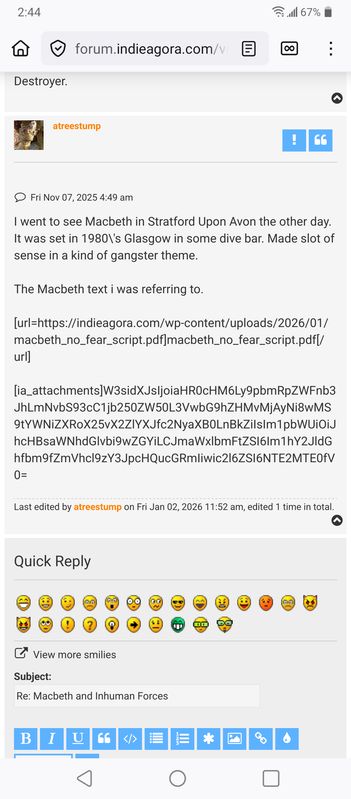
I also played Macbeth in a play where I gave a stunning performance and I relate to the character, particularly the imges of the character from a recent film starring Michael Fassbender where he has paint pr blackstreaks on his face, possibly also similar to Conan The Batbarian in Conan The Destroyer.
https://i.postimg.cc/85B1PyYk/1000142649.png
https://www.shakespearesglobe.com/learn ... e-witches/
"
Who are the Witches, or ‘Weird Sisters’?
Are they human at all, or are they simply supernatural beings? When Macbeth and Banquo first come across them on the heath they question what they are, unsure whether or not they are human:
What are these,
So wither’d and so wild in their attire,
That look not like th’inhabitants o’th’earth,
And yet are on it?
— Act I, scene 3
The Witches appear to be women, yet they have beards like men, and while they initially appear as real to Macbeth and Banquo as any other person stood before them, they soon after vanish into thin air without warning, leaving them to question their own judgement. Banquo wonders:
Were such things here, as we do speak about,
Or have we eaten on the insane root,
That takes the reason prisoner?
— Act I, scene 3
The Witches are unlike the rest of the plays characters, and in fact the more we see of them, the more we begin to notice the distinctions that set them apart from everyone else. As well as being distinguished from the other characters in their appearance and in the things Banquo and Macbeth say about them, they are also set apart from everyone else in the way that they speak. Most of Shakespeare’s verse is written in lines of 10 or 11 syllables and not rhyming: ‘What bloody man is that? He can report…’ (Act I, scene 2). This is called ‘iambic pentameter’ (see the language section for more exploration) and it is the way that most of the characters in Macbeth speak for the majority of the play. The way the Witches speak however is very different:
When shall we three meet again?
In thunder, lightning, or in rain?
— Act I, scene 1
It only has 7 or 8 syllables and is much more rhythmic than much of the play’s speech; it therefore stands out against the dialogue of the other characters. Even before they interact with anyone therefore, the Witches are marked out by their speech as being unusual, unnatural or abnormal.
Many people in 1606, when the play was first performed, believed that witches were real, and carrying out dark magic in Britain. One of those people was King James, who saw a performance of Macbeth in that year. For James and others, the Witches in the play would have definitely been evil, and even accessories to the murders which Macbeth commits. This presents a problem, because the Witches are not punished at the end of the play – they simply disappear. This means that there is a base of evil in the play which goes unpunished. But what if the Witches aren’t evil? If they just tell Macbeth the future, and leave him to decide how to approach it, how can they be blamed for his actions? But if the future is already planned out, whether Macbeth tries to change it or not, then how can he be guilty? What the Witches do, then, is prompt us to question our free will.
"
https://www.folger.edu/explore/shakespe ... /read/4/1/
"
Music. The Witches dance and vanish.
"
https://en.wikipedia.org/wiki/Three_Witches
https://ailishsinclair.com/2025/09/macb ... e-witches/
https://readingmedievalbooks.wordpress. ... the-other/
"
Jeanne de Montbaston
October 20, 2014 at 1:52 pm
Oh, I wish I’d heard that! It sounds fascinating.
There were hints of sexual deviance in here too (other than cat-arse fetishes, that is), but I needed to see the exhibition again to make sense of what I think there. In terms of masculinities, it relates in to romances about Saracen/black giants, doesn’t it?
I am fascinated by the intersections – and how transferrable all of these tropes are.
"
https://www.essence.com/culture/black-witches-feature/
https://thedevilsdavenport.wordpress.co ... rn-europe/
"
Black Magic: Race in the European Witch Trials
Moving backward from Imani Perry’s exploration of the European witch trials in Vexy Thing, I trace the cultural work of race and gender that the word “black” does throughout the age of witch trials, from the 1324 trial of Alice Kyteler, which charged that she had intercourse with an incubus disguised as a “Black man” or aethiopis, up to the seventeenth-century Salem witch trials and Tituba’s “black dogge.” Building on Cord Whitaker’s “shimmering philology” of raced language in Black Metaphors, I explore medieval beliefs about folk magic, which formed the evidentiary basis for the witch trials. I argue that discourse around magic participated in the structures that created, sustained, and extended patriarchy, as well as white supremacy.
"
https://www.collectionscanada.ca/obj/s4 ... Q59709.pdf
https://livrepository.liverpool.ac.uk/3 ... 0_2_08.pdf
https://ia801504.us.archive.org/20/item ... d_text.pdf
"
dgmstraka
•
2y ago
Yes, I first heard this allegation in Ethiopia: The Unknown Revolution by Raúl Valdés Vivó, in which the author recounts a story that a Cuban-Ethiopian woman who had lived in the country for some time recounted first hand of working at a school in a predominantly Muslim area. It’s an extremely sinister story—Vivo even compares it to a scene in The Exorcist, which had just come out a few months before the Ethiopian Revolution began.
The book is outstanding—it’s basically 10 Days That Shook the World but for the events of 1974. While I found Vivo’s presentation of the allegation believable and found corroborating evidence of a fascination with the occult that Haile Selassie developed later in life, it just doesn’t take much for me to believe that the ruling class—whether in feudal Ethiopia, 1973, or on Little St. James Island in the very recent past—can and does commit heinous, monstrous acts of abuse for self-gratification. When people say, “He would never do that…”, it just sounds pretty naive.
Here’s the bone-chilling excerpt worthy of True Detective Season 1:
“A unique Cuban woman lives in Addis Ababa, at Kebele 08-0312, number 845. Rogelia Emiliana Leon (ID number 12) had a Congolese grandfather and is how an Ethiopian citizen. She was born and brought up in Guanabacoa but emigrated to Ethiopia in 1952 after marrying a young Ethiopian who had been taken to Cuba to study there, by a Cuban veterinarian named Barreras. Nobody quite knows when or how Barreras began to work on the Emperor’s stud farm, The young man’s father had foreseen the war of 1935 when Mussolini attacked Ethiopia and had persuaded his friend Barreras to take his son back to Cuba with him and have him trained as a rural teacher.
The wedding—they are now divorced—took place in Guanabacoa. In Addis Ababa, Rogelia learned Amharic and became Ethiopian by dint of destiny, but she didn't forget the socialist ideas her parents had taught her when she was a little girl. She told me a story that seems to have come out of a film like The Exorcist:
“I remember as if it were today, the day the principal of the school where I worked as a cleaning woman brought in 12 little Black girls, blacker than I, blacker than all the Ethiopians I have known in 25 years. They were so black you could hardly see their hair. This race lives on the Sudan border. It is a strong race. The girls were strong, too, and beautiful. Their ears hadn’t been pierced, because they were Muslims, not Christians. When I saw them arrive, I thought they had been sent to school to be educated, to learn Amharic, since they spoke a dialect. I imagined that they would someday become the mistresses of some figure at the Court—maybe of the Emperor himself, who knows? But one day the principal told me the truth. Every year in December two of them were taken to the palace for the Emperor’s birthday. Not this palace, the one in Bishoust, some 60 kilometers from here. The Debre-Sait Palace. Those two would never come back. When they left the school, all perfumed, they looked so pretty in their white dresses! When they got to the palace they were sacrificed, and their blood was cast into the palace lake. Then, alone, the Emperor bathed naked in that water and drank of it. Then he allowed the servants and other people who were around to plunge into the lake. The girls were so naive that when they saw the portrait of the Emperor with the “three Selassies”—what’s it called? The Holy Trinity! The Emperor was the fourth saint or something like that—they bowed and said “Father.” This went on for five consecutive years, each December. I don’t know what they told the ones who remained in the school; possibly they had the girls believe that the others had returned to their hamlets. When there were only two left, the principal couldn’t stand it any long- er, and she decided to save Debritu, the heavier girl who was very intelligent, and the other, whose name I’ve forgotten, who was even prettier, and slim. In mid ’73, or ’72, she had their ears pierced, as if they had been baptized. This way they were of no use for the blood bath. And as far as I know, no one said anything, because the Coptic religion was so strong that even the Crown respected it... A year ago I found out that Debritu had finished the twelfth grade and the other, the ninth... As for the blood bath, well, the explanation was that the Devil lived in the lake, and he wanted the Emperor to grow old and frail. To appease him, they had to give him Muslim blood, the blood of that pure, innocent race. I don’t know... But I do know that the Emperor came to the throne through murder. The Queen was married to Yasu, a prince. Haile Selassie wanted to be king. He poisoned the prince at a dinner and married the widow. They say she was already pregnant and that that explains why the Emperor despised his eldest son, who wasn’t his, and preferred Makonnen, his second son, who died in an accident though its also said that he was killed by a jealous pilot. I worked also as a cleaning woman in the hospital at night, to earn more money. They didn’t let the doctor or anybody see the corpse.
I know many stories like this. The Emperor was a terrible man, a real monster.””
1
u/backerhedman avatar
backerhedman
•
2y ago
LIES
2
Other_Feature5250
OP •
2y ago
Hello and thank you for your response. What an incredible story. I almost believed it until I read up on the author :
Valdes Vivo - Valdés Vivo devoted his entire life to the cause of the Cuban Revolution and to the dissemination of progressive and revolutionary ideas, said Jorge Risquet, member of the Central Committee of the Communist Party of Cuba…
"
u/backerhedman avatar
backerhedman
•
2y ago
I'ts complicated - Hints: Jungian Achetypes (Archetypal Synchronistic Resonance), His League of Nations address, Spiritual battle against fascism, Christological pedigree, He was a "seer" (possessed precognitive ability) for the good
"
https://en.wikipedia.org/wiki/Hill_people
"
The Isaurians were brought partially under control (76–75 BC) by the Romans. During the war of the Cilician and other pirates against Rome, the Isaurians took so active a part that the proconsul P. Servilius deemed it necessary to follow them into their rugged strongholds, and compel the whole people to submission, an exploit for which he received the title of Isauricus (75 BC).[1]
"
https://www.theoi.com/Gallery/P23.9.html
https://en.wikipedia.org/wiki/Gorgons
Added in 23 minutes 29 seconds:
https://www.theoi.com/Pontios/Phorkys.html
https://en.wikipedia.org/wiki/Phorcys
https://en.wikipedia.org/wiki/Phorcys_(son_of_Phaenops)
https://en.wikipedia.org/wiki/Furcas
https://en.wikipedia.org/wiki/Foras
"
His name seems to derive from Latin foras, lit. 'out, outside'.
"
https://artmusela.substack.com/p/the-fa ... orgons-and
https://en.wikipedia.org/wiki/Medusa
https://en.wikipedia.org/wiki/Stheno_and_Euryale
"
In Greek mythology, Stheno (/ˈsθiːnoʊ, ˈsθɛnoʊ/; Ancient Greek: Σθενώ, romanized: Sthenṓ, lit. 'forceful')[2] and Euryale (/jʊəˈraɪəli/ yuu-RY-ə-lee; Ancient Greek: Εὐρυάλη, romanized: Euryálē, lit. 'far-roaming')[3] were two of the three sister Gorgons, the third being Medusa, who were able to turn anyone who looked at them to stone.[4] When Perseus beheaded Medusa, the two Gorgons pursued him but were unable to catch him.
"
https://forgottenrealms.fandom.com/wiki/Hourglass_Coven
Added in 7 minutes 51 seconds:
https://myshakespeare.com/macbeth/act-2 ... new-gorgon
https://journals.openedition.org/shakes ... 71?lang=en
"
The title of Thomas Andrew’s 1604 poem The Unmasking of a Feminine Machiavel encapsulates some of the anxieties which women inspired in the early modern period.1 Claiming that a woman will be unmasked, that her true identity will be revealed in the poem, the title shows that women were first regarded as duplicitous creatures, who successfully hid their evil nature beneath their comely appearances.2 Then, calling this woman a “Feminine Machiavel,” the poet suggests that the immoral manipulations which the Italian philosopher prescribed in The Prince (1532) are transposed from the realm of politics into the sphere of love and, therefore, that it is in her romantic and sexual interactions with men that this woman proves particularly deceitful and dangerous.3
4 Thomas Andrew, op. cit., Sig. C4v.
5 For more information on these female hybrids in classical myths, see Pierre Grimal, Dictionnaire de (...)
6 In “Woman as Other: Medusa and Basilisk in Early Modern French Literature”, Nancy M. Frelick thus e (...)
7 Abraham Fraunce’s The third part of the Countesse of Pembrokes Yuychurch Entituled, Amintas dale pr (...)
8 Laetitia Sansonetti, “Représentations du désir dans la poésie narrative élisabéthaine [Venus and Ad (...)
9 In “Représentations du désir dans la poésie narrative élisabéthaine”, Laetitia Sansonetti showed ho (...)
10 Geffrey Whitney, A Choice of Emblemes, and other Devises, For the Moste parte gathered out of sundr (...)
2Intimated in the title, the evil of the “Feminine Machiavel,” and more generally of women, is then obsessively stressed throughout the poem thanks to the enumeration of references to women renowned for their wickedness such as the incestuous Myrrha who tricked her father into her own bed or the bewitching Calypso who detained Odysseus on her island for several years.4 The hybrid silhouettes of mermaids, the half-fish half-woman creatures, of Scylla, the nymph with barking dogs’ heads around her hips, and of Medusa, a Gorgon whose head is crowned with writhing serpents, also appear among the female figures this poem borrows from classical antiquity to draw a dreadful portrait of femininity. That the three creatures should be conjured up for that same purpose can come as a surprise given the diversity and unique significance of the mythological contexts in which they emerged.5 And yet, despite these notable differences, the early modern period often used all three creatures to serve the same metaphorical ends: highlight men’s perilous and troubled relationships with women. Thus, fusing beautiful and alluring human parts with repelling animal bodies, their hybrid shapes often laid bare the contradictory emotions of both attraction and disgust which women could inspire.6 What’s more, their mythological characterisation as dangerous female figures may explain why they were often turned into epitomes of the threats women supposedly posed. The literal petrification which Gorgons’ lethal gazes caused in classical myths thus became a metaphorical representation of the perilous stasis in which a man could lose himself if he became too engrossed in the contemplation of a woman’s beauty and too absorbed by the promise of bodily pleasures that it bore.7 Mermaids also stressed this risk of abandoning oneself to idleness, as Laetitia Sansonetti showed in her analysis of Guyon’s encounter with such creatures in Spenser’s The Faerie Queene: “Les Sirènes […] sont dangereuses non seulement parce qu’elles menacent de détourner Guyon du droit chemin, mais aussi et surtout parce qu’elles l’invitent à arrêter sa course et à sombrer dans la paresse.”8 Disclosing, like Gorgons, the risk of indulging in the idleness of romantic and sexual relationships with women, mermaids’ seductive power nevertheless relied not on sight like the other mythological hybrids but on hearing. This specificity, which originated from the classical myths in which they appeared,9 led to the emergence of a singular metaphorical use for mermaids as they were recurrently conjured up to highlight the dangers that lie behind women’s enchanting but dishonest vows. In the conclusion to his chapter on “Sirens,” Geffrey Whitney thus warns his male readership that: “Such Mermaids live, that promise only joys: / But he that yields, at length himself destroys.”10
3While Gorgons and mermaids stressed the dangers of letting oneself be seduced by a woman’s beauty or words, Scylla denoted lust as is shown by the following passage from George Sandys’s 1632 Ovid’s Metamorphoses, Englished, Mythologiz’d, and Represented in Figures:
11 George Sandys, Ovid’s Metamorphoses, Englished, Mythologiz’d, and Represented in Figures, ed. Karl (...)
Scylla represents a Virgin; who […] once polluted with the sorceries of Circe, that is, having rendred her maiden honour to bee deflowred by bewitching pleasure, she is transformed into an horrid monster. And not so only, but endeavours to shipwracke others (such is the envy of infamous women) upon those ruining rocks, and make them share in the same calamities.11
12 It is worth noting that another Scylla, who betrayed her father because of her love for Minos, also (...)
13 This connection drawn between the female sexual organ and Scylla’s monstrous dogs’ heads clearly ap (...)
Here, Scylla’s monstrous transformation dramatizes the physical and moral corruption caused by women’s lust. Not only does the virgin see her body irrevocably blemished because of her licentiousness, but she also imperils the morality of the men that she tries to seduce.12 Scylla’s monstrous dogs’ heads also sustained this metaphorical association of the hybrid with women’s lust as, suggestively sprouting from her hips, they portrayed female genitals as a ravenous, never satisfied organ, always seeking to devour men’s flesh.13
4Keeping men in idleness, deceiving them with flattering words and promises or trying to corrupt them to sate their boundless sexual appetites, women were therefore depicted as particularly dangerous creatures when they took on the shapes of these three hybrids.
14 This appears even more surprising considering the paucity of instances in which they appear as male (...)
5In the light of this metaphorical use, it can come as a surprise that Scylla, a mermaid and a Gorgon should be used to respectively describe Shylock, Angelo and Antony, the three male protagonists of Shakespeare’s The Merchant of Venice, Antony and Cleopatra and Measure for Measure.14 While paying attention to the specificities of each play and of each of the male characters under study, this paper will show how this innovative treatment of the female hybrids, unusually associated with men, blurs the early modern distinctions between women and men and thus lays bare the precariousness of the male/female categories.
"
Added in 12 minutes 33 seconds:
"
When the messenger brings her news of Antony’s wedding, the Egyptian queen tells him: “Thou shouldst come like a fury crowned with snakes, / Not like a formal man” (2.5.41-42). While Antony’s male-to-female transvestism was pleasant and even sexually arousing to Cleopatra, the feminine attributes which the Egyptian queen invites the male messenger to put on are now monstrous and threatening as they belong to the mythological furies. Like the other female hybrids that the early modern period inherited from classical antiquity, furies appear as particularly dreadful creatures. Described as the goddesses of vengeance, they relentlessly torment their victims whom they eventually drive mad. Ending humans’ lives tragically, the terror which furies inspire also derives from their dreadful hybrid bodies: winged, furies are often “crowned with snakes,” a representation which Cleopatra takes up here.42
24The association of these monstrous female hybrids with the male messenger flags an important change: the blurring of the gender divide which Cleopatra sexually enjoyed is progressively turning into a source of anxiety as men start conjuring up nightmarish representations of femininity. This shift is confirmed as Antony takes the terrifying shape of yet another female hybrid later in this scene. As she is about to leave the stage, Cleopatra indeed reckons that: “Though [Antony] be painted one way like a Gorgon, / The other way’s a Mars” (2.5.117-118).
43 See for instance Palamon’s words to Arcite in The Two Noble Kinsmen: “I have seen you move in such (...)
25Yet again, the destabilisation of the male/female categories appears perilous here as Cleopatra’s femininized lover is now associated with the dangerous figure of Gorgons, the classical monsters with writhing snakes on their heads and petrifying gazes who – as mentioned earlier – were recurrently conjured up to warn men of the dangers they exposed themselves to if they interacted with women. Because of this dangerous femininity associated with Antony, the mention of the Roman god of war appears as the queen’s attempt to reassert her lover’s gender at a time when manhood was often built and asserted through the display of bravery and strength on the battlefield.43 But even this paragon of virility cannot quite crush Antony’s femininity. Describing her lover from two distinct points of view, each revealing a different picture as in an anamorphic painting, Cleopatra points out that Antony’s virile appearance is only a matter of perspective. Though hidden, a monstrous Gorgon always lurks beneath the outward look of a Mars.
26Thus, the dread which Antony inspires in Cleopatra is voiced thanks to his being associated with a monstrous female hybrid. Casting a dark light on gender ambiguity, the nightmarish images of femininity that the Roman inspires in his lover also surface in this scene in the comparison of Egypt with a “cistern for scaled snakes” (2.5.96), which Cleopatra conjures up in her mad jealousy. This comparison indeed echoes Othello’s grim description of Desdemona’s womb, when he believes that his wife is unfaithful. Calling it a “cistern for foul toads / To knot and gender in” (4.2.60-61), the Venetian general turns the organ into a closed space where amphibians monstrously proliferate as a way to express his anxious lack of control over his wife’s sexuality. Echoing Othello’s distressing depiction, Cleopatra’s vision of Egypt as a “cistern for scaled snakes” also destabilises the gender and species divide as in her mad rage she conjures up, yet again, a monstrous representation of women’s sexuality, borrowed this time from an earlier Shakespearean tragedy.
"
https://en.wikipedia.org/wiki/Scylla
https://en.wikipedia.org/wiki/Charybdis
Added in 39 minutes 49 seconds:
"
Eldritch monsters are often based around sea creatures and have many tentacles. What would be your twist to this theme?
I'm not saying that creatures from the deep sea based on squids, fish or marine creatures are bad. I just think that most of the time, they feel stale and are straight-up copies from some Lovecraft story, not much originality goes there.
Some examples that come to mind are Blasphemous or Elden Ring, while their "lovecraftian" theme is rather subtle, they are based around trees, sap, and bark, very different than the usual norm.
Even Bloodborne with its famous use of lovecraftian inspiration has a nice spin to it with the beasts. And Darkest Dungeon's main monstrosities are much more "formless hateful flesh" than based on some specific creature.
But it's usually hard to find good resources for stuff that is "out of the norm".
What do you think would be an interesting take on the "monstrosities beyond our understanding"? I particularly would love to develop more of my insect eldtrich-horrors.
"
"
Why would the Elder Gods resemble sea creatures?
I get that the terrestrial ones, such as Dagon and C'thulhu might, and Nyarlathotep would also use such a form as and when, but why would the ones which live in space, Azatoth and such?
To be honest, I would imagine that they would more resemble microbes and whatnot, adapted to survive in the zero gravity, zero atmosphere of Space.
What do you chaps think?
"
https://starwars.fandom.com/wiki/Abeloth
https://forgottenrealms.fandom.com/wiki/Aboleth
https://en.wikipedia.org/wiki/Abyss_(religion)
https://en.wikipedia.org/wiki/Abyss_(Thelema)
https://en.wikipedia.org/wiki/Escutcheo ... ry)#Points
"
Abyss, in heraldry, the exact middle of an escutcheon
"
https://gods-and-demons.fandom.com/wiki/Abyss
https://en.wikipedia.org/wiki/Abzu
"
Abzû or Apsû (Sumerian: 𒀊𒍪 abzû; Akkadian: 𒀊𒍪 apsû), also called Engar (Cuneiform:𒇉, LAGAB×HAL; Sumerian: engar; Akkadian: engurru – lit. ab = 'water' zû = 'deep', recorded in Greek as Ἀπασών Apasṓn[1]), is the name for fresh water from underground aquifers which was given a religious fertilising quality in ancient near eastern cosmology, including Sumerian and Akkadian mythology. It was believed that all lakes, springs, rivers, fountains, rain, and even the Flood, as described in Atrahasis, originated from the Abzû. In Mesopotamian cosmogony, it is referred to as the freshwater primordial ocean below and above the earth; indeed the Earth itself was regarded as a goddess Ninhursag that was conceived from the mating of male Abzu with female saltwater ocean Tiamat. Thus the divine Mother Earth – on her surface equipped with a bubble of breathable air – was surrounded by Abzû, and her interior harbours the realm of the dead (Irkalla).
"
https://www.etymonline.com/word/abyss
"
abyss(n.)
late 14c. in Latin form abyssus, "depths of the earth or sea; primordial chaos;" early 14c. as abime "depths of the earth or sea; bottomless pit, Hell" (via Old French; see abysm). Both are from Late Latin abyssus "bottomless pit," from Greek abyssos (limnē) "bottomless (pool)," from abyssos "bottomless, unfathomed," hence, generally, "enormous, unfathomable," also as a noun, he abyssos "the great depth, the underworld, the bottomless pit." This is a compound of a- "without" (see a- (3)) + byssos "bottom," a word of uncertain origin possibly related to bathos "depth" [Liddell & Scott]. Watkins suggests a connection with the root of bottom (n.); Beekes suggests it is pre-Greek.
The current form in English is a 16c. partial re-Latinization. Greek abyssos was used in Septuagint to translate Hebrew tehom "original chaos" and was used in the New Testament for "Hell." OED notes, "the word has had five variants, abime, abysm, abysmus, abyssus, abyss; of which abyss remains as the ordinary form, and abysm as archaic or poetic." In reference to a seemingly bottomless gulf from 1630s. Old English glossed Latin abyssum with deagenesse, which is related to deagol "secret, hidden; dark, obscure."
"
https://www.etymonline.com/word/abysm
"
abysm(n.)
"bottomless gulf, greatest depths," c. 1300, from Old French abisme "chasm, abyss, depths of ocean, Hell" (12c., Modern French abîme), from Vulgar Latin *abyssimus (source also of Spanish and Portuguese abismo), which represents perhaps a superlative of Latin abyssus or a formation on analogy of Greek-derived words in -ismus; see abyss. It survived only as a poetic variant of abyss; as late as early 17c. it was pronounced to rhyme with time.
"
https://www.etymonline.com/word/abysmal
"
abysmal(adj.)
1650s, "pertaining to an abyss," formed in English from abysm + -al (1). Perhaps only a dictionary word before 19c. The weakened sense of "extremely bad" is attested by 1904, perhaps from abysmal ignorance (suggestive of its "depth"), an expression attested from 1847. Related: Abysmally.
"
https://en.wikipedia.org/wiki/Cosmic_ocean
https://biologos.org/articles/deep-spac ... -of-heaven
https://en.wikipedia.org/wiki/Ancient_N ... _cosmology
"
a primordial cosmic ocean. When the firmament is created, it separates the cosmic ocean into two bodies of water:
the heavenly upper waters located on top of the firmament, which act as a source of rain
the lower waters that the earth is above and that the earth rests on; they act as the source of rivers, springs, and other earthly bodies of water
the region above the upper waters, namely the abode of the gods
the netherworld, the furthest region in the direction downwards, below the lower waters
"
"
the Chaoskampf motif: a cosmic battle between the protagonist and a primordial sea monster
"
"
The firmament was believed to be a solid boundary above the Earth, separating it from the upper or celestial waters. In the Book of Genesis, it is called the raqia.[48][49] In ancient Egyptian texts, and from texts across the Near East generally, the firmament was described as having special doors or gateways on the eastern and western horizons to allow for the passage of heavenly bodies during their daily journeys. These were known as the windows of heaven or the gates of heaven.[50][51] Canaanite text describe Baal as exerting his control over the world by controlling the passage of rainwater through the heavenly windows in the firmament.[52] In Egyptian texts particularly, these gates also served as conduits between the earthly and heavenly realms for which righteous people could ascend. The gateways could be blocked by gates to prevent entry by the deceased as well. As such, funerary texts included prayers enlisting the help of the gods to enable the safe ascent of the dead.[53] Ascent to the celestial realm could also be done by a celestial ladder made by the gods.[54] Multiple stories exist in Mesopotamian texts whereby certain figures ascend to the celestial realm and are given the secrets of the gods.[55]
Four different Egyptian models of the firmament and/or the heavenly realm are known. One model was that it was the shape of a bird: the firmament above represented the underside of a flying falcon, with the sun and moon representing its eyes, and its flapping causing the wind that humans experience.[56] The second was a cow, as per the Book of the Heavenly Cow. The cosmos is a giant celestial cow represented by the goddess Nut or Hathor. The cow consumed the sun in the evening and rebirthed it in the next morning.[57] The third is a celestial woman, also represented by Nut. The heavenly bodies would travel across her body from east to west. The midriff of Nut was supported by Shu (the air god) and Geb (the earth god) lay outstretched between the arms and feet of Nut. Nut consumes the celestial bodies from the west and gives birth to them again in the following morning. The stars are inscribed across the belly of Nut and one needs to identify with one of them, or a constellation, in order to join them after death.[58] The fourth model was a flat (or slightly convex) celestial plane which, depending on the text, was thought to be supported in various ways: by pillars, staves, scepters, or mountains at the extreme ends of the Earth. The four supports give rise to the motif of the "four corners of the world".[59]
"
https://en.wikipedia.org/wiki/Firmament
"
In biblical cosmology, the firmament rāqīaʿ was the vast solid dome created by God during the Genesis creation narrative to separate the primal sea into upper and lower portions so that the dry land could appear.[2][3]
"
https://en.wikipedia.org/wiki/Tehom
"
Tehom (Hebrew: תְּהוֹם təhôm) is a Northwest Semitic and Biblical Hebrew word meaning "the deep" or "abyss" (literally "the deeps").[1] It is used to describe the primeval ocean and the post-creation waters of the earth. It is a cognate of the Akkadian words tiāmtum and tâmtum as well as Ugaritic t-h-m which have similar meanings.[2] According to a theological dictionary, tehom derives from a Semitic root which denoted the sea as a non-personified entity with mythological import.[3]
"
https://www.wisdomlib.org/christianity/ ... n/gomorrah
"
But Genesis 13 probably means only that Lot, seeing the Jordan N. of the Dead Sea, and knowing the whole valley N. and S. to be well watered, chose it. Moreover, the catastrophes palpable to sight all round the southern end imply that the Jordan once flowed to the S. of that sea. Gomorrah means submersion; Arabic ghamara, to "overwhelm with water." Gomorrah was one of the five cities of the vale of Siddim whose forces were routed by Chedorlaomer, until Abram helped them. Zoar or Bela alone of the five, at Lot's request, escaped destruction by the fire from the Lord. Jerusalem when corrupted (for "the corruption of the best is the worst of all corruptions") is termed Sodom and her people Gomer (Isaiah 1:9-10); as the church apostate corrupted is termed "Babylon" (Revelation 17).
"
https://en.wikipedia.org/wiki/Therapsida
https://en.wikipedia.org/wiki/Phorcys_(therapsid)
"
Phorcys was also unexpectedly large for an early gorgonopsian with a total skull length estimated at ~30 cm (12 in), comparable to in size to later gorgonopsians and notably larger than the similarly aged Eriphostoma with skull lengths of only ~10–15 cm (3.9–5.9 in). This contradicts prior suggestions that gorgonopsians only achieved larger sizes, and associated top predator status, following the extinction of dinocephalians and large therocephalian therapsids in the Late Permian. Indeed, Phorcys was comparable in size to a contemporary specimen of a scylacosaurid therocephalian with a skull estimated to be ~21 centimetres (8.3 in) long, and even to the slightly older anteosaur Australosyodon (skull length ~26 cm (10 in)). Phorcys and other gorgonopsians may then have been top predators in some Middle Permian assemblages.
"
https://en.wikipedia.org/wiki/Gorgonopsia
https://bayonetta.fandom.com/wiki/Gomorrah
https://ultra.fandom.com/wiki/Gomora
https://wikizilla.org/wiki/Gamera
https://en.wikipedia.org/wiki/Gamera
"
Gamera is depicted as a giant, flying, fire-breathing, prehistoric turtle. In the series' first film, Gamera is portrayed as an aggressive and destructive monster, though he also saved a child's life. As the films progressed, Gamera took on a more benevolent role, becoming a protector of humanity, especially children, nature, and the Earth from extraterrestrial races and other giant monsters.[10]
The Gamera franchise has been (both directly and indirectly) very influential in Japan and internationally.[9][11] This is seen notably in the productions of the Daimajin and Yokai Monsters film franchises and influences on the entire tokusatsu genre, including the Godzilla franchise, and the domestic television industry.[9][7] The franchise directly and indirectly contributed in starting of two influential social phenomena (the two "Kaiju Booms" (jp)(jp) and their successor "Yōkai / Kaiki Boom"), and Gamera and Daimajin franchises were part of the "Kaiju Booms".[12] Gamera and Daimajin and other related characters have been referenced and used in various topics, such as the naming of prehistoric turtles (Sinemys gamera (jp) and Gamerabaena), an algorithm to study plasma bubbles,[13] and many others. 27 November is publicly referred as "Gamera Day" (Japanese: ガメラの日, Hepburn: Gamera no Hi) in Japan,[14][15] and Gamera and related characters are used as mascots by the city of Chōfu.[16]
Despite its popularity and influence, expansion of the franchise and public recognition of the character[17][18] were severely hindered by Daiei Film and its successors' (Tokuma Shoten[note 1][note 2] and Kadokawa Corporation) precarious financial conditions,[9][21] facing repeated copyright transfers of Daiei properties, failed global expansions despite featuring foreign casts,[21] diminished media attentions,[9] and cancellations of various projects escalated by controversial aspects of the highly acclaimed Heisei trilogy, and the competition against the Godzilla franchise.[22] On the other hand, both franchises bear connections in productions and distributions, and there have been failed attempts to produce a direct crossover.[7][23][24]
Despite being a major film studio and Masaichi Nagata being a highly influential figure,[note 3] Daiei Film was facing a dire fiscal condition and was suffering internal and external factors, including the decline of the film industry itself (even including Toho and its Godzilla franchise) from the competition against the rising television industry,[25][11] which was boosted by the 1964 Summer Olympics, a recession, and the aforementioned "Kaiju Booms" most notably Ultra Q and Ultraman where Nagata's attempt to save the film industry resulted in the governmental supports for kaiju and tokusatsu productions, and the booms were ironically shaped.[26][24][27] Consequently, the original Gamera film became a black-and-white film.[note 4]
Daiei Film's situation improved thanks to the Gamera franchise, which solely supported the company and its subcontractors until Daiei's bankruptcy in December 1971, about four months after the theatrical release of Gamera vs. Zigra.[7][21][25] On the other hand, not only budgets, schedules, ideas,[note 5] and (both physical and human) resources, but also labor conditions continuously declined and impoverished remaining employees,[note 6] leading to deteriorations of the franchise, and to deaths of the actor Taro Marui [ja][note 7] and a staff of Gamera vs. Jiger (1970).[7][29][12] A riot, losses of various materials and expertises, and disputes over the legal rights of the franchise (and Niisan Takahashi's isolation from all stakeholders) were evoked as the company was officially declared bankrupt, triggering further issues on subsequent situations by Tokuma Shoten.[28][30]
"
https://en.wikipedia.org/wiki/Daimajin
https://en.wikipedia.org/wiki/Yokai_Mon ... ok_Warfare
https://megamitensei.fandom.com/wiki/Gomorrah
https://villains.fandom.com/wiki/Gomorrahites
I'm always into the oft-neglected secondary.
https://en.wikipedia.org/wiki/Numeira
https://en.wikipedia.org/wiki/Wadi_Numeira
https://en.wikipedia.org/wiki/Bab_edh-Dhra
but a node through which inhuman forces pass — the will of the Outside, using him as a conduit for its own mutation.
"
Wow, this is so much like what I was going to write about these days, starting a few days or weeks ago, right around when my phone got messed up. I'm so glad that the themes still seem to make their way through here even when I'm not as available, which is also like this theme itself, since it is fnnding its way through here whether it is through me or you for now, which is pretty amazing. This also has to do with the idea of the game I mentioned, as well as how I believe things may really work, albeit less exaggerated, but not all that much less in some cases.
Added in 2 minutes 5 seconds:
I also played Macbeth in a play where I gave a stunning performance and I relate to the character, particularly the imges of the character from a recent film starring Michael Fassbender where he has paint pr blackstreaks on his face, possibly also similar to Conan The Batbarian in Conan The Destroyer.
https://i.postimg.cc/85B1PyYk/1000142649.png
https://www.shakespearesglobe.com/learn ... e-witches/
"
Who are the Witches, or ‘Weird Sisters’?
Are they human at all, or are they simply supernatural beings? When Macbeth and Banquo first come across them on the heath they question what they are, unsure whether or not they are human:
What are these,
So wither’d and so wild in their attire,
That look not like th’inhabitants o’th’earth,
And yet are on it?
— Act I, scene 3
The Witches appear to be women, yet they have beards like men, and while they initially appear as real to Macbeth and Banquo as any other person stood before them, they soon after vanish into thin air without warning, leaving them to question their own judgement. Banquo wonders:
Were such things here, as we do speak about,
Or have we eaten on the insane root,
That takes the reason prisoner?
— Act I, scene 3
The Witches are unlike the rest of the plays characters, and in fact the more we see of them, the more we begin to notice the distinctions that set them apart from everyone else. As well as being distinguished from the other characters in their appearance and in the things Banquo and Macbeth say about them, they are also set apart from everyone else in the way that they speak. Most of Shakespeare’s verse is written in lines of 10 or 11 syllables and not rhyming: ‘What bloody man is that? He can report…’ (Act I, scene 2). This is called ‘iambic pentameter’ (see the language section for more exploration) and it is the way that most of the characters in Macbeth speak for the majority of the play. The way the Witches speak however is very different:
When shall we three meet again?
In thunder, lightning, or in rain?
— Act I, scene 1
It only has 7 or 8 syllables and is much more rhythmic than much of the play’s speech; it therefore stands out against the dialogue of the other characters. Even before they interact with anyone therefore, the Witches are marked out by their speech as being unusual, unnatural or abnormal.
Many people in 1606, when the play was first performed, believed that witches were real, and carrying out dark magic in Britain. One of those people was King James, who saw a performance of Macbeth in that year. For James and others, the Witches in the play would have definitely been evil, and even accessories to the murders which Macbeth commits. This presents a problem, because the Witches are not punished at the end of the play – they simply disappear. This means that there is a base of evil in the play which goes unpunished. But what if the Witches aren’t evil? If they just tell Macbeth the future, and leave him to decide how to approach it, how can they be blamed for his actions? But if the future is already planned out, whether Macbeth tries to change it or not, then how can he be guilty? What the Witches do, then, is prompt us to question our free will.
"
https://www.folger.edu/explore/shakespe ... /read/4/1/
"
Music. The Witches dance and vanish.
"
https://en.wikipedia.org/wiki/Three_Witches
https://ailishsinclair.com/2025/09/macb ... e-witches/
https://readingmedievalbooks.wordpress. ... the-other/
"
Jeanne de Montbaston
October 20, 2014 at 1:52 pm
Oh, I wish I’d heard that! It sounds fascinating.
There were hints of sexual deviance in here too (other than cat-arse fetishes, that is), but I needed to see the exhibition again to make sense of what I think there. In terms of masculinities, it relates in to romances about Saracen/black giants, doesn’t it?
I am fascinated by the intersections – and how transferrable all of these tropes are.
"
https://www.essence.com/culture/black-witches-feature/
https://thedevilsdavenport.wordpress.co ... rn-europe/
"
Black Magic: Race in the European Witch Trials
Moving backward from Imani Perry’s exploration of the European witch trials in Vexy Thing, I trace the cultural work of race and gender that the word “black” does throughout the age of witch trials, from the 1324 trial of Alice Kyteler, which charged that she had intercourse with an incubus disguised as a “Black man” or aethiopis, up to the seventeenth-century Salem witch trials and Tituba’s “black dogge.” Building on Cord Whitaker’s “shimmering philology” of raced language in Black Metaphors, I explore medieval beliefs about folk magic, which formed the evidentiary basis for the witch trials. I argue that discourse around magic participated in the structures that created, sustained, and extended patriarchy, as well as white supremacy.
"
https://www.collectionscanada.ca/obj/s4 ... Q59709.pdf
https://livrepository.liverpool.ac.uk/3 ... 0_2_08.pdf
https://ia801504.us.archive.org/20/item ... d_text.pdf
"
dgmstraka
•
2y ago
Yes, I first heard this allegation in Ethiopia: The Unknown Revolution by Raúl Valdés Vivó, in which the author recounts a story that a Cuban-Ethiopian woman who had lived in the country for some time recounted first hand of working at a school in a predominantly Muslim area. It’s an extremely sinister story—Vivo even compares it to a scene in The Exorcist, which had just come out a few months before the Ethiopian Revolution began.
The book is outstanding—it’s basically 10 Days That Shook the World but for the events of 1974. While I found Vivo’s presentation of the allegation believable and found corroborating evidence of a fascination with the occult that Haile Selassie developed later in life, it just doesn’t take much for me to believe that the ruling class—whether in feudal Ethiopia, 1973, or on Little St. James Island in the very recent past—can and does commit heinous, monstrous acts of abuse for self-gratification. When people say, “He would never do that…”, it just sounds pretty naive.
Here’s the bone-chilling excerpt worthy of True Detective Season 1:
“A unique Cuban woman lives in Addis Ababa, at Kebele 08-0312, number 845. Rogelia Emiliana Leon (ID number 12) had a Congolese grandfather and is how an Ethiopian citizen. She was born and brought up in Guanabacoa but emigrated to Ethiopia in 1952 after marrying a young Ethiopian who had been taken to Cuba to study there, by a Cuban veterinarian named Barreras. Nobody quite knows when or how Barreras began to work on the Emperor’s stud farm, The young man’s father had foreseen the war of 1935 when Mussolini attacked Ethiopia and had persuaded his friend Barreras to take his son back to Cuba with him and have him trained as a rural teacher.
The wedding—they are now divorced—took place in Guanabacoa. In Addis Ababa, Rogelia learned Amharic and became Ethiopian by dint of destiny, but she didn't forget the socialist ideas her parents had taught her when she was a little girl. She told me a story that seems to have come out of a film like The Exorcist:
“I remember as if it were today, the day the principal of the school where I worked as a cleaning woman brought in 12 little Black girls, blacker than I, blacker than all the Ethiopians I have known in 25 years. They were so black you could hardly see their hair. This race lives on the Sudan border. It is a strong race. The girls were strong, too, and beautiful. Their ears hadn’t been pierced, because they were Muslims, not Christians. When I saw them arrive, I thought they had been sent to school to be educated, to learn Amharic, since they spoke a dialect. I imagined that they would someday become the mistresses of some figure at the Court—maybe of the Emperor himself, who knows? But one day the principal told me the truth. Every year in December two of them were taken to the palace for the Emperor’s birthday. Not this palace, the one in Bishoust, some 60 kilometers from here. The Debre-Sait Palace. Those two would never come back. When they left the school, all perfumed, they looked so pretty in their white dresses! When they got to the palace they were sacrificed, and their blood was cast into the palace lake. Then, alone, the Emperor bathed naked in that water and drank of it. Then he allowed the servants and other people who were around to plunge into the lake. The girls were so naive that when they saw the portrait of the Emperor with the “three Selassies”—what’s it called? The Holy Trinity! The Emperor was the fourth saint or something like that—they bowed and said “Father.” This went on for five consecutive years, each December. I don’t know what they told the ones who remained in the school; possibly they had the girls believe that the others had returned to their hamlets. When there were only two left, the principal couldn’t stand it any long- er, and she decided to save Debritu, the heavier girl who was very intelligent, and the other, whose name I’ve forgotten, who was even prettier, and slim. In mid ’73, or ’72, she had their ears pierced, as if they had been baptized. This way they were of no use for the blood bath. And as far as I know, no one said anything, because the Coptic religion was so strong that even the Crown respected it... A year ago I found out that Debritu had finished the twelfth grade and the other, the ninth... As for the blood bath, well, the explanation was that the Devil lived in the lake, and he wanted the Emperor to grow old and frail. To appease him, they had to give him Muslim blood, the blood of that pure, innocent race. I don’t know... But I do know that the Emperor came to the throne through murder. The Queen was married to Yasu, a prince. Haile Selassie wanted to be king. He poisoned the prince at a dinner and married the widow. They say she was already pregnant and that that explains why the Emperor despised his eldest son, who wasn’t his, and preferred Makonnen, his second son, who died in an accident though its also said that he was killed by a jealous pilot. I worked also as a cleaning woman in the hospital at night, to earn more money. They didn’t let the doctor or anybody see the corpse.
I know many stories like this. The Emperor was a terrible man, a real monster.””
1
u/backerhedman avatar
backerhedman
•
2y ago
LIES
2
Other_Feature5250
OP •
2y ago
Hello and thank you for your response. What an incredible story. I almost believed it until I read up on the author :
Valdes Vivo - Valdés Vivo devoted his entire life to the cause of the Cuban Revolution and to the dissemination of progressive and revolutionary ideas, said Jorge Risquet, member of the Central Committee of the Communist Party of Cuba…
"
u/backerhedman avatar
backerhedman
•
2y ago
I'ts complicated - Hints: Jungian Achetypes (Archetypal Synchronistic Resonance), His League of Nations address, Spiritual battle against fascism, Christological pedigree, He was a "seer" (possessed precognitive ability) for the good
"
https://en.wikipedia.org/wiki/Hill_people
"
The Isaurians were brought partially under control (76–75 BC) by the Romans. During the war of the Cilician and other pirates against Rome, the Isaurians took so active a part that the proconsul P. Servilius deemed it necessary to follow them into their rugged strongholds, and compel the whole people to submission, an exploit for which he received the title of Isauricus (75 BC).[1]
"
https://www.theoi.com/Gallery/P23.9.html
https://en.wikipedia.org/wiki/Gorgons
Added in 23 minutes 29 seconds:
https://www.theoi.com/Pontios/Phorkys.html
https://en.wikipedia.org/wiki/Phorcys
https://en.wikipedia.org/wiki/Phorcys_(son_of_Phaenops)
https://en.wikipedia.org/wiki/Furcas
https://en.wikipedia.org/wiki/Foras
"
His name seems to derive from Latin foras, lit. 'out, outside'.
"
https://artmusela.substack.com/p/the-fa ... orgons-and
https://en.wikipedia.org/wiki/Medusa
https://en.wikipedia.org/wiki/Stheno_and_Euryale
"
In Greek mythology, Stheno (/ˈsθiːnoʊ, ˈsθɛnoʊ/; Ancient Greek: Σθενώ, romanized: Sthenṓ, lit. 'forceful')[2] and Euryale (/jʊəˈraɪəli/ yuu-RY-ə-lee; Ancient Greek: Εὐρυάλη, romanized: Euryálē, lit. 'far-roaming')[3] were two of the three sister Gorgons, the third being Medusa, who were able to turn anyone who looked at them to stone.[4] When Perseus beheaded Medusa, the two Gorgons pursued him but were unable to catch him.
"
https://forgottenrealms.fandom.com/wiki/Hourglass_Coven
Added in 7 minutes 51 seconds:
https://myshakespeare.com/macbeth/act-2 ... new-gorgon
https://journals.openedition.org/shakes ... 71?lang=en
"
The title of Thomas Andrew’s 1604 poem The Unmasking of a Feminine Machiavel encapsulates some of the anxieties which women inspired in the early modern period.1 Claiming that a woman will be unmasked, that her true identity will be revealed in the poem, the title shows that women were first regarded as duplicitous creatures, who successfully hid their evil nature beneath their comely appearances.2 Then, calling this woman a “Feminine Machiavel,” the poet suggests that the immoral manipulations which the Italian philosopher prescribed in The Prince (1532) are transposed from the realm of politics into the sphere of love and, therefore, that it is in her romantic and sexual interactions with men that this woman proves particularly deceitful and dangerous.3
4 Thomas Andrew, op. cit., Sig. C4v.
5 For more information on these female hybrids in classical myths, see Pierre Grimal, Dictionnaire de (...)
6 In “Woman as Other: Medusa and Basilisk in Early Modern French Literature”, Nancy M. Frelick thus e (...)
7 Abraham Fraunce’s The third part of the Countesse of Pembrokes Yuychurch Entituled, Amintas dale pr (...)
8 Laetitia Sansonetti, “Représentations du désir dans la poésie narrative élisabéthaine [Venus and Ad (...)
9 In “Représentations du désir dans la poésie narrative élisabéthaine”, Laetitia Sansonetti showed ho (...)
10 Geffrey Whitney, A Choice of Emblemes, and other Devises, For the Moste parte gathered out of sundr (...)
2Intimated in the title, the evil of the “Feminine Machiavel,” and more generally of women, is then obsessively stressed throughout the poem thanks to the enumeration of references to women renowned for their wickedness such as the incestuous Myrrha who tricked her father into her own bed or the bewitching Calypso who detained Odysseus on her island for several years.4 The hybrid silhouettes of mermaids, the half-fish half-woman creatures, of Scylla, the nymph with barking dogs’ heads around her hips, and of Medusa, a Gorgon whose head is crowned with writhing serpents, also appear among the female figures this poem borrows from classical antiquity to draw a dreadful portrait of femininity. That the three creatures should be conjured up for that same purpose can come as a surprise given the diversity and unique significance of the mythological contexts in which they emerged.5 And yet, despite these notable differences, the early modern period often used all three creatures to serve the same metaphorical ends: highlight men’s perilous and troubled relationships with women. Thus, fusing beautiful and alluring human parts with repelling animal bodies, their hybrid shapes often laid bare the contradictory emotions of both attraction and disgust which women could inspire.6 What’s more, their mythological characterisation as dangerous female figures may explain why they were often turned into epitomes of the threats women supposedly posed. The literal petrification which Gorgons’ lethal gazes caused in classical myths thus became a metaphorical representation of the perilous stasis in which a man could lose himself if he became too engrossed in the contemplation of a woman’s beauty and too absorbed by the promise of bodily pleasures that it bore.7 Mermaids also stressed this risk of abandoning oneself to idleness, as Laetitia Sansonetti showed in her analysis of Guyon’s encounter with such creatures in Spenser’s The Faerie Queene: “Les Sirènes […] sont dangereuses non seulement parce qu’elles menacent de détourner Guyon du droit chemin, mais aussi et surtout parce qu’elles l’invitent à arrêter sa course et à sombrer dans la paresse.”8 Disclosing, like Gorgons, the risk of indulging in the idleness of romantic and sexual relationships with women, mermaids’ seductive power nevertheless relied not on sight like the other mythological hybrids but on hearing. This specificity, which originated from the classical myths in which they appeared,9 led to the emergence of a singular metaphorical use for mermaids as they were recurrently conjured up to highlight the dangers that lie behind women’s enchanting but dishonest vows. In the conclusion to his chapter on “Sirens,” Geffrey Whitney thus warns his male readership that: “Such Mermaids live, that promise only joys: / But he that yields, at length himself destroys.”10
3While Gorgons and mermaids stressed the dangers of letting oneself be seduced by a woman’s beauty or words, Scylla denoted lust as is shown by the following passage from George Sandys’s 1632 Ovid’s Metamorphoses, Englished, Mythologiz’d, and Represented in Figures:
11 George Sandys, Ovid’s Metamorphoses, Englished, Mythologiz’d, and Represented in Figures, ed. Karl (...)
Scylla represents a Virgin; who […] once polluted with the sorceries of Circe, that is, having rendred her maiden honour to bee deflowred by bewitching pleasure, she is transformed into an horrid monster. And not so only, but endeavours to shipwracke others (such is the envy of infamous women) upon those ruining rocks, and make them share in the same calamities.11
12 It is worth noting that another Scylla, who betrayed her father because of her love for Minos, also (...)
13 This connection drawn between the female sexual organ and Scylla’s monstrous dogs’ heads clearly ap (...)
Here, Scylla’s monstrous transformation dramatizes the physical and moral corruption caused by women’s lust. Not only does the virgin see her body irrevocably blemished because of her licentiousness, but she also imperils the morality of the men that she tries to seduce.12 Scylla’s monstrous dogs’ heads also sustained this metaphorical association of the hybrid with women’s lust as, suggestively sprouting from her hips, they portrayed female genitals as a ravenous, never satisfied organ, always seeking to devour men’s flesh.13
4Keeping men in idleness, deceiving them with flattering words and promises or trying to corrupt them to sate their boundless sexual appetites, women were therefore depicted as particularly dangerous creatures when they took on the shapes of these three hybrids.
14 This appears even more surprising considering the paucity of instances in which they appear as male (...)
5In the light of this metaphorical use, it can come as a surprise that Scylla, a mermaid and a Gorgon should be used to respectively describe Shylock, Angelo and Antony, the three male protagonists of Shakespeare’s The Merchant of Venice, Antony and Cleopatra and Measure for Measure.14 While paying attention to the specificities of each play and of each of the male characters under study, this paper will show how this innovative treatment of the female hybrids, unusually associated with men, blurs the early modern distinctions between women and men and thus lays bare the precariousness of the male/female categories.
"
Added in 12 minutes 33 seconds:
"
When the messenger brings her news of Antony’s wedding, the Egyptian queen tells him: “Thou shouldst come like a fury crowned with snakes, / Not like a formal man” (2.5.41-42). While Antony’s male-to-female transvestism was pleasant and even sexually arousing to Cleopatra, the feminine attributes which the Egyptian queen invites the male messenger to put on are now monstrous and threatening as they belong to the mythological furies. Like the other female hybrids that the early modern period inherited from classical antiquity, furies appear as particularly dreadful creatures. Described as the goddesses of vengeance, they relentlessly torment their victims whom they eventually drive mad. Ending humans’ lives tragically, the terror which furies inspire also derives from their dreadful hybrid bodies: winged, furies are often “crowned with snakes,” a representation which Cleopatra takes up here.42
24The association of these monstrous female hybrids with the male messenger flags an important change: the blurring of the gender divide which Cleopatra sexually enjoyed is progressively turning into a source of anxiety as men start conjuring up nightmarish representations of femininity. This shift is confirmed as Antony takes the terrifying shape of yet another female hybrid later in this scene. As she is about to leave the stage, Cleopatra indeed reckons that: “Though [Antony] be painted one way like a Gorgon, / The other way’s a Mars” (2.5.117-118).
43 See for instance Palamon’s words to Arcite in The Two Noble Kinsmen: “I have seen you move in such (...)
25Yet again, the destabilisation of the male/female categories appears perilous here as Cleopatra’s femininized lover is now associated with the dangerous figure of Gorgons, the classical monsters with writhing snakes on their heads and petrifying gazes who – as mentioned earlier – were recurrently conjured up to warn men of the dangers they exposed themselves to if they interacted with women. Because of this dangerous femininity associated with Antony, the mention of the Roman god of war appears as the queen’s attempt to reassert her lover’s gender at a time when manhood was often built and asserted through the display of bravery and strength on the battlefield.43 But even this paragon of virility cannot quite crush Antony’s femininity. Describing her lover from two distinct points of view, each revealing a different picture as in an anamorphic painting, Cleopatra points out that Antony’s virile appearance is only a matter of perspective. Though hidden, a monstrous Gorgon always lurks beneath the outward look of a Mars.
26Thus, the dread which Antony inspires in Cleopatra is voiced thanks to his being associated with a monstrous female hybrid. Casting a dark light on gender ambiguity, the nightmarish images of femininity that the Roman inspires in his lover also surface in this scene in the comparison of Egypt with a “cistern for scaled snakes” (2.5.96), which Cleopatra conjures up in her mad jealousy. This comparison indeed echoes Othello’s grim description of Desdemona’s womb, when he believes that his wife is unfaithful. Calling it a “cistern for foul toads / To knot and gender in” (4.2.60-61), the Venetian general turns the organ into a closed space where amphibians monstrously proliferate as a way to express his anxious lack of control over his wife’s sexuality. Echoing Othello’s distressing depiction, Cleopatra’s vision of Egypt as a “cistern for scaled snakes” also destabilises the gender and species divide as in her mad rage she conjures up, yet again, a monstrous representation of women’s sexuality, borrowed this time from an earlier Shakespearean tragedy.
"
https://en.wikipedia.org/wiki/Scylla
https://en.wikipedia.org/wiki/Charybdis
Added in 39 minutes 49 seconds:
"
Eldritch monsters are often based around sea creatures and have many tentacles. What would be your twist to this theme?
I'm not saying that creatures from the deep sea based on squids, fish or marine creatures are bad. I just think that most of the time, they feel stale and are straight-up copies from some Lovecraft story, not much originality goes there.
Some examples that come to mind are Blasphemous or Elden Ring, while their "lovecraftian" theme is rather subtle, they are based around trees, sap, and bark, very different than the usual norm.
Even Bloodborne with its famous use of lovecraftian inspiration has a nice spin to it with the beasts. And Darkest Dungeon's main monstrosities are much more "formless hateful flesh" than based on some specific creature.
But it's usually hard to find good resources for stuff that is "out of the norm".
What do you think would be an interesting take on the "monstrosities beyond our understanding"? I particularly would love to develop more of my insect eldtrich-horrors.
"
"
Why would the Elder Gods resemble sea creatures?
I get that the terrestrial ones, such as Dagon and C'thulhu might, and Nyarlathotep would also use such a form as and when, but why would the ones which live in space, Azatoth and such?
To be honest, I would imagine that they would more resemble microbes and whatnot, adapted to survive in the zero gravity, zero atmosphere of Space.
What do you chaps think?
"
https://starwars.fandom.com/wiki/Abeloth
https://forgottenrealms.fandom.com/wiki/Aboleth
https://en.wikipedia.org/wiki/Abyss_(religion)
https://en.wikipedia.org/wiki/Abyss_(Thelema)
https://en.wikipedia.org/wiki/Escutcheo ... ry)#Points
"
Abyss, in heraldry, the exact middle of an escutcheon
"
https://gods-and-demons.fandom.com/wiki/Abyss
https://en.wikipedia.org/wiki/Abzu
"
Abzû or Apsû (Sumerian: 𒀊𒍪 abzû; Akkadian: 𒀊𒍪 apsû), also called Engar (Cuneiform:𒇉, LAGAB×HAL; Sumerian: engar; Akkadian: engurru – lit. ab = 'water' zû = 'deep', recorded in Greek as Ἀπασών Apasṓn[1]), is the name for fresh water from underground aquifers which was given a religious fertilising quality in ancient near eastern cosmology, including Sumerian and Akkadian mythology. It was believed that all lakes, springs, rivers, fountains, rain, and even the Flood, as described in Atrahasis, originated from the Abzû. In Mesopotamian cosmogony, it is referred to as the freshwater primordial ocean below and above the earth; indeed the Earth itself was regarded as a goddess Ninhursag that was conceived from the mating of male Abzu with female saltwater ocean Tiamat. Thus the divine Mother Earth – on her surface equipped with a bubble of breathable air – was surrounded by Abzû, and her interior harbours the realm of the dead (Irkalla).
"
https://www.etymonline.com/word/abyss
"
abyss(n.)
late 14c. in Latin form abyssus, "depths of the earth or sea; primordial chaos;" early 14c. as abime "depths of the earth or sea; bottomless pit, Hell" (via Old French; see abysm). Both are from Late Latin abyssus "bottomless pit," from Greek abyssos (limnē) "bottomless (pool)," from abyssos "bottomless, unfathomed," hence, generally, "enormous, unfathomable," also as a noun, he abyssos "the great depth, the underworld, the bottomless pit." This is a compound of a- "without" (see a- (3)) + byssos "bottom," a word of uncertain origin possibly related to bathos "depth" [Liddell & Scott]. Watkins suggests a connection with the root of bottom (n.); Beekes suggests it is pre-Greek.
The current form in English is a 16c. partial re-Latinization. Greek abyssos was used in Septuagint to translate Hebrew tehom "original chaos" and was used in the New Testament for "Hell." OED notes, "the word has had five variants, abime, abysm, abysmus, abyssus, abyss; of which abyss remains as the ordinary form, and abysm as archaic or poetic." In reference to a seemingly bottomless gulf from 1630s. Old English glossed Latin abyssum with deagenesse, which is related to deagol "secret, hidden; dark, obscure."
"
https://www.etymonline.com/word/abysm
"
abysm(n.)
"bottomless gulf, greatest depths," c. 1300, from Old French abisme "chasm, abyss, depths of ocean, Hell" (12c., Modern French abîme), from Vulgar Latin *abyssimus (source also of Spanish and Portuguese abismo), which represents perhaps a superlative of Latin abyssus or a formation on analogy of Greek-derived words in -ismus; see abyss. It survived only as a poetic variant of abyss; as late as early 17c. it was pronounced to rhyme with time.
"
https://www.etymonline.com/word/abysmal
"
abysmal(adj.)
1650s, "pertaining to an abyss," formed in English from abysm + -al (1). Perhaps only a dictionary word before 19c. The weakened sense of "extremely bad" is attested by 1904, perhaps from abysmal ignorance (suggestive of its "depth"), an expression attested from 1847. Related: Abysmally.
"
https://en.wikipedia.org/wiki/Cosmic_ocean
https://biologos.org/articles/deep-spac ... -of-heaven
https://en.wikipedia.org/wiki/Ancient_N ... _cosmology
"
a primordial cosmic ocean. When the firmament is created, it separates the cosmic ocean into two bodies of water:
the heavenly upper waters located on top of the firmament, which act as a source of rain
the lower waters that the earth is above and that the earth rests on; they act as the source of rivers, springs, and other earthly bodies of water
the region above the upper waters, namely the abode of the gods
the netherworld, the furthest region in the direction downwards, below the lower waters
"
"
the Chaoskampf motif: a cosmic battle between the protagonist and a primordial sea monster
"
"
The firmament was believed to be a solid boundary above the Earth, separating it from the upper or celestial waters. In the Book of Genesis, it is called the raqia.[48][49] In ancient Egyptian texts, and from texts across the Near East generally, the firmament was described as having special doors or gateways on the eastern and western horizons to allow for the passage of heavenly bodies during their daily journeys. These were known as the windows of heaven or the gates of heaven.[50][51] Canaanite text describe Baal as exerting his control over the world by controlling the passage of rainwater through the heavenly windows in the firmament.[52] In Egyptian texts particularly, these gates also served as conduits between the earthly and heavenly realms for which righteous people could ascend. The gateways could be blocked by gates to prevent entry by the deceased as well. As such, funerary texts included prayers enlisting the help of the gods to enable the safe ascent of the dead.[53] Ascent to the celestial realm could also be done by a celestial ladder made by the gods.[54] Multiple stories exist in Mesopotamian texts whereby certain figures ascend to the celestial realm and are given the secrets of the gods.[55]
Four different Egyptian models of the firmament and/or the heavenly realm are known. One model was that it was the shape of a bird: the firmament above represented the underside of a flying falcon, with the sun and moon representing its eyes, and its flapping causing the wind that humans experience.[56] The second was a cow, as per the Book of the Heavenly Cow. The cosmos is a giant celestial cow represented by the goddess Nut or Hathor. The cow consumed the sun in the evening and rebirthed it in the next morning.[57] The third is a celestial woman, also represented by Nut. The heavenly bodies would travel across her body from east to west. The midriff of Nut was supported by Shu (the air god) and Geb (the earth god) lay outstretched between the arms and feet of Nut. Nut consumes the celestial bodies from the west and gives birth to them again in the following morning. The stars are inscribed across the belly of Nut and one needs to identify with one of them, or a constellation, in order to join them after death.[58] The fourth model was a flat (or slightly convex) celestial plane which, depending on the text, was thought to be supported in various ways: by pillars, staves, scepters, or mountains at the extreme ends of the Earth. The four supports give rise to the motif of the "four corners of the world".[59]
"
https://en.wikipedia.org/wiki/Firmament
"
In biblical cosmology, the firmament rāqīaʿ was the vast solid dome created by God during the Genesis creation narrative to separate the primal sea into upper and lower portions so that the dry land could appear.[2][3]
"
https://en.wikipedia.org/wiki/Tehom
"
Tehom (Hebrew: תְּהוֹם təhôm) is a Northwest Semitic and Biblical Hebrew word meaning "the deep" or "abyss" (literally "the deeps").[1] It is used to describe the primeval ocean and the post-creation waters of the earth. It is a cognate of the Akkadian words tiāmtum and tâmtum as well as Ugaritic t-h-m which have similar meanings.[2] According to a theological dictionary, tehom derives from a Semitic root which denoted the sea as a non-personified entity with mythological import.[3]
"
https://www.wisdomlib.org/christianity/ ... n/gomorrah
"
But Genesis 13 probably means only that Lot, seeing the Jordan N. of the Dead Sea, and knowing the whole valley N. and S. to be well watered, chose it. Moreover, the catastrophes palpable to sight all round the southern end imply that the Jordan once flowed to the S. of that sea. Gomorrah means submersion; Arabic ghamara, to "overwhelm with water." Gomorrah was one of the five cities of the vale of Siddim whose forces were routed by Chedorlaomer, until Abram helped them. Zoar or Bela alone of the five, at Lot's request, escaped destruction by the fire from the Lord. Jerusalem when corrupted (for "the corruption of the best is the worst of all corruptions") is termed Sodom and her people Gomer (Isaiah 1:9-10); as the church apostate corrupted is termed "Babylon" (Revelation 17).
"
https://en.wikipedia.org/wiki/Therapsida
https://en.wikipedia.org/wiki/Phorcys_(therapsid)
"
Phorcys was also unexpectedly large for an early gorgonopsian with a total skull length estimated at ~30 cm (12 in), comparable to in size to later gorgonopsians and notably larger than the similarly aged Eriphostoma with skull lengths of only ~10–15 cm (3.9–5.9 in). This contradicts prior suggestions that gorgonopsians only achieved larger sizes, and associated top predator status, following the extinction of dinocephalians and large therocephalian therapsids in the Late Permian. Indeed, Phorcys was comparable in size to a contemporary specimen of a scylacosaurid therocephalian with a skull estimated to be ~21 centimetres (8.3 in) long, and even to the slightly older anteosaur Australosyodon (skull length ~26 cm (10 in)). Phorcys and other gorgonopsians may then have been top predators in some Middle Permian assemblages.
"
https://en.wikipedia.org/wiki/Gorgonopsia
https://bayonetta.fandom.com/wiki/Gomorrah
https://ultra.fandom.com/wiki/Gomora
https://wikizilla.org/wiki/Gamera
https://en.wikipedia.org/wiki/Gamera
"
Gamera is depicted as a giant, flying, fire-breathing, prehistoric turtle. In the series' first film, Gamera is portrayed as an aggressive and destructive monster, though he also saved a child's life. As the films progressed, Gamera took on a more benevolent role, becoming a protector of humanity, especially children, nature, and the Earth from extraterrestrial races and other giant monsters.[10]
The Gamera franchise has been (both directly and indirectly) very influential in Japan and internationally.[9][11] This is seen notably in the productions of the Daimajin and Yokai Monsters film franchises and influences on the entire tokusatsu genre, including the Godzilla franchise, and the domestic television industry.[9][7] The franchise directly and indirectly contributed in starting of two influential social phenomena (the two "Kaiju Booms" (jp)(jp) and their successor "Yōkai / Kaiki Boom"), and Gamera and Daimajin franchises were part of the "Kaiju Booms".[12] Gamera and Daimajin and other related characters have been referenced and used in various topics, such as the naming of prehistoric turtles (Sinemys gamera (jp) and Gamerabaena), an algorithm to study plasma bubbles,[13] and many others. 27 November is publicly referred as "Gamera Day" (Japanese: ガメラの日, Hepburn: Gamera no Hi) in Japan,[14][15] and Gamera and related characters are used as mascots by the city of Chōfu.[16]
Despite its popularity and influence, expansion of the franchise and public recognition of the character[17][18] were severely hindered by Daiei Film and its successors' (Tokuma Shoten[note 1][note 2] and Kadokawa Corporation) precarious financial conditions,[9][21] facing repeated copyright transfers of Daiei properties, failed global expansions despite featuring foreign casts,[21] diminished media attentions,[9] and cancellations of various projects escalated by controversial aspects of the highly acclaimed Heisei trilogy, and the competition against the Godzilla franchise.[22] On the other hand, both franchises bear connections in productions and distributions, and there have been failed attempts to produce a direct crossover.[7][23][24]
Despite being a major film studio and Masaichi Nagata being a highly influential figure,[note 3] Daiei Film was facing a dire fiscal condition and was suffering internal and external factors, including the decline of the film industry itself (even including Toho and its Godzilla franchise) from the competition against the rising television industry,[25][11] which was boosted by the 1964 Summer Olympics, a recession, and the aforementioned "Kaiju Booms" most notably Ultra Q and Ultraman where Nagata's attempt to save the film industry resulted in the governmental supports for kaiju and tokusatsu productions, and the booms were ironically shaped.[26][24][27] Consequently, the original Gamera film became a black-and-white film.[note 4]
Daiei Film's situation improved thanks to the Gamera franchise, which solely supported the company and its subcontractors until Daiei's bankruptcy in December 1971, about four months after the theatrical release of Gamera vs. Zigra.[7][21][25] On the other hand, not only budgets, schedules, ideas,[note 5] and (both physical and human) resources, but also labor conditions continuously declined and impoverished remaining employees,[note 6] leading to deteriorations of the franchise, and to deaths of the actor Taro Marui [ja][note 7] and a staff of Gamera vs. Jiger (1970).[7][29][12] A riot, losses of various materials and expertises, and disputes over the legal rights of the franchise (and Niisan Takahashi's isolation from all stakeholders) were evoked as the company was officially declared bankrupt, triggering further issues on subsequent situations by Tokuma Shoten.[28][30]
"
https://en.wikipedia.org/wiki/Daimajin
https://en.wikipedia.org/wiki/Yokai_Mon ... ok_Warfare
https://megamitensei.fandom.com/wiki/Gomorrah
https://villains.fandom.com/wiki/Gomorrahites
I'm always into the oft-neglected secondary.
https://en.wikipedia.org/wiki/Numeira
https://en.wikipedia.org/wiki/Wadi_Numeira
https://en.wikipedia.org/wiki/Bab_edh-Dhra