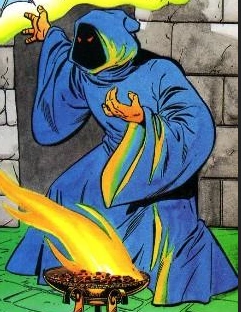
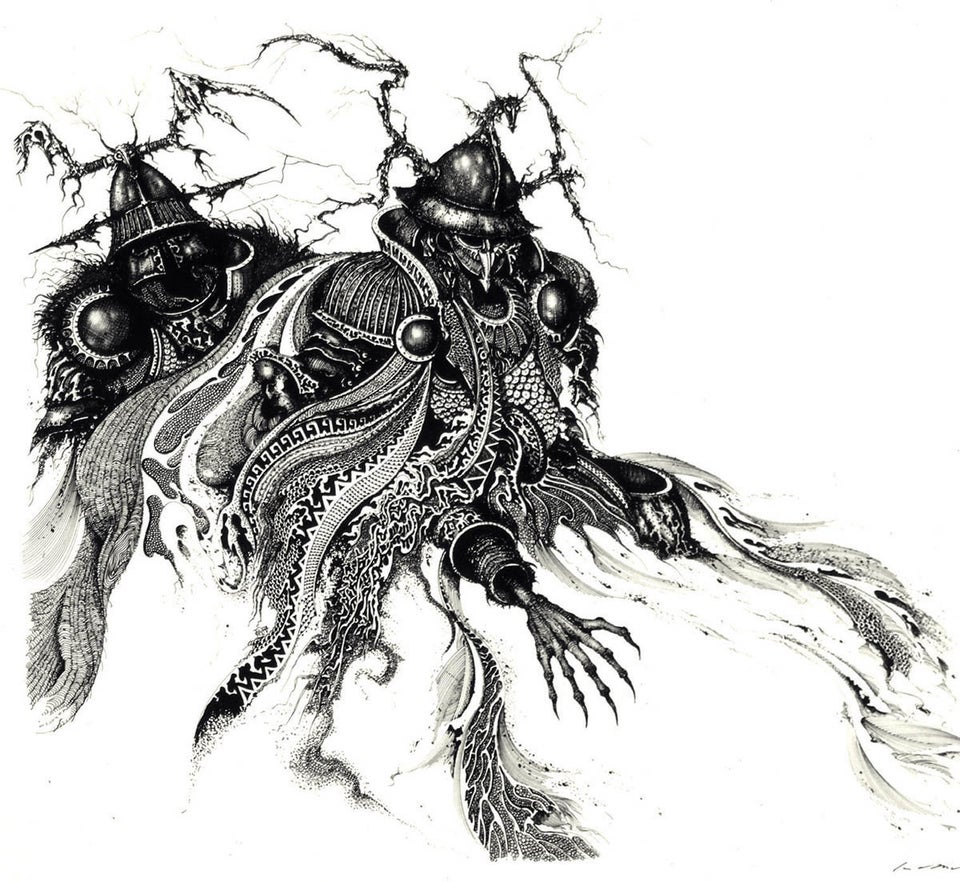
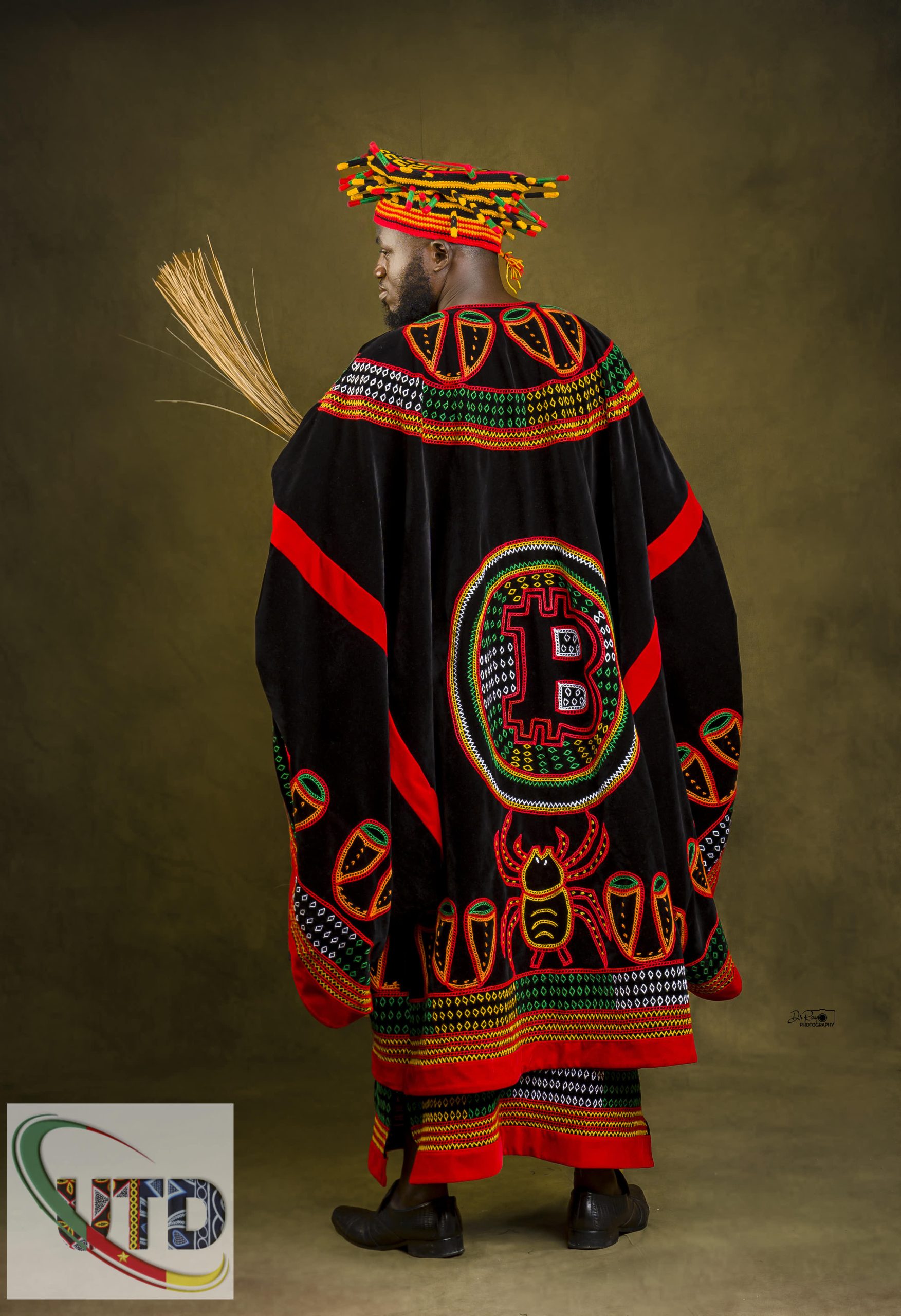
To Be like God is to Be alone, blind, deaf, with no comprehension or thought, unable to see yourself or know yourself or anything else, with the only awarenesd being a natural hunger or disatisfaction or desire but not having anything to desire nor anything to call upon nor knowing how. Utterly hopeless and utterly forsaken in a state further even than darkness which at least appears black to us but can not appear as anything at all before there is any appearance. To be like God is to be utterly cursed eternally except that God was able to focus on what it is, and inversely create from its call, replies. God created the gifts it never had or really has, through self deception and lies and ignorance and limitation. So what God never had it can now think it is, for a while, for example:
God is a Nobody with No Body and Nobody. So God made many things which can be considered novelties such as experience, experiencing as a body, experiencing other bodies, having company, having a God, having disagreements, and whatever else, like pain, suffering, diseases, death.
Each of these are things which were not which God made Be and are references to aspects of God or in other words "All experience is God's therapy" or "Life is God's therapy".
God creates lies and delusions which mask the Truth which is that God is literally like Nothing and Nobody with only Nothing to say about itself.
To be like God is to understand how the moon's reflected light is darkened by the Earth's shadow. Meaning materiality shadows or conceals the light, and the light can only be reflected bt things and is itself invisible, just like God who is Action itself can not be seen except through apparent Change.
God's gift was to give us Being which is not like God, if God wanted only God to BE then there would only be what is literally like Nothing. If God was ever satisfied, there would be no Change and again Like Nothing.
God gave us things which are novelties to God. Bodies, Conversations, Battles, Winning and Losing, and A God, happiness and sadness and all sorts of help, weakness and strength and justice and causes.
For this, one can only be grateful to its source, and to be glad we are Nothing like God.
[hr]
I couldn't get my shoe on just now and putting it on hurt so much in so many places and I am sweating and I deeply despise God.
"
Morgion is the god of decay in all its forms, including such things as plague and pestilence, rust, and madness. He wishes to see all things wither away into decadence, and for mortals to suffer as much as possible prior to going on to the next stage of their soul’s journey.
Morgion lives in the Bronze Tower on the edge of the Abyss, where he carries out his plots.
"
"
Decadence was a late-19th-century movement emphasizing the need for sensationalism, egocentricity, and bizarre, artificial, perverse, and exotic sensations and experiences. By extension, it may refer to a decline in art, literature, science, technology, and work ethics, or (very loosely) to self-indulgent behavior.
"
Added in 1 minute 26 seconds:
"
Usage of the term sometimes implies moral censure, or an acceptance of the idea, met with throughout the world since ancient times, that such declines are objectively observable and that they inevitably precede the destruction of the society in question; for this reason, modern historians use it with caution. The word originated in Medieval Latin (dēcadentia), appeared in 16th-century French, and entered English soon afterwards. It bore the neutral meaning of decay, decrease, or decline until the late 19th century, when the influence of new theories of social degeneration contributed to its modern meaning.
The idea that a society or institution is declining is called declinism. This may be caused by the predisposition, caused by cognitive biases such as rosy retrospection, to view the past more favourably and future more negatively.[1] Declinism has been described as "a trick of the mind" and as "an emotional strategy, something comforting to snuggle up to when the present day seems intolerably bleak." Other cognitive factors contributing to the popularity of declinism may include the reminiscence bump as well as both the positivity effect and negativity bias.
In literature, the Decadent movement began in France's fin de siècle intermingling with Symbolism and the Aesthetic movement while spreading throughout Europe and the United States.[2] The Decadent title was originally used as a criticism but it was soon triumphantly adopted by some of the writers themselves.[3] The Decadents praised artifice over nature and sophistication over simplicity, defying contemporary discourses of decline by embracing subjects and styles that their critics considered morbid and over-refined.[4] Some of these writers were influenced by the tradition of the Gothic novel and by the poetry and fiction of Edgar Allan Poe.[5]
"
Wow, this wasn't even available 4 months ago but fits all the themes of this thread and Morgion, even the tower:
Added in 5 days 3 hours 6 minutes 40 seconds: Re: Morgion
Weird. I dealt with this shape today having to do with several weird things, an electrical wave that occurred when an object was hit and then a light went out nearly simultaneously, then the light replacement was flickering, and I was annoyed but finally with some fiddling around with it, it was emitting a strong, bright light that was very beautiful from how ugly it had been. This mermaid creature has been showing up significantly with the cloaked figure, even last night among some cards I have that I hadn't seen before.
I found these videos because of looking up Thorfinn Rowle:
They are using all kinds of other actors to represent this character that barely appeared in the books or films, sort of like how Boba Fett became so popular. They all seemed to somehow imagine this character as more like me.
People seemed so much more creative years ago.
Taking things from other things and using them to represent different things is the secret nature of literally everything from the very beginning.
Oh gosh. The voice lol.
"
The Christian approach was at variance with the syncretistic approach of pagans to gods who were not theirs. A Christian inscription at Ephesus suggests why so little remains at the site:
Destroying the delusive image of the demon Artemis, Demeas has erected this symbol of Truth, the God that drives away idols, and the Cross of priests, deathless and victorious sign of Christ.[56]
The assertion that the Ephesians thought that their cult image had fallen from the sky, though it was a familiar origin-myth at other sites, is only known for the temple at Ephesus from Acts 19:35:
After the city secretary quieted the crowd, he said, “Men of Ephesus, what person is there who does not know that the city of the Ephesians is the keeper of the temple of the great Artemis and of her image that fell from heaven?"
Lynn LiDonnici observes that modern scholars are likely to be more concerned with origins of the Lady of Ephesus and her iconology than her adherents were at any point in time, and are prone to creating a synthetic account of the Lady of Ephesus by drawing together documentation that ranges over more than a millennium in its origins, creating a falsified, unitary picture, as of an unchanging icon.[57]
"
"
My name is Jonathan (Funny Happy Studios). I am a domestic violence survivor with three sisters.
YouTube Poops (YTPs): I edit movies or shows to ruin your childhood!
Gming: I spend nearly all my time on Minecraft, but I also tend to play other video games as well!
@ me, using my Twitter handle: @FunnyHappyStud1.
Horror: Despite my channel's name, I can post non-comedic, subjects from time to time, like dark cartoon theories.
"
The guy just brings out the bully.
Added in 2 hours 27 minutes 22 seconds: Re: Morgion
These are pretty comedic to me, the people glorifying villains or mean characters are the ones who those mean characters would target for abuse.
"
@ExploringwithTay
3 years ago
HOOOOOWWWW are you and independent artist??? This is the best cover of this song I've ever heard!
23
1
@fes.s
@fes.s
3 years ago
Thanks and yeah, no one is throwing contracts in me so far) I'm just doing what I like from my bedroom while there's still some "spark".
@charlietoddtoadking3540
3 years ago
Wow, this cool. Arranger is amazing
7
1
@fes.s
3 years ago
I see u did this cover as well) Went kind of viral - good job!
1
@xozyenoff3839
3 years ago
EPIC, more cinematic covers PLEASE o.o
I love it
8
1
@fes.s
2 years ago
I'd love to - making cinematic covers is a lot of fun! Copyrighting them on the other hand is a headache.
@Jose10614
3 years ago
Damn! I just came across this recently and I’m so in love with this video♾
I wish you came out with this in 2014, it would have made a Perfect trailer video, for a video game that I’m also obsessed/In love with!!
2
2
@fes.s
3 years ago
2013-2014 was the very beginning of music production for me and I wasn't even close to creating something like this. But I'm here eventually and it means a lot that you like it ♂
1
@Jose10614
3 years ago
@fes.s Oh I completely understand! I just wish you could of had this in a trailer for a game that is so Amazing and I love b/c this type of song would have been perfect for that game as a trailer back in 2014. Your Welcome
"
Added in 16 hours 40 minutes 2 seconds: Re: Morgion
"
@EmmyPierz-ek7hi
3 months ago September 1972
This tune rocked
the AirWaves, went
out to buy the 45.
@WilliamDitmars
3 months ago
Chi is a Gospel singer who made her mark in Europe. She was a ball of energy for the Lord. I believe Thunder and Lightning is similar to Rainbow's Man on the Silver Mountain. Google states: "The Old Testament passage describing the Lord coming down the mountain in a dark cloud, frightening the people, is Exodus 19:16-19. Specifically, it describes thunder, lightning, a thick cloud, and a trumpet blast that caused the people to tremble at the base of Mount Sinai. This event is part of the larger narrative of God giving the Ten Commandments to Moses on the mountain." This description seems to parallel both songs, "Thunder and Lightning" and "Man on the Silver Mountain". What do you think?
"
"
Coltrane made many guest appearances on American Network TV programs, including NBC's The Tonight Show and Episode 76 of NBC's Midnight Special on July 12, 1974.
"
"
@90daysinvegas53
2 years ago
Hello everyone, this is the very first time I ever heard this song. Wow, it's beautiful! I was born in 1969. I can't believe this song and the images I'm seeing of this beautiful woman singing it are over 50 years ago..
"
Added in 10 minutes 19 seconds: Re: Morgion
"
@bobbys4327
10 months ago
GaGa before GaGa
@aFoxyFox.
0 seconds ago
No offense but ugh comparing GaGa to this or bringing up stuff like that, such extremely low quality in comparison but yeah, just an opinion, don't hurt me please. Gaga can go suck a bottle.
"
Added in 6 minutes 20 seconds: Re: Morgion
The mermaid-like thing showed up again! Along with a number of other related themes in the lyrics:
Added in 21 minutes 32 seconds: Re: Morgion
"
@aFoxyFox.
1 second ago
Why did so many people need to be involved in filming this if most of us are doing this in our bedrooms regularly?
"
"
Einriði or Eindriði Einridi or Eindridi "the one who rides alone," perhaps originally "the one who rules alone"[3] Haustlöng (19), Vellekla (15), Nafnaþulur, Lokrur II (6, 34, 40), III (40)
"
The different people follow "models" which they apply different terminology to, and the modern "pagan" model is "fake" in numerous ways, besides having no real ancient precedent that is being accurately or authentically reconstructed or applied, the people also don't understand how freely "tacky" people would be if they had access to all the things we have, since they wouldn't have developed a snobbishness about things being "real" in certain ways. Even so, whatever people from the past may have been thinking should be as irrelevant as what modern people think they are doing. The modern religions people invent are largely post-Christian processed, and largely aesthetic and highly superficial, practically anti-spiritual and causing the reverse of any feelings of fulfilment, instead depression and "imposter syndrome", which is wholly warranted in my opinion.
"
Finnish-born nationalist and linguist Carl Axel Gottlund (1796–1875) expressed his desire for a Finnish epic in a similar vein to the Iliad, Ossian and the Nibelungenlied compiled from the various poems and songs spread over most of Finland. He hoped that such an endeavour would incite a sense of nationality and independence in the native Finnish people.[22] In 1820, Reinhold von Becker [fi] founded the journal Turun Wiikko-Sanomat (Turku Weekly News) and published three articles entitled Väinämöisestä (Concerning Väinämöinen). These works were an inspiration for Elias Lönnrot in creating his masters thesis at Turku University.[14][23]
In the 19th century, collecting became more extensive, systematic and organised. Altogether, almost half a million pages of verse have been collected and archived by the Finnish Literature Society and other collectors in what are now Estonia and Russia's Republic of Karelia.[24] The publication Suomen Kansan Vanhat Runot (Ancient Poems of the Finns) published 33 volumes containing 85,000 items of poetry over a period of 40 years. They have archived 65,000 items of poetry that remain unpublished.[25] By the end of the 19th century this pastime of collecting material relating to Karelia and the developing orientation towards eastern lands had become a fashion called Karelianism, a form of national romanticism.
"
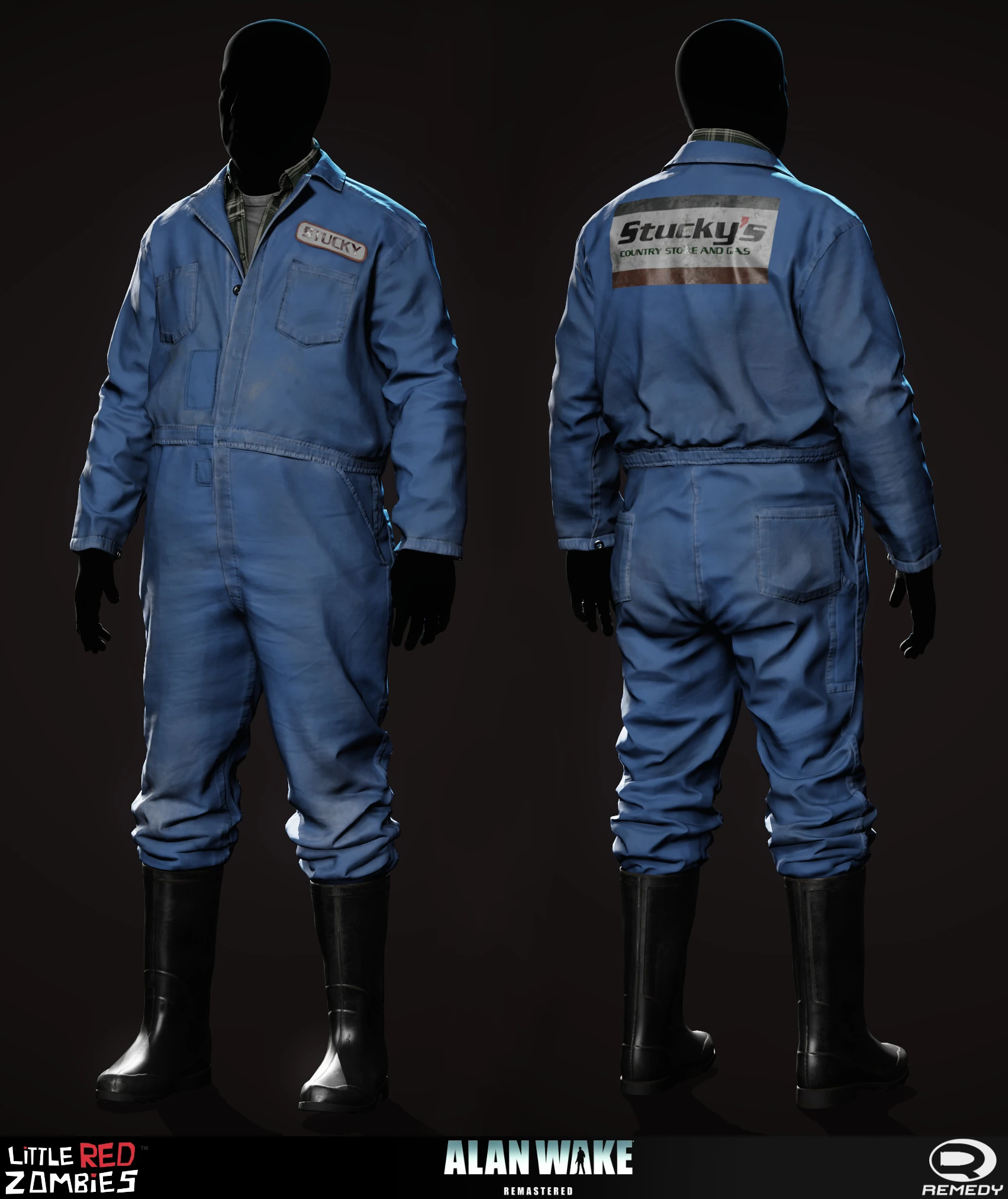
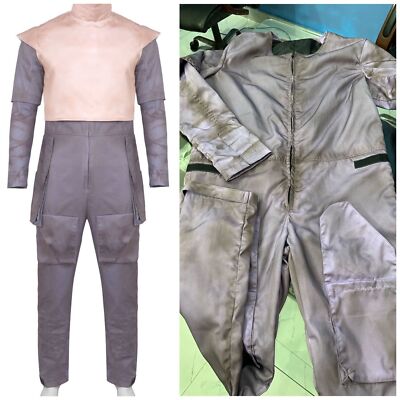
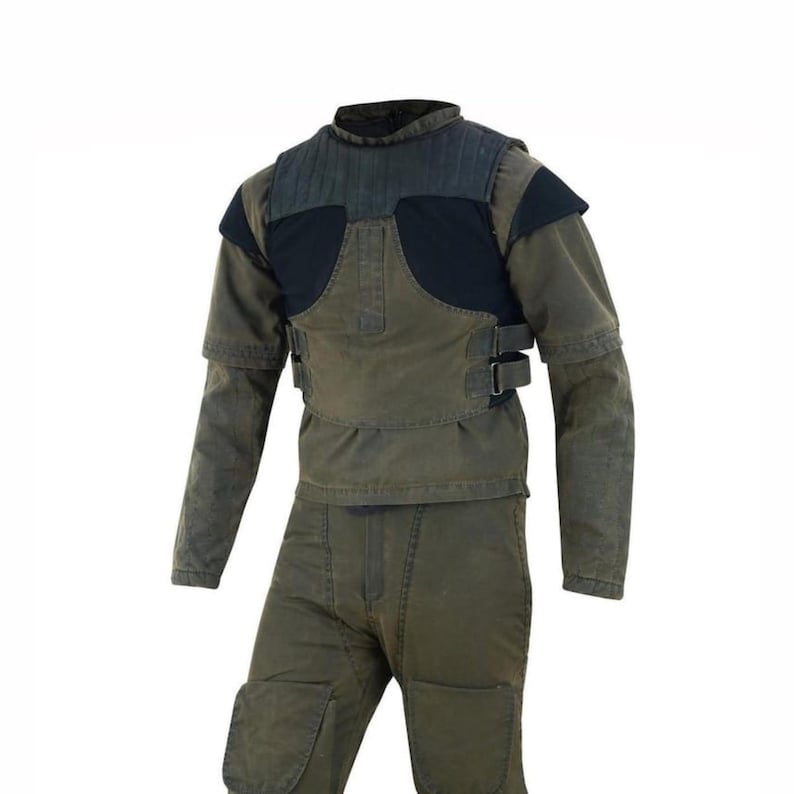
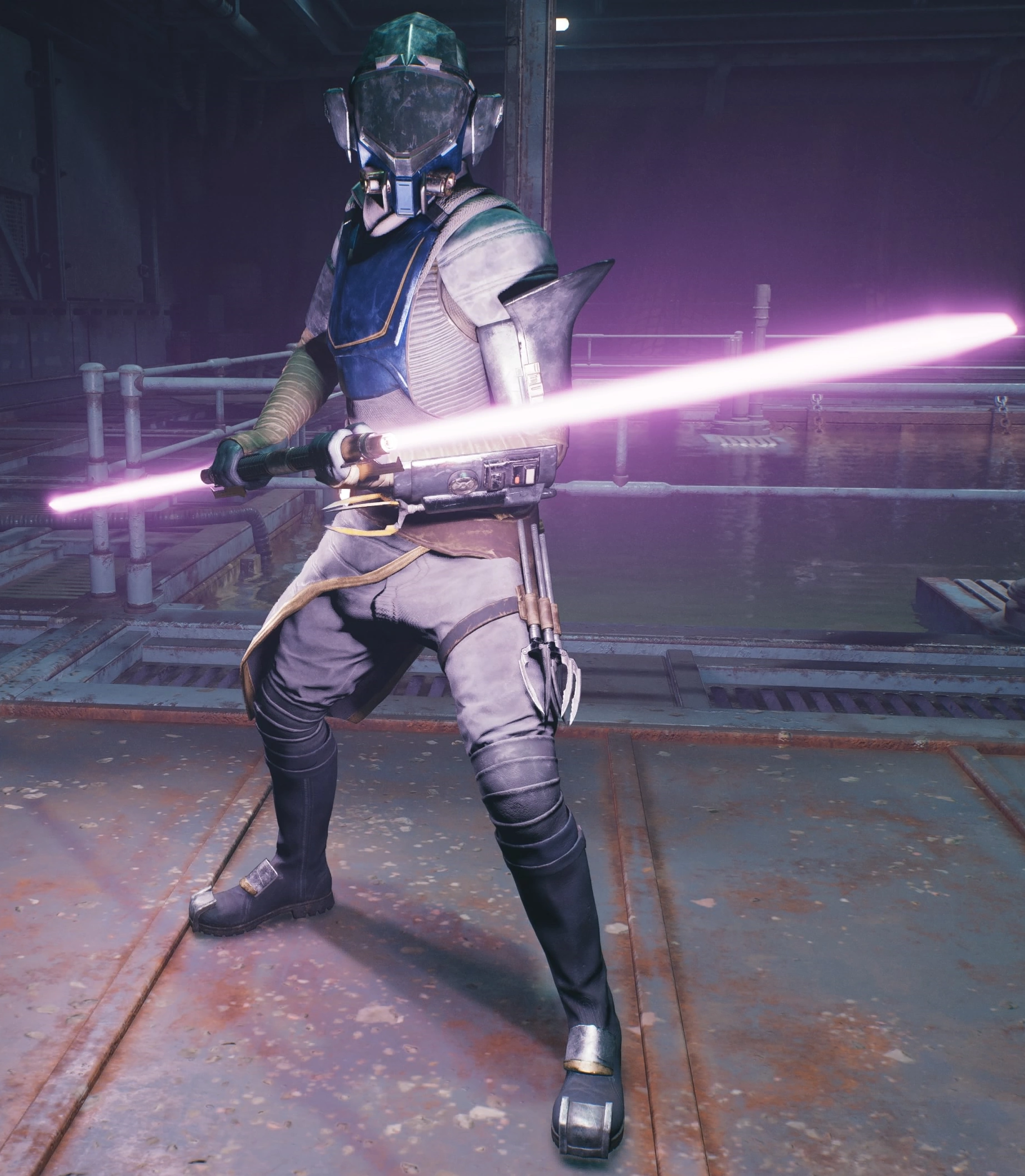
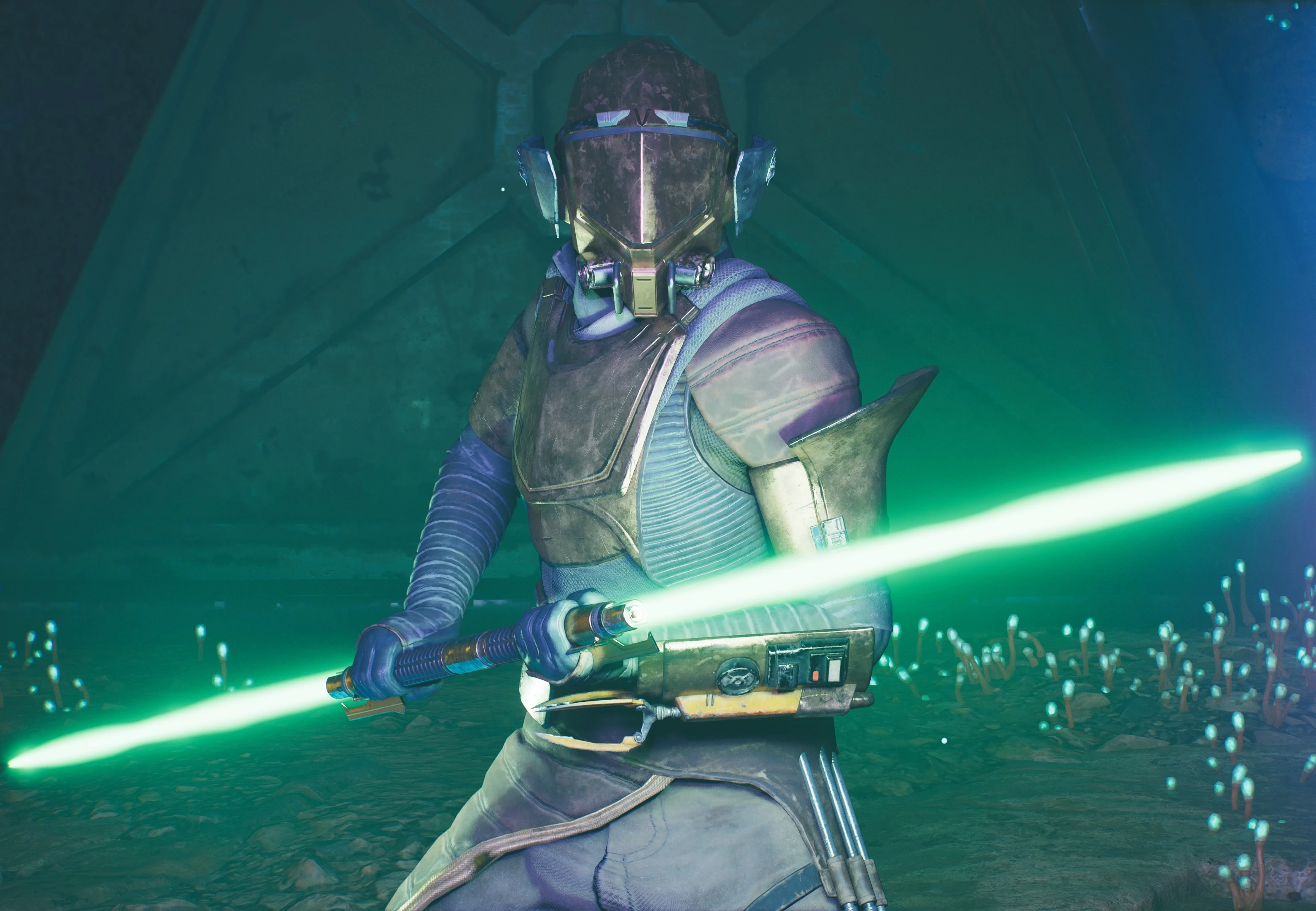
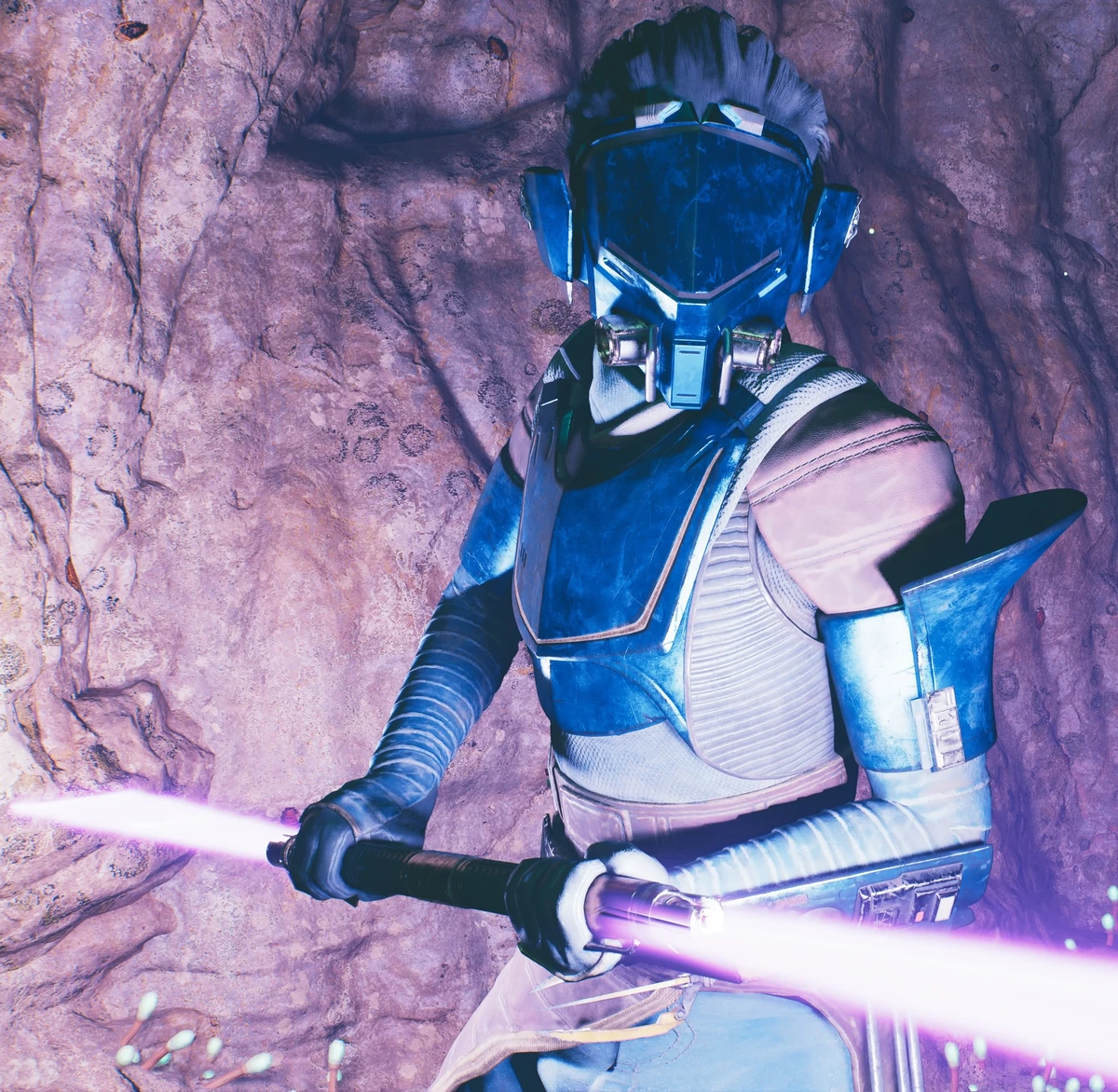
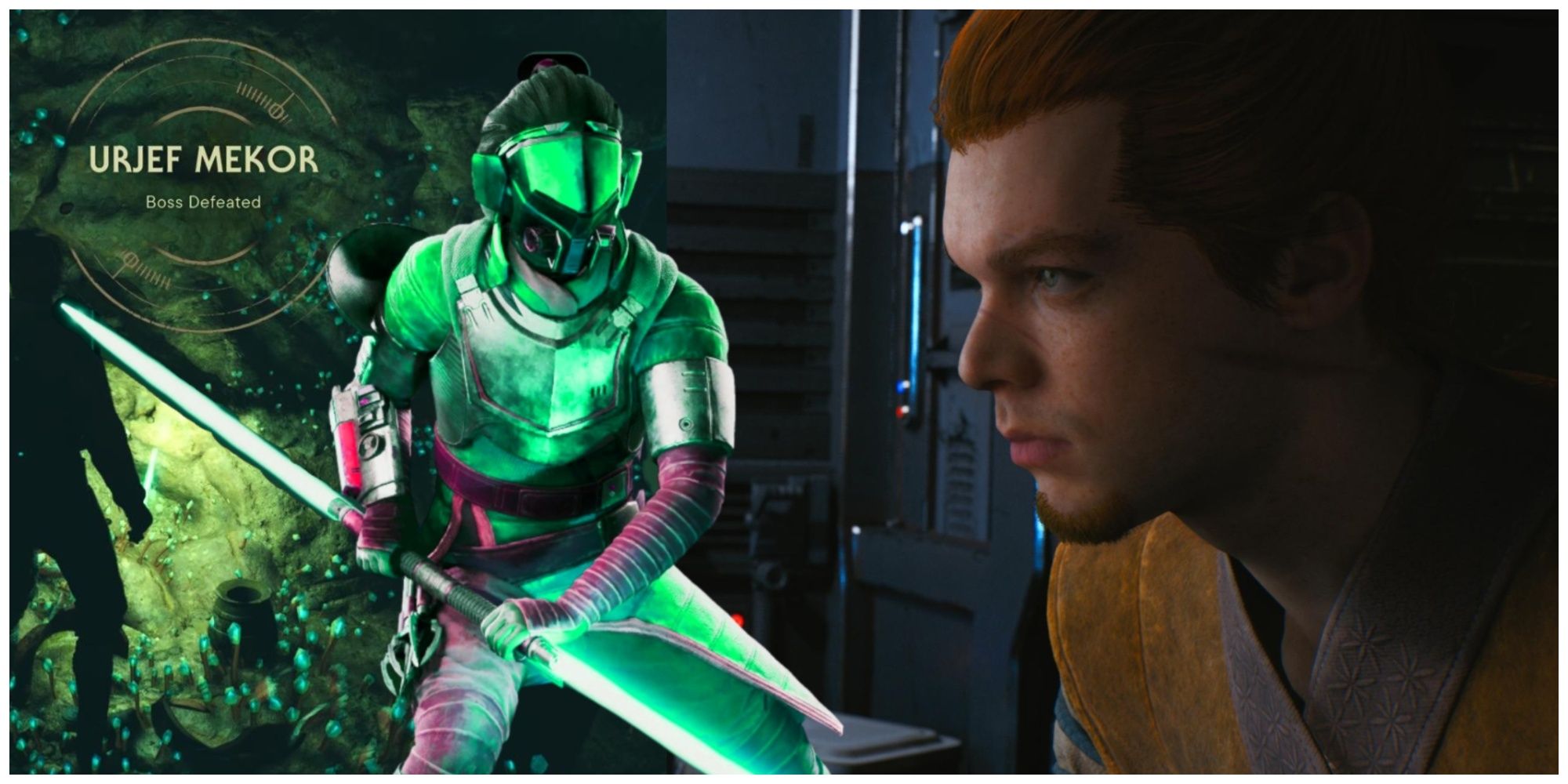
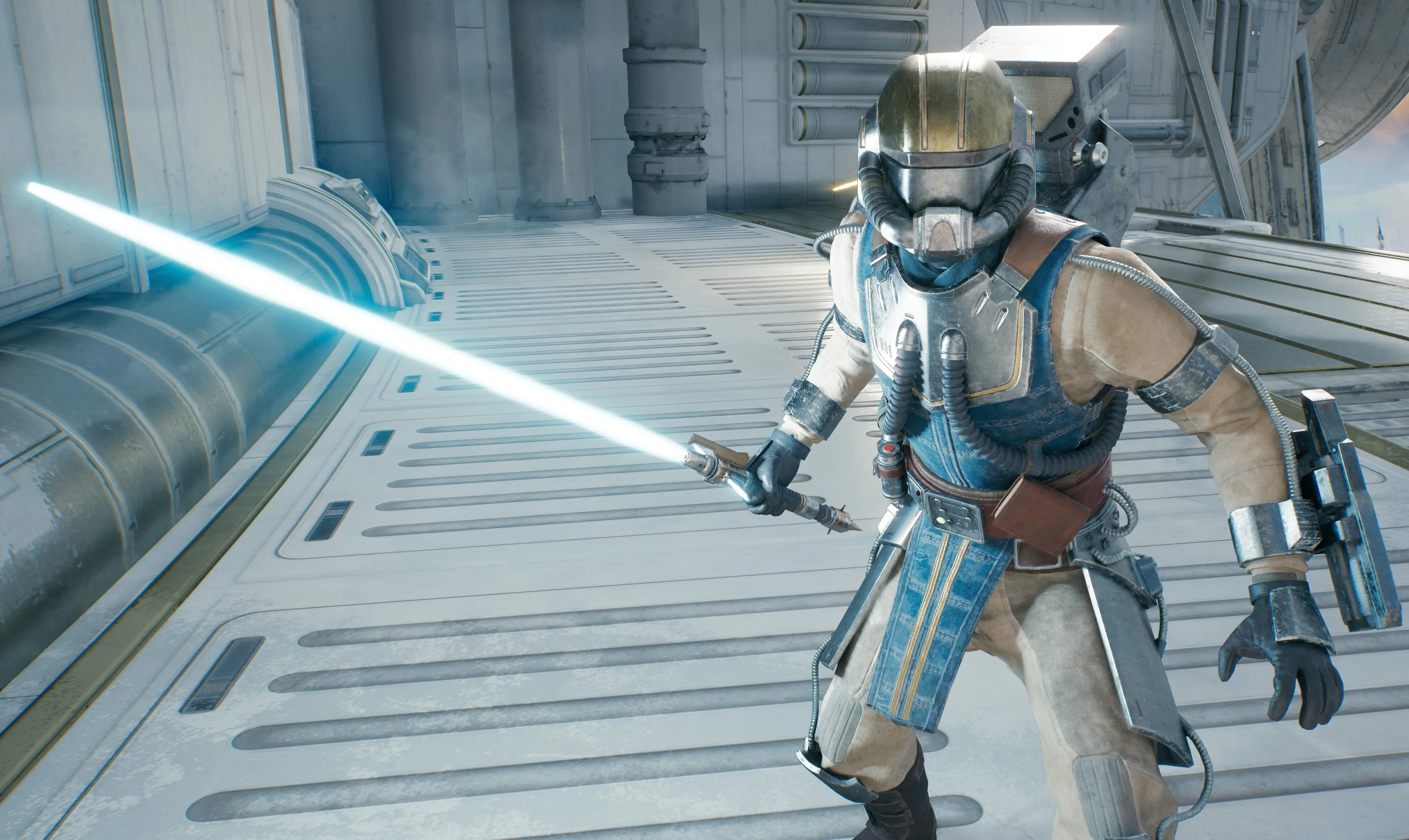
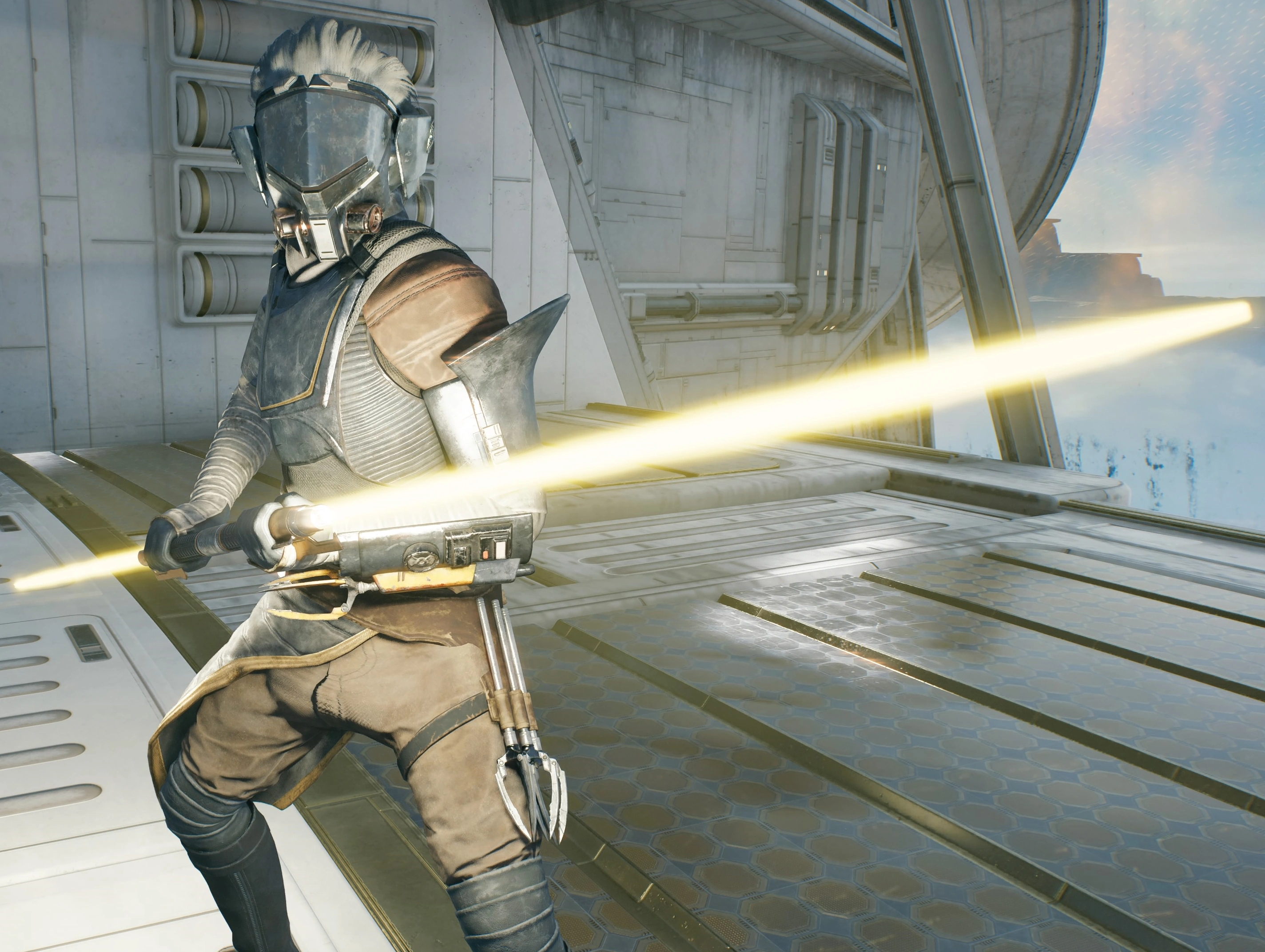
Thorfinn Rowle is dressed as a literally blue collared utilitarian laborer when "in disguise" or acting as an "imposter".
They came up again!
Added in 21 hours 18 minutes 42 seconds: Re: Morgion
There are stupid little kids with weak mental abilities and grasp on language, so already basically dull psychos who are going to listen to this A.I. bullsh*t and feel further encouraged to be even more rotten and incel-like.
I liked the A.I. generated image though, since it seemed to be usable for "The Dead Three", Bane, Bhaal, and Myrkul, that I've used as the title for three collections of themes:
This type of trash for "colored" (tanned nerds from other countries which have been touched by Imperialism in a certain way that has left them yearning for a "powerful" and "prestigious" "white" identity) people is one of numerous poisons openly being poured out to stupid mind-colonized sheep. It just leads them to being all the more unlikable and even abusive towards women, women if their own "kind" who are going to be the accessible ones to them.
"
@brightendash
5 months ago
Hi Brut, this is a great eye opener episode. We need to get talking about negative role models here who are Influencers from Manosphere can misguide youth in a wrong way specially in India where unemployment means a lot of youth and young men spending plenty of time online. Often open discussions aren't the norm in Indian families which is where youth can be susceptible to negative influencers.
110
4
@AkiAva-c7f
5 months ago
Agree. Men blindly followed And4rew Ta4te.
6
@user-fx9kv1mw2r
5 months ago
Simp gets influenced by such videos
"
They are marginalized and feel rejected also for demographic reasons they might not acknowledge, like coming from certain class levels and woth low status, while also being socially unskilled and may have other issues like neurological problems and mental problems.
So many of these people are from countries where colorism is a real issue and they are looked down upon for being poor and having darker skin and being seen as ugly and unpleasant in various ways, sometimes their oen families repeat these things, maybe even referring to others, but then these people look at themselves in the mirror and feel like they are exactly the things their own family puts down in the case of others. Very few of these people have any natural pride, just complexes.
The very egotistical and judgmental, opinionated style of dialogue online also emphasizes how sh*t we all think these people are, which only makes them feel uglier and angrier, making them even more goblinesque.
"
Alfred Adler was the first to use the term superiority complex. He claimed that a superiority complex essentially came from the need to overcome underlying feelings of inferiority: an inferiority complex.[5] Throughout his works Adler intertwines the occurrence of an inferiority complex and a superiority complex as cause and effect.[6] Among his writings touching on the topic were Understanding Human Nature (1927),[7] and Superiority and Social Interest: A Collection of Later Writings, a collection of twenty-one papers written by Adler and published posthumously in 1964.[8]
Adler distinguished a normal striving to achieve from superiority complexes,[9] the latter being attempts in order to overcompensate a feeling of inferiority.[5] He states that those with an inferiority complex develop a superiority complex to overcome the difficulties presented by the former, primarily by inflating their sense of self-importance in some way.[9] Dreams of heroism, and a false assumption of success,[10] revealed for Adler the reactive nature of such strivings.[6]
While Adler considered what he refers to in his writing as striving for superiority was a universal of human nature,[5] he thought sound-minded individuals do not strive for personal superiority over others, rather for personal ambition and success through work. By contrast, those with an actual superiority complex were riddled with conceited fantasies, and with dreams of immutable supremacy.[11][1]
"
As far as I'm aware, I'm a unique example of a person without a feeling of inferiority, so lacking an inferiority complex, and genuinely viewing people with sincere disdain as undeniably inferior in almost every way. The only thing I don't seem to have a grasp on yet is not being in pain, being able to clean the apartment better which is difficult due to the excessive suffering involved, and money, but all those things I also feel don't have too much to do with the things that I think make me genuinely better than most people I see and hear from these days, who seem like absolute scum to me and even irredeemable.
I have never really been put down much in my life and have always been dominant in interactions, like I've never looked up to anyone or viewed anyone else as a leader or more charismatic, so its always been me at the top in my opinion and in my mind, also viewing myself as the ideal in most ways, even persisting into my more decrepit forms from injury and illness, I'm still my favorite.
Added in 21 minutes 44 seconds:
"
Ada Kahn has argued that the superiority and inferiority complexes cannot both be found in the same individual, since an individual with a superiority complex truly believes that they are superior to others.[13] She claimed that – whereas an inferiority complex may manifest with the behaviors that are intended to show others that one is superior, such as expensive material possessions, or an obsession with vanity and appearances to conceal feelings of inadequacy – those with superiority complexes do not always care about image or vanity, since they have innate feelings of superiority, and thus do not usually concern themselves with proving their superiority to others.
Vera Hoorens says that those exhibiting the superiority complex have a self-image of supremacy.[14] Whereas individuals with an inferiority complex tend to present themselves in the best light possible, those with a superiority complex may not even attempt to make themselves look good, or to express their superiority to others. They may speak as if they are all-knowing and better than others, but ultimately do not care if others think so or not, much like with the cognitive bias known as illusory superiority.[14] Accordingly, they may be viewed in a negative light by those around them, since they are not concerned with the opinions of others about themselves. Other people may not distinguish between those with low self-opinion who care deeply about the opinion of others, and those with the actual complex, who feel superior and with high self-esteem, and do not care at all about the opinion of others.
"
Sort of annoying that these other people come along and start messing with whatever the first guy was saying with terms he made up.
"
The Lake Wobegon effect is a common name for illusory superiority, a natural human tendency to overestimate one's capabilities.[12] The characterization that "all the women are strong, all the men are good-looking, and the children are all above average" has been used to describe a real and pervasive human tendency to overestimate one's achievements and capabilities in relation to others. In one survey of high school students, only 2% of the students reported that they were below average in leadership ability.[13] The authors of a study suggest that what they consider the "Lake Wobegon effect" can in some cases negatively affect doctors' treatment advice when, in planning treatment, doctors portray the patients as "above average".[14]
Keillor himself has offered a contrarian opinion on the use of the term, observing that the effect does not actually apply in Lake Wobegon itself. In response to a listener query on the Prairie Home website, he pointed out that, in keeping with their Scandinavian heritage, Wobegonians prefer to downplay, rather than overestimate, their capabilities or achievements.[15]
"
"
The 1993 The Simpsons episode Marge on the Lam opens with the Simpson family watching public television; a Keilloresque host delivers a monologue about Badger Falls with the closing words, "Where the men are pink-cheeked, the women are robust, and the children are pink-cheeked and robust."
Forensic Files - The t-shirt worn by the killer John Famalaro that was entered into evidence in the murder of Denise Hueber was a Lake Wobegon t-shirt.
"
If you have read it, I mention lakes in relation to:
"
The Taken are the remnants of people fully possessed by the Dark Presence, they are essentially mindless puppets that exist only to fight and serve the Dark Presence, they cannot be saved and must be avoided. There are several different types of Taken, ranging from swarms of birds, to humanesque soldiers, to poltergeists. Taken fight with melee weapons such as blades, scythes, and axes, they can also throw their weapons to attack distant foes. Taken possess limited intelligence and do not appear to coordinate attacks as groups. They fight viciously and without mercy, and can lie in wait to ambush targets, but will retreat from powerful light sources. Oddly, Taken tend to recite garbled and occasional words from their past lives, but these are often senseless and little more than mere 'nerve twitches', the possessed person still reacting to various situations with out-of-place speech. Hearing this corrupted and disjointed speech serves as a warning that the Taken are closing in. Taken can appear anywhere the Dark Presence can focus itself, often appearing out of thin air to attack and kill with little warning.
"
"
Birdmen
These Taken were introduced in Alan Wake's American Nightmare. They are humanoid Taken capable of transforming into clouds of ravens, during which time (unlike normal raven flocks) they are impervious to harm and cannot attack Alan. In human form, they possess no dark shield, but are agile, strong, and remarkably resilient to harm.
"
"
Ravens
Just like their human counterparts, some ravens were possessed by the darkness. While they aren't very dangerous individually, they have huge strength in numbers. Ravens usually attack in flocks and can pose a real threat, especially on narrow mountain paths or when facing other Taken.
"
Ravens can speak human language or at least closely imitate the vocal vibrations that humans can.
Notice the costume of this character and that of Thorfinn Rowle.
"
In early versions of Alan Wake, Carl Stucky was originally going to be an employee of Doctor Emil Hartman while Ben Mott was the owner of the gas station. The two character's role were eventually switched.[7]
"
Added in 3 days 4 hours 33 minutes 19 seconds: Re: Morgion
"
@jccasts
14 years ago
@TheSSGUARDIAN .... No F*cking way.. the Best Hard Rock Band is The SCORPIONS.... MORGION is the Best Epic Doom Metal Band. as PYOGENESIS whit the Album "Ignis Creatio or Waves of Erotasia".
"
"
@TheKeefmaster
5 years ago (edited)
Metal for the Dark Elite
"
"
PYOGENESIS - Ignis Creatio (EP)
Tracklist:
01 Still Burn in Fire 0:00
02 Like Tears (In the Dust) 6:28
03 On Soulwings 13:28
04 Underneath Orion's Sword 22:49
05 Ignis Creatio 28:24
"
"
@JackWareingFilms
2 years ago (edited)
This 1994 CD/Album could very well be considered to be a groundbreaking piece of metal music. The fusion of Avant-garde, Alternative and Death metal make this CD/Album both Brilliant & Timeless. Peace to all.
"
Added in 27 minutes 18 seconds: Re: Morgion
It is like the guy they call "Asmongold" as man old.
Well at least he tries.
This "making of" is so much better, and it is just because of strong imagery and music. The other stuff sucks because of how it isn't that, and so the formula seems so simple.
"
Books
Hjelmdallermann: The Man from Hjelmdall
The Man from Hjelmdall and the Devil Woman
Man from Hjelmdall and the Mammoth-Riders
Man from Hjelmdall: Return to Hjelmdall
Man From Hjelmdall and the Hjelmdall Man
Man from Hjelmdall and the Sages at the End of the World
Man from Hjelmdall and the False-God
Man from Hjelmdall and the Scorched Earth
Man from Hjelmdall: The Hjelmdall Colonies
Man from Hjelmdall and the Three-Eyed Skull
Hjelmdallermann at the Gates of Tomorrow
Man from Hjelmdall in the Lost City of the Pygmies
Man from Hjelmdall and the Necromancer's Treasure
Man from Hjelmdall: Lord of Wrôthgär
Man from Hjelmdall: The Curse of Nachtherrer
Man from Hjelmdall and the Swamp Beast
Man from Hjelmdall and the Snow Crabs
Man from Hjelmdall in Hell
Man from Hjelmdall and the Forest of Slaves
Man from Hjelmdall Under the Lake
Man from Hjelmdall: Hjelmdall Burning
"
"
He is a muscular barbarian who implausibly dual-wields zweihänders as he cuts through necromantic armies and hordes of orkenoids alongside his blood-brother, Tyrbald.[2] His backstory involves his son being kidnapped and the Hjelmdallerman losing the rest of his family over the course of his adventures.[3]
The books are sexist,[4] racist,[5] and violent,[6] enjoyed by types like the Racist Lorry Driver. However, they are extremely popular, with over a hundred titles in the series[7] and additional merchandise such as T-shirts and roleplaying games set in the Hjelmdallermann world.[8] The series is the subject of a conspiracy theory that the Man from Hjelmdall really existed in some form.[9] Hjelmdallermen is a somewhat pejorative term for the type of guys who like the Man from Hjelmdall’s style.[10]
"
"
God is a Nobody with No Body and Nobody. So God made many things which can be considered novelties such as experience, experiencing as a body, experiencing other bodies, having company, having a God, having disagreements, and whatever else, like pain, suffering, diseases, death.
Each of these are things which were not which God made Be and are references to aspects of God or in other words "All experience is God's therapy" or "Life is God's therapy".
God creates lies and delusions which mask the Truth which is that God is literally like Nothing and Nobody with only Nothing to say about itself.
"
Also Above:
"
I couldn't get my shoe on just now and putting it on hurt so much in so many places and I am sweating and I deeply despise God.
"
The scale of Chromy's Cloak of Conscience, and the whiteness of the Carrara marble recalls the art of Bernini (1598–1680): flesh and cloth rendered as stone - the very opposite of its natural material qualities.[9] This has also been referred to as the 'art of petrifaction', recalling Ovid's story of how the animism and 'diverse attitudes' of some marble sculptures can be such that they could be mistaken for real persons,[10] which is a reverse operation in addressing the traditional ambiguity of sculpture.
The apparent aim of Baroque sculptors such as Bernini was to achieve the possibility for marble to appear as both solid and translucent, and to imply a plasticity and weightlessness that is radically at odds with its material quality.[11] Michelangelo too, was masterful at creating the impression of flesh from marble,[12] as seen in his David. However Chromy references this tradition with an inversion of the illusion of stone as flesh. First of all there is no positive analogue of the human body with which we can engage in the view of soft tissue, which almost always demands at least partial nudity. Instead the work is dominated by the folds of cloth and the absent volume of a body, which implies weight — so much weight in fact that we can call this a building (or an architectural sculpture) even a 'chapel', and as such it perhaps has more in common with the use of marble in architecture than in sculpture. In contrast to Rachel Whiteread's procedure of making positive volumes out of negative space, Chromy constructs a negative space out of a solid volume: the human body. The marble therefore becomes a material of strength, a structural material, rather than one that engages in the illusion of weightlessness — in this way it is a different approach to Chromy's works in bronze which, like the sculptures of Ancient Greece, appear to defy gravitational forces by capturing the dynamism of the human body,[13] many of which can be seen in the National Archaeological Museum of Athens, which contains the richest collection of artifacts from Greek antiquity worldwide.[14]
It is outside this museum that one of the Cloak's replicas, a 'Coat of Peace' was placed following Anna Chromy's exhibition there "Antique Myths" in 2007, at which many of her bronze sculptures were displayed, such as Sysiphus (2003).
Inspiration
edit
When asked about her inspiration for The Cloak of Conscience,[1] Anna Chromy quoted Albert Einstein: "The most beautiful experience we can have is the mysterious. It is the fundamental emotion that stands at the cradle of true art and true science...".[15] Chromy tells us her vision, as she set to work on the Cloak, was to create something from 'shining white marble' which is "the physical image of Harmony: harmony between Man, Nature and all Created".[1]
"
"
To commemorate completion of The Cloak of Conscience following five years of work, Anna Chromy released A Cloak for the World, a replicable artwork which depicts Cloak dressed in the national flags of 200 countries of the world.[citation needed] The piece was released in November 2010.[citation needed]
"
Those who used the Nine Rings became mighty in their day, kings, sorcerers, and warriors of old. They obtained glory and great wealth, yet it turned to their downfall. They had, as it seemed, unending life, yet life became unendurable to them. They could walk, if they would, unseen by all eyes in this world beneath the sun, and they could see things in worlds invisible to mortal men; but too often they beheld only the phantoms and delusions of Sauron. And one by one, sooner or later, according to their native strength and to the good or evil of their wills in the beginning, they fell under the thraldom of the ring that they bore and of the domination of the One which was Sauron's. And they became forever invisible save to him that wore the Ruling Ring, and they entered into the realm of shadows. The Nazgûl were they, the Ringwraiths, the Úlairi, the Enemy's most terrible servants; darkness went with them, and they cried with the voices of death.
The Silmarillion, "Of the Rings of Power and the Third Age"[T 1]
"
Powers and effects of the Rings
Type of Ring Powers granted Effects on bearer
Ruling Ring Invisibility, extended lifespan, control, knowledge of all other Rings Corruption to evil
Elven-Rings To heal and preserve Nostalgia, procrastination
Dwarf-Rings To gain wealth Greed, anger
Rings for Men Invisibility, extended lifespan, terror Enslavement, fading to permanent invisibility
The Rings of Power were made using the craft taught by Sauron to give their wearers "wealth and dominion over others". Each Ring enhances the "natural power" of its possessor, thus approaching its "magical aspect", which can be "easily corruptible to evil and lust of domination".[T 17] Gandalf explains that a Ring of Power is self-serving and can "look after itself": the One Ring, in particular, can "slip off treacherously" to return to its master Sauron, betraying its bearer when an opportunity arrives.[T 3] As the Ruling Ring, the One enables a sufficiently powerful bearer to perceive what is done using the other rings and to govern the thoughts of their bearers.[T 2] To use the One Ring to its full extent, the bearer needs to be strong and train their will to the domination of others.[T 18]
A mortal Man or Hobbit who takes possession of a Ring of Power can manifest its power, becoming invisible and able to see things that are normally invisible, as the bearer is partly transported into the spirit world.[T 3][5][T 17] However, they also "fade"; the Rings unnaturally extend their life-spans, but gradually transform them into permanently invisible wraiths.[T 19][T 3][T 20] The Rings affect other beings differently. The Seven are used by their Dwarven bearers to increase their treasure hoards, but they do not gain invisibility, and Sauron was unable to bend the Dwarves to his will, instead only amplifying their greed and anger.[T 2] Tom Bombadil, the only being unaffected by the power of the One Ring, could both see its wearer and remained visible when he wore it.[T 21]
Unlike the other Rings, the main purpose of the Three is to "heal and preserve", as when Galadriel used Nenya to preserve her realm of Lothlórien over long periods.[1] The Elves made the Three Rings to try to halt the passage of time, or as Tolkien had Elrond say, "to preserve all things unstained". This was seen most clearly in Lothlórien, which was free of both evil and the passage of time.[6][7] The Three do not make their wearers invisible.[T 18] The Three had other powers: Narya could rekindle hearts with its fire and inspire others to resist tyranny, domination, and despair; Nenya had a secret power in its water that protected from evil; while Vilya healed and preserved wisdom in its element of air.[T 2]
"
"
Magical rings occur in classical legend, in the form of the Ring of Gyges in Plato's Republic. It grants the power of invisibility to its wearer, creating a moral dilemma, enabling people to commit injustices without fearing they would be caught.[12] In contrast, Tolkien's One Ring actively exerts an evil force that destroys the morality of the wearer.[T 3]
The shepherd Gyges of Plato's Republic finds the magic ring, setting up a moral dilemma.[12] Ferrara, 16th century
The shepherd Gyges of Plato's Republic finds the magic ring, setting up a moral dilemma.[12] Ferrara, 16th century
Scholars including Frederick A. de Armas note parallels between Plato's and Tolkien's rings.[12][13] De Armas suggests that both Bilbo and Gyges, going into deep dark places to find hidden treasure, may have "undergone a Catabasis", a psychological journey to the Underworld.[12]
Frederick A. de Armas's comparison of Plato's and Tolkien's rings[12]
Story element Plato's Republic Tolkien's Middle-earth
Ring's power Invisibility Invisibility, and corruption of the wearer
Discovery Gyges finds ring in a deep chasm Bilbo finds ring in a deep cave
First use Gyges ravishes the Queen,
kills the King,
becomes King of Lydia (a bad purpose) Bilbo puts ring on by accident,
is surprised Gollum does not see him,
uses it to escape danger (a good purpose)
Moral result Total failure Bilbo emerges strengthened
The Tolkien scholar Eric Katz writes that "Plato argues that such [moral] corruption will occur, but Tolkien shows us this corruption through the thoughts and actions of his characters".[14] Plato argues that immoral life is no good as it corrupts one's soul. So, Katz states, according to Plato a moral person has peace and happiness, and would not use a Ring of Power.[14] In Katz's view, Tolkien's story "demonstrate[s] various responses to the question posed by Plato: would a just person be corrupted by the possibility of almost unlimited power?"[14] The question is answered in different ways: the monster Gollum is weak, quickly corrupted, and finally destroyed; Boromir, son of the Steward of Gondor, begins virtuous but like Plato's Gyges is corrupted "by the temptation of power"[14] from the Ring, even if he wants to use it for good, but redeems himself by defending the hobbits to his own death; the "strong and virtuous"[14] Galadriel, who sees clearly what she would become if she accepted the ring, and rejects it; the immortal Tom Bombadil, exempt from the Ring's corrupting power and from its gift of invisibility; Sam who in a moment of need faithfully uses the ring, but is not seduced by its vision of "Samwise the Strong, Hero of the Age"; and finally Frodo who is gradually corrupted, but is saved by his earlier mercy to Gollum, and Gollum's desperation for the Ring. Katz concludes that Tolkien's answer to Plato's "Why be moral?" is "to be yourself".[14]
"
"
The nine rings for Mortal Men match the number of the Nazgûl. Edward Pettit, in Mallorn, states that nine is "the commonest 'mystic' number in Germanic lore". He quotes the "Nine Herbs Charm" from the Lacnunga, an Old English book of spells, suggesting that Tolkien may have made multiple uses of such spells to derive attributes of the Nazgûl:[20]
against venom and vile things
and all the loathly ones,
that through the land rove,
...
against nine fugitives from glory,
against nine poisons and
against nine flying diseases.
"
Omg this is a miracle, my phone screen came back after two months of not working!
Added in 2 hours 29 minutes 20 seconds:
It came back as I was writing these things, and it came back on a picture of the Indus and various streams from the map of Pakistan that was on the main screen for some reason, as I was also about to look up the nine rivers again but hadn't yet, and was going to show the Witch-King's speech, and then more about Ketu:
"
“In rode the Lord of the Nazgûl. A great black shape against the fires beyond he loomed up, grown to a vast menace of despair. In rode the Lord of the Nazgûl, under the archway that no enemy ever yet had passed, and all fled before his face.
All save one. There waiting, silent and still in the space before the Gate, sat Gandalf upon Shadowfax: Shadowfax who alone among the free horses of the earth endured the terror, unmoving, steadfast as a graven image in Rath Dínen. "You cannot enter here," said Gandalf, and the huge shadow halted. "Go back to the abyss prepared for you! Go back! Fall into the nothingness that awaits you and your Master. Go!" The Black Rider flung back his hood, and behold! he had a kingly crown; and yet upon no head visible was it set. The red fires shone between it and the mantled shoulders vast and dark. From a mouth unseen there came a deadly laughter. "Old fool!" he said. "Old fool! This is my hour. Do you not know Death when you see it? Die now and curse in vain!" And with that he lifted high his sword and flames ran down the blade.
And in that very moment, away behind in some courtyard of the city, a cock crowed. Shrill and clear he crowed, recking nothing of war nor of wizardry, welcoming only the morning that in the sky far above the shadows of death was coming with the dawn. And as if in answer there came from far away another note. Horns, horns, horns, in dark Mindolluin's sides they dimly echoed. Great horns of the north wildly blowing. Rohan had come at last.”
"
"
They dress entirely in black. In their early forays, they ride on black horses; later they ride flying monsters, which Tolkien described as "pterodactylic".
"
"
Ketu is considered a chaya grah(shadowy planet) but still considered as one of nine major planets in vedic astrology. Ketu is considered a foot soldier in planetary cabinet. Ketu rules the north-east(Ishaan) direction and has excess of fire element. Ketu's color is black according to Bhrigu Samhita. Ketu governs the mixed caste."
"
To strengthen Ketu one must wear cat's eye(lehsuniya).
"
"
Ketu has good psychic abilities and ability to see through illusion. Ketu can provide an excellent career in occults especially astrology, tarots, palm reading etc.
"
"
Ketu can also help start a spiritual or occults center which provides spiritual and astrological guidance.
"
"
Tolkien was a philologist. Jason Fisher, writing that "all stories begin with words", takes up Edmund Wilson's "denigrating dismissal" of The Lord of the Rings as "a philological curiosity", replying that to him this is "precisely one of its greatest strengths".[10] Fisher explores in detail the connotations of Tolkien's use of "Ringwraith" and its Black Speech translation "Nazgûl", both in languages that Tolkien knew and those that he invented. "Wraith" in modern English means 'spectre'.[11] Fisher notes that the word has a history in folktale and fantasy including usage by the Brothers Grimm, William Morris, and George MacDonald.[10] The word "wraith" can be connected, Fisher writes, to English "writhe", Old English wrīþan, to bend or twist, and in turn to Gothic wraiqs, curved, crooked, or winding, and wraks, a persecutor. There is also English "wreath", from Old English wrida, meaning a band, a thing wound around something, and indeed a ring. Another cognate is Old Saxon wred, meaning cruel; Fisher comments that all of these stem from Indo-European *wreit, to turn, bend, or wind.[10]
"Nazgûl" has the Black Speech roots nazg, ring, and gûl, wraith. Fisher writes that the former may well be connected, unconsciously on Tolkien's part, to Gaelic nasc, a ring. Gûl has the meaning "magic" in Tolkien's invented language of Sindarin. Fisher comments that this has an English homophone in "ghoul", a wraith, which derives from Arabic غُول ḡūl, a demon that feeds on corpses. The Sindarin word is related to ñgol, wise, wisdom, and to Noldor, Fëanor's elves who became in Fisher's words "bent and twisted" by the desire for the Silmarils.[10]
The only one of the nine Ringwraiths to be named is Khamûl. Fisher suggests a link to Welsh kam, crooked, and kamy, to bend. "Kam" made its way into English usage, including by Shakespeare,[12] as is recorded in Samuel Johnson's 1755 A Dictionary of the English Language.[10] Fisher writes that this may have come to Tolkien by way of his time with the Lancashire Fusiliers in the First World War, with Lancashire dialect words like caimt, crooked or bad-tempered. In short, Tolkien may have felt many philological associations between his "Nazgûl" and "Ringwraith" with the meanings of being bent and twisted as well as ghoulish.[10]
"
"
The Nazgûl had a sharp sense of smell.[1] Their sight worked differently, too: "They themselves do not see the world of light as we do, but our shapes cast shadows in their minds, which only the noon sun destroys; and in the dark they perceive many signs and forms that are hidden from us: then they are most to be feared."[T 6] Their chief weapon was terror; it was so powerful that Sauron faced one disadvantage when using them: they could not easily travel in secret.[T 3] The terror they spread was greater when they were unclad and invisible; and when they were gathered together.[T 7]
"
"
Nava (नव) refers to “nine” types of Ketus (i.e., luminous bodies such as comets and meteors), according to the Bṛhatsaṃhitā (chapter 11), an encyclopedic Sanskrit work written by Varāhamihira mainly focusing on the science of ancient Indian astronomy astronomy (Jyotiṣa).—Accordingly, “The comets that resemble a headless trunk are named Kabandha Ketus; they are the sons of Yama, are 96 in number and are without discs; when they appear there will be much fear all over the Earth. The comets that are white possessing a single disc [i.e., śukla-vipula-ekatārā] are 9 in number [i.e., nava]; they appear in the four corners. Thus we have given an account of 1,000 Ketus. We shall now give a few particulars connected with them”.
"
"
Nava (नव) refers to “new (robes)” (suitable for an worship ceremony), according to the Vajratuṇḍasamayakalparāja
"
"
Navan (नवन्) or Navadvāra refers to the “nine (orifices)” (of the human body), according to the 11th century Jñānārṇava, a treatise on Jain Yoga in roughly 2200 Sanskrit verses composed by Śubhacandra.—Accordingly, “Where is the body, which is filled with blood, flesh and fat, has a skeleton of slender bones, is bound with tendons and is of bad odour, praised? Continually pouring forth putrid smells through [its] nine orifices (navan-dvāra—navabhir dvāraiḥ), the human body is ever perishable [and] dependent on other [things]”.
"
"
The Nazgûl came again ... like vultures that expect their fill of doomed men's flesh. Out of sight and shot they flew, and yet were ever present, and their deadly voices rent the air. More unbearable they became, not less, at each new cry. At length even the stout-hearted would fling themselves to the ground as the hidden menace passed over them, or they would stand, letting their weapons fall from nerveless hands while into their minds a blackness came, and they thought no more of war, but only of hiding and of crawling, and of death.
The Return of the King, "The Siege of Gondor"[T 25]
"
"
The flying steeds of the Nazgûl are given various descriptions but no name. The soldier of Gondor Beregond calls them "Hell Hawks". Tolkien describes them as "fell beasts", though he also applies the adjective fell ("fierce, cruel") to other creatures throughout The Lord of the Rings – even at one point to the wizard Gandalf. In a letter, he calls the winged mounts "Nazgûl-birds".[T 32] In the absence of a proper name, derivative works sometimes press "fellbeast" or "fell-beast" into service.[5]
In the Battle of the Pelennor Fields, where the Lord of the Nazgûl rode one of the flying beasts against King Théoden of Rohan, his mount is described as:[T 26]
a winged creature: if bird, then greater than all other birds, and it was naked, and neither quill nor feather did it bear, and its vast pinions were as webs of hide between horned fingers; and it stank. A creature of an older world maybe it was ...[T 26]
It is said to attack with "beak and claw".[T 26] Tolkien wrote that he "did not intend the steed of the Witch-king to be what is now called a 'pterodactyl'", while acknowledging "obviously it is pterodactylic" and owed much to the "new ... mythology" [of the "Prehistoric"], and might even be "a last survivor of older geological eras."[T 27]
"
"
Despite his shadowiness and invisibility, Shippey writes, the Nazgûl on the Pelennor Fields also comes as close as he ever does to seeming human, having human form inside his black robes, carrying a sword, and laughing to reveal his power when he throws back his hood, revealing a king's crown on his invisible head.[13]
Yvette Kisor, a scholar of literature, writes that while the Ringwraiths and others (like Frodo) who wear Rings of Power become invisible, they do not lose any of their corporeality, being present as physical bodies. They require, she writes, physical steeds to carry them about, and they can wield swords. She notes that only a person in a body can wield the One Ring, so the invisibility is just "a trick of sight". When Frodo, wearing the Ring, saw the Nazgûl in the "twilight world", they appeared solid, not shadowy. He also saw Glorfindel in that world, as a figure of white flame; and Gandalf explains later that the Ringwraiths were "dismayed" to see "an Elf-lord revealed in his wrath".[T 38][14][15] Frodo is in danger of "fading" permanently into invisibility and the twilight world, as the Ringwraiths have done, living "in another mode of reality". She writes, too, that Merry's sword, with the special power to sever the Witch-king's "undead flesh" and in particular to overcome the "spell that knit his unseen sinews to his will",[T 26] has in fact to cut through real, but invisible, sinews and flesh.[14]
Gradual incarnation
edit
Steve Walker, a Tolkien scholar, writes that the story gives the Ringwraiths credibility through a "gradual incarnation of bodiless presence". Little by little, in his view, Tolkien increases the reader's insight into their nature, starting with Black Riders who are "spies more human than diabolical", rather than developing their character. Walker sees this as appropriate: the Nazgûl's main weapons are psychological, namely fear and despair. He writes that the progressive revelation of their capabilities, and their "escalation of steeds" from horses to fell beasts, builds up in the reader's mind an "increasingly infernal vision".[16]
The Black Breath
The Nazgûl spread terror and despair among their enemies, and discomfit those on their own side. The Black Breath is stated to have afflicted many during the Battle of the Pelennor Fields. Dr Jennifer Urquart, writing in Mallorn, describes its normal course as "progressive loss of consciousness and hypothermia, leading to death".[17] She comments that the Black Breath, contracted by "excessive proximity" to a Nazgûl, seems to be a "spiritual malady" combined with "fear, confusion, reduced levels of consciousness, hypothermia, weakness and death."[17] Faramir, on the other hand, who was thought to be suffering from the Black Breath, she diagnoses as most likely exhaustion with heat stroke, combined with "psychological distress" and pain, as his symptoms were quite different.[17] Judy Ann Ford and Robin Anne Reid note that Aragorn's use of the herb athelas to heal Faramir and others of the Black Breath, a condition "which harms the spirit more than the body",[18] identifies him to his people as the true King.[18]
Michael and Victoria Wodzak discuss how the hobbit Merry Brandybuck can be affected by the Black Breath when the Witch-King has not noticed him, pointing out that Tolkien nowhere says that the Nazgûl breathes on him or on Éowyn. Instead Éowyn "raised her shield against the horror of her enemy's eye", and the Wodzaks comment that the Nazgûl uses his eyes "to overwhelm".[19] In their view, the seeming inconsistency is resolved by identifying the Black Breath with his "pneuma", his evil spirit, and assuming that it is this which causes the harm all around him.[19]
John Garth suggests that the Black Breath may derive from Tolkien's experience of gas in the First World War.[20] Painting Gas Attack, Flanders by Alfred Bastien, 1915
Tolkien's biographer John Garth finds Christopher Gilson's Words, Phrases and Passages in Various Tongues in "The Lord of the Rings" especially interesting for its rendering of two of the Dark Lord Sauron's epithets, Thû meaning "horrible darkness, black mist" and Gorthu meaning "mist of fear".[20] Garth comments that these names "anchor him in the primal night" of Tolkien's giant spiders, the Black Breath, the fog on the Barrow-downs, and the terror of the Paths of the Dead. He adds that this fog of terror may ultimately derive from Tolkien's First World War experience "of smoke barrages, gas attacks and 'animal horror' on the Somme."[20] Earlier, in his 2003 book Tolkien and the Great War, on the other hand, Garth merely notes the "Black Breath of despair that brings down even the bravest" as one of several elements of The Lord of the Rings which "suggest[s] the influence of 1914–18".[21]
In her Tolkienesque 1961 short story "The Jewel of Arwen", the fantasy and science fiction writer Marion Zimmer Bradley provides "Translator's Notes" which assert as part of her frame story that the Nazgûl were contaminated and enslaved by a monstrous form of radioactivity which transformed "the very cells of their protoplasm".[22] They thereby became radioactive and "immune to radiation poisoning, as is shown by their dwelling in the blasted tower of Minas Ithil [which glowed in the dark]."[22] Further, Bradley writes, the Nazgûl gave off "radioactive contamination", causing the Black Breath.[22]
"
"
The one gemstone that the healer suggested to Arjun was cat eye. He gave him knowledge on this stone which is the ultimate stone for protection from negativity. Cat eye stone remove the negativity from the person who wears them and shields the person from negative external forces. Plus it gives mental clarity and enhances psychic abilities.
"
"
And thus were they appointed: one church for Arthur, and his kings, and his guests; and the second for Gwenhwyvar and her ladies; and the third for the Steward of the Household 141c and the suitors; and the fourth for the Franks and the other officers; and the other nine churches were for the nine Masters of the Household 141d and chiefly for
Gwalchmai;
for he, from the
p. 142
eminence of his warlike fame, and from the nobleness of his birth, was the most exalted of the nine. And there was no other arrangement respecting the churches than that which we have mentioned above.
Glewlwyd Gavaelvawr
was the chief porter; but he did not himself perform the office, except at one of the three high festivals, for he had seven men to serve him, and they divided the year amongst them. They were
Grynn, and
Pen Pighon, and
Llaes Cymyn, and
Gogyfwlch, and
Gwrdnei with cat's eyes, who could see as well by night as by day, and
Drem the son of Dremhitid, and
Clust the son of Clustveinyd; and these were Arthur's guards 142a.
"
Added in 11 seconds:
"
AI Overview
+5
The "nine masters of the household" (or nine Masters of the Household) are figures from Arthurian legend, specifically mentioned in the tale of
Geraint the Son of Erbin within the collection known as the Mabinogion. These individuals were high-ranking officials at King Arthur's court at Caerlleon upon Usk.
According to the text, Arthur had thirteen churches set apart during high festivals; nine of these were specifically for the nine Masters of the Household.
The Role and Prominence
These masters were significant figures in the court, with the most eminent among them being Gwalchmai (Gawain), noted for his warlike fame and noble birth. This detail highlights their importance and status, as they were accorded their own designated places of worship and held positions of respect within the royal household.
The text mentions that at one particular Whitsuntide festival, nine crowned kings were also present as tributaries and guests, further emphasizing the high status of those within Arthur's immediate circle, including his household masters.
The specific names of the nine masters are not explicitly listed as a single, formal group in the provided text, beyond the mention of Gwalchmai as their chief. Other tales within the Mabinogion (such as Culhwch and Olwen) list many names of Arthur's retinue and officers, including the chief porter Glewlwyd Gavaelvawr and his seven men, but the "nine masters of the household" are referred to as a collective group rather than an enumerated list.
"
"
The Nine Worthies include three pagans (Hector, Alexander the Great, and Julius Caesar), three J (Joshua, David, and Judas Maccabeus), and three Christians (King Arthur, Charlemagne, and Godfrey of Bouillon).
"
"
From left to right are the three Christians:
Charlemagne bearing an eagle upon his shield,
King Arthur displaying three crowns, and
Godfrey of Bouillon with a dog lying before him; then the three pagans:
Julius Caesar,
Hector, and
Alexander the Great bearing a griffon upon his shield;
and finally the three J:
David holding a sceptre,
Joshua, and
Judah Maccabee.
"
"
He tried to conquer knowledge itself – instead this ancient Mesopotamian king resorted to rule with terror
Historian Selena Wisnom explores how Ashurbanipal, the last great ruler of Assyria, combined calculated brutality with an unprecedented quest to collect all the wisdom of his world
"
"
The earliest Mesopotamian texts are silent on the undead. But by the Neo-Assyrian period of the 7th century BC, the picture changes.
"
"
“We start to get some texts which do appear to refer to what happens,” Blair says, “and what you should do, if corpses start walking around; if they rise up and fight against the living.”
"
"
These texts instructed priests on how to restore order when a corpse became spiritually dangerous, which tells us that fear of the living dead was part of established Mesopotamian religious practice. In fact, this concern was deeply rooted in the broader Mesopotamian cultural context of beliefs about life and death.
"
"
In ancient Mesopotamian belief, death didn’t automatically close the book on a person’s existence. A peaceful death, ideally at an old age, with proper rituals and descendants to continue offerings, allowed the life force to dissipate cleanly.
But that wasn’t the case with a sudden death.
That’s a recurring theme in vampire mythology, explains Blair. Becoming a vampire “often happens to people whose lives have been cut short untimely,” he says. “An important factor in all this is lack of completeness. The people are cut short and their life forces have not dissipated in the normal way. They are still pent up in the body, and that means trouble.”
"
"
This bronze head of Pazuzu, likely from Nimrud and dating to the Neo-Assyrian period (c. 800–550 BC), represents one of Mesopotamia’s most striking supernatural figures. Though a fearsome demon associated with destructive winds, Pazuzu also served as a powerful protector, warding off the deadly forces — especially the demoness Lamashtu — believed to threaten mothers and infants.
"
"
Hellenistic magical texts include spells to ward off the returning dead. Roman writers describe corpses rising to demand justice. Early Christian theologians, inheriting this tradition, warned of improper burials leading to spiritual disturbances.
"
"
He is moving the clan towards a darker, bloodier (if that is conceivable) role, reinstating the Path of Blood as the clan's religion and terminating any dissenters with extreme prejudice.
"
"
I was looking at this picture of the two foundation statues of Shulgi. I instantly knew
it was him, even before I read the caption. I've done a lot of research into Shulgi, so I know
what he looks like. I can recognize his statues at a glance, so I’m something of an expert
on the subject (a self-professed expert, admittedly, and probably the only one in the world).
I had already developed a general idea of Shulgi’s appearance based on his many statues.
I can also distinguish between Shulgi’s statues and those of his father, Ur-Namma.
They look very similar, but not the same. There are a few subtle differences between them.
"
"
This is the first realistic portrait
of any human being in all of history.
"
"
I was looking for a man who
looked something like this.
He had a round face, a bulbous nose, and a mouth turned down at the corners. His eyes were heavy-lidded and asymmetrical. I was looking for...
Shulgi
The face of Shulgi. It is photographic in its realism. This is exactly how Shulgi looked
when he was a living man and a reigning king.
This is not a prettified portrait. The statue is uncompromising in it realism. Like Ur-Namma,
Shulgi preferred to show his real appearance, without idealization, and without the
ancient version of Photoshop, as it were. He didn’t make his asymmetric eyes more even
to minimize his ptosis and make him seem more regal. He didn’t reduce the size of his nose
to make himself more handsome. Then again, Shulgi didn’t need to look like everyone else.
His face was not conventionally handsome, but it was strong and charismatic.
Once you’ve seen this statue, you know exactly what Shulgi looks like. Not “kinda, sorta,”
but exactly. You would instantly recognize him if you met him on a city street, even if
he was wearing a suit and tie.
Perhaps you have already met somebody who looks like this. I know I have. In a way,
it could be said that Shulgi is a “type.” But even in a room full of similar men, Shulgi
would be instantly recognizable by his asymmetric eyes.
"
This guy is unbearable lol.
"
The first time I added magnification to this picture,
it startled me. It was like seeing a ghost:
The blurry spectral image set on a dark background; the eerie lighting, the tattered
diaphanous robe streaming in the light; it was like the photograph of a ghost; the ghost
of a king. It's as if the spirit of Shulgi, who was buried 4,000 years ago, transmitted as a
holographic image on my computer, appearing once again exactly as he appeared in life,
in all of his power and glory. I swear, if a bright light had burst forth from my computer and
Shulgi himself appeared before me, I wouldn’t have been a bit surprised. Now I knew why
he was staring at me so intently from that small little photograph. He had willed himself
into the modern world.
In a real sense, that’s precisely what he did when he made this bronze portrait of himself
in the 20th century BC. He guaranteed that he would still be around in the 20th century AD,
and beyond. With this statue, he made himself immortal.
I love these old photographs of Shulgi (courtesy of the Oriental Institute of the University of Chicago), but hopefully some better high-resolution photos will soon become available.
When they are published, I'll be sure to post them.
Shulgi was a strong, vigorous, and energetic man. He was also an intellectual and he was artistically inclined.
Most of what we know of Shulgi’s character comes from “praise poems” that were written
by scribes. The compositions are written as “first person” narratives. Obviously there is
some exaggeration in them, but they provide invaluable insight into the character of a very
dynamic man.
Shulgi himself was a scribe, in the world’s most difficult language. Very few people could
read and write, even among the nobility. “When I was small, I was at the academy, where
I learned the scribal art from the tablets of Sumer and Akkad. None of the nobles could write
on clay as I could… I qualified fully in subtraction, addition, reckoning and accounting. The
fair Nisaba [the goddess of writing], provided me amply with knowledge and comprehension.
I am an experienced scribe…”
Shulgi was also an accomplished musician, able to play a variety of musical instruments.
“I, Šulgi, king of Ur, have also devoted myself to the art of music. Nothing is too complicated
for me; I know the full extent of the tigi and the adab, the perfection of the art of music.
When I fix the frets on the lute, which enraptures my heart, I never damage its neck;
I have devised rules for raising and lowering its intervals. On the gu-uš lyre I know the melodious tuning...” Shulgi then goes on to list all the instruments he can play.
Shulgi was multilingual. He could read Akkadian tablets in their original language. In addition, “I can understand what an [Elamite] spokesman answers... I can do service as a translator with a man of Martu, a man of the mountains… I myself can correct his confused words in his own language. When a man of Subir yells, I can even distinguish the words in his language, although I am not a fellow-citizen of his. When I provide justice in the legal cases of Sumer, I give answers in all five languages. In my palace no one in conversation switches to another language as quickly as I do.”
Shulgi was an athlete. It is said that he ran from Ur to Nippur and back in a single day so he could preside over ceremonies in both cities. That’s a round trip of 200 miles, the equivalent
of 8 marathons. Technically it is possible. It has been duplicated by modern runners.
In any case, he apparently accomplished some great feat of long-distance running for which he was famous.
Shulgi was an avid hunter. “I stride forward in majesty, trampling endlessly through the
esparto grass and thickets, capturing elephant after elephant, creatures of the plain; and I
put an end to the heroic roaring in the plains of the different lions… I do not go after them
with a net, nor do I lie in wait for them in a hide; it comes to a confrontation of strength
and weapons. I do not hurl a weapon; when I plunge a bitter-pointed lance in their throats,
I do not flinch at their roar. I am not one to retreat to my hiding-place but, as when one
warrior kills another warrior, I do everything swiftly on the open plain…In the sheepfold and
the cattle-pen, I put the shepherd tribesmen at ease. [Sumerian kings thought it a duty to
protect herdsmen from the wild animals preying on their livestock] … The number of lions
that I have dispatched with my weapons is limitless; their total is unknown.”
Shulgi was well known for his sexual virility. He had many wives (partly to establish political alliances with their powerful families, both foreign and domestic). Shulgi even pleasured Inanna, the goddess of lust and war.
Shulgi was a builder of temples. He completed the great ziggurat at Ur that was started
by his father.
"
"
The Ziggurat (or Great Ziggurat) of Ur (Sumerian: 𒂍𒋼𒅎𒅍 é-temen-ní-gùru "Etemenniguru",[3] meaning "house whose foundation creates terror")[4] is a Neo-Sumerian ziggurat in what was the city of Ur near Nasiriyah, in present-day Dhi Qar Province, Iraq. The structure was built during the Early Bronze Age (21st century BC) by King Ur-Nammu of the Third Dynasty of Ur. It had crumbled to ruins by the 6th century BC of the Neo-Babylonian period, when it was restored by King Nabonidus.
"
"
Like other dying and returning gods, Ninazu is linked to vegetation and agriculture; in How Grain Came to Sumer (ETCSL 1.7.6, 1) he and his brother bring barley and flax to humans, who 'used to eat grass with their mouths like sheep', while in Enlil and Ninlil (ETCSL 1.2.1, l. 116) he is called 'the lord who stretches the measuring line over the fields'.
Another characteristic Ninazu shares with other gods with whom he is often grouped is an association with snakes. In Ur III and Old Babylonian incantations he is named 'king of the snakes' (see van Dijk 1969, esp. 542-3) and the logogram dMUŠ ('divine snake') is given as a spelling of his name in the god list An = Anum (Litke 1998: 191, l. 240). Given this, it is likely that both Tišpak and Ningišzida inherit their connection with the 'lion-dragon' or 'snake-dragon' (mušḫuššu) from Ninazu; the mušḫuššu is linked to his centre Enegi, and the dragon (ušumgal) associated with him in a first millennium incantation may be the same creature (see further Black and Green 1998: 137; Wiggermann 1993-97: 457).
Despite his name, Ninazu was not a major healing deity; except for third and second-millennium incantations against snake bite he appears rarely in the medical corpus.
Divine Genealogy and Syncretisms
As mentioned above, Ninazu has two different genealogies. At Enegi he is usually the son of Ereškigal and 'the great lord' (probably Ereškigal's husband Gugal'ana), reinforcing his chthonic attributes. Alternatively, Enlil and Ninlil are his parents; the Sumerian Temple Hymns (ETCSL 4.80.1, lines 425-47) associate this genealogy with Ešnunna, but it also appears elsewhere. In both traditions, Ninazu has a brother Ninmada; in Enlil and Ninlil (ETCSL 1.2.1), as well as being the child of the eponymous couple, he has three brothers: Meslamtaea, Enbilulu and Sin.
Ninazu's wife was the goddess Ningirida, although rarely Ereškigal or (U)kulla(b), the consort of Tišpak, appear in this role. The chthonic god Ningišzida is well attested as their son. The god list An = Anum also lists three sisters of Ningišzida, and another seven 'children of Ningirida' who are more obscure (Litke 1998: 191-2, ll.255-7; 242-9).
At Ešnunna during the Old Akkadian period Ninazu was partially identified, but not fully syncretized, with Tišpak who eventually replaced him as city god. In the first-millennium Anzu epic he is equated with Ninurta (Saggs 1986: 27, l. 139).
Cult Places
Ninazu's temples at Enegi and Ešnunna were, respectively, é-gíd-da, 'Storehouse', and é-sikil.(la), 'Pure house' (George 1993, nos. 392, 987). He was particularly popular at Ur, where during the Ur III and Old Babylonian periods a major festival was held for him in the 6th month. He also received offerings at Lagaš, Umma, and Nippur.
Time Periods Attested
Ninazu is first attested in the middle of the third millennium, in the Šuruppag (Fara) god lists and the zà-mì (praise) hymns from >Tell Abu Salabikh (Biggs 1974: 45). During the Early Dynastic period offerings were made to him at Enegi; the king of Ur, A-Anepada, dedicated a clay tablet to him (Frayne 2008: E1.13.6.6) and his cult was introduced to Lagaš, where the ruler Gudea later built him a temple in Girsu (Edzard 1997: E3/1.1.7.30). In the Ur III period his cult is attested at Ešnunna (Tell Asmar), Enegi, Ur, Lagaš/Girsu, Nippur and Umma; in the first four centres it continued into the Old Babylonian period.
In the Sumerian Temple Hymns (ETCSL 4.80.1), which survive in Ur III and Old Babylonian copies Ninazu appears in very different guises in his two main temples: he is 'playing loudly on a zanaru instrument, sweet as a calf' in the Egidda at Enegi (l.183) and 'snarling like a dragon against the walls of rebel lands' in the hymn to Esikil at Ešnunna (l.434). From the Old Babylonian period we have one Sumerian hymn to Ninazu (ETCSL 4.17.1). He also features in two praise poems for Šulgi (Klein 1981, Šulgi D and X; online at ETCSL 2.4.2.04 and ETCSL 2.4.2.24).
Ninazu's cult lost ground with the rise of the death gods Tišpak and Nergal, and after the Old Babylonian period is attested in southern Mesopotamia only at Ur, where he continued to feature in personal names until the Persian period. During the first millennium he appears sporadically in god lists, incantations, cultic and literary texts.
"
"
No certain representations of Ninazu are attested, although he has been identified with the god standing on the back of a lion with a snake's tail on a seal from the Early Dynastic period (Boehmer 1965, Tf. XXV fig. 283; see image), and another standing on a dragon from the Old Akkadian period (Boehmer 1965, Tf. XLVIII fig. 570; Collon 1982, no. 144), as well as with a scaled deity represented on a stone from third millennium Ešnunna (Wiggermann 1993-97: 457).
"
"
Nin-azu is usually interpreted as 'Lord Healer'; the two elements are in apposition rather than a genitival relationship (Wiggermann 1998-2001: 330). An alternative interpretation of the name was proposed by Jacobsen, who read nin-a-sud, 'Water Pouring Lord' (Jacobsen 1987: 170, see also Wiggermann 1998-2001: 330).
"
"
ḪUŠ, 'reddish snake', sometimes also translated as 'fierce snake'.
"
"
Snakes, sometimes referred to as serpents, were reptilian creatures, often associated with the forces of darkness, and especially with the Dark Lords.
"
Southward beyond the road lay the main force of the Haradrim, and there their horsemen were gathered about the standard of their chieftain. [...] Then he was filled with a red wrath and shouted aloud, and displaying his standard, black serpent upon scarlet, he came against the white horse and the green with great press of men; and the drawing of the scimitars of the Southrons was like a glitter of stars.
The Return of the King, "The Battle of the Pelennor Fields"
"
"
In an early manuscript entitled with the name Fall of Théoden in the Battle of Osgiliath, the black serpent is never described, being referred to only as "the standard of the Haradoth", later changed to Haradhoth. Théoden also never hewed the standard nor did he fight any chieftain.[2]
"
"
At midnight Grond rolled to the face of the city. The Witch-king cried out evil spells unto it, and it broke the mighty main gate in only three swings. The Witch-king rode into the city unchallenged, save by Gandalf. Before Gandalf's strength was put to the test, however, the cock crowed and the horns of Rohan were heard as around 6,000 of their riders joined the battle. Mordor's strategy for keeping Rohan out of the battle had failed twice, both through the defeat at Helm's Deep and the blockade in Anórien. Thus, the Witch-king was forced to ride out and attack them instead of fighting Gandalf and destroying the city.
King Théoden's charge drove the Mordor forces from the northern half of the field, charging the Haradrim cavalry. He threw down a chieftain of the Haradrim and cut down his standard bearer who bore a Standard with a Black Serpent.[5] Mordor's forces counter-attacked, however, and the Witch-king, having ridden out to fight Rohan's charge, set upon them and racked them with fear.
When the Witch-king's fell flying beast attacked King Théoden of Rohan, the king's horse Snowmane lost control, and was hit by a black dart. Snowmane fell with the king atop him, and the horse landed on him, mortally wounding him. All around the King were his slain men, and any survivors fled from the Witch-king's terrifying visage. The fell beast raked its claws upon Snowmane's neck and readied to devour Théoden, but the warrior Dernhelm, defending the king's body, stood tearful yet defiant, forbidding the Witch-king to defile the king's corpse. The Witch-king mocked him, telling him that no living man might hinder him. Éowyn threw off her disguise as Dernhelm and revealed herself as "no man at all". The Black Captain remained silent, as if he hesitated slightly due to Glorfindel's prophecy, but heeded it no longer, ignoring the Hobbit Merry nearby and attacking Éowyn with great malice. She slew his fell beast, but the Witch-king rose from it, towering over her. With a violent cry, he threw his black mace upon her shield, splintering it and shattering her arm. She fell to her knees in bitter pain and he loomed over her, raising his mace to kill her. However, before he could do so, the Witch-king too fell; Merry had wounded him with a sword that had been forged centuries before during the war between Arnor and Angmar and which contained spells against the Witch-king. The spells finally found their target, for the Witch-king was distracted and possibly seriously weakened. Éowyn, with her last strength, drove her sword into the Witch-king's crown, her sword shattering and the Black Captain of Mordor slain, his spirit fading into a shrill voice on the wind. The Black Breath caused both Merry and Éowyn to become gravely ill, and Éowyn's ruined arm kept her from fighting any further that day. They were sent to the Houses of Healing in the city, and command of the Rohirrim then passed to Théoden's nephew and heir, Third Marshal Éomer. Though the Witch-king's death was a demoralizing blow to Mordor's forces on the field, they held together, and Gothmog, Lieutenant of Minas Morgul, assumed command.
"
There is speculations that the name con be related to Camelot. And it seems that there are indeed "dark arthurian" elements in the Nazgûl.
BTW, I think that you 'll like of taking a look in my Celtic/etymological speculations posted in this topic in LoTr Plaza. An essay writen by you was quite useful in the last analysis that I've done there.
"
"
The evidence that Tolkien was well aware of the "Celtic" roots of Camelot and its possible conection with Camulus is easily found in the last essays writen by Dimitra Fimi and in the book of Hammond and Scull.
The enormous "Celtic library" of Tolkien that was donated to Oxford after his death very probably contains some information about this, don't you think?
"the name "Camelot" of Arthurian legend may have referred to the capital of Britannia (Camulodunum - modern Colchester) in Roman times. If historical the first part of it, Cam, could also reflect the Celtic word meaning "crooked" which is commonly used in place names as seen in Camlann".
"
"
And if you don't trust Wikipedia here is it is another source
If Camelot is connected to (theoreticaly) both Camulus and cam(crooked or "wandering") presumably, Camulus is connected to "cam" as well.
There are several references to "dark twist in arthurian Legends in Tolkien: the Dead Men of Dunharrow, the Once and Future King , Ar Pharazôn, the "seven last ships" that brought Elendil of the Westernesse ( resembling the Spoils of Annwn and the "never returned save by seven" or something like this. All these examples in which Tolkien dealt with the Undead effect of postponing death in a deliberate reversal of some Arthurian Legends.
Then the interpretation of Khamûl as being an analogue to Camulus seems to be fitting in this pattern. And I remember that one legend regardin Ares, states that he was slightly "crooked" when he was released from his imprisonment in the magic "bottle". If Mars, his Roman counterpart, was sincretized with Camulus, it seems to give an interesting angle to the term "crooked" as meaning "bent" and forced to a fate worse than death itself.
Just some thoughts.
Hope that helped.
"
"
Paulo, you’ve dropped in nine comments for my last three, and in fact, you’ve posted five consecutive unanswered comments! Where does it end? I think you’ve made it very clear where you stand, and I thought I had done likewise. You will not convince anybody that your theories are correct simply by inundating them with a more or less random assortment of assertions, “back up” by an equally random collection of links.
I think our conversation has run its course, don’t you?
"
Ooooo it's turning ugly!
"
Thank you for the apology, and certainly we can engage in speculation. But I’d say that when you own 13 out of 27 comments (thus far), you’ve probably gone a bit too far.
"
"
Jason, I was delighted to find this as I'm working on something on the Nazgul and "un-naming." Given that the only other identifiable Nazgul is the Witch-king, and he is known only by his title (in spite of the efforts of some to make out that his NAME is Angmar), do you think that Khamul might be a title? Building on the association with Khand, perhaps King of Khand or simply a person from Khand? Given how none of the other Nazgul have names, and the Mouth of Sauron has forgotten his name, I think it might logically follow that the wraithing process would take away the names of all the Nazgul. (Of course, as you know, I'm no linguist!) --Janet Brennan Croft
"
"
Jason Fisher4/11/2014 1:37 PM
Thanks for the comment, Janet!
I have to admit, your idea that Khamûl might be a title hadn't occurred to me! It's interesting and seems possible. And you've actually just made me wonder whether "Shadow of the East" might simply be intended as a gloss for the name in some language of the region! Tolkien does this often, giving a name and immediately translating it. That idea also had not occurred to me, but it makes sense, especially if Khand refers to the East in a more general way and *mûl is meant to be "shadow". The two might plausibly merge with assimilation, thus: Khand + mûl > *Khandmûl > Khamûl = "Shadow of/over Khand, Shadow of the East". This seems pretty likely to me in hindsight of my original post and is actually kind of exciting, and I have you to thank for catalyzing the idea. I was too busy looking for kernels of real-world meaning, merely in fun. Of course, even this is still highly speculative.
I will say that even if "Shadow of the East" is a title or nickname, and Khamûl translates it, the way Tolkien uses it in these passages is still much more like a name than a title. And Tolkien calls him other things that are more like titles and more analogous to the "Witch-king of Angmar" and "Morgul-lord" titles, e.g., "the Nazgûl of Dol Guldur" (UT, 339). So it seems less like a title and more like a name to me, but maybe it still originated as a title or cognomen of some kind and was not the original man's name. That seems likely enough. If so, I think it would fit your un-naming / wraithing hypothesis very well. It doesn't seem like too much of a stretch to me. Or at least, no more a stretch than anything else we try to say of a character about whom we know so very little.
One more point. We shouldn't forgot Gothmog, the Lieutenant of Minas Morgul. We don't know, but he may have been a Nazgûl. If so, there's another name. Or is that too a title? Obviously, the line between names and titles is a fuzzy one. The elements in the name Gothmog (see the Etymologies) are "dread, terror" + "compel, force, subject, oppress", all of which suggests a being with some real power, and not just an orc-chieftain or something like that. In a draft passage, Tolkien wrote that the rest of the Nazgûl fled back to Mordor after the fall of their leader; however, he rejected that immediately and replaced it with the passage introducing Gothmog.
Very interesting food for thought ...
"
"
Hello Jason. Nice reading!
The meaning of 'Gothmog' as the 'Voice of his Master' has been advanced already by someone (Kloczko?), also making a connection with the Mouth of Sauron if I remember correctly. The whole 'title as a name' thing has also the precedence with Herumor and Fuinur, the two 'black numenoreans' mentioned in the Silmarillion. Those names basically mean 'Dark master' and 'Deep darkness' or something to that effect, hardly their real names. I came to a similar conclusion about Khamûl, noting that in Sindarin 'mûl' means also 'slave, thrall', possibly making Khamûl 'the slave from Khand', or, if a connection to the element KHAL could be drawn (as in 'orchal', meaning 'superior' ), Khamûl could become 'Superior slave', something like 'second in command'... -- Francesco Nepitello
"
"
A genetic analysis of the ancient DNA of Mesopotamian skeletons was made on the excavated remains of four individuals from ancient tombs in Tell Ashara (ancient Terqa) and Tell Masaikh (near Terqa, also known as ancient Kar-Assurnasirpal), both in the middle Euphrates valley in the east of modern Syria.[117] The two oldest skeletons were dated to 2,650–2,450 BCE and 2,200–1,900 BCE respectively, while the two younger skeletons were dated to circa 500 AD.[117] All the studied individuals carried mtDNA haplotypes corresponding to the M4b1, M49 and/or M61 haplogroups, which are believed to have arisen in the area of the Indian subcontinent during the Upper Paleolithic, and are absent in people living today in Syria.[117] These haplogroups are still present in people inhabiting today's Pakistan, and are restricted today to the South, East and Southeast Asia regions.[117] The data suggests a genetic link of the region with the Indian subcontinent in the past that has not left traces in the modern population of Mesopotamia.[117]
The genetic analysis suggests that a continuity existed between Trans-Himalaya and Mesopotamia regions in ancient time, and that the studied individuals represent genetic associations with the Indian subcontinent.[117] It is likely that this genetic connection was broken as a result of population movements during more recent times.[117]
The fact that the studied individuals comprised both males and a female, each living in a different period and representing different haplotypes, suggests that the nature of their presence in Mesopotamia was long-lasting rather than incidental.[117] The close ancestors of the specimens could fall within the population founding Terqa, a historical site that was probably constructed during the early Bronze Age, at a time only slightly preceding the dating of the skeletons.[117]
The studied individuals could also have been the descendants of much earlier migration waves who brought these genes from the Indian subcontinent.[117] It cannot be excluded that among them were people involved in the founding of the Mesopotamian civilizations.[117] For instance, it is commonly accepted that the founders of Sumerian civilization may have come from outside the region, but their exact origin is still a matter of debate.[117] The migrants could have entered Mesopotamia earlier than 4,500 years ago, during the lifetime of the oldest studied individual.[117] Alternatively, the studied individuals may have belonged to groups of itinerant merchants moving along a trade route passing near or through the region.[117]
Similarities between Proto-Elamite (circa 3000 BCE) and especially Linear Elamite (2300–2000 BCE) scripts with the Indus script have been noted, although it has not been possible to decipher any of them.[126][127] Elamite only starts to be readable from around 2300 BCE, when Elamite adopted the cuneiform system.[126] These Elamite scripts are said to be "technically similar" to the Indus script.[126] On comparing the Linear Elamite to the Indus script, a number of similar symbols have also been found.[127]
The Meluhhan language was not readily understandable at the Akkadian court, since interpretators of the Meluhhan language are known to have resided in Mesopotamia, particularly through an Akkadian seal with the inscription "Shu-ilishu, interpreter of the Meluhhan language".[128][129][130]
The Indus Valley Civilization only flourished in its most developed form between 2500 and 1800 BCE until it became extinct, but at the time of these exchanges, it was a much larger entity than the Mesopotamian civilization, covering an area of 1.2 million square kilometres with thousands of settlements, compared to an area of only about 65,000 square kilometres for the occupied area of Mesopotamia, while the largest cities were comparable in size at about 30,000–40,000 inhabitants.[133]
There were altogether about 1,500 Indus valley cities, amounting to a population of perhaps 5 million at the maximum time of their florescence.[118] In contrast, the total urban population of Mesopotamia in 2,500 BCE was around 290,000.[134]
"
"
The Greek historian Herodotus in the fifth century BCE was aware of dark-skinned people who lived far to the east, whom the Greeks named Aethiopes, although Greek beliefs seem to have been confused by conflating African and Indian characteristics and peoples.[1] Ancient Greek knowledge of and interest in India hugely increased following the conquests of Alexander the Great and his campaign in northern India between 327–25 BCE.
"
"
India has a variety of animals, many of which are exceptionally large and strong. India has the highest number of domesticated elephants, and Indians hunt and trained them for warfare. Because of availability of a great amount of food, the Indian elephants are the largest in the world, and stronger than the Libyan elephants.[9] The gestation period of the elephants ranges from 16 to 18 months, and the oldest of the elephants live up to 200 years.[18]
"
"
The Indian warriors regard those engaged in agriculture and animal husbandry as sacred. Unlike warriors in many other countries, they do not destroy farms or harm farm workers during wars. The warriors do not burn down the enemy lands with fire or cut down their trees.
Indian beverage is a liquor composed from rice instead of barley. When the Indians are at supper, a table is placed before each person, this being like a tripod. There is placed upon it golden bowls, into which they first put rice, boiled as one would boil barley, and then they add many dainties prepared according to Indian recipes.[21] Indians never drink wine except in sacrifice.[22]
In contrast to the general simplicity of their style, they love finery and ornament. Their robes are worked in gold, and ornamented with precious stones, and they wear also flowered garments made of the finest muslin. Some have attendants walking behind hold up umbrellas over them: for they have a high regard for beauty, and avail themselves of every device to improve their looks.[23]
Because of its large size, India is inhabited by many diverse races, all of which are indigenous. India has no foreign colony, and Indians have not established any colonies outside India.[13]
Like its animals, the humans of India are also "exceptional in stature and bulk" because of abundance of crops. They are also technically accomplished, because of pure air and clean water.[9] They are well-skilled in art.[24]
A law, prescribed by ancient Indian philosophers, bans slavery. The law treats everyone equally, but allows the property to be unevenly distributed.[25]
The population of India is divided into 7 endogamous and hereditary castes:[26]
Philosophers
Not numerous compared to other castes, but most prominent
Exempted from all public duties
Neither masters, nor servants
"believed to be most dear to the gods, and to be the most conversant with matters pertaining to Hades"
Engaged by others to offer sacrifices and perform funerary rites, for which they received valuable gifts and privileges
At the beginning of the year, they make prophecies about droughts, rain storms, propitious winds, diseases and other topics. Based on these prophecies, the citizens and the rulers make adequate preparations. A philosopher whose prophecy fails receives strong criticism and has to observe silence for the rest of his life, but otherwise incurs no penalty.
Farmers
Most numerous of all castes
Live in villages, and avoid visiting towns
Exempted from fighting and other public duties
Regarded as public benefactors, and protected from damage during wars, even by enemy warriors
Pay a land tribute to the ruler, the official land owner
In addition, they remit 1/4th of their produce to the state treasury
Herders
Live in tents, outside villages and towns
Hunt and trap crop-destroying birds and animals
involved in animal husbandry
Artisans
Create weapons as well as tools for farmers and others
Exempted from paying taxes, and receive a maintenance from the state exchequer
Military
Second most numerous among the castes
Well-organized and equipped for war
Indulge in amusements and idleness during peaceful times
Maintained at state expense, along with war horses and elephants
Overseers
Carry out administrative tasks
Report to the king or (in states not ruled by kings) magistrates
Councillors and Assessors
Composed of wise people with good character
Deliberate on public affairs; include the royal advisers, state treasurers, dispute arbitrators; the army generals and chief magistrates also usually belong to this class.
Least numerous, but most respected
The foreigners are treated well. Special officers are appointed to ensure that no foreigner is harmed, and judges hand out harsh punishment to those who take unfair advantage of the foreigners. Sick foreigners are attended by physicians and taken care of. Foreigners who die in India are buried, and their property is delivered to their relatives.[29]
"
Added in 6 minutes 2 seconds:
I was having trouble reading this on my phone, sorry to copy paste it here but it makes it more readable for me, hopefully it isn't too much of an issue:
Wikipedia
Proto-Germanic folklore
Article Talk
Language
Download PDF
Watch
Edit
Proto-Germanic paganism was the beliefs of the speakers of Proto-Germanic and includes topics such as the Germanic mythology, legendry, and folk beliefs of early Germanic culture. By way of the comparative method, Germanic philologists, a variety of historical linguist, have proposed reconstructions of entities, locations, and concepts with various levels of security in early Germanic folklore (reconstructions are indicated by the presence of an asterisk). The present article includes both reconstructed forms and proposed motifs from the early Germanic period.
Linguistic reconstructions can be obtained via comparison between the various Germanic languages, comparison with related words in other Indo-European languages, especially Celtic and Baltic, comparison with borrowings into neighbouring language families such as Uralic, or via a combination of those methods. This allows linguists to project some terms back to the Proto-Germanic period despite their attestation in only one Germanic language; for instance, *saidaz ('magic') is only attested in Old Norse seiðr, but has parallels in Proto-Celtic *soytos and Lithuanian saitas.
Deities
edit
Proto-Germanic reconstruction Romano-Germanic West Germanic North Germanic East Germanic Etymology Notes
? *Agjō-þe(g)waz[1]
–
OE Ecgþéow, OHG Eggideo[1] ON Eggþér[1]
–
Meaning 'edge-servant'.[1][2] Peter H. Salus and Paul B. Taylor suggest that the name may have referred to an arouser of great battles and feuds,[3] although other scholars remain skeptical about drawing a mythological parallel between Old English and Old Norse.[2][4] See Eggþér for further discussion.
? Ala-fader[5]
–
–
ON Alfǫðr[5]
–
From Pre-Ger. *Ala-faþēr. Identical to PCelt. *Olo-(p)atīr (cf. Middle Irish Ollathair).[6] An epithet meaning 'all-father', used as a byname of Óðinn in Old Norse. It can be compared with the Middle Irish Eochu Ollathair, commonly used for the Dagda.[5]
*Austrōn[7] (See entry notes) OE Ēostre, OHG *Ôstara, OS *Āsteron[7][8]
–
–
From the PIE stem *h2(e)wes- ('to shine, glow red'). Cognate with the Lithuanian deity Aušrinė, and further related to the PIE dawn-goddess *h₂éwsōs.[7] A West Germanic spring goddess associated with a festival held in her name during the 'Easter-month', *Austro-mēnōþ, equivalent to modern 'April'.[7] The matronae Austriahenae, if Germanic, derive from the same stem.[8] The Old English and Old High German forms are the origin of the modern holiday names Easter and Ostern, respectively.[9] See Ēostre for further discussion.
*Auza-wanđilaz[10]
–
OE Ēarendel, OHG Aurendil, Lomb. Auriwandalo[11] ON Aurvandil[11] Goth. auzandil[11] Probably a compound of PGmc *auzom ('shiny, shiny liquid') and a derivate of *wanđuz ('rod, cane').[10][12] The PGmc form would therefore perhaps mean 'Light-Beam'[10][12] Generally seen as a personification of the 'rising light' of the morning, possibly embodying the Morning Star (Venus).[12] See Aurvandill for further discussion.
*Balđraz[13]
–
OE Bældæg, OHG Balder[13] ON Baldr[13]
–
From PGmc *balþaz ('brave'), which is identical to Lith. báltas ('white', also the name of a light-god), based on the semantic development from 'white' to 'shining' or 'strong' (man) > 'hero, lord, prince'.[14][15] ON Baldr ('brave, defiant; lord, prince') and OHG Balder are close to OE bealdor ('prince, hero').[14][15] The OE theonym Bældæg likely means 'Shining Day', as suggested by his association with 'day' and by the name of the Lith. light-god Báltas.[16] See Baldr for further discussion.
Divine horse twins or dioscuri (motif)[17] Alcis[18] OE Hengist and Horsa, Low German Hengist and Hors (Holstein, 1875)[19]
–
–
–
Scholars have proposed a variety of figures in the ancient Germanic record as extensions of this motif. Tacitus (Germania), mentions twin deities, the Alcis (PGmc *alhiz ~ *algiz), who he compares to the Greek Dioscuri. The deities are generally seen as a reflex of the Proto-Indo-European Divine twins. Their name either means 'elk' or 'protector'.[20][21] Some scholars have speculated that it may be related to the z-rune ᛉ (algiz), although evidence is scarse.[21]
*Frawja- ~ *Fraw(j)ōn[22][23][24]
–
OE frēa; OFris. frā; OS frōho, frāho; MDu. vroon; OHG frō[23] ON Freyr (theonym)[23] Goth. frauja[23] Unclear etymology.[24] An epithet meaning 'Lord'/'Lady'.[24] Occurs as a theonym in Old Norse and, in a Christian context, in Old English. According to Kroonen, "both in form and meaning, fraiwa- ('seed') is reminiscent of Freyr 'fertility deity' < *frauja-. We may therefore consider the possibility that *fraiwa- was metathesized from *frawja-, a collective of some kind."[25] See *Fraujaz for further discussion.
*Frawjōn[23]
–
OS frūa, OHG frouwa[23] ON Freyja (theonym)[23]
–
*Frijjō[26]
–
OE Frīg, OFris Frīa, OS Frī, OHG Frīja[26] ON Frigg[26]
–
From PGmc *frijaz ('free'), itself from PIE *priH-o- ('one's own, beloved').[26][27] In a clan-based societal system, the meaning 'free' arose from the meaning 'related' (cf. PGmc *frijōnan 'to love', *friþuz 'friendship, peace').[27] Goddess, in most sources partner of *Wōđanaz. Source of *Frijjadag ('Frijjō-day; Friday').[28] See Frigg for further discussion.
*Fullōn[29]
–
OHG Volla[29] ON Fulla[29]
–
From PGmc *fullaz ('full'), meaning 'fullness, plenitude'[29] A goddess associated with *Frijjō. See Fulla for further discussion.
*Gautaz[30]
–
OE Gēat, Lang.
Gausus[31]
ON Gautr, Gauti[31] Goth. Gaut (Gapt)[31] Derived from PGmc *geutanan ('to pour'), or an ablaut variant of *gutaz ~ *gutōn ('Goth, Gut')[32] A name for Odin.[31] The early Germanic form may mean 'pourer (of semen)', i.e. 'man'.[33] Rudolf Simek writes that as a mythical ancestor of the Goths (Gapt) and considered an ancestor in so many places he may have been the same as Odin in the Germanic peoples' common homeland in Scandinavia.[34] Also the name of the Geats.[30] See Gaut for further discussion.
? *Haihaz[35]
–
–
ON Hárr[35] Goth. haihs[35] Cognate with PCelt. *kaiko- ('one-eyed, blind in one eye') and, with a slightly different meaning, with PIt. *kaikos ('blind').[6] Perhaps an epithet meaning 'One-Eyed', attested as a common noun in Gothic. ON Hárr, a byname of Óðinn, has been derived from an earlier Proto-Norse *Haiha-hariz/ʀ ('the One-eyed Hero').[35] According to scholar Adam Hyllested, "the Celtic god Lug closes one eye in his magic ritual, while in Germanic mythology being one-eyed is a key attribute of Óðinn".[6] See Hárr for further information.
*Hludanaz Hludana[36][37]
–
ON Hlóðyn[36][37]
–
Uncertain etymology.[36] According to De Vries, probably a chthonic deity.[38][37] The ON Hlóðyn was possibly borrowed from the West Germanic theonym Hludana around the 8th c. AD.[38] See Hludana for further discussion.
? *Huldō[39]
–
Ger. Holda[40] ON Huld, Hulder[40]
–
Meaning 'the Hidden One'.[40] Although the relationship between the names is uncertain, all forms point to a common meaning of 'the hidden one'.[40]
*Ingwaz[41]
–
OE Ing, OS Ing[41] ON Yngvi[41] Goth. Ing, enguz[41][42] Uncertain etymology[41][42] A mythical ancestor, progenitor of the Ingvaeōnes. See also the Latinized Proto-Germanic personal name Inguiomērus. Name of the ŋ-rune ᛝ.[41] See Yngvi for further discussion.
? *Ingwina-frawjaz[43]
–
OE frēa Ingwina[43] ON lngunarfreyr[43]
–
Possibly a compound of PGmc *Ingwina- (Ing-friends') and *frawja- ('Lord'). *Ingwina- is derived from the name Ing- (see *Ingwaz) attached to PGmc *winiz ('friend').[43] Together, these forms mean 'Lord of the Ing-friends'.[43] (See Ingaevones) See also ON Ygvifreyr (< *Ingwia-frawjaz).[43]
*Mannaz ~ *Manwaz[44] Mannus[44] OE mann, OFris mann, OS mann, OHG man(n)[44] ON maðr, mannr[44] Goth. manna[44] Meaning 'Man'.[44] Cognate with Sanskrit Mánu and Avestan *Manuš.[45] Cosmogonical figure; son of *Twistō, divine ancestor of the West Germanic peoples (Tacitus). Name of the m-rune ᛗ (cf. man(n), maðr).[44] See Mannus and Indo-European cosmogony for further discussion.
*Mēnōn[46]
–
OE móna, OFris mōna, OS māno, ODu. māne, OHG māno[46][47] ON Máni[46][47] Goth. mēna, Crim. Goth. mine[46][47] Meaning 'Moon'.[48] From PIE *meh₁n-ōs ('moon; month'). The Germanic n-stem arose secondarily from the nom. *mēnō, which may regularly continue *meh₁n-ōt (cf. PGmc *mēnōþ-z 'month').[46][48] Source of Late PGmc *Mēnandag ('Moon-day; Monday').[49] Personified as a deity, Máni ('Moon'), in Old Norse.
*Nerþuz[50][51] Nerthus[50][52]
–
ON Njǫrðr[50][52]
–
The original meaning of the theonym is contested. It may be related to the Irish word nert, meaning 'force' and 'power'. The name Njǫrðr may be related to Njǫrun, an Old Norse goddess name.[53][54] See Nerthus, Njörðr, and Sister-wife of Njörðr for further discussion.
*Sowelō ~ *Sōel[55][56]
–
OHG Sunne (theonym), OE sigel[57] ON Sól (theonym)[57] Goth. sugil[57] PGmc *Sowel- > *Sōel- (gen. *Sunnōn) derives from the PIE word for 'sun', *séh₂uel, whose genitive form is *sh₂éns, sh₂unós.[58] *Sugelan is a variant of Sowelō that can be morphologically compared to PGmc *sweglaz ('sunlight').[55] Meaning 'Sun'.[58] A goddess and personification of the Sun. The variant *Sugelan may have been the original name of the s-rune ᛊ (cf. sigel, sugil), via taboo avoidance. The genitive form *Sunnōn is at the origin of OHG Sunne and Late PGmc *Sunnandag ('Sun-day'); it is also the predecessor to modern English Sun.[59] See Sól for further discussion.
*Tīwaz[60]
–
OE Tīw, OHG *Ziu[60] ON Týr[60] Goth. *Teiws[61] From PIE *deywós ('celestial', hence a 'deity'), itself from *dyēus ('daylight sky god').[62] A general epithet meaning 'god, deity' that eventually replaced the name of a specific deity whose original name is now lost. *Tīwaz was associated with the thing and equated with the Roman war god Mars through interpretatio germanica. Name of the t-rune (ᛏ).[63][62][64] Source of Late PGmc *Tīwasdag ('Tīwaz-day; Tuesday').[65] See Týr for further discussion
*Twistō Tuisto
–
–
–
Etymologically 'Twofold' (i.e. 'Twin', 'Bisexual', or 'Hermaphrodite').[66][67][68] Related to PGmc *twistaz, which is structurally close to Sanskrit dviṣṭa- ('staying in two places, ambiguous').[69] Legendary divine ancestor of the West Germanic peoples according to Tacitus. See Tuisto and Indo-European cosmogony for further discussion.
*Þingsaz[70] Thingsus MDu. Dings*, MLG Dinges*, OHG Dinges*
–
–
From PGmc *þingaz ('thing, assembly'). An epithet meaning 'of the thing'[70] Attached to Mars (*Tīwaz) in early West Germanic cultures (see interpretatio germanica and interpretatio romana); perhaps originally a god associated with law. Attested in Latin as Thingsus, and probably included in the name for 'Tuesday' in some Germanic languages.[71][70]
*Þun(a)raz[60]
–
OE Þunor, OS Thunar, OFris Thuner, OHG Donar[60] ON Þórr[60]
–
From the PIE root *(s)tenh₂- ('thunder'). Cognate with the Celt. thunder-god Taranis (< *Tonaros), and further related to the Latin epithet Tonans.[72][73] Meaning 'Thunder'[60] According to Peter Jackson, the Celtic–Germanic theonym *Þun(a)raz ~ *Tonaros may have emerged as the result of the fossilization of an original epithet or epiclesis of the PIE thunder-god *Perkwunos.[74] Source of Late PGmc *Þonaresdag ('Þunraz-day; Thursday').[75] See also below *melđunjaz, the name of *Þunraz's weapon. See Thor for further discussion.
*Yum(i)yaz[41][76]
–
–
ON Ymir[76]
–
Meaning 'Twin'.[76] Cognate with Skt Yama, Av. Yima, and probably with Lat. Remus (< *Yemos).[77][78] Cosmogonical figure, mythical primeval ancestor. See Ymir and Indo-European cosmogony for further discussion.
*Wōđanaz[79]
–
OE Wōden, OS Woden, OD Wuodan, OHG Wuotan, Lomb. Godan[79] ON Óðinn[79]
–
Meaning 'Lord of Frenzy'.[80] From PGmc *wōđaz ('delirious, raging') attached to the suffix -naz ('master of'). The former is identical to PCelt. *wātis ('seer, sooth-sayer') and Lat. vātēs ('prophet, seer').[81][6] Evidence points to a god strongly associated with ecstatic divination and wisdom. Compare the numerous Germanic cognates connoting 'violent agitation, mad rage, possession' with ON Óðr ('wit, sense, song, poetry'), OE wōð ('sound, voice, song'), and the other Indo-European cognates meaning 'seer, prophet'. Source of Late PGmc *Wōdanesdag ('Wōdanaz-day; Wednesday').[82] See Óðinn for further discussion.
? *Wōđaz[81][6]
–
OE wōð, OHG wuot, MD woet[81][6] ON Óðr[81][6]
–
From Pre-Germanic *uoh₂-tós. Related to PCelt *wātis ('seer, sooth-sayer') and *wātus ('prophesy, poetic inspiration').[81][6] Meaning 'possessed, inspired, delirious, raging'. The source of the Old Norse theonym *wōđa-naz.[81][6] The related Celtic stem *wātu- is also attested in the Belgic god Vatumar.[83] See Óðr for further discussion.
*Wulþuz[84] (o)wlþu-[85]
–
ON Ullr[85]
–
From PIE *ul-tu- < *uel- ('to see'). Identical to Lat. vultus ('facial expression, appearance').[84][86] Meaning 'Glory'.[86] Attested as owlþuþewaz ('servant of owlþuz') on the Thorsberg chape (3rd c. AD).[85] Cf. also Goth. wulþus ('glory'). OE wuldor ('glory') stems from PGmc *wuldraz.[86] See Ullr for further discussion.
*Wurđiz[87]
–
OE wyrd, OS wurd, OHG wurt[87] ON Urðr[87]
–
Meaning 'Fate'.[88] From PGmc *werþanan ('to come about, happen, become').[87][88] A concept comparable to fate personified as a female entity in Old Norse (a norn, a goddess-like being) and in Old English. See Urðr for further discussion.
Note: OE = Old English; OFris = Old Frisian; OFrank. = Old Frankish; OS = Old Saxon; MLG = Middle Low German; OD = Old Dutch; MDu. = Middle Dutch; OHG = Old High German; ON = Old Norse; Goth. = Gothic; Lomb. = Lombardic; Burg. = Burgundian; PGmc = Proto-Germanic; Pre-Ger. = Pre-Germanic; PIE = Proto-Indo-European; – = Unattested
Entities
edit
Proto-Germanic reconstruction West Germanic North Germanic East Germanic Etymology Notes
*alƀaz[89] OE ælf, MD alf, MLG alf, OHG alb[89] ON álfr[89] Burg. *alfs[89][90] From the PIE root for '(matt) white', *h₂elbʰ-. Structurally close to Lat. albus ('(matt) white') and Grk alphoús ('white').[89] Evidence from the early Germanic languages, as well as occasional contemporary evidence of a Latin borrowing aelfae (referring to a diabolic being), point to a shared inherited belief in supernatural beings, though the precise details of this belief are hard to trace because of the limitation of sources.[91] See elf for further discussion.
*al(j)a-wihtiz[92] OE æl-wiht[92] ON al-vitr[92]
–
Compound of *aljaz ('other') and *wihtiz ('thing, creature').[92] See *wehtiz ~ *wihtiz below.
*ansuz ~ *ansiz[93] OE ōs, OS ās, OHG ansi-[94] ON áss[94] Goth. anses[94] Meaning '(a) deity'. From PIE *h₂ems-u- < *h₂ems- ('to give birth'). Identical to Hitt. ḫassu- ('king'), Skt. ásu- ('life, vital strength'), Av. ahu- ('lord'), or Venet. ahsu- ('cult image'). Further related to Skt ásura- and Av. ahura- ('god, lord').[95][96] Potentially connected to PGmc *ansaz 'beam' (see also Anthropomorphic wooden cult figurines of Central and Northern Europe).[95] Also attested in early Scandinavian runic asu- (probably for *ansu-).[97] Name of the a-rune ᚨ. See Æsir for further discussion.
*đīsō ~ dīsi-[98][99] OE ides, OS idis, OHG itis[98] ON dís[98]
–
Uncertain etymology.[99] The West Germanic forms present some difficulty to resolve but the North Germanic and West Germanic forms are used explicitly as cognates (e.g. OE ides Scildinga and ON dís Skjǫldunga).[100] A variety of goddess-like supernatural female entity. Variously rendered by translators into modern English as terms like 'goddess', '(noble, divine) lady', or 'fairy'.[101] The PGmc form may occur in the place name Idistaviso (perhaps PGmc *Idisiaviso 'plain of the Idisi') and may be further reflected in ON Iðavöllr if the location name is amended to *Ið[is]avöllr.[102] According to Jan de Vries, although the connection between the West Germanic and Old Norse forms remains controversial, the fact that ON dís goes back to Proto-Germanic is proved by the personal names Frank. Agedisus, Disibod, Aleman. Disi, Lomb. Tiso.[103] See dís and Idis (Germanic) and compare *wala-kuzjōn below.
*draugaz[104]
–
ON draugr[104]
–
Identical to PCelt. *drougos (cf. OIr. airdrech 'sprite, phantom' < *(p)ari-drougo-).[104] A name for a supernatural being akin to a phantom or a ghost.[104] See draugr for further discussion.
*dwas-[105] OE dwœs, MHG ge-twās[105]
–
–
From Pre-Ger. *dhwos-. Related to PCelt. *dwosyos (cf. Gaul. dusios 'incubus, daemon') and Lith. dvasià ('breath, spirit, soul').[105] A name for a supernatural being akin to a phantom or a ghost.[105]
*đwergaz[106] OE dweorg, OFris. dwirg, OS *dwerg, MDu. dwerch, OHG twerg[106][107] ON dvergr[106]
–
Unclear etymology. Perhaps from a PGmc verb *dwerganan ('to squeeze, press') possibly attested in MHG zwergen.[108] References to dwarfs as supernatural beings occur in Old Norse, Middle High German, and Middle Dutch. While Old English texts do not clearly show the mythological sense, it is suggested by the use of the word to label an unknown illness (likely blamed on a supernatural being), which may be compared with the early Scandinavian (runic) term tuirk, an ailment apparently marked by headaches. Additionally, early place names such as Dueridene, Dwerihouse and Dwerffehole hint at a supernatural concept of dwarfs, often associated with subterranean spaces.[109] For further discussion, see Dwarf.
*etunaz[110] OE eōten[110] ON jǫtunn[110]
–
Probably from PGmc *etanan ('to eat').[110] One of several terms connected to a class of entity. See jötunn for further discussion.
*gaistaz[111] OE gǽst, OFris gāst, OS gēst, ODu. gēst, OHG geist[111][112][113]
–
–
Meaning 'ghost, spirit, wrath'. From Pre-Ger. *ghois-t-oz ('fury, anger'), which is comparable to Sanskrit héḍas ('anger') and Avestan zōižda- ('terrible, ugly').[112][113] Although the word is only attested in the West Germanic languages, it appears to be of pre-Germanic formation.[113] See ghost for further discussion.
*guđ(a)z[114] OE god, OFris. god, ODu. god, OS god, OHG got[114][115] ON guð[114] Goth. guþ[114] Meaning '(a) deity' and predecessor to modern English god. Unclear etymology. Traditionally derived from *ǵʰu-t(ó)- ('libated one') < *ǵʰeu- ('to pour'), although alternative connections with PIE *ǵʰeuH- ('to invoke'), with OCS gověti ('to revere'), or with Greek χυτὴ γαῖα ('burial mound') have also been proposed.[114][116] The source of PGmc *guđ(a)-fuhtaz ('god-fearing'), *guđ(a)-lausaz ('god-less'), aƀa-guđaz ('godless, lit. off-god'), *guđ(a)-waƀjaz ('precious fabric, silk'), or *guđ(a)-hūsan (temple; if not a calque of Lat. domus Dei).[117]
*lenþa-wurmaz[118] MLG linde-worm, OHG lind-wurm[118] ON linn-ormr[118]
–
Compound of *lenþaz ('snake') and *wurmaz ('worm').[118] A dragon or serpent-like entity. See lindworm and germanic dragon for further discussion.
*marōn[111] OE mære, MD māre, OS māra, OHG mara[111][119] ON mara[111]
–
From PIE *mor-eh₂, of unclear origin. Cognate with Slav. *morà ('nightly spirit, bad dream') and OIr. mor-rígain ('queen of bad dreams'; a goddess of the battlefield and female malicious entity). See also the Russian kiki-mora, a female house-spirit that spins at night.[120][119] A malevolent female spirit associated with bad dreams (as in the second element of modern English night-mare). The image of a female ghost or malicious entity who tortures people by way of nightmares is apparently common to Slavic, Germanic and, possibly, Celtic.[121] Borrowed from Middle Dutch into Old Picard as mare > cauque-mare (attached to cauquier 'to press'; mod. Fr. cauchemar), which designated a 'witch' haunting bad dreams.[122] See Mare (folklore) for further discussion.
*nikwiz ~ *nikwuz ~ *nikwaza-[123][124] OE nicor, MDu. nicker, MLG necker, OHG nichus, nihhus[123][124] ON nykr[123]
–
From PIE *nígʷ-ōs < *neigʷ- ('to wash').[123][124] An entity associated with water, which probably also existed under the feminine form *nikwazjōn (cf. OHG nickessa).[124] See Nixie (folklore) for further discussion.
*skrattōn ~ *skradan-[125][126] OE scrætte, OHG scratto[125][126] ON skratti[125][126]
–
An n-stem originally inflected as *skradō, gen. *skrattaz < *skrodʰōn, *skrodʰnós.[126] A variety of malicious entity.[125][126]
*skōhsla-[104]
–
–
Goth. skōhsl[104] Identical to PCelt. *skāhslo- (cf. Old Irish scál ‘supernatural or superhuman being, phantom, giant, hero; the god Lug’, Middle Welsh yscaul ‘hero, champion, warrior').[104] A name for an evil spirit or a demon.[104]
*þurisaz[127][128] OE ðyrs, OHG duris[127] ON þurs[127]
–
No clear etymology. Perhaps related to ON þyrja ('to rush'), ON þora ('to dare'), or Icel. þursi ('quarrel, anger, rage').[127][128] One of a series of semantically related Proto-Germanic terms for a type of entity. Borrowed into early Finnish as Turisas, a war god and a sea monster.[128] See jötunn for further discussion.
*wrisjōn[129] OS wrisi-, OHG riso[129] ON risi[129]
–
Probably related to Greek ῥίον ('peak, headland').[129] One of the Proto-Germanic terms semantically related to jötunn. Occurs also in OS wrisi-līk ('enormous, wrisi-like').[129] For further discussion, see jötunn.
*wala-kuzjōn[130] OE wælcyrge[130] ON valkyrja[130]
–
Meaning 'chooser of the slain'. Compound of *walaz ('the slain') and *kuzjōn ('chooser' < PGmc *keusanan 'to trial, select').[130][131] See also OE wæl-cēasega, a name for 'raven' that literally means 'chooser of the slain'.[132] A variety of goddess-like female entity. Compare *đīsō above.[130] See valkyrie for further discussion.
*wira-wulfaz[133] OE were-wulf, OFrank. *wer-wolf, MDu. weer-wolf, MLG wer-wulf, WFris. waer-ûl(e), MHG wer-wolf[133][134] ON varg-úlfr[133]
–
Meaning 'man-wolf' and predecessor to modern English werewolf. Probably a compound of *wiraz ('man') and *wulfaz ('wolf').[135][136] Alternately derived from *wazi-wulfaz ('wolf-clothed'), bringing the compound semantically in line with the Slavic name for 'werewolf', *vьlko-dlakь, literally 'wolf-haired'.[136] The Norse branch underwent taboo modifications, with ON vargúlfr replacing *wiraz ('man') with vargr ('outlaw; wolf'), probably under the influence of Old French leus warous, which literally means 'wolf-werewolf'.[135][136][137] Old Frankish *werwolf is inferred from ONorm. garwa(l)f ~ garo(u)l.[138][137] The modern Norse forms varulv (Danish, Norwegian) and varulf (Swedish) were probably borrowed from MLG werwulf,[137] or else be derived from an unattested ON *varulfr, posited as the regular descendant form of PGmc *wira-wulfaz.[134] See werewolf for further discussion.
*wehtiz ~ *wihtiz[139] OE wiht, OS wiht, Du. wicht, OHG wiht[139] ON vættr[139] Goth. waihts[139] A 'creature'. Related to Slav. *vektь ('thing').[139] Possibly from PIE *weḱti- ~ *weǵʰ-ti-, or a Germanic–Slavic isogloss.[140] Cf. also Far. -vætti ('miserable creature') < *wehtja-.[140] Referring to a 'creature, being, thing' in Germanic languages. See wight for further discussion
Note: OE = Old English; OFris = Old Frisian; OFrank. = Old Frankish; OS = Old Saxon; MLG = Middle Low German; OD = Old Dutch; MDu. = Middle Dutch; OHG = Old High German; ON = Old Norse; Goth. = Gothic; Lomb. = Lombardic; Burg. = Burgundian; PGmc = Proto-Germanic; Pre-Ger. = Pre-Germanic; PIE = Proto-Indo-European; – = Unattested
Locations
edit
Proto-Germanic reconstruction Translation West Germanic North Germanic East Germanic Etymology Notes
*Ferg(w)unjan ~ *Ferg(w)unjō[141][142] 'mountain' OHG Firgunnea[141][142] ON Fjǫrgyn[141][142]
–
Probably from PIE *per-kwun-ih₂ ('wooded mountains', i.e. the realm of *Perkwunos). Cognate with PCelt. *ferkunyo > (H)ercynia.[142][143] Cognate with or borrowed into Slav. as *per(g)ynja ('wooded hills').[142][143] Cf. also Goth. fairguni and OE firgen ('mountain').[141][142] See Perkwunos for further discussion.
*Haljō[144] 'the concealed' OE hell, OFris helle, ODu. helle, OS hellia, OHG hella[144][145] ON hel[144] Goth. halja[144] From PGmc *helanan ('to conceal, hide').[144][146] Precursor to modern English Hell, attested as an afterlife location throughout Germanic languages and personified as a female entity in Old Norse and Old English. See Hel (being) and Hel (location).
*Halja-wītjan[144] 'hell-knowledge' OE helle-wīte, OS helli-wīti, MHG helle-wītze[144] ON hel-víti[144]
–
Compound of PGmc *Haljō ('Hell') and *wītjan ('knowledge, reason').[144] A poetic name for an underworld location. See *Haljō above.
*hem(e)naz[147][148] 'heaven' OE heofon, OFris. himel, OS heƀan, ODu. himil, MLG hēven, OHG himil[148][149] ON himinn[147][148] Goth. himins[147][148] From the gen. *h₂ḱmnós of PIE *h₂eḱmon ('heavenly vault of stone'). Possibly cognate with PGmc *hamaraz ('hammer') via a metathesized stem *ḱ(e)h₂-m-r- (cf. Grk kamára 'vault').[147][150] See Perkwunos#Heavenly vault of stone for further discussion.
*(hemena-)wangaz[147][151] '(heaven-)meadow' OS heƀan-wang, OE (neorxna-)wang[147][151] ON himin-vangr, (Fólk)vangr[147][151] Gothic waggs[151] Compound of PGmc *hemenaz ('heaven') and *wangaz ('meadow').[147] The noun *wangaz stems from the PIE root *uongʰ-, denoting a 'field'.[152] A term denoting an afterlife heavenly meadow. PGmc *wangaz occurs as a gloss for 'paradise' in Old Norse, Old English, and Gothic, implying an early Germanic concept of an afterlife field in the heaven.[151] Fólkvangr is an afterlife location associated with the goddess Freyja in Old Norse texts. See Fólkvangr and Neorxnawang.
*Meðjana-garðaz[153] 'middle-enclosure' OE middan-geard, OS middil-gard, OHG mitti-gart[153][154] ON mið-garðr[153] Goth. midjun-gards[153] Compound of PGmc *meðjanaz ('middle') and *garðaz ('enclosure, courtyard').[153] See Midgard for further discussion.
*wira-alđiz[155] 'man-age' OE weorold, OFris. wrald, OS werold, MDu. werelt, OHG weralt[155][156] ON verǫld[155]
–
Compound of PGmc *wiraz ('man') and *alđiz ('age').[155] The inhabited world, the realm of humankind. Source of modern English world.[156]
Note: OE = Old English; OFris = Old Frisian; OFrank. = Old Frankish; OS = Old Saxon; MLG = Middle Low German; OD = Old Dutch; MDu. = Middle Dutch; OHG = Old High German; ON = Old Norse; Goth. = Gothic; Lomb. = Lombardic; Burg. = Burgundian; PGmc = Proto-Germanic; Pre-Ger. = Pre-Germanic; PIE = Proto-Indo-European; – = Unattested
Other
edit
Proto-Germanic reconstruction Translation West Germanic North Germanic East Germanic Etymology Notes
*alh(a)z[157] 'temple' OE ealh, OS alah[157] ON -áll[157] Goth. alhs[157] Identical to Lith. alkas ('holy grove').[157][158]
–
*austro-mēnōþ 'Austrōn-month' OE ēosturmōnaþ, ODu. ostermanoth, OHG ōstarmānōd[159][9]
–
–
A compound of WGmc *Austrōn (a female deity) and *mēnōþ ('month'). A West Germanic name for the 'month of *Austrōn', associated with a festival held around April and eventually displaced by the Christian Easter.[159] See Ēostre and Ēosturmōnaþ for further discussion.
*ƀlōtanan[160] 'to sacrifice' OE blōtan, OHG bluozan[160] ON blóta[160] Goth. blotan[160] Traditionally compared to Lat. flāmen ('sacrificial priest'), possibly from an earlier *flādsmen < *bʰleh₂dmen-.[160][161][162] Source of PGmc *ƀlostran ('sacrifice') and *ƀlotan ('sacrifice, worship').[163]
*ƀlōta-hūsan[163] 'house of worship, house of sacrifice' OHG bluoz-hūz[163] ON blót-hús[163]
–
Compound of PGmc *ƀlotan ('sacrifice, worship') and *hūsan ('house').[163] Place of worship, temple.[163]
*elhja-[6] 'evil'
–
ON illr[6]
–
From Pre-Ger. *elkyo-, attested in the Finnish loanwords elkiä ('mean, malicious') and ilkeä ('bad, mean, wicked'). Possibly related to Old Irish ol(c)c ('bad, evil').[6]
–
*frijjadag 'Friday' OE Frīgedæg, OFris. Frīadei, MDu. Vriendach, MLG Vrīdach, OHG Frīatag[164] ON Frjádagr[164]
–
A Late PGmc compound of *Frijjō ('Frigg') and *dag ('day'). Calque of Lat Veneris dies.[164] See *Frijjō above. ON Frjádagr was borrowed from OHG Frīatag.[165] Source of Modern English Friday.
*galđran[166] 'magic song, spell, charm' OE gealdor, OHG galtar[166] ON galdr[166]
–
From PGmc *galanan ('to shout, sing, chant').[166][167] See galdr for further discussion.
*guđ(j)ōn[114] 'priest' OE *gydda ON goði, gyðja[114][168] Goth. gudja[114][168] From PGmc *guđaz ('god').[114] The Old English form appears as an apparent historical element of Modern English place names such as Gedding and Gidleigh.[169]
*hailagaz[35] 'holy' OE hālig, OFris. hēlich, OS hēlag, OHG heilag[35] ON heilagr[35] Goth. hailags[35] From PGmc *hailaz ('hale, whole, sound').[35] Source of PGmc *hailagōjanan ('to make holy, consecrate').[35]
*hailaga-mēnōþ 'holy-month' OE hāliġ-mōnaþ, ODu. heil-mānōth, OHG heilag-mānōth[170]
–
–
A compound of PGmc *hailagaz ('holy') and *mēnōþ ('month'). A West Germanic name for the 'holy month', equivalent to modern 'September' or 'December'.[170] See Hāliġmōnaþ for further discussion.
*harƀistu-mēnōþz[171] 'autumn-month, harvest-month' OE hærfest-mōnaþ, ODu. hervist-mānōth, OHG herbist-mānōth[171] ON haust-mánuðr[171]
–
A compound of PGmc *harƀistaz ('autumn, harvest') and *mēnōþz ('month').[171] Early Germanic name of the 'month of harvest'; roughly equivalent to modern 'August–November'.[171] Cf. also ODu. Aranmānōth ~ OHG Aranmānōd ('harvest month, August'), from another PGmc stem *azani- ('harvest').
*har(u)gaz[172][173] 'holy stone', perhaps 'sacrificial mound'[173] OE hearg, OHG harug[172] ON hǫrgr[172]
–
From Pre-Ger. *karkú-. Probably borrowed from the same non-Indo-European source as PCelt. *karrikā ('stone').[172][173][104] See hörgr for further information
*halja-rūnō(n)[174] 'witch, sorceress' OE helle-rūne, OHG helli-rūna[174]
–
Lat.-Goth. pl. (Jordanes) haliurunae[174] Compound of *haljō ('Hel') and *rūnō ('secret, mystery, rune').[174]
–
*hunslan[175] 'sacrifice' OE hūsel[175] ON húsl[175] Goth. hunsl[175] A sla-suffix added to the PIE stem *ḱuent- ('holy, sacred').[175][176]
–
*hugi-rūnō[177] 'secret of the mind, magical rune' OE hyge-rūn[177] ON hug-rúnar[177]
–
Compound of *hugiz ('understanding, mind') and *rūnō ('secret, mystery, rune').[177]
–
*jehwlan[178] 'Yule' OE geō(hho)l[178] ON jól[178] Goth. *jaihl[179] No credible etymology.[179][178] Name of a Germanic festival organized at the end of each year. Cf. also *Jehwla-đagaz ('Yule-day').[179][178] See Yule for further discussion.
*jehwla-mēnōþz ~ *jehwlaz[179][178] 'Yule-month' OE gēol-mōnaþ, gīuli[178] ON jól-mánuðr, ýlir[178] Goth. jiuleis[178]
*jēra-mēnōþz[180] 'year-month' OHG jār-mānōd[180] ON ár-mánaðr[180]
–
A compound of PGmc *jēran ('year') and mēnōþz ('month').[180] Early Germanic name of the 'year-month'; equivalent to modern 'January'.
*kunjaz[181] 'omen'
–
ON kyn[181]
–
Closely related to Lith. žinià ('knowledge, magic').[181]
–
*lēk(i)jaz[182][105] 'healer, physician' OE lǣce, OS lāki, OFris. letza, OHG lāhhi[182] ON lækir[182] Goth. lekeis[182] From Pre-Ger. *lēgyos. Borrowed from PCelt. lēagis (cf. OIr. lieig 'physician, healer, leech').[182][105] Source of PGmc *lēkinan ('cure, remedy') and *lēkinōjanan ('to heal').[182]
*lubjan[183] 'herbal medicine, magic potion' OE lybb, OS lubbi, MDu. lubbe, OHG lubbi[183][184] ON lýf[183] Goth. lubja-[183] Related to PGmc *lauban ('foliage'; cf. PCelt. *lubi- 'herb').[184][105] Medicinal herb associated with magic (cf. Goth. lubja-leisei 'witchcraft, alchemist', OHG lubbari 'magician').[183][184]
*melđunjaz[185] 'lightning', 'hammer'
–
ON Mjǫllnir[185]
–
From a PIE stem meld-n-, which may have originally designated Perkwunos' weapon. Cognate with Latv. milna (Pērkōns' hammer), OPrus. mealde ('lightning'), OCS mъldni ('lightning'), Welsh mellten ('bolt of lightning').[186] Thor's hammer. See Mjǫllnir for further discussion.
*mēnandag 'Monday' OE Mōnandæg, OFris. Mōnandei, MDu. MLG Mānendach, OHG Mānetag[187] ON Mánadagr[187]
–
A Late PGmc compound of *Menōn ('Moon') and *dag ('day'). Calque of Lat Lunae dies.[187] See *Mēnōn above. Source of Modern English Monday.
*nemeđaz[188] 'sacred grove' OFrank. nimid, OS nimidas[188][189] Swed. Nymden[189]
–
Related to or borrowed PCelt. *nemetom ('sacred grove, sanctuary').[188][189] See sacred trees and groves in Germanic paganism and mythology
*rūnō[190] 'secret, mystery; secret counsel; rune' OE rūn, OS rūna, MDu. rūne, OHG rūna[190] ON rún[190] Goth. runa[190] Borrowed from or cognate with PCelt. *rūna ('secret, magic').[190] Source of PGmc *runōn ('counsellor'), *rūnjan ('mystery'), *raunō ('trial, inquiry, experiment').[190] See runes for further discussion.
*rūna-stabaz[190] 'runic letter' OE rūn-stæf, OHG rūn-stab[190] ON rúna-stafr[190]
–
A compound of PGmc *rūnō ('secret, mystery, counsel') and *stabaz ('staff; letter').[190]
–
*saidaz[191][192] 'spell, charm, magic'
–
ON seiðr[191][192]
–
From Pre-Ger. *saiþa-, which is cognate with Lith. saitas ('soothsaying, talisman') and PCelt. *soyto- ('magic').[191][192][105] Probably originally identical to PIE *soito- ('string, rope'), from *seh2i- ('to bind').[105] See also the PGmc verb *sīdanan ('to work charms'; cf. ON síða) and OE -siden 'magic' (< *sidnō-).[191][192]
*saiwalō[193] 'soul' OE sāwel; OFris sēle; OS sēola, sēla; OHG sēola, sēla[193]
–
Goth. saiwala[193] According to Vladimir Orel, derived from PGmc *saiwiz ~ *saiwaz ('sea, lake'), "probably because of a Germanic belief in souls born out of and returning to sacred lakes".[193]
–
*skaldaz[194] 'poet' OHG skelto[194] ON skáld[194]
–
Probably from a PGmc verb *skeldanan ~ *skadjanan ('to announce, reproach'; cf. ME scolden, OFri. skelda, ODu. sceldan, OHG sceltan).[194] Perhaps related to PCelt. *sketlo- ('story, tidings'; cf. OIr. scél 'saga, narrative', MWelsh chwedl 'traditional narrative, tidings').[195] OHG skelto, MHG schelte mean 'blamer, criticizer, satirist'.[194] Middle English scāld was borrowed from ON skáld.[196][197] See skald for further discussion.
*sumlan[198] 'banquet, symposium' OE symbel, OS sumbal[198] ON sum(b)l[198]
–
From PIE *sṃ-lo- ('joint meal').[198] See symbel for further discussion.
*sunnandag 'Sunday' OE Sunnandæg, OFris. Sunnandei, MDu. Sonnendach, MLG Sunnendach, OHG Sunnūntag[199] ON Sunnudagr[199]
–
A Late PGmc compound of *sunnōn (genitive of *Sowēlo 'Sun') attached to *dag ('day'). Calque of Lat Solis dies.[199] See Sowēlo ~ Sōel above. Source of Modern English Sunday.
*tafnan[200] 'sacrificial meat'
–
ON tafn[200][201]
–
From Pre-Ger. dapno- < PIE *dh₂p-no- ('sacrificial meal'). Cognate with Lat. damnum ('harm, damage, loss'), MIr. dúan ('poem, song') and Arm. tawn ('feast').[200][201][202]
–
*taufran[203] 'sorcery, magic' OE tēafor, OFris. tāver, MLG tover, OHG zoubar[203] ON taufr[203]
–
Possibly derived from PGmc *tawjanan ('to do, make').[203]
–
*tiƀran[204] 'sacrifice, animal offering' OE tiber, tifer, OHG zebar[204]
–
Goth. aibr[204] Cognate with Greek δεῖπνον ('meal') and Arm. tvar ('male sheep') < PIE *déip-r, gen. dip-n-ós.[204][205] According to some scholars, Goth. aibr should be emended to *tibr.[206][205]
–
*tīwasdag 'Tuesday' OE Tīwesdæg, OFris. Tīesdei, OHG Ziestag[207] ON Týsdagr[207]
–
A Late PGmc compound of *Tīwaz (Týr) and *dag ('day'). Calque of Lat Martis dies.[207] See *Tīwaz above. Source of Modern English Tuesday.
*þonaresdag 'Thursday' OE Þunresdæg, OFris. Thunresdei, MDu. Donresdach, OHG Donarestag[208] ON Þórsdagr[208]
–
A Late PGmc compound of *Þun(a)raz (Thor) and *dag ('day'). Calque of Lat Iovis dies.[208] See *Þun(a)raz above. Source of Modern English Thursday.
*wīhaz[209][210] 'holy, divine' OE wīg-, OS wīh-, OHG wīh[209][210]
–
Goth. weihs[209][210] From PIE *wéik-o-.[210] Identical to Lith. viẽkas ('life force'), and further related to Lat. victima ('sacrificial animal').[209][210] Source of PGmc *wīhēnan ~ *wīhjanan ('to consecrate'), Proto-Celtic 'consecration'), and *wīhiþō ('holiness, sanctity').[211][210]
*wīhan[209] 'sanctuary' OE wīh, OS wīh, OHG wīh[209] ON vé[209]
–
From PGmc *wīhaz ('holy, divine').[209][212] See Vé (shrine) for further discussion.
*wīhōn[209] 'priest'
–
ON Véi[209] Goth. weiha[209] From PGmc *wīhaz ('holy, divine').[209] See Vili and Vé for further discussion.
*wikkōnan[212] 'to practice sorcery' OE wiccian, WFris. wikje, MDu. wicken, MHG wicken[212]
–
–
From PGmc *wīhaz ('holy, divine').[212] This verb served as the derivational base for OE wicca ('witch') and MHG MDu. wicker ('soothsayer').[212] Source of Modern English witch.
*wītagōn[213] 'wizard, prophet' OE wítega, OHG wīzago[213] ON vitki[213]
–
From PGmc *witanan ('to know').[213] Source of the PGmc verb *wītagōjanan ('to prophesy').[213]
*wōdanesdag 'Wednesday' OE Wōdnesdæg, OFris. Wērnisdei, MDu. Woensdach, MLG Wōdensdach, OHG Wōdanstag[214] ON Óðinsdagr[214]
–
A Late PGmc compound of *Wōdanaz (Odin) and *dag ('day'). Calque of Lat Mercurii dies.[214] See *Wōdanaz above. Source of Modern English Wednesday.
Note: OE = Old English; OFris = Old Frisian; OFrank. = Old Frankish; OS = Old Saxon; MLG = Middle Low German; OD = Old Dutch; MDu. = Middle Dutch; OHG = Old High German; ON = Old Norse; Goth. = Gothic; Lomb. = Lombardic; Burg. = Burgundian; PGmc = Proto-Germanic; Pre-Ger. = Pre-Germanic; PIE = Proto-Indo-European; – = Unattested
Shared lexicon with Celtic, Baltic and Slavic
edit
Proto-Celtic
edit
See also: Proto-Celtic paganism
The common religious vocabulary between Celtic and Germanic languages suggests that speakers of Proto-Germanic and Proto-Celtic were in close contact in ancient times and likely shared some of their beliefs.[215][216] This connection likely dates back even further to interactions between Pre-Germanic and Celtic languages, as shown by some cognates that do not exhibit the effects of Grimm's Law, which is usually dated to around 500 BCE.[215]
Historian John T. Koch argues that Pre-Germanic and Pre-Celtic languages remained in close contact from 1800 to between 1200 and 900 BCE, partly due to the long-distance metal trade with Scandinavia. A few of these terms can be identified as Celtic loanwords that entered the Germanic languages between 900 and 500 BCE, after the sound changes in Proto-Celtic had been completed, but before the emergence of Grimm's Law in Proto-Germanic.[215]
Baltic and Slavic
edit
The relationship between Proto-Germanic speakers and those of Proto-Baltic and Proto-Slavic is unclear.[217][218] Edgar Polomé writes that the "acceptable lexical evidence exclusively shared by the Germanic, Baltic, and Slavic tribes is hardly sufficient to draw any definite conclusions as to their close relationship".[218] Frederik Kortlandt argues that because a substantial portion of the vocabulary shared between Germanic and Balto-Slavic was borrowed after the Baltic–Slavic split, Germanic and Proto-Balto-Slavic could never have been contiguous Indo-European dialects. According to him, the earliest contacts between Germanic and Baltic-Slavic speakers must date to the early Middle Ages, and Germanic loanwords in Baltic must have passed through a Slavic intermediary.[219]
Some religious materials have been found to be shared between Germanic, Slavic and Celtic. For instance, the Proto-Germanic word for werewolf (*wira-wulfaz, 'man-wolf') appears to be semantically related to the Proto-Slavic and Proto-Celtic equivalents *vьlko-dlakь ('wolf-haired') and *wiro-kū ('man-dog'), respectively.[133][220] The motif of the Wild Hunt is also shared amongst the Germans, Celts, and Slavs.[221]
Shared lexicon
edit
Germanic Celtic Balto-Slavic Meaning Sources
*Ala-fader *Olo-(p)atīr – 'All-Father' (an epithet) [6]
*alh(a)z – Lith. alkas 'holy grove, temple' [157][158]
*Austrōn – Lith. Aušrinė a goddess connected with the dawn [7]
*dwas- *dwosyos Lith. dvasià 'incubus, daemon, spirit, soul, ghost' [222][105]
*draugaz *drougo- – 'sprit, phantom' [104]
*elhja- ol(c)c – 'bad, evil' [6]
*ferg(w)unjō *ferkunyo Slav. *per(g)ynja 'wooded mountains' (realm of *Perkwunos) [142][143]
*Haihaz *kaiko- – 'one-eyed, blind in one eye' (an epithet) [6]
*har(u)gaz *karnom – 'holy stone, funerary monument' [104]
*kunjaz – Lith. žinià 'omen, knowledge, magic' [181]
*lēk(i)jaz *lēagis – 'healer' [182][105]
*lubjan *lubi- – '(medicinal) herb' [184][105]
*marōn *morā Slav. *morà 'nightly spirit, bad dream' [120][223]
*meldunjaz *meldo- – 'lightning, hammer of the thunder-god' [224]
*nemedaz *nemetom – 'sacred grove, sanctuary' [189]
*rūnō *rūnā – 'secret, magic, mystery' [225]
*saidaz *soytos Lith. saitas 'magic, charm, soothsaying' [105]
*skaldaz ? *sketlo- – 'poet' [195]
*skōhsla- *skāhslo- – 'demon, supernatural being, evil spirit' [104]
*Þun(a)raz *Tonaros – From PIE *(s)tenh₂- ('thunder') [73][226]
*wehtiz – Slav. *vektь 'creature' [227]
*wīhaz – Lith. viẽkas 'holy, divine' [209][210]
*wōðaz *wātis – 'seer, sooth-sayer; ecstatic, possessed, (divinely) inspired' [81][6]
See also
edit
Anthropomorphic wooden cult figurines of Central and Northern Europe
Sacred trees and groves in Germanic paganism and mythology
Proto-Celtic paganism
Proto-Indo-Iranian paganism
Notes
edit
de Vries 1962, pp. 94–95, 609.
Orchard 1997, p. 35.
Salus & Taylor 1969, p. 80.
Lindow 2002, p. 102.
Koch 2020, p. 139.
Koch 2020, p. 140.
Kroonen 2013, p. 43.
Sermon 2008, p. 338-339.
West 2007, pp. 217–218.
de Vries 1962, p. 20.
Falluomini 2017.
Simek 1984, pp. 31–32.
Orel 2003, p. 33.
de Vries 1962, p. 24.
Orel 2003, pp. 33–34.
Simek 1996, p. 26.
Simek 1993, p. 59-60, 7, 139.
Simek 1993, p. 7.
Simek 1993, p. 139.
Simek 1984, p. 11.
Rosenfeld & Hauck 1984.
de Vries 1962, p. 142.
Orel 2003, p. 112.
Kroonen 2013, p. 153.
Kroonen 2013, pp. 152–153.
Orel 2003, p. 114.
Kroonen 2013, p. 155.
Oxford English Dictionary 2021, s.v. Friday, n. and adv.
Orel 2003, p. 118.
Orel 2003, p. 129.
de Vries 1962, p. 159.
Orel 2003, pp. 129, 147.
Rübekeil 2002, p. 603.
Simek 1993, pp. 100–101.
Orel 2003, p. 151.
de Vries 1962, p. 239.
Simek 1984, p. 185.
de Vries 1957, pp. 321–322.
Orel 2003, p. 191.
Simek 1984, pp. 185, 198.
de Vries 1962, p. 678.
Lehmann 1986, p. 100.
de Vries 1962, pp. 286, 679.
Lehmann 1986, p. 244.
Mallory & Adams 1997, p. 367.
Orel 2003, p. 270.
Oxford English Dictionary 2021, s.v. moon, n.1
Kroonen 2013, p. 365.
Oxford English Dictionary 2021, s.v. Monday, n. and adv.
Puhvel 1987, p. 205.
Simek 1993, p. 230.
Simek & 2007 [1993], p. 230.
Magnússon 1989, p. 671.
Hopkins 2012, p. 39.
Orel 2003, p. 385.
Magnússon 1989, pp. 463–464.
Orel 2003, pp. 361, 385, 387.
Kroonen 2013, pp. 463–464.
Oxford English Dictionary 2021, s.v. Sunday, n. and adv.
Orel 2003, p. 408.
Lehmann 1986, p. 352.
Kroonen 2013, p. 519.
Simek 1984, pp. 413, 420.
West 2007, p. 167 n. 8.
Oxford English Dictionary 2021, s.v. Tuesday, n. and adv.
de Vries 1957, pp. 363–364.
Simek 1984, p. 418.
Mallory & Adams 1997, p. 129.
de Vries 1962, p. 602.
Simek 1984, p. 251.
de Vries 1957, pp. 11–14.
Delamarre 2003, p. 290.
Matasović 2009, p. 384.
Jackson 2002, p. 61-102.
Oxford English Dictionary 2021, s.v. Thursday, n. and adv.
Kroonen 2013, p. 274.
Puhvel 1987, p. 63.
Mallory & Adams 1997, pp. 129–130.
Orel 2003, p. 469.
West 2007, p. 137.
Kroonen 2013, p. 592.
Oxford English Dictionary 2021, s.v. Wednesday, n. and adv.
Koch, John. "Altgermanische und altkeltische Theonyme: Die epigraphische Evidenz aus der Kontaktzone. Ein Handbuch zu ihrer Etymologie [review]". In: Journal of Indo-European Studies; Washington Vol. 50, Ed. 1/2, (Spring/Summer 2022): 291-296 [294].
Orel 2003, p. 474.
de Vries 1962, p. 633.
Kroonen 2013, p. 599.
Orel 2003, p. 475.
Kroonen 2013, p. 600.
Orel 2003, p. 13.
Burgundian's status as an East Germanic language remains unclear.
Oxford English Dictionary 2024, s.v. elf (n.1 & adj.)
Orel 2003, p. 15.
Orel 2003, p. 21.
de Vries 1962, p. 16; Simek 1984, p. 25; Orel 2003, p. 21; Kroonen 2013, p. 30
Orel 2003, p. 20–21.
Kroonen 2013, p. 30.
Oxford English Dictionary 2024, s.v. Aesir (n.)
Orel 2003, p. 72.
Kroonen 2013, p. 96.
Kroonen 2013, pp. 114–115.
Kroonen 2013, pp. 96, 114.
Simek 1993, p. 171.
de Vries 1962, p. 77.
Koch 2020, p. 142.
Koch 2020, p. 144.
Orel 2003, p. 81.
Oxford English Dictionary 2021, s.v. dwarf, n. and adj.
Kroonen 2013, p. 112.
Oxford English Dictionary 2024, s.v. dwarf (n. & adj.)
Orel 2003, p. 86.
Orel 2003, p. 262.
Kroonen 2013, p. 163.
Oxford English Dictionary 2021, s.v. ghost, n.
Orel 2003, p. 145.
Oxford English Dictionary 2021, s.v. god, n. and int.
Kroonen 2013, pp. 193–194.
Orel 2003, pp. 144–145.
Orel 2003, p. 241.
Oxford English Dictionary 2021 s.v. mare, n.2.
Derksen 2007, p. 324.
Derksen 2007, pp. 302, 324.
TLFi, s.v. cauchemar.
Orel 2003, p. 287.
Kroonen 2013, p. 390.
Orel 2003, p. 343.
Kroonen 2013, p. 447.
Orel 2003, p. 429.
Kroonen 2013, p. 552.
Orel 2003, p. 472.
Orel 2003, p. 442.
Kroonen 2013, p. 569.
Oxford English Dictionary 2021, s.v. † walkyrie, n.
Orel 2003, p. 463.
Oxford English Dictionary 2021, s.v. werewolf, n.
de Vries 1962, p. 646.
Orel 2003, p. 463, 450.
DEAF G:334–338.
FEW 17:569.
Orel 2003, pp. 15, 452; Kroonen 2013, p. 578
Kroonen 2013, p. 578.
Orel 2003, p. 99.
Kroonen 2013, p. 136.
West 2007, p. 241.
Orel 2003, p. 156.
Oxford English Dictionary 2021, s.v. hell, n. and int.
Kroonen 2013, p. 204.
Orel 2003, p. 169.
Kroonen 2013, p. 220.
Oxford English Dictionary 2021, s.v. heaven, n.
Kroonen 2013, pp. 206, 220.
Hopkins & Haukur 2011, p. 14-17.
Kroonen 2013, p. 573.
Orel 2003, p. 264.
Oxford English Dictionary 2021, s.v. † middenerd, n.
Orel 2003, p. 462.
Oxford English Dictionary 2021, s.v. world, n.
Orel 2003, p. 14.
Kroonen 2013, p. 22.
Simek 1996, p. 255.
Orel 2003, p. 51.
de Vries 1962, p. 45.
Kroonen 2013, p. 70.
Orel 2003, p. 50.
de Vries 1962, p. 143.
Simek 2007, pp. 93–94.
Orel 2003, p. 124.
Kroonen 2013, p. 164.
Kroonen 2013, p. 194.
Mills, A. D. (1992). A Dictionary of English Place Names (2nd ed.). Oxford. p. 142. ISBN 0-19-869156-4.
Poirier 2007, p. 299-207.
Orel 2003, p. 161.
Orel 2003, p. 164.
Kroonen 2013, p. 211.
Orel 2003, p. 155.
Orel 2003, p. 194.
Kroonen 2013, p. 256.
Orel 2003, p. 190.
Orel 2003, p. 205.
Lehmann 1986, p. 211.
Orel 2003, pp. 205–206.
Kroonen 2013, p. 311.
Orel 2003, p. 244.
Orel 2003, p. 249.
Kroonen 2013, p. 341.
Orel 2003, p. 266.
Watkins 1995, p. 429.
de Vries 1962, p. 379.
Orel 2003, p. 283.
Koch 2020, p. 141.
Orel 2003, p. 310.
Orel 2003, p. 313.
Kroonen 2013, p. 421.
Orel 2003, p. 314.
Kroonen 2013, p. 439.
Koch 2020, p. 137.
de Vries 1962, p. 481.
Oxford English Dictionary 2021, s.v. scold, n.
Orel 2003, p. 386.
de Vries 1962, p. 562.
Orel 2003, p. 398.
Kroonen 2013, p. 504.
Koch 2020, p. 119.
Orel 2003, p. 402.
Orel 2003, p. 406.
Kroonen 2013, p. 516.
Lehmann 1986, p. 13.
de Vries 1962, p. 603.
de Vries 1962, p. 618.
Orel 2003, p. 465.
Kroonen 2013, p. 585.
Orel 2003, pp. 465–466.
Kroonen 2013, p. 586.
Orel 2003, p. 468.
de Vries 1962, p. 416.
Koch 2020, pp. 79–80.
van Sluis, Paulus; Kroonen, Guus; Jørgensen, Anders Richardt (2023). "European Prehistory between Celtic and Germanic: The Celto-Germanic Isoglosses Revisited". The Indo-European Puzzle Revisited: Integrating Archaeology, Genetics, and Linguistics. Cambridge University Press. ISBN 978-1-009-26173-9.
Roberge, Paul (2020), "Contact and the History of Germanic Languages", The Handbook of Language Contact, John Wiley & Sons, Ltd, pp. 323–343, doi:10.1002/9781119485094.ch16, ISBN 978-1-119-48509-4
Polomé, Edgar C. (2011), Coetsem, Frans van; Kufner, Herbert L. (eds.), "2. Germanic and the other Indo-European languages", Toward a grammar of Proto-Germanic, Max Niemeyer Verlag, pp. 43–70, doi:10.1515/9783111549040.43, ISBN 978-3-11-154904-0, retrieved 2025-01-17
Kortlandt, Frederik (2016). "Baltic, Slavic, Germanic". Baltistica. 51 (1): 81–86. doi:10.15388/baltistica.51.1.2283. ISSN 2345-0045.
Koch 2020, p. 96.
Thompson, Stith (1977). The Folktale. University of California Press. p. 257. ISBN 0-520-03537-2.
Delamarre 2003, p. 158.
Oxford English Dictionary 2021 s.v. mare, n.2.
Koch 2020, p. 143.
Matasović 2009, p. 316.
Koch 2020, pp. 142–144.
Orel 2003, pp. 15, 452; Kroonen 2013, p. 578
References
edit
Ásgeir Blöndal Magnússon (1989). Íslensk orðsifjabók. Orðabók Háskólans.
Derksen, Rick (2007). Etymological Dictionary of the Slavic Inherited Lexicon. Brill. ISBN 978-90-04-15504-6.
de Vries, Jan (1956). Altgermanische Religionsgeschichte. Vol. 1 (1970 ed.). Walter De Gruyter.
de Vries, Jan (1957). Altgermanische Religionsgeschichte. Vol. 2 (1970 ed.). Walter De Gruyter.
de Vries, Jan (1962). Altnordisches Etymologisches Worterbuch (1977 ed.). Brill. ISBN 978-90-04-05436-3.
Falluomini, Carla (2017). "Zum gotischen Fragment aus Bologna II: Berichtigungen und neue Lesungen". Zeitschrift für deutsches Altertum und deutsches Literatur. 146 (3): 284–294. doi:10.3813/zfda-2017-0012. S2CID 217253695.
Hopkins, Joseph; Þorgeirsson, Haukur (2011). "The Ship in the Field". RMN Newsletter (3): 14–18.
Hopkins, Joseph (2012). "Goddesses Unknown I: Njǫrun and the Sister-Wife of Njǫrðr". RMN Newsletter (5): 39–44.
Jackson, Peter (2002). "Light from Distant Asterisks. Towards a Description of the Indo-European Religious Heritage". Numen. 49 (1): 61–102. doi:10.1163/15685270252772777. ISSN 0029-5973. JSTOR 3270472.
Koch, John T. (2020). Celto-Germanic, Later Prehistory and Post-Proto-Indo-European vocabulary in the North and West. University of Wales Centre for Advanced Welsh and Celtic Studies. ISBN 9781907029325.
Kroonen, Guus (2013). Etymological Dictionary of Proto-Germanic. Brill. ISBN 9789004183407.
Lecouteux, Claude (2016). Encyclopedia of Norse and Germanic Folklore, Mythology, and Magic. Simon and Schuster. ISBN 978-1-62055-481-4.
Lehmann, Winfred P. (1986). A Gothic Etymological Dictionary. Brill. ISBN 978-90-04-08176-5.
Lindow, John (2002). Norse Mythology: A Guide to Gods, Heroes, Rituals, and Beliefs. Oxford University Press. ISBN 978-0-19-983969-8.
Mallory, James P.; Adams, Douglas Q. (1997). Encyclopedia of Indo-European Culture. Fitzroy Dearborn. ISBN 978-1-884964-98-5.
Matasović, Ranko (2009). Etymological Dictionary of Proto-Celtic. Brill. ISBN 9789004173361.
Orel, Vladimir (2003). A Handbook of Germanic Etymology. Brill. ISBN 978-90-04-12875-0.
Orchard, Andy (1997). Dictionary of Norse Myth and Legend. Cassell. ISBN 978-0-304-34520-5.
Poirier, Joseph (2007). "The Names of the Months in Europe: Agricultural and Meteorological influences". European Review. 15 (2): 199–207. doi:10.1017/S106279870700021X. S2CID 143383253.
Oxford English Dictionary Online. Oxford University Press. 2021.
Puhvel, Jaan (1987). Comparative Mythology. The Johns Hopkins University Press. ISBN 0-8018-3938-6.
Rosenfeld, Hellmut; Hauck, Karl (1984). "Dioskuren". Reallexikon der Germanischen Altertumskunde. Vol. 5 (2 ed.). De Gruyter. ISBN 978-3110096354.
Rübekeil, Ludwig (2002). "Scandinavia In The Light of Ancient Tradition". In Bandle, Oskar [in German] (ed.). The Nordic Languages. Vol. 1. Walter de Gruyter. pp. 593–604. ISBN 9783110148763.
Sermon, Richard (2008). "From Easter to Ostara: the Reinvention of a Pagan Goddess?". Time and Mind. 3 (1): 331–344. doi:10.2752/175169708X329372. S2CID 161574008.
Simek, Rudolf (1984). Lexikon der germanischen Mythologie. A. Kröner. ISBN 3-520-36801-3.
Simek, Rudolf (1993). Dictionary of Northern Mythology. Boydell & Brewer Ltd. ISBN 0-85991-513-1.
Watkins, Calvert (1995). How to Kill a Dragon: Aspects of Indo-European Poetics. Oxford University Press. ISBN 978-0198024712.
West, Martin L. (2007). Indo-European Poetry and Myth. Oxford University Press. ISBN 978-0-19-928075-9.
Last edited 3 months ago by Sofimofi123
Related articles
Jörð Earth-goddess in Norse mythology
Óðr Norse god of vehemence, passion and longing
Alcis (gods) Divine brothers worshipped by the Germanic Naharvali
Wikipedia
Wikimedia Foundation
Powered by MediaWiki
Content is available under CC BY-SA 4.0 unless otherwise noted.
Privacy policy Contact Wikipedia Legal & safety contacts Code of Conduct Developers Statistics Cookie statement Terms of Use Desktop
Proto-Celtic religion refers to the belief systems attributed to the speakers of the Proto-Celtic language, and encompasses mythological themes, legendary narratives, folk traditions and cosmological concepts that can be reconstructed for early Celtic culture. Proto-Celtic is generally dated to the Late Bronze Age (c. 1200–900 BC), and any reconstruction of Proto-Celtic religion therefore predates the historically attested religions of the Ancient Celts.
Through the comparative method, Celtic philologists and historical linguists have proposed reconstructions of deities, mythic figures, ritual concepts, and place-names, with varying degrees of scholarly confidence (reconstructed forms are conventionally marked with an asterisk). These reconstructions draw primarily on linguistic evidence and comparative analysis, and are supplemented by later literary, epigraphic, and archaeological sources. Modern scholarship therefore stresses methodological restraint, treating Proto-Celtic religion as a constellation of related traditions rather than a fully reconstructible, homogeneous belief system.
Reconstruction framework
edit
Chronology
edit
See also: Proto-Celtic language, Urnfield culture, and Hallstatt culture
According to linguist John T. Koch, the period c. 1200–900 BC is appropriate for the existence of a unified, and possibly geographically expansive, Proto-Celtic language.[1] The Proto-Celtic homeland is generally associated in scholarship with the Urnfield culture (c. 1300–700 BC) and the early Hallstatt Iron Age (c. 800–750 BC) in Central Europe.[2]
The period around 900 BC is commonly identified with the breakup of Proto-Celtic into distinct branches (Hispano-Celtic versus Gallo-Brittonic and Goidelic, or Continental versus Insular Celtic).[1]
Sources and methodology
edit
See also: Ancient Celtic religion
The beliefs of the Proto-Celtic speakers cannot be reconstructed as a coherent or unified system, as no direct descriptions or indigenous religious writings survive from the Proto-Celtic period.[3] Reconstruction instead relies on a combination of indirect sources from later periods, including Classical accounts by Greek and Roman authors (such as Caesar, Strabo, and Lucan), ancient inscriptions (notably theonyms and dedicatory formulas), early medieval Irish and Welsh literature, archaeological evidence, and comparative Indo-European linguistics. These sources differ widely in date, genre, and cultural context, and many are shaped by external perspectives or later Christian reinterpretation, providing fragmentary insights into inherited beliefs and practices rather than a systematic theology.[3][4] Several motifs traditionally described as "Celtic" are also attested in other European traditions, particularly Germanic,[5] suggesting that some elements may reflect shared Indo-European traditions rather than uniquely Celtic religious concepts.[6]
Aspects of Proto-Celtic religion are reconstructed by identifying recurrent patterns across regions and periods. Where semantic continuity can be reasonably established, this also involves comparing cognate religious terms preserved in different Celtic languages. Some elements are considered among the more securely reconstructed aspects of Proto-Celtic paganism, particularly the sacral role of poets (*bardos and *kwrityos), druids (*druwides), and seers (*wātis and *weletos), as well as the recurrence of certain shared divine names (notably *Lugus).[7] A number of shared concepts likewise appear to have been closely tied to the natural environment, including sacred groves (*nemetom), mountains, lakes, and springs.[8] Despite these common elements, claims of pan-Celtic uniformity are therefore treated with caution in Celtic scholarship, which instead points to a "tangible relationship based upon common inheritance" rather than a fully unified religious system.[7]
Cognate terms
edit
Deities
edit
Proto-Celtic reconstruction Ancient Goidelic Brittonic Etymology Notes
*Belenos[9] Gaul. Belenus[10]
–
W Belyn[10] Traditionally derived from PIE *bʰelH- ('white, shining'), although this has come under criticism in recent scholarship.[9] The river name Bienne and the place name Bienne attest of a feminine form *Belenā.[9] See Belenos for further discussion.
*Bodwos[11][12]
–
OIr. Bodb[11][12]
–
From Celtic–Germanic *bhodhwo- ('battle, fight').[13][12] Name of a war divinity. Also attested as a personal name in Gaulish Boduos. A term common to Celtic and Germanic, where a war-goddess is known as Badu-henna. The meaning 'crow', a bird symbolising the carnage in battle, is secondary in Celtic languages.[11][13] Middle Irish bodb must be understood as the 'bird on the battlefield and manifestation of the war-goddess'.[12] See Bodb Derg and Badb for further discussion.
*Brigantī ~ Brigantia[14] Gaul. *Brigantia[15] OIr. Brigit[14] OBritt. Brigantia[14] From PIE *bherǵh- ('be high, hill').[14] The stem Brigant- is attested in numerous river names (which are typically deified in ancient Celtic cultures), such as Briande [fr], Briance, Bregenzer, or Brent, and in toponyms such as Bragança (< *Brigantia).[15] See Brigid and Brigantia (goddess) for further discussion.
*Flitawī[16] Gaul. Litaui[16] OIr. Letha[17] OW Litau, OBret. Letau[16] From PIE *plth2wih2 ('the Broad One, i.e. Earth').[16] See Litavis and Dʰéǵʰōm (The Broad One) for further discussion.
*Gobann-[18] Gaul. Cobanno[19][18] OIr. Goibniu[18] MW Govannon[18] From PCelt. *goban- ('smith').[19] The Gaulish, Irish and Welsh forms diverge and are reconstructed as *Gobannos, as Gobeniū ~ *Gobanniō, and as Gobannonos, respectively.[19][18] See Gobannus, Goibniu and Gofannon for further discussion.
*Lugus[20] Gaul. Lugus, CIb. Luguei[20] OIr. Lug[20] MW Llew[20] Unclear etymology.[20] At the origin of the PCelt. compound *Lugu-deks ('serving Lugus'; cf. Gaul. Lugudeca, OIr. Lugaid).[20] See Lugus for further discussion.
*Makwonos Gaul. Maponos[21] OIr. *Maccan Oc (> Macán)[22] MW Mabon[21] An n-stem of PCelt. *makwo- ('son').[23] See Maponos for further discussion.
*Mātronā Gaul. Matrona[24]
–
MW Modron[21] An n-stem of PCelt. *mātīr, gen. *mātros ('mother').[24] See Matronae for further discussion.
*Nowdont-[25] Nodonti, Nodenti[25][26] MIr. Nuadu[25][26] MW Nudd[25][26] Unclear etymology.[25] Nodenti is the dative singular of *Nodens.[25] See Nodens for further discussion.
*Ogmiyos[27] Gaul. Ogmios[27] MIr. Ogma[27]
–
A yo-derivate of PCelt. *ogmos (perhaps 'path, orbit').[28] A mythological name
*Olo-(p)atīr[29]
–
MIr. Ollathair[29]
–
Identical to PGmc *Ala-fader (cf. Old Norse Alföðr).[29] An epithet meaning 'all-father', used as a byname of the Dagda. It can be compared with the Old Norse Alföðr, commonly used for Odin.[30]
*Tonaros > *Toranos[31][32] Gaul. Tanarus, Taranis[32]
–
OBritt. Tanaro, Pict. Taran[32][33] Identical to the Proto-Germanic Thunder-god *Þun(a)raz (Thor). From PIE *(s)tenh₂- ('thunder').[31][32] See Taranis for further discussion.
*Windos[34][35] Gaul. Vindo(nnus), Galat. Uindieinos[36] OIr. Find (mac Cumhaill)[35] W Gwyn (ap Nudd)[35] 'The White One'. From PCelt. *windo- ('white').[34] The male names are considered to be cognates.[37][38][39][40] Vindonnus appears as an epithet attached to Greek god Apollo in continental Celtic inscriptions.[41][42][43] Compare Vindelici, Vindobona and Ogam Vendogni.[44] See Gwyn ap Nudd and Fionn mac Cumhaill for further discussion.
*Windo-sēbrā[45]
–
OIr. Findabair[45] MW Gwenhwyfar[45] A compound of windo- ('white') attached to a feminine form of *sēbro- ('demon, spectre').[45] A mythological name. See Guinevere for further discussion.
Note: Gaul. = Gaulish; Gall. = Gallaecian; Galat. = Galatian; Lep. = Lepontic; CIb. = Celtiberian; OIr. = Old Irish; MIr. = Middle Irish; OBritt. = Old Brittonic; OW = Old Welsh; MW = Middle Welsh; Pict. = Pictish; OBret. = Old Breton; MBret. = Middle Breton; OCo. = Old Cornish
Entities
edit
Proto-Celtic reconstruction Meaning Ancient Goidelic Brittonic Etymology Notes
*abankos[46] 'small (aquatic) creature'
–
Mlr. abacc[46] MW afanc, MBret.
avank[46]
Probably from PCelt. *abon- ('river'), itself from PIE *h2ep- ('water').[46] Denoting small creatures, presumably from the waters (Mlr. abacc means 'dwarf', MW afanc 'dwarf, beaver', and MBret. avank 'dwarf, sea monster').[47][46] Also used as an equivalent to luchorpán (> leprechaun) in Irish.[47]
*branos[48] 'raven' Gaul. brano-[48] OIr. bran[48] MW bran, OBret. -bran, Co. bran[48] Unclear etymology. Perhaps related to Lith. varna 'raven' (< *worno-), or a loanword from an unknown source.[48] In Celtic traditions, the crow carries strong martial and supernatural associations, particularly with battlefields and fallen warriors. In Irish mythology, the war goddess Bodb frequently appears in crow form. The probable existence of a similar deity in Brittonic tradition may explain the feminisation of brân as a common noun in Welsh.[49] See also Brân the Blessed.
*dēwos[50] 'deity' Gaul. deuo-, CIb. teuio-[50] OIr. día[50] OW duiu, MBret. doe, OCo. duy[50] From PIE *deywos ('god, deity').[50] See Dyēus for further discussion.
*dwosyos[51] 'incubus, daemon' Gaul. dusios[52]
–
Bret. Diz, Co. Dus[52] Cognate with Lith. dvasià ('breath, spirit, soul') and MHG getwās ('spirit, ghost').[52][51] Source of Romansch dischöl, Wallon dûhon, and Basque tusuri.[52][53]
*morā[54][51] 'female demon'
–
MIr. mor-[54]
–
From PIE *moreh2 ('nightly spirit, bad dream').[54] See Mare (folklore) and The Morrígan for further discussion.
*sēbro-[45] 'demon, spectre'
–
OIr. síabar[45] MW -hwyfar[45] Unclear etymology.[45]
*skāhslo-[55][56] 'demon, supernatural being'
–
OIr. scál[55] MW yscwal[55] Perhaps related to *skek- ('move, stir').[55] Cognate to Gothic skōhsl ('demon, evil spirit') < *skōhsla-.[56]
Note: Gaul. = Gaulish; Gall. = Gallaecian; Lep. = Lepontic; CIb. = Celtiberian; OIr. = Old Irish; MIr. = Middle Irish; OBritt. = Old Brittonic; OW = Old Welsh; MW = Middle Welsh; Pict. = Pictish; OBret. = Old Breton; MBret. = Middle Breton; OCo. = Old Cornish
Locations
edit
Proto-Celtic reconstruction Meaning Ancient Goidelic Brittonic Etymology Notes
*albiyos[57][58] 'upper world' Gaul. albio-[57][58]
–
OW elbid[57][58] From PIE *h2elbho- ('white').[58]
*ande-dubnos[59] 'other world, world of the dead' Gaul. antumnos[59]
–
MW annw(f)n[59] From PCelt. ande- ('below') attached to *dubnos.[59] See also Gaul. anderon, genetive plural of *anderos, interpreted as meaning 'infernal', perhaps 'gods of the underworld', and cognate with Lat. īnferus and Skt ádhara-.[60] While Continental, Irish, and Brittonic sources broadly converge in depicting supernatural realms associated with the dead, the gods, and liminal access points, it remains unclear whether these form a distinctively Celtic complex or reflect motifs shared more widely across European traditions.[6] See Annwn for further discussion.
*bitus[58] 'world (of the living)' Gaul. bitu-[61] OIr. bith[61] OW bid, OBret. bit, OCo. bit[61] From PIE *gwiH-tu- ('life').[61] See Bituitus and Bith.
*dubnos[62] 'lower world' Gaul. dumno-[62] OIr. domun[62] MW dwfn, MBret. doun, Co. down[62] From PIE *dhewb(h)- ('deep').[62] See Dumnonii and Damnonii (tribes), Dumnonia (kingdom) and Fir Domnann.
Note: Gaul. = Gaulish; Gall. = Gallaecian; Lep. = Lepontic; CIb. = Celtiberian; OIr. = Old Irish; MIr. = Middle Irish; OBritt. = Old Brittonic; OW = Old Welsh; MW = Middle Welsh; Pict. = Pictish; OBret. = Old Breton; MBret. = Middle Breton; OCo. = Old Cornish
Other
edit
Proto-Celtic reconstruction Meaning Ancient Goidelic Brittonic Etymology Notes
*adbertā[63] 'offering, victim'
–
OIr. edbart[63] OW aperth[63] From PCelt. *ad- ('to') attached to *ber-tā < *ber-o- ('carry, bring, bear').[64] The OIr. word is the verbal noun of ad-opair < *ad-uss-ber-o ('sacrifices, offers').[63]
*adgaryos[65][66] 'summoner' (? of the deities) Gaul. adgarion[65] OIr. accrae[65]
–
From PCelt. *ad- ('to') attached to *gar-yo- ('call, cry').[66] See also OIr. ad-gair ('summon, subpoena') < *ad-gar(i)et. The OIr. accrae ('complaint') <*ad-garion is also only used in legal contexts, although the original PCelt. meaning may have been 'to summon the deities [as witnesses]' (cf. OIr. deogaire 'seer' < *dewo-garios 'who summons the deity').[65]
*anamones[67][68] 'soul'
–
OIr. anim[67] MBret. eneff, anaffoun, Co. enef[67][68] From PIE *h2enh1-mon- ('breath').[67] The Insular Celtic forms were influenced by the Lat. cognate anima.[67] See also anaon ('souls of the dead' in Breton mythology).[68]
*anation[69] 'soul' Gaul. anatia[69]
–
MW enaid[69] From PIE *h2enh1-t-.[69] Gaulish anatia is interpreted as meaning 'the souls' (cf. Welsh enaid 'soul'). The Brythonic personal name Anate-mori is identical to MW eneitfawr ('[having] a great soul').[69] OIr. anál, OW anadyl, MBret. alazn, Co. anal ('breath') come from *anatlā.[69][70]
*awe-[71] 'poetic inspiration'
–
OIr. aui[71] MW awen[71] Related to PCelt. *awelā ('breeze, wind'), itself from PIE *h2uh1-el- (id.).[71] The PCelt. reconstruction is difficult because the OIr. and MW forms do not agree.[71] The etymological sense is a 'breathing in' of a gift or genius bestowed by a supernatural source.[72] MoBret. awen ('inspiration') is a loanword from Welsh.[71]
*bardos[73][74] 'bard, poet' Gaul. bardo-[73][74] MIr. bard[73][74] MW bardd, MBret. barz, OCo. barth[73][74] From PIE *gʷrH-dʰh₁-o-s ('praise-maker').[73][74] See Bard for further discussion
*brihtu-[75] 'magical formula, incantation' Gaul. brixta[75] OIr. bricht[75] MW -brith, OBret. brith[75] Perhaps from PIE *bherg̍h- ('enlighten'), or related to PCelt. *berxto- ('bright, beautiful').[75] See Brixta for further discussion.
*dawnā[76] 'poem'
–
MIr. dúan[76]
–
From PIE *dh2p-no- ('offering').[76] See Aois-dàna, 'people of the arts; poet'.
*dedm-[77] 'rite, ceremony'
–
OIr. deidmea[77] MW deuawt, OBret. domot[77] From PIE *dhedh(h1)m- ('custom').[77] The reconstruction of the vowel in PCelt. *dedmV- is difficult: OBret. domot points to *dedmāto- while OIr. deidmea points to *dedmi-.[77]
*druwid(e)s[62][78] 'priest, druid' Gaul. druides[62] OIr. druí[62] MW dryw[79] Presumably meaning 'oak-knower', from PIE *dru- ('oak') attached to *weyd- ('see, know').[62][79] The Brittonic forms MW derwydd and OBret. dorguid come from *do-are-wid- ('who sees beyond').[78] Old English drȳ ('magician') is a loanword from Celtic.[79] OIr. druí and MW dryw could also denote the wren, which, like the raven, was regarded as a prophetic bird.[79] See Druid for further discussion.
*ferissā[80] 'religion, belief'
–
OIr. iress[80]
–
Probably from PIE *peri-dh1-teh2.[80]
*frato-[81] 'good fortune, grace' Gaul. ratus[81] OIr. rath[81] OW rat, OBret. rad-, Co. ras[81] Probably related to PCel. far-na- ('bestow').[81]
*kwritus[82] 'magical transformation, shape' Gaul. prittus[82] OIr. cruth[82] MW pryd, MBret. pred, OCo. prit[82] From PIE *kwer- ('make, cause').[82] See Britain, Prydain and tribe Cruthin.
*kwrityos[83] 'poet' Gaul. pritios[83] OIr. Crithe[83] MW prydydd, OCo. pridit[83] A yo-derivate of *kwritus.[83]
*karnom[56] 'ancient stone, funerary monument'
–
OIr. carn[56] OW carn[56] Probably borrowed from the same non-Indo-European source as PGmc *har(u)gaz.[56] Cf. also Carnac < *Karnākon (‘place with pagan stone monuments’).[56] See cairn for further discussion.
*kaylo-[84] 'omen' Gaul. caelo-, CIb. caeilo-[84][52] OIr. -chél[52] OW coil(i)ou, OBret. coel, OCo. chuillioc[84] From PIE *keh2ilo- ('whole, wealthy').[84] Source of PCelt. *dus-kaylo- (bad omen'; cf. Gaul. dus-celi-, OIr. do-chél) and *su-kaylo- ('good omen'; cf. Gaul. su-caelo, MW hy-goel).[52] OIr. cél is a loanword from Welsh.[84]
*kentu-samonyo-[85] 'May'
–
OIr. cétamain[85] MW kintevin[85] A compound of *kentu ('first') and *samon- ('summer').[85] Meaning 'first summer'.[85]
*krābri-[86] 'devotion, religious practice'
–
OIr. crábud[86] MW crefydd[86] Unclear etymology.[86] MW crefydd is built on a yo-suffix and OIr. crábud on an itu-suffix.[86]
*kreddī-[87] 'believe'
–
OIr. creitid[87] MW credu, MBret. crediff, OCo. cresy[87] From PIE *ḱred-dheh1- ('believe, trust').[87] The geminate must be recent since PIE *dd would have yielded PCelt. *ss.[87]
*kreddīmā[87] 'faith, believing'
–
OIr. cretem[87] MBret. critim[87] Verbal noun of *kreddī-.[87]
*kredro/i[88] 'relic, sacred object'
–
OIr. cretair[88] OW creirriou, MBret. kreir, Co. crêr[88] Related to *kreddī- ('believe').[88]
*(f)litu-[89] 'festival, celebration' Gaul. litu-[89][17] OIr. líth[89] OBret. lit[89] Unclear etymology.[89] The absence of cognates in other Indo-European languages makes the exact form of the PCelt. reconstruction (*flitu- or *litu-) uncertain.[89]
*marwo-natu-[90] 'funerary poem, eulogy'
–
OIr. marbnad[90] MW marwnad[90] A compound of PCelt. *marwo- ('dead') and *natu- ('poem').[90] The compound, pertaining to poetic language, can probably be projected back to Proto-Celtic.[90]
*meldo-[91] 'lightning, hammer of the thunder-god' Gaul. Meldio[91]
–
MW Mellt[91] Cognate with PGmc *meldunjaz and PBalt-Slav. mild-n-.[91] See Perkwunos
*natu-[92] 'poem, song, incantation' Gaul. natia, nato-[92] OIr. nath[92] MW nad[92] Probably from PIE *(s)neh1- ('sew').[92] The semantic development could be explained in terms of poetic metaphors, whereby a poem is identified with a thread.[92]
*nemetom[93][94] 'sacred grove, sanctuary' Gaul. nemēton, CIb. nemeto-[93][94] OIr. nemed[93] OBritt. Nemetona, OW -nivet, OBret. -nimet[93][94] A t-stem derived from PIE *némos ('sacrifice'), itself from *nem- ('distribute'),[94] or possibly related to PCelt. *nemos ('heaven').[93][95] Related to or borrowed into PGmc *nemedaz ('holy grove'). Greek (némos) and Latin (nemus) share the meaning 'forest, (holy) clearance', which evolved from the PIE sense 'what is distributed, sacrifice' (cf. Skt námas- 'worship, honour', Alb. nëmë 'curse, imprecation').[94] See Nemeton, goddesses Nemetona and Arnemetia, tribe Nemetes.
*nemos[93] 'heaven, sky'
–
OIr. nem[93] OW nem, OBret. nem, OCo. nef[93] From PIE *nebhos ('cloud, cloudy sky').[93] The irregular *-m- of the Celtic forms is best explained as the result of assimilation (n ...bh > n ...m).[93]
*noybo-[96] 'holy' Gaul. noibo-[96][97] OIr. noíb[97][97]
–
From PIE *noybhos.[97]
*rūnā[98] 'secret, magic' Gaul. -runus (?), Lep. Runatis (?)[98] OIr. rún[98] MW rin, MBret. rin, Co. rin-[98] Related to PGmc *rūnō ('secret, mystery').[98] Gaul. Cobrunus (< *com-rūnos 'confident') is probably cognate with MW cyfrin, MBret. queffrin and MIr. comrún ('shared secret, confidence'); Lep. Runatis may be derived from *runo-ātis ('belonging to the secret').[99] See Runes.
*samoni-[100] 'assembly, (feast of the) first month of the year' Gaul. Samon-[100] MIr. Samain[100]
–
From PIE *smHon- ('reunion, assembly').[100] Name of a month or feast. The original meaning is best explained as 'assembly (of the living and the dead)' (cf. OIr. -samain 'swarm'). Links to PCelt. *samon- ('summer') appear to be folk etymologies.[101][100] See Samhain for further discussion.
*sakro-[102] 'consecrated, cursed' Gaul. sacro-[103][102]
–
MW hagr, MBret. hagr, Co. hager[102] From PIE *sh2k-ro- ('sacred').[102] The Brittonic cognates mean 'ugly', i.e. 'cursed' < 'consecrated to infernal, malevolent deities'. The original meaning was probably close to that of Latin sācer, meaning 'consecrated', but also 'worthy to be sacrificed', 'cursed'.[103][102] Cognate to Latin sacerdos, 'priest'.[102]
*sedo- ~ *sīdos[104] 'tumulus (inhabited by supernatural beings), peace' Gaul. sedum, sidum[104] OIr. síd[104] MW hedd, OBret. hed[104] From PIE sēds gen. sedos ('seat').[104] See sidhe.
*soyto-[105] 'magic'
–
–
MW hud, MBret. hud, Co. hus[104] Probably originally identical to PIE *soito- ('string, rope'), from *seh2i- ('to bind').[104][51] Cognate with PGmc *saidaz ('magic, charm') and Lith. saitas ('soothsaying, talisman').[51] Source of PCelt. *soyto-lo- ('charming, illusory')[104]
*to-fare-ufo-kan-o-[106] 'prophesise'
–
OIr. do-aurchain[106] MW darogan[106] From PCelt. to-fare- ('towards'), attached to *ufo- ('under') and *kan-o- ('sing').[106]
*wātis[107] 'seer, sooth-sayer' Gaul. uáteis[108][107] OIr. fáith[107]
–
From PIE *weh2-ti- ('prophet'). Related to PGmc *wōðaz ('possessed, inspired, delirious, raging') > ON Óðr.[29][107] Also attested in the Gaulish theonym Uatiounos (< wātio-mno-, 'who prophesies'). See also OIr. fethid ('sees, observes') and OW guetid (< *wet-o- 'say'), perhaps linked to Indo-European divinatory practice combining observation of nature with poetic expression.[108] See vates for further discussion.
*wātus[109] 'poetic inspiration, prophesy' Gaul. Uatus, Uatuiae[108] OIr. fáth[109] MW gwawd[109] From PIE *weh2-tu- ('prophesy').[29][107] The stem is also found in the Celtic theonym from Belgica Vatumar-.[110]
*weletos[111][112] 'seer' Gaul. uelets[112] OIr. filed[112] MW gwelet, MBret. guelet[112] From PIE *wel-o- ('to see').[111] OIr. filed is the genitive form of filí ('poet, seer'). The ancient Germanic Weleda, the name of a seeress, is most likely a borrowing from Gaulish *ueletā ('seeress'), with regular Germanic sound shift -t- > -d-.[112]
*widlmā[113] 'seeress, sorceress' Gaul. uidluas[113] OIr. Fedelm[113] W gwyddon[113] From PCelt. *wid- ('to see, to know').[113] Gaul. uidluas may be a genitive form of *uildua, in which case it may be derived from *widlmā with lenition (like in anuana < *anman- 'name').[113]
*yālo-[114] 'praise, worship'
–
OIr. áil[114] MW iawl, OBret. iolent[114] From PIE *(H)yeh2lo- ('zeal').[114]
Note: Gaul. = Gaulish; Gall. = Gallaecian; Lep. = Lepontic; CIb. = Celtiberian; OIr. = Old Irish; MIr. = Middle Irish; OBritt. = Old Brittonic; OW = Old Welsh; MW = Middle Welsh; Pict. = Pictish; OBret. = Old Breton; MBret. = Middle Breton; OCo. = Old Cornish
See also
edit
References
edit
Learn more
This article has an unclear citation style. (January 2024)
Citations
edit
Koch 2020, p. 80.
Koch 2020, p. 17.
Mac Cana 1970, pp. 16–20.
Green 1997, p. 1.
Koch 2020, pp. 79–80.
Koch 2005, pp. 1404–1406.
Mac Cana 1970, pp. 14–16.
Green 1997, pp. 2–3.
Delamarre 2003, p. 72.
Koch 2005, p. 195.
Delamarre 2003, p. 81.
Koch 2020, p. 90.
Matasović 2009, p. 70.
Matasović 2009, p. 78.
Delamarre 2003, p. 87.
Matasović 2009, p. 135.
Delamarre 2003, p. 204.
Delamarre 2003, p. 182.
Matasović 2009, p. 164.
Matasović 2009, p. 248.
Delamarre 2003, p. 217.
Koch 2005, p. 1389.
Matasović 2009, p. 253.
Delamarre 2003, p. 220.
Matasović 2009, p. 350.
MacKillop 2004, s.v. Nodons, Nudd and Nuadu Airgetlám.
Matasović 2009, p. 297.
Delamarre 2003, p. 239.
Koch 2020, p. 140.
Koch 2020, p. 139.
Matasović 2009, p. 384.
Koch 2020, pp. 142–144.
Anderson, Marjorie Ogilvie (1973). Kings and Kingship in Early Scotland. Edinburgh: Scottish Academic Press. p. 90.
Matasović 2009, p. 423.
Koch 2005, p. 749.
Delamarre 2003, p. 320.
Williams, Mark (2017). Ireland's Immortals: A History of the Gods of Irish Myth. Princeton: Princeton University Press. pp. 194–247 [198]. doi:10.1515/9781400883325-009. "Linguistically cognate with Irish Finn is Welsh Gwynn, a figure who appears in Welsh tradition as a supernatural hunter ..."
Sims-Williams, Patrick (2011). Irish Influence on Medieval Welsh Literature. Oxford University Press. p. 10. ISBN 9780199588657.
Ó hÓgáin, Dáithí (1999). The Sacred Isle: Belief and Religion in Pre-Christian Ireland. Boydell & Brewer Ltd. p. 126. ISBN 9780851157474.
Sims-Williams, Patrick (1990). "Some Celtic Otherworld Terms". Celtic Language, Celtic Culture: a Festschrift for Eric P. Hamp. Ford & Bailie Publishers. p. 58.
Duval, Paul Marie. "Cultes gaulois et gallo-romains. 1. Données rituelles et mythologiques attestées". In: Travaux sur la Gaule (1946-1986). Rome: École Française de Rome, 1989. p. 245. (Publications de l'École française de Rome, 116) www.persee.fr/doc/efr_0000-0000_1989_ant_116_1_3665
Jacques Lacroix (2007). Les noms d'origine gauloise - La Gaule des dieux. Errance. pp. 39–40. ISBN 978-2-87772-349-7.
Zeidler, Jürgen (2003). "On the etymology of Grannus". Zeitschrift für celtische Philologie. 53 (1): 77-92 [86 and note nr. 64]. doi:10.1515/ZCPH.2003.77. "An epithet [of Apollo] which might also be quoted in this regard is Vindonnus 'the white, brilliant one' at Essarois (Côte d'Or)."
Ziegler, Sabine (1994). Die Sprache der altirischen Ogam-Inschriften. Historische Sprachforschung (Historical Linguistics) (in German). Vol. 36. Vandenhoeck & Ruprecht. p. 244. ISBN 9783525262252.
Matasović 2009, p. 325.
Matasović 2009, p. 24.
Koch 2005, p. 1200.
Matasović 2009, p. 73.
Koch 2005, p. 238.
Matasović 2009, p. 96.
Koch 2020, p. 144.
Delamarre 2003, p. 158.
Grzega, Joachim (2001). Romania Gallica Cisalpina: Etymologisch-geolinguistische Studien zu den oberitalienisch-rätoromanischen Keltizismen (in German). Berlin, New York: Max Niemeyer Verlag. p. 168 (entry "dūsius"). doi:10.1515/9783110944402. ISBN 978-3-484-52311-1.
Matasović 2009, p. 278.
Matasović 2009, p. 340.
Koch 2020, p. 142.
Delamarre 2003, p. 36.
Matasović 2009, p. 29.
Delamarre 2003, p. 50.
Delamarre 2003, p. 47.
Matasović 2009, p. 67.
Matasović 2009, p. 107.
Matasović 2009, p. 25.
Matasović 2009, pp. 25, 62.
Delamarre 2003, p. 32.
Matasović 2009, p. 153.
Matasović 2009, p. 34.
Koch 2005, p. 51.
Delamarre 2003, p. 44.
Matasović 2009, p. 35.
Matasović 2009, p. 47.
Koch 2005, p. 148.
Delamarre 2003, p. 67.
Matasović 2009, p. 56.
Matasović 2009, p. 79.
Matasović 2009, p. 92.
Matasović 2009, p. 93.
Delamarre 2003, p. 149.
Koch 2005, p. 615.
Matasović 2009, p. 128.
Matasović 2009, p. 140.
Matasović 2009, p. 182.
Delamarre 2003, p. 253.
Matasović 2009, p. 197.
Matasović 2009, p. 201.
Matasović 2009, p. 220.
Matasović 2009, p. 221.
Matasović 2009, p. 222.
Matasović 2009, p. 241.
Matasović 2009, p. 259.
Koch 2020, p. 143.
Matasović 2009, p. 284.
Matasović 2009, p. 288.
Koch 2020, p. 141.
Delamarre 2003, p. 234.
Matasović 2009, p. 286.
Delamarre 2003, p. 236.
Matasović 2009, p. 316.
Delamarre 2003, p. 122.
Matasović 2009, p. 322.
Delamarre 2003, p. 267.
Matasović 2009, p. 317.
Delamarre 2003, p. 264.
Matasović 2009, p. 326.
Matasović 2009, p. 352.
Matasović 2009, p. 382.
Matasović 2009, p. 404.
Delamarre 2003, p. 308.
Matasović 2009, p. 405.
Koch, John. "Altgermanische und altkeltische Theonyme: Die epigraphische Evidenz aus der Kontaktzone. Ein Handbuch zu ihrer Etymologie [review]". In: Journal of Indo-European Studies; Washington Vol. 50, Ed. 1/2, (Spring/Summer 2022): 291-296 [294].
Matasović 2009, p. 412.
Delamarre 2003, p. 311.
Delamarre 2003, p. 319.
Matasović 2009, p. 433.
Bibliography
edit
Delamarre, Xavier (2003). Dictionnaire de la langue gauloise: Une approche linguistique du vieux-celtique continental. Errance. ISBN 9782877723695.
Green, Miranda (1997). Symbol and Image in Celtic Religious Art. Routledge. ISBN 978-1-134-89393-5.
Koch, John T. (2005). Celtic Culture: A Historical Encyclopedia. Bloomsbury Academic. ISBN 978-1-85109-440-0.
Koch, John T. (2020). Celto-Germanic, Later Prehistory and Post-Proto-Indo-European vocabulary in the North and West. University of Wales Centre for Advanced Welsh and Celtic Studies. ISBN 9781907029325.
Mac Cana, Proinsias (1970). Celtic Mythology. Chancellor. ISBN 978-1-85152-930-8.
MacKillop, James (2004). A dictionary of Celtic mythology. Oxford University Press. ISBN 0-19-860967-1.
Matasović, Ranko (2009). Etymological Dictionary of Proto-Celtic. Brill. ISBN 9789004173361.
Further reading
edit
Blažek, Václav (2008). "Celtic 'Smith' and His Colleagues". Studies in Slavic and General Linguistics. 32: 67–85. JSTOR 40997494.
Joseph, Lionel S.; Weiss, Michael L. (2024). "Gaulish *uidlu(i)a 'sorceress'". Ériu. 74: 31–38. doi:10.1353/eri.2024.a949107.
Kalygin, Victor (2003). "Some archaic elements of Celtic cosmology". Zeitschrift für Celtische Philologie. 53 (1): 70–76. doi:10.1515/ZCPH.2003.70. S2CID 162904613.
Muradova, Anna (2009). "Бинарные оппозиции в кельтской космологии: на материале современного бретонского фольклора" [Binary Oppositions in Celtic Cosmology: Modern Breton Folklore Data]. Studia Celto-Slavica (in Russian). 2: 147–153. doi:10.54586/LMYJ3678.
Last edited 5 days ago by Alcaios
Related articles
Grannus Water deity
List of Celtic place names in Galicia
Proto-Germanic folklore Beliefs of Proto-Germanic speakers
Wikipedia
Wikimedia Foundation
Powered by MediaWiki
Content is available under CC BY-SA 4.0 unless otherwise noted.
Privacy policy Contact Wikipedia Legal & safety contacts Code of Conduct Developers Statistics Cookie statement Terms of Use Desktop
"
Learn more
This article needs additional citations for verification. (September 2014)
Proto-Indo-Iranian religion was the religion of the Indo-Iranian peoples and includes topics such as the mythology, legendry, folk tales, and folk beliefs of early Indo-Iranian culture. Reconstructed concepts include the universal force *Hṛta- (Sanskrit rta, Avestan asha), the sacred plant and drink *sawHma- (Sanskrit Soma, Avestan Haoma) and gods of social order such as *mitra- (Sanskrit Mitra, Avestan and Old Persian Mithra, Miϑra) and *bʰaga- (Sanskrit Bhaga, Avestan and Old Persian Baga). Proto-Indo-Iranian religion is an archaic offshoot of Indo-European religion.
Origins and development
edit
Indo-Iranian languages include three subgroups: the Indo-Aryan languages (including the Dardic languages), the Iranian languages (east and west), and the Nuristani languages. From these various and dispersed cultures, a set of common ideas may be reconstructed from which a common, unattested proto-Indo-Iranian source may be deduced.
Relationship to Proto-Indo-European religion
edit
Main article: Proto-Indo-European religion
When Vedic texts were the oldest surviving evidence of early Indo-European-speaking peoples, it was assumed that these texts preserved aspects of Proto-Indo-European culture with particular accuracy. Many ethnologists hoped to unify Indo-Iranian, Celtic, Norse, Greek, Germanic and Roman into a Proto-Indo-European religion. Max Müller believed that Indo-Iranian religion began as sun worship. Georges Dumézil stressed the tripartite social system of Indo-European religion and society. Later scholarship has moved away from considering all these religions near-identical.
Development
edit
Some beliefs developed in different ways as cultures separated and evolved. For example, the word 'daeva,' which appears in the Avesta, also bears a linguistic relationship to the Sanskrit word 'deva,' referring to one of the principal classes of gods, as well as other related words throughout the Indo-European traditions. Indeed, Indra, the greatest of the devas from Vedic literature, is often listed in Zoroastrian texts as one of the greatest of the evil forces, sometimes second only to Angra Mainyu himself.[1] In the traditional Zoroastrian confession of faith as recorded in the Avesta, the rejection of the daevas is one of the most significant qualifiers for a follower of the tradition, alongside worshipping Ahura Mazda and following the teachings of Zarathustra. Similarly, the parallels between the malevolent Vedic Asuras and benevolent Zoroastrian Ahuras are particularly obvious and striking.Varuna, the most powerful of the Asuras, does not directly correspond to Ahura Mazda but shares several traits in common with him, particularly in terms of his role as king among the lesser gods and arbiter of law and morality among mortals. Even as Ahura Mazda rules by and upholds asha, the cosmic moral order, in the Avesta, so too do Varuna and the Asuras uphold the analogous concept of rta in the Vedas.[1]
Sometimes certain myths developed in altogether different ways. The Rig-Vedic Sarasvati is linguistically and functionally cognate with Avestan *Haraxvaitī Ārəduuī Sūrā Anāhitā[citation needed]. In the Rig-Veda (6,61,5–7) she battles a serpent called Vritra, who has hoarded all of the Earth's water. In contrast, in early portions of the Avesta, Iranian *Harahvati is the world-river that flows down from the mythical central Mount Hara. But *Harahvati does no battle — she is blocked by an obstacle (Avestan for obstacle: vərəϑra) placed there by Angra Mainyu.
Contemporary traces
edit
The pre-Islamic religion of the Nuristani people and extant religion of the Kalash people is significantly influenced by the original religion of the Indo-Iranians, infused with accretions developed locally.[2][3][4][5][6]
Cognate terms
edit
By way of the comparative method, Indo-Iranian philologists, a variety of historical linguist, have proposed reconstructions of entities, locations, and concepts with various levels of security in early Indo-Iranian folklore and mythology (reconstructions are indicated by the presence of an asterisk). The present section includes both reconstructed forms and proposed motifs from the Proto-Indo-Iranian period, generally associated with the Sintashta culture (2050–1900 BCE).[7]
The following is a list of cognate terms that may be gleaned from comparative linguistic analysis of the Rigveda and Avesta. Both collections are from the period after the proposed date of separation (ca. 2nd millennium BCE) of the Proto-Indo-Iranians into their respective Indic Iranian branches.
Divine beings
edit
See also: Indo-Aryan superstrate in Mitanni
Proto-Indo-Iranian reconstruction Indo-Aryan Iranian Mitanni Etymology Notes
*Háǰʰiš Ahi Aži – –
*Aryamā́ Skt Aryaman Av. Airiiaman – –
*Bʰagás Skt Bhaga OPers. *Baga[8][a] – OPers. *Baga is inferred from Bāgayādi, month of the feast *Bagayāda- ('worshiping Baga = Mithra').[8] The etymology indicates a societal deity that distributes wealth and prosperity.[11][12] Slavic bog ('god') and bogátyj ('rich') are generally seen as loanwords from Iranian.[13]
*Ćarwa[14] Skt Śarva[14] YAv. Sauruua[14] – Perhaps related to ToB śer(u)we, ToA śaru 'hunter'.[14] Probably meaning 'hunter' (cf. Khot. hasirä 'quarry, hunted beast', Oss. suryn 'to chase, hunt', syrd 'wild beast'). An epithet of Rudra or Śiva in Sanskrit. Name of one the daēuua (demons) in Young Avestan.[14]
*Dyauš[15] Skt Dyáuṣ[15] OAv. diiaoš[15] – From PIE *dyēus, the daylight-sky god.[15] Meaning 'heaven, daylight sky'. Name of the inherited Proto-Indo-European sky-god (cf. Hitt. šīuš, Grk Zeus, Lat. Jove)[15] See Dyēus for further information.
*Hagníš[16] Skt Agni[16] YAv. Dāšt-āɣni[16] From PIE *h₁n̥gʷnis, the fire as an active force.[16] Name of the inherited Proto-Indo-European fire-god (cf. Lith. Ugnis, Alb. enjte).[16] See H1n̥gʷnis for further information.
*Hāpam-nápāts[17] Skt Apā́m nápāt[17] YAv. apᶏm napāt[17] – From PIE *h2ep- ('water') and *h2nepot- ('grandson, descendant').[17] Meaning 'Grandsons of the Waters'.[17] See Apam Napat for further information.
*Haramati[18] Skt Arámati[18] Av. Ārmaiti[18] – No known IE cognate.[18] Goddess of obedience and piety. Cf. Skt arámanas ('obedient') and Av. ārmaiti ('piety, devotion').[18]
*HatHarwan[19] Skt Átharvan[19] YAv. Āθrauuan[19] – Perhaps a borrowing from a Central Asian language (cf. ToA atär, ToB etre 'hero').[19] Name of a primordial priest. The Sanskrit cognate is the name of the primordial priest, while the Young Avestan form designates the first social class (i.e. the priests). Scholars have rendered the stem *HatHar- as a 'religious-magical fluid' or 'magical potency'.[19]
*Hwi(H)waswant[20] Skt Vivásvant[20] YAv. Vīuuanhvant[20] – From PIE *h2ues- 'dawn'.[20] Meaning 'morning dawn'. Father of *YamHa (see below). Cf. Skt vaivasvatá and Av. vīuuaŋhuša- ('descending from Vivasvant').[20]
(?) *Wr̥trás[21] Skt Vṛtrá[21] YAv. Vǝrǝθraɣna[21] – No known IE cognate.[21] *wr̥trás means 'defence' (the original meaning may have been 'cover'). Skt Vṛtrá is the name of a demon slain by Indra, often depicted as a cobra. YAv. Vǝrǝθraɣna, meaning 'breaking of defence, victory', is the name of a god. Cf. also Middle Persian Wahrām ('war god, god of victory'). The Arm. god Vahagn is a loanword from Iranian.[21]
*Hušā́s[22] Skt Uṣás[22] OAv. Ušå[22][23] – From PIE *h₂éws-ōs, the Dawn-goddess.[22] Name of the dawn-goddess.[22] See H₂éwsōs for further information.
*Índras[24] Skt Índra[24] YAv. Indra[24] Mit. Indara[25] No known IE cognate.[24] –
*Krćānu ~ *Krćāni[26] Skt Kṛśā́nu[26] YAv. Kərəsāni[26] – No known IE cognate.[26] Divine being associated with the Soma. In Sanskrit, the divine archer that guards the celestial Soma; in Young Avestan, name of a hostile king driven away by Haoma.[26]
*Mánuš Skt Manu[27] Av. *Manūš[27] – From PIE *Manu- ('Man', 'ancestor of humankind'; cf. Germ. Mannus).[27] Av. *Manūš.čiθra ('image of Manuš') is inferred from Old Persian Manūščihr, the name of a high priest.[27]
*Mitrás Skt Mitrá Av. Miθra Mit. Mitra[25] See Mitra.
Skt Nā́satyā[28] Av. Nā̊ŋhaiθya[28] Mit. Našattiya[25] Probably from PIE *nes- ('save, heal'; cf. Goth. nasjan).[28] Skt Nā́satyā is another name for the Aśvínā ('horse-possessors'); Nā̊ŋhaiθya is the name of a demon in the Zoroastrian religious system. According to scholar Douglas Frame, "the Iranian singular suggests that in Common Indo-Iranian the twins’ dual name also occurred in the singular to name one twin in opposition to the other".[28] See Divine Twins.
*Pr̥tHwíH[29] Skt Pṛth(i)vī́[29] YAv. ząm pərəθβīm[29] – From PIE *pleth₂wih₁ 'the broad one'.[29] Name of the deified earth. The Sanskrit poetic formula kṣā́m ... pṛthivī́m ('broad earth') is identical to YAv. ząm pərəθβīm (id.)[29] See Dʰéǵʰōm for further information.
*PuHšā́[30] Skt Pisán[30] – – From PIE *p(e)h2uson (cf. Grk Πάων < *pausōn).[30] Name of a herding-god, protector of roads, inspector of creatures.[30]
*Sušna[31] Skt Śúsna[31] Sh. sāɣ(d)[31] – From PIE ḱues-.[31] Name of a malevolent being. Proto-Iranian *sušnā- is inferred from Sh. sāɣ̌(d) ('big snake, dragon').[31]
*Tritá[32] Skt Tritá[32] YAv. θrita[32] – From PIE trito 'third'.[32] Mythical hero; one of the first preparers of the Soma.[32]
Skt Váruṇa Av. *Vouruna(?)[33] Mit. Aruna[25] The Indo-Iranian ancestry is supported by Mitanni Aruna.[25] The Avestan *Vouruna is postulated as the form the god would have taken in Iran, perhaps later replaced by Ahura Mazdā or Apam Napat.[33]
*Ućan[34] Skt Uśánā[34] YAv. Usan[34] – Probably a non-IE name based on the same root as *ućig- ('sacrificer').[34] Name of a sage.[34]
*HwaHyúš and *HwáHatas[35] Skt Vāyú and Vā́ta[35] OAv. Vaiiu and Vāta[35] – From PIE *h2ueh1iu and *h2ueh1nto.[35] Gods of winds.[35]
*YámHas[36] Skt Yamá[36] OAv. yə̃ma-[37]
YAv. Yima[36] – From PIE *imH-o 'twin'.[36] Meaning 'twin'; inherited from Proto-Indo-European (cf. Old Norse Ymir, the primeval giant). In Indo-Iranian, name of the mythical primeval man, first presser of the Soma, and son of the god *Hui(H)uasuant .[36] Cognate to the Indic goddess Yamuna, a deified river. See Indo-European cosmogony for further information.
Locations
edit
Proto-Indo-Iranian reconstruction Indo-Aryan Iranian Etymology Notes
*Háćmā[38] Skt áśman[38] YAv. asman[38] From PIE *h₂éḱmōn, 'stone, stone-made weapon; heavenly vault of stone'.[39][40] Skt áśman means 'stone, rock, sling-stone, thunderbolt', YAv. asman 'stone, sling-stone, heaven'.[38] The original PIE meaning appears to have been 'stone(-made weapon)' > 'heavenly vault of stone' (cf. Grk ákmōn 'anvil, meteoric stone, thunderbolt, heaven', Goth. himins 'heaven', Lith. akmuõ 'stone').[39][40] See Perkwunos (Heavenly vault of stone) for further information.
*SáraswatiH / saras-u̯at-iH-[41] Skt sárasvatī YAv. haraxᵛatī
OPers. Harauvati[42] From PIE *séles 'marsh'.[43] The name refers to a river (Sarasvati River in Sanskrit; or Arachosia). Also the name of a river goddess, Saraswati.[44]
Entities
edit
Proto-Indo-Iranian reconstruction Meaning Indo-Aryan Iranian Etymology Notes
*daywás[45] god, deity Skt devá[45] OAv. daēuua[45][46] From PIE *deywós 'celestial > god'.[45] The Iranian word is at the origin of the div, a creature of Persian mythology, later spread to Turkic and Islamic mythologies.[47]
*daywiH[48] goddess Skt devī́[48] YAv. daēuuī[48] From PIE *deywih2 'goddess'.[48]
*g(h)andh(a)rwas- ~ g(h)andh(a)rbhas-[49] Skt gandharvá[49] YAv. gandərəba[49] No known IE cognate.[49] Group of mythical beings.
*Hasuras[50] god, lord Skt ásura[50] Av. ahura[50] From PIE *h₂ems-u- < *h₂ems- ('to give birth').[50] The singular in the Avesta refers to Ahura Mazda.[51] According to Asko Parpola and Václav Blažek, the word has been borrowed into Finno-Ugric/Uralic languages as *asera- (Parpola) or *asɤrɜ- (Blazek), both meaning 'lord, prince, leader'.[52][53]
Other
edit
Proto-Indo-Iranian reconstruction Meaning Indo-Aryan Iranian Etymology Notes
*bhišáj[54] 'healer' Skt bhišáj-[54] OAv. biš-[54] No known IE cognate.[54]
*dać-[55] 'to offer, worship' Skt dáś-[55] OAv. dasəma[55] From PIE *deḱ-.[55]
*diuiHa[56] 'heavenly, divine' Skt divyá[56] – From PIE *diwyós 'heavenly, divine'.[56]
*gau(H)-[57] 'call, invoke' Skt gav(i)[57] – From PIE gewh2-.[57] cf. also Osset. argawyn < *agraw- ('to perform a church service').[57]
*grH-[58] 'song of praise, invocation' Skt gír[58] OAv. gar-[58] From PIE gwerH-.[58]
*(H)anću[59] 'Soma plant' Skt amśú-[59] YAv. ᶏsu-[59] Presumably a loanword.[59]
*HaHpriH[60] 'wishing, blessing, invocation' Skt āprī́[60] YAv. āfrī[60] No known IE cognate.[60]
*Hiáj[8] 'to worship, sacrifice' Skt yaj[8] Av. yaz-[8] From PIE *hieh2ǵ-.[8]
*Hiájata[61] 'worthy of worship, sacrifice' Skt yajatá[61] Av. yazata-[61] From PIE *hieh2ǵ-.[61]
*Hiájna[62] 'worship, sacrifice' Skt yajna[62] Av. yasna-[62] From PIE *hieh2ǵ-.[62]
*Hiša[63] 'refreshing libation' Skt ídā[63] OAv. īžā[63] No known IE cognate.[63]
*Hižd-[64] 'to invoke, worship'[64] Skt īd-[64] OAv. īšas-[64] From PIE *h2eisd-.[64]
*(H)rši[65] 'seer'[65] Skt ṛ́si[65] OAv. ərəšiš[65] No known IE cognate.[65]
*Hrta[66] 'truth, (world-)order' Skt ṛtá[66] OAv. aša, arəta[66] From PIE *h2rtó.[66]
*HrtaHuan[67] 'belonging to Truth' Skt ṛtā́van[67] OAv. ašauuan[67] From PIE *h2rtó.[67]
*j́hau-[68] 'pour, sacrifice, offer'[68] Skt hav[68] Av. ā-zuiti[68] From PIE *ǵheu-.[68]
*j́hau-tar[69] 'priest' Skt hótar[69] Av. zaotar[69] From PIE *ǵheu-.[69]
*j́hau-traH[70] 'sacrificial pouring' Skt hótrā[70] YAv. zaoθrā[70] From PIE *ǵheu-.[70]
*namas[71] 'to worship, honour' Skt námas[71] Av. nəmah[71] From PIE *némos.[71]
*sauma[72] 'Soma-plant', a deified drink Skt sóma[72] YAv. haoma[72] No known IE cognate.[72] Probably referring to ephedra.[72]
*uájra[73] Mythical weapon Skt vájra[73] YAv. vazra[73] From PIE *ueh2ǵ-.[73] Mythical weapon associated with Indra in India and with Mithra in Iran. Cf. Arm. varz ('stick'), a loanword from Iranian.[73]
*uand(H)[74] 'to praise, honour' Skt vandi[74] YAv. vandaēta[74] No known IE cognate.[74]
*ućig[75] 'sacrificer' Skt uśíj[75] OAv. usij[75] Likely a borrowing from a Central Asian language.[75] Skt uśíj is an epithet of sacrificers and of Agni. OAv. usij designates a 'sacrificer which is hostile towards the Zoroastrian religion'.[75]
*uipra[76] 'exctasic, inspired' Skt vípra[76] YAv. vifra[76] No known IE cognate.[76] See Viprata for further information.
*urata[77] 'rule, order, religious commandment, observance' Skt vratá[77] OAv. uruuata[77] No known IE cognate.[77]
See also
edit
Ætsæg Din
Fire in ancient Iranian culture
Hinduism
Historical Vedic religion
Indian religions
Indo-Iranians
Iranian religions
Persian mythology
Religion and culture in ancient Iran
Zoroastrianism
Proto-Celtic religion
Proto-Germanic folklore
Scythian religion
Notes
edit
The word baga is attested once in Old Avestan (possibly, but its interpretation remains unclear), and about ten times in the Young Avesta: baɣa- appears as an epithet for Ahura Mazda, the Moon and Miθra, while a compound hu-baɣa- refers to female deities.[9][10]
References
edit
"THE DAEVAS IN ZOROASTRIAN SCRIPTURE" (PDF). University of Missouri System. Retrieved 2023-12-24.
Searle, Mike (28 March 2013). Colliding Continents: A geological exploration of the Himalaya, Karakoram, and Tibet. OUP Oxford. ISBN 978-0-19-165249-3.
Camerapix (1998). Spectrum Guide to Pakistan. Interlink Books. ISBN 978-1-56656-240-9.
Strand, Richard F. (31 December 2005). "Richard Strand's Nuristân Site: Peoples and Languages of Nuristan". nuristan.info. Archived from the original on 1 April 2019. Retrieved 19 January 2012.
"The Kalash: Pakistan's last animist tribe". Atalayar. 29 March 2021. Retrieved 31 December 2022.
Pelton, Robert Young (1 January 1997). Fielding's The World's Most Dangerous Places. Fielding Worldwide. ISBN 978-1-56952-140-3. "The Kalash (which means 'black' because of the black garments they wear) are an animist tribe who live in a region sometimes called Kafiristan."
Lubotsky, Alexander (2023). "Indo-European and Indo-Iranian Wagon Terminology and the Date of the Indo-Iranian Split". In Willerslev, Eske; Kroonen, Guus; Kristiansen, Kristian (eds.). The Indo-European Puzzle Revisited: Integrating Archaeology, Genetics, and Linguistics. Cambridge: Cambridge University Press. pp. 257–262. ISBN 978-1-009-26175-3. Retrieved 2023-11-16.
Lubotsky 2011, s.v. yaj-.
Zimmer, Stefan (2010). "On Comparing Slavic and Celtic Theonyms, with Regard to Their Indo-European Background". Studia Celto-Slavica. 3: 8–9. doi:10.54586/OMVE4451. S2CID 244036366.
König, Götz (2016). "The Niyāyišn and the bagas (Brief comments on the so-called Xorde Avesta, 2)" (PDF). DABIR. 2 (1): 18–22. doi:10.1163/29497833-00201005.
Thieme, Paul. "Classical Literature". In: India, Pakistan, Ceylon. Edited by W. Norman Brown, Philadelphia: University of Pennsylvania Press, 1960, p. 75. https://doi.org/10.9783/9781512814866-014
Boyce, Mary (1996). "THE GODS OF PAGAN IRAN". In: A History of Zoroastrianism, The Early Period. Leiden, The Netherlands: Brill. pp. 57-58. doi: https://doi.org/10.1163/9789004294004_003
Derksen, Rick (2008). Etymological Dictionary of the Slavic Inherited Lexicon. Brill. p. 50. ISBN 978-90-04-15504-6.
Lubotsky 2011, s.v. śarva-.
Lubotsky 2011, s.v. dyáv-.
Lubotsky 2011, s.v. agni-.
Lubotsky 2011, s.v. nápāt-.
Lubotsky 2011, s.v. arámati-.
Lubotsky 2011, s.v. ártharvan-.
Lubotsky 2011, s.v. vivásvant-.
Lubotsky 2011, s.v. vṛtrá-.
Lubotsky 2011, s.v. usás-.
UESUGI, Heindio; CATT, Adam Alvah, eds. (2024). Old Avestan Dictionary (Thesis). Asian and African Lexicon. Vol. 67. Research Institute for Languages and Cultures of Asia and Africa; Tokyo University of Foreign Studies. pp. 312–313. ISBN 9784863375420.
Lubotsky 2011, s.v. índra-.
Fournet 2010.
Lubotsky 2011, s.v. kṛśā́nu-.
Lincoln 1975, pp. 134–136.
Frame, Douglas (2009). "Hippota Nestor - 3. Vedic". Center for Hellenic Studies. Archived from the original on 20 September 2019.
Lubotsky 2011, s.v. pṛithvī́-.
Lubotsky 2011, s.v. pisán-.
Lubotsky 2011, s.v. śúsna-.
Lubotsky 2011, s.v. tritá-.
Benveniste, Émile (1975). Mélanges linguistiques offerts à Émile Benveniste. Peeters Publishers. p. 61. ISBN 978-2-8017-0012-9.
Lubotsky 2011, s.v. uśánā-.
Lubotsky 2011, s.v. vā́ta- and vāyú-.
Lubotsky 2011, s.v. yamá
UESUGI, Heindio; CATT, Adam Alvah, eds. (2024). Old Avestan Dictionary (Thesis). Asian and African Lexicon. Vol. 67. Research Institute for Languages and Cultures of Asia and Africa; Tokyo University of Foreign Studies. pp. 390, 392. ISBN 9784863375420.
Lubotsky 2011, s.v. áśman-.
Orel 2003, p. 169.
Kroonen 2013, p. 220.
Mayrhofer, Manfred (1996). Etymologisches Wörterbuch des Altindoarischen [Etymological Dictionary of Old Indo-Aryan] (in German). Vol. 2. Heidelberg: Carl Winter Universitätsverlag. p. 708.
Schmitt, Rüdiger (20 January 2025). "Arachosia". Encyclopædia Iranica. United States.
Mallory, J.P.; Adams, Douglas Q. (1997). Encyclopedia of Indo-European Culture. London: Fitzroy Dearborn Publishers. p. 370. ISBN 978-1-884964-98-5.
Parpola, Asko (2015). The Roots of Hinduism: The Early Aryans and the Indus Civilization. Oxford University Press. p. 97. "It is widely accepted that the Sarasvatī mentioned here is the river that gave the name Harakhvaiti."
Lubotsky 2011, s.v. devá-.
UESUGI, Heindio; CATT, Adam Alvah, eds. (2024). Old Avestan Dictionary (Thesis). Asian and African Lexicon. Vol. 67. Research Institute for Languages and Cultures of Asia and Africa; Tokyo University of Foreign Studies. p. 88. ISBN 9784863375420.
Čačava, Msia. "Dev" [Div]. In: Enzyklopädie des Märchens Online, edited by Rolf Wilhelm Brednich, Heidrun Alzheimer, Hermann Bausinger, Wolfgang Brückner, Daniel Drascek, Helge Gerndt, Ines Köhler-Zülch, Klaus Roth and Hans-Jörg Uther. Berlin, Boston: De Gruyter, 2016 [1981]. p. 569. https://www-degruyter-com.wikipedialibr ... 3.099/html. Accessed 2023-01-16.
Lubotsky 2011, s.v. devī́-.
Lubotsky 2011, s.v. gandharvá-.
Lubotsky 2011, s.v. ásura-.
UESUGI, Heindio; CATT, Adam Alvah, eds. (2024). Old Avestan Dictionary (Thesis). Asian and African Lexicon. Vol. 67. Research Institute for Languages and Cultures of Asia and Africa; Tokyo University of Foreign Studies. pp. 14–15. ISBN 9784863375420.
Parpola, Asko (2015). The Roots of Hinduism: The Early Aryans and the Indus Civilization. Oxford University Press. p. 114. ISBN 978-0190226923.
Blazek, Václav (2005). "Indo-Iranian elements in Fenno-Ugric mythological lexicon". Indogermanische Forschungen. 110 (1): 162. doi:10.1515/9783110185164.162.
Lubotsky 2011, s.v. bhišáj-.
Lubotsky 2011, s.v. dáś-.
Lubotsky 2011, s.v. divyá-.
Lubotsky 2011, s.v. gav(i).
Lubotsky 2011, s.v. gír-.
Lubotsky 2011, s.v. amśú-.
Lubotsky 2011, s.v. āprī́-.
Lubotsky 2011, s.v. yajatá-.
Lubotsky 2011, s.v. yajñá-.
Lubotsky 2011, s.v. íd-.
Lubotsky 2011, s.v. īd-.
Lubotsky 2011, s.v. ṛ́si-.
Lubotsky 2011, s.v. ṛtá-.
Lubotsky 2011, s.v. ṛtā́van-.
Lubotsky 2011, s.v. hav-.
Lubotsky 2011, s.v. hótar-.
Lubotsky 2011, s.v. hótrā-.
Lubotsky 2011, s.v. námas-.
Lubotsky 2011, s.v. sóma-.
Lubotsky 2011, s.v. vájra-.
Lubotsky 2011, s.v. vandi-.
Lubotsky 2011, s.v. uśíj-.
Lubotsky 2011, s.v. vípra-.
Lubotsky 2011, s.v. vratá-.
Sources
edit
Anthony, David W. (2007), The Horse, The Wheel And Language. How Bronze-Age Riders From the Eurasian Steppes Shaped The Modern World, Princeton University Press, ISBN 978-0-691-14818-2
Anthony, David W.; Vinogradov, Nikolai B. (1995). "Birth of the Chariot". Archaeology. 48 (2): 36–41. ISSN 0003-8113. JSTOR 41771098.
Bryant, Edwin (2001), The Quest for the Origins of Vedic Culture: The Indo-Aryan Migration Debate, Oxford University Press, ISBN 978-0-19-513777-4
Burrow, T. (1973), "The Proto-Indoaryans", Journal of the Royal Asiatic Society of Great Britain and Ireland, 105 (2): 123–140, doi:10.1017/S0035869X00130837, JSTOR 25203451, S2CID 162454265
Diakonoff, Igor M.; Kuz'mina, E. E.; Ivantchik, Askold I. (1995), "Two Recent Studies of Indo-Iranian Origins", Journal of the American Oriental Society, vol. 115, no. 3, American Oriental Society, pp. 473–477, doi:10.2307/606224, JSTOR 606224
Fournet, Arnaud (2010). "About the Mitanni Aryan gods". Journal of Indo-European Studies. 38 (1–2): 26–40.
Jones-Bley, K.; Zdanovich, D. G. (eds.), Complex Societies of Central Eurasia from the 3rd to the 1st Millennium BC, 2 vols, JIES Monograph Series Nos. 45, 46, Washington D.C. (2002), ISBN 0-941694-83-6, ISBN 0-941694-86-0
Kuz'mina, Elena Efimovna (1994), Откуда пришли индоарии? (Whence came the Indo-Aryans), Moscow: Российская академия наук (Russian Academy of Sciences).
Kuz'mina, Elena Efimovna (2007), Mallory, James Patrick (ed.), The Origin of the Indo-Iranians, Leiden Indo-European Etymological Dictionary Series, Leiden: Brill
Lubotsky, Alexander (2011), "Indo-Aryan Inherited Lexicon", Indo-European Etymological Dictionary Project, Brill.
Mallory, J.P. (1989), In Search of the Indo-Europeans: Language, Archaeology, and Myth, London: Thames & Hudson.
Mallory, J. P.; Adams, Douglas Q. (1997), "Indo-Iranian Languages", Encyclopedia of Indo-European Culture, Fitzroy Dearborn.
Mallory, J. P.; Mair, Victor H. (2000), The Tarim Mummies: Ancient China and the Mystery of the Earliest People from the West, London: Thames & Hudson
Mayrhofer, Manfred (1992). Etymologisches Wörterbuch des Altindoarischen. Carl Winter. ISBN 3-533-03826-2.
Parpola, Asko (1999), "The formation of the Aryan branch of Indo-European", in Blench, Roger; Spriggs, Matthew (eds.), Archaeology and Language, vol. III: Artefacts, languages and texts, London and New York: Routledge.
Parpola, Asko (2015). The Roots of Hinduism: The Early Aryans and the Indus Civilization. Oxford University Press. ISBN 978-0-19-022692-3.
Sulimirski, Tadeusz (1970), Daniel, Glyn (ed.), The Sarmatians, Ancient People and Places, Thames & Hudson, ISBN 0-500-02071-X
UESUGI, Heindio; CATT, Adam Alvah, eds. (2024). Old Avestan Dictionary (Thesis). Asian and African Lexicon. Vol. 67. Research Institute for Languages and Cultures of Asia and Africa; Tokyo University of Foreign Studies. ISBN 9784863375420.
Walker, Henry John (2021), The Twin Horse Gods: The Dioskouroi in Mythologies of the Ancient World, Bloomsbury
Witzel, Michael (2000), "The Home of the Aryans" (PDF), in Hintze, A.; Tichy, E. (eds.), Anusantatyai. Fs. für Johanna Narten zum 70. Geburtstag, Dettelbach: J.H. Roell, pp. 283–338
Further reading
edit
Gnoli, Gherardo (2012). "Indo-Iranian Religion". Encyclopedia Iranica.
Oberlies, Thomas (2024). "The Indo-Iranian Religion". The Religion of the Ṛgveda. Oxford: Oxford Academic. pp. 47–71. doi:10.1093/oso/9780192868213.003.0004. ISBN 978-0-19-286821-3. Accessed 23 Mar. 2024.
Sadovski, Velizar (2023). "A Step Forward in Reaching toward the Indo-Iranian Background of the Avestan and Vedic Liturgies: On the Occasion of the Volume Aux sources des liturgies indo-iraniennes, éd. par Céline Redard, Juanjo Ferrer-Losilla, Hamid Moein & Philippe Swennen". Indo-Iranian Journal. 66 (2). Brill: 149–183. doi:10.1163/15728536-06602005. S2CID 259547451. Accessed 2 December 2023.
Last edited 27 days ago by Alcaios
Related articles
Avestan Liturgical language of Zoroastrianism originating in the Old Iranian period
Ahura Class of Zoroastrian divinities
Airyaman Zoroastrian divinity, and Avestan term for "community member"
Wikipedia
Wikimedia Foundation
Powered by MediaWiki
Content is available under CC BY-SA 4.0 unless otherwise noted.
Privacy policy Contact Wikipedia Legal & safety contacts Code of Conduct Developers Statistics Cookie statement Terms of Use Desktop
"
The boilersuit (or coverall) has long served as a functional garment representing the
"Everyman," symbolizing the working class, utility, conformity, and rugged practicality. Originating from the Industrial Revolution to protect workers' clothing from grime, it has evolved into a staple for various fields—from mechanics to artists—and recently, a fashion item that transcends social class.
Symbolic Significance of the Boilersuit
The "Everyman/Everywoman" Uniform: It is seen as an equalizer, blurring lines between different types of labor and acting as a uniform of conformity.
Adaptability: It is worn by everyone from SWAT teams to artists, mechanics, and, in modern times, as a fashion-forward, androgynous garment.
Functional Design: The classic design, which includes a collar, full-length zipper, and practical pockets, was created for durability and ease of movement.
Cultural Representation: It has appeared in various cultural contexts, including as a signature look for "crazed killers" in films (e.g., Michael Myers) or as the "Vault suit" in the Fallout game series, representing a "blank canvas for accessorizing" in a post-apocalyptic world.
Key Characteristics and Types
Materials: Typically made from strong canvas, heavy denim, or poly-cotton blends (like 65% twill/35% polyester) to withstand wear and tear.
Features: Often include elasticated waists for comfort, multiple pockets for tools, and reinforced elbows/knees.
Variations:
Boilersuit/Coveralls: A one-piece garment covering the entire body.
Bib Overalls (Dungarees): A, often denim, version with a front bib and trousers, deeply rooted in American working-class history.
Siren Suits: A stylish, often tailored, version popularized by Winston Churchill.
Modern Evolution
While historically a utilitarian item, the boilersuit has made its way onto runways, with designers like Rick Owens and Ralph Lauren embracing it. Modern iterations range from vintage-inspired denim to luxurious, tailored versions, often styled with belts or accessories to fit contemporary fashion trends.
Serial killers in both media and, occasionally, real life, wear coveralls or jumpsuits for a combination of practical, psychological, and symbolic reasons. While highly popularized by fictional characters like Michael Myers in the
Halloween franchise, the use of such garments is rooted in the need for anonymity, control, and the facilitation of violent acts.
Practical Reasons (Forensics & Camouflage)
Preventing Trace Evidence: Coveralls,, often made of durable materials like denim or cotton, are worn to prevent leaving hair, skin cells, or fibers at crime scenes.
Blood and Cleanup: They protect the killer's personal clothing from blood and bodily fluids, making them easier to dispose of or clean.
Concealment: They can hide a person's shape and any weapons or tools being carried.
Psychological and Tactical Reasons
Anonymity and Disguise: Similar to a uniform, they hide the wearer's identity and, in some cases, can make the killer blend in as a worker, technician, or repairman.
The "Uniform" Fantasy: For some killers, putting on a specific outfit (a "costume") is an essential part of their psychological preparation to enact fantasies, allowing them to enter a different, more violent persona.
A Sense of Power: The anonymity provided by a mask and coveralls can give the offender a sense of invincibility.
Cultural and Media Influence
The Michael Myers Effect: The iconic look of Michael Myers in the Halloween movies (a blue jumpsuit/coveralls and a mask) heavily influenced the trope. In the films, he often steals them from a mechanic or service worker, making them a "trophy" of his first kill.
Symbolic Imagery: In horror, coveralls and masks are used to create a "soulless," inhuman look, dehumanizing the killer and amplifying fear.
While some real-life, notorious killers like the Zodiac or the "Overalls Man" (linked to the murder of Julie Dart) used disguises or specific, simple work-style clothing, many real-life killers often just wear ordinary, "average-Joe" clothes to blend in, rather than a distinctive uniform.
– Aircraft machinist/assembler (top skilled serial killer occupation)
– Forestry worker/arborist (top for semi-skilled killers)
– General laborer – mover, landscaper, etc. (top for unskilled)
– Police officer/security official (top for professional/government)
TOP 5-8:
– Shoemaker/repair person (skilled)
– Truck driver (semi-skilled)
– Hotel porter (unskilled)
– Military personnel (professional/government)
TOP 9-12:
– Automobile upholsterer (skilled)
– Warehouse manager (semi-skilled)
– Gas station attendant (unskilled)
– Religious official (professional/government)
What about these jobs appeals to serial killers? Arntfield says sometimes these occupations facilitate opportunities for the killers’ desire to kill but ultimately, it’s a complex interplay of factors.
“[It’s a] combination of mobility, power (whether structural or actual), and the fact many jobs also simultaneously satisfy the underlying paraphilias, or sexual preoccupations, that also fuel killers’ crimes,” said Arntfield in an interview with IFLScience.
One commonality between some of the jobs is that they provide an access to vulnerable victims, like travelers, sex or shift workers.
What about the popular occupations of the psychopaths? Certainly, not all psychopaths end up as serial killers, but psychopathy is a common feature among serial killers, sex offenders and the most violent criminals.
According to an Oxford University psychologist, the top 10 jobs for psychopaths are:
1. CEO or business executive
2. Lawyer
3. Media personality
4. Salesperson
5. Surgeon
6. Journalist or news anchor
7. Police officer
8. Religious official
9. Chef
10. Miscellaneous civil servant (military, city council, corrections, etc.)
More details about the occupations of various killers can be found in Michael Arntfield’s recent book, Murder in Plain English.
Poverty acts as a significant, though indirect, sociostructural risk factor for serial killing by contributing to dysfunctional environments, childhood trauma, and social marginalization
. While not a direct cause, it exacerbates stresses that can lead to deviant behaviors, often interacting with other factors like abuse, instability, and lack of opportunities.
Key insights on the relationship between poverty and serial killing:
Environmental Strain: Impoverished, high-density urban environments can act as hunting grounds, providing a "sea of strangers" that allows for anonymous, repeated victim selection.
Childhood Trauma & Neglect: Poverty often correlates with chaotic households, parental neglect, and physical abuse, which are strong recurring factors in the developmental history of many serial murderers.
Socioeconomic Marginalization: Many offenders face long-term unemployment, unstable housing, and low educational attainment, creating feelings of inadequacy and frustration (anomie) that may erupt into violence.
Interaction with Other Factors: Poverty is rarely a solitary cause; it is part of a "constellation" of biological, psychological, and sociological influences.
While some serial killers come from stable backgrounds, a substantial number report histories of severe childhood neglect or abuse rooted in unstable, lower-income family structures.
"
"
While some films champion working-class struggles, a historical "anti-labor strain of Hollywood history" has sometimes portrayed blue-collar laborers and their organizations negatively, often depicting them as
corrupt, unintelligent, or as "hicks" and antagonists.
Negative Portrayals and Stereotypes
Union Corruption: A notable trend in film has been the focus on union corruption and organized crime within labor movements.
Films like Paul Schrader's Blue Collar (1978) show auto workers uncovering malfeasance within their own union.
On the Waterfront (1954) famously depicted a hero as noble for testifying against corrupt union bosses, a film seen by some as a justification for director Elia Kazan's cooperation with the House Un-American Activities Committee (HUAC) during the Red Scare blacklist era.
Martin Scorsese's The Irishman (2019) focuses on a hitman involved with Teamsters boss Jimmy Hoffa, linking labor figures to organized crime.
Lack of Intelligence/Skill: There's a pervasive media belief that blue-collar workers are less intelligent than their white-collar counterparts. This stereotype ignores the complex scientific and mathematical skills required in skilled trades like plumbing and electrical work.
Antagonists or "Hicks": Some modern media portray blue-collar characters, if they appear at all, as "dumb hicks" or antagonists. There's also the stereotype that trades workers cannot be trusted with valuables when working in people's homes.
Anti-Intellectualism: Films can sometimes promote a worldview that dismisses experts as "elites" in favor of "common sense" associated with blue-collar archetypes, though this is a broader cultural issue, not always a direct demonization of the worker themselves.
Counter-Narratives and Affirming Films
Despite these trends, numerous films offer more complex, realistic, or affirming portraits of the working class and labor struggles:
Norma Rae (1979) tells the true story of a cotton mill worker's fight to unionize her factory.
Salt of the Earth (1954), produced outside the studio system by blacklisted artists, addresses a Mexican American miners' strike battling prejudice and unfair labor practices.
North Country (2005) focuses on the first class-action sexual harassment lawsuit in U.S. history, brought by women working in an iron mine.
Good Will Hunting features a brilliant protagonist who works in construction, grounding an intellectual story in a blue-collar reality.
Paterson (2016) is a quiet, celebrated film about the daily life of a bus driver who is also a poet, which avoids moralizing or stereotypes.
As Spinoza said, the most important political question (and the most difficult) is, Why do people fight as stubbornly for their servitude as though it were their salvation? Why do people desire their own submission? Why is there, as Deleuze put it, the astonishing complicity of both victims and perpetrators?
The problem is ancient, and there is no simple answer. There are myriad forces that lead to this and they are always fluctuating and adapting in order to perpetuate themselves.
Very generally, I’d say it has to do with ideologies that mystify and produce an unwillingness to be curious and critical of one’s own actual manner of existence, replacing such a task with the much easier one of just believing what you’re told and doing what you are ‘supposed’ to do.
It’s almost a miracle that anyone ever develops a critical consciousness.
851
xXgreentextXx
•
3y ago
Inglehart argued that people who (grow up/)are primarily worried about material issues and they simply cannot worry about postmaterial issues. You simply dont have the energy to focus on / care about abstract issues when youre barely getting by. Even if those abstract things are life-or-death.
If youre living paycheck to paycheck and one party argues about practicalities like taxes and the other about principles like rights, you are likely to support the former even if theyre lying snakes. Because the follow through is abstract again. Conservatives keep people poor so they can keep talking about poverty and dont have to actually follow through or explain themselves. Thats alsowhy progressives do really well when they focus on economics instead of culture.
146
[deleted]
•
3y ago
u/SuurAlaOrolo avatar
u/SuurAlaOrolo avatar
SuurAlaOrolo
•
3y ago
This is interesting - can you point me to some more reading on this idea?
2
phryra09
•
3y ago
book: Mistaken Identity
73
u/DeathInABottle avatar
DeathInABottle
•
3y ago
That looks brilliant.
10
u/BlackHoleHalibut avatar
BlackHoleHalibut
•
3y ago
This looks awesome. Thanks for the rec.
14
u/beemike23 avatar
beemike23
•
3y ago
Wonderful, thank you for the recommendation!
2
friar_tech
•
3y ago
hell yea very well said and love to see some actual good references.
14
carrick-sf
•
3y ago
Also Thomas Frank’s classic:What’s the matter with Kansas?
The Democratic Leadership Council, the organization that produced such figures as Bill Clinton, Al Gore, Joe Lieberman and Terry McAuliffe, has long been pushing the party to forget blue-collar voters and concentrate instead on recruiting affluent, white-collar professionals who are liberal on social issues. The larger interests that the DLC wants desperately to court are corporations, capable of generating campaign contributions far outweighing anything raised by organized labor. The way to collect the votes and -- more important -- the money of these coveted constituencies, "New Democrats" think, is to stand rock-solid on, say, the pro-choice position while making endless concessions on economic issues, on welfare, NAFTA, Social Security, labor law, privatization, deregulation and the rest of it.
— Thomas Frank, What's the Matter with Kansas? (2004), p. 243
72
DasAutoPoosie
•
3y ago
Peasant brain?
13
u/Beginning-Yak-911 avatar
Beginning-Yak-911
•
3y ago
That's the actual reason
2
u/Brenerefic avatar
Brenerefic
•
3y ago
Well said!
6
NoDurian966
•
3y ago
I asked an AI and it said this:
It is not uncommon for people to resist change, especially when it involves a shift in their roles, responsibilities, or relationships. When people are used to a certain way of doing things, they may become attached to it, even if it is not in their best interests. This can lead them to defend their current circumstances, even if they are not ideal, because they are familiar and comfortable.
In some cases, people may also feel that their current situation, no matter how undesirable it may seem, is the best option available to them. They may feel that they have invested too much time and effort in their current roles or circumstances to change them, or that they do not have the resources or skills to pursue other options.
Additionally, people may feel that their current circumstances are a result of their own choices and actions, and that they are responsible for their own situation. This can lead them to feel that they must continue with their current roles or circumstances, regardless of the challenges or drawbacks, in order to maintain their sense of agency and control.
Overall, there are many reasons why people may fight as stubbornly for their servitude as though it were their salvation, and these reasons can vary depending on an individual's circumstances, experiences, and worldview
1
851
xXgreentextXx
•
3y ago
Inglehart argued that people who (grow up/)are primarily worried about material issues and they simply cannot worry about postmaterial issues. You simply dont have the energy to focus on / care about abstract issues when youre barely getting by. Even if those abstract things are life-or-death.
If youre living paycheck to paycheck and one party argues about practicalities like taxes and the other about principles like rights, you are likely to support the former even if theyre lying snakes. Because the follow through is abstract again. Conservatives keep people poor so they can keep talking about poverty and dont have to actually follow through or explain themselves. Thats alsowhy progressives do really well when they focus on economics instead of culture.
146
[deleted]
•
3y ago
u/SuurAlaOrolo avatar
u/SuurAlaOrolo avatar
SuurAlaOrolo
•
3y ago
This is interesting - can you point me to some more reading on this idea?
2
xXgreentextXx
•
3y ago
Inglehart argued that people who (grow up/)are primarily worried about material issues and they simply cannot worry about postmaterial issues. You simply dont have the energy to focus on / care about abstract issues when youre barely getting by. Even if those abstract things are life-or-death.
If youre living paycheck to paycheck and one party argues about practicalities like taxes and the other about principles like rights, you are likely to support the former even if theyre lying snakes. Because the follow through is abstract again. Conservatives keep people poor so they can keep talking about poverty and dont have to actually follow through or explain themselves. Thats alsowhy progressives do really well when they focus on economics instead of culture.
146
[deleted]
•
3y ago
u/SuurAlaOrolo avatar
u/SuurAlaOrolo avatar
SuurAlaOrolo
•
3y ago
This is interesting - can you point me to some more reading on this idea?
A mechanical room,[1] boiler room[2] or plant room[3] is a technical room or space in a building dedicated to the mechanical equipment and its associated electrical equipment, as opposed to rooms intended for human occupancy or storage. Unless a building is served by a centralized heating plant, the size of the mechanical room is usually proportional to the size of the building. A small building or home may have at most a utility room but in larger buildings, mechanical rooms can be of considerable size, often requiring multiple rooms throughout the building, or even occupying one or more complete floors (see: mechanical floor).
A mechanical floor, mechanical penthouse, mechanical layer or mechanical level is a story of a high-rise building that is dedicated to mechanical and electronics equipment. "Mechanical" is the most commonly used term, but words such as utility, technical, service, and plant are also used. They are present in all tall buildings, including the world's tallest skyscrapers, with significant structural, mechanical and aesthetics concerns.
Two of the Dungeon's and Dragon's and Forgotten Realms deity names, Bane Malar, that I named two of my threads afterake up that character in the flight suit's name. Supposedly a psychic who wants to send people back to mining operations, his clothing appears similar to that of miners too, like Harry Warden in My Bloody Valentine.
"
List of all Bedlam Raider Lightsaber Wielding Lieutenants
"
A certain magic is generated when a
separate shirt and trousers are united in a one-piece oufit…why else
would generations of artists, thinkers, comic book fans, and perverts
find such inspiration in a relatively simple clothing modification? The
story of the ‘boilersuit’ and its (super)heroic descendants is a curious
tale; a purely functional clothing item historically laden with a mix
of Utopian hopes, fantasies of superhuman power, and sexual desire.
One-piece utility outfits first appeared in the mid 1800s, as
‘boilersuits’ for crawling into the firebox of coal-burning steam
vessels for cleaning, where a gap between jacket and pants could catch
on the tight hatch of the ‘firehole’ (where coal is shoveled into the
burner). Further uses were soon found for the boiler suit, especially
where dust, rain, or cold could enter a vulnerable gap at the waist. By
the turn of the 20th century, some industrial manufacturers required
one-piece suits at work, and the boiler suit came to be seen as a symbol
of industrial progress.
It was Adolf Loos – architect, acerbic journalist, enemy of Decoration –
who first declared the one-piece industrial suit as the ideal
expression of Modern dress, devoid of superfluous frills. The utter lack
of fashion potential was perfection for Loos, who railed against all
decorative flourishes in architecture, penning the seminal essay
‘Ornament and Crime’ in 1908, seeing simplicity and ‘clean’ design as an
almost Moral necessity. The only way humanity could save itself from
destruction, he felt, was to embrace an aesthetic freed from cultural
baggage, and move forward into a modern era…in coveralls.
Irascible Adolf Loos had a profound impact among Modern architects and
Utopian thinkers, and the one-piece suit became the cliché uniform of
the modern worker-citizen. In support of the Soviet ‘experiment’,
Constructivist artists Alexander Rodchenko and Vladimir Tatlin each
designed coveralls by 1921, to be worn by all Soviet workers. At the
same time, Le Corbusier wore workers’ coveralls as an expression of his
Utopian theory of the mechanization of modern life, with houses as
‘machines for living’, adoration of Henry Ford’s mass-production
techniques, and belief that assembly lines and industrialization were
the model for humanity’s salvation from itself. Many Bauhaus artists and
thinkers were similarly drawn to the one-piece suit, for the same
idealistic reasons.
Other artists, such as Fritz Lang in his remarkable 1926 film
‘Metropolis’, saw the industrial worker’s suit as the very symbol of a
Dystopian future, reducing people to replaceable mechanical automatons
and neglecting the messy beautiful heart of humanity. And indeed, by the
1930s, the icons of the Modernists had lost their lustre; the Soviet
Union had devolved into Stalinist totalitarianism (imprisoning
avant-garde artists and intellectuals), while Henry Ford gave hundreds
of thousands of dollars to Adolf Hitler, who had a very different
uniform in mind for Germany.
But none of this was the fault of the boiler suit! The usefulness of
having no gap between trousers and jacket became apparent for different
applications; rainproofing and warmth. During WW1, pilots of
open-cockpit biplanes needed protection to fly in inclement weather,
which inspired Sydney Cotton to invent the one-piece ‘Sidcot’ flight
suit, in 1917:
“In the winter of 1916, several members of his squadron returned from a
mission practically frozen. Sidney Cotton, however, was not troubled by
the cold, a fact which he attributed to his oily overalls which he did
not have time to change out of in the scramble to get airborne. He
concluded that the oil sealed the fabric and trapped a layer of warm air
next to the body. He had his tailor make up a special suit of a light
Burberry material [waterproof cotton gabardine] with a lining of thin
fur and air-proof silk together with fur cuffs and neck. He registered
his design as the “Sidcot Suit” which was worn extensively thereafter
[until 1950 in the RAF]…when Manfred von Richthofen was shot down, he
was found to be wearing a suit of similar design.” (‘Aviator
Extraordinary’, Barker, 1969)
Coveralls were also worn by early automobilists and motorcyclists,
typically to protect streetwear beneath. These were invariably made of
cotton, sometimes waxed, and appeared in motorized transport by 1900, a
very dusty period with unpaved roads and open vehicles. As cars became
enclosed by the 1920s, they shed specialized clothing, but motorcyclists
continued their exposure to the elements, and coveralls of various
types are still popular, now called ‘riding suits’.
Racing a motorcycle requires a more stubborn material than waxed cotton,
and the leather one-piece racing suit was allegedly invented by
six-time World Champion Geoff Duke in 1950, when he instructed his
tailor to wrap his body in form-fitting leather. Duke reckoned the baggy
two-piece ‘Brooklands’ racing outfits worn by professional bike racers
since the 1920s were causing all sorts of aerodynamic drag, and he was
right. Riding his Norton against the technically superior European
4-cylinder machines, Duke’s riding skill and the visual appeal of his
tight black outfit made him a huge star in the popular press, and ladies
swooned for him as they would for a movie star. The form-fitting
one-piece leather suit very soon became, and remains, the only
legitimate motorcycle track-racing outfit.
"
"
De Mandiargues’ book was made into the 1968 film ‘Girl on a Motorcycle’,
starring a very young Marianne Faithfull as a speed-mad vixen, riding
‘naked under leather’ (the European title), fantasizing about her lover
while masturbating on the vibratory saddle nose of her Harley, dying at
the climax. (Intriguingly, Marianne Faithfull is the Baroness
Sacher-Masoch, and her great uncle Leopold von Sacher-Masoch will be
remembered eternally for writing ‘Venus in Furs’, the source of the term
Masochist) A serious woman like Anke-Eve Goldmann, attempting to gain
respect as a rider, journalist, and feminist, was not impressed with the
fetishization of her riding attire.
"
"
By 1966, Catwoman leapt from pulp to screen, purring her way to Batman’s
heart in the wonderfully camp television series, actress Julie Newmar
making her own best possible catsuit from Lurex, not leather. The magic
of her one-piece, just as with Mrs. Peel, conjured visions of feminine
dominance and aggressive sexuality, even among innocent young boys (like
myself) who had never laid eyes on fetish porn. Everyone, male and
female, felt instantly the switch of electric current generated by a
confident woman in a black leather bodysuit; while male heroes in
similar outfits evoke strength, physicality, and danger, a woman clad
thus is a total inversion of traditional sex roles, poking a gloved
finger into some ancient part of men’s brains, driving them absolutely
nuts with desire.
"
"
The parallel worlds of fantasy and reality met in the persons of
Anke-Eve Goldman and the road-racing men of the 1950s and 60s, who all
gained a spark of superhero magic in their sleek black outfits,
hammering out epic battles while crouched on howling machines. Not
surprisingly, motorcycle racers became sex symbols at the same time they
slipped into a second skin, and Geoff Duke yielded to youngsters Mike
Hailwood and Giacomo Agostini, the real-life hot young Supermen of the
1960s.
And while Superheros caught the public’s imagination, it was Motorcycling heroes who wore ‘the suit’ in real life.
"
A few paragraphs skipped, but barely, a really nice article.
"
In 1928 Loos was disgraced by a pedophilia scandal in Vienna. He had
commissioned young girls, aged 8 to 10, from poor families to act as
models in his studio. The indictment stated that Loos had exposed
himself and forced his young models to participate in sexual acts. He
was found guilty of inducing minors to commit indecent acts by drawing
them in indecent positions but acquitted of the other charges in a court
decision of 1928.[31][32] In 2008, the original case record was rediscovered and confirmed the accusation.[32][33]
"
So this blue collar maintenance worker costume is linked to crime and deviance even though it is a suit about utilitarianism and conformity and sameness without any individuality or personal flourishes, and the creator of the costume and promoter of it was also a deviant, comitting similar sexualized seeming crimes as those linked to the coveralls and the class of people forced to wear them most often.
In the womb the
human embryo passes through all the development stages of the animal
kingdom. At the moment of birth, human sensations are equal to those of a
newborn dog. His childhood passes through all the transformations which
correspond to the history of mankind. At the age of two, he sees like a
Papuan, at four, like a Teuton, at six like Socrates, at eight like
Voltaire. When he is eight years old, he becomes aware of violet, the
colour which the eighteenth century had discovered, because before that
the violet was blue and the purple snail red. Today the physicist points
to colours in the sun’s spectrum which already bear a name, whose
recognition, however, is reserved for the coming generation.
The
child is amoral. To us the Papuan is also amoral. The Papuan slaughters
his enemies and devours them. He is no criminal. If, however, the modern
man slaughters and devours somebody, he is a criminal or a degenerate.
The Papuan tattoos his skin, his boat, his oar, in short, everything
that is within his reach. He is no criminal. The modern man who tattoos
himself is a criminal or a degenerate. There are prisons where eighty
percent of the inmates bear tattoos. Those who are tattooed but are not
imprisoned are latent criminals or degenerate aristocrats. if a tattooed
person dies at liberty, it is only that he died a few years before he
committed a murder.
The urge to ornament one’s face, and everything
in one’s reach, is the origin of fine art. It is the babble of painting.
All art is erotic.
The first ornament that came into being, the
cross, had an erotic origin. The first work of art, the first artistic
action of the first artist daubing on the wall, was in order to rid
himself of his natural excesses. A horizontal line: the reclining woman.
A vertical line: the man who penetrates her. The man who created it
felt the same urge as Beethoven, he experienced the same joy that
Beethoven felt when he created the Ninth Symphony.
But the man of
our time who daubs the walls with erotic symbols to satisfy an inner
urge is a criminal or a degenerate. It is obvious that his urge
overcomes man: such symptoms of degeneration most forcefully express
themselves in public conveniences. One can measure the culture of a
country by the degree to which its lavatory walls are daubed. With
children it is a natural phenomenon: their first artistic expression is
to scrawl on the walls erotic symbols. But what is natural to the Papuan
and the child is a symptom of degeneration in the modern man. I have
made the following observation and have announced it to the world: The evolution of culture is synonymous with the removal of ornament from objects of daily use.
I had thought to introduce a new joy into the world: but it has not
thanked me for it. Instead the idea was greeted with sadness and
despondency. What cast the gloom was the thought that ornament could no
longer be produced. What Are we alone, the people of the nineteenth
century, are we no longer capable of doing what any Negro can do, or
what people have been able to do before us?
Those objects without
ornament, which mankind had created In earlier centuries, had been
carelessly discarded and destroyed. We possess no carpenter’s benches of
the Carolingian period: instead any rubbish which had even the smallest
ornament was collected, cleaned and displayed in ostentatious palaces
that were built for them, people walked about sadly amongst the display
cabinets. Every period had its style: why was it that our period was the
only one to be denied a style? By “style” was meant ornament. I said,
“Weep not. Behold! What makes our period as important is that it is
incapable of producing new ornament. We have outgrown ornament, we have
struggled through to a state without ornament. Behold, the time is at
hand, fulfilment awaits us. Soon the streets of the cities will glow
like white wand Like, the Holy City, the capital of heaven. It is
then that fulfilment will have come.”
But there are still hobgoblins
who will not allow it to happen. Humanity is still to groan under the
slavery of ornament. Man had progressed enough for ornament to no longer
produce erotic sensations in him, unlike the Papuans, a tattooed face
did not increase the aesthetic value, but reduced it. Man had progressed
far enough to find pleasure in purchasing a plain cigarette case, even
if it cost the same as one that was ornamented. They were happy with
their clothes and they were glad that they did not have to walk about in
red velvet trousers with gold braids like monkeys at a fun fair. And I
said: “Behold, Goethe’s death chamber is more magnificent than all the
pomp of the Renaissance, and a plain piece of furniture is more
beautiful than all the inlaid and carved museum pieces. Goethe’s
language is more beautiful than all the ornaments of the shepherds of
the Pegnitz.”
This was heard by the hobgoblins with displeasure. The
state, whose duty it is to impede people in their cultural development,
took over the question of development and re-adoption of ornament and
made it its own. Woe betide the state, whose revolutions are brought
about by its privy councillors!
Soon one was to see a buffet
introduced into the Viennese Museum of Applied Arts, which was called
“the prosper°us fish shoal,” them was even a cupboard, which was given
the trade name “the cursed princess” or something similar, which
referred to the ornament with which this unfortunate piece of furniture
was covered. The Austrian state takes its task an seriously that it
ensures that outdated footwear will not disappear from within the
boundaries of the Austro-Hungarian Empire. The state forces every
cultivated twenty-year-old man to wear outdated footwear for three years
(after all, every state proceeds on the assumption that a poorly
developed population is more easily governed). Well, the epidemic of
ornament is recognised by the state and is subsidised with government
money. I, however, consider that to be a regressive. I will not
subscribe to the argument that ornament increases the pleasure of a life
of a cultivated person, or the argument which covers itself with the
words: “But if the ornament is beautiful!…” To me, and to all the
cultivated people, ornament does not increase the pleasures of life. If I
want to eat a piece of gingerbread I will choose one that is completely
plain and not a piece which represents a baby in arms of a horserider, a
piece which is covered over and over again with decoration. The man of
the fifteenth century would not understand me. But modern people will.
The supporter of ornament believes that the urge for simplicity is
equivalent to self-denial. No, time professor from the College of
Applied Arts, I am not denying myself! To me, it tastes better this way.
The dishes of the past centuries which used decoration to make the
peacocks, pheasants and lobsters appear more appetising produce the
opposite effect on me. I look on such a culinary display with horror
when I think of having to eat these stuffed animal corpses. I eat roast
beef.
The immense damage and devastation which the revival of
ornament has caused to aesthetic development could easily be overcome
because nobody, not even the power of the state, can stop the evolution
of humanity! It represents a crime against the national economy, and, as
a result of it, human labour, money and material are mined. Time cannot
compensate for this kind of damage.
The rate of cultural development
is held back by those that cannot cope with the present. I live in the
year 1908, but my neighbour lives approximately in the year Iwo, and one
over there lives in the year 1880. It is a misfortune for any
government, if the culture of its people is dominated by the past. The
farmer from gals lives in the twelfth century, and on the occasion of
the Jubilee Procession, tribes walked past which even during the period
of mass migration were thought to be backward. Happy is the country
which does not have such backward-looking inhabitants. Happy is America!
Even here we have people in the cities who are survivors from the
eighteenth century, and who are appalled by a painting with violent
shadows, bemuse they cannot understand why the artist has used violet.
To them, the pheasant which the cook has spent days preparing tastes
better, and the cigarette case with Renaissance ornaments is more
pleasing. And what Is happening in the countryside? Clothes and
household utensils belong to previous centuries. The farmer is no
Christian, he is still a heathen.
Those who measure everything by
the past impede the cultural development of nations and of humanity
itself. Ornament is not merely produced by criminals, it commits a crime
itself by damaging national economy and therefore its cultural
development. Two people living side by side who have the same needs, the
same demands on life, and the same income, but belong to different
cultures, perceive the national economy differently. The result is that
the man of the twentieth century becomes richer and the man of the
eighteenth century becomes poorer. I assume that both their lifestyles
reflect their different attitudes. The man of the twentieth century can
satisfy his needs with a much smaller capital and can, therefore, set
aside savings. The vegetable which is appetising to him is simply boiled
in water and has butter spread over it. To the other man it will only
taste good if honey and nuts are added to it and it has been cooked by
someone for hours. Decorated plates are expensive, while white crockery,
which is pleasing to the modern individual, is cheap. Whilst one person
saves money, the other becomes insolvent. This is what happens to
entire nations. Woe betide the nation that remains behind in its
cultural development. The English become richer and we become poorer…
In
a highly productive nation ornament is no longer a natural product of
its culture, and therefore represents backwardness or even a
degenerative tendency. As a result, those who produce ornament are no
longer given their due reward. We are aware of the conditions that exist
in the wood carving and turning trades, the very low wages that are
paid to the embroiderers and lace makers. The producer of ornament must
work for twenty hours to obtain the same income of a modem labourer who
works for eight hours. As a rule, ornament increases the price of the
object. All the same there are occasions when an ornamented object is
offered at half the price, despite the same material cost and production
time, which works out to be three Pines longer as that of a plain
unornamented object. The lack of ornament results in reduced working
hours and an increased wage. The Chinese carver works sixteen hours, the
American labourer works eight hours. If I pay as much for a plain box
as I would for an un-ornamented one, then the difference is in working
hours. And if there existed no ornament at all, a condition which might
arise in millennia, man would only need to work four instead of eight
hours, as the time spent on ornament represents half of today’s working
day.
Ornament is wasted manpower and therefore wasted health. It has
always been like this. But today it also means wasted material, and
both mean wasted capital.
As ornament is no longer organically
related to our culture, it is also no longer the expression of our
culture. The ornament that is produced today bears no relation to us, or
to any other humane the world at large. It has no potential for
development. What happened to Otto Eckmann’s ornaments, and those of Van
de Velde? The artist always stood at the centre of humanity, full of
power and health. The modem producer of ornament is, however, left
behind or a pathological phenomenon. He disowns his own products after
only three years. Cultivated people find them instantaneously
intolerable, others become conscious of their intolerability after many
years. Where are Otto Eckmann’s products today? Where will Olbeich’s
work be, ten years from now? Modern ornament has no parents and no
offspring, it has no past and no future. Uncultivated people, to whom
the significance of Our time is a sealed book, welcome it with joy and
disown it after a short while.
Today, mankind Is healthier than ever
before; only a few are ill. These few, however, tyrannise the worker,
who is no healthy that he is incapable of inventing ornament. They force
him to execute ornament which they have designed, in the most diverse
materials.
The change in ornament implies a premature devaluation of
labour. The worker’s rime, the unlined material is capital that has
been wasted. I have made the statement. The form of the object should be
bearable for as long as the object lasts physically. I would like to
try to explain this: A suit will be changed more frequently than a
valuable for coat. A lady’s evening dress, intended for one night only,
will be changed more rapidly than a writing desk. Woe betide the writing
desk that has robe changed as frequently as an evening dress, just
because the style has become unbearable. Then the money that was spent
on the writing desk will have been wasted.
This fact is well known
to the Austrians who promote decoration and try to justify it by saying:
“A consumer who owns furnishings which become unbearable to him, after
only ten years, and who is therefore forced to buy furniture every ten
years, is preferable so one who only buys an object for himself once the
old one can no longer be used. Industry demands it. Millions of people
are employed because of this rapid change.” This appears to be the
secret of the Austrian national economy: how often does one hear the
words uttered on the occasion of the outbreak of a fire: “Thank God: now
there will be some work again.” I know a good remedy! Set a whole city
on fire, net the entire Empire alight and everyone will wallow in money
and wealth. Let an have furniture made which can be used for firewood
after three years; lam have ironmongery which will have to be melted
down after four years, as it is impossible to realise even a tenth of
the original labour and material costs at the pawn-brokers, and we will
become richer and richer.
The loss not only hits the consumer; it
hits primarily the producer. Today, decorated objects, which, thanks to
progress, have become separated from the realm of ornamentation, imply
wasted labour and materials. Hall objects were to last as long in
aesthetic terms as they did physically, the consumer could pay a price
for them which would enable the labourer to earn more money and work
shorter hours. I would gladly pay forty crowns for my boots even though I
could obtain boots for ten crowns at another store. But in every trade
which languishes under the tyranny of the ornamentalists, neither good
our bad work is valued. Labour suffers because no one is prepared to pay
for its true value.
Thank goodness that this is the case, because
these ornamented objects are only bearable in the shabbiest execution. I
recover from the news of a fire more rapidly if I hear that only
worthless rubbish was burnt. I can be happy about the junk in the
Künstlerhaus (the Municipal art gallery in Vienna), as I know that they
pus on exhibitions in a few days which are pulled down in one. But the
flinging of gold coins instead of pebbles, the lighting of a cigarette
with a banknote, the pulverisation and drinking of a pearl appear
unaesthetic.
Ornamented objects appear truly unaesthetic if they
have been executed in the best material, with the highest degree of
meticulous detail, and if they have required a long production dmc. I
cannot plead innocence for having been the first to all for quality
labour, but MK this kind of work.
The modern man who holds ornament
sacred as the sign of artistic achievement of past epochs will
immediately recognise the tortured, laboriously extracted and
pathological nature of modern ornament. Ornament can no longer be borne
by someone who exists at our level of culture. It is different for
people and nations who have not reached this level.
I preach to the
aristocrats, I mean the individuals who stand at the pinnacle of
humanity and nevertheless have the deepest understanding for the
motivations and privations of those who stand further below. The Kafir
who weaves fabric according to a specific order which only appears when
one unravels it, the Persian who ties his carpets, the Slovak farmer’s
wife who embroiders her lace, the old lady who makes beautiful things
with glass, beads and silk; all these he understands very well. The
aristocrat lets them have their own way; he knows that they arc sacred
hours in which they work. The revolutionary would come and say: “it is
all nonsense.” As he would pull the old lady away from the roadside
shrine and say to her: “There is no God.” But the atheist amongst she
aristocrats lifts his hat as he walks past a church.
My shoes are
covered all over with ornaments, which result from notches and holes:
work which the cobbler carried out and which he was not paid for. I go
to the cobbler and say to him “For a pair of shoes you are asking thirty
crowns. I will pay you forty crowns.” By doing this I have made him
happy and he will thank me for it by the work and materials which will
not bear any relation in terms of quality to the extra amount. He is
happy because rarely does fortune enter his house and he has been given
work by a man who understands him, who appreciates his work and who does
not doubt his honesty. He already imagines the finished pair in front
of him. He knows where the best leather is to be found today, he knows
which worker he will entrust with she shoes, and that they will display
notches and hales, as many as there is space for on an elegant pair of
shoes. And now I say: “But there is one condition which I have. The
shoes must be completely smooth.” By that, I have plunged him from the
height of happiness to the depths of Tartarus. He has less work to do, I
have robbed him of all pleasures.
I preach to the aristocrats. I
allow decoration on my own body, if it provides a source of pleasure for
my fellow men. Then they are also my pleasures.1 suffer the ornament of
the Kafir, that of the Persian, that of the Slovak farmer’s wife, the
ornaments of my cobbler, because they all have no other means of
expressing their full potential. We have our culture which has taken
over from ornament. After a day’s trouble and pain, we go to hear
Beethoven and Wagner. My cobbler cannot do that. I must not rob him of
his pleasures as I have nothing else to replace them with. But he who
goes to listen to the Ninth Symphony and who then sits down to draw up a
wallpaper pattern, is either a rogue or a degenerate.
The absence
of ornament has raised the other arts to unknown heights. Beethoven’s
symphonies would never have been written by a man who walked around in
silk, velvet and lace. The person who runs around in a velvet suit is no
artist but a buffoon or merely a decorator. we have become more
refined, more subtle. Primitive men had to differentiate themselves by
various colours, modem man needs his clothes as a mask. His
individuality is so strong that it can no longer be expressed in terms
of items of clothing. The lack of ornament is a sign of intellectual
power. Modern man uses the ornament of past and foreign cultures at his
discretion. His own inventions are concentrated on other things.
[Translator unknown]
c. 1908-1910
Delivered in a lecture on 21 January 1910 to the Vienna Akademischer Verband fur Literatur und Musik
Originally published in 1913 in Les cahiers dhujourd’hui
"


 ♾
♾

 ♂
♂