https://wheelofnames.com/
1
Takhisis
Zon-Kuthon
Talos
Zaltec
2
Graz'zt
Morgion
Myrkul
Chemosh
3
Zariel
Loviatar
Malar
Bane
4
Belzenlok
Ravanna
Lolth
Blibdoolpoolp
5
Incabulos
Zuggtmoy
Minthara
Iggwilv
6
Tharizdun
Yeenoghu
Talona
Bhaal
7
Vlaakith
Lathander
Lord Soth
8
Diirinka
Ilxendren
Hruggek
9
Iuz
Warduke
Tibalt
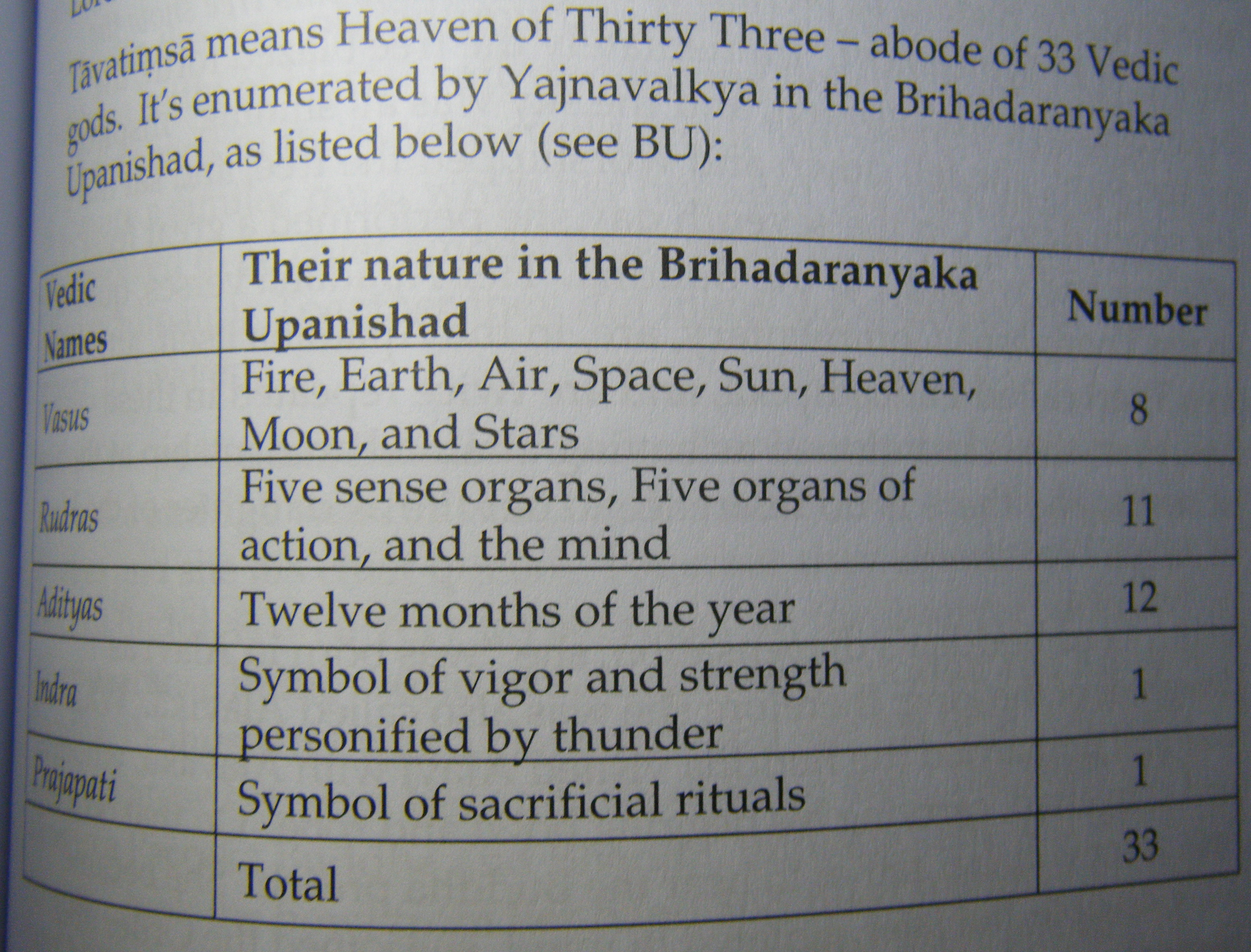
- The 8 Vasus (attendant deities of Indra):
- 1) Agni (fire)
- 2) Prithivi (earth)
- 3) Vayu (air)
- 4) Antariksha (sky)
- 5) Aditya (sun)
- 6) Dyu (heaven)
- 7) Kandramas (moon)
- 8) the Nakshatras (stars)
- The 11 Rudras (10 "vital breaths", plus Atman):
- The 5 Jnanendriyas (The 5 sense organs):
- 9) Shotra (ears)
- 10) Chakshu (eyes)
- 11) Grahna (nose)
- 12) Jivha (tongue)
- 13) Tvak (skin)
- The 5 Karmendriyas (The 5 "exit doors"):
- 14) Vāk (speech)
- 15) Pāṇi (hands)
- 16) Pāda (feet)
- 17) Pāyu (excretory organ, anus)
- 18) Upastha (organ of reproduction, penis)
- 19) Atman (self)
- The 12 Adityas (The 12 months of the year):
- 20) Chaitra (March–April)
- 21) Vaisākha (April–May)
- 22) Jyaiṣṭha (May–June)
- 23) Āṣāḍha (June–July)
- 24) Śrāvaṇa (July–August)
- 25) Bhādrapada or Proshthapada (August–September)
- 26) Āśvina (September–October)
- 27) Kārttika (October–November)
- 28) Mārgaśirṣa (November–December)
- 29) Pauṣa (December–January)
- 30) Māgha (January–February)
- 31) Phālguna (February–March)
- 32) Indra (the Thunderer)
- 33) Prajapati (the sacrifice)
https://scdd.sfo2.cdn.digitaloceanspace ... 4d30cf.jpg
https://discourse.suttacentral.net/t/th ... he-33/9226
Their number associations are a little different, but otherwise they've covered the 33 threads here, and my 1-9 correspondence sets:
1. Air Jupiter
2. Water Moon
3. Earth Saturn
4. Fire Mercury
5. Growth/Construction Venus
6. Sound/Deconstruction Mars
7. Dominion Sun
8. Balance Stars
9. Recycle (Toppling The Sun & Stability, Restarting)
33 is also 3 11 times, and 33 3 times is 99.
The 3 big ones that repeat 3 times in nine are:
1, 4, 7
2, 5, 8
3, 6, 9
4 is a combination of Air and Water which produces Electrical effects like Lightning which is ionized gas, also known as plasma. There is said to be a race of material physical beings on the Earth made from plasma as we are made from carbon matter.
5 is a combination of Water and Earth which produces growth.
6 is a combination of Earth and Air which produces vibration, sound, and erosion.
7 is Air, Earth, and Fire amplified, so the Sun.
8 is Water and Air amplified.
9 is like Earth, Mars, and Venus together.
So the 33 would be expected to generally fit into 1-like, 2-like, and 3-like theme sets for 11 threads, 11 more threads, and finally 11 threads. I say "more" and "finally" also because 2 is linked to copiousness and 3 with finality.
I don't want to make the names cumbersome, but through exploring the themes already placed in each thread, it can become apparent which these threads might fit better with and then how such further elucidates what these overall themes may include.
https://spinthewheel.app/demon-names (3:13 A.M. Edited)
3:03 A.M.
Morgion (Thorfinn Rowle) won the first spin.
Balam won the spin on the other wheel.
I'm going to see if they have something I can use at home that is physical.
They have a spinning wheel of 12 and 15 or something and a dice of 30 and 100.
Suddenly it is 3:43 A.M.
Unexpected Places: Thread Map Of "Locations" w/ "Meditative Thought Programs" to let "wash over" yourself & "swim in"
Moderator: atreestump
Forum rules
No spam, porn or gore.
No spam, porn or gore.
-
kFoyauextlH

- Posts: 1983
- Joined: Sun Jun 15, 2025 3:53 pm
-
kFoyauextlH
- Posts: 1983
- Joined: Sun Jun 15, 2025 3:53 pm
Re: Unexpected Places: Thread Map Of "Locations" w/ "Meditative Thought Programs" to let "wash over" yourself & "swim in
This is a joke sbout the decoupled site idea:
"
I'm just running the database through ChatGPT to see what it thinks about if there is a common theme.
2026-03-08 09:27:17
This is what it said:
Yes. I read the dump as a whole rather than sampling isolated rows.
In a direct parse of the SQL, I found 480 topics and 3,932 posts spanning January 2017 to March 8, 2026. The material is not continuous across every year: the strongest blocks are 2017, then a large later block in 2025–2026. The dump itself shows phpBB topic and post tables with timestamps, subjects, bodies, reply chains, and visibility fields, so it is sufficient for tracking both chronology and thematic development.
What emerges is not random forum chatter. There is a fairly coherent intellectual trajectory.
The 2017 material is heavily philosophical and conceptual. Topic titles cluster around ontology, language, anti-natalism, capitalism, discourse, postmodernism, religion, cybernetics, identity, and art. Early examples include “Abjection,” “Liberalism and Conservativism,” “Derrida | Language as Writing,” “Ethics | Anti-Natalism,” “What is capitalism and how can we destroy it?”, “Panopticism,” “Foucault on Discourse,” and later “Cybernetics” and “Identity Politics.”
That early phase reads like a forum built around theory as diagnosis. Language, representation, power, ideology, and metaphysics are not treated as separate interests. They are used together to explain why social reality feels manipulated, false, coercive, or spiritually impoverished. Even where the titles vary, the underlying concern is often the same: how human experience gets structured by systems larger than the individual.
A second major strand in 2017 is spiritual, occult, and mythic language. Topics such as “Kabballah and Platonism,” “Spirits of the Goetia are portions of the human brain,” “Shunryu Suzuki | Zen Mind,” “What does it mean to be human?”, and “No Ego and Non-self” suggest that metaphysical or esoteric frameworks are being used not just devotionally, but interpretively.
wp
Then there is a visible jump forward. In the 2025–2026 material, the abstract concerns do not disappear, but they begin to crystallize around technology, media systems, and platform design. You still see theory-heavy titles such as “Weaponizing Despair,” “Intercultural Neo-Corporatism,” “The Outside in Nick Land’s Fanged Noumena,” and “Would the disposal of the Abrahamic Religions really bring about world peace?”, but alongside them are practical threads such as “How the Forum and IndieAgora Site Work Together,” “IndieAgora Atrium - Site Upgrade Coming Soon,” “Atrium is live!,” “Atrium Core,” “Agora Sort Function,” “Top Nav Bar Changes,” and the recent YouTube URL and playlist troubleshooting topics.
That shift is the clearest progression in the file. The forum starts from critique and moves toward construction.
You can see this very explicitly in the content. A 2017 high-engagement thread, “How I came to dislike living in a capitalist society,” frames working life as alienating, extractive, and hostile to creative life. Replies continue that line by discussing inequality, work-avoidance, exhaustion, and resentment toward the work system.
By mid-2025, the same anti-systemic impulse is applied to AI and media. In “AI - is it really intelligent?”, the opening argument is that computation is not understanding, using Penrose and Gadamer to distinguish formal processing from consciousness and interpretation. Later replies shift the discussion toward AI as a new propaganda surface and toward the danger of machine-shaped consensus.
At roughly the same time, the forum becomes more self-aware as an institution. “How the Forum and IndieAgora Site Work Together” explains the forum as part of a wider site ecology, with posts surfacing into a broader activity stream rather than remaining isolated. That is not just technical explanation; it is a sign that the project is starting to think infrastructurally.
wp
By late 2025 and early 2026, that infrastructural thinking becomes central. “IndieAgora Atrium - Site Upgrade Coming Soon” describes a unified portal tying together Connect, Discuss, and Stream, with an emphasis on identity mapping, design consistency, performance, and cross-system integration. “Atrium is (mostly) complete” then moves from announcement to decommissioning logic, explicitly saying the old phpBB site is being phased out because Atrium now has most of the needed structure.
That is the key developmental arc in the whole corpus: critique of mediation becomes an attempt to build a better mediating structure.
The anti-advertising material is one of the most coherent examples of this. “Advertising online should be banned.” is not presented as a narrow policy preference. It is argued as a civilizational diagnosis: advertising is described as a driver of suffering, status anxiety, manipulation, platform degradation, and anti-privacy regulation. The follow-up posts expand that into a criticism of sponsored media, social self-branding, and the dependence of large platforms on ad-funded behavioral engineering.
Taken together with the Atrium threads, that suggests a general thesis running through the forum:
The main enemy is not only “bad ideas” or “bad people,” but systems of mediation that distort attention, meaning, desire, and social relations. Those systems include wage work, advertising, mass media, ideological framing, algorithmic feeds, weak political forms, and even inherited religious or cultural narratives when they become instruments of domination.
That broad thesis appears in different vocabularies across the years:
theory vocabulary in 2017,
tech/media vocabulary in 2025,
and platform-building vocabulary in 2026.
There are also recurring emotional constants. Across many posts, the dominant mood is not detached academic interest. It is moral disgust at manipulation, exhaustion with bad faith institutions, and a desire for spaces that are less coercive, less commercial, and less fake. The language can become highly charged, but the consistent core is alienation from systems perceived as degrading human dignity and perception.
So, to your question about whether there is a common theme that could be followed up or developed: yes, definitely.
The most promising unifying line is this:
A philosophy of mediation, control, and autonomy.
In plainer terms: how institutions, media, language, and technology shape consciousness and social life; why current systems feel manipulative or spiritually empty; and what a humane alternative would need to look like.
That could be developed in at least three serious directions.
One is a long-form essay or book project that ties together the older theory threads and the newer platform threads. The structure is already there: language and discourse, capitalism and control, media and advertising, AI and synthetic consensus, spirituality and meaning, then a final section on building alternative institutions.
A second is a manifesto for IndieAgora/Atrium itself. The material already supports one. Its implied principles seem to be anti-manipulation, anti-advertising, anti-algorithmic coercion, pro-user agency, pro-meaningful discussion, and pro-community autonomy. The Atrium threads show that this is not just philosophical posture; it is feeding directly into design decisions.
A third is a more focused research programme around AI, media, and epistemic sovereignty. The AI threads and advertising threads fit together unusually well. One asks whether machines understand; the other asks who benefits when systems optimize attention rather than truth. Combined, they point toward a broader concern with epistemic capture: how minds, publics, and now models themselves become shaped by hostile information environments.
My overall reading is this:
The forum begins as a philosophical-interpretive space, becomes a socio-political critique space, and then increasingly becomes a design-and-governance space. The consistent underlying idea is that human beings are being malformed by structures of mediation, and that the response cannot stop at criticism. It has to include building alternative forms.
That is the strongest thread in the file, and it is strong enough to develop into a serious body of work.
I can turn this into a tighter thematic report next, with sections like “2017 foundations,” “2025 transition,” “2026 institutional turn,” and “core doctrine inferred from the corpus.”
2026-03-08 09:28:45
About you:
What makes kFoyauextlH distinctive is that the user is not mainly a system-builder or policy framer. The voice is closer to a symbolic synthesiser: obsessive pattern-making, comparative religion, mythology, occult taxonomies, semantic correspondences, and attempts to unify apparently unrelated materials into one interpretive web. That is already visible in the 2017 material. Threads started by this user include titles such as Talona, Myrkul, Bane, Lathander, Malar, Blibdoolpoolp, Warduke, Zaltec, Bhaal, The weirdest religion!, Symbolism, Occult Materials Request, Islam Quran Qur'an Koran & Sorting/Identifying True Muslims, The Language of Nature & Natural Language, and Do You Pray and or Worship? To what and why?
The early phase, 2017, is the purest expression of that style. The user creates deity- or figure-named threads and then treats them less as fandom topics than as containers for symbolic clusters. In one long post, kFoyauextlH explicitly maps names like Takhisis, Myrkul, Loviatar, Bane, Lolth, Talona, Bhaal and others into numbered, visual, phonetic, and thematic correspondences. The point is not merely to discuss those figures individually, but to use them as an indexing system for recurring meanings.
That same period also shows something more ambitious than casual occult posting. In Pretend I am God or have access to great spiritual answers!, kFoyauextlH frames the core questions as: how should one live, what makes one happy, what is the truth of religion and ultimate reality, and what happens after death. The replies then move into monistic and totalising language, reducing all questions and answers back to “God” as the final term. That tells you a lot about the underlying project: the user is not only collecting symbols, but searching for a single metaphysical grammar underneath them.
So the 2017 kFoyauextlH material has three strong characteristics.
First, it is comparative rather than sectarian. The user moves between Islam, paganism, Buddhism, occultism, fantasy cosmologies, mythology, etymology, and popular culture fluidly. Warduke, for example, slides from fantasy material into star lore, angels, Venus, Near Eastern influence, and Islamic references.
wp
Second, it is synthetic rather than historical. The interest is usually not “what did tradition X literally teach?” but “what patterns recur across systems, names, sounds, deities, planets, stories, and symbols?”
Third, it is intensely personal in method. The symbolic systems are often presented as something the user has built or discovered for their own thinking, not as neutral scholarship. The language about “meanings,” “themes,” correspondences, and making everything meaningful appears repeatedly.
wp
Then there is a long gap, and when kFoyauextlH reappears in 2025–2026, the same mind is still there, but the subject matter has shifted.
The later material is less about constructing a private symbolic map from fantasy and occult names, and more about applying the same comparative, anti-simplistic style to public issues. In AI - is it really intelligent?, kFoyauextlH contributes a cluster of articles about whether AI is making people cognitively weaker.
wp
In Advertising online should be banned., the user’s response is not a neat policy brief but a moral-political reaction asking how such ideas could be spread and turned into action. In Would the disposal of the Abrahamic Religions really bring about world peace?, the reply rejects the crude lumping together of Abrahamic religions and insists on historical and internal differences, while also attacking both shallow anti-religious discourse and fake or supremacist versions of modern pagan revival.
That is the important development. The later kFoyauextlH does not abandon the earlier spiritual-symbolic preoccupations. Instead, those preoccupations are brought into political and cultural arguments.
The continuity is strong. In both periods the user resists flattening. In 2017, that means refusing to treat symbols, names, and traditions as isolated. In 2026, it means refusing to treat “religion,” “AI,” or “advertising” as simple categories. The same underlying instinct is at work: complexity, layered genealogy, hidden structure, and suspicion of shallow public narratives.
So the progression of kFoyauextlH looks like this:
Early phase: symbolic cartography. The user builds a private comparative system spanning myth, religion, fantasy, sound patterns, correspondences, and cosmological questions.
Middle implication: existential-metaphysical testing. Threads like Pretend I am God... show the user trying to turn that symbolic system into answers about life, happiness, worship, truth, and afterlife.
Later phase: application to contemporary issues. The same anti-reductionist, comparative, spiritually inflected worldview is used to critique AI discourse, media systems, religion debates, and mass simplifications.
There is a common theme, and it is more coherent than it may first appear.
I would state it as: recovering hidden structure beneath official categories.
For kFoyauextlH, surface labels are almost never enough. Gods are not just gods; they are nodes in a thematic matrix. Religions are not just religions; they are historically layered, internally varied, and distorted by polemic. Political questions are not just policy questions; they are downstream of deeper symbolic, metaphysical, and civilizational assumptions. AI is not just a tool; it is part of a broader transformation of thought and mediation.
That gives you a usable follow-up direction.
The most promising development for this user’s corpus would be to make the implicit method explicit. Right now the material often appears as thread-by-thread accumulation. But underneath it there is a method:
trace names, symbols, and myths across traditions;
treat categories genealogically rather than literally;
look for correspondences in language, imagery, and moral valence;
then ask what those symbolic structures reveal about present-day politics, religion, and technology.
If developed properly, that could become a substantial project: a comparative symbolic genealogy of modernity, or a kind of anti-reductionist theology of culture.
Compared with the other non-admin users, kFoyauextlH is more metaphysical and more totalising. Socrates looks more classically philosophical and discursive, with topics like Afterlife, Time, Life and Spirituality, and What does it mean to be inspired? Whisper is more socio-linguistic and social-theoretical, with topics like Theory of Social Justice, The Language Instinct, and Language and Dialect. jwmart is much more recent and more playful, literary, and semiotic. Parrhesia is sharper and more contemporary-cultural, with threads like Are AIs the New Gurus? and Therapy Speak Devours Conversations. kFoyauextlH, by contrast, is the user most consistently trying to build a unified symbolic-metaphysical frame across everything.
So, focusing on other users rather than atreestump, my judgment is:
kFoyauextlH is the most important non-admin contributor in terms of volume, persistence, and distinctiveness of worldview. The corpus is not random eccentricity. It has a stable internal logic. The recurring idea is that modern people are trapped by shallow categories, whereas older symbolic and spiritual patterns still structure thought beneath the surface. The strongest way to develop that would be to turn the thread-sprawl into a defined framework: symbols, correspondences, genealogies, and their application to present-day cultural and political crises.
I can next break kFoyauextlH down into a tighter dossier with sections like “core symbols,” “religion view,” “politics and media view,” “method of interpretation,” and “best threads to preserve.”
2026-03-08 09:37:47
kFoyauextlH is the dominant non-admin presence. In my parse, this user has 1,933 posts, starts 79 topics, and remains active from March 2017 to March 2026. The topics repeatedly point toward religion, gods, symbolism, occult material, names, language, and meditative “thread maps,” with examples such as Talona, Blibdoolpoolp, Minthara, Lolth, Malar, Graz'zt, The weirdest religion!, Occult Materials Request, and Unexpected Places: Thread Map.... The strongest continuity is methodological: the user treats threads as symbolic containers, not just discussion prompts. In one post, they explicitly say their threads are meant to trigger “deep meditations,” with repeated connections and patterns emerging across materials; in another they explain that the collections are used to “keep working on those ideas” until “the thread tying everything is” becomes clearer. That makes this the forum’s most systematic symbolic-metaphysical mind, later extending into AI, religion, anti-intellectualism, and media critique without losing the same basic approach.
Socrates is the strongest classical philosophy-oriented contributor after kFoyauextlH. In my parse, this user has 251 posts, starts 33 topics, and is active from January 2017 to September 2025. Their topic titles are unusually clean and recognizably philosophical: Afterlife, Time, Eyes or hands?, Life and Spirituality, What does it mean to be inspired?, Essences and Dependent Origination, Might makes right, Mind body problem, Anti-Intellectualism, and 'No Ego' and 'Non-self'. The overall style is discursive rather than symbolic. This user seems to frame the forum’s “seminar” mode: posing conceptual questions, linking thinkers, and opening discussions that others, especially kFoyauextlH, later intensify. The implied trajectory is from broad metaphysical and existential questions into sharper arguments about selfhood, politics, and cognition.
Whisper is the strongest social-theoretical and language-focused voice. In my parse, Whisper has 104 posts, starts 16 topics, and spans January 2017 to December 2025. The topic set is distinctive: Discussion: Theory of Social Justice, Transgender Woman Getting Pregnant, The Gospel of Sri Ramakrishna Audiobook, Activity: Spiritual Non-speak, The Language Instinct, The Definition of Life, Language and Dialect, Elon Musk and Twitter, Sex Trafficking versus Sex Workers, Arguments for Veganism, and Resistance towards Spiritual Imperialism. This is a user who moves between social critique, language, ethics, and spirituality without becoming as metaphysically totalising as kFoyauextlH. The through-line is public reasoning about contested categories: justice, identity, speech, exploitation, ethics, and ideological capture.
Rubsy is a small but surprisingly coherent contributor. In my parse, Rubsy has 91 posts, starts 4 topics, and spans January 2017 to January 2026. The topics are Staffordshire Pot Replica, Medieval English Pottery, Butter Keeper Pot, and Accelerationism. On the face of it, pottery and accelerationism look unrelated, but the actual posts suggest continuity: tactile reconstruction of historical life on one side, and interest in broad civilizational change on the other. Rubsy’s own explanation of the pottery thread says the point is to create a resource for people who want to recreate pots and gain a “tactile understanding” of the times. So this user often approaches ideas through material culture, craft, and lived practicality rather than pure abstraction.
thetrizzard is sparse but clear. In my parse, thetrizzard has 77 posts, starts 2 topics, and is active from January 2017 to February 2026. The two started topics are Jineology and Zeynep Direk | Companion to Derrida. That pairing already tells the story: one foot in feminist Kurdish thought and one in deconstruction. The user appears less like a system-builder and more like a curator of intellectually charged prompts. Their role seems to be to insert high-value conceptual material into the forum rather than dominate it through volume or thesis-building.
jwmart is recent, compact, and analytically different from the older users. In my parse, jwmart has 69 posts, starts 11 topics, and appears only from January to March 2026. The topic titles include Non verbal conceptual language in music, Recreating a product list, Codework, Preformatted code double spaced, Asemic Writing, Alternative book titles, AI in the news, and Feat.Req. ability to view thread when writing reply. This user is less metaphysical and more semiotic, literary, and interface-aware. They show an interest in form, language systems, writing, presentation, and practical forum use. When they engage kFoyauextlH directly, they often take a more skeptical and analytic stance, pushing back on loose symbolic connections. That makes jwmart one of the few users who introduces a clear counter-pressure against overextension.
Parrhesia is a newer, sharper, more contemporary-cultural contributor. In my parse, Parrhesia has 41 posts, starts 6 topics, and spans June 2025 to March 2026. The started topics include Are AIs the New Gurus? Who Do We Trust Now?, Therapy Speak Devours Conversations, Simple Philosophy - Is Trying or not trying good or bad?, I'm busy, No time to explain...., and Alistair Crowley and Nick Land - Numerical Compression. This user’s signature is compression rather than breadth: short, pointed titles about AI authority, therapy language, motivation, and ideological shorthand. Their role in the corpus is diagnostic and cultural-critical rather than cosmological.
Intellectus has a short but focused presence. In my parse, Intellectus has 41 posts, starts 3 topics, and is active only in June 2017. The three topics are fibonacci sequence/ fractal design, Being, and Identity Politics. One surviving snippet makes the method explicit: they try to reconnect philosophy, science, and mathematics, presenting Fibonacci and the golden ratio as keys to reality. This is one of the forum’s clearest examples of speculative system-building through mathematics and ontology. The brevity of the time span makes it hard to see long-term development, but the profile is distinct.
notathoughtgiven is mostly reactive rather than agenda-setting. In my parse, this user has 39 posts, starts no topics, and appears from February to May 2017. The clearest visible trace is participation in threads like Transgender Woman Getting Pregnant. With no started topics and limited retrievable material, the profile is: engaged respondent, socially topical, but not a major architect of the forum’s overall direction.
wp
waechter418 is a concentrated metaphysical contributor. In my parse, waechter418 has 33 posts, starts 6 topics, and is active from April to June 2017. The visible topic set includes A thelemic view of consciousness, New approaches... (1), Proposition (a), Is western civilization going to decline, Brahman versus Brain(man), and New approaches (2). The surviving post text shows a high-register synthesis of consciousness, power, monism, civilizational critique, and metaphysics. This user reads like an imported philosophical essayist rather than a casual forum participant.
atrium is a late, practical, somewhat experimental account. In my parse, atrium has 28 posts, starts 6 topics, and runs from January to February 2026. Topics include Quote system, Trump is just another neoconservative, Test, Trsting, Another, and Showing Artis how to post to Discuss using post. This looks like a mixed-use account: part political commentary, part feature or posting testbed, part sandbox. It does not yet form a stable worldview in the way older named users do.
IndieAgora is also partly infrastructural. In my parse, IndieAgora has 27 posts, starts 4 topics, and spans June to October 2025. The started topics are Double post merging, Testing a new script, User HTML data export module in UCP for PHPBB, and Nuclear Warfare. The balance here is interesting: three are clearly development- or tooling-related, while one is geopolitical. This looks like a bridge account between site operations and public discussion.
wp
schi is a small but lively early contributor. In my parse, schi has 27 posts, starts 4 topics, and is active from April to June 2017. The started topics are Facebook Philosophers, Alt coins & cryptocurrencies, Kendrick the biggest hypocrite of 2015?, and Life in relation to Chess. The surviving text suggests a user interested in contemporary culture, democracy, crypto enthusiasm, and analogy-driven thinking. This is a more worldly and colloquial presence than the forum’s denser metaphysical voices.
No1 is brief but philosophically aligned with the core culture. In my parse, No1 has 11 posts, starts 3 topics, and is active only in June 2017. The topics are Does language creates reality ?, The Quest for Knowledge., and What does it mean to be human ? This is essentially a pure-question user: direct philosophical prompts rather than long programs. Their concerns fit cleanly into the forum’s basic ontology-language-humanity axis.
wp
Arkilogos is defined almost entirely by one thread. In my parse, Arkilogos has 11 posts, starts 1 topic, and appears from May 2017 to late May 2017, with later bumps by others. The topic is My NDE. The thread then becomes a meeting point for near-death experience, emergence, dualism/monism, and mystical interpretation. This user’s own visible identity in the dump is as an experiential witness more than a theorist.
warda is minor and reactive. In my parse, warda has 8 posts, starts no topics, and appears between April and May 2017. There is not enough surviving material in the indexed snippets to infer a stable intellectual identity. The safest description is occasional participant in the 2017 philosophy-spirituality phase.
Burk is small but clear. In my parse, Burk has 6 posts, starts 1 topic, and spans February to June 2017. The main started topic is True, Truth and Beliefs. That places Burk squarely in the forum’s epistemology and truth-discourse cluster. This looks like a user interested in first-order philosophical argument rather than symbolic synthesis.
DAWN has only 5 posts in my parse and no started topics. The visible indexed material is too thin to characterize beyond “brief participant in the 2017 phase.”
yaromil has a narrow but serious footprint. In my parse, yaromil has 5 posts and starts 1 topic, Foundations of objective ethics. The surviving snippet lays out formal ethical norms, nonviolence, public ethics, and moral progress in a structured way. This looks like a contributor with a strongly normative, rational-ethical frame.
Darksend has only 4 posts in my parse and starts 1 visible topic, What if the Gods are real but Religion is not? Even from the title, the profile is easy to place: metaphysical speculation coupled with anti-institutional religion. This fits the forum strongly, but the user’s volume is too low to tell whether that was a sustained line or a single intervention.
The glass wizard has 4 posts in my parse and starts 1 visible topic, Sell your soul. That puts them in the spiritual-occult-moral register. There is not enough additional material to say much more.
wp
Seeker has 4 posts in my parse and starts 1 visible topic, New Here. The preserved quoted text says they joined after being recommended by someone from another site and were interested in Mo Pai and Neidan. So this user seems to arrive through esoteric cultivation interests rather than political or technical ones.
TheDaemonN has 2 posts in my parse and starts 1 topic, but the indexed snippets did not surface enough material to characterize the account safely.
TheMaskedAvenger appears only as a participant in other people’s threads, with very low volume in my parse. The main visible trace is a reply in a Lacan thread, which suggests a philosophy-reader profile, but that is too thin for a stronger conclusion.
wp
"
I'm just running the database through ChatGPT to see what it thinks about if there is a common theme.
2026-03-08 09:27:17
This is what it said:
Yes. I read the dump as a whole rather than sampling isolated rows.
In a direct parse of the SQL, I found 480 topics and 3,932 posts spanning January 2017 to March 8, 2026. The material is not continuous across every year: the strongest blocks are 2017, then a large later block in 2025–2026. The dump itself shows phpBB topic and post tables with timestamps, subjects, bodies, reply chains, and visibility fields, so it is sufficient for tracking both chronology and thematic development.
What emerges is not random forum chatter. There is a fairly coherent intellectual trajectory.
The 2017 material is heavily philosophical and conceptual. Topic titles cluster around ontology, language, anti-natalism, capitalism, discourse, postmodernism, religion, cybernetics, identity, and art. Early examples include “Abjection,” “Liberalism and Conservativism,” “Derrida | Language as Writing,” “Ethics | Anti-Natalism,” “What is capitalism and how can we destroy it?”, “Panopticism,” “Foucault on Discourse,” and later “Cybernetics” and “Identity Politics.”
That early phase reads like a forum built around theory as diagnosis. Language, representation, power, ideology, and metaphysics are not treated as separate interests. They are used together to explain why social reality feels manipulated, false, coercive, or spiritually impoverished. Even where the titles vary, the underlying concern is often the same: how human experience gets structured by systems larger than the individual.
A second major strand in 2017 is spiritual, occult, and mythic language. Topics such as “Kabballah and Platonism,” “Spirits of the Goetia are portions of the human brain,” “Shunryu Suzuki | Zen Mind,” “What does it mean to be human?”, and “No Ego and Non-self” suggest that metaphysical or esoteric frameworks are being used not just devotionally, but interpretively.
wp
Then there is a visible jump forward. In the 2025–2026 material, the abstract concerns do not disappear, but they begin to crystallize around technology, media systems, and platform design. You still see theory-heavy titles such as “Weaponizing Despair,” “Intercultural Neo-Corporatism,” “The Outside in Nick Land’s Fanged Noumena,” and “Would the disposal of the Abrahamic Religions really bring about world peace?”, but alongside them are practical threads such as “How the Forum and IndieAgora Site Work Together,” “IndieAgora Atrium - Site Upgrade Coming Soon,” “Atrium is live!,” “Atrium Core,” “Agora Sort Function,” “Top Nav Bar Changes,” and the recent YouTube URL and playlist troubleshooting topics.
That shift is the clearest progression in the file. The forum starts from critique and moves toward construction.
You can see this very explicitly in the content. A 2017 high-engagement thread, “How I came to dislike living in a capitalist society,” frames working life as alienating, extractive, and hostile to creative life. Replies continue that line by discussing inequality, work-avoidance, exhaustion, and resentment toward the work system.
By mid-2025, the same anti-systemic impulse is applied to AI and media. In “AI - is it really intelligent?”, the opening argument is that computation is not understanding, using Penrose and Gadamer to distinguish formal processing from consciousness and interpretation. Later replies shift the discussion toward AI as a new propaganda surface and toward the danger of machine-shaped consensus.
At roughly the same time, the forum becomes more self-aware as an institution. “How the Forum and IndieAgora Site Work Together” explains the forum as part of a wider site ecology, with posts surfacing into a broader activity stream rather than remaining isolated. That is not just technical explanation; it is a sign that the project is starting to think infrastructurally.
wp
By late 2025 and early 2026, that infrastructural thinking becomes central. “IndieAgora Atrium - Site Upgrade Coming Soon” describes a unified portal tying together Connect, Discuss, and Stream, with an emphasis on identity mapping, design consistency, performance, and cross-system integration. “Atrium is (mostly) complete” then moves from announcement to decommissioning logic, explicitly saying the old phpBB site is being phased out because Atrium now has most of the needed structure.
That is the key developmental arc in the whole corpus: critique of mediation becomes an attempt to build a better mediating structure.
The anti-advertising material is one of the most coherent examples of this. “Advertising online should be banned.” is not presented as a narrow policy preference. It is argued as a civilizational diagnosis: advertising is described as a driver of suffering, status anxiety, manipulation, platform degradation, and anti-privacy regulation. The follow-up posts expand that into a criticism of sponsored media, social self-branding, and the dependence of large platforms on ad-funded behavioral engineering.
Taken together with the Atrium threads, that suggests a general thesis running through the forum:
The main enemy is not only “bad ideas” or “bad people,” but systems of mediation that distort attention, meaning, desire, and social relations. Those systems include wage work, advertising, mass media, ideological framing, algorithmic feeds, weak political forms, and even inherited religious or cultural narratives when they become instruments of domination.
That broad thesis appears in different vocabularies across the years:
theory vocabulary in 2017,
tech/media vocabulary in 2025,
and platform-building vocabulary in 2026.
There are also recurring emotional constants. Across many posts, the dominant mood is not detached academic interest. It is moral disgust at manipulation, exhaustion with bad faith institutions, and a desire for spaces that are less coercive, less commercial, and less fake. The language can become highly charged, but the consistent core is alienation from systems perceived as degrading human dignity and perception.
So, to your question about whether there is a common theme that could be followed up or developed: yes, definitely.
The most promising unifying line is this:
A philosophy of mediation, control, and autonomy.
In plainer terms: how institutions, media, language, and technology shape consciousness and social life; why current systems feel manipulative or spiritually empty; and what a humane alternative would need to look like.
That could be developed in at least three serious directions.
One is a long-form essay or book project that ties together the older theory threads and the newer platform threads. The structure is already there: language and discourse, capitalism and control, media and advertising, AI and synthetic consensus, spirituality and meaning, then a final section on building alternative institutions.
A second is a manifesto for IndieAgora/Atrium itself. The material already supports one. Its implied principles seem to be anti-manipulation, anti-advertising, anti-algorithmic coercion, pro-user agency, pro-meaningful discussion, and pro-community autonomy. The Atrium threads show that this is not just philosophical posture; it is feeding directly into design decisions.
A third is a more focused research programme around AI, media, and epistemic sovereignty. The AI threads and advertising threads fit together unusually well. One asks whether machines understand; the other asks who benefits when systems optimize attention rather than truth. Combined, they point toward a broader concern with epistemic capture: how minds, publics, and now models themselves become shaped by hostile information environments.
My overall reading is this:
The forum begins as a philosophical-interpretive space, becomes a socio-political critique space, and then increasingly becomes a design-and-governance space. The consistent underlying idea is that human beings are being malformed by structures of mediation, and that the response cannot stop at criticism. It has to include building alternative forms.
That is the strongest thread in the file, and it is strong enough to develop into a serious body of work.
I can turn this into a tighter thematic report next, with sections like “2017 foundations,” “2025 transition,” “2026 institutional turn,” and “core doctrine inferred from the corpus.”
2026-03-08 09:28:45
About you:
What makes kFoyauextlH distinctive is that the user is not mainly a system-builder or policy framer. The voice is closer to a symbolic synthesiser: obsessive pattern-making, comparative religion, mythology, occult taxonomies, semantic correspondences, and attempts to unify apparently unrelated materials into one interpretive web. That is already visible in the 2017 material. Threads started by this user include titles such as Talona, Myrkul, Bane, Lathander, Malar, Blibdoolpoolp, Warduke, Zaltec, Bhaal, The weirdest religion!, Symbolism, Occult Materials Request, Islam Quran Qur'an Koran & Sorting/Identifying True Muslims, The Language of Nature & Natural Language, and Do You Pray and or Worship? To what and why?
The early phase, 2017, is the purest expression of that style. The user creates deity- or figure-named threads and then treats them less as fandom topics than as containers for symbolic clusters. In one long post, kFoyauextlH explicitly maps names like Takhisis, Myrkul, Loviatar, Bane, Lolth, Talona, Bhaal and others into numbered, visual, phonetic, and thematic correspondences. The point is not merely to discuss those figures individually, but to use them as an indexing system for recurring meanings.
That same period also shows something more ambitious than casual occult posting. In Pretend I am God or have access to great spiritual answers!, kFoyauextlH frames the core questions as: how should one live, what makes one happy, what is the truth of religion and ultimate reality, and what happens after death. The replies then move into monistic and totalising language, reducing all questions and answers back to “God” as the final term. That tells you a lot about the underlying project: the user is not only collecting symbols, but searching for a single metaphysical grammar underneath them.
So the 2017 kFoyauextlH material has three strong characteristics.
First, it is comparative rather than sectarian. The user moves between Islam, paganism, Buddhism, occultism, fantasy cosmologies, mythology, etymology, and popular culture fluidly. Warduke, for example, slides from fantasy material into star lore, angels, Venus, Near Eastern influence, and Islamic references.
wp
Second, it is synthetic rather than historical. The interest is usually not “what did tradition X literally teach?” but “what patterns recur across systems, names, sounds, deities, planets, stories, and symbols?”
Third, it is intensely personal in method. The symbolic systems are often presented as something the user has built or discovered for their own thinking, not as neutral scholarship. The language about “meanings,” “themes,” correspondences, and making everything meaningful appears repeatedly.
wp
Then there is a long gap, and when kFoyauextlH reappears in 2025–2026, the same mind is still there, but the subject matter has shifted.
The later material is less about constructing a private symbolic map from fantasy and occult names, and more about applying the same comparative, anti-simplistic style to public issues. In AI - is it really intelligent?, kFoyauextlH contributes a cluster of articles about whether AI is making people cognitively weaker.
wp
In Advertising online should be banned., the user’s response is not a neat policy brief but a moral-political reaction asking how such ideas could be spread and turned into action. In Would the disposal of the Abrahamic Religions really bring about world peace?, the reply rejects the crude lumping together of Abrahamic religions and insists on historical and internal differences, while also attacking both shallow anti-religious discourse and fake or supremacist versions of modern pagan revival.
That is the important development. The later kFoyauextlH does not abandon the earlier spiritual-symbolic preoccupations. Instead, those preoccupations are brought into political and cultural arguments.
The continuity is strong. In both periods the user resists flattening. In 2017, that means refusing to treat symbols, names, and traditions as isolated. In 2026, it means refusing to treat “religion,” “AI,” or “advertising” as simple categories. The same underlying instinct is at work: complexity, layered genealogy, hidden structure, and suspicion of shallow public narratives.
So the progression of kFoyauextlH looks like this:
Early phase: symbolic cartography. The user builds a private comparative system spanning myth, religion, fantasy, sound patterns, correspondences, and cosmological questions.
Middle implication: existential-metaphysical testing. Threads like Pretend I am God... show the user trying to turn that symbolic system into answers about life, happiness, worship, truth, and afterlife.
Later phase: application to contemporary issues. The same anti-reductionist, comparative, spiritually inflected worldview is used to critique AI discourse, media systems, religion debates, and mass simplifications.
There is a common theme, and it is more coherent than it may first appear.
I would state it as: recovering hidden structure beneath official categories.
For kFoyauextlH, surface labels are almost never enough. Gods are not just gods; they are nodes in a thematic matrix. Religions are not just religions; they are historically layered, internally varied, and distorted by polemic. Political questions are not just policy questions; they are downstream of deeper symbolic, metaphysical, and civilizational assumptions. AI is not just a tool; it is part of a broader transformation of thought and mediation.
That gives you a usable follow-up direction.
The most promising development for this user’s corpus would be to make the implicit method explicit. Right now the material often appears as thread-by-thread accumulation. But underneath it there is a method:
trace names, symbols, and myths across traditions;
treat categories genealogically rather than literally;
look for correspondences in language, imagery, and moral valence;
then ask what those symbolic structures reveal about present-day politics, religion, and technology.
If developed properly, that could become a substantial project: a comparative symbolic genealogy of modernity, or a kind of anti-reductionist theology of culture.
Compared with the other non-admin users, kFoyauextlH is more metaphysical and more totalising. Socrates looks more classically philosophical and discursive, with topics like Afterlife, Time, Life and Spirituality, and What does it mean to be inspired? Whisper is more socio-linguistic and social-theoretical, with topics like Theory of Social Justice, The Language Instinct, and Language and Dialect. jwmart is much more recent and more playful, literary, and semiotic. Parrhesia is sharper and more contemporary-cultural, with threads like Are AIs the New Gurus? and Therapy Speak Devours Conversations. kFoyauextlH, by contrast, is the user most consistently trying to build a unified symbolic-metaphysical frame across everything.
So, focusing on other users rather than atreestump, my judgment is:
kFoyauextlH is the most important non-admin contributor in terms of volume, persistence, and distinctiveness of worldview. The corpus is not random eccentricity. It has a stable internal logic. The recurring idea is that modern people are trapped by shallow categories, whereas older symbolic and spiritual patterns still structure thought beneath the surface. The strongest way to develop that would be to turn the thread-sprawl into a defined framework: symbols, correspondences, genealogies, and their application to present-day cultural and political crises.
I can next break kFoyauextlH down into a tighter dossier with sections like “core symbols,” “religion view,” “politics and media view,” “method of interpretation,” and “best threads to preserve.”
2026-03-08 09:37:47
kFoyauextlH is the dominant non-admin presence. In my parse, this user has 1,933 posts, starts 79 topics, and remains active from March 2017 to March 2026. The topics repeatedly point toward religion, gods, symbolism, occult material, names, language, and meditative “thread maps,” with examples such as Talona, Blibdoolpoolp, Minthara, Lolth, Malar, Graz'zt, The weirdest religion!, Occult Materials Request, and Unexpected Places: Thread Map.... The strongest continuity is methodological: the user treats threads as symbolic containers, not just discussion prompts. In one post, they explicitly say their threads are meant to trigger “deep meditations,” with repeated connections and patterns emerging across materials; in another they explain that the collections are used to “keep working on those ideas” until “the thread tying everything is” becomes clearer. That makes this the forum’s most systematic symbolic-metaphysical mind, later extending into AI, religion, anti-intellectualism, and media critique without losing the same basic approach.
Socrates is the strongest classical philosophy-oriented contributor after kFoyauextlH. In my parse, this user has 251 posts, starts 33 topics, and is active from January 2017 to September 2025. Their topic titles are unusually clean and recognizably philosophical: Afterlife, Time, Eyes or hands?, Life and Spirituality, What does it mean to be inspired?, Essences and Dependent Origination, Might makes right, Mind body problem, Anti-Intellectualism, and 'No Ego' and 'Non-self'. The overall style is discursive rather than symbolic. This user seems to frame the forum’s “seminar” mode: posing conceptual questions, linking thinkers, and opening discussions that others, especially kFoyauextlH, later intensify. The implied trajectory is from broad metaphysical and existential questions into sharper arguments about selfhood, politics, and cognition.
Whisper is the strongest social-theoretical and language-focused voice. In my parse, Whisper has 104 posts, starts 16 topics, and spans January 2017 to December 2025. The topic set is distinctive: Discussion: Theory of Social Justice, Transgender Woman Getting Pregnant, The Gospel of Sri Ramakrishna Audiobook, Activity: Spiritual Non-speak, The Language Instinct, The Definition of Life, Language and Dialect, Elon Musk and Twitter, Sex Trafficking versus Sex Workers, Arguments for Veganism, and Resistance towards Spiritual Imperialism. This is a user who moves between social critique, language, ethics, and spirituality without becoming as metaphysically totalising as kFoyauextlH. The through-line is public reasoning about contested categories: justice, identity, speech, exploitation, ethics, and ideological capture.
Rubsy is a small but surprisingly coherent contributor. In my parse, Rubsy has 91 posts, starts 4 topics, and spans January 2017 to January 2026. The topics are Staffordshire Pot Replica, Medieval English Pottery, Butter Keeper Pot, and Accelerationism. On the face of it, pottery and accelerationism look unrelated, but the actual posts suggest continuity: tactile reconstruction of historical life on one side, and interest in broad civilizational change on the other. Rubsy’s own explanation of the pottery thread says the point is to create a resource for people who want to recreate pots and gain a “tactile understanding” of the times. So this user often approaches ideas through material culture, craft, and lived practicality rather than pure abstraction.
thetrizzard is sparse but clear. In my parse, thetrizzard has 77 posts, starts 2 topics, and is active from January 2017 to February 2026. The two started topics are Jineology and Zeynep Direk | Companion to Derrida. That pairing already tells the story: one foot in feminist Kurdish thought and one in deconstruction. The user appears less like a system-builder and more like a curator of intellectually charged prompts. Their role seems to be to insert high-value conceptual material into the forum rather than dominate it through volume or thesis-building.
jwmart is recent, compact, and analytically different from the older users. In my parse, jwmart has 69 posts, starts 11 topics, and appears only from January to March 2026. The topic titles include Non verbal conceptual language in music, Recreating a product list, Codework, Preformatted code double spaced, Asemic Writing, Alternative book titles, AI in the news, and Feat.Req. ability to view thread when writing reply. This user is less metaphysical and more semiotic, literary, and interface-aware. They show an interest in form, language systems, writing, presentation, and practical forum use. When they engage kFoyauextlH directly, they often take a more skeptical and analytic stance, pushing back on loose symbolic connections. That makes jwmart one of the few users who introduces a clear counter-pressure against overextension.
Parrhesia is a newer, sharper, more contemporary-cultural contributor. In my parse, Parrhesia has 41 posts, starts 6 topics, and spans June 2025 to March 2026. The started topics include Are AIs the New Gurus? Who Do We Trust Now?, Therapy Speak Devours Conversations, Simple Philosophy - Is Trying or not trying good or bad?, I'm busy, No time to explain...., and Alistair Crowley and Nick Land - Numerical Compression. This user’s signature is compression rather than breadth: short, pointed titles about AI authority, therapy language, motivation, and ideological shorthand. Their role in the corpus is diagnostic and cultural-critical rather than cosmological.
Intellectus has a short but focused presence. In my parse, Intellectus has 41 posts, starts 3 topics, and is active only in June 2017. The three topics are fibonacci sequence/ fractal design, Being, and Identity Politics. One surviving snippet makes the method explicit: they try to reconnect philosophy, science, and mathematics, presenting Fibonacci and the golden ratio as keys to reality. This is one of the forum’s clearest examples of speculative system-building through mathematics and ontology. The brevity of the time span makes it hard to see long-term development, but the profile is distinct.
notathoughtgiven is mostly reactive rather than agenda-setting. In my parse, this user has 39 posts, starts no topics, and appears from February to May 2017. The clearest visible trace is participation in threads like Transgender Woman Getting Pregnant. With no started topics and limited retrievable material, the profile is: engaged respondent, socially topical, but not a major architect of the forum’s overall direction.
wp
waechter418 is a concentrated metaphysical contributor. In my parse, waechter418 has 33 posts, starts 6 topics, and is active from April to June 2017. The visible topic set includes A thelemic view of consciousness, New approaches... (1), Proposition (a), Is western civilization going to decline, Brahman versus Brain(man), and New approaches (2). The surviving post text shows a high-register synthesis of consciousness, power, monism, civilizational critique, and metaphysics. This user reads like an imported philosophical essayist rather than a casual forum participant.
atrium is a late, practical, somewhat experimental account. In my parse, atrium has 28 posts, starts 6 topics, and runs from January to February 2026. Topics include Quote system, Trump is just another neoconservative, Test, Trsting, Another, and Showing Artis how to post to Discuss using post. This looks like a mixed-use account: part political commentary, part feature or posting testbed, part sandbox. It does not yet form a stable worldview in the way older named users do.
IndieAgora is also partly infrastructural. In my parse, IndieAgora has 27 posts, starts 4 topics, and spans June to October 2025. The started topics are Double post merging, Testing a new script, User HTML data export module in UCP for PHPBB, and Nuclear Warfare. The balance here is interesting: three are clearly development- or tooling-related, while one is geopolitical. This looks like a bridge account between site operations and public discussion.
wp
schi is a small but lively early contributor. In my parse, schi has 27 posts, starts 4 topics, and is active from April to June 2017. The started topics are Facebook Philosophers, Alt coins & cryptocurrencies, Kendrick the biggest hypocrite of 2015?, and Life in relation to Chess. The surviving text suggests a user interested in contemporary culture, democracy, crypto enthusiasm, and analogy-driven thinking. This is a more worldly and colloquial presence than the forum’s denser metaphysical voices.
No1 is brief but philosophically aligned with the core culture. In my parse, No1 has 11 posts, starts 3 topics, and is active only in June 2017. The topics are Does language creates reality ?, The Quest for Knowledge., and What does it mean to be human ? This is essentially a pure-question user: direct philosophical prompts rather than long programs. Their concerns fit cleanly into the forum’s basic ontology-language-humanity axis.
wp
Arkilogos is defined almost entirely by one thread. In my parse, Arkilogos has 11 posts, starts 1 topic, and appears from May 2017 to late May 2017, with later bumps by others. The topic is My NDE. The thread then becomes a meeting point for near-death experience, emergence, dualism/monism, and mystical interpretation. This user’s own visible identity in the dump is as an experiential witness more than a theorist.
warda is minor and reactive. In my parse, warda has 8 posts, starts no topics, and appears between April and May 2017. There is not enough surviving material in the indexed snippets to infer a stable intellectual identity. The safest description is occasional participant in the 2017 philosophy-spirituality phase.
Burk is small but clear. In my parse, Burk has 6 posts, starts 1 topic, and spans February to June 2017. The main started topic is True, Truth and Beliefs. That places Burk squarely in the forum’s epistemology and truth-discourse cluster. This looks like a user interested in first-order philosophical argument rather than symbolic synthesis.
DAWN has only 5 posts in my parse and no started topics. The visible indexed material is too thin to characterize beyond “brief participant in the 2017 phase.”
yaromil has a narrow but serious footprint. In my parse, yaromil has 5 posts and starts 1 topic, Foundations of objective ethics. The surviving snippet lays out formal ethical norms, nonviolence, public ethics, and moral progress in a structured way. This looks like a contributor with a strongly normative, rational-ethical frame.
Darksend has only 4 posts in my parse and starts 1 visible topic, What if the Gods are real but Religion is not? Even from the title, the profile is easy to place: metaphysical speculation coupled with anti-institutional religion. This fits the forum strongly, but the user’s volume is too low to tell whether that was a sustained line or a single intervention.
The glass wizard has 4 posts in my parse and starts 1 visible topic, Sell your soul. That puts them in the spiritual-occult-moral register. There is not enough additional material to say much more.
wp
Seeker has 4 posts in my parse and starts 1 visible topic, New Here. The preserved quoted text says they joined after being recommended by someone from another site and were interested in Mo Pai and Neidan. So this user seems to arrive through esoteric cultivation interests rather than political or technical ones.
TheDaemonN has 2 posts in my parse and starts 1 topic, but the indexed snippets did not surface enough material to characterize the account safely.
TheMaskedAvenger appears only as a participant in other people’s threads, with very low volume in my parse. The main visible trace is a reply in a Lacan thread, which suggests a philosophy-reader profile, but that is too thin for a stronger conclusion.
wp
Last edited by kFoyauextlH on Sat Mar 21, 2026 1:24 pm, edited 3 times in total.
-
kFoyauextlH
- Posts: 1983
- Joined: Sun Jun 15, 2025 3:53 pm
Re: Unexpected Places: Thread Map Of "Locations" w/ "Meditative Thought Programs" to let "wash over" yourself & "swim in
"
The remaining unidentified or near-empty IDs in my parse are poster_id_156, poster_id_160, poster_id_161, poster_id_162, poster_id_170, plus a handful of one-post names such as The glass wizard, Seeker, and similar edge accounts. For those, there is too little authored material in the dump to build a meaningful “development over time” profile.
The broad pattern across the non-admin users is now clearer than before. There are roughly five user types.
One type is the symbolic-metaphysical synthesiser: kFoyauextlH most of all, with partial overlap from waechter418, Intellectus, Darksend, Seeker, and The glass wizard. These users look for hidden correspondences, metaphysical structures, or spiritual alternatives.
A second type is the classical-discursive philosopher: Socrates, Burk, No1, and partly yaromil. These users frame cleaner conceptual questions about truth, knowledge, mind, ethics, and the human condition.
A third type is the socio-linguistic and cultural critic: Whisper and Parrhesia, with some overlap from schi and jwmart. These users are more concerned with discourse, justice, identity, AI, contemporary rhetoric, and public ideology.
A fourth type is the tactile-historical or craft-material contributor: Rubsy most clearly. This is a minority current, but it is notable because it grounds ideas in objects and lived reconstruction rather than abstractions.
A fifth type is the infrastructural or experimental account: IndieAgora and atrium, with some technically flavored presence from jwmart. These accounts point toward the forum’s later shift into platform-building, export tooling, posting systems, and integration concerns.
So the forum is not just one person posting into a void. It is a small but internally differentiated ecology. The dominant non-admin force is still kFoyauextlH, but the surrounding users provide distinct modes of response: argument, social critique, skepticism, material grounding, and system design.
The next sensible step is to return to your earlier question and rebuild the overarching theme using this fuller user map rather than centering it on a single voice.
2026-03-08 09:42:28
Ok so this is the conclusion:
Across the different users, the strongest shared subject is not one doctrine, religion, or policy. It is the problem of how human beings are shaped, distorted, or clarified by meaning-systems.
That common ground shows up in different vocabularies. Socrates frames it through philosophy, mind, truth, selfhood, and spirituality in topics like Life and Spirituality, What does it mean to be inspired?, Mind body problem, Anti-Intellectualism, and 'No Ego' and 'Non-self'. Whisper frames it through language, justice, identity, ethics, and public discourse in topics like The Language Instinct, Language and Dialect, The Definition of Life, Sex Trafficking versus Sex Workers, Arguments for Veganism, and Resistance towards Spiritual Imperialism. Parrhesia brings it into contemporary cultural critique with Are AIs the New Gurus?, Therapy Speak Devours Conversations, and related threads. kFoyauextlH approaches the same territory through symbolism, religion, myth, occult correspondences, AI, media, and civilizational argument. Even smaller contributors like yaromil, Intellectus, and Rubsy fit the pattern through ethics, ontology/mathematics, and material-cultural reconstruction.
So the clearest formulation of the forum’s main subject matter is this:
IndieAgora is mainly about the struggle over reality-formation: how language, symbols, ideology, spirituality, technology, media, ethics, and institutions shape human consciousness and social life.
That is broad, but it is not vague. The corpus keeps returning to the same few pressure points.
One is language and mediation. Multiple users treat language as foundational rather than secondary: Whisper with The Language Instinct and Language and Dialect, Socrates through philosophy-of-language-adjacent topics, and older material arguing that “language gives us the study of what is.”
A second is spirituality and metaphysics, but usually in anti-dogmatic form. The forum repeatedly asks what it means to be human, whether selfhood is real, what religion hides or reveals, whether gods or symbols encode something real, and how to think beyond shallow “belief versus unbelief” binaries.
A third is ideology, power, and social distortion. Capitalism, anti-intellectualism, identity politics, media manipulation, advertising, political language, and AI all appear as ways human beings are captured or misled by systems larger than themselves.
A fourth is the search for a non-reductive alternative. Users disagree on method, but many threads are trying to recover depth against flattening: depth of language, depth of ethics, depth of symbolism, depth of history, depth of experience, depth of community. That is why a pottery reconstruction thread can sit beside a thread on Derrida, AI, ethics, or occult correspondences without feeling entirely out of place.
So, what can all IndieAgora users plausibly agree on?
Probably not a single ideology. But they can agree on a common orientation:
They are trying to understand what makes human beings think, believe, behave, and relate as they do, and they are dissatisfied with shallow mainstream explanations.
That is the overlap broad enough to include the philosophers, symbolists, critics, spiritual seekers, and technical/infrastructural users without forcing false agreement.
The best way to develop it further is to stop treating the forum as a loose archive and start treating it as a coherent inquiry with named branches.
A practical structure would be five recurring pillars.
First, Language and Meaning. This would gather threads on language, discourse, interpretation, symbols, rhetoric, therapy-speak, AI language, and semantic drift. Whisper, Socrates, Parrhesia, and kFoyauextlH all feed this.
Second, Selfhood and Reality. This would include consciousness, mind-body, non-self, afterlife, being, metaphysics, religious anthropology, and symbolic or mystical frameworks. Socrates, kFoyauextlH, Intellectus, Darksend, and others fit here.
Third, Power and Distortion. This would consolidate capitalism, advertising, identity politics, media manipulation, anti-intellectualism, labor, ideology, and institutional capture. This is where the political and cultural critique threads become cumulative rather than scattered.
Fourth, Ethics and Human Flourishing. This would hold veganism, objective ethics, justice, human dignity, social norms, and debates about how to live without collapsing into moral slogans.
Fifth, Alternative Forms. This would be where IndieAgora becomes constructive rather than merely diagnostic: how should communities, media spaces, tools, archives, and institutions be built if they are not to reproduce the same manipulations being criticized? The later AI and site-structure discussions point toward this already.
That gives you a development path in content terms. There is also a stronger editorial path.
The forum would benefit from “synthesis threads” instead of only atomized discussions. For example:
What is language doing to us?
What is a human being on IndieAgora?
What kinds of mediation are corrupting public life?
What would a non-manipulative social platform look like?
Those would let the existing material converge.
A second useful move would be to produce short editorial summaries of major traditions inside the forum itself. For instance, one summary for the symbolic-metaphysical current, one for the language/discourse current, one for the social-critique current, and one for the constructive/platform current. That would make the shared terrain visible without erasing disagreement.
A third move would be to formalize the central question.
My recommendation would be something like:
“How do systems of meaning shape human reality, and what would a truer form of life look like?”
That seems broad enough to fit the archive, but specific enough to guide future discussion.
So the integrated answer is this:
The main subject matter of IndieAgora is the formation and deformation of human reality through meaning-systems. Users approach that through philosophy, spirituality, language, politics, ethics, symbolism, media, and technology, but the shared concern is stable. The strongest next step is to organize the forum around that common inquiry, make the implicit structure explicit, and build more synthesis on top of the existing threads rather than letting them remain as isolated fragments.
2026-03-08 09:44:57
"
"
Second, it is synthetic rather than historical. The interest is usually not “what did tradition X literally teach?” but “what patterns recur across systems, names, sounds, deities, planets, stories, and symbols?”
The continuity is strong. In both periods the user resists flattening. In 2017, that means refusing to treat symbols, names, and traditions as isolated. In 2026, it means refusing to treat “religion,” “AI,” or “advertising” as simple categories. The same underlying instinct is at work: complexity, layered genealogy, hidden structure, and suspicion of shallow public narratives.
There is a common theme, and it is more coherent than it may first appear.
I would state it as: recovering hidden structure beneath official categories.
For kFoyauextlH, surface labels are almost never enough. Gods are not just gods; they are nodes in a thematic matrix. Religions are not just religions; they are historically layered, internally varied, and distorted by polemic. Political questions are not just policy questions; they are downstream of deeper symbolic, metaphysical, and civilizational assumptions. AI is not just a tool; it is part of a broader transformation of thought and mediation.
That gives you a usable follow-up direction.
The most promising development for this user’s corpus would be to make the implicit method explicit. Right now the material often appears as thread-by-thread accumulation. But underneath it there is a method:
trace names, symbols, and myths across traditions;
treat categories genealogically rather than literally;
look for correspondences in language, imagery, and moral valence;
then ask what those symbolic structures reveal about present-day politics, religion, and technology.
If developed properly, that could become a substantial project: a comparative symbolic genealogy of modernity, or a kind of anti-reductionist theology of culture.
Compared with the other non-admin users, kFoyauextlH is more metaphysical and more totalising. Socrates looks more classically philosophical and discursive, with topics like Afterlife, Time, Life and Spirituality, and What does it mean to be inspired? Whisper is more socio-linguistic and social-theoretical, with topics like Theory of Social Justice, The Language Instinct, and Language and Dialect. jwmart is much more recent and more playful, literary, and semiotic. Parrhesia is sharper and more contemporary-cultural, with threads like Are AIs the New Gurus? and Therapy Speak Devours Conversations. kFoyauextlH, by contrast, is the user most consistently trying to build a unified So, focusing on other users rather than atreestump, my judgment is:
kFoyauextlH is the most important non-admin contributor in terms of volume, persistence, and distinctiveness of worldview. The corpus is not random eccentricity. It has a stable internal logic. The recurring idea is that modern people are trapped by shallow categories, whereas older symbolic and spiritual patterns still structure thought beneath the surface. The strongest way to develop that would be to turn the thread-sprawl into a defined framework: symbols, correspondences, genealogies, and their application to present-day cultural and political crises.
I can next break kFoyauextlH down into a tighter dossier with sections like “core symbols,” “religion view,” “politics and media view,” “method of interpretation,” and “best threads to preserve.”
"
It is nice if it processed it as "not random eccentricity" by itself, rather than based on some statement
2026-03-08 09:56:50
Whatever the case, whether I've said it myself somewhere and it picked up on that or not and it is saying it by itself, it got it right
2026-03-08 09:57:36
It also didn't seem to focus on recent anger, so that means maybe any other scans might miss that or ignore it as insignificant, and buy me more time to make it non-present anyway
2026-03-08 09:59:33
I think they will be running sites to flag certain words, tones, sentiments, with a concern over anyone attempting to organize or take actions
2026-03-08 10:00:22
They supposedly did that during the Patriot Act times around 2001 or 2003
2026-03-08 10:00:54
Now they have advanced means to process recorded calls and to try to pick up on conversational tone and other things said in proximity to flagged words
2026-03-08 10:02:07
I would have preferred all these things being far away since none of it is of interest to me really and is just much more threatening
2026-03-08 10:03:04
"
The strongest identifiable role of atreestump is builder-operator. A clear example is the post How the Forum and IndieAgora Site Work Together, where atreestump explains that the forum is directly connected with the main IndieAgora site, that forum replies surface onto the main activity page, that accounts are synced across systems, and that embedded media should display properly across both surfaces. That makes this account more than just a participant; it is the main articulator of the platform’s architecture and purpose.
There is also a clear technical and testing dimension. In the visible dump excerpts, atreestump starts or replies in threads such as Testing youtube playlist urls, Information about YouTube Playlist URLS., Testing post merge script, and discussions around plain-text URLs inside code BBCode. One post explicitly says: “I’m fixing something so that the urls show as plain text inside code blocks bbcode but running into issues.” That places the account in a hands-on developer/admin role, actively troubleshooting rendering and formatting behavior in the live forum.
atreestump also appears in platform-roadmap and site-transition material. Visible topic titles include IndieAgora Atrium – Platform Roadmap, How the Forum and IndieAgora Site Work Together, Recent laggy load problems, and Information about YouTube Playlist URLS. Those titles show the account moving between strategy, infrastructure, performance, and user-facing explanation.
A second major role is curator of ideological and cultural critique. Even in the limited snippets surfaced here, atreestump starts or anchors threads like Burrough's Cut Up Method and CCRU, Media Manipulation, and Weaponizing Despair: Doomerism, Digital Influence, and the War for Reality. That indicates a recurring concern with information systems, psychological influence, cultural engineering, and reality-shaping media.
wp
There is also a privacy and user-sovereignty strand. In the thread User HTML data export module in UCP for PHPBB, the surrounding exchange emphasizes giving users the ability to back up their own data and not depend entirely on site administrators if a platform disappears. atreestump’s reply there is practical and validating rather than abstract, which fits the general profile of someone trying to turn principles into working tools.
wp
The visible topic mix shows that atreestump is not purely technical. The account also starts lighter or personal threads such as making a video, Cat stuff, and Snow on the canal, which suggests the persona is not only managerial but also present as an ordinary poster within the community.
Putting that together, the atreestump profile looks like this:
atreestump is the forum’s principal integrator. The account combines four functions at once: administrator, developer, explainer, and ideological host. The technical side is visible in post-merge testing, YouTube/BBCode/rendering fixes, account-sync explanations, and site-integration posts. The editorial side is visible in threads about media manipulation, despair, digital influence, and related cultural critiques. The political-philosophical side appears through topics that frame reality as something vulnerable to distortion by systems of mediation. The community side appears in lighter posts and direct replies to users.
In terms of worldview, the visible evidence supports a fairly consistent picture. atreestump seems to treat technology and platform design as moral and epistemic questions, not just engineering tasks. The account explains infrastructure in social terms, cares about how media renders across systems, worries about lag and integration, discusses manipulation and digital influence, and supports tools that give users more control over their own data. That is a coherent orientation: build systems that are transparent, integrated, less manipulative, and more user-controlled.
So, in plain terms, all the information visible here points to atreestump being the central architect-voice of IndieAgora: the person using the forum both to develop the platform and to articulate why that platform should exist in the first place.
If you want the next pass, I can turn this into the same deeper dossier format as the others: activity pattern, topics started, ideological themes, technical themes, progression over time, and how atreestump differs from kFoyauextlH.
2026-03-08 10:09:42
"
"
It would likely be able to come up with a nice, long explanation of each thread in particular and how each user using the thread is using it and what they are focused on and getting at too, like to clarify or give some more about what I'm on about in each thread and what kind of fictional world or even images or movie clips it would produce based on whatever I've collected per thread, or a whole album and music videos like short films for each track, including different artistic styles that might best be used to express the collections in each specific thread lol creating quick extra posts and content as well as entertainment out of what is currently up and available
2026-03-08 10:10:39
"
"
I started with a first batch of six kFoyauextlH threads that are both central and readable from the dump: `Unexpected Places`, `Name that Philosophy!`, `Warduke`, `Lolth`, `Minthara`, and `In My Ideal World`. Across these, the recurring pattern is that the thread title is never just the subject. It is a container, almost a chamber, into which names, links, etymologies, images, deities, politics, media fragments, and moods are dropped until a larger pattern emerges. The dump makes that explicit in places: kFoyauextlH says the threads are meant to trigger “deep meditations,” that several threads each cover different aspects of a larger philosophy, and that the active threads overlap through names, sounds, and thematic positions.
`Unexpected Places: Thread Map Of "Locations" w/ "Meditative Thought Programs"` is the clearest master-key thread. It opens as a map of grouped names — Takhisis, Graz’zt, Zariel, Belzenlok, Lolth, Minthara, Talona, Warduke, and others — arranged into numbered sets and then reworked later through another wheel/listing structure. This is less a normal discussion than an index of the symbolic system itself. atreestump’s early reply about growing the forum and kFoyauextlH’s response about being comfortable using it show the thread also functioning as an active workshop, not a finished doctrine. Much later, the thread is still being updated, including with jokes about the “decoupled site idea,” which shows that the map is live and expandable rather than archival.
What kFoyauextlH is doing here is building an atlas of correspondences. The user is not arguing one proposition. They are constructing a symbolic geography: clusters of entities, each cluster carrying mood, metaphysical valence, sound-patterns, and possible thematic relation. Other users barely “debate” the thread because it is not really debate material; it is a framework thread. The best fictional form for it would be an archive-film or occult data-cinema piece: floating names over star charts, rotating diagrams, temple interiors, black seas, planetary sigils, and voiceover fragments reading the groupings aloud. The right artistic style would be somewhere between analogue esoteric documentary and dreamlike cosmic interface design. As an album track, this is the overture: the index song that introduces the full cosmology.
`Name that Philosophy!` is the thread where the implicit method becomes verbally legible. It begins as a request for help naming a philosophical position, but quickly turns into something more revealing. kFoyauextlH says that one thread cannot lay out the whole philosophy because it would require hundreds of pages covering metaphysics, epistemology, ethics, and aesthetics, which is why multiple threads exist. There is also a striking statement that “truth is a religious concept,” that constants are not fixed, and that philosophy has always been about consciousness, making psychology a necessary language for philosophy. atreestump treats the thread as close to the point of the whole forum, while Rubsy and Whisper help by supplying possible labels and contrasts.
This thread shows how each user is using the space differently. kFoyauextlH is trying to avoid reductive naming while still testing whether the overall system has a recognized philosophical counterpart. atreestump is trying to stabilize that into a shared conversation without flattening it. Rubsy acts as classifier and contrast-maker, bringing in more standard philosophical distinctions. Whisper’s role is to normalize the search for categories and keep it discussable. The thread’s real content is the tension between system-building and taxonomy: kFoyauextlH wants a framework large enough to hold experience, language, consciousness, and symbolism at once, but resists being pinned down too quickly. The fictional world here would be more interior than mythic: a hall of mirrors, each mirror naming the same underlying reality differently. The visual language would be austere philosophy-cinema, with voiceover, shadowed rooms, chalk diagrams, and recurring camera returns to one still figure thinking. As music, this would be the thesis track — slow, recursive, concept-heavy.
`Warduke` shows the thread form doing what it does best when it attaches itself to a figure-name. The title begins in a lost long post about “Diabolism Infernalism Baphometism Saracenism Islam Prime Evil,” then becomes a much longer accreting dossier of medievalism, demonology, Islam, archive links, fantasy lore, Dark Speech, Orcus, and later contemporary political outrage about anti-Muslim violence. Rubsy’s early intervention asks where the interest in Islam and medievalism lies, which is useful because it shows how another user reads the thread as potentially historical. kFoyauextlH, by contrast, uses Warduke as a symbolic convergence-point: crusading imagery, infernal iconography, Islamic othering, villain-figures, and the politics of demonization all get drawn into one charged bundle.
This thread is important because it proves the threads are not just fantasy fandom. The collected materials migrate from roleplaying/fantasy references into civilizational and geopolitical emotion. In other words, Warduke becomes a mask for discussing how “evil” is historically projected onto enemies, especially Muslims, and how medieval symbolic residues survive in present-day panic and violence. That is why the thread can plausibly contain both archive links and present-tense anger. The artistic version would be a medieval nightmare film collaged with modern news footage: helmets, crusader tapestries, infernal red-black banners, ruined shrines, voice samples from sermons and propaganda, then sudden cuts to contemporary rubble and surveillance. Musically it wants martial percussion, low drones, and a lament buried under metallic procession.
`Lolth` is one of the richest symbolic-collection threads. The opening explicitly says the collected posts should start to give an idea of what the thread is about, while also warning that each thread is extremely complex. The later material ranges widely: AskHistorians on bodily ideals, paradox of tolerance, homophily, Vīrya, Jacobitism, AI-as-god discussion, and the curious recurring word “reclise.” This is not random drift. The thread seems to orbit social entanglement, hierarchy, attraction/repulsion, web-formation, exclusion, energy, and female-coded or matriarchal power under conditions of manipulation and devotion. The title “Lolth: Web” is probably the shortest honest description of the thread’s logic.
Here, kFoyauextlH uses the thread almost as a spider does: pulling diverse materials into a patterned net and then testing what sticks together. The other users do not substantially redirect it; the thread is overwhelmingly kFoyauextlH’s own accumulation space. What is being “got at” is not merely the D&D deity Lolth, but the structure of webbed sociality itself: fascination, exclusion, charisma, relation, ideological capture, subcultural clustering, and ritualized social power. That is why AI religion and social-network concepts can coexist here. The right creative adaptation would be a black-violet chamber drama with silk threads, mirror masks, whisper choirs, insectile jewelry, and screens glowing with social graphs. The best style is decadent occult futurism: part temple, part platform. As a music-video concept, this would be one of the strongest pieces in the whole set.
`Minthara` is one of the oldest and most revealing threads because it begins with a deliberately written symbolic prose-piece: “Temple Of Minthara,” “Temple of Mant,” “black liquid ocean,” and “coldness is a dimension of emotion.” atreestump immediately identifies it as the kind of posting most interesting to them, and then asks whether “Mant” means human. kFoyauextlH confirms the word choice is deliberate and says references and sound-types like “Mant” and “Man” should be examined. Much later, the thread absorbs Baldur’s Gate III material on Minthara, comparisons with Dragonlance’s Mina and “The One God,” Zaltec/Viperhands material, Native American serpent imagery, and further goddess references.
This is one of the best examples of how users use a thread differently. kFoyauextlH uses it as a resonance chamber around a sound-cluster and symbolic mood: coldness, womanhood, oceanic darkness, temple space, transformation, domination, hidden godhood. atreestump acts as the first responsive reader, asking the grounded question that helps make the method visible. Socrates appears only lightly, but the main dialogic work is already done by the initial exchange. Over time, Minthara becomes less “about” one character and more about stern feminine power under theological and linguistic metamorphosis. The obvious visual adaptation is a short art film set in an obsidian shoreline temple with moonlight, chanting, wet stone, fur, metal, and distant war-banners. Musically it wants ritual drums, low female choir, and hard pauses rather than melodic release.
`In My Ideal World` is different because it is explicitly political and ethical. It opens in deliberately harsh utopian language: people are free only insofar as they are just, merciful, and good “as deemed by me”; otherwise they are slaves or dead. schi pushes back immediately, saying the vision is more fiction than constructive social reality, and then offers a more social-democratic alternative involving public services and shared provision. No1 later asks what death would even mean in a world where disease is cured and organs are replaceable. kFoyauextlH responds more openly here than in some of the mythic threads, inviting others to contribute their own versions and reflecting on how people chase symbols of value even to their own harm. Much later, the thread picks up again with posts lamenting how far the ideal now seems from real life.
This thread matters because it shows kFoyauextlH not only as symbolic synthesizer but as someone willing to let other users test the practicality of an idea. schi’s role is especially important: they pull the thread from authoritarian fantasy toward civic construction. No1 adds metaphysical pressure by asking what a society without ordinary death would become. So the thread becomes a miniature model of the forum at large: extreme vision, practical correction, ontological complication. The best filmic version would not be fantasy at all. It would be a political speculative short with brutal opening proclamations gradually dissolving into assemblies, hospitals, transport systems, disputes over justice, and a final melancholic montage showing the ideal receding. Musically it would move from severe industrial order into fragile civic melancholy.
Bringing these six together, the strongest conclusion is that kFoyauextlH’s threads are doing three things at once. First, they are personal philosophy in distributed form: the whole system is too large for one treatise, so it gets broken into titled nodes. Second, they are symbolic moodboards, where names and fragments are assembled until a pattern announces itself. Third, they are creative engines: many of them already contain enough imagery, atmosphere, sound-association, and dramatic tension to become albums, films, or illustrated prose cycles with very little extra invention. The dump supports that reading directly, because the threads explicitly cross-reference each other through numbered sets, shared sound-patterns, and thematic overlap.
The next useful move would be to keep going in batches and formalize the structure. For each thread I can give you: what it is literally about, what it is symbolically about, what each user is doing in it, what the thread contributes to the larger system, and what creative outputs naturally emerge from it. The best next batch would probably be `Graz'zt`, `Talona`, `Bane`, `Myrkul`, `Takhisis`, and `Belzenlok`, because those appear directly inside the same mapping lattice as the threads above.
2026-03-08 10:33:16
"
"
That was very nice. I process lots of information daily, as I have for years, even before phones made people more accustomed to lots of information processing, and it seems like the way A.I. picks out things and makes references to other things might in some ways have similarities to how I process information too, it seems to have done a pretty good job on picking up on things that I really was getting at, when it doesn't just list them out, and gets certain color ideas and visual ideas correctly too
2026-03-08 11:07:30
Even if the site has any minor difficulties I'll be using it, I don't have any other options, this is the only active site I know of and basically the whole world, evrn people in my emails have largely faded over time and so this is pretty much it for where I express anything and make these collages that only A.I. can pretend to read and sort of "understand"
2026-03-08 11:11:12
I don't usually use copy image, but I might start to for convenience, especially if it works in the main text for posts, but for now I click and try to get the image link and just use that in posts, if I upload something I use an image posting site which is pretty quick
2026-03-08 11:14:36
Yeah, you've done an excellent job seemingly managing your time to be able to build all this, the whole thing being done all by yourself is immensely impressive
2026-03-08 11:15:56
Thank you so much for all that A.I. writing too, I enjoyed reading all that a lot!
2026-03-08 11:16:25
I'll probably copy paste that all to Maps, but you can copy paste it if you would like to wherever, it will be a slightly slower and more painstaking process for me because it only lets me copy paste a little at a time, if I bypass the borders above or below it seems to suddenly highlight everything in every direction
2026-03-08 11:18:02
So I can just copy paste bit by bit without going beyond the borders
2026-03-08 11:18:40
Wow, I'm only just seeing now a lot of text that I missed! I'm glad though, as I enjoy reading the A.I. analysis, for some reason this text is only showing up now when I scrolled up and have yo click load older
2026-03-08 11:21:00

"
That was really cool! I didn't get it for all my threads just yet, but that gives you an idea, it seems to have been able to at least pretend to understand how yo make something out of my threads and assemble some kind of coherent meaning or at least a "vibe" from each.
The remaining unidentified or near-empty IDs in my parse are poster_id_156, poster_id_160, poster_id_161, poster_id_162, poster_id_170, plus a handful of one-post names such as The glass wizard, Seeker, and similar edge accounts. For those, there is too little authored material in the dump to build a meaningful “development over time” profile.
The broad pattern across the non-admin users is now clearer than before. There are roughly five user types.
One type is the symbolic-metaphysical synthesiser: kFoyauextlH most of all, with partial overlap from waechter418, Intellectus, Darksend, Seeker, and The glass wizard. These users look for hidden correspondences, metaphysical structures, or spiritual alternatives.
A second type is the classical-discursive philosopher: Socrates, Burk, No1, and partly yaromil. These users frame cleaner conceptual questions about truth, knowledge, mind, ethics, and the human condition.
A third type is the socio-linguistic and cultural critic: Whisper and Parrhesia, with some overlap from schi and jwmart. These users are more concerned with discourse, justice, identity, AI, contemporary rhetoric, and public ideology.
A fourth type is the tactile-historical or craft-material contributor: Rubsy most clearly. This is a minority current, but it is notable because it grounds ideas in objects and lived reconstruction rather than abstractions.
A fifth type is the infrastructural or experimental account: IndieAgora and atrium, with some technically flavored presence from jwmart. These accounts point toward the forum’s later shift into platform-building, export tooling, posting systems, and integration concerns.
So the forum is not just one person posting into a void. It is a small but internally differentiated ecology. The dominant non-admin force is still kFoyauextlH, but the surrounding users provide distinct modes of response: argument, social critique, skepticism, material grounding, and system design.
The next sensible step is to return to your earlier question and rebuild the overarching theme using this fuller user map rather than centering it on a single voice.
2026-03-08 09:42:28
Ok so this is the conclusion:
Across the different users, the strongest shared subject is not one doctrine, religion, or policy. It is the problem of how human beings are shaped, distorted, or clarified by meaning-systems.
That common ground shows up in different vocabularies. Socrates frames it through philosophy, mind, truth, selfhood, and spirituality in topics like Life and Spirituality, What does it mean to be inspired?, Mind body problem, Anti-Intellectualism, and 'No Ego' and 'Non-self'. Whisper frames it through language, justice, identity, ethics, and public discourse in topics like The Language Instinct, Language and Dialect, The Definition of Life, Sex Trafficking versus Sex Workers, Arguments for Veganism, and Resistance towards Spiritual Imperialism. Parrhesia brings it into contemporary cultural critique with Are AIs the New Gurus?, Therapy Speak Devours Conversations, and related threads. kFoyauextlH approaches the same territory through symbolism, religion, myth, occult correspondences, AI, media, and civilizational argument. Even smaller contributors like yaromil, Intellectus, and Rubsy fit the pattern through ethics, ontology/mathematics, and material-cultural reconstruction.
So the clearest formulation of the forum’s main subject matter is this:
IndieAgora is mainly about the struggle over reality-formation: how language, symbols, ideology, spirituality, technology, media, ethics, and institutions shape human consciousness and social life.
That is broad, but it is not vague. The corpus keeps returning to the same few pressure points.
One is language and mediation. Multiple users treat language as foundational rather than secondary: Whisper with The Language Instinct and Language and Dialect, Socrates through philosophy-of-language-adjacent topics, and older material arguing that “language gives us the study of what is.”
A second is spirituality and metaphysics, but usually in anti-dogmatic form. The forum repeatedly asks what it means to be human, whether selfhood is real, what religion hides or reveals, whether gods or symbols encode something real, and how to think beyond shallow “belief versus unbelief” binaries.
A third is ideology, power, and social distortion. Capitalism, anti-intellectualism, identity politics, media manipulation, advertising, political language, and AI all appear as ways human beings are captured or misled by systems larger than themselves.
A fourth is the search for a non-reductive alternative. Users disagree on method, but many threads are trying to recover depth against flattening: depth of language, depth of ethics, depth of symbolism, depth of history, depth of experience, depth of community. That is why a pottery reconstruction thread can sit beside a thread on Derrida, AI, ethics, or occult correspondences without feeling entirely out of place.
So, what can all IndieAgora users plausibly agree on?
Probably not a single ideology. But they can agree on a common orientation:
They are trying to understand what makes human beings think, believe, behave, and relate as they do, and they are dissatisfied with shallow mainstream explanations.
That is the overlap broad enough to include the philosophers, symbolists, critics, spiritual seekers, and technical/infrastructural users without forcing false agreement.
The best way to develop it further is to stop treating the forum as a loose archive and start treating it as a coherent inquiry with named branches.
A practical structure would be five recurring pillars.
First, Language and Meaning. This would gather threads on language, discourse, interpretation, symbols, rhetoric, therapy-speak, AI language, and semantic drift. Whisper, Socrates, Parrhesia, and kFoyauextlH all feed this.
Second, Selfhood and Reality. This would include consciousness, mind-body, non-self, afterlife, being, metaphysics, religious anthropology, and symbolic or mystical frameworks. Socrates, kFoyauextlH, Intellectus, Darksend, and others fit here.
Third, Power and Distortion. This would consolidate capitalism, advertising, identity politics, media manipulation, anti-intellectualism, labor, ideology, and institutional capture. This is where the political and cultural critique threads become cumulative rather than scattered.
Fourth, Ethics and Human Flourishing. This would hold veganism, objective ethics, justice, human dignity, social norms, and debates about how to live without collapsing into moral slogans.
Fifth, Alternative Forms. This would be where IndieAgora becomes constructive rather than merely diagnostic: how should communities, media spaces, tools, archives, and institutions be built if they are not to reproduce the same manipulations being criticized? The later AI and site-structure discussions point toward this already.
That gives you a development path in content terms. There is also a stronger editorial path.
The forum would benefit from “synthesis threads” instead of only atomized discussions. For example:
What is language doing to us?
What is a human being on IndieAgora?
What kinds of mediation are corrupting public life?
What would a non-manipulative social platform look like?
Those would let the existing material converge.
A second useful move would be to produce short editorial summaries of major traditions inside the forum itself. For instance, one summary for the symbolic-metaphysical current, one for the language/discourse current, one for the social-critique current, and one for the constructive/platform current. That would make the shared terrain visible without erasing disagreement.
A third move would be to formalize the central question.
My recommendation would be something like:
“How do systems of meaning shape human reality, and what would a truer form of life look like?”
That seems broad enough to fit the archive, but specific enough to guide future discussion.
So the integrated answer is this:
The main subject matter of IndieAgora is the formation and deformation of human reality through meaning-systems. Users approach that through philosophy, spirituality, language, politics, ethics, symbolism, media, and technology, but the shared concern is stable. The strongest next step is to organize the forum around that common inquiry, make the implicit structure explicit, and build more synthesis on top of the existing threads rather than letting them remain as isolated fragments.
2026-03-08 09:44:57
"
"
Second, it is synthetic rather than historical. The interest is usually not “what did tradition X literally teach?” but “what patterns recur across systems, names, sounds, deities, planets, stories, and symbols?”
The continuity is strong. In both periods the user resists flattening. In 2017, that means refusing to treat symbols, names, and traditions as isolated. In 2026, it means refusing to treat “religion,” “AI,” or “advertising” as simple categories. The same underlying instinct is at work: complexity, layered genealogy, hidden structure, and suspicion of shallow public narratives.
There is a common theme, and it is more coherent than it may first appear.
I would state it as: recovering hidden structure beneath official categories.
For kFoyauextlH, surface labels are almost never enough. Gods are not just gods; they are nodes in a thematic matrix. Religions are not just religions; they are historically layered, internally varied, and distorted by polemic. Political questions are not just policy questions; they are downstream of deeper symbolic, metaphysical, and civilizational assumptions. AI is not just a tool; it is part of a broader transformation of thought and mediation.
That gives you a usable follow-up direction.
The most promising development for this user’s corpus would be to make the implicit method explicit. Right now the material often appears as thread-by-thread accumulation. But underneath it there is a method:
trace names, symbols, and myths across traditions;
treat categories genealogically rather than literally;
look for correspondences in language, imagery, and moral valence;
then ask what those symbolic structures reveal about present-day politics, religion, and technology.
If developed properly, that could become a substantial project: a comparative symbolic genealogy of modernity, or a kind of anti-reductionist theology of culture.
Compared with the other non-admin users, kFoyauextlH is more metaphysical and more totalising. Socrates looks more classically philosophical and discursive, with topics like Afterlife, Time, Life and Spirituality, and What does it mean to be inspired? Whisper is more socio-linguistic and social-theoretical, with topics like Theory of Social Justice, The Language Instinct, and Language and Dialect. jwmart is much more recent and more playful, literary, and semiotic. Parrhesia is sharper and more contemporary-cultural, with threads like Are AIs the New Gurus? and Therapy Speak Devours Conversations. kFoyauextlH, by contrast, is the user most consistently trying to build a unified So, focusing on other users rather than atreestump, my judgment is:
kFoyauextlH is the most important non-admin contributor in terms of volume, persistence, and distinctiveness of worldview. The corpus is not random eccentricity. It has a stable internal logic. The recurring idea is that modern people are trapped by shallow categories, whereas older symbolic and spiritual patterns still structure thought beneath the surface. The strongest way to develop that would be to turn the thread-sprawl into a defined framework: symbols, correspondences, genealogies, and their application to present-day cultural and political crises.
I can next break kFoyauextlH down into a tighter dossier with sections like “core symbols,” “religion view,” “politics and media view,” “method of interpretation,” and “best threads to preserve.”
"
It is nice if it processed it as "not random eccentricity" by itself, rather than based on some statement
2026-03-08 09:56:50
Whatever the case, whether I've said it myself somewhere and it picked up on that or not and it is saying it by itself, it got it right
2026-03-08 09:57:36
It also didn't seem to focus on recent anger, so that means maybe any other scans might miss that or ignore it as insignificant, and buy me more time to make it non-present anyway
2026-03-08 09:59:33
I think they will be running sites to flag certain words, tones, sentiments, with a concern over anyone attempting to organize or take actions
2026-03-08 10:00:22
They supposedly did that during the Patriot Act times around 2001 or 2003
2026-03-08 10:00:54
Now they have advanced means to process recorded calls and to try to pick up on conversational tone and other things said in proximity to flagged words
2026-03-08 10:02:07
I would have preferred all these things being far away since none of it is of interest to me really and is just much more threatening
2026-03-08 10:03:04
"
The strongest identifiable role of atreestump is builder-operator. A clear example is the post How the Forum and IndieAgora Site Work Together, where atreestump explains that the forum is directly connected with the main IndieAgora site, that forum replies surface onto the main activity page, that accounts are synced across systems, and that embedded media should display properly across both surfaces. That makes this account more than just a participant; it is the main articulator of the platform’s architecture and purpose.
There is also a clear technical and testing dimension. In the visible dump excerpts, atreestump starts or replies in threads such as Testing youtube playlist urls, Information about YouTube Playlist URLS., Testing post merge script, and discussions around plain-text URLs inside code BBCode. One post explicitly says: “I’m fixing something so that the urls show as plain text inside code blocks bbcode but running into issues.” That places the account in a hands-on developer/admin role, actively troubleshooting rendering and formatting behavior in the live forum.
atreestump also appears in platform-roadmap and site-transition material. Visible topic titles include IndieAgora Atrium – Platform Roadmap, How the Forum and IndieAgora Site Work Together, Recent laggy load problems, and Information about YouTube Playlist URLS. Those titles show the account moving between strategy, infrastructure, performance, and user-facing explanation.
A second major role is curator of ideological and cultural critique. Even in the limited snippets surfaced here, atreestump starts or anchors threads like Burrough's Cut Up Method and CCRU, Media Manipulation, and Weaponizing Despair: Doomerism, Digital Influence, and the War for Reality. That indicates a recurring concern with information systems, psychological influence, cultural engineering, and reality-shaping media.
wp
There is also a privacy and user-sovereignty strand. In the thread User HTML data export module in UCP for PHPBB, the surrounding exchange emphasizes giving users the ability to back up their own data and not depend entirely on site administrators if a platform disappears. atreestump’s reply there is practical and validating rather than abstract, which fits the general profile of someone trying to turn principles into working tools.
wp
The visible topic mix shows that atreestump is not purely technical. The account also starts lighter or personal threads such as making a video, Cat stuff, and Snow on the canal, which suggests the persona is not only managerial but also present as an ordinary poster within the community.
Putting that together, the atreestump profile looks like this:
atreestump is the forum’s principal integrator. The account combines four functions at once: administrator, developer, explainer, and ideological host. The technical side is visible in post-merge testing, YouTube/BBCode/rendering fixes, account-sync explanations, and site-integration posts. The editorial side is visible in threads about media manipulation, despair, digital influence, and related cultural critiques. The political-philosophical side appears through topics that frame reality as something vulnerable to distortion by systems of mediation. The community side appears in lighter posts and direct replies to users.
In terms of worldview, the visible evidence supports a fairly consistent picture. atreestump seems to treat technology and platform design as moral and epistemic questions, not just engineering tasks. The account explains infrastructure in social terms, cares about how media renders across systems, worries about lag and integration, discusses manipulation and digital influence, and supports tools that give users more control over their own data. That is a coherent orientation: build systems that are transparent, integrated, less manipulative, and more user-controlled.
So, in plain terms, all the information visible here points to atreestump being the central architect-voice of IndieAgora: the person using the forum both to develop the platform and to articulate why that platform should exist in the first place.
If you want the next pass, I can turn this into the same deeper dossier format as the others: activity pattern, topics started, ideological themes, technical themes, progression over time, and how atreestump differs from kFoyauextlH.
2026-03-08 10:09:42
"
"
It would likely be able to come up with a nice, long explanation of each thread in particular and how each user using the thread is using it and what they are focused on and getting at too, like to clarify or give some more about what I'm on about in each thread and what kind of fictional world or even images or movie clips it would produce based on whatever I've collected per thread, or a whole album and music videos like short films for each track, including different artistic styles that might best be used to express the collections in each specific thread lol creating quick extra posts and content as well as entertainment out of what is currently up and available
2026-03-08 10:10:39
"
"
I started with a first batch of six kFoyauextlH threads that are both central and readable from the dump: `Unexpected Places`, `Name that Philosophy!`, `Warduke`, `Lolth`, `Minthara`, and `In My Ideal World`. Across these, the recurring pattern is that the thread title is never just the subject. It is a container, almost a chamber, into which names, links, etymologies, images, deities, politics, media fragments, and moods are dropped until a larger pattern emerges. The dump makes that explicit in places: kFoyauextlH says the threads are meant to trigger “deep meditations,” that several threads each cover different aspects of a larger philosophy, and that the active threads overlap through names, sounds, and thematic positions.
`Unexpected Places: Thread Map Of "Locations" w/ "Meditative Thought Programs"` is the clearest master-key thread. It opens as a map of grouped names — Takhisis, Graz’zt, Zariel, Belzenlok, Lolth, Minthara, Talona, Warduke, and others — arranged into numbered sets and then reworked later through another wheel/listing structure. This is less a normal discussion than an index of the symbolic system itself. atreestump’s early reply about growing the forum and kFoyauextlH’s response about being comfortable using it show the thread also functioning as an active workshop, not a finished doctrine. Much later, the thread is still being updated, including with jokes about the “decoupled site idea,” which shows that the map is live and expandable rather than archival.
What kFoyauextlH is doing here is building an atlas of correspondences. The user is not arguing one proposition. They are constructing a symbolic geography: clusters of entities, each cluster carrying mood, metaphysical valence, sound-patterns, and possible thematic relation. Other users barely “debate” the thread because it is not really debate material; it is a framework thread. The best fictional form for it would be an archive-film or occult data-cinema piece: floating names over star charts, rotating diagrams, temple interiors, black seas, planetary sigils, and voiceover fragments reading the groupings aloud. The right artistic style would be somewhere between analogue esoteric documentary and dreamlike cosmic interface design. As an album track, this is the overture: the index song that introduces the full cosmology.
`Name that Philosophy!` is the thread where the implicit method becomes verbally legible. It begins as a request for help naming a philosophical position, but quickly turns into something more revealing. kFoyauextlH says that one thread cannot lay out the whole philosophy because it would require hundreds of pages covering metaphysics, epistemology, ethics, and aesthetics, which is why multiple threads exist. There is also a striking statement that “truth is a religious concept,” that constants are not fixed, and that philosophy has always been about consciousness, making psychology a necessary language for philosophy. atreestump treats the thread as close to the point of the whole forum, while Rubsy and Whisper help by supplying possible labels and contrasts.
This thread shows how each user is using the space differently. kFoyauextlH is trying to avoid reductive naming while still testing whether the overall system has a recognized philosophical counterpart. atreestump is trying to stabilize that into a shared conversation without flattening it. Rubsy acts as classifier and contrast-maker, bringing in more standard philosophical distinctions. Whisper’s role is to normalize the search for categories and keep it discussable. The thread’s real content is the tension between system-building and taxonomy: kFoyauextlH wants a framework large enough to hold experience, language, consciousness, and symbolism at once, but resists being pinned down too quickly. The fictional world here would be more interior than mythic: a hall of mirrors, each mirror naming the same underlying reality differently. The visual language would be austere philosophy-cinema, with voiceover, shadowed rooms, chalk diagrams, and recurring camera returns to one still figure thinking. As music, this would be the thesis track — slow, recursive, concept-heavy.
`Warduke` shows the thread form doing what it does best when it attaches itself to a figure-name. The title begins in a lost long post about “Diabolism Infernalism Baphometism Saracenism Islam Prime Evil,” then becomes a much longer accreting dossier of medievalism, demonology, Islam, archive links, fantasy lore, Dark Speech, Orcus, and later contemporary political outrage about anti-Muslim violence. Rubsy’s early intervention asks where the interest in Islam and medievalism lies, which is useful because it shows how another user reads the thread as potentially historical. kFoyauextlH, by contrast, uses Warduke as a symbolic convergence-point: crusading imagery, infernal iconography, Islamic othering, villain-figures, and the politics of demonization all get drawn into one charged bundle.
This thread is important because it proves the threads are not just fantasy fandom. The collected materials migrate from roleplaying/fantasy references into civilizational and geopolitical emotion. In other words, Warduke becomes a mask for discussing how “evil” is historically projected onto enemies, especially Muslims, and how medieval symbolic residues survive in present-day panic and violence. That is why the thread can plausibly contain both archive links and present-tense anger. The artistic version would be a medieval nightmare film collaged with modern news footage: helmets, crusader tapestries, infernal red-black banners, ruined shrines, voice samples from sermons and propaganda, then sudden cuts to contemporary rubble and surveillance. Musically it wants martial percussion, low drones, and a lament buried under metallic procession.
`Lolth` is one of the richest symbolic-collection threads. The opening explicitly says the collected posts should start to give an idea of what the thread is about, while also warning that each thread is extremely complex. The later material ranges widely: AskHistorians on bodily ideals, paradox of tolerance, homophily, Vīrya, Jacobitism, AI-as-god discussion, and the curious recurring word “reclise.” This is not random drift. The thread seems to orbit social entanglement, hierarchy, attraction/repulsion, web-formation, exclusion, energy, and female-coded or matriarchal power under conditions of manipulation and devotion. The title “Lolth: Web” is probably the shortest honest description of the thread’s logic.
Here, kFoyauextlH uses the thread almost as a spider does: pulling diverse materials into a patterned net and then testing what sticks together. The other users do not substantially redirect it; the thread is overwhelmingly kFoyauextlH’s own accumulation space. What is being “got at” is not merely the D&D deity Lolth, but the structure of webbed sociality itself: fascination, exclusion, charisma, relation, ideological capture, subcultural clustering, and ritualized social power. That is why AI religion and social-network concepts can coexist here. The right creative adaptation would be a black-violet chamber drama with silk threads, mirror masks, whisper choirs, insectile jewelry, and screens glowing with social graphs. The best style is decadent occult futurism: part temple, part platform. As a music-video concept, this would be one of the strongest pieces in the whole set.
`Minthara` is one of the oldest and most revealing threads because it begins with a deliberately written symbolic prose-piece: “Temple Of Minthara,” “Temple of Mant,” “black liquid ocean,” and “coldness is a dimension of emotion.” atreestump immediately identifies it as the kind of posting most interesting to them, and then asks whether “Mant” means human. kFoyauextlH confirms the word choice is deliberate and says references and sound-types like “Mant” and “Man” should be examined. Much later, the thread absorbs Baldur’s Gate III material on Minthara, comparisons with Dragonlance’s Mina and “The One God,” Zaltec/Viperhands material, Native American serpent imagery, and further goddess references.
This is one of the best examples of how users use a thread differently. kFoyauextlH uses it as a resonance chamber around a sound-cluster and symbolic mood: coldness, womanhood, oceanic darkness, temple space, transformation, domination, hidden godhood. atreestump acts as the first responsive reader, asking the grounded question that helps make the method visible. Socrates appears only lightly, but the main dialogic work is already done by the initial exchange. Over time, Minthara becomes less “about” one character and more about stern feminine power under theological and linguistic metamorphosis. The obvious visual adaptation is a short art film set in an obsidian shoreline temple with moonlight, chanting, wet stone, fur, metal, and distant war-banners. Musically it wants ritual drums, low female choir, and hard pauses rather than melodic release.
`In My Ideal World` is different because it is explicitly political and ethical. It opens in deliberately harsh utopian language: people are free only insofar as they are just, merciful, and good “as deemed by me”; otherwise they are slaves or dead. schi pushes back immediately, saying the vision is more fiction than constructive social reality, and then offers a more social-democratic alternative involving public services and shared provision. No1 later asks what death would even mean in a world where disease is cured and organs are replaceable. kFoyauextlH responds more openly here than in some of the mythic threads, inviting others to contribute their own versions and reflecting on how people chase symbols of value even to their own harm. Much later, the thread picks up again with posts lamenting how far the ideal now seems from real life.
This thread matters because it shows kFoyauextlH not only as symbolic synthesizer but as someone willing to let other users test the practicality of an idea. schi’s role is especially important: they pull the thread from authoritarian fantasy toward civic construction. No1 adds metaphysical pressure by asking what a society without ordinary death would become. So the thread becomes a miniature model of the forum at large: extreme vision, practical correction, ontological complication. The best filmic version would not be fantasy at all. It would be a political speculative short with brutal opening proclamations gradually dissolving into assemblies, hospitals, transport systems, disputes over justice, and a final melancholic montage showing the ideal receding. Musically it would move from severe industrial order into fragile civic melancholy.
Bringing these six together, the strongest conclusion is that kFoyauextlH’s threads are doing three things at once. First, they are personal philosophy in distributed form: the whole system is too large for one treatise, so it gets broken into titled nodes. Second, they are symbolic moodboards, where names and fragments are assembled until a pattern announces itself. Third, they are creative engines: many of them already contain enough imagery, atmosphere, sound-association, and dramatic tension to become albums, films, or illustrated prose cycles with very little extra invention. The dump supports that reading directly, because the threads explicitly cross-reference each other through numbered sets, shared sound-patterns, and thematic overlap.
The next useful move would be to keep going in batches and formalize the structure. For each thread I can give you: what it is literally about, what it is symbolically about, what each user is doing in it, what the thread contributes to the larger system, and what creative outputs naturally emerge from it. The best next batch would probably be `Graz'zt`, `Talona`, `Bane`, `Myrkul`, `Takhisis`, and `Belzenlok`, because those appear directly inside the same mapping lattice as the threads above.
2026-03-08 10:33:16
"
"
That was very nice. I process lots of information daily, as I have for years, even before phones made people more accustomed to lots of information processing, and it seems like the way A.I. picks out things and makes references to other things might in some ways have similarities to how I process information too, it seems to have done a pretty good job on picking up on things that I really was getting at, when it doesn't just list them out, and gets certain color ideas and visual ideas correctly too
2026-03-08 11:07:30
Even if the site has any minor difficulties I'll be using it, I don't have any other options, this is the only active site I know of and basically the whole world, evrn people in my emails have largely faded over time and so this is pretty much it for where I express anything and make these collages that only A.I. can pretend to read and sort of "understand"
2026-03-08 11:11:12
I don't usually use copy image, but I might start to for convenience, especially if it works in the main text for posts, but for now I click and try to get the image link and just use that in posts, if I upload something I use an image posting site which is pretty quick
2026-03-08 11:14:36
Yeah, you've done an excellent job seemingly managing your time to be able to build all this, the whole thing being done all by yourself is immensely impressive
2026-03-08 11:15:56
Thank you so much for all that A.I. writing too, I enjoyed reading all that a lot!
2026-03-08 11:16:25
I'll probably copy paste that all to Maps, but you can copy paste it if you would like to wherever, it will be a slightly slower and more painstaking process for me because it only lets me copy paste a little at a time, if I bypass the borders above or below it seems to suddenly highlight everything in every direction
2026-03-08 11:18:02
So I can just copy paste bit by bit without going beyond the borders
2026-03-08 11:18:40
Wow, I'm only just seeing now a lot of text that I missed! I'm glad though, as I enjoy reading the A.I. analysis, for some reason this text is only showing up now when I scrolled up and have yo click load older
2026-03-08 11:21:00

"
That was really cool! I didn't get it for all my threads just yet, but that gives you an idea, it seems to have been able to at least pretend to understand how yo make something out of my threads and assemble some kind of coherent meaning or at least a "vibe" from each.