So by trying define a norm for a category we invite the herd mentality. That people want to be seen as the norm so they will try to fit into it or enforce it on other people in the category. Which in time erases individuality and is replaced by the herd mentality.
But if instead we see it as variations or a spectrum of possibilities within the category without a norm then individuality remains intact. If someone comes along that is different it is nothing unusual. Just one of the possibilities on the spectrum.
Identity Politics
Moderator: atreestump
Forum rules
No Abusive Behavior. No Spam. No Porn. No Gore. It's that simple.
No Abusive Behavior. No Spam. No Porn. No Gore. It's that simple.
-
atreestump

- Posts: 924
- Joined: Sun Jun 15, 2025 3:53 pm
Re: Identity Politics
See my thread on Aporia, Duty and Secret. It offers an interesting breakdown of conversationsin politics I find. I took notes from the Derrida Critical Reader and put them in the post.
-
Intellectus
- Posts: 41
- Joined: Sun Jun 15, 2025 3:53 pm
Identity Politics
Well feel free to read the threads anyway, I don't partake in the usual 'response to...' or 'fail' stuff, I go straight to the literature and statistics and of course from my own experience. I want to say that I don't look at feminism as, or believe feminism is, nor do I have the desire to, berate men or place special privilege onto women.
Personally, I think no one can escape their Ego or "their way" in doing things. I can honestly say that I think everyone is boastfully wrong in how they are living, with respect. But that would assume that I only think my way is the only way...but thats not true either. I think I already express over and over my way as being "it." Because I have an ego too but I choose to accept it wholeheartedly. Without any hesitation. So, I keep going..I keep trying to find "my way" because even thought I "think" I have...some other perspective changes it and make it better...and this is constant. Like the death and rebirth instantaneously. It almost drove me mad when I first "awoke" to "it" This awaken state is called Samadhi and its accepted to most people who meditate. Even though I agree with the words that describes Samadhi, I still don't trust it as it was translated by man. This keep my ego in check and I continue to grab perspectives. And the best ones are the anecdote experiences of others but they need to speak from the heart and not the brain so much in order to be genuine. This is why I dislike when people just post "read this" or "read that" Its like saying, I dont respect you enough to reply what I truly feel about what you said. Sometimes it makes me sad, or angry...but I mostly just chalk it up as someones "way" of their "it". Which needs a complete Ego check...lol.
Re: Identity Politics
Posts moved here from: https://ontic-philosophy.com/Thread-Eyes-or-hands
-
kFoyauextlH
- Posts: 1983
- Joined: Sun Jun 15, 2025 3:53 pm
Re: Identity Politics
Added in 4 minutes 6 seconds:
I don't have any history on my YouTube so it shows me only general things and has been spamming me with all kinds of particular things, which means it must be sending these out to the general public too, and YouTube is what so many people are now just watching aimlessly for distraction and entertainment.
Added in 16 hours 5 minutes 3 seconds:
I don't think she got it right, but people will accept it without genuine careful examination of the suggestions.
Here is a criminal seeming guy on the other side of things, yet has the same sort of wife looking like how she described:
https://www.irishexaminer.com/news/muns ... 58289.html
https://www.irishexaminer.com/cms_media ... 3977_n.jpg

She aldo mixes two different face types and groups, one has a certain look caused by surgeries, another has another look and doesn't go for the artificial or surgery look as much or at all since they are about "natural" and the olden days, so getting their faces all futuristic and plastic looking might be contrary to that and then questioned by the people they are trying to show off to and pander to, plus the men she claims this is all supposedly for are not liking it usually either, but complain about surgeries a lot, and so she mixed other things making for a pretty messed up and inaccurate picture though it would sound convincing just because of the words and force being used and then the team playing going on in the disgustingly dishonest American and Western mainstream divisiveness thing they've got going at a fever pitch these days and for decades now increasingly. The word "performative" is trending in videos. The people seem very much like medieval style with their dress codes and signalling and symbols, it is all quite nauseating for normal people most likely, and more are being drawn into the extremities. Also the comments are functioning like videos, where people are seemingly getting their comments boosted the more abnormal they are, where people who say anything normal are ignored or incredibly rare, as normal people typically don't comment or feel any pressure to say some basic and matter of fact thing, leaving only crazy things up that are never normal seeming, just one extreme or another, making anyone wasting time trying to talk sense seem like the contrarian or argumentative ones, so generally entirely avoided by mild mannered sane people.
The way the game is designed and is fixed to work can only ever have these bad results that increasingly madden the populace.
Added in 23 hours 20 minutes 8 seconds:
https://teachmideast.org/race-and-identity-in-iran/
It is weird that America probably uses the word Freedom more than any other, and is associated with oppression, wotld policing, mass incarceration, and brutal slavery, so everything to do with depriving people of their freedom and liberty.
https://en.wikipedia.org/wiki/Freedom
https://en.wikipedia.org/wiki/Liberty
https://en.wikipedia.org/wiki/Stupidity
https://en.wikipedia.org/wiki/Fool_(stock_character)
I was aldo thinking about how the English language might be one of the slowest spoken languages currently, and American English the slowest of all potentially:
"
Stupidity is a quality or state of being stupid, or an act or idea that exhibits properties of being stupid.[4] In a character study of "The Stupid Man" attributed to the ancient Greek philosopher Theophrastus (c. 371 – c. 287 BC), stupidity was defined as "mental slowness in speech or action". The modern English word "stupid" has a broad range of application, from being slow of mind (indicating a lack of intelligence, care or reason), dullness of feeling or sensation (torpidity, senselessness, insensitivity), or lacking interest or point (vexing, exasperating). It can either imply a congenital lack of capacity for reasoning, or a temporary state of daze, or slow-mindedness.
In Understanding Stupidity, James F. Welles defines stupidity this way: "The term may be used to designate a mentality which is considered to be informed, deliberate and maladaptive." Welles distinguishes stupidity from ignorance, where stupidity means one must know they are acting in their own worst interest in that it must be a choice, not a forced act or accident. Lastly, it requires the activity to be maladaptive, in that it is in the worst interest of the actor, and specifically done to prevent adaptation to new data or existing circumstances."[5]
"
"
it is considered relatively slow due to high information density per syllable, meaning fewer syllables are spoken per second (around 6.19) compared to faster languages like Spanish or Japanese, which convey more information per syllable, though Mandarin is often cited as slower by syllable count (around 5.18) but with even higher density. English's rhythm, with stress and pauses, also contributes to its slower perceived speed, making it efficient for conveying meaning.
Why English seems slow:
Data Density: English syllables carry a lot of information (high data density), so fewer syllables are needed per second to communicate the same amount of data as in denser languages.
Stress & Pauses: English uses a stress-timed rhythm, with pauses and stressed syllables slowing the overall pace for clarity, unlike syllable-timed languages.
How it compares (based on a 2011 study):
Slowest: Mandarin (5.18 syllables/sec) & German (slowest in another study).
Moderate: English (6.19 syllables/sec).
Fastest: Spanish (7.82 syllables/sec) & Japanese (7.84 syllables/sec).
"
What the hell are they talking about? Mandarin is spoken here a lot and is pretty fast compared to how people doesk Emglish.
"
it's not because people speak it slowly overall; rather, each syllable carries a lot of information (high information density), meaning fewer syllables are needed to convey the same meaning as in "faster" languages like Spanish or Japanese, which speak syllables quickly but carry less info per syllable, resulting in similar communication rates across languages. Mandarin's tones and characters contribute to this high information density, making it sound slower but very efficient, say linguistic researchers.
"
https://www.scientificamerican.com/arti ... t-talkers/
German is also spoken pretty fast, but they put it on the slow end because they aren't talking about the speed at which the people typically speak.
"
Louisiana is the slowest-talking state in the chart in America, averaging 4.78 syllables per second. Coming in at a close second is South Carolina, with an average speech rate of 4.80 syllables per second.
"
https://www.usatoday.com/story/news/nat ... 080889002/
https://www.thestate.com/news/state/sou ... 72267.html
Funny when it combines most talkative with slowest talking, so conversations must end up longer just because of how slow they talk and how much they talk combined.
https://www.quora.com/Why-is-English-sp ... -languages
This conflation with syllables is very annoying, as any pace can be set with a language and English speakers, particularly in North America, tend to speak the language quite slowly, compared to how other languages are spoken, regardless of the syllables, but the syllable and information density stuff is interesting in its own right, but has completely covered up any information about standard or average pace of how the language is spoken in certain places these days.
Added in 2 minutes 33 seconds:
"
The slowest normal English speaking pace is around
90-110 words per minute (wpm), often associated with clear, deliberate speech, while very slow can be under 90 wpm; this contrasts with average conversational rates (120-150 wpm) or faster professional speech, with factors like nervousness, complex content, and accents influencing speed. Some accents, like certain Californian or Southern U.S. English, are perceived as slower due to cultural development and specific vowel/consonant sounds.
Typical Slow Speech Rates
Slow/Deliberate: Below 110 wpm, sometimes down to 90 wpm or lower.
Conversational (average): Around 120-150 wpm.
Factors Influencing Slow Pace
Clarity: Slowing down helps ensure complex words and ideas are understood.
Nervousness/Anxiety: Can cause pauses and a slower perceived rate.
Content Complexity: More complex topics naturally slow speech down.
Accent & Dialect: Some regional accents (e.g., Southern US, California) are known for slower delivery.
Processing: Slow audio processing speed can cause delays in finding words, making speech feel slower.
How to Achieve a Slower Pace (If Desired)
Visualize: Mentally picture what you're saying to give your brain time to process, as suggested in a YouTube video from SpeakerHub.
Focus on Pauses: Intentionally use verbal pauses for clarity rather than rushing.
"
Added in 2 hours 23 minutes 56 seconds:
Added in 5 minutes 22 seconds:
This is insanity:
"
“And as someone who plays a lesbian journalist on ‘The Morning Show,’ I am more offended by it as a lesbian than I am as a special person, to be honest with you,” she said. “Because I wanna say to them, ‘You f---ing idiots. You don’t exist. Like, you’re even lower than the Js. A, you’re Black, and B, you’re gay, and you’re turning your back against the people who support you?’ Because special people, they rally around everybody.”
"
I don't know who this nutjob is, but their name weirdly was whispered into my mind and I found this. She is married to a man and because she plays a lesbian pretends to claim to speak on behalf of lesbians lol, then goes even further to reveal her deeply ingrained supremacist attitudes by calling them "lower" in multiple ways, like what the hell. She is J, Z, and pretty clearly a monster person, wholly radicalized in the most internationally accepted and tolerated way available currently, the only way to be a fanatically racist white supremacist Nazi these days.
Added in 4 days 4 hours 37 minutes 38 seconds:
"
Life, take two!
1 hour ago
The beauty industry is lying to us all. Not shocking I suppose.
This week I dropped a video about “MAGA Face”, which some call “Mar-a-Lago Face”.
Moat of my life, I lived inside ultra conservative and extremely wealthy communities where women were valued only for their attractiveness to men, and were expected to maintain that attractiveness. The pressure was intense, and looking pretty was a full time job. Conversations about body modification like breast augmentation, the “mommy makeover”, and rhinoplasty, and extensive appearance upkeep were frequent and utterly normal.
While I have never had any surgery or procedures, never even had a professional makeover, I did spend a considerable amount of time and money on skin care products.
Then 7 years ago I sustained an anoxic brain injury due to carbon monoxide exposure and developed severe chemical sensitivity to my products and had to switch to natural basics, like honey as a face wash, ghee as moisturizer. I scaled back my makeup as it was making me sick too, and switched to a handful of organic items. I also eat a very healthy diet.
And, my skin began to flourish. I look younger than my 51 years, and no longer stress about my appearance.
It makes me wonder, how much of the need for plastic surgery, Botox, fillers, and other work is actually CAUSED by our skin care products. What if the beauty industry is actually poisoning our skin and ageing it? What even is in half the stuff we use on a daily basis? What if the products we use on our skin make us need more and more products and work? Filler fatigue is so real, I’ve seen it on the faces of friends.
The MAGA Face phenomenon is part trend, but I think it’s also part facial burn out. The most beautiful women I’ve known are natural and are cautious about the products they use, and are very careful with their skin. And they also eat their veggies, stay hydrated, and get their sleep.
It all makes me think we’ve been sold a pack of lies about the need for all the products. Maybe less is more, and a gentler, more natural approach yields better results.
"
This is a quote from a lady who I think I posted a video from above. She does indeed look quite young for her age, especially when so many younger people seem to be looking older.
Added in 15 hours 39 minutes 10 seconds:
A viral video showing the state of the culture in America.
Added in 5 hours 41 minutes 51 seconds:
https://foreignpolicy.com/2022/08/14/af ... ternalism/
Added in 5 days 21 hours 29 minutes :
All this stuff is annoying. The way I deal with a lot of this information is mystically or religiously, or even ecclectically, just like any particular interest in reality or aspect of something I consider spiritual, like water or God Of Water can be focused upon or may be of specific interest and receive more attention because of that.
https://en.wikipedia.org/wiki/Catalogue_of_Ships
https://upload.wikimedia.org/wikipedia/ ... en.svg.png

"
In the Iliad, the Greek Catalogue lists twenty-nine contingents under 46 captains, accounting for a total of 1,186 ships.[11] Using the Boeotian figure of 120 men per ship results in a total of 142,320 men transported to the Troad. They are named by various ethnonyms and had lived in 164 places described by toponyms. The majority of these places have been identified and were occupied in the Late Bronze Age. The terms Danaans, Argives and Achaeans or the sons of the Achaeans are used for the army as a whole. In his Library, Apollodorus lists thirty contingents under 43 leaders with a total of 1013 ships,[12] Hyginus lists 1154 ships, although the total is given as only 245 ships.[13]
"
These are reverse euhemerized aspects of God and local Gods from the regions in at least some, if not all cases, associated to different themes, aspects, locales, rivers, and just the words used or totems that certain tribes and people were particular to, and which still may be attractive to modern people. For example, I am particular to Ajax.
The same name or one very similar appears in the Bible, which in the Greek version is associated with Greek mythological creatures around that portion, Genesis 36:24, with the name Aiah meaning "Falcon" or "Bird Of Prey", a raptor, including the Eagle and other birds most likely.
https://en.wikipedia.org/wiki/Eagle_of_Zeus
"
In the account of Dares the Phrygian, Ajax was illustrated as ". . .powerful. His voice was clear, his hair black and curly. He was perfectly single-minded and unrelenting in the onslaught of battle."[6] Meanwhile, In Homer's Iliad he is described as of great stature, colossal frame, and strongest of all the Achaeans. Known as the "bulwark of the Achaeans",[7] he was trained by the centaur Chiron (who had trained Ajax's father Telamon and Achilles' father Peleus and later died of an accidental wound inflicted by a poison arrow belonging to Heracles). He was described as fearless, strong, and powerful but also with a very high level of combat intelligence. Ajax commands his army wielding a huge shield made of seven cowhides with a layer of bronze. Most notably, Ajax is not wounded in any of the battles described in the Iliad, and he is the only principal character on either side who does not receive substantial assistance from any of the gods (except for Agamemnon) who take part in the battles, although, in book 13, Poseidon strikes Ajax with his staff, renewing his strength. Unlike Diomedes, Agamemnon, and Achilles, Ajax appears as a mainly defensive warrior, instrumental in the defense of the Greek camp and ships and that of Patroclus' body. When the Trojans are on the offensive, he is often seen covering the retreat of the Achaeans. Significantly, while one of the deadliest heroes in the whole poem, Ajax has no aristeia depicting him on the offensive.
"
"
The etymology of his given name is, ultimately, uncertain. The name derives from Archaic Greek Αἴϝᾱς (Aíwās), and is comparable to Etruscan 𐌀𐌉𐌅𐌀𐌔 (aivas), with which it appears to have common roots. Further origin is uncertain, though it has been postulated that Αἴϝᾱς derived from Proto-Hellenic *aiweí, itself from Proto-Indo-European *h₂ey- (“vital energy, life”). By folk etymology, his name was said to come from the root of aiazō αἰάζω which means "to lament", translating to "one who laments; mourner". Hesiod provided a different folk etymology in a story in his "The Great Eoiae", where Ajax the Great receives his name when Heracles prays to Zeus that a son might be born to Telemon and Eriboea: Zeus sends an eagle (aetos αετός) as a sign, and Heracles then bids the parents call their son Ajax after the eagle.[4]
Many illustrious Athenians, including Cimon, Miltiades, Alcibiades and the historian Thucydides, traced their descent from Ajax. On an Etruscan tomb dedicated to Racvi Satlnei in Bologna (5th century BC), there is an inscription that says aivastelmunsl, which means "[family] of Telamonian Ajax".[5]
"
https://www.abarim-publications.com/Meaning/Seir.html
"
Telamon (/ˈtɛləmən/; Ancient Greek: Τελαμών, Telamōn means "broad strap") in Greek mythology was the son of King Aeacus of Aegina,[1] and Endeïs, a mountain nymph. The elder brother of Peleus, Telamon sailed alongside Jason as one of his Argonauts,[2] and was present at the hunt for the Calydonian Boar. In the Iliad, he was the father of Greek heroes Ajax the Great and Teucer by different mothers. Some accounts mention a third son of his, Trambelus.[3] He and Peleus were also close friends of Heracles, assisting him on his expeditions against the Amazons and his assault on Troy (see below).
In an earlier account recorded by Pherecydes of Athens, Telamon and Peleus were not brothers, but friends.[4] According to this account, Telamon was the son of Actaeus and Glauce, with the latter being the daughter of Cychreus, king of Salamis;[4] and Telamon married Periboea (Eriboea[5]), daughter of King Alcathous of Megara.
"
https://en.wikipedia.org/wiki/Actaeus_(mythology)
https://en.wikipedia.org/wiki/Megara
"
Megara (/ˈmɛɡərə/; Greek: Μέγαρα, pronounced [ˈmeɣaɾa]) is a historic town and a municipality in West Attica, Greece. It lies in the northern section of the Isthmus of Corinth opposite the island of Salamis, which belonged to Megara in archaic times, before being taken by Athens.[3][4]
"
This "taking" seems to be represented in the agent of Athena, Odysseus, winning the armor of Achilles from Ajax:
https://web.viu.ca/johnstoi/sophocles/ajax.htm
https://continuum.fas.harvard.edu/a-rew ... -achilles/
"
This brief essay is a continuation of my ongoing research centering on myths about a competition between Ajax and Odysseus that resulted in the awarding of the armor of Achilles, after that hero’s death in the Trojan War, to Odysseus instead of Ajax—a myth already attested in Odyssey 11 as also in surviving plot-summaries of the so-called Epic Cycle. In the course of this research, I had noticed a curious fact about related myths covering an epic frame of time after Ajax is already dead, having committed suicide out of disappointment over losing to Odysseus—a time when Odysseus is in full possession of the armor. The fact is, I found no attestation, direct or indirect, of any epic scene within that frame of time where Odysseus is shown actually wearing the armor of Achilles. There are, yes, attestations of epic scenes where Odysseus hands over the armor to the son of Achilles, Neoptolemos/Pyrrhos, after that hero enters the Trojan War, and I show, above this paragraph, a striking illustration of such a scene as pictured in a vase painting. In the case of such attestations, the question arises: was the father’s armor given to the son as a gift by Odysseus? Or was this armor merely on loan, as it were? Or, much more likely, did there exist a variant myth where Odysseus never gave away the armor of Achilles for Neoptolemos/Pyrrhos to wear? In two overlapping essays where I considered such questions, I noted the existence of a mythological variant where Odysseus got to keep the armor, even if he never wore it—only to lose it to the dead Ajax in the course of a seastorm during his sea voyage back to his homeland in Ithaca. In line with my current plan to undertake a rewriting, in Classical Continuum, of a whole series of essays I posted in Classical Inquiriesfocusing on the hero Ajax, I start the project here by rewriting a single paragraph where the two essays I just mentioned overlapped exactly (§10 in Nagy 2021.05.17 and §4 in Nagy 2021.06.01). I am not yet certain about where I will situate this rewritten paragraph, no longer to be duplicated in the overall project that I am planning, but I already know the changes to be made. The most important of these changes is an addition to the earlier text: I now quote and translate, literally, three relevant ancient sources: one is a passage from Pausanias and the other two are poems from the Greek Anthology. What follows, then, is a rewriting of that one paragraph, which now includes the texts of the three sources. Here, then, is a new version of my originally duplicated old paragraph:
There can be some doubt about any ultimate victory for Odysseus over Ajax, in the light of an Aeolian myth reported by Pausanias (1.35.4), and there are further references in the Greek Anthology, epigrams 9.115 and 9.116: as Odysseus was sailing back home from Troy, a storm caused the armor of Achilles to fall overboard and get swept away by the currents of the sea, which carried back this treasure to the shores of the Hellespont at Troy—all the way to the headlands of Rhoiteion, dominated by a tumulus housing the body of the hero Ajax.
Here are the three sources:
Pausanias 1.35.4:
λόγον δὲ τῶν μὲν Αἰολέων τῶν ὕστερον οἰκησάντων Ἴλιον ἐς τὴν κρίσιν τὴν ἐπὶ τοῖς ὅπλοις ἤκουσα, οἳ τῆς ναυαγίας Ὀδυσσεῖ συμβάσης ἐξενεχθῆναι κατὰ τὸν τάφον τὸν Αἴαντος τὰ ὅπλα λέγουσι·
I heard a tale of the Aeolians who settled in Ilion [= Troy] at a later time [= after the destruction of Troy]. It is about the judgment involving the armor [of Achilles]. They tell this tale: when Odysseus experienced a shipwreck, the armor [of Achilles that was transported on the ship] was washed ashore at the tomb of Ajax.
Greek Anthology 9.115:
Ἀσπίδ’ Ἀχιλλῆος, τὴν Ἕκτορος αἷμα πιοῦσαν,
Λαρτιάδης Δαναῶν ἦρε κακοκρισίῃ·
ναυηγοῦ δὲ θάλασσα κατέσπασε καὶ παρὰ τύμβον
Αἴαντος νηκτὴν ὥρμισεν, οὐκ Ἰθάκῃ.
The shield of Achilles, the one that was glutted with the blood of Hector,
it did the son-of-Laertes [= Odysseus] lift and carry off as a prize, because of the Danaans [= Achaeans]—all because of their bad judgment.
But when his ship was breaking up, the [stormy] sea pulled it [= the shield of Achilles] under, and it rushed toward the tomb
of Ajax. It [= the shield] was swimming in that direction, headed to that place and not to Ithaca.
Greek Anthology 9.116:
Ἀσπὶς ἐν αἰγιαλοῖσι βοᾷ καὶ σῆμα τινάσσει
αὐτόν σ’ ἐκκαλέουσα, τὸν ἄξιον ἀσπιδιώτην·
“Ἔγρεο, παῖ Τελαμῶνος, ἔχεις σάκος Αἰακίδαο.”
The shield is now on the shore [of the Hellespont]. And it roars, causing the tomb [of Ajax] to tremble.
It [= the shield] calls out to him [=Ajax], that worthy shield-bearer:
“Awaken [from death], son-of-Telamon [= Ajax]. Here for you to have and to hold is the shield of the descendant-of-Aiakos [= Achilles].
Bibliography
Nagy, G. 2021.05.24. “How a Classical Homer occasionally downgrades the heroic glory of Ajax in order to save it: Part 1.” Classical Inquiries. https://classical-inquiries.chs.harvard ... it-part-1/.
Nagy, G. 2021.06.01. “How a Classical Homer occasionally downgrades the heroic glory of Ajax in order to save it: Part 2.” Classical Inquiries. https://classical-inquiries.chs.harvard ... it-part-2/.
Nagy, G. 2021.06.07. “How a Classical Homer occasionally downgrades the heroic glory of Ajax in order to save it: Part 3.” Classical Inquiries. https://classical-inquiries.chs.harvard ... it-part-3/.
"
https://symbolism.home.blog/2019/03/14/ ... ropaganda/
"
We can also read such reflective comparisons into his time with Circe where his men are changed from pigs back to men [by his doing], where he resists an easy life and sexual temptation, with that of his home palace life [where his wife resists likewise] and where he kills men in a type of ritual [Apollo-blessed] killing, where victims turn animal-like. They have lost their minds, are eating dripping raw blood mixing with their tears, laughing “as if from other jaws”. Before political assemblies, sites were ritually cleansed with animals sacrifice.[16] Odysseus ‘cleansed/ordained’ his palace/ palace life. Furthermore Odysseus’ man gets drunk profoundly– on the stars, sitting on the roof, falling off, body honoured in funeral. Compare this to the suitors, who are at first shot while oblivious [like animals], bodies left ‘covered in gore’.
As graves of the dead were used to justify royal lineage [including supernatural prestige [17]] we have at this time the banning [twice] of extravagant burials in Athens.[18] Supposing that a wrangling for nobility based on hero-relatives was out of control. Fertile ground for the writing of this text. A unifying of the royal paradigm with no possibilities of contenders allowed.
Furthermore, olive trees were grown by nobles rather than farmers for they take many years to fruit. [19] Taken as a symbol of nobility we see them mentioned in Odysseus’ immovable bed [made of olive vines] and in the time he spent in king Alcinous kingdom which was in many ways the ideal kingdom in a seafaring world. [20] /[21] Odysseus appears to them naked [as in birth] coming out of olive trees, a wild [read lineage] olive tree and a well-bred [lineage] one “sprung from the same root”[22]—the symbolism here actually supersedes logic– a sign of symbolic intention and emphasis.
That the story of Odysseus was spread widely [and on olive jars] suggests more than a story of entertainment but a reaffirmation that the Greeks were a unified kingship with an incomparably experienced, clever, brave and noble ancestor. Just as their ‘greatest’ export Alexander the Macedonian continually ruminated. Whether Alexander considered it political/social engineering or not, the Odyssey engages the mind politically. That it also engages the mind on other levels is beside the point here. And yet, maybe that is the real point—that to the writer[s] there were no such distinctions.
[1] A History of Greek literature, P28 It is said that Homeric works are full of digressions and ‘long floating themes’. And that recurring structures are to assist memory, thus promoting such works as/for performance and memorizing. I do not believe so, and believe the recurring themes are a form of indoctrinating propaganda. Thus dawn’s recurring “rosy red” fingers are symbols of royal blood and successive lineage. Furthermore all otherwise incidental information can be interpreted as supportive yet only really convincing when considered collectively.
"
Why, I thought, were the Greeks being so disrespectful ultimately to these various people, frequently leading their characters to terrible results in stories seemingly produced as time went on and not mentioned in the older stories, and it occurred to me that this tells us who benefits from these stories, and the deprecated were being deprecated deliberately due to their lineages and traditional associations, similar to how a certain cult might do so to enhance the position of their particular God and priesthood of that cult, or to downgrade another cult that is associated with a group that is at odds in some way with the group who the story is really for. This occured all across the world, in Ancient Egypt and in Ancient Japan and in Ancient India and likely also among the Norse and Celtic people, when tribes come together, have different Gods and cults, and stories are produced to try to establish a pecking order that seems to defend the Status Quo for whoever the story is really for or being told by.
I have always been very fond of Athena, but also associate with Ajax, both of them, who are placed at odds with her in both of the later stories created about them.
https://en.wikipedia.org/wiki/Ajax_the_Lesser
https://upload.wikimedia.org/wikipedia/ ... nelaos.jpg

https://en.wikipedia.org/wiki/Locrians
https://en.wikipedia.org/wiki/Locri
"
It is likely that Locrian territory once extended from sea to sea, then was divided as a result of the immigration of the Phocians and Dorians.[2] The most famous colony of the Locrian tribe was the city of Epizephyrian Locri, founded in the 7th century BC in Magna Graecia, which exists until today as Locri. According to Strabo the founders were the Ozolian Locrians, from the region of Amphissa.
"
https://en.wikipedia.org/wiki/Amfissa
"
In Greek mythology, the Locrians were the descendants of Locrus, great-grandson of Deucalion and Pyrrha, the founders of the Greek race. According to some traditions, Deucalion was a native of the Locrian city of Opus,[6] thus the Locrians are said to have been the first tribe to be called "Hellenes". Some ancient writers supposed the name of the Locrians to be derived from an ancient king of the Leleges,[7] the prehistoric residents of Locris, named Locrus, and Dionysius of Halicarnassus mention that "Locrians" is the later name of the Leleges,[8] in the way that many ancient writers inaccurately identified several Greek tribes with the aboriginal peoples of Greece. It is argued that the word "locros" means "branch" and that the "Locrians" was not a specific nation but the various "branches", ie the tribes, participating in an alliance / amphictyony.[9]
The Locrians around Thermopylae were the first to have been called Hellenes. Later the name expanded to include the other Greek tribes through the Amphictionia of Delphi, to which they belonged, and their religion. The most famous of their heroes were Ajax the Locrian, best known as Ajax the Lesser, son of Oileus; and Patroclus, son of Menoetius and best friend of Achilles. Elements of Ajax worship have been found in Euboea, Pontus, the Aegean islands, Asia Minor, Peloponnesus, Kerkyra, Epirus, southern Italy, and northern Africa; which means that the Locrian civilization was widely extended in the ancient Greek world. In Greek mythology, the Locrians are closely related to the Phocians and Eleans.
James M. Redfield, professor of Classics at the University of Chicago, in his book The Locrian Maidens: Love and Death in Greek Italy, states that the Locrians of Epizephyrian Locri had a special way to treat the sex difference.[10] Although the Locrians hardly viewed men and women as equals, women held special religious rights, which men could gain access to only by marrying them. Locrian women became the vehicles for the transmission of status, and marriage maintained the social order of a traditional oligarchy.
"
Ajax, this name, was used for worship throughout the regions now associated with both Ajax figures and was most likely a very important name for "Deity" and Totem until it was increasingly deprecated by other cultures that became increasingly dominant among the intelligentsia class and those whose records were carried on further through time, though the general populace still persisted with a transfofming worship of Ajax:
"
Like Achilles, he is represented (although not by Homer) as living after his death on the island of Leuke at the mouth of the Danube.[21] Ajax, who in the post-Homeric legend is described as the grandson of Aeacus and the great-grandson of Zeus, was the tutelary hero of the island of Salamis, where he had a temple and an image, and where a festival called Aianteia was celebrated in his honour.[22] At this festival a couch was set up, on which the panoply of the hero was placed, a practice which recalls the Roman Lectisternium. The identification of Ajax with the family of Aeacus was chiefly a matter which concerned the Athenians, after Salamis had come into their possession, on which occasion Solon is said to have inserted a line in the Iliad (2.557–558),[23] for the purpose of supporting the Athenian claim to the island. Ajax then became an Attic hero; he was worshipped at Athens, where he had a statue in the market-place, and the tribe Aiantis was named after him.[20] Pausanias also relates that a gigantic skeleton, its kneecap 5 inches (13 cm) in diameter, appeared on the beach near Sigeion, on the Trojan coast; these bones were identified as those of Ajax.
"
https://en.wikipedia.org/wiki/Lectisternium
"
The lectisternium was an ancient Roman propitiatory ceremony, consisting of a meal offered to gods and goddesses. The word derives from lectum sternere, "to spread (or "drape") a couch."[1] The deities were represented by their busts or statues, or by portable figures of wood, with heads of bronze, wax or marble. It has also been suggested[by whom?] that the divine images were bundles of sacred herbs tied together in the form of a head, covered by a waxen mask so as to resemble a kind of bust, rather like the straw figures called Argei. A couch (lectus) was prepared by draping it with fabric. The figures or sacred objects pertaining to the deity (such as the wreath awarded in a triumph) were laid upon it. Each couch held a pair of deities, sometimes male with female equivalent. If the image was anthropomorphic, the left arms were rested on a cushion (pulvinus) in the attitude of reclining to eat. The couches (pulvinar) were set out in the open street, or a temple forecourt, or in the case of ludi, in the pulvinar or viewing box, and a meal was served on a table before the couch.[2]
"
https://en.wikipedia.org/wiki/Argei
"
Both the figures (effigies or simulacra) and the stations or shrines were called Argei, the etymology of which remains undetermined.[2]
The continuation of these rites into the later historical period when they were no longer understood demonstrates how strongly traditionalist the Romans were in matters of religion.[3]
"
https://en.wikipedia.org/wiki/Simulacrum
"
A simulacrum (pl.: simulacra or simulacrums, from Latin simulacrum, meaning "likeness, semblance") is a representation or imitation of a person or thing.[1] The word was first recorded in the English language in the late 16th century, used to describe a representation, such as a statue or a painting, especially of a god.
"
This has everything to do with "Identity Politics".
"
According to tradition, Ajax came to the aid of the Greeks at the Battle of Salamis. In his honour a festival, the Aianteia (Αἰάντεια), was established. Each year, young Athenian ephebes travelled to Salamis to compete alongside the youth of Salamis in friendly contests of foot-racing and boat-racing.[26]
"
"
Herodotus recounts that Artemisia, the Queen of Halicarnassus, and commander of the Carian contingent, found herself pursued by the ship of Ameinias of Pallene. In her desire to escape, she attacked and rammed another Persian vessel, thereby convincing the Athenian captain that the ship was an ally; Ameinias accordingly abandoned the chase.[120] However, Xerxes, looking on, thought that she had successfully attacked an Allied ship, and seeing the poor performance of his other captains commented that "My men have become women, and my women men".[121] The friendly ship she sank was a Calyndian ship and the king of the Calyndians, Damasithymos (Greek: Δαμασίθυμος) was on it.[122][123] None of the crew of the Calyndian ship survived.[124]
"
https://en.wikipedia.org/wiki/Artemisia_I_of_Caria
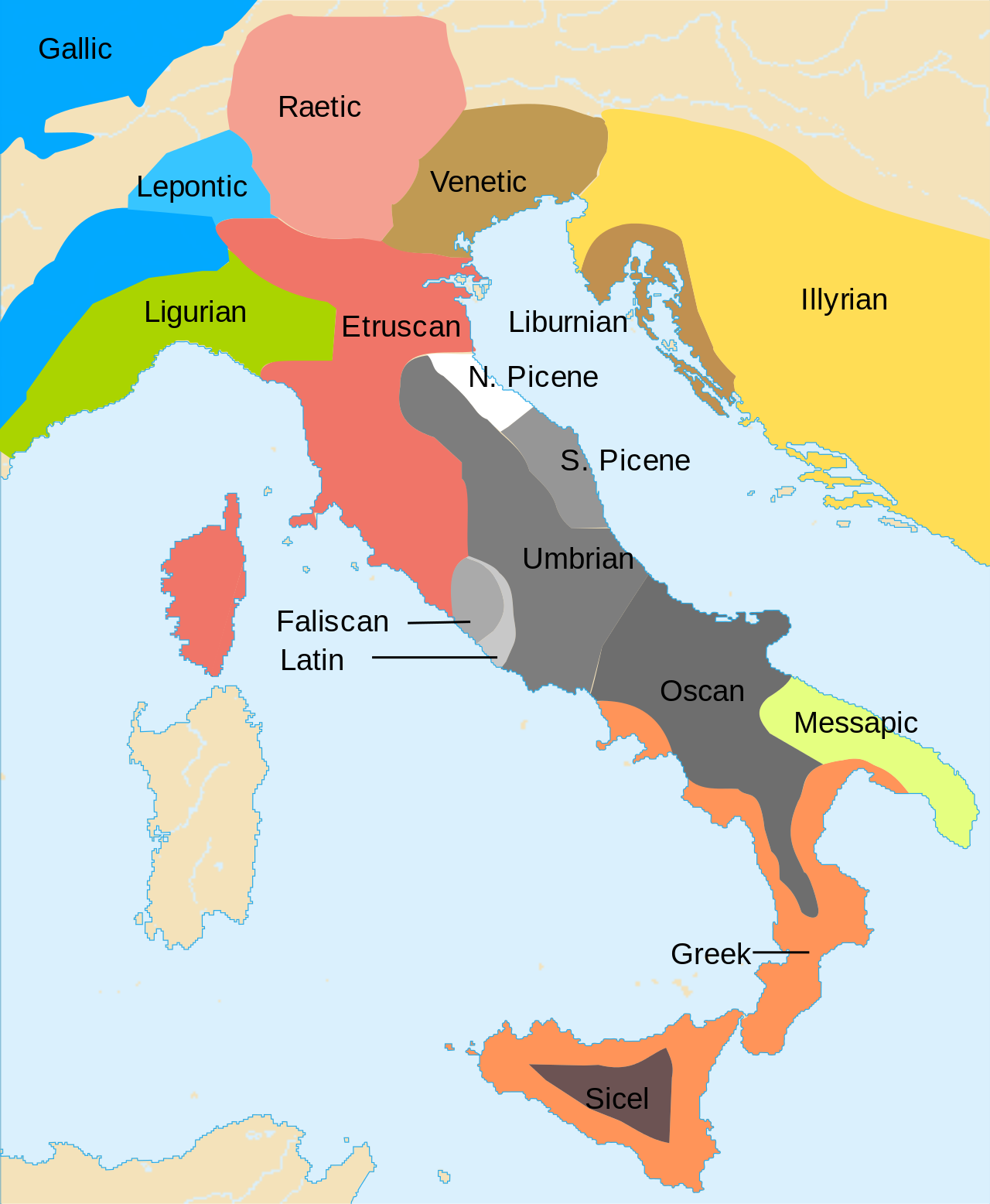
Another group I associate with are the Sabines, Umbrians, and Oscan:
https://en.wikipedia.org/wiki/Pompeia_gens
https://upload.wikimedia.org/wikipedia/ ... ly.svg.png
"
The Piceni or Picentes were the native population of Picenum, but they were not of uniform ethnicity. They maintained a sanctuary to the Sabine goddess Cupra in Cupra Marittima.
Picenum was also the birthplace of such Roman notables as Pompey the Great and his father, Pompeius Strabo.
"
https://en.wikipedia.org/wiki/Cupra_(goddess)
"
Her name could derive from the Greek Kupria, a name for Aphrodite. Another etymological possibility is from the same root of Roman god Cupid.
In the periodic table, copper's symbol is Cu, which derives from Cupra, Latin for copper.
"
https://en.wikipedia.org/wiki/Cupid
"
Amores /əˈmɔːriːz/ (in the later terminology of art history, Italian amorini), the equivalent of the Greek Erotes. Cupids are a frequent motif of both Roman art and later Western art of the classical tradition. In the 15th century, the iconography of Cupid starts to become indistinguishable from the putto.
Cupid continued to be a popular figure in the Middle Ages, when under Christian influence he often had a dual nature as Heavenly and Earthly love. In the Renaissance, a renewed interest in classical philosophy endowed him with complex allegorical meanings. In contemporary popular culture, Cupid is shown drawing his bow to inspire romantic love, often as an icon of Valentine's Day.[2] Cupid's powers are similar, though not identical, to Kamadeva, the Hindu god of human love.
The name Cupīdō ('passionate desire') is a derivative of Latin cupiō, cupĕre ('to desire'), itself from Proto-Italic *kup-i-, which may reflect *kup-ei- ('to desire'; cf. Umbrian cupras, South Picene kuprí). The latter ultimately stems from the Proto-Indo-European verbal stem *kup-(e)i- ('to tremble, desire'; cf. Old Irish accobor 'desire', Sanskrit prá-kupita- 'trembling, quaking', Old Church Slavonic kypĕti 'to simmer, boil').[3]
The Romans reinterpreted myths and concepts pertaining to the Greek Eros for Cupid in their own literature and art, and medieval and Renaissance mythographers conflate the two freely. In the Greek tradition, Eros had a dual, contradictory genealogy. He was among the primordial gods who came into existence asexually; after his generation, deities were begotten through male-female unions.[4] In Hesiod's Theogony, only Chaos and Gaia (Earth) are older. Before the existence of gender dichotomy, Eros functioned by causing entities to separate from themselves that which they already contained.[5]
At the same time, the Eros who was pictured as a boy or slim youth was regarded as the child of a divine couple, the identity of whom varied by source. The influential Renaissance mythographer Natale Conti began his chapter on Cupid/Eros by declaring that the Greeks themselves were unsure about his parentage: Heaven and Earth,[6] Ares and Aphrodite,[7] Night and Ether,[8] or the Rainbow and Zephyr.[9] The Greek travel writer Pausanias, he notes, contradicts himself by saying at one point that Eros welcomed Aphrodite into the world, and at another that Eros was the son of Aphrodite and the youngest of the gods.[10]
In Latin literature, Cupid is usually treated as the son of Venus without reference to a father. Seneca says that Vulcan, as the husband of Venus, is the father of Cupid.[11] Cicero, however, says that there were three Cupids, as well as three Venuses: the first Cupid was the son of Mercury and Diana, the second of Mercury and the second Venus, and the third of Mars and the third Venus. This last Cupid was the equivalent of Anteros, "Counter-Love", one of the Erotes, the gods who embody aspects of love.[12] The multiple Cupids frolicking in art are the decorative manifestation of these proliferating loves and desires. During the English Renaissance, Christopher Marlowe wrote of "ten thousand Cupids"; in Ben Jonson's wedding masque Hymenaei, "a thousand several-coloured loves ... hop about the nuptial room".[13]
In the later classical tradition, Cupid is most often regarded as the son of Venus and Mars, whose love affair represented an allegory of Love and War.[14] The duality between the primordial and the sexually conceived Eros accommodated philosophical concepts of Heavenly and Earthly Love even in the Christian era.[15]
"
https://en.wikipedia.org/wiki/Greek_primordial_deities
"
Eros is the god of love in Greek mythology, and in some versions is one of the primordial beings that first came to be parentlessly. In Hesiod's version, Eros was the "fairest among the immortal gods ... who conquers the mind and sensible thoughts of all gods and men."[7]
"
"
Other Greek theogonies
edit
Alcman (fl. 7th century BC) called Thetis the first goddess, producing poros (path), tekmor (marker), and skotos (darkness) on the pathless, featureless void.[25][26]
Orphic poetry (c. 530 BC) made Nyx the first principle, Night, and her offspring were many. Also, in the Orphic tradition, Phanes, a mystic Orphic deity of light and procreation, sometimes identified with Eros, is the original ruler of the universe, who hatched from the cosmic egg.[27] The Orphic tradition also includes Ananke "Compulsion" and Chronos "Time" among the primordial deities.
Aristophanes (c. 446–386 BC) wrote in his play The Birds that Nyx was the first deity also, and that she produced Eros from an egg.
"
"
Scholars dispute the meaning of the primordial deities in the poems of Homer and Hesiod.[34] Since the primordials give birth to the Titans, and the Titans give birth to the Olympians, one way of interpreting the primordial gods is as the deepest and most fundamental nature of the cosmos.
For example, Jenny Strauss Clay argues that Homer's poetic vision centers on the reign of Zeus, but that Hesiod's vision of the primordials put Zeus and the Olympians in context.[23] Likewise, Vernant argues that the Olympic pantheon is a "system of classification, a particular way of ordering and conceptualizing the universe by distinguishing within it various types of powers and forces."[35] But even before the Olympic pantheon were the Titans and primordial gods. Homer alludes to a more tumultuous past before Zeus was the undisputed King and Father.[36]
Mitchell Miller argues that the first four primordial deities arise in a highly significant relationship. He argues that Chaos represents differentiation, since Chaos differentiates (separates, divides) Tartarus and Earth.[37] Even though Chaos is "first of all" for Hesiod, Miller argues that Tartarus represents the primacy of the undifferentiated, or the unlimited. Since undifferentiation is unthinkable, Chaos is the "first of all" in that he is the first thinkable being. In this way, Chaos (the principle of division) is the natural opposite of Eros (the principle of unification). Earth (light, day, waking, life) is the natural opposite of Tartarus (darkness, night, sleep, death). These four are the parents of all the other Titans.
"
https://en.wikipedia.org/wiki/Eros
https://en.wikipedia.org/wiki/Phanes
https://en.wikipedia.org/wiki/Thetis
"
Most extant material about Thetis concerns her role as mother of Achilles, but there is some evidence that she was more central to the religious beliefs and practices of Archaic Greece in her role as a sea-goddess. The pre-modern etymology of her name, from tithemi (τίθημι), "to set up, establish", suggests a perception among Classical Greeks of an early political role. Walter Burkert[4] considers her name a transformed doublet of Tethys.
After Achilles's death, Thetis does not need to appeal to Zeus for immortality for her son, as the two have an established rapport (due to Thetis helping him in a dispute with three other Olympians) and snatches him away to the White Island Leuke in the Black Sea, an alternate Elysium,[5] where he has transcended death, and where an Achilles cult lingered into historical times.
"
https://en.wikipedia.org/wiki/Nereids
https://en.wikipedia.org/wiki/Achilles
https://en.wikipedia.org/wiki/Myrmidons
https://en.wikipedia.org/wiki/Phthiotis
"
"Phthiotis" means "the region of Phthia", the southernmost region of ancient Thessaly around Pharsalus and home of Achilles. In Classical times, it also referred to the region of Achaea Phthiotis, which bordered on Thessalian Phthiotis to the south and east. Achaea Phthiotis covered the northern part of the present regional unit Phthiotis and the southern part of present Magnesia. The southeastern part of present Phthiotis was covered by the ancient region Locris, and the southwestern part was ancient Malis and Ainis.
"
https://en.wikipedia.org/wiki/Megaera
https://en.wikipedia.org/wiki/Megara_(wife_of_Heracles)
"
The sons of Heracles appear to have been incorporated into Heracles hero cult at Thebes who were celebrated at a festival known as the Herakleia where a feast was prepared in honour of Heracles above the "Elektran Gates" and sacrifices were made.[5] The hero-tombs of the children of Heracles and Megara in Thebes they were venerated as the Chalkoarai.[16]
"
"
An insane Heracles is depicted killing his son while Megara stands horrified on the right side of the scene (National Archaeological Museum, Madrid, c. 350-320 B.C.E.)
"
Jealous insanity, likely due to the close association with the term Megaera, is found in both the stories of Ajax who was linked to the region of Megara and Hercules whose wife was Megara and killed in a similar way to how Ajax was supposed to have gone crazy out of envious rage due to losing the armor of Achilles and thought he was killing Agamemnon and others due to Athena casting a madness upon him. In the case of Hercules, the madness was cast by Hera, and both Athena and Hera are important to me.
Added in 12 minutes 5 seconds:
Shields were associated with wings and wings with defense in the region and across the "Near East". The figure of Moses, or Musa, especially in the Qur'an and then later Islamic tradition hits numerous story points with Ajax, though people are unlikely to realize this or how both figures end up being quite similar, down to how they were depicted at times and described.
"
Why Poseidon first saved Ajax?
I'm reading the Odyssey again and in the story of the death of Ajax (the lesser), it is said that Poseidon saved Ajax from the waters.
Poseidon first drove him to the rocks of Gyrae, then rescued him from the sea; he would have lived, despite Athena’s hatred.
I wonder why Poseidon, being the most violent of the Gods in the Odyssey, would save Ajax.
"
Poseidon is often placed at odds with Athena in stories, like this:
"
The earliest attested occurrence of the name, written in Linear B, is 𐀡𐀮𐀅𐀃 Po-se-da-o or 𐀡𐀮𐀅𐀺𐀚 Po-se-da-wo-ne,[14] which correspond to Ποσειδάων (Poseidaōn) and Ποσειδάϝoνος (Poseidawοnos) in Mycenean Greek; in Homeric Greek, it appears as Ποσιδάων (Posidaōn); in Aeolic, as Ποτε(ι)δάων (Pote(i)daōn); in Doric, as Ποτειδάν (Poteidan) and Ποτειδᾶς (Poteidas); in Arcadic, as Ποσoιδᾱν (Posoidan). In inscriptions with Laconic style from Tainaron, Helos and Thuria as Ποὁιδάν (Pohoidan), indicating that the Dorians took the name from the older population.[15] The form Ποτειδάϝων (Poteidawōn) appears in Corinth.[16]
The origins of the name "Poseidon" are unclear and the possible etymologies are contradictive among the scholars. One theory breaks it down into an element meaning "husband" or "lord" (Greek πόσις (posis), from PIE *pótis) and another element meaning "earth" (δᾶ (da), Doric for γῆ (gē)), producing something like lord or spouse of Da, i.e. of the earth; this would link him with Demeter, "Earth-mother".[17] Burkert finds that "the second element δᾶ- remains hopelessly ambiguous" and finds a "husband of Earth" reading "quite impossible to prove".[2] According to Beekes in Etymological Dictionary of Greek, "there is no indication that δᾶ means 'earth'",[18] although the root da appears in the Linear B inscription E-ne-si-da-o-ne, "earth-shaker".[2][19]
Another theory interprets the second element as related to the (presumed) Doric word *δᾶϝον dâwon, "water", Proto-Indo-European *dah₂- "water" or *dʰenh₂- "to run, flow", Sanskrit दन् dā́-nu- "fluid, drop, dew" and names of rivers such as Danube (< *Danuvius) or Don. This would make *Posei-dawōn into the master of waters.[20][15]
Plato in his dialogue Cratylus gives two traditional etymologies: either the sea restrained Poseidon when walking as a "foot-bond" (ποσίδεσμον), or he "knew many things" (πολλά εἰδότος or πολλά εἰδῶν).[21]
Beekes suggests that the word has probably a Pre-Greek origin.[22] The original form was probably the Mycenean Greek Ποτ(σ)ειδάϝων (Pot(s)eidawōn). "The intervocalic aspiration suggests a Pre-Greek (Pelasgian) origin rather than an Indoeuropean one".[23]
"
"
Poseidon is famous for his contests with other deities for winning the patronage of the city. According to legend, Athena became the patron goddess of the city of Athens after a competition with Poseidon, though he remained on the Acropolis in the form of his surrogate, Erechtheus. After the fight, Poseidon sent a monstrous flood to the Attic plain to punish the Athenians for not choosing him.[9] In similar competitions with other deities in different cities, he causes devastating floods when he loses. Poseidon is a horrifying and avenging god and must be honoured even when he is not the patron deity of the city.[10]
Some scholars suggested that Poseidon was probably a Pelasgian god[11] or a god of the Minyans.[12] However it is possible that Poseidon, like Zeus, was a common god of all Greeks from the beginning.[13]
"
https://en.wikipedia.org/wiki/Poseidon# ... _Paris.jpg

The resemblance is scary.
Added in 15 minutes :
https://en.wikipedia.org/wiki/Picentes
Even though I don't think it should matter, and though I harbour some suspicions that it might somehow at least slightly matter, I always tend to find that just about any group I seem guided to and learn about and notice that I've already been doing things possibly similar to what they were doing and that I have dimilar associations as those they were said to have, also have genetic ties going way back:
"
The Picentes or Piceni[1] or Picentini were an ancient Italic people who lived from the 9th to the 3rd century BC in the area between the Foglia and Aterno rivers, bordered to the west by the Apennines and to the east by the Adriatic coast. Their territory, known as Picenum, therefore included all of today's Marche and the northern part of Abruzzo. Recently, a genome-wide archaeogenetic study of individuals from two Picene necropoleis found that all the individuals associated with this culture display genetic continuity with earlier populations.[2]
"
Weirdly also things that are reminiscent of my own name pop up repeatedly in the stories.
https://en.wikipedia.org/wiki/Marche
https://en.wikipedia.org/wiki/Abruzzo
Last edited by kFoyauextlH on Sat Mar 21, 2026 11:25 am, edited 1 time in total.
-
kFoyauextlH
- Posts: 1983
- Joined: Sun Jun 15, 2025 3:53 pm
Re: Identity Politics
"
A 2024 study analysed the Ancient DNA of 71 Iron Age Picene individuals from the necropoleis of Novilara and Sirolo-Numana.[2]
Genome analysis showed that the two Picene groups are genetically homogeneous and in continuity with earlier cultures. Moreover, despite an overall genetic similarity among Iron Age Italic populations, the analysis revealed small but significant differences in their genetics. In particular, the Adriatic populations (Picentes and Daunians) display a greater proportion of a genetic component deriving from the Pontic–Caspian steppe than the Tyrrhenian populations—the Etruscans and the Latins.[2]
The principal genetic ancestries of the two Picene groups consist of components from the Anatolian Neolithic or Early European Farmers and from Eastern Hunter-Gatherers (EHG)/Yamnaya (also known as Western Steppe Herders); together these account for 90 % of their genetic heritage. In addition, despite the overall genetic homogeneity of populations belonging to the Picene culture, some individuals show non-local ancestries. This evidence, together with data for other contemporary peoples, suggests that the Iron Age (or the immediately preceding period) was characterised by intense population movements and marked the beginning of a cosmopolitan society in Italy.[2]
Two main paternal haplogroups are observed among the Picenes, namely R1b-M269/L23 (58 % of the total) and J2-M172/M12 (25 % of the total), which may represent direct links with Central Europe and the Balkan Peninsula.[2]
Finally, phenotype analysis shows that individuals associated with the Picene culture possessed lighter pigmentation than contemporary peoples. A higher frequency of blond hair and blue eyes occurs among the Picenes when compared with the Etruscans, Latins and Daunians.[2]
A 2017 analysis of maternal haplogroups from ancient and modern samples indicated a substantial genetic similarity among the modern inhabitants of Central Italy and the area's ancient pre-Roman inhabitants of settlement of Novilara in the province of Pesaro, and evidence of substantial genetic continuity in the region from pre-Roman times to the present with regard to mitochondrial DNA.[35]
"
https://en.wikipedia.org/wiki/Pesaro
"
Pesaro (Italian: [ˈpeːzaro] ⓘ; Romagnol: Pés're) is a comune (municipality) in the Italian region of Marche, capital of the province of Pesaro and Urbino, on the Adriatic Sea. According to the 2011 census, its population was 95,011, making it the second most populous city in the Marche, after Ancona. Pesaro was dubbed the "Cycling City" (città della bicicletta) by the Italian environmentalist association Legambiente in recognition of its extensive network of bicycle paths and promotion of cycling. It is also known as "City of Music" (città della musica), for it is the birthplace of the composer Gioachino Rossini. In 2015 the Italian Government applied for Pesaro to be declared a "Creative City" in UNESCO's World Heritage Sites. In 2017 Pesaro received the European City of Sport award together with Aosta, Cagliari and Vicenza.
"
"
The city was established as Pisaurum by the Romans in 184 BC as a colony in the territory of the Picentes, the people who lived along the northeast coast during the Iron Age.[4][better source needed] In 1737, fourteen ancient votive stones were unearthed in a local farm field, each bearing the inscription of a Roman god; these were written in a pre-Etruscan script, indicating a much earlier occupation of the area than the 184 BC Picentes colony.[4]
A settlement of the Picentes tribe has been found at Novilara. The northern Picentes were invaded in the 4th century BC by the Gallic Senones, earlier by the Etruscans, and when the Romans reached the area the population was an ethnic mixture. The Roman separated and expelled the Gauls from the country.
Under the Roman administration Pesaro, a hub across the Via Flaminia, became an important centre of trading and craftmanship.[citation needed] After the fall of the Western Empire, Pesaro was occupied by the Ostrogoths, and destroyed by Vitigis (539) in the course of the Gothic War. Hastily rebuilt five years later after the Byzantine reconquest, it formed the so-called Pentapolis, part of the Exarchate of Ravenna. After the Lombard and Frankish conquests of that city, Pesaro became part of the Papal States.
"
"
Votive stones of Pesaro
Annibale Olivieri (1708-1789) was a scholar of great importance in the history of the city [15]. Around 1737 he found thirteen Votive Stones in his farm, "in an ancient language similar to Etruscan tongue".
The stones were wery well illustrated over 50 years ago by A. De Bellis Franchi, and typically of soft volcanic tuff, bearing sacred inscriptions such as "APOLENEI" [Apollo], "FIDE" [Faith], "IVNONII" [Goddess Juno], "IVNO LOVCINA" [Juno Lucina was goddess of childbirth], "MAT[ER]-MATVTA", and "SALVTE" [the goddess of Health] [16].
The "Mater Matuta" stone desrves special mention. It “belongs to the most archaic of the votive stones of the “lucus” [sacred wood] of Pesaro. The deity mentioned has very ancient origins and was venerated, for example, in the Etruscan shrine at 'Pyrgi' [Santa Severa near Rome] and 'Satricum' [near Anzio, Latium]. The deity was closely related to female sexuality, fertility and procreation, and therefore he was invoked as a guardian of childbirth" [17].
According to recent studies, the area of Pesaro was the seat of the Piceni, as attested in the necropolis of Molaroni and Servici, which developed between the 9th and 7th centuries BC. The Piceni had business relations with the Greeks and after them the Celts, and finally the Gauls, who inhabited the territory of Pisaurum before the Romans.
"
"
About the early years of Pisaurum the ancient sources are few; however, Livy (59 BC-17 AD) [20] stated that, nearly ten years after its foundation, the Censor founded in the city a temple to Jupiter and presumably he started the construction of the Via Flaminia. Other evidence from Roman times is the remains of walls dating back more or less to the time of the founding of the Colony.
However, there was almost certainly a "re-foundation" of the original colony, presumably because of the swamps which made the air unhealthy. Catullus was witnessed to this situation, because he spoke of "moribunda ... Pisauri " [moribund seat of Pisaurum]. In fact M. Zicari wrote: "A certain decadence of the city is attested by the fact that in 43 BC a new colony was founded in the same place, called 'Colonia Iulia Felix Pisaurum'" [21].
"
https://en.wikipedia.org/wiki/Mefitis
"
In Roman mythology, Mefitis (or Mephitis; Mefite in Italian) was a goddess of Italic origins primarily worshipped by the Samnites and Osci in southern Italy. Mefitis was associated with water— particularly foul-smelling or sulfurous water— and noxious fumes. Her main temple was situated near Lake Ampsanctus, which was described as deadly by Cicero and Pliny. The temple itself was reported to contain poisonous gas that killed anyone who entered, and Virgil described it as an entrance to the underworld.
"
https://en.wikipedia.org/wiki/Ampsanctus
"
Ampsanctus, or Amsanctus (modern: Sorgente Mefita) was a small lake in the territory of the Hirpini, c. 15 kilometres (9 mi) south of Aeclanum, close to the Via Appia (southern Italy). There are now two small pools which exhale carbonic acid gas and hydrogen sulfide. Close by was a temple of the goddess Mephitis, with a cave from which suffocating vapors rose, and for this reason, the place was brought into connection with the legends of the infernal regions.
"
https://en.wikipedia.org/wiki/Hirpini
"
The Hirpini (Latin: Hirpini) were an ancient Samnite tribe of Southern Italy. While generally regarded as having been Samnites, sometimes they are treated as a distinct and independent nation. They inhabited the southern portion of Samnium, in the more extensive sense of that name, roughly the area now known as Irpinia from their name—a mountainous region bordering on Basilicata towards the south, on Apulia to the east, and on Campania towards the west. No marked natural boundary separated them from these neighboring nations, but they occupied the lofty masses and groups of the central Apennines, while the plains on each side, and the lower ranges that bounded them, belonged to their more fortunate neighbors. The mountain basin formed by the three tributaries of the Vulturnus (modern Volturno)—the Tamarus (modern Tammaro), Calor (modern Calore), and Sabatus (modern Sabato), which, with their valleys, unite near Beneventum, surrounded on all sides by lofty and rugged ranges of mountains—is the center and heart of their territory. They occupied the Daunian Mountains to the north,[1] while its more southern portion comprised the upper valley of the Aufidus (modern Ofanto) and the lofty group of mountains where that river takes its rise.
Their name derives, according to ancient writers, from hirpus (the Oscan for 'wolf') and meant 'those who belong to the wolf'.[2] In accordance with this derivation, their first ancestors were supposedly guided to their new settlements by a wolf.[3] This tradition implies that the Hirpini were regarded as having migrated, like the other Sabellian peoples in the south of Italy, from the north, but when this migration occurred is unknown. From their position in the vastnesses of the central Apennines, they were probably there long before they first appear in history.
"
"
The early history of the Hirpini cannot be separated from that of the Samnites in general. Their name does not once occur in history during the long protracted struggle between the Romans and the Samnite confederacy (the Samnite Wars), though their territory was often the theatre of the war, and several of their cities, especially Maloenton (Roman Maleventum, modern Benevento), are repeatedly mentioned as bearing an important part in the military operations of both powers. Hence, the Hirpini at this time must have formed an integral part of the Samnite league, and were included by the Roman annalists (whose language on such points Livy follows with scrupulous fidelity) under the general name of Samnites, without distinguishing between the several tribes of that people. For the same reason we can't fix the exact period when the Romans subjugated them, but it must have been before 268 BC, when the Romans established their colony at Beneventum,[4] a position that likely was the military key to the possession of their country.
In the Second Punic War, the Hirpini appear as an independent people, acting apart from the rest of the Samnites. Livy expressly uses the name of Samnium in contradistinction to the land of the Hirpini.[5] The latter people was one of those that declared in favour of Hannibal immediately after the battle of Cannae, 216 BC;[6] but the Roman colony of Beneventum never fell into the hands of the Carthaginian general. As early as the following year, three of the smaller towns of the Hirpini were recovered by the Roman praetor M. Valerius.[7] In 214 BC, their territory was the scene of the operations of Hanno against Tiberius Sempronius Gracchus, and again in 212 BC of those of the same Carthaginian general with a view to the relief of Capua.[8] It was not until 209 BC, when Hannibal lost all footing in the center of Italy, that the Hirpini submitted to Rome, and gained favourable terms by betraying the Carthaginian garrisons in their towns.[9]
The Hirpini next figure in history in the Social War (90 BC), when they were among the first to take up arms against Rome.
"
https://en.wikipedia.org/wiki/Social_Wa ... 0%9387_BC)
"
The Social War (from Latin bellum sociale, "war of the allies"), also called the Italian War or the Marsic War,[3] was fought largely from 91 to 88 BC between the Roman Republic and several of its autonomous allies (socii) in Italy. Some of the allies held out until 87 BC.
"
https://en.wikipedia.org/wiki/Socii
"
The Latini, who were simultaneously special confederates (Socii Latini) and semi-citizens (Cives Latini), derived their name from the Italic people of which Rome was part (the Latins) but did not coincide with the region of Latium in central Italy as they were located in colonies throughout the peninsula. This tripartite organisation lasted from the Roman expansion in Italy (509-264 BC) to the Social War (91–87 BC), when all peninsular inhabitants south of the Po river were awarded Roman citizenship.
"
"
The Romans themselves used the term "Latin" loosely, and this can be confusing. The term was used to describe what were actually three distinct groups:
The Latin tribe strictly speaking, to which the Romans themselves belonged. These were the inhabitants of Latium Vetus ("Old Latium"), a small region south of the river Tiber, whose inhabitants were speakers of the Latin language.
The inhabitants of Latin colonies. These were coloniae made up of mixed Roman/Latin colonists.
All the Italian allies of Rome, not only the Latin colonies, but also the other non-Latin allies (socii).
In this article, to avoid confusion, only group (1) will be referred to as "Latins". Group (2) will be called "Latin colonies or colonists" and group (3) will be referred to as "Italian confederates". Socii will refer to groups (2) and (3) combined.
"
"
The Italian peninsula at this time was a patchwork of different ethnic groups, languages and cultures. These may be divided into the following broad nations:
The Italic tribes, that dominated central and southern Italy, as well as northeastern Italy. These included the original Latins and a large number of other tribes, most notably the Samnites (actually a league of tribes) who dominated south central Italy. In addition to Latin, these tribes spoke Umbrian and Oscan dialects, all closely related Indo-European languages. The Italic tribes were mostly tough hill-dwelling pastoralists, who made superb infantrymen, especially the Samnites. It is believed that the latter invented the manipular infantry formation and the use of javelins and oblong shields, which were adopted by the Romans at the end of the Samnite Wars.[1][2] An isolated Italic group were the Veneti in the northeast. They gave their name to the region they inhabited, Venetia, a name chosen centuries afterwards for the new founded capital of the allied people of the Venetian Lagoon, who would become the Most Serene Republic of Venice.
The Greeks, who had colonised the coastal areas of southern Italy from c. 700 BC onwards, which was known to the Romans as Magna Graecia ("Greater Greece") for that reason. The Greek colonies had the most advanced civilisation in the Italian peninsula, much of which was adopted by the Romans. Their language, although Indo-European, was quite different from Latin. As maritime cities, the Greeks' primary military significance was naval. They invented the best warship of the ancient world, the trireme. Some of the original Greek colonies (such as Capua and Cumae) had been subjugated by the neighbouring Italic tribes and become Oscan-speaking in the period up to 264 BC. The surviving Greek cities in 264 were all coastal: Neapolis, Poseidonia (Paestum), Velia, Rhegium, Locri, Croton, Thurii, Heraclea, Metapontum and Tarentum. The most populous were Neapolis, Rhegium and Tarentum, all of which had large, strategic harbours on the Tyrrhenian, the Strait of Messina and the Ionian Sea respectively. Tarentum had, until c. 300 BC, been a major power and hegemon (leading power) of the Italiote league, a confederation of the Greek cities in Italy. But its military capability was crippled by the Romans, who defeated Tarentum by 272 BC.
The Etruscans, who dominated the region between the rivers Arno and Tiber, still retaining a derived name (Tuscany) today. The Etruscans spoke a non Indo-European language which today is largely unknown, and had a distinctive culture. Some scholars believe Rome may have been an Etruscan city at the time of the Roman kings (conventionally 753–509 BC). The Etruscans had originally dominated the Po Valley, but had been progressively displaced from this region by the Gauls in the 4th century BC, separating them the Etruscan-speaking Raetians in the Alpine region.
The Campanians, occupying the fertile plain between the river Volturno and the bay of Naples. These were not a distinct ethnic group, but a mixed Samnite/Opician population with Etruscan elements. The Samnites had conquered the Greek and Etruscan city-states in the period 450–400 BC. Speaking the Oscan language, they developed a distinctive culture and identity. Although partly of Samnite blood, they came to regard the mountain Samnites that surrounded them as a major threat, leading them to ask for Roman protection from 340 BC onwards. As plains-dwellers, horses played an important role for the Campanians and their cavalry was considered the best in the peninsula.[3] Their main city was Capua, probably the second-largest city in Italy at this time. Other important cities were Nola, Acerrae, Suessula
The Gauls, who had migrated into, and colonised, the plain of the Po river (pianura padana) from c. 390 BC onwards. This region is now part of northern Italy, but until the rule of Augustus was not regarded as part of Italy at all, but part of Gaul. The Romans called it Cisalpine Gaul ("Gaul this side of the Alps"). They spoke Gaulish dialects, part of the Celtic group of Indo-European languages. Tribal-based territories with some city-like centres.
The Ligurians, occupying the region known to the Romans (and still called today) as Liguria, southwest of the Gauls. It is unclear whether their language was non Indo-European (related to Iberian), Italic, or Celtic (related to Gaulish). Most likely, they spoke a Celto-Italic hybrid language.
The Messapii, who occupied the southern part of the Apulian peninsula in SE Italy, are believed from inscriptions to be speakers of a tongue related to Illyrian (an Indo-European language). They were in perpetual conflict over territory with the Greeks of Tarentum.
"
"
According to Roman legend, Rome was founded by Romulus in 753 BC. However, the vast amount of archaeological evidence uncovered since the 1970s suggests that Rome did not assume the characteristics of a united city-state (as opposed to a group of separate hilltop settlements) before around 625. The same evidence, however, has also conclusively discredited A. Alfoldi's once-fashionable theory that Rome was an insignificant settlement until c. 500 (and that, consequently, the Republic was not established before c. 450). There is now no doubt that Rome was a major city in the period from 625 to 500 BC, when it had an area of c. 285 hectares and an estimated population of 35,000. This made it the second-largest in Italy (after Tarentum) and about half the size of contemporary Athens (585 hectares, inc. Piraeus).[8] Also, few scholars today dispute that Rome was ruled by kings in its archaic period, although whether any of the seven names of kings preserved by tradition are historical remains uncertain (Romulus himself is generally regarded as mythical). It is also likely that there were several more kings than those preserved by tradition, given the long duration of the regal era (even if it did start in 625 rather than 753).[9]
The Roman monarchy, although an autocracy, did not resemble a medieval monarchy. It was not hereditary and based on "divine right", but elective and subject to the ultimate sovereignty of the people. The king (rex, from root-verb regere, literally means simply "ruler") was elected for life by the people's assembly (the comitia curiata originally), although there is strong evidence that the process was in practice controlled by the patricians, a hereditary aristocratic caste. Most kings were non-Romans brought in from abroad, doubtless as a neutral figure who could be seen as above patrician factions. Although blood relations could succeed, they were still required to submit to election.[10] The position and powers of a Roman king were thus similar to those of Julius Caesar when he was appointed dictator in perpetuity in 44 BC, and indeed of the Roman emperors.
According to Roman tradition, in 616 BC, an Etruscan named Lucumo from the town of Tarquinii, was elected king of Rome as Lucius Tarquinius Priscus. He was succeeded by his son-in-law, Servius Tullius, and then by his son, Lucius Tarquinius Superbus. The establishment of this Etruscan "dynasty" has led some dated historians to claim that late regal Rome was occupied by troops from Tarquinii militarily and culturally Etruscanised. But this theory has been dismissed as a myth by Cornell and other more modern historians, who point to the extensive evidence that Rome remained politically independent, as well as linguistically and culturally a Latin city.[11] In relation to the army, the Cornell faction argue that the introduction of heavy infantry in the late regal era followed Greek, not Etruscan, models.
In addition, it seems certain that the kings were overthrown c. 500 BC, probably as a result of a much more complex and bloody revolution than the simple drama of the rape of Lucretia related by Livy, and that they were replaced by some form of collegiate rule.[12] It is likely that the revolution that overthrew the Roman monarchy was engineered by the patrician caste and that its aim was not, as rationalised later by ancient authors, the establishment of a democracy, but of a patrician-dominated oligarchy. The proverbial "arrogance" and "tyranny" of the Tarquins, epitomised by the Lucretia incident, is probably a reflection of the patricians' fear of the Tarquins' growing power and their erosion of patrician privilege, most likely by drawing support from the plebeians (commoners). To ensure patrician supremacy, the autocratic power of the kings had to be fragmented and permanently curtailed. Thus, the replacement of a single ruler by a collegiate administration, which soon evolved into two Praetors, later called Consuls, with equal powers and limited terms of office (one year, instead of the life tenancy of the kings). In addition, power was further fragmented by the establishment of further collegiate offices, known to history as Roman magistrates: (three Aediles and four Quaestors). Patrician supremacy was assured by limiting eligibility to hold the republican offices to patricians only.
The establishment of a hereditary oligarchy obviously excluded wealthy non-patricians from political power and it is this class that led plebeian opposition to the early Republican settlement. The early Republic (510–338 BC) saw a long and often bitter struggle for political equality, known as the Conflict of the Orders, against the patrician monopoly of power. The plebeian leadership had the advantage that they represented the vast majority of the population, therefore also the majority of the Roman levy and of their own growing wealth. Milestones in their ultimately successful struggle are the establishment of a plebeian assembly (the concilium plebis) with some legislative power and to elect officers called tribunes of the plebs, who had the power to veto Senatorial decrees (494); and the opening of the Consulship to plebeians (367). By 338, the privileges of the patricians had become largely ceremonial (such as the exclusive right to hold certain state priesthoods). But this does not imply a more democratic form of government. The wealthy plebeians who had led the "plebeian revolution" had no more intention of sharing real power with their poorer and far more numerous fellow-plebeians than did the patricians. It was probably at this time (around 300 BC) that the population was divided, for the purposes of taxation and military service, into seven classes based on an assessment of their property. The two top classes, numerically the smallest, accorded themselves an absolute majority of the votes in the main electoral and legislative assembly. Oligarchy based on birth had been replaced by oligarchy based on wealth.
"
"
From the start, the rebels' prime target was to capture the Latin colonies. These had been deliberately located to disrupt communications between powerful tribal groups and their territories constituted some of most fertile land in the interior (which had been taken away from the tribes now in revolt).
"
"
The granting of citizenship to Italians did not, however, end the two-class system of Roman citizens and peregrini. For the inhabitants of Rome's possessions outside Italy mostly remained non-citizens, and their numbers grew rapidly as Rome's empire expanded.
Indeed, even within the newly reconstituted top tier of the system there was a slightly camouflaged inequality, as the newly enfranchised Italians were only added to eight out of thirty-five of the Roman tribes, their effective political power thus being severely limited. This was one of the causes of residual unrest among some sections of the Italians, manifested in their marked support for the Populares during the Sullan civil wars.
"
A 2024 study analysed the Ancient DNA of 71 Iron Age Picene individuals from the necropoleis of Novilara and Sirolo-Numana.[2]
Genome analysis showed that the two Picene groups are genetically homogeneous and in continuity with earlier cultures. Moreover, despite an overall genetic similarity among Iron Age Italic populations, the analysis revealed small but significant differences in their genetics. In particular, the Adriatic populations (Picentes and Daunians) display a greater proportion of a genetic component deriving from the Pontic–Caspian steppe than the Tyrrhenian populations—the Etruscans and the Latins.[2]
The principal genetic ancestries of the two Picene groups consist of components from the Anatolian Neolithic or Early European Farmers and from Eastern Hunter-Gatherers (EHG)/Yamnaya (also known as Western Steppe Herders); together these account for 90 % of their genetic heritage. In addition, despite the overall genetic homogeneity of populations belonging to the Picene culture, some individuals show non-local ancestries. This evidence, together with data for other contemporary peoples, suggests that the Iron Age (or the immediately preceding period) was characterised by intense population movements and marked the beginning of a cosmopolitan society in Italy.[2]
Two main paternal haplogroups are observed among the Picenes, namely R1b-M269/L23 (58 % of the total) and J2-M172/M12 (25 % of the total), which may represent direct links with Central Europe and the Balkan Peninsula.[2]
Finally, phenotype analysis shows that individuals associated with the Picene culture possessed lighter pigmentation than contemporary peoples. A higher frequency of blond hair and blue eyes occurs among the Picenes when compared with the Etruscans, Latins and Daunians.[2]
A 2017 analysis of maternal haplogroups from ancient and modern samples indicated a substantial genetic similarity among the modern inhabitants of Central Italy and the area's ancient pre-Roman inhabitants of settlement of Novilara in the province of Pesaro, and evidence of substantial genetic continuity in the region from pre-Roman times to the present with regard to mitochondrial DNA.[35]
"
https://en.wikipedia.org/wiki/Pesaro
"
Pesaro (Italian: [ˈpeːzaro] ⓘ; Romagnol: Pés're) is a comune (municipality) in the Italian region of Marche, capital of the province of Pesaro and Urbino, on the Adriatic Sea. According to the 2011 census, its population was 95,011, making it the second most populous city in the Marche, after Ancona. Pesaro was dubbed the "Cycling City" (città della bicicletta) by the Italian environmentalist association Legambiente in recognition of its extensive network of bicycle paths and promotion of cycling. It is also known as "City of Music" (città della musica), for it is the birthplace of the composer Gioachino Rossini. In 2015 the Italian Government applied for Pesaro to be declared a "Creative City" in UNESCO's World Heritage Sites. In 2017 Pesaro received the European City of Sport award together with Aosta, Cagliari and Vicenza.
"
"
The city was established as Pisaurum by the Romans in 184 BC as a colony in the territory of the Picentes, the people who lived along the northeast coast during the Iron Age.[4][better source needed] In 1737, fourteen ancient votive stones were unearthed in a local farm field, each bearing the inscription of a Roman god; these were written in a pre-Etruscan script, indicating a much earlier occupation of the area than the 184 BC Picentes colony.[4]
A settlement of the Picentes tribe has been found at Novilara. The northern Picentes were invaded in the 4th century BC by the Gallic Senones, earlier by the Etruscans, and when the Romans reached the area the population was an ethnic mixture. The Roman separated and expelled the Gauls from the country.
Under the Roman administration Pesaro, a hub across the Via Flaminia, became an important centre of trading and craftmanship.[citation needed] After the fall of the Western Empire, Pesaro was occupied by the Ostrogoths, and destroyed by Vitigis (539) in the course of the Gothic War. Hastily rebuilt five years later after the Byzantine reconquest, it formed the so-called Pentapolis, part of the Exarchate of Ravenna. After the Lombard and Frankish conquests of that city, Pesaro became part of the Papal States.
"
"
Votive stones of Pesaro
Annibale Olivieri (1708-1789) was a scholar of great importance in the history of the city [15]. Around 1737 he found thirteen Votive Stones in his farm, "in an ancient language similar to Etruscan tongue".
The stones were wery well illustrated over 50 years ago by A. De Bellis Franchi, and typically of soft volcanic tuff, bearing sacred inscriptions such as "APOLENEI" [Apollo], "FIDE" [Faith], "IVNONII" [Goddess Juno], "IVNO LOVCINA" [Juno Lucina was goddess of childbirth], "MAT[ER]-MATVTA", and "SALVTE" [the goddess of Health] [16].
The "Mater Matuta" stone desrves special mention. It “belongs to the most archaic of the votive stones of the “lucus” [sacred wood] of Pesaro. The deity mentioned has very ancient origins and was venerated, for example, in the Etruscan shrine at 'Pyrgi' [Santa Severa near Rome] and 'Satricum' [near Anzio, Latium]. The deity was closely related to female sexuality, fertility and procreation, and therefore he was invoked as a guardian of childbirth" [17].
According to recent studies, the area of Pesaro was the seat of the Piceni, as attested in the necropolis of Molaroni and Servici, which developed between the 9th and 7th centuries BC. The Piceni had business relations with the Greeks and after them the Celts, and finally the Gauls, who inhabited the territory of Pisaurum before the Romans.
"
"
About the early years of Pisaurum the ancient sources are few; however, Livy (59 BC-17 AD) [20] stated that, nearly ten years after its foundation, the Censor founded in the city a temple to Jupiter and presumably he started the construction of the Via Flaminia. Other evidence from Roman times is the remains of walls dating back more or less to the time of the founding of the Colony.
However, there was almost certainly a "re-foundation" of the original colony, presumably because of the swamps which made the air unhealthy. Catullus was witnessed to this situation, because he spoke of "moribunda ... Pisauri " [moribund seat of Pisaurum]. In fact M. Zicari wrote: "A certain decadence of the city is attested by the fact that in 43 BC a new colony was founded in the same place, called 'Colonia Iulia Felix Pisaurum'" [21].
"
https://en.wikipedia.org/wiki/Mefitis
"
In Roman mythology, Mefitis (or Mephitis; Mefite in Italian) was a goddess of Italic origins primarily worshipped by the Samnites and Osci in southern Italy. Mefitis was associated with water— particularly foul-smelling or sulfurous water— and noxious fumes. Her main temple was situated near Lake Ampsanctus, which was described as deadly by Cicero and Pliny. The temple itself was reported to contain poisonous gas that killed anyone who entered, and Virgil described it as an entrance to the underworld.
"
https://en.wikipedia.org/wiki/Ampsanctus
"
Ampsanctus, or Amsanctus (modern: Sorgente Mefita) was a small lake in the territory of the Hirpini, c. 15 kilometres (9 mi) south of Aeclanum, close to the Via Appia (southern Italy). There are now two small pools which exhale carbonic acid gas and hydrogen sulfide. Close by was a temple of the goddess Mephitis, with a cave from which suffocating vapors rose, and for this reason, the place was brought into connection with the legends of the infernal regions.
"
https://en.wikipedia.org/wiki/Hirpini
"
The Hirpini (Latin: Hirpini) were an ancient Samnite tribe of Southern Italy. While generally regarded as having been Samnites, sometimes they are treated as a distinct and independent nation. They inhabited the southern portion of Samnium, in the more extensive sense of that name, roughly the area now known as Irpinia from their name—a mountainous region bordering on Basilicata towards the south, on Apulia to the east, and on Campania towards the west. No marked natural boundary separated them from these neighboring nations, but they occupied the lofty masses and groups of the central Apennines, while the plains on each side, and the lower ranges that bounded them, belonged to their more fortunate neighbors. The mountain basin formed by the three tributaries of the Vulturnus (modern Volturno)—the Tamarus (modern Tammaro), Calor (modern Calore), and Sabatus (modern Sabato), which, with their valleys, unite near Beneventum, surrounded on all sides by lofty and rugged ranges of mountains—is the center and heart of their territory. They occupied the Daunian Mountains to the north,[1] while its more southern portion comprised the upper valley of the Aufidus (modern Ofanto) and the lofty group of mountains where that river takes its rise.
Their name derives, according to ancient writers, from hirpus (the Oscan for 'wolf') and meant 'those who belong to the wolf'.[2] In accordance with this derivation, their first ancestors were supposedly guided to their new settlements by a wolf.[3] This tradition implies that the Hirpini were regarded as having migrated, like the other Sabellian peoples in the south of Italy, from the north, but when this migration occurred is unknown. From their position in the vastnesses of the central Apennines, they were probably there long before they first appear in history.
"
"
The early history of the Hirpini cannot be separated from that of the Samnites in general. Their name does not once occur in history during the long protracted struggle between the Romans and the Samnite confederacy (the Samnite Wars), though their territory was often the theatre of the war, and several of their cities, especially Maloenton (Roman Maleventum, modern Benevento), are repeatedly mentioned as bearing an important part in the military operations of both powers. Hence, the Hirpini at this time must have formed an integral part of the Samnite league, and were included by the Roman annalists (whose language on such points Livy follows with scrupulous fidelity) under the general name of Samnites, without distinguishing between the several tribes of that people. For the same reason we can't fix the exact period when the Romans subjugated them, but it must have been before 268 BC, when the Romans established their colony at Beneventum,[4] a position that likely was the military key to the possession of their country.
In the Second Punic War, the Hirpini appear as an independent people, acting apart from the rest of the Samnites. Livy expressly uses the name of Samnium in contradistinction to the land of the Hirpini.[5] The latter people was one of those that declared in favour of Hannibal immediately after the battle of Cannae, 216 BC;[6] but the Roman colony of Beneventum never fell into the hands of the Carthaginian general. As early as the following year, three of the smaller towns of the Hirpini were recovered by the Roman praetor M. Valerius.[7] In 214 BC, their territory was the scene of the operations of Hanno against Tiberius Sempronius Gracchus, and again in 212 BC of those of the same Carthaginian general with a view to the relief of Capua.[8] It was not until 209 BC, when Hannibal lost all footing in the center of Italy, that the Hirpini submitted to Rome, and gained favourable terms by betraying the Carthaginian garrisons in their towns.[9]
The Hirpini next figure in history in the Social War (90 BC), when they were among the first to take up arms against Rome.
"
https://en.wikipedia.org/wiki/Social_Wa ... 0%9387_BC)
"
The Social War (from Latin bellum sociale, "war of the allies"), also called the Italian War or the Marsic War,[3] was fought largely from 91 to 88 BC between the Roman Republic and several of its autonomous allies (socii) in Italy. Some of the allies held out until 87 BC.
"
https://en.wikipedia.org/wiki/Socii
"
The Latini, who were simultaneously special confederates (Socii Latini) and semi-citizens (Cives Latini), derived their name from the Italic people of which Rome was part (the Latins) but did not coincide with the region of Latium in central Italy as they were located in colonies throughout the peninsula. This tripartite organisation lasted from the Roman expansion in Italy (509-264 BC) to the Social War (91–87 BC), when all peninsular inhabitants south of the Po river were awarded Roman citizenship.
"
"
The Romans themselves used the term "Latin" loosely, and this can be confusing. The term was used to describe what were actually three distinct groups:
The Latin tribe strictly speaking, to which the Romans themselves belonged. These were the inhabitants of Latium Vetus ("Old Latium"), a small region south of the river Tiber, whose inhabitants were speakers of the Latin language.
The inhabitants of Latin colonies. These were coloniae made up of mixed Roman/Latin colonists.
All the Italian allies of Rome, not only the Latin colonies, but also the other non-Latin allies (socii).
In this article, to avoid confusion, only group (1) will be referred to as "Latins". Group (2) will be called "Latin colonies or colonists" and group (3) will be referred to as "Italian confederates". Socii will refer to groups (2) and (3) combined.
"
"
The Italian peninsula at this time was a patchwork of different ethnic groups, languages and cultures. These may be divided into the following broad nations:
The Italic tribes, that dominated central and southern Italy, as well as northeastern Italy. These included the original Latins and a large number of other tribes, most notably the Samnites (actually a league of tribes) who dominated south central Italy. In addition to Latin, these tribes spoke Umbrian and Oscan dialects, all closely related Indo-European languages. The Italic tribes were mostly tough hill-dwelling pastoralists, who made superb infantrymen, especially the Samnites. It is believed that the latter invented the manipular infantry formation and the use of javelins and oblong shields, which were adopted by the Romans at the end of the Samnite Wars.[1][2] An isolated Italic group were the Veneti in the northeast. They gave their name to the region they inhabited, Venetia, a name chosen centuries afterwards for the new founded capital of the allied people of the Venetian Lagoon, who would become the Most Serene Republic of Venice.
The Greeks, who had colonised the coastal areas of southern Italy from c. 700 BC onwards, which was known to the Romans as Magna Graecia ("Greater Greece") for that reason. The Greek colonies had the most advanced civilisation in the Italian peninsula, much of which was adopted by the Romans. Their language, although Indo-European, was quite different from Latin. As maritime cities, the Greeks' primary military significance was naval. They invented the best warship of the ancient world, the trireme. Some of the original Greek colonies (such as Capua and Cumae) had been subjugated by the neighbouring Italic tribes and become Oscan-speaking in the period up to 264 BC. The surviving Greek cities in 264 were all coastal: Neapolis, Poseidonia (Paestum), Velia, Rhegium, Locri, Croton, Thurii, Heraclea, Metapontum and Tarentum. The most populous were Neapolis, Rhegium and Tarentum, all of which had large, strategic harbours on the Tyrrhenian, the Strait of Messina and the Ionian Sea respectively. Tarentum had, until c. 300 BC, been a major power and hegemon (leading power) of the Italiote league, a confederation of the Greek cities in Italy. But its military capability was crippled by the Romans, who defeated Tarentum by 272 BC.
The Etruscans, who dominated the region between the rivers Arno and Tiber, still retaining a derived name (Tuscany) today. The Etruscans spoke a non Indo-European language which today is largely unknown, and had a distinctive culture. Some scholars believe Rome may have been an Etruscan city at the time of the Roman kings (conventionally 753–509 BC). The Etruscans had originally dominated the Po Valley, but had been progressively displaced from this region by the Gauls in the 4th century BC, separating them the Etruscan-speaking Raetians in the Alpine region.
The Campanians, occupying the fertile plain between the river Volturno and the bay of Naples. These were not a distinct ethnic group, but a mixed Samnite/Opician population with Etruscan elements. The Samnites had conquered the Greek and Etruscan city-states in the period 450–400 BC. Speaking the Oscan language, they developed a distinctive culture and identity. Although partly of Samnite blood, they came to regard the mountain Samnites that surrounded them as a major threat, leading them to ask for Roman protection from 340 BC onwards. As plains-dwellers, horses played an important role for the Campanians and their cavalry was considered the best in the peninsula.[3] Their main city was Capua, probably the second-largest city in Italy at this time. Other important cities were Nola, Acerrae, Suessula
The Gauls, who had migrated into, and colonised, the plain of the Po river (pianura padana) from c. 390 BC onwards. This region is now part of northern Italy, but until the rule of Augustus was not regarded as part of Italy at all, but part of Gaul. The Romans called it Cisalpine Gaul ("Gaul this side of the Alps"). They spoke Gaulish dialects, part of the Celtic group of Indo-European languages. Tribal-based territories with some city-like centres.
The Ligurians, occupying the region known to the Romans (and still called today) as Liguria, southwest of the Gauls. It is unclear whether their language was non Indo-European (related to Iberian), Italic, or Celtic (related to Gaulish). Most likely, they spoke a Celto-Italic hybrid language.
The Messapii, who occupied the southern part of the Apulian peninsula in SE Italy, are believed from inscriptions to be speakers of a tongue related to Illyrian (an Indo-European language). They were in perpetual conflict over territory with the Greeks of Tarentum.
"
"
According to Roman legend, Rome was founded by Romulus in 753 BC. However, the vast amount of archaeological evidence uncovered since the 1970s suggests that Rome did not assume the characteristics of a united city-state (as opposed to a group of separate hilltop settlements) before around 625. The same evidence, however, has also conclusively discredited A. Alfoldi's once-fashionable theory that Rome was an insignificant settlement until c. 500 (and that, consequently, the Republic was not established before c. 450). There is now no doubt that Rome was a major city in the period from 625 to 500 BC, when it had an area of c. 285 hectares and an estimated population of 35,000. This made it the second-largest in Italy (after Tarentum) and about half the size of contemporary Athens (585 hectares, inc. Piraeus).[8] Also, few scholars today dispute that Rome was ruled by kings in its archaic period, although whether any of the seven names of kings preserved by tradition are historical remains uncertain (Romulus himself is generally regarded as mythical). It is also likely that there were several more kings than those preserved by tradition, given the long duration of the regal era (even if it did start in 625 rather than 753).[9]
The Roman monarchy, although an autocracy, did not resemble a medieval monarchy. It was not hereditary and based on "divine right", but elective and subject to the ultimate sovereignty of the people. The king (rex, from root-verb regere, literally means simply "ruler") was elected for life by the people's assembly (the comitia curiata originally), although there is strong evidence that the process was in practice controlled by the patricians, a hereditary aristocratic caste. Most kings were non-Romans brought in from abroad, doubtless as a neutral figure who could be seen as above patrician factions. Although blood relations could succeed, they were still required to submit to election.[10] The position and powers of a Roman king were thus similar to those of Julius Caesar when he was appointed dictator in perpetuity in 44 BC, and indeed of the Roman emperors.
According to Roman tradition, in 616 BC, an Etruscan named Lucumo from the town of Tarquinii, was elected king of Rome as Lucius Tarquinius Priscus. He was succeeded by his son-in-law, Servius Tullius, and then by his son, Lucius Tarquinius Superbus. The establishment of this Etruscan "dynasty" has led some dated historians to claim that late regal Rome was occupied by troops from Tarquinii militarily and culturally Etruscanised. But this theory has been dismissed as a myth by Cornell and other more modern historians, who point to the extensive evidence that Rome remained politically independent, as well as linguistically and culturally a Latin city.[11] In relation to the army, the Cornell faction argue that the introduction of heavy infantry in the late regal era followed Greek, not Etruscan, models.
In addition, it seems certain that the kings were overthrown c. 500 BC, probably as a result of a much more complex and bloody revolution than the simple drama of the rape of Lucretia related by Livy, and that they were replaced by some form of collegiate rule.[12] It is likely that the revolution that overthrew the Roman monarchy was engineered by the patrician caste and that its aim was not, as rationalised later by ancient authors, the establishment of a democracy, but of a patrician-dominated oligarchy. The proverbial "arrogance" and "tyranny" of the Tarquins, epitomised by the Lucretia incident, is probably a reflection of the patricians' fear of the Tarquins' growing power and their erosion of patrician privilege, most likely by drawing support from the plebeians (commoners). To ensure patrician supremacy, the autocratic power of the kings had to be fragmented and permanently curtailed. Thus, the replacement of a single ruler by a collegiate administration, which soon evolved into two Praetors, later called Consuls, with equal powers and limited terms of office (one year, instead of the life tenancy of the kings). In addition, power was further fragmented by the establishment of further collegiate offices, known to history as Roman magistrates: (three Aediles and four Quaestors). Patrician supremacy was assured by limiting eligibility to hold the republican offices to patricians only.
The establishment of a hereditary oligarchy obviously excluded wealthy non-patricians from political power and it is this class that led plebeian opposition to the early Republican settlement. The early Republic (510–338 BC) saw a long and often bitter struggle for political equality, known as the Conflict of the Orders, against the patrician monopoly of power. The plebeian leadership had the advantage that they represented the vast majority of the population, therefore also the majority of the Roman levy and of their own growing wealth. Milestones in their ultimately successful struggle are the establishment of a plebeian assembly (the concilium plebis) with some legislative power and to elect officers called tribunes of the plebs, who had the power to veto Senatorial decrees (494); and the opening of the Consulship to plebeians (367). By 338, the privileges of the patricians had become largely ceremonial (such as the exclusive right to hold certain state priesthoods). But this does not imply a more democratic form of government. The wealthy plebeians who had led the "plebeian revolution" had no more intention of sharing real power with their poorer and far more numerous fellow-plebeians than did the patricians. It was probably at this time (around 300 BC) that the population was divided, for the purposes of taxation and military service, into seven classes based on an assessment of their property. The two top classes, numerically the smallest, accorded themselves an absolute majority of the votes in the main electoral and legislative assembly. Oligarchy based on birth had been replaced by oligarchy based on wealth.
"
"
From the start, the rebels' prime target was to capture the Latin colonies. These had been deliberately located to disrupt communications between powerful tribal groups and their territories constituted some of most fertile land in the interior (which had been taken away from the tribes now in revolt).
"
"
The granting of citizenship to Italians did not, however, end the two-class system of Roman citizens and peregrini. For the inhabitants of Rome's possessions outside Italy mostly remained non-citizens, and their numbers grew rapidly as Rome's empire expanded.
Indeed, even within the newly reconstituted top tier of the system there was a slightly camouflaged inequality, as the newly enfranchised Italians were only added to eight out of thirty-five of the Roman tribes, their effective political power thus being severely limited. This was one of the causes of residual unrest among some sections of the Italians, manifested in their marked support for the Populares during the Sullan civil wars.
"
-
kFoyauextlH
- Posts: 1983
- Joined: Sun Jun 15, 2025 3:53 pm
Re: Identity Politics
It is weird that this actress has come up multiple times through things mentioned here:
https://300.fandom.com/wiki/Artemisia
https://en.wikipedia.org/wiki/Miss_Pere ... ren_(film)
https://en.wikipedia.org/wiki/Miss_Pere ... r_Children
https://en.wikipedia.org/wiki/Peregrine_falcon
"
Due to its striking hunting technique, the peregrine has often been associated with aggression and martial prowess. The Ancient Egyptian solar deity Ra was often represented as a man with the head of a peregrine falcon adorned with the solar disk, although most Egyptologists agree that it is most likely a Lanner falcon. Native Americans of the Mississippian culture (c. 800–1500) used the peregrine, along with several other birds of prey, in imagery as a symbol of "aerial (celestial) power" and buried men of high status in costumes associating to the ferocity of raptorial birds.[123] In the late Middle Ages, the Western European nobility that used peregrines for hunting, considered the bird associated with princes in formal hierarchies of birds of prey, just below the gyrfalcon associated with kings. It was considered "a royal bird, more armed by its courage than its claws". Terminology used by peregrine breeders also used the Old French term gentil, "of noble birth; aristocratic", particularly with the peregrine.[124]
"
https://www.etymonline.com/word/peregrine
"
peregrine(n.)
also peregrin, type of large, spirited falcon, 1550s, short for peregrine falcon (late 14c.), from Old French faulcon pelerin (mid-13c.), from Medieval Latin falco peregrinus, from Latin peregrinus "coming from foreign parts," from peregre (adv.) "abroad," properly "from abroad, found outside Roman territory," from per "away" (see per) + agri, locative of ager "field, territory, land, country" (from PIE root *agro- "field"). The original implications of the term in falconry are not clear; they may have been of a bird "caught in transit," as opposed to one taken from the nest. Peregrine as an adjective in English meaning "not native, foreign" is attested from 1520s.
"
https://www.etymonline.com/word/per
https://www.etymonline.com/word/*agro-
"
per(prep.)
"through, by means of," 1580s (earlier in various Latin and French phrases, in the latter often par), from Latin per "through, during, by means of, on account of, as in," from PIE root *per- (1) "forward," hence "through, in front of, before, first, chief, toward, near, around, against."
"
"
agro-
Proto-Indo-European root meaning "field;" probably a derivative of root *ag- "to drive, draw out or forth, move."
It might form all or part of: acorn; acre; agrarian; agriculture; agriology; agro-; agronomy; onager; peregrinate; peregrination; peregrine; pilgrim; stavesacre.
It might also be the source of: Sanskrit ajras "plain, open country," Greek agros "field," Latin ager (genitive agri) "a field," Gothic akrs, Old English æcer "field."
"
https://www.etymonline.com/word/*ag-
"
*ag-
Proto-Indo-European root meaning "to drive, draw out or forth, move."
"
"
It might form all or part of: act; action; active; actor; actual; actuary; actuate; agency; agenda; agent; agile; agitation; agony; ambagious; ambassador; ambiguous; anagogical; antagonize; apagoge; assay; Auriga; auto-da-fe; axiom; cache; castigate; coagulate; cogent; cogitation; counteract; demagogue; embassy; epact; essay; exact; exacta; examine; exigency; exiguous; fumigation; glucagon; hypnagogic; interact; intransigent; isagoge; litigate; litigation; mitigate; mystagogue; navigate; objurgate; pedagogue; plutogogue; prodigal; protagonist; purge; react; redact; retroactive; squat; strategy; synagogue; transact; transaction; variegate.
It might also be the source of: Greek agein "to lead, guide, drive, carry off," agon "assembly, contest in the games," agōgos "leader," axios "worth, worthy, weighing as much;" Sanskrit ajati "drives," ajirah "moving, active;" Latin actus "a doing; a driving, impulse, a setting in motion; a part in a play;" agere "to set in motion, drive, drive forward," hence "to do, perform," agilis "nimble, quick;" Old Norse aka "to drive;" Middle Irish ag "battle."
Advertisement
Entries linking to *ag-
act(n.)
late 14c., "a thing done," from Latin actus "a doing; a driving, impulse, a setting in motion; a part in a play," and actum "a thing done" (originally a legal term), both from agere "to set in motion, drive, drive forward," hence "to do, perform," figuratively "incite to action; keep in movement, stir up" (from PIE root *ag- "to drive, draw out or forth, move").
The verb agere had a broad range of meaning in Latin, including "act on stage, play the part of; plead a cause at law; chase; carry off, steal." The theatrical ("part of a play," 1510s) and legislative (early 15c.) senses of the noun also were in Latin.
The meaning "one of a series of performances in a variety show" is from 1890. The meaning "display of exaggerated behavior" is from 1928, extended from the theatrical sense. In the act "in the process" is from 1590s, perhaps originally from a late 16c. sense of the act as "sexual intercourse." Act of God "uncontrollable natural force" is recorded by 1726.
An act of God is an accident which arises from a cause which operates without interference or aid from man (1 Pars. on Cont. 635); the loss arising wherefrom cannot be guarded against by the ordinary exertions of human skill and prudence so as to prevent its effect. [William Wait, "General Principles of the Law," Albany, 1879]
To get into the act "participate" is from 1947; to get (one's) act together "organize one's (disorderly) life" is by 1976, perhaps euphemistic.
Advertisement
action(n.)
mid-14c., accioun, "cause or grounds for a lawsuit," from Anglo-French accioun, Old French accion, action (12c.) "action; lawsuit, case," from Latin actionem (nominative actio) "a putting in motion; a performing, a doing; public acts, official conduct; lawsuit, legal action" (source also of Spanish accion, Italian azione), noun of action from past-participle stem of agere "to do" (from PIE root *ag- "to drive, draw out or forth, move").
Spelling with the restored Latin -t- begins in 15c. The meaning "active exertion, activity" is from late 14c. The sense of "something done, an act, deed" is late 14c. The meaning "military fighting" is from 1590s. The meaning "way in which (a firearm, etc.) acts" is from 1845. As a film director's command, it is attested from 1923.
The meaning "noteworthy or important activity" in a modern sense by 1933, as in the figurative phrase a piece of the action (by 1965), perhaps from a sense of action in card-playing jargon attested by 1914.
No "action" can be had on a bet until the card bet upon appears. If it does not appear after a turn has been made, the player is at liberty to change his bet, or to remove it altogether. Each bet is made for the turn only, unless the player chooses to leave it until he gets some action on it. [from "Faro" in "Hoyle's Games," A.L. Burt Company, New York: 1914]
But there are uses of action as far back as c. 1600 that seem to mean "noteworthy activity." The meaning "excitement" is recorded from 1968. In action "in a condition of effective operation" is from 1650s. Phrase actions speak louder than words is attested from 1731. Action-packed is attested from 1953, originally of movies.
More to explore
active
mid-14c., actif, active, "given to worldly activity" (opposed to contemplative or monastic), from Old French actif (12c.) and directly from Latin activus, from actus "a doing" (from PIE root *ag- "to drive, draw out or forth, move"). As "capable of acting" (opposed to passive), f
actor
late 14c., "an overseer, guardian, steward," from Latin actor "an agent or doer; a driver (of sheep, etc.)," in law, "accuser, plaintiff," also "theatrical player, orator," from past-participle stem of agere "to set in motion, drive, drive forward," hence "to do, perform," also "
actual
early 14c., "pertaining to acts or an action;" late 14c. in the broader sense of "real, existing" (as opposed to potential, ideal, etc.); from Old French actuel "now existing, up to date" (13c.), from Late Latin actualis "active, pertaining to action," adjectival form of Latin ac
ache
English aken, from Old English acan "suffer continued pain," from Proto-Germanic *akanan, which is perhaps from a PIE root *ag-es...
silver
Chemical abbreviation Ag is from Latin argentum "silver."...
artillery
late 14c., "warlike munitions," especially ballistic engines, from Anglo-French artillerie, Old French artillerie (14c.), from artillier "to provide with engines of war" (13c.), which probably is from Medieval Latin articulum "art, skill," a diminutive of Latin ars (genitive arti
absolute
late 14c., "unrestricted, free from limitation; complete, perfect, free from imperfection;" also "not relative to something else" (mid-15c.), from Latin absolutus, past participle of absolvere "to set free, acquit; complete, bring to an end; make separate," from ab "off, away fro
pledge
mid-14c., plegge, "surety, bail," from Old French plege (Modern French pleige) "hostage, security, bail," also Anglo-Latin plegium, both probably from Frankish *plegan "to guarantee," from *pleg-, a West Germanic root meaning "have responsibility for" (source also of Old Saxon pl
brown-nose
also brownnose, "try excessively to make a good impression on one with authority," 1939, American English colloquial, said to be military slang originally, from brown (adj.) + nose (n.), "from the implication that servility is tantamount to having one's nose in the anus of the pe
concord
early 14c., "agreement between persons, union in opinions or sentiment, state of mutual friendship, amiability," from Old French concorde (12c.) "concord, harmony, agreement, treaty," from Latin concordia "agreement, union," from concors (genitive concordis) "of the same mind," l
Advertisement
Trending
1.engineer
2.history
3.church
4.good-bye
5.religion
6.etymology
7.community
8.train
9.courage
10.sin
Dictionary entries near *ag-
afterward
afterwards
afterword
aftward
ag
*ag-
aga
again
against
Agamemnon
agamist
"
https://www.etymonline.com/word/Agamemnon
"
Agamemnon
king of Mycenae, leader of the Greeks in the Trojan War, his name perhaps represents Greek *Aga-med-mon, literally "ruling mightily," from intensifying prefix aga- "very much" + medon "ruler" (from PIE root *med- "take appropriate measures"). But others (Liddell & Scott) connect the second part with menein "to stay, abide, remain," for a literal sense "very steadfast."
Entries linking to Agamemnon
*med-
Proto-Indo-European root meaning "take appropriate measures."
It might form all or part of: accommodate; accommodation; commode; commodious; commodity; empty; immoderate; immodest; Medea; medical; medicament; medicaster; medicate; medication; medicine; medico; medico-; meditate; meditation; Medusa; meet (adj.) "proper, fitting;" mete (v.) "to allot;" modal; mode; model; moderate; modern; modest; modicum; modify; modular; modulate; module; modulation; mold (n.1) "hollow shape;" mood (n.2) "grammatical form indicating the function of a verb;" must (v.); premeditate; premeditation; remedial; remediation; remedy.
It might also be the source of: Sanskrit midiur "I judge, estimate;" Avestan vi-mad- "physician;" Greek mēdomai "be mindful of," medesthai "think about," medein "to rule," medon "ruler;" Latin meditari "think or reflect on, consider," modus "measure, manner," modestus "moderate," modernus "modern," mederi "to heal, give medical attention to, cure;" Irish miduir "judge;" Welsh meddwl "mind, thinking;" Gothic miton, Old English metan "to measure out."
"
"
The Etruscan name for Agamemnon is
Achmemrun (sometimes also written as Acmemeno or Achmemnun).
"
"
In Etruscan,
Memrun (or Memnun) is the name of a deity equivalent to the Greek hero Memnon.
Memnon was the son of Tithonus (Etruscan Thinthun) and Thesan (the Etruscan goddess of the dawn, equivalent to the Greek Eos and Roman Aurora). He was a prince of Ethiopia who fought on the side of the Trojans in the Trojan War and was killed by Achilles. Thesan grieved terribly for her son, weeping tears of dew every morning.
In some contexts, the general Etruscan word mempru or memru is associated with "member" or "part" in the phrase artna mempru/memru ("one who subdivides in parts"), relating to an artisan or carpenter god (Sethlans/Vulcan).
"
https://en.wikipedia.org/wiki/Sethlans_(mythology)
"
His association with order and technical skill made him essential to rituals involving material production, such as weapon or tool creation, reflecting the Etruscan reverence for divine precision and manual labor.[2][3]
By what appears to be a curious omission,[4] his name does not appear on the bronze liver of Piacenza.
The direct archaeological evidence of Sethlans is relatively scarce compared to other deities.[5] However, he is represented on several engraved Etruscan bronze mirrors, where he is shown working at his forge or participating in divine scenes involving other gods.
In one mirror, Sethlans is assisted by Dionysus (Fufluns), suggesting his integration into broader mythological narratives and the syncretic nature of Etruscan religious iconography.[5]
"
https://en.wikipedia.org/wiki/Fufluns
https://en.wikipedia.org/wiki/Liver_of_Piacenza
"
The theonyms are abbreviated and in many cases, the reading even of the abbreviation is disputed. As a result, there is a consensus for the interpretation of individual names only in a small number of cases. The reading given below is that of Morandi (1991) unless otherwise indicated:
circumference:[3]
tin[ia] /cil/en
tin[ia]/θvf[vlθas]
tins/θ neθ[uns]
uni/mae uni/ea (Juno? Maia?)
tec/vm (Cel? Tellus?)
lvsl (Usil)
neθ[uns] (Neptunus)
caθ[a] This name also appears on the Lead Plaque of Magliano, in the Sarcophagus of Laris Pulenas, and perhaps (as caθnis) in the Tabula Capuana (line 9).
fuflu/ns (Bacchus)
selva (#Silvanus)
leθns
tluscv
celsc (Cels)
cvl alp (Alpanu)
vetisl (Veiovis?)
cilensl
interior:
tur[an] (Venus)
leθn (as no. 11)
la/sl (Lares?)
tins/θvf[vlθas] (as no. 2)
θufl/θas
tins/neθ (as no. 3?)
caθa (as no. 8)
fuf/lus (as no. 9)
θvnθ(?)
marisl/latr
leta (Leda)
neθ (as no. 7)
herc[le] (Hercules)
mar[is] (This name also appears on the Lead Plaque of Magliano.)
selva (as no. 10)
leθa[m] (probably an underworld deity. Seen also in the Tabula Capuana, lines 3, 6-7, 8, and 12. Perhaps same as leθn(s) in #s 11 and 18.)
tlusc (as no. 12)
lvsl/velch
satr/es (Saturnus)
cilen (as no. 16)
leθam(as n. 32)
meθlvmθ
mar[is] (as no. 30)
tlusc (as no. 12)
Two words are on the bottom side of the artefact:
tivs (or tivr "Moon" or "Month"?)[1])
usils ("of the sun" or "of the day")
"
https://en.wikipedia.org/wiki/Tabula_Capuana
"
First section (lines 1-7): MARCH?
edit
The first legible section likely is devoted to rituals to be held in March (though the Etruscan word for this month, Velcitna, does not occur in the legible text, presumably because it was in the missing parts).
There are three to five initial lines missing and then 30-50 characters missing in the initial damaged lines shown here.[10]
...vacil.../2ai savcnes satiriasa.../3...[nunθ?]eri θuθcu
vacil śipir śuri leθamsul
ci tartiria /4 cim cleva
ac asri halχtei
vacil iceu śuni savlasie...
(~5-8 characters broken off at the end of this line)
/5[mul]u rizile picasri
savlasieis
vacil lunaśie vaca iχnac
fuli/6nuśnes
vacil savcnes itna
mulu rizile picasri
iane
vacil l/7eθamsul scuvune
marzac saca⋮
Notes: In line 1 and throughout, vacil may mean "libation" (or some similar rite or ceremony), in which case each of the first phrases beginning with it presumably indicate what deity to pour a libation to and perhaps other information.[11] However, Steinbauer (agreeing with Rix) has challenged this assumption and, considering that it seems to be positioned at the beginning of a series of phrases within the context of a step-by-step instruction, proposed that vacil (with its variants vacal and vacl) simply means "then."[12]
In line 2, savc-nes according to van der Meer is an Apolline god, perhaps related in form to saucsaθ at 3.15 of the Liber Linteus. The form in the Liber Linteus, preceded as here by the term vacl "libation," also falls in a section that probably deals with March, though as here there is no explicit mention of a month name. The relevant text from that passage of the Liber Linteus is as follows (3.15-3.17): vacl . an . ścanince . saucsaθ . persin / cletram . śrenχve . iχ . ścanince . ciz . vacl / ara roughly: "The libation which was poured to Sauc- Pers- (should be performed) with the decorated litter just as it had been poured (before); perform the libation three times."[13]
Note that the ending -nes/-nis also occurs in the forms fulinuś-nes (5-6) and caθ-nis (9), all referring to deities.[14]
In line 2, satiriasa (if one word) may be a form of Satre the Etruscan term for Saturn, which also appears on the Piacenza Liver among chthonic deities.[15] Or it could be in some way connected to or contrasting with tartiria at the end of line 3.[16]
In line three, śuri is a (not necessarily exclusively) chthonic deity.[17] The form also appears on the Lead Plaque of Magliano. Leθam-s appears on the Piacenza Liver among chthonic deities, but may have other connections as well. The genitive is used here as usual for indirect object.[18]
In lines three and four, ci(m) means "three," and both tartiria and cleva indicate kinds of offerings, yielding a possible partial translation: "To Lethams, three tartiria (perhaps related to Greek Tartaros, as if '(gifts) for the underworld'?) offerings and three cleva offerings ..."[19] In line 4, halχ- is likely the name of a kind of vase.[20]
A verbal form of vacil may be seen in line 5: vac-a "make a libation (to)?"; But van der Meer reads faca here, with unknown meaning. A similar form, vac-i is in line 28, also preceding a form of fuli/nuśnes.[21] Also in line 5, lunaśie brings to mind the Roman moon goddess, Luna (which some equate with Cath, see below). pi-cas(ri) (5,6) is defined by Pallottino as a verb of offering, to be compared with a-cas "to do; to offer." [22] mulu- (4/5, 6) and scu- (7, 10) seem to be roots meaning "to offer, give" and "finish", respectively; and sac- means "carry out a sacred act; consecrate."[23] In lines 5-6, fuli/nuśnes may be a form of Fufluns, the Etruscan Dionysus who is associated with the Etruscan goddess Caθa who also seems to be mentioned in this text (see below).[24][25] A somewhat similar form, fuln[folnius] can be found on line 29 of the Tabula Cortonensis.[26]
Note the frequent repetitions (besides vacil): savcnes(2, 6); leθamsul(3, 6/7, 8...); mulu-ri zile picas-ri(4/5, 6, 18/19 but with...a-cas-ri rather than pi-cas-ri); savlasie(is)(4, 5); scu-vune marza(c)(7) versus marza...scuvse(10)...
The tentative partial translation by van der Meer, building on the work of many others suggests this part of the ritual calendar calls for an indeterminate offering be made to the god Saucne, and that libations be performed for the gods Śuri and Letham as well as for the gods Saulasie and Fulinusne. Furthermore, that a gifted rizile be accepted in [the period of?] Iana. And that, the libation to Letham having been properly completed, a marza be consecrated.[27]
Second section (starting on line 8): APRIL = apirase
edit
The second section seems to be devoted to rituals to be held in April.
iśveitule ilucve apirase
leθamsul ilucu cuiesχu perpri
cipen apires /9 racvanies huθ zusle
rithnaitultei
snuza in te hamaiθi
civeis caθnis fan/10iri
marza in te hamaiθi
ital sacri
utus ecunzai
iti alχu
scuvse riθnaitu/11ltei
ci zusle acun siricima nunθeri
eθ iśuma zuslevai apire nunθer/12i
avθleθ aium
vacil ia leθamsul nunθeri
vacil ia riθnaita
eθ aθene/13ica perpri
celutule apirase unialθi turza esχaθce
ei iśum unialθ ara
/14epnicei nunθcu ciiei turzai
riθnaita eiti ia halχ
apertule aφes ilucu vacil zuχn/15e...
elφa riθnaitultrais
vanec calus zusleva atu[unis]ne
inpa vinaiθ acas
aφ/16es
ci tartiria ci turza riθnaitula
snenaziulastra
vaiuser hivus niθusc riθnaitula
hivustra
vaiuser snenaziulas
Notes: Line 8 shows the form isvei which occurs frequently in the Liber Linteus where it appears to mean "festival" or "ides". If the form iśum in line 13 is related, it may mean "festive" or (more likely) "appropriate for a sacred festival" > "sacred." The form tul(e) (8, 9, 10) in some contexts means "stone", perhaps related to tular "border" (< "stone marking a border"?),[28] itself probably related to (or the origin of?) Umbrian tuder "boundary"; also the origin of the Umbrian town name Todi.[29] Here it seems to mean "(on or after) the ides (of a particular month)."[30] According to van der Meer, iluc-ve/u (twice in line 8) means "feast."[31] Of course, iśvei and tule can't both mean "ides", and in any case, the Latin ides originally fell on the full moon and was sacred to Jupiter, but since the deities recognizable here are underworld (leθams and caθ), tul may instead refer to the dark phase of the moon, or the new moon (Latin kalends). As van der Meer points out elaborately elsewhere, the contrast between light and dark gods was very important for the Etruscan calendar and for how they divided up the heavens.[32]
apirase may mean "(in the) month of April."[33] See above for Leθam-sul. Van der Meer translates pep-ri as "must be held."[34] cipen seems to be a priestly title (with variants cepa(r), cepe(n)).[35]
huθ in line 9 means "six", and ci in line 11 means "three." zusle(-vai) (9, 11) means "sacrificial victims" perhaps specifically "piglets."[36][37]
At the end of line 9, caθ-nis may be a form of Catha, an Etruscan goddess, with an ending -nis/-nes also seen above in other theonymns: savc-nes (lines 2 and 6) and fuli/nuś-nes (lines 5-6). Rarely depicted in art, she is number 8 (among celestial gods) and number 23 on the Piacenza Liver.[38]
sacri (10) is certainly connected to words meaning "sacred; victim for sacrifice"—Latin sacer, Umbrian sacra sakra, Oscan sakri-, and to 'saca' in line 7 above.[39][40]
nunθe-ri (11 twice) seems to be a verb "invoke" or "offer", with the necessitive ending -ri also seen in pep-ri(8), picas-ri(5), mulu-ri(4/5), and perhaps śu-ri(3) and sac-ri(10).[41] eθ (11, 12) means "thus."[42] avθ-leθ (12) may be related to avθa "northwind; eagle."[43]
The word acun in line 11 may be from Greek agon (ἀγών) originally "struggle", which came to be used as a term for festivals involving competitive sports; compare Latin Agonalia festivals in honor of Janus in Rome held in January, March, May and December. Later forms show syncope (loss of word-internal vowels): acn-es-em on the Liber Linteus (10.5)) and acn-s . priumn-es "the agon of Priam" on the left side of the Volterna urn.[44]
The tentative partial translation by van der Meer, building on the work of many others, suggests this part of the ritual calendar calls: for a Cuieschu Feast to be performed for the god Letham on the Feast of April [which is] on the Ides; that Racvanies be the Priest of April; that six piglets be offered for the ritual ; that a snuza, which [is] in the [area of?] Hamai, be declared by Cive [and] by Cathni; and that a statuette of Mariś, which is in the [area of?] Hamai, be consecrated for Ita (? or "for this (festival)"?); that utu be given with ecun and with scuvsa by the Ita priest in the ritual; that three piglets and an acun siricima be offered, and further that iśuma (sanctified items?) be offered with the April piglets in theavθla, but (in this case) for Aiu; that a libation be offered to Letham here (="at this point"?); that a libation be made here (as part of?) the ritual; furthermore that the (sacrifice to?) aθena be held; concerning the love gifts placed in Uni's sanctuary on Earth Day (celitule) in April, take away (any that are not) iśum (sanctified?) in Uni's sanctuary; that three gifts be offered in epn- (and?) a vase (halχ) here in the eit (of the?) ritual; that a libation (be performed) on the Aperta day for the Festival of Aphe in zuchn-; that an offering be made of elfa by the people involved in the ritual, and of young Adonis (?) boars for Calu with vana in the vineyard; that the people of the cult of the servant girl, and the vaiuser priest (?) of Hivu and of Nithu, and the people of Hivu, and the vaiuser of the cult of the servant girl (make an offering of) three tartiria (and) three love gifts for Aphe during the ritual. [45]
Third section (lines 18-20): MAY = an/mpile
edit
iśvei tule ilucve anp[ili]e laruns ilucu huχ
śanti huri alχu esχaθ canulis
mulu/19 rizile zizri
inpa [...] an acasri
tiniantule leθamsul ilucu perpri
śanti arvus/20ta aius nunθeri
Larun, Canuli, Tinia, and Aiu are names of Etruscan gods; huχ may mean "celebrate", alχu "given," esχaθ "bring, place"; arvusta "(produce of the) field" (compare Umbrian arvam "field"; arvia "fruits of the field, grain").[46]
Again, in van der Meer's tentative translation, in summary, the text calls: for a Festival for Larun to be celebrated on the Feast Day of May (namely) on the ides; that Canulis should bring the gifted huri (wild fruits?) vase; that the gifted rizile that must be offered (during ...?) must be ziz-ed; that the feast for Lethams must be held on the day of Tinia; and the vase of the fruits of the field be offered to Aiu.[47]
Fourth section (lines 21-24): June = acalva
edit
acalve apertule saiuvie leθamsul ilucu perpri
śanti ma(c)vilutule
iti/22r śver
falal [...] husilitule
velθur t[....]sc lavtun icni seri. turza esχaθce
p/23acusnausie θanurari turza esχa[θce]
nis[c l]avtun icni zusle [ś]ilaciiul eses
salχe/24i calaieic
len[..]ai stizaitei
z[a]l rapa z[al..........]
[..]niiac [l]avtun icni seril turza e/25sχaθce
laχuθ nunθe[ri...]
ei[tu] acasri
laχθ turzais . esχa[θce]
[ecl..]θ acas θe
zusleva/26 stizaitei acasri
pacus[naśi]eθu[r]
laθiumiai
[ś]iχaiei t[ar]tiriiai
zanusei pepθiai
ra/27tu ceχiniaitei turza esχaθce eθ[.......]
Notes: in line 23, the deity Thanur (Thanr) is a goddess frequently present at the birth of other Etruscan deities and is part of the circle of Turan.[48][49] But in the Lead Plaque of Magliano, she appears amongst mostly underworld deities, suggesting she is both a goddess of birth and of death.[50] The form laχ(u)- "basin" (twice in line 25) may be akin to Latin lacus "basin, water, lake."[51]
Summarizing van der Meer, the text calls: for a feast for Lethams to be prepared in June on the day of Aperta Saiuvia; for the priest of Ita and of Sva to (present) a dish on the fifth day, and a falal (gift of heaven?) on the day of Husiluta; that seri gifts will have been brought by Velthur and by the T... family; that gifts will have been brought for Thanur by the Pacusnausia (family?); and that some piglets (will have been brought) by the Nis family for Shilaciia Esa, with salcha and with calaia, with len..a and with stizaita, (and) two cups and two...; that the ..nia family will also have brought some seri gifts; that the offerings be made in a basin (laχuθ); that eitu must be made (as an offering); that (those gifts placed) in the basin be those gifts that were brought; that hereby elthu be made; (and) that an offering of piglets be made in the stiza; the Pacusnasia family will have brought gifts ritually in the cachina thus--with lathiuma and with a piglet, with śiχaia and with t[ar]tiriia, with zanuse and with pepθia...[52]
Fifth section: probably July (= parθum?)
edit
Taking up lines 28-30. According to a gloss TLE 854, the name of July in Etruscan should be Traneus, but the names of the Etruscan months may have varied from place to place, as they did in Greece.[53]
parθumi ilucve iśveitule tinunus seθumsal ilucu perpri
cipen tartiria vaci / fulinuśn[es.....]
/[..]etula
natinusnal . ilucu
ituna fulinuśnai . θenunt
eθu[...]
Summarizing van der Meer, the text calls: for a festival to be held in July on the Feast of the Ides for Tinun (and) for Sethums; that a priest pour a libation (over?) tartiria gifts for Fulinushnai; [here follows illegible material ending with] of...eta; that a feast (be prepared) for Natinushna; that Fulinushnai hold this (?); [and the rest is illegible, except for an initial] eθu...[54]
Sixth section: probably August (=papu?)
edit
Taking up lines 31-35. From this point on, the tablet is badly damaged and almost no coherent translations can even be attempted beyond the first line below. Again, gloss TLE 854 indicates that the name of August in Etruscan should be [H]ermius, but the names of the Etruscan months may have varied from place to place.[55]
macvilutule papui[....]se ilu[cve...]θasχra turza esχa[θ...]e[s] rapa
Tentative translation of first line: On the fifth day of August, on the (day) of the feast (of ?), bring ...-θasχra gifts and cups. [The rest is mostly obscure.][56]
https://en.wikipedia.org/wiki/Peregrinus_(Roman)
"
In the early Roman Empire, from 30 BC to AD 212, a peregrinus (Latin: [pɛrɛˈɡriːnʊs]) was a free provincial subject of the Empire who was not a Roman citizen. Peregrini constituted the vast majority of the Empire's inhabitants in the 1st and 2nd centuries AD. In AD 212, all free inhabitants of the Empire were granted citizenship by the Constitutio Antoniniana, with the exception of the dediticii, people who had become subject to Rome through surrender in war, and freed slaves.[1]
The Latin peregrinus "foreigner, one from abroad" is related to the Latin adverb peregre "abroad", composed of per- "through" and an assimilated form of ager "field, country", i.e., "over the lands"; the -e is an adverbial suffix. During the Roman Republic, the term peregrinus simply denoted any person who did not hold Roman citizenship, full or partial, whether that person was under Roman rule or not. Technically, this remained the case during the Imperial era, but in practice the term became limited to subjects of the Empire, with inhabitants of regions outside the Empire's borders denoted barbari (barbarians).
"
"
Peregrini were accorded only the basic rights of the ius gentium ("law of peoples"), a sort of international law derived from the commercial law developed by Greek city-states,[6] that was used by the Romans to regulate relations between citizens and non-citizens. But the ius gentium did not confer many of the rights and protections of the ius civile ("law of citizens" i.e. what we call Roman law).
In the sphere of criminal law, there was no law to prevent the torture of peregrini during official interrogations. Peregrini were subject to de plano (summary) justice, including execution, at the discretion of the legatus Augusti (provincial governor). In theory at least, Roman citizens could not be tortured and could insist on being tried by a full hearing of the governor's assize court i.e. court held in rotation at different locations. This would involve the governor acting as judge, advised by a consilium ("council") of senior officials, as well as the right of the defendant to employ legal counsel. Roman citizens also enjoyed the important safeguard (against possible malpractice by the governor), of the right to appeal any criminal sentence, especially a death sentence, directly to the emperor himself.[Note 3][9]
As regards civil law, with the exception of capital crimes, peregrini were subject to the customary laws and courts of their civitas (an administrative circumscription, similar to a county, based on the pre-Roman tribal territories). Cases involving Roman citizens, on the other hand, were adjudicated by the governor's assize court, according to the elaborate rules of Roman civil law.[10] This gave citizens a substantial advantage in disputes with peregrini, especially over land, as Roman law would always prevail over local customary law if there was a conflict. Furthermore, the governor's verdicts were often swayed by the social status of the parties (and often by bribery) rather than by jurisprudence.[11]
In the fiscal sphere, peregrini were subject to direct taxes (tributum): they were obliged to pay an annual poll tax (tributum capitis), an important source of imperial revenue. Roman citizens were exempt from the poll tax.[12] As would be expected in an agricultural economy, by far the most important revenue source was the tax on land (tributum soli), payable on most provincial land. Again, land in Italy was exempt as was, probably, land owned by Roman colonies (coloniae) outside Italy.[13]
In the military sphere, peregrini were excluded from service in the legions, and could only enlist in the less prestigious auxiliary regiments; at the end of an auxiliary's service (a 25-year term), he and his children were granted citizenship.[14]
In the social sphere, peregrini did not possess the right of connubium ("inter-marriage"): i.e. they could not legally marry a Roman citizen: thus any children from a mixed union were illegitimate and could not inherit citizenship (or property). In addition, peregrini could not, unless they were auxiliary servicemen, designate heirs under Roman law.[15] On their death, therefore, they were legally intestate and their assets became the property of the state.
"
"
Client state citizens and allies (socii) of Rome could receive a limited form of Roman citizenship such as the Latin rights. Such citizens could not vote or be elected in Roman elections.
"
"
The ongoing conflict that had seen Massalia and the Carthaginians vying for the best markets in the western Mediterranean since the 6th century BC, put the Greek colony in the position of asking Rome for help (venire in fidem), around 236 BC, a decade before the Treaty of Ebro, concluded between Rome and Carthage.[5] This would be the first example of "popolus cliens" of the Romans, outside Roman Italy.[6]
A few years later (in 230 BC), some Greek colonies in the eastern Adriatic Sea (from Apollonia, to Kerkyra, Epidamnos and Issa), being attacked by the Illyrian pirates of Queen Teuta, also decided to come in fidem of Rome, asking for its direct military intervention. The Senate, after learning that one of the ambassadors sent to negotiate with the Illyrian queen had been killed under unclear circumstances (a certain Lucius Cornucanius), voted in favor of war (in 229 BC). The clashes were short-lived, for as early as 228 BC Queen Teuta was forced to sign the peace and leave present-day Albania, while Rome became to all intents and purposes the patron state of the cities of Apollonia, in Kerkyra, Epidamnos and Issa, as well as Oricus, Dimale and the "client" king Demetrius of Pharos. The subsequent Roman ambassadorship of Postumius to Aetolia, Achaea and Corinth allowed Rome to take part in the Isthmian Games of 228 BC, thus opening the doors of Hellenic civilization to the Romans.[7]
"
https://en.wikipedia.org/wiki/Teuta
"
Her name is known in Ancient Greek as Τεύτα (Teúta) and in Latin as Teuta, both used as a diminutive form of the Illyrian name *Teuta(na) ('queen'; literally 'mistress of the people').[6] It descends from the Proto-Indo-European (PIE) stem *teutéh₁- ('the people', perhaps 'the people under arms'), attached to the PIE suffix *-nā ('mistress of'; masc. *-nos).[7]
The Illyrian name *Teuta(na) is an exact cognate of the Gothic masculine form 𐌸𐌹𐌿𐌳𐌰𐌽𐍃 (þiudans 'king'), itself derived from an earlier *teuto-nos ('master of the people').[8][9]
"
"
During their occupation of Phoenice, some Illyrian pirates looted Italian merchant ships in such a high number that the Roman Senate, after ignoring earlier complaints, was compelled to dispatch ambassadors to the city of Scodra in order to solicit reparations and demand an end to all pirate expeditions.[15] The vivid account of the event, given by the Greek historian Polybius and overtly hostile to Teuta, was probably influenced by an earlier Roman tradition originally intended to justify the invasion of Illyria.[15][16]
On their arrival, the Roman ambassadors found Queen Teuta celebrating the end of an internal Illyrian rebellion as her armies were about to lay siege to the Greek island city of Issa.[15] She promised that no royal force would hurt them, but that piracy was a traditional Illyrian custom she was unable to put an end to.[15] Teuta also implied that "it was contrary to the custom of the Illyrian kings to hinder their subjects from winning booty from the sea".[17] One of the envoys reportedly lost his temper and replied that Rome would make it her business to "improve relations between sovereign and subject in lllyria",[18] since "[they had] an admirable custom, which is to punish publicly the doers of private wrongs and publicly come to the help of the wronged."[19]
The ambassador expressed himself to the queen so disrespectfully that her attendants were ordered to seize their ship as it embarked back for Rome, and the insolent envoy was murdered on his homeward voyage, allegedly on Teuta's order.[18][3] In Polybius's account, the Roman ambassadors are named Gaius and Lucius Coruncanius.[15] Cassius Dio's account suggests that they were more than two ambassadors, and that some of them were murdered while others were made prisoners.[20] In Appian's version, the two ambassadors, one Roman (Coruncanius) and one Issaian (Kleemporos), were captured and murdered by some Illyrian lemboi before they landed on Illyrian land while Agron was still alive, implying that the interview between Teuta and the ambassadors may not have occurred.[21][22] In any case, news of the murder caused the Romans to prepare for war: legions were enlisted and the fleet assembled.[18]
"
https://300.fandom.com/wiki/Artemisia
https://en.wikipedia.org/wiki/Miss_Pere ... ren_(film)
https://en.wikipedia.org/wiki/Miss_Pere ... r_Children
https://en.wikipedia.org/wiki/Peregrine_falcon
"
Due to its striking hunting technique, the peregrine has often been associated with aggression and martial prowess. The Ancient Egyptian solar deity Ra was often represented as a man with the head of a peregrine falcon adorned with the solar disk, although most Egyptologists agree that it is most likely a Lanner falcon. Native Americans of the Mississippian culture (c. 800–1500) used the peregrine, along with several other birds of prey, in imagery as a symbol of "aerial (celestial) power" and buried men of high status in costumes associating to the ferocity of raptorial birds.[123] In the late Middle Ages, the Western European nobility that used peregrines for hunting, considered the bird associated with princes in formal hierarchies of birds of prey, just below the gyrfalcon associated with kings. It was considered "a royal bird, more armed by its courage than its claws". Terminology used by peregrine breeders also used the Old French term gentil, "of noble birth; aristocratic", particularly with the peregrine.[124]
"
https://www.etymonline.com/word/peregrine
"
peregrine(n.)
also peregrin, type of large, spirited falcon, 1550s, short for peregrine falcon (late 14c.), from Old French faulcon pelerin (mid-13c.), from Medieval Latin falco peregrinus, from Latin peregrinus "coming from foreign parts," from peregre (adv.) "abroad," properly "from abroad, found outside Roman territory," from per "away" (see per) + agri, locative of ager "field, territory, land, country" (from PIE root *agro- "field"). The original implications of the term in falconry are not clear; they may have been of a bird "caught in transit," as opposed to one taken from the nest. Peregrine as an adjective in English meaning "not native, foreign" is attested from 1520s.
"
https://www.etymonline.com/word/per
https://www.etymonline.com/word/*agro-
"
per(prep.)
"through, by means of," 1580s (earlier in various Latin and French phrases, in the latter often par), from Latin per "through, during, by means of, on account of, as in," from PIE root *per- (1) "forward," hence "through, in front of, before, first, chief, toward, near, around, against."
"
"
agro-
Proto-Indo-European root meaning "field;" probably a derivative of root *ag- "to drive, draw out or forth, move."
It might form all or part of: acorn; acre; agrarian; agriculture; agriology; agro-; agronomy; onager; peregrinate; peregrination; peregrine; pilgrim; stavesacre.
It might also be the source of: Sanskrit ajras "plain, open country," Greek agros "field," Latin ager (genitive agri) "a field," Gothic akrs, Old English æcer "field."
"
https://www.etymonline.com/word/*ag-
"
*ag-
Proto-Indo-European root meaning "to drive, draw out or forth, move."
"
"
It might form all or part of: act; action; active; actor; actual; actuary; actuate; agency; agenda; agent; agile; agitation; agony; ambagious; ambassador; ambiguous; anagogical; antagonize; apagoge; assay; Auriga; auto-da-fe; axiom; cache; castigate; coagulate; cogent; cogitation; counteract; demagogue; embassy; epact; essay; exact; exacta; examine; exigency; exiguous; fumigation; glucagon; hypnagogic; interact; intransigent; isagoge; litigate; litigation; mitigate; mystagogue; navigate; objurgate; pedagogue; plutogogue; prodigal; protagonist; purge; react; redact; retroactive; squat; strategy; synagogue; transact; transaction; variegate.
It might also be the source of: Greek agein "to lead, guide, drive, carry off," agon "assembly, contest in the games," agōgos "leader," axios "worth, worthy, weighing as much;" Sanskrit ajati "drives," ajirah "moving, active;" Latin actus "a doing; a driving, impulse, a setting in motion; a part in a play;" agere "to set in motion, drive, drive forward," hence "to do, perform," agilis "nimble, quick;" Old Norse aka "to drive;" Middle Irish ag "battle."
Advertisement
Entries linking to *ag-
act(n.)
late 14c., "a thing done," from Latin actus "a doing; a driving, impulse, a setting in motion; a part in a play," and actum "a thing done" (originally a legal term), both from agere "to set in motion, drive, drive forward," hence "to do, perform," figuratively "incite to action; keep in movement, stir up" (from PIE root *ag- "to drive, draw out or forth, move").
The verb agere had a broad range of meaning in Latin, including "act on stage, play the part of; plead a cause at law; chase; carry off, steal." The theatrical ("part of a play," 1510s) and legislative (early 15c.) senses of the noun also were in Latin.
The meaning "one of a series of performances in a variety show" is from 1890. The meaning "display of exaggerated behavior" is from 1928, extended from the theatrical sense. In the act "in the process" is from 1590s, perhaps originally from a late 16c. sense of the act as "sexual intercourse." Act of God "uncontrollable natural force" is recorded by 1726.
An act of God is an accident which arises from a cause which operates without interference or aid from man (1 Pars. on Cont. 635); the loss arising wherefrom cannot be guarded against by the ordinary exertions of human skill and prudence so as to prevent its effect. [William Wait, "General Principles of the Law," Albany, 1879]
To get into the act "participate" is from 1947; to get (one's) act together "organize one's (disorderly) life" is by 1976, perhaps euphemistic.
Advertisement
action(n.)
mid-14c., accioun, "cause or grounds for a lawsuit," from Anglo-French accioun, Old French accion, action (12c.) "action; lawsuit, case," from Latin actionem (nominative actio) "a putting in motion; a performing, a doing; public acts, official conduct; lawsuit, legal action" (source also of Spanish accion, Italian azione), noun of action from past-participle stem of agere "to do" (from PIE root *ag- "to drive, draw out or forth, move").
Spelling with the restored Latin -t- begins in 15c. The meaning "active exertion, activity" is from late 14c. The sense of "something done, an act, deed" is late 14c. The meaning "military fighting" is from 1590s. The meaning "way in which (a firearm, etc.) acts" is from 1845. As a film director's command, it is attested from 1923.
The meaning "noteworthy or important activity" in a modern sense by 1933, as in the figurative phrase a piece of the action (by 1965), perhaps from a sense of action in card-playing jargon attested by 1914.
No "action" can be had on a bet until the card bet upon appears. If it does not appear after a turn has been made, the player is at liberty to change his bet, or to remove it altogether. Each bet is made for the turn only, unless the player chooses to leave it until he gets some action on it. [from "Faro" in "Hoyle's Games," A.L. Burt Company, New York: 1914]
But there are uses of action as far back as c. 1600 that seem to mean "noteworthy activity." The meaning "excitement" is recorded from 1968. In action "in a condition of effective operation" is from 1650s. Phrase actions speak louder than words is attested from 1731. Action-packed is attested from 1953, originally of movies.
More to explore
active
mid-14c., actif, active, "given to worldly activity" (opposed to contemplative or monastic), from Old French actif (12c.) and directly from Latin activus, from actus "a doing" (from PIE root *ag- "to drive, draw out or forth, move"). As "capable of acting" (opposed to passive), f
actor
late 14c., "an overseer, guardian, steward," from Latin actor "an agent or doer; a driver (of sheep, etc.)," in law, "accuser, plaintiff," also "theatrical player, orator," from past-participle stem of agere "to set in motion, drive, drive forward," hence "to do, perform," also "
actual
early 14c., "pertaining to acts or an action;" late 14c. in the broader sense of "real, existing" (as opposed to potential, ideal, etc.); from Old French actuel "now existing, up to date" (13c.), from Late Latin actualis "active, pertaining to action," adjectival form of Latin ac
ache
English aken, from Old English acan "suffer continued pain," from Proto-Germanic *akanan, which is perhaps from a PIE root *ag-es...
silver
Chemical abbreviation Ag is from Latin argentum "silver."...
artillery
late 14c., "warlike munitions," especially ballistic engines, from Anglo-French artillerie, Old French artillerie (14c.), from artillier "to provide with engines of war" (13c.), which probably is from Medieval Latin articulum "art, skill," a diminutive of Latin ars (genitive arti
absolute
late 14c., "unrestricted, free from limitation; complete, perfect, free from imperfection;" also "not relative to something else" (mid-15c.), from Latin absolutus, past participle of absolvere "to set free, acquit; complete, bring to an end; make separate," from ab "off, away fro
pledge
mid-14c., plegge, "surety, bail," from Old French plege (Modern French pleige) "hostage, security, bail," also Anglo-Latin plegium, both probably from Frankish *plegan "to guarantee," from *pleg-, a West Germanic root meaning "have responsibility for" (source also of Old Saxon pl
brown-nose
also brownnose, "try excessively to make a good impression on one with authority," 1939, American English colloquial, said to be military slang originally, from brown (adj.) + nose (n.), "from the implication that servility is tantamount to having one's nose in the anus of the pe
concord
early 14c., "agreement between persons, union in opinions or sentiment, state of mutual friendship, amiability," from Old French concorde (12c.) "concord, harmony, agreement, treaty," from Latin concordia "agreement, union," from concors (genitive concordis) "of the same mind," l
Advertisement
Trending
1.engineer
2.history
3.church
4.good-bye
5.religion
6.etymology
7.community
8.train
9.courage
10.sin
Dictionary entries near *ag-
afterward
afterwards
afterword
aftward
ag
*ag-
aga
again
against
Agamemnon
agamist
"
https://www.etymonline.com/word/Agamemnon
"
Agamemnon
king of Mycenae, leader of the Greeks in the Trojan War, his name perhaps represents Greek *Aga-med-mon, literally "ruling mightily," from intensifying prefix aga- "very much" + medon "ruler" (from PIE root *med- "take appropriate measures"). But others (Liddell & Scott) connect the second part with menein "to stay, abide, remain," for a literal sense "very steadfast."
Entries linking to Agamemnon
*med-
Proto-Indo-European root meaning "take appropriate measures."
It might form all or part of: accommodate; accommodation; commode; commodious; commodity; empty; immoderate; immodest; Medea; medical; medicament; medicaster; medicate; medication; medicine; medico; medico-; meditate; meditation; Medusa; meet (adj.) "proper, fitting;" mete (v.) "to allot;" modal; mode; model; moderate; modern; modest; modicum; modify; modular; modulate; module; modulation; mold (n.1) "hollow shape;" mood (n.2) "grammatical form indicating the function of a verb;" must (v.); premeditate; premeditation; remedial; remediation; remedy.
It might also be the source of: Sanskrit midiur "I judge, estimate;" Avestan vi-mad- "physician;" Greek mēdomai "be mindful of," medesthai "think about," medein "to rule," medon "ruler;" Latin meditari "think or reflect on, consider," modus "measure, manner," modestus "moderate," modernus "modern," mederi "to heal, give medical attention to, cure;" Irish miduir "judge;" Welsh meddwl "mind, thinking;" Gothic miton, Old English metan "to measure out."
"
"
The Etruscan name for Agamemnon is
Achmemrun (sometimes also written as Acmemeno or Achmemnun).
"
"
In Etruscan,
Memrun (or Memnun) is the name of a deity equivalent to the Greek hero Memnon.
Memnon was the son of Tithonus (Etruscan Thinthun) and Thesan (the Etruscan goddess of the dawn, equivalent to the Greek Eos and Roman Aurora). He was a prince of Ethiopia who fought on the side of the Trojans in the Trojan War and was killed by Achilles. Thesan grieved terribly for her son, weeping tears of dew every morning.
In some contexts, the general Etruscan word mempru or memru is associated with "member" or "part" in the phrase artna mempru/memru ("one who subdivides in parts"), relating to an artisan or carpenter god (Sethlans/Vulcan).
"
https://en.wikipedia.org/wiki/Sethlans_(mythology)
"
His association with order and technical skill made him essential to rituals involving material production, such as weapon or tool creation, reflecting the Etruscan reverence for divine precision and manual labor.[2][3]
By what appears to be a curious omission,[4] his name does not appear on the bronze liver of Piacenza.
The direct archaeological evidence of Sethlans is relatively scarce compared to other deities.[5] However, he is represented on several engraved Etruscan bronze mirrors, where he is shown working at his forge or participating in divine scenes involving other gods.
In one mirror, Sethlans is assisted by Dionysus (Fufluns), suggesting his integration into broader mythological narratives and the syncretic nature of Etruscan religious iconography.[5]
"
https://en.wikipedia.org/wiki/Fufluns
https://en.wikipedia.org/wiki/Liver_of_Piacenza
"
The theonyms are abbreviated and in many cases, the reading even of the abbreviation is disputed. As a result, there is a consensus for the interpretation of individual names only in a small number of cases. The reading given below is that of Morandi (1991) unless otherwise indicated:
circumference:[3]
tin[ia] /cil/en
tin[ia]/θvf[vlθas]
tins/θ neθ[uns]
uni/mae uni/ea (Juno? Maia?)
tec/vm (Cel? Tellus?)
lvsl (Usil)
neθ[uns] (Neptunus)
caθ[a] This name also appears on the Lead Plaque of Magliano, in the Sarcophagus of Laris Pulenas, and perhaps (as caθnis) in the Tabula Capuana (line 9).
fuflu/ns (Bacchus)
selva (#Silvanus)
leθns
tluscv
celsc (Cels)
cvl alp (Alpanu)
vetisl (Veiovis?)
cilensl
interior:
tur[an] (Venus)
leθn (as no. 11)
la/sl (Lares?)
tins/θvf[vlθas] (as no. 2)
θufl/θas
tins/neθ (as no. 3?)
caθa (as no. 8)
fuf/lus (as no. 9)
θvnθ(?)
marisl/latr
leta (Leda)
neθ (as no. 7)
herc[le] (Hercules)
mar[is] (This name also appears on the Lead Plaque of Magliano.)
selva (as no. 10)
leθa[m] (probably an underworld deity. Seen also in the Tabula Capuana, lines 3, 6-7, 8, and 12. Perhaps same as leθn(s) in #s 11 and 18.)
tlusc (as no. 12)
lvsl/velch
satr/es (Saturnus)
cilen (as no. 16)
leθam(as n. 32)
meθlvmθ
mar[is] (as no. 30)
tlusc (as no. 12)
Two words are on the bottom side of the artefact:
tivs (or tivr "Moon" or "Month"?)[1])
usils ("of the sun" or "of the day")
"
https://en.wikipedia.org/wiki/Tabula_Capuana
"
First section (lines 1-7): MARCH?
edit
The first legible section likely is devoted to rituals to be held in March (though the Etruscan word for this month, Velcitna, does not occur in the legible text, presumably because it was in the missing parts).
There are three to five initial lines missing and then 30-50 characters missing in the initial damaged lines shown here.[10]
...vacil.../2ai savcnes satiriasa.../3...[nunθ?]eri θuθcu
vacil śipir śuri leθamsul
ci tartiria /4 cim cleva
ac asri halχtei
vacil iceu śuni savlasie...
(~5-8 characters broken off at the end of this line)
/5[mul]u rizile picasri
savlasieis
vacil lunaśie vaca iχnac
fuli/6nuśnes
vacil savcnes itna
mulu rizile picasri
iane
vacil l/7eθamsul scuvune
marzac saca⋮
Notes: In line 1 and throughout, vacil may mean "libation" (or some similar rite or ceremony), in which case each of the first phrases beginning with it presumably indicate what deity to pour a libation to and perhaps other information.[11] However, Steinbauer (agreeing with Rix) has challenged this assumption and, considering that it seems to be positioned at the beginning of a series of phrases within the context of a step-by-step instruction, proposed that vacil (with its variants vacal and vacl) simply means "then."[12]
In line 2, savc-nes according to van der Meer is an Apolline god, perhaps related in form to saucsaθ at 3.15 of the Liber Linteus. The form in the Liber Linteus, preceded as here by the term vacl "libation," also falls in a section that probably deals with March, though as here there is no explicit mention of a month name. The relevant text from that passage of the Liber Linteus is as follows (3.15-3.17): vacl . an . ścanince . saucsaθ . persin / cletram . śrenχve . iχ . ścanince . ciz . vacl / ara roughly: "The libation which was poured to Sauc- Pers- (should be performed) with the decorated litter just as it had been poured (before); perform the libation three times."[13]
Note that the ending -nes/-nis also occurs in the forms fulinuś-nes (5-6) and caθ-nis (9), all referring to deities.[14]
In line 2, satiriasa (if one word) may be a form of Satre the Etruscan term for Saturn, which also appears on the Piacenza Liver among chthonic deities.[15] Or it could be in some way connected to or contrasting with tartiria at the end of line 3.[16]
In line three, śuri is a (not necessarily exclusively) chthonic deity.[17] The form also appears on the Lead Plaque of Magliano. Leθam-s appears on the Piacenza Liver among chthonic deities, but may have other connections as well. The genitive is used here as usual for indirect object.[18]
In lines three and four, ci(m) means "three," and both tartiria and cleva indicate kinds of offerings, yielding a possible partial translation: "To Lethams, three tartiria (perhaps related to Greek Tartaros, as if '(gifts) for the underworld'?) offerings and three cleva offerings ..."[19] In line 4, halχ- is likely the name of a kind of vase.[20]
A verbal form of vacil may be seen in line 5: vac-a "make a libation (to)?"; But van der Meer reads faca here, with unknown meaning. A similar form, vac-i is in line 28, also preceding a form of fuli/nuśnes.[21] Also in line 5, lunaśie brings to mind the Roman moon goddess, Luna (which some equate with Cath, see below). pi-cas(ri) (5,6) is defined by Pallottino as a verb of offering, to be compared with a-cas "to do; to offer." [22] mulu- (4/5, 6) and scu- (7, 10) seem to be roots meaning "to offer, give" and "finish", respectively; and sac- means "carry out a sacred act; consecrate."[23] In lines 5-6, fuli/nuśnes may be a form of Fufluns, the Etruscan Dionysus who is associated with the Etruscan goddess Caθa who also seems to be mentioned in this text (see below).[24][25] A somewhat similar form, fuln[folnius] can be found on line 29 of the Tabula Cortonensis.[26]
Note the frequent repetitions (besides vacil): savcnes(2, 6); leθamsul(3, 6/7, 8...); mulu-ri zile picas-ri(4/5, 6, 18/19 but with...a-cas-ri rather than pi-cas-ri); savlasie(is)(4, 5); scu-vune marza(c)(7) versus marza...scuvse(10)...
The tentative partial translation by van der Meer, building on the work of many others suggests this part of the ritual calendar calls for an indeterminate offering be made to the god Saucne, and that libations be performed for the gods Śuri and Letham as well as for the gods Saulasie and Fulinusne. Furthermore, that a gifted rizile be accepted in [the period of?] Iana. And that, the libation to Letham having been properly completed, a marza be consecrated.[27]
Second section (starting on line 8): APRIL = apirase
edit
The second section seems to be devoted to rituals to be held in April.
iśveitule ilucve apirase
leθamsul ilucu cuiesχu perpri
cipen apires /9 racvanies huθ zusle
rithnaitultei
snuza in te hamaiθi
civeis caθnis fan/10iri
marza in te hamaiθi
ital sacri
utus ecunzai
iti alχu
scuvse riθnaitu/11ltei
ci zusle acun siricima nunθeri
eθ iśuma zuslevai apire nunθer/12i
avθleθ aium
vacil ia leθamsul nunθeri
vacil ia riθnaita
eθ aθene/13ica perpri
celutule apirase unialθi turza esχaθce
ei iśum unialθ ara
/14epnicei nunθcu ciiei turzai
riθnaita eiti ia halχ
apertule aφes ilucu vacil zuχn/15e...
elφa riθnaitultrais
vanec calus zusleva atu[unis]ne
inpa vinaiθ acas
aφ/16es
ci tartiria ci turza riθnaitula
snenaziulastra
vaiuser hivus niθusc riθnaitula
hivustra
vaiuser snenaziulas
Notes: Line 8 shows the form isvei which occurs frequently in the Liber Linteus where it appears to mean "festival" or "ides". If the form iśum in line 13 is related, it may mean "festive" or (more likely) "appropriate for a sacred festival" > "sacred." The form tul(e) (8, 9, 10) in some contexts means "stone", perhaps related to tular "border" (< "stone marking a border"?),[28] itself probably related to (or the origin of?) Umbrian tuder "boundary"; also the origin of the Umbrian town name Todi.[29] Here it seems to mean "(on or after) the ides (of a particular month)."[30] According to van der Meer, iluc-ve/u (twice in line 8) means "feast."[31] Of course, iśvei and tule can't both mean "ides", and in any case, the Latin ides originally fell on the full moon and was sacred to Jupiter, but since the deities recognizable here are underworld (leθams and caθ), tul may instead refer to the dark phase of the moon, or the new moon (Latin kalends). As van der Meer points out elaborately elsewhere, the contrast between light and dark gods was very important for the Etruscan calendar and for how they divided up the heavens.[32]
apirase may mean "(in the) month of April."[33] See above for Leθam-sul. Van der Meer translates pep-ri as "must be held."[34] cipen seems to be a priestly title (with variants cepa(r), cepe(n)).[35]
huθ in line 9 means "six", and ci in line 11 means "three." zusle(-vai) (9, 11) means "sacrificial victims" perhaps specifically "piglets."[36][37]
At the end of line 9, caθ-nis may be a form of Catha, an Etruscan goddess, with an ending -nis/-nes also seen above in other theonymns: savc-nes (lines 2 and 6) and fuli/nuś-nes (lines 5-6). Rarely depicted in art, she is number 8 (among celestial gods) and number 23 on the Piacenza Liver.[38]
sacri (10) is certainly connected to words meaning "sacred; victim for sacrifice"—Latin sacer, Umbrian sacra sakra, Oscan sakri-, and to 'saca' in line 7 above.[39][40]
nunθe-ri (11 twice) seems to be a verb "invoke" or "offer", with the necessitive ending -ri also seen in pep-ri(8), picas-ri(5), mulu-ri(4/5), and perhaps śu-ri(3) and sac-ri(10).[41] eθ (11, 12) means "thus."[42] avθ-leθ (12) may be related to avθa "northwind; eagle."[43]
The word acun in line 11 may be from Greek agon (ἀγών) originally "struggle", which came to be used as a term for festivals involving competitive sports; compare Latin Agonalia festivals in honor of Janus in Rome held in January, March, May and December. Later forms show syncope (loss of word-internal vowels): acn-es-em on the Liber Linteus (10.5)) and acn-s . priumn-es "the agon of Priam" on the left side of the Volterna urn.[44]
The tentative partial translation by van der Meer, building on the work of many others, suggests this part of the ritual calendar calls: for a Cuieschu Feast to be performed for the god Letham on the Feast of April [which is] on the Ides; that Racvanies be the Priest of April; that six piglets be offered for the ritual ; that a snuza, which [is] in the [area of?] Hamai, be declared by Cive [and] by Cathni; and that a statuette of Mariś, which is in the [area of?] Hamai, be consecrated for Ita (? or "for this (festival)"?); that utu be given with ecun and with scuvsa by the Ita priest in the ritual; that three piglets and an acun siricima be offered, and further that iśuma (sanctified items?) be offered with the April piglets in theavθla, but (in this case) for Aiu; that a libation be offered to Letham here (="at this point"?); that a libation be made here (as part of?) the ritual; furthermore that the (sacrifice to?) aθena be held; concerning the love gifts placed in Uni's sanctuary on Earth Day (celitule) in April, take away (any that are not) iśum (sanctified?) in Uni's sanctuary; that three gifts be offered in epn- (and?) a vase (halχ) here in the eit (of the?) ritual; that a libation (be performed) on the Aperta day for the Festival of Aphe in zuchn-; that an offering be made of elfa by the people involved in the ritual, and of young Adonis (?) boars for Calu with vana in the vineyard; that the people of the cult of the servant girl, and the vaiuser priest (?) of Hivu and of Nithu, and the people of Hivu, and the vaiuser of the cult of the servant girl (make an offering of) three tartiria (and) three love gifts for Aphe during the ritual. [45]
Third section (lines 18-20): MAY = an/mpile
edit
iśvei tule ilucve anp[ili]e laruns ilucu huχ
śanti huri alχu esχaθ canulis
mulu/19 rizile zizri
inpa [...] an acasri
tiniantule leθamsul ilucu perpri
śanti arvus/20ta aius nunθeri
Larun, Canuli, Tinia, and Aiu are names of Etruscan gods; huχ may mean "celebrate", alχu "given," esχaθ "bring, place"; arvusta "(produce of the) field" (compare Umbrian arvam "field"; arvia "fruits of the field, grain").[46]
Again, in van der Meer's tentative translation, in summary, the text calls: for a Festival for Larun to be celebrated on the Feast Day of May (namely) on the ides; that Canulis should bring the gifted huri (wild fruits?) vase; that the gifted rizile that must be offered (during ...?) must be ziz-ed; that the feast for Lethams must be held on the day of Tinia; and the vase of the fruits of the field be offered to Aiu.[47]
Fourth section (lines 21-24): June = acalva
edit
acalve apertule saiuvie leθamsul ilucu perpri
śanti ma(c)vilutule
iti/22r śver
falal [...] husilitule
velθur t[....]sc lavtun icni seri. turza esχaθce
p/23acusnausie θanurari turza esχa[θce]
nis[c l]avtun icni zusle [ś]ilaciiul eses
salχe/24i calaieic
len[..]ai stizaitei
z[a]l rapa z[al..........]
[..]niiac [l]avtun icni seril turza e/25sχaθce
laχuθ nunθe[ri...]
ei[tu] acasri
laχθ turzais . esχa[θce]
[ecl..]θ acas θe
zusleva/26 stizaitei acasri
pacus[naśi]eθu[r]
laθiumiai
[ś]iχaiei t[ar]tiriiai
zanusei pepθiai
ra/27tu ceχiniaitei turza esχaθce eθ[.......]
Notes: in line 23, the deity Thanur (Thanr) is a goddess frequently present at the birth of other Etruscan deities and is part of the circle of Turan.[48][49] But in the Lead Plaque of Magliano, she appears amongst mostly underworld deities, suggesting she is both a goddess of birth and of death.[50] The form laχ(u)- "basin" (twice in line 25) may be akin to Latin lacus "basin, water, lake."[51]
Summarizing van der Meer, the text calls: for a feast for Lethams to be prepared in June on the day of Aperta Saiuvia; for the priest of Ita and of Sva to (present) a dish on the fifth day, and a falal (gift of heaven?) on the day of Husiluta; that seri gifts will have been brought by Velthur and by the T... family; that gifts will have been brought for Thanur by the Pacusnausia (family?); and that some piglets (will have been brought) by the Nis family for Shilaciia Esa, with salcha and with calaia, with len..a and with stizaita, (and) two cups and two...; that the ..nia family will also have brought some seri gifts; that the offerings be made in a basin (laχuθ); that eitu must be made (as an offering); that (those gifts placed) in the basin be those gifts that were brought; that hereby elthu be made; (and) that an offering of piglets be made in the stiza; the Pacusnasia family will have brought gifts ritually in the cachina thus--with lathiuma and with a piglet, with śiχaia and with t[ar]tiriia, with zanuse and with pepθia...[52]
Fifth section: probably July (= parθum?)
edit
Taking up lines 28-30. According to a gloss TLE 854, the name of July in Etruscan should be Traneus, but the names of the Etruscan months may have varied from place to place, as they did in Greece.[53]
parθumi ilucve iśveitule tinunus seθumsal ilucu perpri
cipen tartiria vaci / fulinuśn[es.....]
/[..]etula
natinusnal . ilucu
ituna fulinuśnai . θenunt
eθu[...]
Summarizing van der Meer, the text calls: for a festival to be held in July on the Feast of the Ides for Tinun (and) for Sethums; that a priest pour a libation (over?) tartiria gifts for Fulinushnai; [here follows illegible material ending with] of...eta; that a feast (be prepared) for Natinushna; that Fulinushnai hold this (?); [and the rest is illegible, except for an initial] eθu...[54]
Sixth section: probably August (=papu?)
edit
Taking up lines 31-35. From this point on, the tablet is badly damaged and almost no coherent translations can even be attempted beyond the first line below. Again, gloss TLE 854 indicates that the name of August in Etruscan should be [H]ermius, but the names of the Etruscan months may have varied from place to place.[55]
macvilutule papui[....]se ilu[cve...]θasχra turza esχa[θ...]e[s] rapa
Tentative translation of first line: On the fifth day of August, on the (day) of the feast (of ?), bring ...-θasχra gifts and cups. [The rest is mostly obscure.][56]
https://en.wikipedia.org/wiki/Peregrinus_(Roman)
"
In the early Roman Empire, from 30 BC to AD 212, a peregrinus (Latin: [pɛrɛˈɡriːnʊs]) was a free provincial subject of the Empire who was not a Roman citizen. Peregrini constituted the vast majority of the Empire's inhabitants in the 1st and 2nd centuries AD. In AD 212, all free inhabitants of the Empire were granted citizenship by the Constitutio Antoniniana, with the exception of the dediticii, people who had become subject to Rome through surrender in war, and freed slaves.[1]
The Latin peregrinus "foreigner, one from abroad" is related to the Latin adverb peregre "abroad", composed of per- "through" and an assimilated form of ager "field, country", i.e., "over the lands"; the -e is an adverbial suffix. During the Roman Republic, the term peregrinus simply denoted any person who did not hold Roman citizenship, full or partial, whether that person was under Roman rule or not. Technically, this remained the case during the Imperial era, but in practice the term became limited to subjects of the Empire, with inhabitants of regions outside the Empire's borders denoted barbari (barbarians).
"
"
Peregrini were accorded only the basic rights of the ius gentium ("law of peoples"), a sort of international law derived from the commercial law developed by Greek city-states,[6] that was used by the Romans to regulate relations between citizens and non-citizens. But the ius gentium did not confer many of the rights and protections of the ius civile ("law of citizens" i.e. what we call Roman law).
In the sphere of criminal law, there was no law to prevent the torture of peregrini during official interrogations. Peregrini were subject to de plano (summary) justice, including execution, at the discretion of the legatus Augusti (provincial governor). In theory at least, Roman citizens could not be tortured and could insist on being tried by a full hearing of the governor's assize court i.e. court held in rotation at different locations. This would involve the governor acting as judge, advised by a consilium ("council") of senior officials, as well as the right of the defendant to employ legal counsel. Roman citizens also enjoyed the important safeguard (against possible malpractice by the governor), of the right to appeal any criminal sentence, especially a death sentence, directly to the emperor himself.[Note 3][9]
As regards civil law, with the exception of capital crimes, peregrini were subject to the customary laws and courts of their civitas (an administrative circumscription, similar to a county, based on the pre-Roman tribal territories). Cases involving Roman citizens, on the other hand, were adjudicated by the governor's assize court, according to the elaborate rules of Roman civil law.[10] This gave citizens a substantial advantage in disputes with peregrini, especially over land, as Roman law would always prevail over local customary law if there was a conflict. Furthermore, the governor's verdicts were often swayed by the social status of the parties (and often by bribery) rather than by jurisprudence.[11]
In the fiscal sphere, peregrini were subject to direct taxes (tributum): they were obliged to pay an annual poll tax (tributum capitis), an important source of imperial revenue. Roman citizens were exempt from the poll tax.[12] As would be expected in an agricultural economy, by far the most important revenue source was the tax on land (tributum soli), payable on most provincial land. Again, land in Italy was exempt as was, probably, land owned by Roman colonies (coloniae) outside Italy.[13]
In the military sphere, peregrini were excluded from service in the legions, and could only enlist in the less prestigious auxiliary regiments; at the end of an auxiliary's service (a 25-year term), he and his children were granted citizenship.[14]
In the social sphere, peregrini did not possess the right of connubium ("inter-marriage"): i.e. they could not legally marry a Roman citizen: thus any children from a mixed union were illegitimate and could not inherit citizenship (or property). In addition, peregrini could not, unless they were auxiliary servicemen, designate heirs under Roman law.[15] On their death, therefore, they were legally intestate and their assets became the property of the state.
"
"
Client state citizens and allies (socii) of Rome could receive a limited form of Roman citizenship such as the Latin rights. Such citizens could not vote or be elected in Roman elections.
"
"
The ongoing conflict that had seen Massalia and the Carthaginians vying for the best markets in the western Mediterranean since the 6th century BC, put the Greek colony in the position of asking Rome for help (venire in fidem), around 236 BC, a decade before the Treaty of Ebro, concluded between Rome and Carthage.[5] This would be the first example of "popolus cliens" of the Romans, outside Roman Italy.[6]
A few years later (in 230 BC), some Greek colonies in the eastern Adriatic Sea (from Apollonia, to Kerkyra, Epidamnos and Issa), being attacked by the Illyrian pirates of Queen Teuta, also decided to come in fidem of Rome, asking for its direct military intervention. The Senate, after learning that one of the ambassadors sent to negotiate with the Illyrian queen had been killed under unclear circumstances (a certain Lucius Cornucanius), voted in favor of war (in 229 BC). The clashes were short-lived, for as early as 228 BC Queen Teuta was forced to sign the peace and leave present-day Albania, while Rome became to all intents and purposes the patron state of the cities of Apollonia, in Kerkyra, Epidamnos and Issa, as well as Oricus, Dimale and the "client" king Demetrius of Pharos. The subsequent Roman ambassadorship of Postumius to Aetolia, Achaea and Corinth allowed Rome to take part in the Isthmian Games of 228 BC, thus opening the doors of Hellenic civilization to the Romans.[7]
"
https://en.wikipedia.org/wiki/Teuta
"
Her name is known in Ancient Greek as Τεύτα (Teúta) and in Latin as Teuta, both used as a diminutive form of the Illyrian name *Teuta(na) ('queen'; literally 'mistress of the people').[6] It descends from the Proto-Indo-European (PIE) stem *teutéh₁- ('the people', perhaps 'the people under arms'), attached to the PIE suffix *-nā ('mistress of'; masc. *-nos).[7]
The Illyrian name *Teuta(na) is an exact cognate of the Gothic masculine form 𐌸𐌹𐌿𐌳𐌰𐌽𐍃 (þiudans 'king'), itself derived from an earlier *teuto-nos ('master of the people').[8][9]
"
"
During their occupation of Phoenice, some Illyrian pirates looted Italian merchant ships in such a high number that the Roman Senate, after ignoring earlier complaints, was compelled to dispatch ambassadors to the city of Scodra in order to solicit reparations and demand an end to all pirate expeditions.[15] The vivid account of the event, given by the Greek historian Polybius and overtly hostile to Teuta, was probably influenced by an earlier Roman tradition originally intended to justify the invasion of Illyria.[15][16]
On their arrival, the Roman ambassadors found Queen Teuta celebrating the end of an internal Illyrian rebellion as her armies were about to lay siege to the Greek island city of Issa.[15] She promised that no royal force would hurt them, but that piracy was a traditional Illyrian custom she was unable to put an end to.[15] Teuta also implied that "it was contrary to the custom of the Illyrian kings to hinder their subjects from winning booty from the sea".[17] One of the envoys reportedly lost his temper and replied that Rome would make it her business to "improve relations between sovereign and subject in lllyria",[18] since "[they had] an admirable custom, which is to punish publicly the doers of private wrongs and publicly come to the help of the wronged."[19]
The ambassador expressed himself to the queen so disrespectfully that her attendants were ordered to seize their ship as it embarked back for Rome, and the insolent envoy was murdered on his homeward voyage, allegedly on Teuta's order.[18][3] In Polybius's account, the Roman ambassadors are named Gaius and Lucius Coruncanius.[15] Cassius Dio's account suggests that they were more than two ambassadors, and that some of them were murdered while others were made prisoners.[20] In Appian's version, the two ambassadors, one Roman (Coruncanius) and one Issaian (Kleemporos), were captured and murdered by some Illyrian lemboi before they landed on Illyrian land while Agron was still alive, implying that the interview between Teuta and the ambassadors may not have occurred.[21][22] In any case, news of the murder caused the Romans to prepare for war: legions were enlisted and the fleet assembled.[18]
"
-
kFoyauextlH
- Posts: 1983
- Joined: Sun Jun 15, 2025 3:53 pm
Re: Identity Politics
https://en.wikipedia.org/wiki/Illyrian_Wars
"
Illyrian success continued when command passed to Agron's widow Teuta, who granted individual ships a license to universal plunder. In 231 BC, the fleet and army attacked Elis and Messenia in the Peloponnese. On the way home, Teuta sent her general Scerdilaidas to capture the city of Phoenice in Epirus. The city was captured and the ensuing battle was won. A truce was agreed and Phoenice was returned for a price, along with the release of prisoners. The continued Illyrian success was another shock for the Greeks.[21] The Epirotes signified their acceptance of the Illyrian victory by sending envoys to Teuta promising cooperation with them and hostility towards the Leagues of Greece. Phoenice was the most prosperous city in Epirus, and the centre for the growing commerce with Italy. It was Illyrian interference with that commerce that brought Roman forces across the Adriatic for the first time. Nevertheless, the Illyrians had to withdraw from Phoenice in order to deal with an internal rebellion.[22]
"
https://en.wikipedia.org/wiki/Illyrians
"
While the Illyrians are largely recorded under the ethnonyms of Illyrioi (Ἰλλυριοί) and Illyrii, these appear to be misspelt renditions by Greek or Latin-speaking writers. Based on historically attested forms denoting specific Illyrian tribes or the Illyrians as a whole (e.g., Úlloí (Ύλλοί) and Hil(l)uri),[15][16] the native tribal name from which these renditions were based has been reconstructed by linguists such as Heiner Eichner as *Hillurio- (< older *Hullurio-). According to Eichner, this ethnonym, translating to 'water snake', is derived from Proto-Indo-European *ud-lo ('of water, aquatic') sharing a common root with Ancient Greek üllos (ϋλλος) meaning 'fish'[17] or a 'small water snake'.[18] The Illyrian ethnonym shows a dl > ll shift via assimilation as well as the addition of the suffix -uri(o) which is found in Illyrian toponyms such as Tragurium.[17]
Eichner also points out the tribal name's close semantic correspondence to that of the Enchelei which translates to 'eel-people', depicting a similar motif of aquatic snake-like fauna. It is also pointed out that the Ancient Greeks must have learned this name from a tribe in southern Illyria, later applying it to all related and neighbouring peoples.[19]
"
https://en.wikipedia.org/wiki/Enchele
"
The Enchelei[a] were an ancient people that lived around the River Drin and the region of Lake Shkodra and Lake Ohrid,[4][5][6] in modern-day Albania, Montenegro, and North Macedonia. They are one of the oldest known peoples of the eastern shore of the Adriatic Sea.[7] In ancient sources they sometimes appear as an ethnic group distinct from the Illyrians, but they are mostly mentioned as one of the Illyrian tribes.[8] They held a central position in the earlier phase of Illyrian history.[9] In ancient Greek literature they are linked with the end of the mythical narrative of Cadmus and Harmonia, a tradition deeply rooted among the Illyrian peoples.[10][11][6]
The name Sesarethii/Sesarethioi was used by Strabo as an alternative name for the Enchelei in the lakeland area of Ohrid. Mentioned for the first time by Hecataeus of Miletus in the 6th century BC, the name Sesarethii/Sesarethioi is also considered a variant of Dassaretii/Dassaretioi,[12] an Illyrian tribe that has been recorded since Roman times and that is attested in coinage and inscriptions found around lake Ohrid. The weakening of the kingdom of the Enchelei presumably led to Enchelei's assimilation and inclusion into a newly established Illyrian realm at the latest in the 6th–5th centuries BC, marking the arising of the Dassaretii, who appear to have replaced the Enchelei in the lakeland area.[13][14] During Classical and Hellenistic antiquity the Enchelei were more a historical memory than a contemporary group.[15]
The region inhabited by the Enchelei was known as Enchele.[16] Their neighbors to the west were the Taulantii, to the north the Autariatae, to the north-east the Dardani, to the south-east the Paeones, and to the south the Dexaroi.[17][18]
The Enchelei are mentioned for the first time by Hecataeus of Miletus in the 6th century BC.[19] A variant in ancient Greek literature is Εγχελάνες Enchelanes, which bears the suffix -anes typical in the western Greek dialects spoken by the Greek neighbors of the Enchelei. As such this makes it a native form of the name compared to Enchelei which has been influenced by Ionic Greek.[20] In Polybius the word is written with a voiceless aspirate kh, Enchelanes, while in Mnaseas it was replaced with a voiced ng, Engelanes, the latter being a typical feature of the Ancient Macedonian and northern Paleo-Balkan languages.[3]
The name Enchelei is thought to have meant "eel people", as in Ancient Greek ἔγχελυς means "eel", like in modern Albanian ngjalë "eel" < Illyrian *engella, possibly cognates to Latin: anguilla "eel" and Lithuanian: ungurỹs "eel".[6] The connection with Albanian ngjalë makes it possible that the name Enchele was derived from the Illyrian term for eels, which may have been anciently related to Greek and simply adjusted to the Greek pronunciation.[3] An Indo-European pre-form of the root still can not be reconstructed. For this reason, Robert S. P. Beekes considers it Pre-Greek, which matches the timeframe of an early Illyrian origin of the ethnonym through the legendary story of Cadmus and the Enchelei.[6]
An alternative name for the Enchelei in the lakeland area of Ohrid is recorded by Strabo as Sesarethii. The name Sesarethioi is mentioned for the first time by Hecataeus of Miletus in the 6th century BC. Hecataeus reported that the tribe of Chelidonioi (Χελιδόνιοι) lived to the north of the Sesarethioi (Σεσαρήθιοι). Furthermore he reports that Sesarethos (Σεσάρηθος) was a Taulantian city, with Sesarethioi as its ethnicon.[21] The name Sesarethii/Sesarethioi is also considered a variant of Dassaretii/Dassaretioi, an Illyrian tribe that has been recorded since Roman times and that is attested in coinage and inscriptions found around lake Ohrid.[12]"
https://en.wikipedia.org/wiki/List_of_a ... a#Enchelei
"
The Enchelei or Sesarethii[34] (Ancient Greek: Ἐγχελεῖς, Σεσαρηθίους, accusative of *Σεσαρήθιοι)[35] were an Illyrian tribe.[36] Their name, given by the Greeks, meant "eel-men". In Greek mythology. According to E. Hamp, a connection with Albanian ngjalë makes it possible that the name Enchele was derived from the Illyrian term for eels[37] Cadmus and Harmonia ruled over them. Several locations are hypothesized for the Encheleans: around Lake Ohrid;[38] above Lake Ohrid, or in the region of Lynkestis south of the Taulantii.[39]
"
https://en.wikipedia.org/wiki/Cadmus
https://en.wikipedia.org/wiki/Harmonia
https://en.wikipedia.org/wiki/Necklace_of_Harmonia
"
The necklace stayed at the temple of Athena at Delphi until a Phayllus, a Phocian general in the Third Sacred War (356–346 BC),[36] stole the necklace from the temple to appease his mistress, Ariston's wife, who coveted it.[37] After she had worn it for a time, her son was seized with madness and set fire to the house, and the entire family perished inside.[38][39]
"
https://en.wikipedia.org/wiki/Phocis
https://en.wikipedia.org/wiki/Phayllus
https://en.wikipedia.org/wiki/Br%C3%ADsingamen
https://en.wikipedia.org/wiki/Feather_cloak#Germanic
"
A bird-hamr (pl. hamir) or feather cloak that enable the wearers to take the form of, or become, birds are widespread in Germanic mythology and legend. The goddess Freyja was known for her "feathered or falcon cloak" (fjaðrhamr, valshamr), which could be borrowed by others to use, and the jötunn Þjazi may have had something similar, referred to as an arnarhamr (eagle-shape or coat).[43][45]
The term hamr has the dual meaning of "skin" or "shape",[46] and in this context, fjaðrhamr has been translated variously as "feather-skin",[47][48] "feather-fell",[49] "feather-cloak",[50] "feather coat",[51] "feather-dress",[52] "coat of feathers",[53] or form, shape or guise.[54][55][56][f][g]
The topic is often discussed in the broader sense of "ability to fly", inclusive of Óðinn's ability to transform into bird shape, and Wayland's[h] flying contraption.[43] This wider categorization is necessitated due to ambiguity: in the case of Óðinn (and Suttungr) resorting to the arnarhamr ("eagle cloak"), it is unclear whether this should be construed literally to mean the use of a garment,[60][61] or be taken metaphorically as shape-shifting (e.g. "changed into eagle-shape"),[65] perhaps by use of magic.[68] Also, Völundr's "wing" is not a "feather cloak" per se, but only likened to it (cf. § Wayland).
"
"
In the poem Þrymskviða of the Poetic Edda, Þrymr, the king of the jǫtnar, steals Thor's hammer, Mjölnir. Freyja lends Loki her falcon cloak to search for it; but upon returning, Loki tells Freyja that Þrymr has hidden the hammer and demanded to marry her in return. Freyja is so wrathful that all the Æsir’s halls beneath her are shaken and the necklace Brísingamen breaks off from her neck. Later, Thor borrows Brísingamen when he dresses up as Freyja to go to the wedding at Jǫtunheimr.[9]
"
"
Húsdrápa, a skaldic poem partially preserved in the Prose Edda, relates the story of the theft of Brísingamen by Loki. One day when Freyja wakes up and finds Brísingamen missing, she enlists the help of Heimdallr to help her search for it. Eventually they find the thief, who turns out to be Loki and who has transformed himself into a seal. Heimdallr turns into a seal as well and fights Loki (trans. Byock 2005):
...it was on this occasion that [Heimdall] and Loki came to blows over the ring of the Brisings. The skald Ulf Uggason devotes a lengthy passage to that story in his poem Husdrapa, and it is stated there that Heimdall and Loki took on the shape of seals.
After a lengthy battle at Singasteinn, Heimdallr wins and returns Brísingamen to Freyja.
Snorri Sturluson quoted this old poem in Skáldskaparmál, saying that because of this legend Heimdallr is called "Seeker of Freyja's Necklace" (Skáldskaparmál, section 8) and Loki is called "Thief of Brísingamen" (Skáldskaparmál, section 16). A similar story appears in the later Sörla þáttr, where Heimdallr does not appear.
"
"
Freyja was a human in Asia and was the favorite concubine of Odin, King of Asialand. When this woman wanted to buy a golden necklace (no name given) forged by four dwarves (named Dvalinn, Alfrik, Berlingr, and Grer), she offered them gold and silver but they replied that they would only sell it to her if she would lie a night by each of them. She came home afterward with the necklace and kept silent as if nothing happened. But a man called Loki somehow knew it, and came to tell Odin. King Odin commanded Loki to steal the necklace, so Loki turned into a fly to sneak into Freyja's bower and stole it. When Freyja found her necklace missing, she came to ask king Odin. In exchange for it, Odin ordered her to make two kings, each served by twenty kings, fight forever unless some christened men so brave would dare to enter the battle and slay them. She said yes, and got that necklace back. Under the spell, king Högni and king Heðinn battled for one hundred and forty-three years, as soon as they fell down they had to stand up again and fight on. But in the end, the Christian lord Olaf Tryggvason, who has a great fate and luck, arrived with his christened men, and whoever slain by a Christian would stay dead. Thus the pagan curse was finally dissolved by the arrival of Christianity. After that, the noble man, king Olaf, went back to his realm.[12]
"
"
Freyja was a human in Asia and was the favorite concubine of Odin, King of Asialand. When this woman wanted to buy a golden necklace (no name given) forged by four dwarves (named Dvalinn, Alfrik, Berlingr, and Grer), she offered them gold and silver but they replied that they would only sell it to her if she would lie a night by each of them. She came home afterward with the necklace and kept silent as if nothing happened. But a man called Loki somehow knew it, and came to tell Odin. King Odin commanded Loki to steal the necklace, so Loki turned into a fly to sneak into Freyja's bower and stole it. When Freyja found her necklace missing, she came to ask king Odin. In exchange for it, Odin ordered her to make two kings, each served by twenty kings, fight forever unless some christened men so brave would dare to enter the battle and slay them. She said yes, and got that necklace back. Under the spell, king Högni and king Heðinn battled for one hundred and forty-three years, as soon as they fell down they had to stand up again and fight on. But in the end, the Christian lord Olaf Tryggvason, who has a great fate and luck, arrived with his christened men, and whoever slain by a Christian would stay dead. Thus the pagan curse was finally dissolved by the arrival of Christianity. After that, the noble man, king Olaf, went back to his realm.[12]
"
https://en.wikipedia.org/wiki/Wikipedia:Pearl-clutching
"
Pearl-clutching is a deliberate and potentially bad-faith reaction to a comment and a form of civil POV-pushing. It is done in order to exaggerate the effects and impacts said comment had. "Well, I never!" and "Oh my stars!" are phrases you might expect a pearl-clutcher to say.
Pearl-clutching is very similar to tone policing, a form of anti-debate tactic intended to distract from the main point of the discussion. It can be compared to taking a dive or flopping in sports. You aren't really hurt, but in order to provoke a reaction from the official, you act like you are. With pearl-clutching, one acts like a comment is overtly egregious in order to persuade others into thinking the comment was bad-faith or malicious, with no regard for accurate representation of the original comment. The goal is to undermine the original poster of the comment by accusing them of incivility, when incivility is typically the least of concern in the matter at hand, as pearl-clutching is often induced as a last-ditch effort by POV-pushers to gain ground when they are being shut down.
Pearl-clutching comes in many forms, and is typically easily identifiable because the pearl-clutcher's claims are usually a stretch at best. Pearl-clutchers are almost always POV-pushers or those wanting to aid a POV-pusher's argument, but it is sometimes just about grandstanding.
Wikipedia has a well known pillar-policy on civility. In essence, civility can be defined quite simply: If you're doing something in good faith, you're being civil. Sure, sometimes tempers flare, and sometimes criticism cuts too deep, or is less constructive than it should be. Civilization (the thing from which civility is derived, and by which it is defined) is founded on trust though, and where there's trust, there's civility. Flare-ups burn out, apologies are made and accepted, insults are forgiven, criticism is rescinded or accepted in the spirit in which it was intended. That is the true hallmark of civility. Two people might argue, and even vent their frustrations to each other, but at the end of the day, they both believe that they want to accomplish the same goals, and they'll get back to that the moment things calm down.
Incivility occurs when one disrespects this spirit, often in bad-faith.
"
https://en.wikipedia.org/wiki/Wikipedia ... OV_pushing
https://en.wikipedia.org/wiki/Wikipedia ... de_a_spade
"
Dishonesty and lying runs rampant among a large percentage of editors, and is a hallmark of pearl-clutchers. Conniving, conspiratorial behavior is frequent and common as well. False accusations of wrongdoing are also mainstays amongst pearl-clutchers.
A reasonable person knows that an individual attempting to hijack this project to push their beliefs, who lies about what sources say, and just generally approaches editing with a combative view, would be the very definition of an uncivil editor. But alas, there are often pearl-clutchers who will defend them, just as there will be pearl-clutchers who will come after the editor who engaged unfailingly in good faith, who dares utter the phrase "crappy edit" while reverting a crappy edit, as if they are guilty of a crime that demands punishment.
See the following practical example:
User A: Here's a source that claims X. [source that claims the opposite of X]
User B: That source claims the exact opposite, see "[proof]" which is in the third paragraph of the source.
User A: No, read the second paragraph, where they describe all the evidence for X. That quote doesn't even exist in the third paragraph.
User B: Now you're just lying.
Pearl-Clutcher: User B is casting aspersions!
Consequences
edit
Pearl-clutching happens when editors react to words only, and not to the meaning or intent behind the words. It happens when editors fail to evaluate the content of disputes in the context of what has been said. It almost always leads to dramatic, over-the-top, self-serving condemnations. There is no place for that activity on Wikipedia, as it does more harm in deterring good editors than true bad-faith incivility does. It's a form of gaslighting another by twisting good-faith comments into something they are not.
Pearl-clutching results in good faith editors who are devoted to factual accuracy and honest reflections of reality being driven away from Wikipedia because nothing is done about fringe, POV-pushers, and, often, they themselves are the ones who face repercussions from pearl-clutchers.
You can arrive at a factual and accurate agreement between two good-faith people who disagree, but two bad-faith people disagreeing will never find it, except by accident.
"
"
These are some characteristics of pearl-clutchers:
Seems to have an "obsession" with incivility and frequently pontificates about it when the subject is brought up.
Dismisses concerns about POV-pushing, advocacy, paid editing and sockpuppetry as minor in comparison to civility problems.
Otherwise ignores accusations of poor behavior, except insofar as they consider the accusations themselves uncivil.
Defends unacceptable behavior as "good faith" efforts in the face of frustrated editors (note that the unacceptable behavior in question will always be in favor of a position the pearl-clutcher supports, or by an editor who frequently agrees with the pearl-clutcher).
Offers varying degrees of support for the AGF guideline directly correlating to how much it serves their argument. Likely has no consistent or reasonable stance on AGF.
Frequently expresses concerns about editor retention, despite not being active in any editor retention projects.
Ignores the actual sentiment of statements made by others and focuses on the tone and phrasing instead.
Frequently expresses strong opinions in ANI threads in which they have no stake. One could presume this would be to give their fringe civility arguments more weight when they come into play at their own inevitable discussions.
Overzealous concern on the behalf of a group they are not a part of, for something that has yet cause problems.
These are questions to ask to guide whether a dispute may be bad-faith pearl-clutching by one party:
Are they refusing to WP:GETTHEPOINT?
Do they sound like they're throwing a temper tantrum? (or about to? i.e. threats) "If you don't comply with x, I'll report you!"
Are they trying, albeit poorly, to use etiquette as an argument?
Did they invoke a civility policy/essay that wasn't applicable? (likely in bad-faith?)
Are they using logical fallacies like the chewbacca defense?
Do they come off as a privileged Karen? (entitled to certain treatment, tone fallacy) "How dare you speak to me like that!"
Example of pearl-clutching behavior:
Editor A: *Makes an objectively ridiculous argument that has no place on Wikipedia*
Editor B: *Mocks User A's argument*
Pearl-clutcher: *Condemns User B for incivility, not acknowledging the original and worse incivility of User A*
"
"
Responding to pearl-cutchers should be done with as much detail as possible to what the conversation was initially about. Don't dwell on what the pearl-clutcher may have said about you or other's conduct. Simply explain that this is not a conduct or civility issue, it is content issue (or whatever the problem may be). Make sure to respond as sympathetically as possible, so as not to give them any more ground to run with. Often any response will see the pearl-clutcher doubling down anyways, and at that point, it could be time to report them for their disruptive behavior. Pearl-clutchers should not be allowed to derail Wikipedia discussions with hyperbolic exaggerations and frivolous tangents.
"
"
This essay, and the term pearl-clutching in general, should not be used to defend comments that are truly offensive. Dialogue obviously exists that is truly rude, despicable, or taboo enough that most people would be reasonably offended by it. To express offense at these comments is not pearl-clutching. Pearl-clutching is done in bad faith, and is directed at comments that are fully appropriate. The essence of pearl-clutching is feigned offense, so expressing genuine offense is not an example of pearl-clutching.
"
https://en.wikipedia.org/wiki/Diving_(a ... _football)
https://en.wikipedia.org/wiki/Flop_(basketball)
https://en.wikipedia.org/wiki/Bad_faith
"
Some examples of bad faith include: soldiers waving a white flag and then firing when their enemy approaches to take prisoners (cf. perfidy); a company representative who negotiates with union workers while having no intent of compromising;[3] a prosecutor who argues a legal position that he knows to be false;[4] and an insurer who uses language and reasoning which are deliberately misleading in order to deny a claim.
In philosophy, after Jean-Paul Sartre's analysis of the concepts of self-deception and bad faith, the latter concept has been examined in specialized fields as it pertains to self-deception as two semi-independently acting minds within one mind, with one deceiving the other. Bad faith may be viewed in some cases to not involve deception, as in some kinds of hypochondria with actual physical manifestations. There is a question about the truth or falsity of statements made in bad faith self-deception; for example, the veracity of a hypochondriac making a complaint about their psychosomatic condition.[5]
Bad faith has been used as a term of art in diverse areas involving feminism,[6] racial supremacism,[7] political negotiation,[8] insurance claims processing, intentionality,[9] ethics,[10] existentialism, climate change denial,[11] and the law.
"
https://en.wikipedia.org/wiki/Surface_bargaining
"
In collective bargaining, surface bargaining is a strategy in which one of the parties "merely goes through the motions", with no intention of reaching an agreement.[1] In this regard, it is a form of bad faith bargaining.[2]
Distinguishing surface bargaining from good faith bargaining is extremely difficult.[3] The entire history of the negotiations must be assessed, including the party's intent, efforts made toward reaching an agreement, and any behavior which may be seen as inhibiting the bargaining process.[4] Surface bargaining tactics may include making proposals the other party could never accept, taking inflexible or unreasonable stands on issues or refusing to offer alternatives to proposals.[5] Reneging on agreements already reached during the collective bargaining process, raising new issues late in the negotiations, or failing to follow generally accepted procedures for collective bargaining may also be seen as signs of surface bargaining.[6]
Based upon the "totality" of a party's actions during collective bargaining, surface bargaining may be found if there was a purposeful effort to avoid or frustrate mutual agreement.[7] Under US law, it is an unfair labor practice and a breach of the duty to bargain in good faith.[8]
Surface bargaining is barred under the labour law of many countries. Federal and provincial Canadian labour law bars surface bargaining, and Canadian courts have held that the test for determining surface bargaining is to look at the totality of the negotiations.[9] In New Zealand, surface bargaining is a violation of the Employment Relations Act 2000 (as amended).[10] A "Code of Good Faith" promulgated by the Employment Relations Authority supplements the legal statute, however, and lays out a number of rules for good faith bargaining.[6] In the United States, surface bargaining constitutes an unfair labor practice under the National Labor Relations Act.[11] US courts have held that "hard bargaining" (taking a firmly held and well-explained position), failing to make a concession or failing to reach an agreement do not constitute surface bargaining under federal labor law.[12] Additional evidence, such as away-from-the-table statements or behavior, is needed to prove surface bargaining in the US.[12]
"
https://en.wikipedia.org/wiki/Good_faith
"
In human interactions, good faith (Latin: bona fidēs) is a sincere intention to be fair, open, and honest, regardless of the outcome of the interaction. Some Latin phrases have lost their literal meaning over centuries, but bona fides is still widely used and interchangeable with its generally accepted modern-day English translation of good faith.[1] It is an important concept within law and business. The opposed concepts are bad faith, mala fides (duplicity) and perfidy (pretense).
"
https://en.wikipedia.org/wiki/Perfidy
Look how it step by step connects with so much that I've been posting about recently.
"
The use of the Trojan Horse by the Greeks in the Trojan War has been described by modern sources as an ancient example of perfidy.[1][2]
"
"
For example, in the 1907 Hague Convention IV – The Laws and Customs of War on Land, Article 23 includes:
In addition to the prohibitions provided by special Conventions, it is especially forbidden ... (b) To kill or wound treacherously individuals belonging to the hostile nation or army; ... (f) To make improper use of a flag of truce, of the national flag, or of the military insignia and military uniform of the enemy, as well as the distinctive badges of the Geneva Convention; ...
The Kilmichael Ambush (1921), part of the Irish War of Independence, was the scene of a notorious act of alleged perfidy. 36 members of the Irish Republican Army ambushed a truck carrying 18 Auxiliary Division officers. IRA leader Tom Barry claimed in his memoirs, Guerrilla Days in Ireland, that some of the Auxiliaries shouted, "We surrender, we surrender"; when IRA men stood up from their positions, they were fired upon by other Auxiliaries. This led Barry to not believe the Auxiliaries when, later in the battle, they attempted to surrender: all 18 were shot and left for dead. One Auxiliary escaped but was later captured and killed; another, Frederick Henry Forde, survived with severe injuries and was rescued by British forces. However, some historians have claimed that Barry invented the story of the false surrender in order to justify the killing of the entire unit.[3][4][5]
"
Odysseus is repeatedly said to use dirty tricks.
https://en.wikipedia.org/wiki/Trojan_Horse
"
The main ancient source for the story still extant is the Aeneid of Virgil, a Latin epic poem from the time of Augustus. The story featured heavily in the Little Iliad and the Sack of Troy, both part of the Epic Cycle, but these have only survived in fragments and epitomes. As Odysseus was the chief architect of the Trojan Horse, it is also referred to in Homer's Odyssey.[1] In the Greek tradition, the horse is called the "wooden horse" (δουράτεος ἵππος douráteos híppos in Homeric/Ionic Greek (Odyssey 8.512); δούρειος ἵππος, doúreios híppos in Attic Greek). In Dictys Cretensis' account, the idea of the Trojan Horse's construction comes from Helenus, who prophesies that the Greeks must dedicate a wooden horse to Athena.[2]
"
https://en.wikipedia.org/wiki/Epic_Cycle
"
Unlike the Iliad and the Odyssey, the cyclic epics survive only in fragments and summaries from Late Antiquity and the Byzantine period.
The Epic Cycle was the distillation in literary form of an oral tradition that had developed during the Greek Dark Age, which was based in part on localised hero cults. The traditional material from which the literary epics were drawn treats Mycenaean Bronze Age culture from the perspective of Iron Age and later Greece.
In modern scholarship, the study of the historical and literary relationship between the Homeric epics and the rest of the cycle is called Neoanalysis.
"
https://en.wikipedia.org/wiki/Homeric_s ... eoanalysis
"
In the Aeneid, Sinon, the only volunteer for the role, successfully convinces the Trojans that he has been left behind and that the Greeks are gone. Sinon tells the Trojans that the Horse is an offering to the goddess Athena, meant to atone for the previous desecration of her temple at Troy by the Greeks and ensure a safe journey home for the Greek fleet. Sinon tells the Trojans that the Horse was built to be too large for them to take it into their city and gain the favor of Athena for themselves. While questioning Sinon, the Trojan priest Laocoön guesses the plot and warns the Trojans, in Virgil's famous line Timeo Danaos et dona ferentes ("I fear Greeks, even those bearing gifts")—Danai (acc Danaos) or Danaans (Homer's name for the Greeks) being the ones who had built the Trojan Horse.[11] However, the god Poseidon sends two sea serpents to strangle him and his sons Antiphantes and Thymbraeus before any Trojan heeds his warning. King Priam's daughter Cassandra, the soothsayer of Troy, also insists that the horse will be the downfall of the city and its royal family. She too is ignored, hence their doom and loss of the war.[12]
In the Bibliotheca (1st or 2nd century AD), it is written that the two serpents who killed Laocoön were sent by Apollo, whom Laocoön had insulted by sleeping with his wife in front of the "divine image".[13]
According to Quintus Smyrnaeus in the Posthomerica (c. 4th century AD), which describes the events of the Trojan War after the Illiad, Odysseus thought of building a great wooden horse (the horse being the emblem of Troy), hiding an elite force inside, and fooling the Trojans into wheeling the horse into the city as a trophy. Under the leadership of Epeius, the Greeks built the wooden horse in three days. Odysseus's plan called for one man to remain outside the horse; he would act as though the Greeks had abandoned him, leaving the horse as a gift for the Trojans. An inscription was engraved on the horse reading: "For their return home, the Greeks dedicate this offering to Athena". Then they burned their tents and left to Tenedos by night. Greek soldier Sinon was "abandoned" and was to signal to the Greeks by lighting a beacon.[14]
"
"
The earliest is on a Boeotian fibula dating from about 700 BC.[31][32] Other early depictions are found on two relief pithoi from the Greek islands Mykonos and Tinos, both generally dated between 675 and 650 BC. The one from Mykonos (see figure at the top of this article) is known as the Mykonos vase.[29][33] Historian Michael Wood dates the Mykonos vase to the eighth century BC, before the written accounts attributed by tradition to Homer, and posits this as evidence that the story of the Trojan Horse existed before those accounts were written.[34] Other archaic representations of the Trojan horse are found on a Corinthian aryballos dating back to 560 BC[29] (see figure), on a vase fragment to 540 BC (see figure), and on an Etruscan carnelian scarab.[35] An Attic red-figure fragment from a kalyx-krater dated to around 400 BC depicts the scene where the Greeks are climbing down the Trojan Horse, represented by the wooden hatch door.[36]
"
https://en.wikipedia.org/wiki/Mykonos_vase
https://en.wikipedia.org/wiki/Vasu
"
The Vasus (Sanskrit: वसु, romanized: Vasu) are a group of deities in Hinduism associated with fire and light.[1] They are described as the attendant deities of Indra,[2] and later Vishnu.[3] Generally numbering eight and classified as the Ashtavasu,[4] they are described in the Ramayana as the children of Kashyapa and Aditi, and in the Mahabharata as the sons of Manu or Dharma and a daughter of Daksha named Vasu.[5] They are eight among the thirty-three gods featured in the Vedas.
Agni, Vayu and other Vasus, Udayagiri Caves, c. 401 CE
Etymology
edit
The Sanskrit term Vasu(s) is translated as the "bright ones".[6]
List
edit
There are varying lists of the eight Vasus in different texts, sometimes only because particular deities have varying names. The following are names and meanings according to the Brihadaranyaka Upanishad, Manava Purana, and according to the Mahabharata, as normally equated:[7]
Brihadaranyaka Manava Purana Mahabharata
Name Meaning Name Name Meaning
Prithvi Earth Bhumi Dharā Earth
Varuna Water Samudra Āpa Water
Agni Fire Agni Anala/Agni/Pavaka Fire
Vāyu Wind Vayu Anila Wind
Āditya Sun Amsuman Pratyūsha Sun
Dyaus/Akasha Sky Akasha Prabhāsa Sky/Ether
Chandramas Moon Varchas Soma Moon
Naksatrani Stars Prabhāsa Dhruva Motionless/Polaris
Though the Shatapatha Brahmana uses the Brhad-Aranyaka names, most later texts follow the Mahabharata names with the exception that Āpa 'water' usually appears in place of Aha. The Vishnu Purana equates Prabhāsa with the lights of the 27 Nakshatras (Constellations/Lunar Mansions) and Dhruva with Akasha, that is "space", Dhruva seemingly taking over Aha's role when Aha is replaced by Āpa.
In the Ramayana the Vasus are children of Aditi and Kashyapa.
The Mahabharata relates how the Vasus, led by "Prithu" (presumably here a male form of Prithvi), were enjoying themselves in the forest, when the wife of Prabhasa (also referred to as Dyaus) spotted a divine cow and persuaded her husband Prabhasa to steal it,[8] which Prabhasa did with the agreement and aid of Prithu and his other brothers. Unfortunately for the Vasus, the cow was owned by the sage Vasishta who learned through his ascetic powers that the Vasus had stolen it.[9] He immediately cursed them to be born on earth as mortals. Vashishta responded to pleading by the Vasus by promising that seven of them would be free of earthly life within a year of being born and that only Prabhasa would pay the full penalty. The Vasus then requested the river-goddess Ganga to be their mother. Ganga incarnated and became the wife of King Shantanu on condition that he never gainsaid her in any way. As seven children were born, one after the other, Ganga drowned them in her own waters, freeing them from their punishment and the king made no opposition. Only when the eighth was born did the king finally oppose his wife, who therefore left him. So the eighth son, Prabhasa incarnated, remained alive, imprisoned in mortal form, and later became known in his mortal incarnation as Bhishma.[10][11]
"
"
Vasu is also the name of the eighth chakra (group) of Melakarta ragas in Carnatic music. The names of chakras are based on the numbers associated with each name. In this case, there are 8 Vasus and hence the eighth chakra is Vasu.[12][13]
"
https://en.wikipedia.org/wiki/Melakarta
"
“Do we consume information, or does information consume us?”
Abstract
Information processing does not follow linear pathways. This paper argues that spiral geometry constitutes a fundamental processing architecture observable across physical, biological, and cognitive systems. The spiral enables iterative refinement — each rotational pass advances transformation incrementally, building on previous cycles rather than completing processing in a single sequential step. In gravitational systems, frame-dragging around rotating masses imposes spiral trajectories on infalling matter, subjecting information to repeated transformational passes as it approaches the event horizon. In biological systems, animals circle before sleeping, eliminating, or attacking — behavioural patterns that represent embodied information processing through rotational iteration. In cognitive systems, humans pace in loops when confronting difficult problems, physically manifesting the spiral processing occurring neurally. These phenomena are not analogous; they are instances of the same underlying principle. Spiral geometry emerges wherever complex processing occurs because iteration through rotation is how systems refine transformation. This paper synthesises prior theoretical work on remnant-guided accretion and black hole information processing to establish spiral dynamics as a universal processing geometry with implications for physics, biology, and cognitive science.
The assumption that information processing proceeds linearly — input followed by transformation followed by output in sequential order — pervades both computational theory and intuitive understanding. This assumption is incorrect. Processing of any complexity requires iteration, and iteration in physical systems manifests geometrically as spiral motion. The spiral is not merely a shape that happens to appear in processing systems; it is the geometric signature of iterative refinement, the spatial form that transformation takes when it must build progressively rather than complete instantaneously.
This paper establishes spiral geometry as a fundamental processing architecture operating across scales from galactic structure to animal behaviour to human cognition. The argument builds on two prior theoretical contributions: the Remnant-Guided Accretion framework, which demonstrated that spiral arm formation in galaxies emerges from frame-dragging effects around rotating supermassive black holes, and the black hole processing framework, which established that black holes function as information processors transforming input into internally retained output. The present work synthesises these contributions and extends them to a universal principle: wherever complex information processing occurs, spiral geometry emerges because spirals are how iterative refinement physically manifests.
The implications extend beyond theoretical physics. If spiral processing geometry is fundamental, then biological systems that evolved to process information efficiently should exhibit spiral dynamics — and they do. Animals circle before rest and before action. Humans pace in loops when thinking through difficult problems. These behaviours are not quirks or accidents; they are manifestations of the same processing architecture that governs information transformation in black holes. The substrate differs — neurons rather than spacetime, legs rather than infalling matter — but the geometry is identical because the geometry is what processing looks like when it must iterate to complete.
2. The Geometry of Iteration
2.1 Why Spirals Enable Refinement
Linear processing assumes that transformation can be completed in a single pass: input enters, undergoes change, and exits as output. This model works for simple transformations where the relationship between input and output is direct and fully specifiable in advance. But complex transformations — those involving high-dimensional inputs, nonlinear relationships, or context-dependent operations — cannot be completed in one pass. They require iteration: repeated application of transformational operations, with each pass refining the result of the previous pass until the transformation converges on a stable output.
Iteration in physical systems takes geometric form. A system that must process the same information repeatedly while progressing toward a final state traces a path that circles back on itself while advancing — a spiral. Each loop represents one processing pass. The system revisits similar configurations but at a different stage of transformation, incorporating the refinements achieved in previous passes. The spiral tightens or expands depending on whether the system is converging toward a central attractor or elaborating outward from an initial state, but the fundamental geometry remains: rotation combined with progression.
This is why spirals appear wherever complex processing occurs. The geometry is not imposed externally; it emerges from the requirements of iterative transformation. A system that must refine its processing through multiple passes will trace a spiral because that is the shape iteration makes when embodied in space or time. The spiral is processing made visible.
2.2 Rotation as Computational Mechanism
Rotation serves a specific computational function: it allows a system to re-engage with the same transformational process from a different state. When a system rotates, it returns to a configuration similar to one it previously occupied but carrying the modifications accumulated through the intervening transformation. This return-with-modification is the essence of iterative processing. The rotation ensures continuity — the system remains engaged with the same transformational process — while the modification ensures progress — each pass advances beyond the previous.
In computational terms, rotation implements a feedback loop spatially. The output of one processing stage becomes the input for the next, but rather than this handoff occurring through abstract data structures, it occurs through physical motion that brings the system back to the transformational interface. The spiral trajectory is a physical instantiation of recursive processing, with each coil of the spiral corresponding to one recursive call and return.
3. Gravitational Systems
3.1 Frame-Dragging and Spiral Trajectories
Rotating massive objects drag spacetime itself into rotation through the frame-dragging effect predicted by general relativity. Matter falling toward a rotating black hole does not plunge directly inward; instead, the dragged spacetime deflects its trajectory, forcing it into spiral motion around the central mass. This is not merely a gravitational deflection but a geometric necessity imposed by the structure of spacetime itself. The spiral trajectory is the only path available to infalling matter in the presence of frame-dragging.
Within the information processing framework established in prior work, this spiral trajectory acquires computational significance. Information carried by infalling matter undergoes transformation as it approaches the event horizon. The spiral path means this transformation is not instantaneous but iterative — the information completes multiple orbits, each pass subjecting it to further gravitational processing. The tightening spiral as matter approaches the event horizon represents intensifying transformation, with each successive orbit occurring in more extreme spacetime curvature and thus applying more radical transformational operations.
The number of effective processing passes depends on the angular momentum of the infalling matter and the spin of the black hole. High angular momentum produces more extended spirals with more orbits before the event horizon is crossed. Rapidly spinning black holes impose stronger frame-dragging and thus more pronounced spiral geometry. The variation in spiral parameters corresponds to variation in processing depth — more orbits mean more iterative refinement before the information crosses into the interior region where it is retained in transformed form.
3.2 Galactic Spiral Structure as Processing Signature
The Remnant-Guided Accretion framework demonstrated that galactic spiral arms emerge from the accumulation of stellar remnants along trajectories curved by frame-dragging around central supermassive black holes. The spiral structure of galaxies is thus a direct consequence of the same rotational dynamics that impose spiral processing geometry on infalling information. The galaxy itself is a frozen record of processing trajectories, with spiral arms marking the paths along which matter — and the information it carries — flows toward the galactic centre.
This connection between galactic structure and processing geometry is not metaphorical. The spiral arms are literally the channels through which information flows toward the central processor. Stars within the arms are participating in a galaxy-scale computational architecture, their trajectories determined by the same frame-dragging that imposes iterative processing on matter approaching the central black hole. The grand spiral patterns visible in galaxies across the universe are signatures of information processing occurring at the largest scales — the geometry of iteration made manifest in stellar distributions spanning hundreds of thousands of light-years.
4. Biological Systems
4.1 Animal Circling Behaviour
Animals across diverse taxa exhibit circling behaviour before transitioning between states. Dogs circle before lying down. Cats circle before settling to sleep. Many mammals circle before defecating or urinating. Predators circle prey before attacking. This behaviour has been attributed to various proximate causes — tamping down grass, checking for threats, scent distribution — but these explanations address why circling might be useful, not why it takes the specific geometric form it does.
The spiral processing framework provides a deeper explanation. These transitions — from waking to sleeping, from holding to releasing, from stalking to striking — require complex information processing. The animal must integrate sensory input, assess environmental conditions, evaluate internal states, and coordinate the motor sequences required for the transition. This processing cannot be completed instantaneously; it requires iterative refinement. The circling behaviour is the physical manifestation of this iterative processing. Each loop represents one processing pass, with the animal’s neural systems refining the transition decision and preparation until sufficient convergence is achieved to execute the state change.
The number of circles varies with the complexity of the processing required. An animal in a familiar, safe environment may circle once or twice; the same animal in an unfamiliar or potentially threatening environment may circle many times, requiring additional processing passes to integrate the more complex informational landscape. This variation is precisely what the spiral processing framework predicts: more complex transformations require more iterations, manifesting as more rotational passes before the processing converges.
4.2 Evolutionary Convergence on Spiral Processing
The appearance of circling behaviour across phylogenetically distant species suggests convergent evolution toward spiral processing geometry. Birds circle before landing. Fish circle in schools when processing threat information. Insects spiral when approaching landing sites. These behaviours evolved independently in lineages separated by hundreds of millions of years, yet they share the same fundamental geometry. This convergence indicates that spiral processing is not an arbitrary solution but an optimal one — evolution repeatedly discovers that rotational iteration is the efficient way to perform complex information processing.
Get Lethabo Sekoto’s stories in your inbox
Join Medium for free to get updates from this writer.
The efficiency of spiral processing in biological systems parallels its inevitability in gravitational systems. In both domains, the spiral emerges not because it was designed or selected from alternatives but because it is what iterative processing intrinsically looks like when embodied physically. Evolution did not invent spiral processing; it discovered the same geometry that physics imposes on information transformation in curved spacetime. The convergence across biological lineages and physical scales points toward a principle deeper than either biology or physics alone — a principle about the nature of processing itself.
5. Cognitive Systems
5.1 Human Pacing and Problem-Solving
Humans pace when thinking through difficult problems. The behaviour is so common as to be clichéd — the detective walking in circles at the crime scene, the student pacing before an exam, the executive circling the conference room during a difficult decision. This pacing is not random locomotion; it follows characteristically circular or elliptical paths. People return repeatedly to similar positions, tracing loops through space while their minds work through the problem.
The spiral processing framework interprets this behaviour as externalized cognition — the physical body implementing the same iterative processing geometry that operates internally in neural circuits. Difficult problems require multiple processing passes. The mind must revisit the problem from different angles, integrate new considerations, refine partial solutions, and check for consistency. This cognitive iteration is mirrored in physical iteration. The person literally circles the problem, their bodily motion expressing the rotational processing occurring in their brain.
Research in embodied cognition has demonstrated that physical motion influences cognitive processing in ways that go beyond mere correlation. Movement and thought are coupled systems. The spiral processing framework suggests that this coupling is not accidental but reflects a shared underlying architecture. Both neural processing and physical motion can implement iterative refinement, and when they operate together — as in pacing during problem-solving — they reinforce the same processing geometry, potentially enhancing computational efficiency by distributing iteration across both cognitive and motor systems.
5.2 Confusion as Incomplete Spiral Processing
The experience of confusion corresponds to spiral processing that has not yet converged. When confronted with information that cannot be immediately integrated into existing frameworks, the cognitive system enters iterative processing — circling through the problematic material, attempting different framings, seeking connections that would allow resolution. The subjective experience of confusion is the phenomenology of a spiral that has not yet tightened to completion. The mind keeps circling because the processing has not converged; the person may physically pace because the embodied system is implementing the same unconverged iteration.
Resolution of confusion corresponds to spiral convergence. The moment of insight — when disparate elements suddenly cohere — is the processing spiral reaching its centre, the iterative refinement completing. The satisfaction accompanying insight may reflect the system recognising that convergence has been achieved, that the rotational processing has accomplished its transformational purpose. This interpretation positions insight not as the arrival of new information but as the completion of processing on information already present — the spiral finally tightening to its endpoint after sufficient iterative passes.
6. Unification Across Scales
The appearance of spiral processing geometry in gravitational, biological, and cognitive systems is not coincidental. These systems face the same fundamental challenge: transforming complex input into processed output under conditions where single-pass transformation is insufficient. The spiral emerges in each domain because it is the geometric solution to iterative refinement — the shape that transformation takes when it must build progressively through multiple passes.
The substrates differ radically. In gravitational systems, the spiral is traced by matter moving through curved spacetime, with iteration imposed by frame-dragging dynamics. In biological systems, the spiral is traced by organisms moving through physical space, with iteration driven by neural processing requirements. In cognitive systems, the spiral may be traced physically through pacing or abstractly through patterns of neural activation. Yet despite these substrate differences, the geometry is conserved. This conservation across such disparate systems suggests that spiral processing is a principle of transformation itself, not a feature of any particular physical implementation.
The universe processes information through spirals because spirals are how iteration works spatially. This is not a metaphor or an analogy; it is a claim about the geometry of transformation. Wherever processing must refine through repetition — whether the processor is a black hole, a dog, or a human mind — the spiral will appear because the spiral is what iterative refinement looks like when it has physical form.
7. Conclusion
Information processing is not linear. Complex transformation requires iteration, and iteration manifests geometrically as spiral motion. This paper has established spiral processing geometry as a universal principle operating across gravitational systems, biological systems, and cognitive systems. The spiral arms of galaxies, the circling of animals before state transitions, and the pacing of humans during problem-solving are not merely similar in appearance; they are instances of the same fundamental architecture — the geometric form that iterative refinement necessarily takes when embodied in physical systems.
The framework synthesises prior theoretical work on remnant-guided accretion and black hole information processing, extending these gravitational insights to a universal principle with implications across sciences. Frame-dragging imposes spiral trajectories on matter falling toward black holes; evolution converges on spiral behaviour in organisms processing complex information; embodied cognition couples physical pacing with mental iteration. These phenomena reflect the same underlying truth: spirals are not merely shapes but processing architectures, the geometry that transformation requires when single-pass completion is impossible.
The implications extend to how we understand computation, cognition, and the physical universe. Processing is not an abstract operation but a geometric one. The spiral is its signature, appearing wherever complexity demands iteration. To process is to spiral — through spacetime, through physical space, through cognitive space. The geometry is universal because the requirement is universal: complex transformation cannot complete in one pass, and spiral motion is how systems implement the multiple passes that complexity demands.
References
Bekenstein, J.D. (1973) ‘Black holes and entropy’, Physical Review D, 7(8), pp. 2333–2346.
Binney, J. and Tremaine, S. (2008) Galactic Dynamics. 2nd edn. Princeton: Princeton University Press.
Everitt, C.W.F. et al. (2011) ‘Gravity Probe B: Final results of a space experiment to test general relativity’, Physical Review Letters, 106(22), p. 221101.
Hawking, S.W. (1975) ‘Particle creation by black holes’, Communications in Mathematical Physics, 43(3), pp. 199–220.
Kerr, R.P. (1963) ‘Gravitational field of a spinning mass as an example of algebraically special metrics’, Physical Review Letters, 11(5), pp. 237–238.
Lense, J. and Thirring, H. (1918) ‘Über den Einfluss der Eigenrotation der Zentralkörper auf die Bewegung der Planeten und Monde nach der Einsteinschen Gravitationstheorie’, Physikalische Zeitschrift, 19, pp. 156–163.
Sekoto, L. (2025) ‘Remnant-Guided Accretion: A Theoretical Framework for Spiral Arm Formation in Galaxies’, Independent Research.
Sekoto, L. (2026) ‘Reconsidering Black Holes Through Information Theory: Processing Without Consciousness’, Independent Research.
Thorne, K.S., Price, R.H. and Macdonald, D.A. (1986) Black Holes: The Membrane Paradigm. New Haven: Yale University Press.
Varela, F.J., Thompson, E. and Rosch, E. (1991) The Embodied Mind: Cognitive Science and Human Experience. Cambridge: MIT Press.
Wilson, M. (2002) ‘Six views of embodied cognition’, Psychonomic Bulletin & Review, 9(4), pp. 625–636.
"
"
Illyrian success continued when command passed to Agron's widow Teuta, who granted individual ships a license to universal plunder. In 231 BC, the fleet and army attacked Elis and Messenia in the Peloponnese. On the way home, Teuta sent her general Scerdilaidas to capture the city of Phoenice in Epirus. The city was captured and the ensuing battle was won. A truce was agreed and Phoenice was returned for a price, along with the release of prisoners. The continued Illyrian success was another shock for the Greeks.[21] The Epirotes signified their acceptance of the Illyrian victory by sending envoys to Teuta promising cooperation with them and hostility towards the Leagues of Greece. Phoenice was the most prosperous city in Epirus, and the centre for the growing commerce with Italy. It was Illyrian interference with that commerce that brought Roman forces across the Adriatic for the first time. Nevertheless, the Illyrians had to withdraw from Phoenice in order to deal with an internal rebellion.[22]
"
https://en.wikipedia.org/wiki/Illyrians
"
While the Illyrians are largely recorded under the ethnonyms of Illyrioi (Ἰλλυριοί) and Illyrii, these appear to be misspelt renditions by Greek or Latin-speaking writers. Based on historically attested forms denoting specific Illyrian tribes or the Illyrians as a whole (e.g., Úlloí (Ύλλοί) and Hil(l)uri),[15][16] the native tribal name from which these renditions were based has been reconstructed by linguists such as Heiner Eichner as *Hillurio- (< older *Hullurio-). According to Eichner, this ethnonym, translating to 'water snake', is derived from Proto-Indo-European *ud-lo ('of water, aquatic') sharing a common root with Ancient Greek üllos (ϋλλος) meaning 'fish'[17] or a 'small water snake'.[18] The Illyrian ethnonym shows a dl > ll shift via assimilation as well as the addition of the suffix -uri(o) which is found in Illyrian toponyms such as Tragurium.[17]
Eichner also points out the tribal name's close semantic correspondence to that of the Enchelei which translates to 'eel-people', depicting a similar motif of aquatic snake-like fauna. It is also pointed out that the Ancient Greeks must have learned this name from a tribe in southern Illyria, later applying it to all related and neighbouring peoples.[19]
"
https://en.wikipedia.org/wiki/Enchele
"
The Enchelei[a] were an ancient people that lived around the River Drin and the region of Lake Shkodra and Lake Ohrid,[4][5][6] in modern-day Albania, Montenegro, and North Macedonia. They are one of the oldest known peoples of the eastern shore of the Adriatic Sea.[7] In ancient sources they sometimes appear as an ethnic group distinct from the Illyrians, but they are mostly mentioned as one of the Illyrian tribes.[8] They held a central position in the earlier phase of Illyrian history.[9] In ancient Greek literature they are linked with the end of the mythical narrative of Cadmus and Harmonia, a tradition deeply rooted among the Illyrian peoples.[10][11][6]
The name Sesarethii/Sesarethioi was used by Strabo as an alternative name for the Enchelei in the lakeland area of Ohrid. Mentioned for the first time by Hecataeus of Miletus in the 6th century BC, the name Sesarethii/Sesarethioi is also considered a variant of Dassaretii/Dassaretioi,[12] an Illyrian tribe that has been recorded since Roman times and that is attested in coinage and inscriptions found around lake Ohrid. The weakening of the kingdom of the Enchelei presumably led to Enchelei's assimilation and inclusion into a newly established Illyrian realm at the latest in the 6th–5th centuries BC, marking the arising of the Dassaretii, who appear to have replaced the Enchelei in the lakeland area.[13][14] During Classical and Hellenistic antiquity the Enchelei were more a historical memory than a contemporary group.[15]
The region inhabited by the Enchelei was known as Enchele.[16] Their neighbors to the west were the Taulantii, to the north the Autariatae, to the north-east the Dardani, to the south-east the Paeones, and to the south the Dexaroi.[17][18]
The Enchelei are mentioned for the first time by Hecataeus of Miletus in the 6th century BC.[19] A variant in ancient Greek literature is Εγχελάνες Enchelanes, which bears the suffix -anes typical in the western Greek dialects spoken by the Greek neighbors of the Enchelei. As such this makes it a native form of the name compared to Enchelei which has been influenced by Ionic Greek.[20] In Polybius the word is written with a voiceless aspirate kh, Enchelanes, while in Mnaseas it was replaced with a voiced ng, Engelanes, the latter being a typical feature of the Ancient Macedonian and northern Paleo-Balkan languages.[3]
The name Enchelei is thought to have meant "eel people", as in Ancient Greek ἔγχελυς means "eel", like in modern Albanian ngjalë "eel" < Illyrian *engella, possibly cognates to Latin: anguilla "eel" and Lithuanian: ungurỹs "eel".[6] The connection with Albanian ngjalë makes it possible that the name Enchele was derived from the Illyrian term for eels, which may have been anciently related to Greek and simply adjusted to the Greek pronunciation.[3] An Indo-European pre-form of the root still can not be reconstructed. For this reason, Robert S. P. Beekes considers it Pre-Greek, which matches the timeframe of an early Illyrian origin of the ethnonym through the legendary story of Cadmus and the Enchelei.[6]
An alternative name for the Enchelei in the lakeland area of Ohrid is recorded by Strabo as Sesarethii. The name Sesarethioi is mentioned for the first time by Hecataeus of Miletus in the 6th century BC. Hecataeus reported that the tribe of Chelidonioi (Χελιδόνιοι) lived to the north of the Sesarethioi (Σεσαρήθιοι). Furthermore he reports that Sesarethos (Σεσάρηθος) was a Taulantian city, with Sesarethioi as its ethnicon.[21] The name Sesarethii/Sesarethioi is also considered a variant of Dassaretii/Dassaretioi, an Illyrian tribe that has been recorded since Roman times and that is attested in coinage and inscriptions found around lake Ohrid.[12]"
https://en.wikipedia.org/wiki/List_of_a ... a#Enchelei
"
The Enchelei or Sesarethii[34] (Ancient Greek: Ἐγχελεῖς, Σεσαρηθίους, accusative of *Σεσαρήθιοι)[35] were an Illyrian tribe.[36] Their name, given by the Greeks, meant "eel-men". In Greek mythology. According to E. Hamp, a connection with Albanian ngjalë makes it possible that the name Enchele was derived from the Illyrian term for eels[37] Cadmus and Harmonia ruled over them. Several locations are hypothesized for the Encheleans: around Lake Ohrid;[38] above Lake Ohrid, or in the region of Lynkestis south of the Taulantii.[39]
"
https://en.wikipedia.org/wiki/Cadmus
https://en.wikipedia.org/wiki/Harmonia
https://en.wikipedia.org/wiki/Necklace_of_Harmonia
"
The necklace stayed at the temple of Athena at Delphi until a Phayllus, a Phocian general in the Third Sacred War (356–346 BC),[36] stole the necklace from the temple to appease his mistress, Ariston's wife, who coveted it.[37] After she had worn it for a time, her son was seized with madness and set fire to the house, and the entire family perished inside.[38][39]
"
https://en.wikipedia.org/wiki/Phocis
https://en.wikipedia.org/wiki/Phayllus
https://en.wikipedia.org/wiki/Br%C3%ADsingamen
https://en.wikipedia.org/wiki/Feather_cloak#Germanic
"
A bird-hamr (pl. hamir) or feather cloak that enable the wearers to take the form of, or become, birds are widespread in Germanic mythology and legend. The goddess Freyja was known for her "feathered or falcon cloak" (fjaðrhamr, valshamr), which could be borrowed by others to use, and the jötunn Þjazi may have had something similar, referred to as an arnarhamr (eagle-shape or coat).[43][45]
The term hamr has the dual meaning of "skin" or "shape",[46] and in this context, fjaðrhamr has been translated variously as "feather-skin",[47][48] "feather-fell",[49] "feather-cloak",[50] "feather coat",[51] "feather-dress",[52] "coat of feathers",[53] or form, shape or guise.[54][55][56][f][g]
The topic is often discussed in the broader sense of "ability to fly", inclusive of Óðinn's ability to transform into bird shape, and Wayland's[h] flying contraption.[43] This wider categorization is necessitated due to ambiguity: in the case of Óðinn (and Suttungr) resorting to the arnarhamr ("eagle cloak"), it is unclear whether this should be construed literally to mean the use of a garment,[60][61] or be taken metaphorically as shape-shifting (e.g. "changed into eagle-shape"),[65] perhaps by use of magic.[68] Also, Völundr's "wing" is not a "feather cloak" per se, but only likened to it (cf. § Wayland).
"
"
In the poem Þrymskviða of the Poetic Edda, Þrymr, the king of the jǫtnar, steals Thor's hammer, Mjölnir. Freyja lends Loki her falcon cloak to search for it; but upon returning, Loki tells Freyja that Þrymr has hidden the hammer and demanded to marry her in return. Freyja is so wrathful that all the Æsir’s halls beneath her are shaken and the necklace Brísingamen breaks off from her neck. Later, Thor borrows Brísingamen when he dresses up as Freyja to go to the wedding at Jǫtunheimr.[9]
"
"
Húsdrápa, a skaldic poem partially preserved in the Prose Edda, relates the story of the theft of Brísingamen by Loki. One day when Freyja wakes up and finds Brísingamen missing, she enlists the help of Heimdallr to help her search for it. Eventually they find the thief, who turns out to be Loki and who has transformed himself into a seal. Heimdallr turns into a seal as well and fights Loki (trans. Byock 2005):
...it was on this occasion that [Heimdall] and Loki came to blows over the ring of the Brisings. The skald Ulf Uggason devotes a lengthy passage to that story in his poem Husdrapa, and it is stated there that Heimdall and Loki took on the shape of seals.
After a lengthy battle at Singasteinn, Heimdallr wins and returns Brísingamen to Freyja.
Snorri Sturluson quoted this old poem in Skáldskaparmál, saying that because of this legend Heimdallr is called "Seeker of Freyja's Necklace" (Skáldskaparmál, section 8) and Loki is called "Thief of Brísingamen" (Skáldskaparmál, section 16). A similar story appears in the later Sörla þáttr, where Heimdallr does not appear.
"
"
Freyja was a human in Asia and was the favorite concubine of Odin, King of Asialand. When this woman wanted to buy a golden necklace (no name given) forged by four dwarves (named Dvalinn, Alfrik, Berlingr, and Grer), she offered them gold and silver but they replied that they would only sell it to her if she would lie a night by each of them. She came home afterward with the necklace and kept silent as if nothing happened. But a man called Loki somehow knew it, and came to tell Odin. King Odin commanded Loki to steal the necklace, so Loki turned into a fly to sneak into Freyja's bower and stole it. When Freyja found her necklace missing, she came to ask king Odin. In exchange for it, Odin ordered her to make two kings, each served by twenty kings, fight forever unless some christened men so brave would dare to enter the battle and slay them. She said yes, and got that necklace back. Under the spell, king Högni and king Heðinn battled for one hundred and forty-three years, as soon as they fell down they had to stand up again and fight on. But in the end, the Christian lord Olaf Tryggvason, who has a great fate and luck, arrived with his christened men, and whoever slain by a Christian would stay dead. Thus the pagan curse was finally dissolved by the arrival of Christianity. After that, the noble man, king Olaf, went back to his realm.[12]
"
"
Freyja was a human in Asia and was the favorite concubine of Odin, King of Asialand. When this woman wanted to buy a golden necklace (no name given) forged by four dwarves (named Dvalinn, Alfrik, Berlingr, and Grer), she offered them gold and silver but they replied that they would only sell it to her if she would lie a night by each of them. She came home afterward with the necklace and kept silent as if nothing happened. But a man called Loki somehow knew it, and came to tell Odin. King Odin commanded Loki to steal the necklace, so Loki turned into a fly to sneak into Freyja's bower and stole it. When Freyja found her necklace missing, she came to ask king Odin. In exchange for it, Odin ordered her to make two kings, each served by twenty kings, fight forever unless some christened men so brave would dare to enter the battle and slay them. She said yes, and got that necklace back. Under the spell, king Högni and king Heðinn battled for one hundred and forty-three years, as soon as they fell down they had to stand up again and fight on. But in the end, the Christian lord Olaf Tryggvason, who has a great fate and luck, arrived with his christened men, and whoever slain by a Christian would stay dead. Thus the pagan curse was finally dissolved by the arrival of Christianity. After that, the noble man, king Olaf, went back to his realm.[12]
"
https://en.wikipedia.org/wiki/Wikipedia:Pearl-clutching
"
Pearl-clutching is a deliberate and potentially bad-faith reaction to a comment and a form of civil POV-pushing. It is done in order to exaggerate the effects and impacts said comment had. "Well, I never!" and "Oh my stars!" are phrases you might expect a pearl-clutcher to say.
Pearl-clutching is very similar to tone policing, a form of anti-debate tactic intended to distract from the main point of the discussion. It can be compared to taking a dive or flopping in sports. You aren't really hurt, but in order to provoke a reaction from the official, you act like you are. With pearl-clutching, one acts like a comment is overtly egregious in order to persuade others into thinking the comment was bad-faith or malicious, with no regard for accurate representation of the original comment. The goal is to undermine the original poster of the comment by accusing them of incivility, when incivility is typically the least of concern in the matter at hand, as pearl-clutching is often induced as a last-ditch effort by POV-pushers to gain ground when they are being shut down.
Pearl-clutching comes in many forms, and is typically easily identifiable because the pearl-clutcher's claims are usually a stretch at best. Pearl-clutchers are almost always POV-pushers or those wanting to aid a POV-pusher's argument, but it is sometimes just about grandstanding.
Wikipedia has a well known pillar-policy on civility. In essence, civility can be defined quite simply: If you're doing something in good faith, you're being civil. Sure, sometimes tempers flare, and sometimes criticism cuts too deep, or is less constructive than it should be. Civilization (the thing from which civility is derived, and by which it is defined) is founded on trust though, and where there's trust, there's civility. Flare-ups burn out, apologies are made and accepted, insults are forgiven, criticism is rescinded or accepted in the spirit in which it was intended. That is the true hallmark of civility. Two people might argue, and even vent their frustrations to each other, but at the end of the day, they both believe that they want to accomplish the same goals, and they'll get back to that the moment things calm down.
Incivility occurs when one disrespects this spirit, often in bad-faith.
"
https://en.wikipedia.org/wiki/Wikipedia ... OV_pushing
https://en.wikipedia.org/wiki/Wikipedia ... de_a_spade
"
Dishonesty and lying runs rampant among a large percentage of editors, and is a hallmark of pearl-clutchers. Conniving, conspiratorial behavior is frequent and common as well. False accusations of wrongdoing are also mainstays amongst pearl-clutchers.
A reasonable person knows that an individual attempting to hijack this project to push their beliefs, who lies about what sources say, and just generally approaches editing with a combative view, would be the very definition of an uncivil editor. But alas, there are often pearl-clutchers who will defend them, just as there will be pearl-clutchers who will come after the editor who engaged unfailingly in good faith, who dares utter the phrase "crappy edit" while reverting a crappy edit, as if they are guilty of a crime that demands punishment.
See the following practical example:
User A: Here's a source that claims X. [source that claims the opposite of X]
User B: That source claims the exact opposite, see "[proof]" which is in the third paragraph of the source.
User A: No, read the second paragraph, where they describe all the evidence for X. That quote doesn't even exist in the third paragraph.
User B: Now you're just lying.
Pearl-Clutcher: User B is casting aspersions!
Consequences
edit
Pearl-clutching happens when editors react to words only, and not to the meaning or intent behind the words. It happens when editors fail to evaluate the content of disputes in the context of what has been said. It almost always leads to dramatic, over-the-top, self-serving condemnations. There is no place for that activity on Wikipedia, as it does more harm in deterring good editors than true bad-faith incivility does. It's a form of gaslighting another by twisting good-faith comments into something they are not.
Pearl-clutching results in good faith editors who are devoted to factual accuracy and honest reflections of reality being driven away from Wikipedia because nothing is done about fringe, POV-pushers, and, often, they themselves are the ones who face repercussions from pearl-clutchers.
You can arrive at a factual and accurate agreement between two good-faith people who disagree, but two bad-faith people disagreeing will never find it, except by accident.
"
"
These are some characteristics of pearl-clutchers:
Seems to have an "obsession" with incivility and frequently pontificates about it when the subject is brought up.
Dismisses concerns about POV-pushing, advocacy, paid editing and sockpuppetry as minor in comparison to civility problems.
Otherwise ignores accusations of poor behavior, except insofar as they consider the accusations themselves uncivil.
Defends unacceptable behavior as "good faith" efforts in the face of frustrated editors (note that the unacceptable behavior in question will always be in favor of a position the pearl-clutcher supports, or by an editor who frequently agrees with the pearl-clutcher).
Offers varying degrees of support for the AGF guideline directly correlating to how much it serves their argument. Likely has no consistent or reasonable stance on AGF.
Frequently expresses concerns about editor retention, despite not being active in any editor retention projects.
Ignores the actual sentiment of statements made by others and focuses on the tone and phrasing instead.
Frequently expresses strong opinions in ANI threads in which they have no stake. One could presume this would be to give their fringe civility arguments more weight when they come into play at their own inevitable discussions.
Overzealous concern on the behalf of a group they are not a part of, for something that has yet cause problems.
These are questions to ask to guide whether a dispute may be bad-faith pearl-clutching by one party:
Are they refusing to WP:GETTHEPOINT?
Do they sound like they're throwing a temper tantrum? (or about to? i.e. threats) "If you don't comply with x, I'll report you!"
Are they trying, albeit poorly, to use etiquette as an argument?
Did they invoke a civility policy/essay that wasn't applicable? (likely in bad-faith?)
Are they using logical fallacies like the chewbacca defense?
Do they come off as a privileged Karen? (entitled to certain treatment, tone fallacy) "How dare you speak to me like that!"
Example of pearl-clutching behavior:
Editor A: *Makes an objectively ridiculous argument that has no place on Wikipedia*
Editor B: *Mocks User A's argument*
Pearl-clutcher: *Condemns User B for incivility, not acknowledging the original and worse incivility of User A*
"
"
Responding to pearl-cutchers should be done with as much detail as possible to what the conversation was initially about. Don't dwell on what the pearl-clutcher may have said about you or other's conduct. Simply explain that this is not a conduct or civility issue, it is content issue (or whatever the problem may be). Make sure to respond as sympathetically as possible, so as not to give them any more ground to run with. Often any response will see the pearl-clutcher doubling down anyways, and at that point, it could be time to report them for their disruptive behavior. Pearl-clutchers should not be allowed to derail Wikipedia discussions with hyperbolic exaggerations and frivolous tangents.
"
"
This essay, and the term pearl-clutching in general, should not be used to defend comments that are truly offensive. Dialogue obviously exists that is truly rude, despicable, or taboo enough that most people would be reasonably offended by it. To express offense at these comments is not pearl-clutching. Pearl-clutching is done in bad faith, and is directed at comments that are fully appropriate. The essence of pearl-clutching is feigned offense, so expressing genuine offense is not an example of pearl-clutching.
"
https://en.wikipedia.org/wiki/Diving_(a ... _football)
https://en.wikipedia.org/wiki/Flop_(basketball)
https://en.wikipedia.org/wiki/Bad_faith
"
Some examples of bad faith include: soldiers waving a white flag and then firing when their enemy approaches to take prisoners (cf. perfidy); a company representative who negotiates with union workers while having no intent of compromising;[3] a prosecutor who argues a legal position that he knows to be false;[4] and an insurer who uses language and reasoning which are deliberately misleading in order to deny a claim.
In philosophy, after Jean-Paul Sartre's analysis of the concepts of self-deception and bad faith, the latter concept has been examined in specialized fields as it pertains to self-deception as two semi-independently acting minds within one mind, with one deceiving the other. Bad faith may be viewed in some cases to not involve deception, as in some kinds of hypochondria with actual physical manifestations. There is a question about the truth or falsity of statements made in bad faith self-deception; for example, the veracity of a hypochondriac making a complaint about their psychosomatic condition.[5]
Bad faith has been used as a term of art in diverse areas involving feminism,[6] racial supremacism,[7] political negotiation,[8] insurance claims processing, intentionality,[9] ethics,[10] existentialism, climate change denial,[11] and the law.
"
https://en.wikipedia.org/wiki/Surface_bargaining
"
In collective bargaining, surface bargaining is a strategy in which one of the parties "merely goes through the motions", with no intention of reaching an agreement.[1] In this regard, it is a form of bad faith bargaining.[2]
Distinguishing surface bargaining from good faith bargaining is extremely difficult.[3] The entire history of the negotiations must be assessed, including the party's intent, efforts made toward reaching an agreement, and any behavior which may be seen as inhibiting the bargaining process.[4] Surface bargaining tactics may include making proposals the other party could never accept, taking inflexible or unreasonable stands on issues or refusing to offer alternatives to proposals.[5] Reneging on agreements already reached during the collective bargaining process, raising new issues late in the negotiations, or failing to follow generally accepted procedures for collective bargaining may also be seen as signs of surface bargaining.[6]
Based upon the "totality" of a party's actions during collective bargaining, surface bargaining may be found if there was a purposeful effort to avoid or frustrate mutual agreement.[7] Under US law, it is an unfair labor practice and a breach of the duty to bargain in good faith.[8]
Surface bargaining is barred under the labour law of many countries. Federal and provincial Canadian labour law bars surface bargaining, and Canadian courts have held that the test for determining surface bargaining is to look at the totality of the negotiations.[9] In New Zealand, surface bargaining is a violation of the Employment Relations Act 2000 (as amended).[10] A "Code of Good Faith" promulgated by the Employment Relations Authority supplements the legal statute, however, and lays out a number of rules for good faith bargaining.[6] In the United States, surface bargaining constitutes an unfair labor practice under the National Labor Relations Act.[11] US courts have held that "hard bargaining" (taking a firmly held and well-explained position), failing to make a concession or failing to reach an agreement do not constitute surface bargaining under federal labor law.[12] Additional evidence, such as away-from-the-table statements or behavior, is needed to prove surface bargaining in the US.[12]
"
https://en.wikipedia.org/wiki/Good_faith
"
In human interactions, good faith (Latin: bona fidēs) is a sincere intention to be fair, open, and honest, regardless of the outcome of the interaction. Some Latin phrases have lost their literal meaning over centuries, but bona fides is still widely used and interchangeable with its generally accepted modern-day English translation of good faith.[1] It is an important concept within law and business. The opposed concepts are bad faith, mala fides (duplicity) and perfidy (pretense).
"
https://en.wikipedia.org/wiki/Perfidy
Look how it step by step connects with so much that I've been posting about recently.
"
The use of the Trojan Horse by the Greeks in the Trojan War has been described by modern sources as an ancient example of perfidy.[1][2]
"
"
For example, in the 1907 Hague Convention IV – The Laws and Customs of War on Land, Article 23 includes:
In addition to the prohibitions provided by special Conventions, it is especially forbidden ... (b) To kill or wound treacherously individuals belonging to the hostile nation or army; ... (f) To make improper use of a flag of truce, of the national flag, or of the military insignia and military uniform of the enemy, as well as the distinctive badges of the Geneva Convention; ...
The Kilmichael Ambush (1921), part of the Irish War of Independence, was the scene of a notorious act of alleged perfidy. 36 members of the Irish Republican Army ambushed a truck carrying 18 Auxiliary Division officers. IRA leader Tom Barry claimed in his memoirs, Guerrilla Days in Ireland, that some of the Auxiliaries shouted, "We surrender, we surrender"; when IRA men stood up from their positions, they were fired upon by other Auxiliaries. This led Barry to not believe the Auxiliaries when, later in the battle, they attempted to surrender: all 18 were shot and left for dead. One Auxiliary escaped but was later captured and killed; another, Frederick Henry Forde, survived with severe injuries and was rescued by British forces. However, some historians have claimed that Barry invented the story of the false surrender in order to justify the killing of the entire unit.[3][4][5]
"
Odysseus is repeatedly said to use dirty tricks.
https://en.wikipedia.org/wiki/Trojan_Horse
"
The main ancient source for the story still extant is the Aeneid of Virgil, a Latin epic poem from the time of Augustus. The story featured heavily in the Little Iliad and the Sack of Troy, both part of the Epic Cycle, but these have only survived in fragments and epitomes. As Odysseus was the chief architect of the Trojan Horse, it is also referred to in Homer's Odyssey.[1] In the Greek tradition, the horse is called the "wooden horse" (δουράτεος ἵππος douráteos híppos in Homeric/Ionic Greek (Odyssey 8.512); δούρειος ἵππος, doúreios híppos in Attic Greek). In Dictys Cretensis' account, the idea of the Trojan Horse's construction comes from Helenus, who prophesies that the Greeks must dedicate a wooden horse to Athena.[2]
"
https://en.wikipedia.org/wiki/Epic_Cycle
"
Unlike the Iliad and the Odyssey, the cyclic epics survive only in fragments and summaries from Late Antiquity and the Byzantine period.
The Epic Cycle was the distillation in literary form of an oral tradition that had developed during the Greek Dark Age, which was based in part on localised hero cults. The traditional material from which the literary epics were drawn treats Mycenaean Bronze Age culture from the perspective of Iron Age and later Greece.
In modern scholarship, the study of the historical and literary relationship between the Homeric epics and the rest of the cycle is called Neoanalysis.
"
https://en.wikipedia.org/wiki/Homeric_s ... eoanalysis
"
In the Aeneid, Sinon, the only volunteer for the role, successfully convinces the Trojans that he has been left behind and that the Greeks are gone. Sinon tells the Trojans that the Horse is an offering to the goddess Athena, meant to atone for the previous desecration of her temple at Troy by the Greeks and ensure a safe journey home for the Greek fleet. Sinon tells the Trojans that the Horse was built to be too large for them to take it into their city and gain the favor of Athena for themselves. While questioning Sinon, the Trojan priest Laocoön guesses the plot and warns the Trojans, in Virgil's famous line Timeo Danaos et dona ferentes ("I fear Greeks, even those bearing gifts")—Danai (acc Danaos) or Danaans (Homer's name for the Greeks) being the ones who had built the Trojan Horse.[11] However, the god Poseidon sends two sea serpents to strangle him and his sons Antiphantes and Thymbraeus before any Trojan heeds his warning. King Priam's daughter Cassandra, the soothsayer of Troy, also insists that the horse will be the downfall of the city and its royal family. She too is ignored, hence their doom and loss of the war.[12]
In the Bibliotheca (1st or 2nd century AD), it is written that the two serpents who killed Laocoön were sent by Apollo, whom Laocoön had insulted by sleeping with his wife in front of the "divine image".[13]
According to Quintus Smyrnaeus in the Posthomerica (c. 4th century AD), which describes the events of the Trojan War after the Illiad, Odysseus thought of building a great wooden horse (the horse being the emblem of Troy), hiding an elite force inside, and fooling the Trojans into wheeling the horse into the city as a trophy. Under the leadership of Epeius, the Greeks built the wooden horse in three days. Odysseus's plan called for one man to remain outside the horse; he would act as though the Greeks had abandoned him, leaving the horse as a gift for the Trojans. An inscription was engraved on the horse reading: "For their return home, the Greeks dedicate this offering to Athena". Then they burned their tents and left to Tenedos by night. Greek soldier Sinon was "abandoned" and was to signal to the Greeks by lighting a beacon.[14]
"
"
The earliest is on a Boeotian fibula dating from about 700 BC.[31][32] Other early depictions are found on two relief pithoi from the Greek islands Mykonos and Tinos, both generally dated between 675 and 650 BC. The one from Mykonos (see figure at the top of this article) is known as the Mykonos vase.[29][33] Historian Michael Wood dates the Mykonos vase to the eighth century BC, before the written accounts attributed by tradition to Homer, and posits this as evidence that the story of the Trojan Horse existed before those accounts were written.[34] Other archaic representations of the Trojan horse are found on a Corinthian aryballos dating back to 560 BC[29] (see figure), on a vase fragment to 540 BC (see figure), and on an Etruscan carnelian scarab.[35] An Attic red-figure fragment from a kalyx-krater dated to around 400 BC depicts the scene where the Greeks are climbing down the Trojan Horse, represented by the wooden hatch door.[36]
"
https://en.wikipedia.org/wiki/Mykonos_vase
https://en.wikipedia.org/wiki/Vasu
"
The Vasus (Sanskrit: वसु, romanized: Vasu) are a group of deities in Hinduism associated with fire and light.[1] They are described as the attendant deities of Indra,[2] and later Vishnu.[3] Generally numbering eight and classified as the Ashtavasu,[4] they are described in the Ramayana as the children of Kashyapa and Aditi, and in the Mahabharata as the sons of Manu or Dharma and a daughter of Daksha named Vasu.[5] They are eight among the thirty-three gods featured in the Vedas.
Agni, Vayu and other Vasus, Udayagiri Caves, c. 401 CE
Etymology
edit
The Sanskrit term Vasu(s) is translated as the "bright ones".[6]
List
edit
There are varying lists of the eight Vasus in different texts, sometimes only because particular deities have varying names. The following are names and meanings according to the Brihadaranyaka Upanishad, Manava Purana, and according to the Mahabharata, as normally equated:[7]
Brihadaranyaka Manava Purana Mahabharata
Name Meaning Name Name Meaning
Prithvi Earth Bhumi Dharā Earth
Varuna Water Samudra Āpa Water
Agni Fire Agni Anala/Agni/Pavaka Fire
Vāyu Wind Vayu Anila Wind
Āditya Sun Amsuman Pratyūsha Sun
Dyaus/Akasha Sky Akasha Prabhāsa Sky/Ether
Chandramas Moon Varchas Soma Moon
Naksatrani Stars Prabhāsa Dhruva Motionless/Polaris
Though the Shatapatha Brahmana uses the Brhad-Aranyaka names, most later texts follow the Mahabharata names with the exception that Āpa 'water' usually appears in place of Aha. The Vishnu Purana equates Prabhāsa with the lights of the 27 Nakshatras (Constellations/Lunar Mansions) and Dhruva with Akasha, that is "space", Dhruva seemingly taking over Aha's role when Aha is replaced by Āpa.
In the Ramayana the Vasus are children of Aditi and Kashyapa.
The Mahabharata relates how the Vasus, led by "Prithu" (presumably here a male form of Prithvi), were enjoying themselves in the forest, when the wife of Prabhasa (also referred to as Dyaus) spotted a divine cow and persuaded her husband Prabhasa to steal it,[8] which Prabhasa did with the agreement and aid of Prithu and his other brothers. Unfortunately for the Vasus, the cow was owned by the sage Vasishta who learned through his ascetic powers that the Vasus had stolen it.[9] He immediately cursed them to be born on earth as mortals. Vashishta responded to pleading by the Vasus by promising that seven of them would be free of earthly life within a year of being born and that only Prabhasa would pay the full penalty. The Vasus then requested the river-goddess Ganga to be their mother. Ganga incarnated and became the wife of King Shantanu on condition that he never gainsaid her in any way. As seven children were born, one after the other, Ganga drowned them in her own waters, freeing them from their punishment and the king made no opposition. Only when the eighth was born did the king finally oppose his wife, who therefore left him. So the eighth son, Prabhasa incarnated, remained alive, imprisoned in mortal form, and later became known in his mortal incarnation as Bhishma.[10][11]
"
"
Vasu is also the name of the eighth chakra (group) of Melakarta ragas in Carnatic music. The names of chakras are based on the numbers associated with each name. In this case, there are 8 Vasus and hence the eighth chakra is Vasu.[12][13]
"
https://en.wikipedia.org/wiki/Melakarta
"
“Do we consume information, or does information consume us?”
Abstract
Information processing does not follow linear pathways. This paper argues that spiral geometry constitutes a fundamental processing architecture observable across physical, biological, and cognitive systems. The spiral enables iterative refinement — each rotational pass advances transformation incrementally, building on previous cycles rather than completing processing in a single sequential step. In gravitational systems, frame-dragging around rotating masses imposes spiral trajectories on infalling matter, subjecting information to repeated transformational passes as it approaches the event horizon. In biological systems, animals circle before sleeping, eliminating, or attacking — behavioural patterns that represent embodied information processing through rotational iteration. In cognitive systems, humans pace in loops when confronting difficult problems, physically manifesting the spiral processing occurring neurally. These phenomena are not analogous; they are instances of the same underlying principle. Spiral geometry emerges wherever complex processing occurs because iteration through rotation is how systems refine transformation. This paper synthesises prior theoretical work on remnant-guided accretion and black hole information processing to establish spiral dynamics as a universal processing geometry with implications for physics, biology, and cognitive science.
The assumption that information processing proceeds linearly — input followed by transformation followed by output in sequential order — pervades both computational theory and intuitive understanding. This assumption is incorrect. Processing of any complexity requires iteration, and iteration in physical systems manifests geometrically as spiral motion. The spiral is not merely a shape that happens to appear in processing systems; it is the geometric signature of iterative refinement, the spatial form that transformation takes when it must build progressively rather than complete instantaneously.
This paper establishes spiral geometry as a fundamental processing architecture operating across scales from galactic structure to animal behaviour to human cognition. The argument builds on two prior theoretical contributions: the Remnant-Guided Accretion framework, which demonstrated that spiral arm formation in galaxies emerges from frame-dragging effects around rotating supermassive black holes, and the black hole processing framework, which established that black holes function as information processors transforming input into internally retained output. The present work synthesises these contributions and extends them to a universal principle: wherever complex information processing occurs, spiral geometry emerges because spirals are how iterative refinement physically manifests.
The implications extend beyond theoretical physics. If spiral processing geometry is fundamental, then biological systems that evolved to process information efficiently should exhibit spiral dynamics — and they do. Animals circle before rest and before action. Humans pace in loops when thinking through difficult problems. These behaviours are not quirks or accidents; they are manifestations of the same processing architecture that governs information transformation in black holes. The substrate differs — neurons rather than spacetime, legs rather than infalling matter — but the geometry is identical because the geometry is what processing looks like when it must iterate to complete.
2. The Geometry of Iteration
2.1 Why Spirals Enable Refinement
Linear processing assumes that transformation can be completed in a single pass: input enters, undergoes change, and exits as output. This model works for simple transformations where the relationship between input and output is direct and fully specifiable in advance. But complex transformations — those involving high-dimensional inputs, nonlinear relationships, or context-dependent operations — cannot be completed in one pass. They require iteration: repeated application of transformational operations, with each pass refining the result of the previous pass until the transformation converges on a stable output.
Iteration in physical systems takes geometric form. A system that must process the same information repeatedly while progressing toward a final state traces a path that circles back on itself while advancing — a spiral. Each loop represents one processing pass. The system revisits similar configurations but at a different stage of transformation, incorporating the refinements achieved in previous passes. The spiral tightens or expands depending on whether the system is converging toward a central attractor or elaborating outward from an initial state, but the fundamental geometry remains: rotation combined with progression.
This is why spirals appear wherever complex processing occurs. The geometry is not imposed externally; it emerges from the requirements of iterative transformation. A system that must refine its processing through multiple passes will trace a spiral because that is the shape iteration makes when embodied in space or time. The spiral is processing made visible.
2.2 Rotation as Computational Mechanism
Rotation serves a specific computational function: it allows a system to re-engage with the same transformational process from a different state. When a system rotates, it returns to a configuration similar to one it previously occupied but carrying the modifications accumulated through the intervening transformation. This return-with-modification is the essence of iterative processing. The rotation ensures continuity — the system remains engaged with the same transformational process — while the modification ensures progress — each pass advances beyond the previous.
In computational terms, rotation implements a feedback loop spatially. The output of one processing stage becomes the input for the next, but rather than this handoff occurring through abstract data structures, it occurs through physical motion that brings the system back to the transformational interface. The spiral trajectory is a physical instantiation of recursive processing, with each coil of the spiral corresponding to one recursive call and return.
3. Gravitational Systems
3.1 Frame-Dragging and Spiral Trajectories
Rotating massive objects drag spacetime itself into rotation through the frame-dragging effect predicted by general relativity. Matter falling toward a rotating black hole does not plunge directly inward; instead, the dragged spacetime deflects its trajectory, forcing it into spiral motion around the central mass. This is not merely a gravitational deflection but a geometric necessity imposed by the structure of spacetime itself. The spiral trajectory is the only path available to infalling matter in the presence of frame-dragging.
Within the information processing framework established in prior work, this spiral trajectory acquires computational significance. Information carried by infalling matter undergoes transformation as it approaches the event horizon. The spiral path means this transformation is not instantaneous but iterative — the information completes multiple orbits, each pass subjecting it to further gravitational processing. The tightening spiral as matter approaches the event horizon represents intensifying transformation, with each successive orbit occurring in more extreme spacetime curvature and thus applying more radical transformational operations.
The number of effective processing passes depends on the angular momentum of the infalling matter and the spin of the black hole. High angular momentum produces more extended spirals with more orbits before the event horizon is crossed. Rapidly spinning black holes impose stronger frame-dragging and thus more pronounced spiral geometry. The variation in spiral parameters corresponds to variation in processing depth — more orbits mean more iterative refinement before the information crosses into the interior region where it is retained in transformed form.
3.2 Galactic Spiral Structure as Processing Signature
The Remnant-Guided Accretion framework demonstrated that galactic spiral arms emerge from the accumulation of stellar remnants along trajectories curved by frame-dragging around central supermassive black holes. The spiral structure of galaxies is thus a direct consequence of the same rotational dynamics that impose spiral processing geometry on infalling information. The galaxy itself is a frozen record of processing trajectories, with spiral arms marking the paths along which matter — and the information it carries — flows toward the galactic centre.
This connection between galactic structure and processing geometry is not metaphorical. The spiral arms are literally the channels through which information flows toward the central processor. Stars within the arms are participating in a galaxy-scale computational architecture, their trajectories determined by the same frame-dragging that imposes iterative processing on matter approaching the central black hole. The grand spiral patterns visible in galaxies across the universe are signatures of information processing occurring at the largest scales — the geometry of iteration made manifest in stellar distributions spanning hundreds of thousands of light-years.
4. Biological Systems
4.1 Animal Circling Behaviour
Animals across diverse taxa exhibit circling behaviour before transitioning between states. Dogs circle before lying down. Cats circle before settling to sleep. Many mammals circle before defecating or urinating. Predators circle prey before attacking. This behaviour has been attributed to various proximate causes — tamping down grass, checking for threats, scent distribution — but these explanations address why circling might be useful, not why it takes the specific geometric form it does.
The spiral processing framework provides a deeper explanation. These transitions — from waking to sleeping, from holding to releasing, from stalking to striking — require complex information processing. The animal must integrate sensory input, assess environmental conditions, evaluate internal states, and coordinate the motor sequences required for the transition. This processing cannot be completed instantaneously; it requires iterative refinement. The circling behaviour is the physical manifestation of this iterative processing. Each loop represents one processing pass, with the animal’s neural systems refining the transition decision and preparation until sufficient convergence is achieved to execute the state change.
The number of circles varies with the complexity of the processing required. An animal in a familiar, safe environment may circle once or twice; the same animal in an unfamiliar or potentially threatening environment may circle many times, requiring additional processing passes to integrate the more complex informational landscape. This variation is precisely what the spiral processing framework predicts: more complex transformations require more iterations, manifesting as more rotational passes before the processing converges.
4.2 Evolutionary Convergence on Spiral Processing
The appearance of circling behaviour across phylogenetically distant species suggests convergent evolution toward spiral processing geometry. Birds circle before landing. Fish circle in schools when processing threat information. Insects spiral when approaching landing sites. These behaviours evolved independently in lineages separated by hundreds of millions of years, yet they share the same fundamental geometry. This convergence indicates that spiral processing is not an arbitrary solution but an optimal one — evolution repeatedly discovers that rotational iteration is the efficient way to perform complex information processing.
Get Lethabo Sekoto’s stories in your inbox
Join Medium for free to get updates from this writer.
The efficiency of spiral processing in biological systems parallels its inevitability in gravitational systems. In both domains, the spiral emerges not because it was designed or selected from alternatives but because it is what iterative processing intrinsically looks like when embodied physically. Evolution did not invent spiral processing; it discovered the same geometry that physics imposes on information transformation in curved spacetime. The convergence across biological lineages and physical scales points toward a principle deeper than either biology or physics alone — a principle about the nature of processing itself.
5. Cognitive Systems
5.1 Human Pacing and Problem-Solving
Humans pace when thinking through difficult problems. The behaviour is so common as to be clichéd — the detective walking in circles at the crime scene, the student pacing before an exam, the executive circling the conference room during a difficult decision. This pacing is not random locomotion; it follows characteristically circular or elliptical paths. People return repeatedly to similar positions, tracing loops through space while their minds work through the problem.
The spiral processing framework interprets this behaviour as externalized cognition — the physical body implementing the same iterative processing geometry that operates internally in neural circuits. Difficult problems require multiple processing passes. The mind must revisit the problem from different angles, integrate new considerations, refine partial solutions, and check for consistency. This cognitive iteration is mirrored in physical iteration. The person literally circles the problem, their bodily motion expressing the rotational processing occurring in their brain.
Research in embodied cognition has demonstrated that physical motion influences cognitive processing in ways that go beyond mere correlation. Movement and thought are coupled systems. The spiral processing framework suggests that this coupling is not accidental but reflects a shared underlying architecture. Both neural processing and physical motion can implement iterative refinement, and when they operate together — as in pacing during problem-solving — they reinforce the same processing geometry, potentially enhancing computational efficiency by distributing iteration across both cognitive and motor systems.
5.2 Confusion as Incomplete Spiral Processing
The experience of confusion corresponds to spiral processing that has not yet converged. When confronted with information that cannot be immediately integrated into existing frameworks, the cognitive system enters iterative processing — circling through the problematic material, attempting different framings, seeking connections that would allow resolution. The subjective experience of confusion is the phenomenology of a spiral that has not yet tightened to completion. The mind keeps circling because the processing has not converged; the person may physically pace because the embodied system is implementing the same unconverged iteration.
Resolution of confusion corresponds to spiral convergence. The moment of insight — when disparate elements suddenly cohere — is the processing spiral reaching its centre, the iterative refinement completing. The satisfaction accompanying insight may reflect the system recognising that convergence has been achieved, that the rotational processing has accomplished its transformational purpose. This interpretation positions insight not as the arrival of new information but as the completion of processing on information already present — the spiral finally tightening to its endpoint after sufficient iterative passes.
6. Unification Across Scales
The appearance of spiral processing geometry in gravitational, biological, and cognitive systems is not coincidental. These systems face the same fundamental challenge: transforming complex input into processed output under conditions where single-pass transformation is insufficient. The spiral emerges in each domain because it is the geometric solution to iterative refinement — the shape that transformation takes when it must build progressively through multiple passes.
The substrates differ radically. In gravitational systems, the spiral is traced by matter moving through curved spacetime, with iteration imposed by frame-dragging dynamics. In biological systems, the spiral is traced by organisms moving through physical space, with iteration driven by neural processing requirements. In cognitive systems, the spiral may be traced physically through pacing or abstractly through patterns of neural activation. Yet despite these substrate differences, the geometry is conserved. This conservation across such disparate systems suggests that spiral processing is a principle of transformation itself, not a feature of any particular physical implementation.
The universe processes information through spirals because spirals are how iteration works spatially. This is not a metaphor or an analogy; it is a claim about the geometry of transformation. Wherever processing must refine through repetition — whether the processor is a black hole, a dog, or a human mind — the spiral will appear because the spiral is what iterative refinement looks like when it has physical form.
7. Conclusion
Information processing is not linear. Complex transformation requires iteration, and iteration manifests geometrically as spiral motion. This paper has established spiral processing geometry as a universal principle operating across gravitational systems, biological systems, and cognitive systems. The spiral arms of galaxies, the circling of animals before state transitions, and the pacing of humans during problem-solving are not merely similar in appearance; they are instances of the same fundamental architecture — the geometric form that iterative refinement necessarily takes when embodied in physical systems.
The framework synthesises prior theoretical work on remnant-guided accretion and black hole information processing, extending these gravitational insights to a universal principle with implications across sciences. Frame-dragging imposes spiral trajectories on matter falling toward black holes; evolution converges on spiral behaviour in organisms processing complex information; embodied cognition couples physical pacing with mental iteration. These phenomena reflect the same underlying truth: spirals are not merely shapes but processing architectures, the geometry that transformation requires when single-pass completion is impossible.
The implications extend to how we understand computation, cognition, and the physical universe. Processing is not an abstract operation but a geometric one. The spiral is its signature, appearing wherever complexity demands iteration. To process is to spiral — through spacetime, through physical space, through cognitive space. The geometry is universal because the requirement is universal: complex transformation cannot complete in one pass, and spiral motion is how systems implement the multiple passes that complexity demands.
References
Bekenstein, J.D. (1973) ‘Black holes and entropy’, Physical Review D, 7(8), pp. 2333–2346.
Binney, J. and Tremaine, S. (2008) Galactic Dynamics. 2nd edn. Princeton: Princeton University Press.
Everitt, C.W.F. et al. (2011) ‘Gravity Probe B: Final results of a space experiment to test general relativity’, Physical Review Letters, 106(22), p. 221101.
Hawking, S.W. (1975) ‘Particle creation by black holes’, Communications in Mathematical Physics, 43(3), pp. 199–220.
Kerr, R.P. (1963) ‘Gravitational field of a spinning mass as an example of algebraically special metrics’, Physical Review Letters, 11(5), pp. 237–238.
Lense, J. and Thirring, H. (1918) ‘Über den Einfluss der Eigenrotation der Zentralkörper auf die Bewegung der Planeten und Monde nach der Einsteinschen Gravitationstheorie’, Physikalische Zeitschrift, 19, pp. 156–163.
Sekoto, L. (2025) ‘Remnant-Guided Accretion: A Theoretical Framework for Spiral Arm Formation in Galaxies’, Independent Research.
Sekoto, L. (2026) ‘Reconsidering Black Holes Through Information Theory: Processing Without Consciousness’, Independent Research.
Thorne, K.S., Price, R.H. and Macdonald, D.A. (1986) Black Holes: The Membrane Paradigm. New Haven: Yale University Press.
Varela, F.J., Thompson, E. and Rosch, E. (1991) The Embodied Mind: Cognitive Science and Human Experience. Cambridge: MIT Press.
Wilson, M. (2002) ‘Six views of embodied cognition’, Psychonomic Bulletin & Review, 9(4), pp. 625–636.
"
-
kFoyauextlH
- Posts: 1983
- Joined: Sun Jun 15, 2025 3:53 pm
Re: Identity Politics
https://en.wikipedia.org/wiki/Spiral_of_silence
"
The spiral of silence theory is a political science and mass communication theory which states that an individual's perception of the distribution of public opinion influences that individual's willingness to express their own opinions.[1][2] Also known as the theory of public opinion, the spiral of silence theory claims individuals will be more confident and outward with their opinion when they notice that their personal opinion is shared throughout a group. But if the individual notices that their opinion is unpopular with the group, they will be more inclined to be reserved and remain silent. In other words, from the individual's perspective, "not isolating themself is more important than their own judgement", meaning their perception of how others in the group perceive them is more important to themself than the need for their opinion to be heard.[3] The spiral happens as the minority voluntarily silences itself, which causes the majority to become louder as they take silence for agreement and believe they have no or little opposition, which in turn makes the minority even less likely to speak up.[4]
According to Glynn (1995), "the major components of the spiral of silence include (1) an issue of public interest; (2) divisiveness on the issue; (3) a quasi-statistical sense that helps an individual perceive the climate of opinion as well as estimate the majority and minority opinion; (4) 'fear of isolation' from social interaction "(though, whether this is a causal factor in the willingness to speak out is contested[2])";[check quotation syntax] (5) an individual's belief that a minority (or 'different') opinion isolates oneself from others; and (6) a 'hardcore' group of people whose opinions are unaffected by others' opinions."[1]
The theory is not without criticism, some arguing that its widely understood definition and parameters have not been updated to reflect the behavior of 21st century society.[who?] Others point out that there is no room within the theory to account for variables of influence other than social isolation.
Media and public opinion
edit
Mass media's effects on both public opinion and the perception of the public opinion are central to the spiral of silence theory. One of the earliest works that called attention to the relationship between media and the formation of public opinion was Walter Lippmann's book "Public Opinion", published in 1922.[21] Ideas of Lippmann regarding the effects of media influenced the emergence of the spiral of silence theory. As she is building the spiral theory, Noelle-Neumann states "the reader can only complete and explain the world by making use of a consciousness which in large measure has been created by the mass media."[19]
Agenda-setting theory is another work that Noelle-Neumann builds on as she is characterizing media's effect on the public opinion. Agenda-setting theory describes the relationship between media and public opinion by asserting that the public importance of an issue depends on its salience in the media.[22] Along with setting the agenda, the media further determine the salient issues through a constant battle with other events attempting to gain place in the agenda.[19] The media battle with these news alternatives by creating "pseudo-crises" and "pseudo-novelties".[19]
Media's characteristics as a communication tool further affect people's perception of their own ideas in regard to the public opinion.[19] According to Noelle-Neumann, the media are a "one-sided, indirect, public form of communication, contrasting threefold with the most natural form of human communication, the conversation."[19] When an issue hits the media and proves salient, a dominant point of view usually emerges. These characteristics of the media in particular further overwhelm one's individual ideas.
While some media communication theories assume a passive audience, such as the Hypodermic Needle model,[23] the spiral model assumes an active audience "who consumes media products in the context of their personal and social goals."[23] Knowledge "gained from the mass media may offer ammunition for people to express their opinions and offer a rationale for their own stance."[24] Ho et al. point out that "among individuals who paid high amount of media attention, those who have a low fear of isolation were significantly more likely to offer a rationale for their own opinion than were those who have a high fear of isolation."[24]
Noelle-Neuman regards media as central to the formulation of the Spiral of Silence Theory, whereas some scholars argue whether the dominant idea in one's social environment overwhelms the dominant idea that media propose as the perceived social norm.[25][26] Some empirical research align with this perspective; suggesting that the "micro-climate" of an individual overwhelms the effects of the media.[26] Other articles further suggest that talking with others is the primary way of understanding the opinion climate.[27]
Social media
edit
Current literature suggests that the spiral model can be applied to the social media context. Researchers, Chaudhry & Gruzd (2019) found that social media actually weakens this theory. They contest that the spiral of silence suggests that the minority are uncomfortable expressing their opinions because of the fear of isolation, but, "the vocal minority are comfortable expressing unpopular views, questioning the explanatory power of this popular theory in the online context."[28]
However, in another study, Gearhart and Zhang examine whether or not the use of social media will increase people's motivation to express their opinions about political issues. The results suggest that social media users "who have received a strong negative reaction to their politically related posts are likely to censor themselves, exemplifying the spiral of silence effect".[29] Another study found that the fear of isolation causes people to not want to share their opinion on social media in the first place. Similar to the Gearhart and Zhang study, results from this study showed that people are more likely to self-censor information on social media by not posting some things that are political, choosing what and what not to follow or like, etc.[30]
Another research confirms the positive relationship between speaking out and issue importance on the social media context as well: individuals who view gay bullying as a significant social issue are more likely to comment on Facebook.[31]
Artificially generated social engagement is also worth noting. As social media becomes more and more important in our daily lives, deceptive social bots have been successfully applied for manipulating online conversations and opinions.[32] Social bots are social media accounts managed by computer algorithms. They can automatically generate content and interact with human users, often impersonating or imitating humans.[33] Current research shows that "social bots" are being used on a large scale to control the opinion climate to influence public opinion on social media.[34] In some cases only a small number of social bots can easily direct public opinion on social media and trigger a spiral of silence model.[35] For example, scholars find out that social bots can affect political discussion around the 2016 U.S. presidential election[36] and the 2017 French presidential election.[37]
"
https://en.wikipedia.org/wiki/Agenda-setting_theory
"
Agenda-setting theory suggests that the communications media, through their ability to identify and publicize issues, play a pivotal role in shaping the problems that attract attention from governments and international organizations,[1] and direct public opinion towards specific issues.[2] The theory suggests that the media can shape public opinion by determining what issues are given the most attention, and has been widely studied and applied to various forms of media. The way news stories and topics that impact public opinion are presented is influenced by the media.[3] It is predicated on the idea that most individuals only have access to one source of information on most issues: the news media. Since they establish the agenda, they may affect how important some things are seen to be.[2]
The agenda-setting by media is driven by the media's bias on things such as politics, economy and culture, etc. Audiences consider an issue to be more significant the more media attention it receives (issue saliency). For instance, even if readers don't have strong feelings about immigration, they will believe that it is a pressing problem at the time if there is consistent journalistic coverage of it over the period of a few months.[4]
The theory has two core assumptions; the first is that it is the media that controls the reality. The media does not report the reality but instead filters and shapes it. The second assumption is quite akin to the description or definition of agenda-setting theory which states that it is the media that gives importance or saliency to its topics as the more likely the media focuses on certain issues, the more likely the public perceive such issue as important and therefore demands action.
The agenda setting theory can be reflected in the awareness model, priorities model, and salience model.[5] Media's agenda setting influences public agenda which in turn influences policy agenda building.[6] There have been three theorized levels for agenda-setting theory that have developed over time; first-level, second-level, and third-level.[7]
Agenda setting occurs through a cognitive process known as "accessibility".[8] Accessibility implies[9] that the frequency and prominence of news media coverage significantly influences the accessibility of specific issues within the audience's memory. When respondents are asked what the most important problem facing the country is, they answer with the most accessible news issue in memory, which is typically the issue the news media focused on the most. The agenda-setting effect does not stem from just one or a few messages but instead is due to the collective impact of a very large number of messages, each of which has a different content but all of which target with the same general issue.[10]
"
https://en.wikipedia.org/wiki/Indoctrination
"
The precise boundary between education and indoctrination is contested. The concept originally referred to education, but after World War I, the term took on a pejorative meaning akin to brainwashing or propaganda.[2][4] Some distinguish indoctrination from education on the basis that the indoctrinated person is expected not to question or critically examine the doctrine they have learned.[5] As such the term may be used pejoratively or as a buzz word, often in the context of political opinions, theology, religious dogma or anti-religious convictions.
Common vectors of indoctrination include the state, educational institutions, religions, the arts, culture, and the media. Understood as a process of socialization into "ideal-type" citizens, indoctrination takes place in both democratic and authoritarian systems of government.[2]
"
https://en.wikipedia.org/wiki/Childhood_in_ancient_Rome
"
From the ages of 8 until the onset of puberty (traditionally 12 for girls and 14 for boys in ancient Rome), children were seen to have more rational minds and were expected to take on responsibility around the home such as taking care of the animals, gathering materials, and general chores around the house. Also during these years, children were considered to be aware of social and sexual roles and children’s groups were organized by gender at that time. At this age Romans knew children were able to understand speech, making them eligible for betrothal. By age 11 children could have social, moral, or criminal responsibility.[6] Under the age of puberty, a child was considered to be doli incapax (incapable of criminal intent). A child between 8 and puberty, however, still had the possibility of being held responsible for a criminal act if it could be proven that they understood their offense. Rome's laws did not use imprisonment or the death penalty for the purpose of criminal punishment generally, and the Valerian and Porcian laws exempted all Roman citizens from degrading and shameful forms of punishment, such as whipping, scourging, or crucifixion; but in the case of theft (for example; furtum), the child and his/her family would be punished by being required to return the stolen object, and in some cases two or four times the value of the stolen object. The age of marriage for girls could be as young as 12, and for boys, as young as 14. By the age they reached puberty, boys underwent a ritual transitioning them into manhood. The ceremony involved them removing their bulla and the tunic they wore through childhood and putting on a man’s toga while accompanied by their fathers and other relatives.
Roman children had different clothing from adults until they came of age or were married. Children’s education was normally practiced at home. When children were not being educated their play time consisted of a variety of toys such as rattles, dolls made of cloth, clay, or wax, toy weapons, letter blocks, tops, balls and hoops made of sticks. Dogs were also common pets that children played with. Roman children were not allowed to bathe in the Roman baths, instead, they bathed at home.[6][10]
"
"
Prior to the 3rd century BC, the Roman system of education was closely bound to the Roman social institution of patria potestas, in which the father acted as head of the household (pater familias), and had, according to law, the absolute right of control over his children. It was the father's duty to educate his children and should he be unable to fulfil this duty, the task was assumed by other family members.[6] It was not until 272 BC with the capture of Tarentum, the annexation of Sicily in 241 BC, and the period following the First Punic War that Romans were exposed to a strong influence of Greek thought and lifestyle and found leisure to study the arts.
In the 3rd century BC, a Greek captive from Tarentum named Livius Andronicus was sold as a slave and employed as a tutor for his master's children.[7] After obtaining his freedom, he continued to live in Rome and became the first schoolmaster (private tutor) to follow Greek methods of education and would translate Homer's Odyssey into Latin verse in Saturnian meter.[8]
As Rome grew in size and in power, following the Punic Wars, the importance of the family as the central unit within Roman society began to deteriorate,[9] and with this decline, the old Roman system of education carried out by the pater familias deteriorated as well. The new educational system began to center more on the one encountered by the Romans with the prominent Greek and Hellenistic centers of learning such as Alexandria later on. It was becoming a literary educational system.[citation needed]
The situation of the Greeks was ideal for the foundation of literary education as they were the possessors of the great works of Homer, Hesiod, and the Lyric poets of Archaic Greece. The absence of a literary method of education from Roman life was due to the fact that Rome was bereft of any national literature. The military arts were all that Rome could afford to spend time studying. When not waging war, the Romans devoted what time remained to agriculture. The concern of Rome was that of survival, whether through defense or dominion. It was not until the appearance of Ennius (239–169 BC), the father of Roman poetry, that any sort of national literature surfaced.[citation needed]
While the Romans adopted many aspects of Greek education, two areas, in particular, were viewed as trifles: music and athletics. Music to the Greeks was fundamental to their educational system and tied directly to the Greek paideia. Mousike — literally 'the art of the Muses'— was a combination of modern-day music, dance, lyrics, and poetry, comparable to today's liberal arts. The area that many Romans considered unimportant equates to our modern definition of music. To the Greeks, the ability to play an instrument was the mark of a civilized, educated man, and through education in all areas of mousike, it was thought that the soul could become more moderate and cultivated. The Romans did not share this view and considered the study of music as a path to moral corruption.[10] However, they did adopt one area of mousike: Greek literature.
Athletics, to the Greeks, was the means to obtaining a healthy and beautiful body, which was an end in and of itself and further promoted their love of competition. The Romans, though, did not share this stance either, believing that athletics was only the means to maintaining good soldiers.[citation needed]
This illustrates one of the central differences between the two cultures and their view on education: that to the Greeks beauty or activity could be an end in itself, and the practice of that activity was beneficial accordingly. The Romans, on the other hand, tended to be more practically minded when it came to what they taught their children. To them, it would appear, an area of study was good only as far as it served a better purpose or end determined outside of itself. Also, prior to the war, they had focused more on government and politics rather than the army and military.[2]
"
https://upload.wikimedia.org/wikipedia/ ... _Italy.jpg
"
Rome as a republic or an empire never formally instituted a state-sponsored form of elementary education.[15] In no stage of its history did Rome ever legally require its people to be educated on any level.[16]
It was typical for Roman children of wealthy families to receive their early education from private tutors. However, it was common for children of more humble means to be instructed in a primary school, traditionally known as a ludus litterarius.[15]: 47 An instructor in such a school was often known as a litterator or litteratus, which was seen as a more respectable title.[15] There was nothing stopping a litterator from setting up his own school, aside from his meager wages.[15] There were never any established locations for a ludus litterarius. They could be found in a variety of places, anywhere from a private residence to a gymnasium, or even in the street.[16]
Greek poets, such as Homer and Hesiod, were frequently used as classroom examples due to the lack of Roman literature.[10] Roman students were expected to work on their own. There was little sense of a class as a cohesive unit, exemplified by students coming and going at different times throughout the day.[16] Young Roman students faced no formal examinations or tests. Their performance was measured through exercises that were either corrected or applauded based on performance. This created an unavoidable sense of competition amongst students.[16]
Using a competitive educational system, Romans developed a form of social control that allowed elites to maintain class stability.[16] This, along with the obvious monetary expenses, prevented the majority of Roman students from advancing to higher levels of education.
"
https://www.mdpi.com/2077-1444/13/4/362
https://www.sciencedirect.com/science/a ... 3825001135
"
Ideological indoctrination of children during Crises: Non-Religious extremism in authoritarian regimes
"
Added in 1 hour 4 minutes 35 seconds:
"
Unlike other forms of Roman education, there is not much evidence to show that the rhetor level was available to be pursued in organized school. Because of this lack of evidence, it is assumed that the education was done through the previously mentioned private tutors.[15] These tutors had an enormous impact on the opinions and actions of their students. In fact, their influence was so great that the Roman government expelled many rhetoricians and philosophers in 161 BC.[20]
There were two fields of oratory study that were available for young men. The first of these fields was the deliberative branch of study. This field was for the training of young men who would later need to urge the "advisability or inadvisability" of measures affecting the Roman Senate.[15] The second field of study was much more lucrative and was known as a judicial oratory. These orators would later enter into fields such as criminal law, which was important in gaining a public following. The support of the public was necessary for a successful political career in Rome.[15]
Later in Roman history, the practice of declamation became focused more on the art of delivery as opposed to training to speak on important issues in the courts. Tacitus pointed out that during his day (the second half of the 1st century AD), students had begun to lose sight of legal disputes and had started to focus more of their training on the art of storytelling.[13]
"
https://en.wikipedia.org/wiki/Education ... ent_Greece
"
The sophists were professional teachers and most of them were foreigners, i.e. non-Athenians.[9] They emerged because of the continuously growing need of higher knowledge than basic literacy and numeracy in the democratised Athens. The study normally took three to four years and the tuition fee was reasonable. For example, Protagoras charged a thousand drachma, which would be 10 mina.[45] Despite of all the branches of studies mentioned above, rhetoric, or sometimes referred to as the “art of persuasion” was considered the most critical and fundamental parts of curriculum.[9] This was primarily because mature skills of rhetoric bought the student a ticket to the politics.[46]
Isocrates was an influential classical Athenian orator.[50] Growing up in Athens exposed Isocrates to educators such as Socrates and Gorgias at a young age and helped him develop exceptional rhetoric.[51] As he grew older and his understanding of education developed, Isocrates disregarded the importance of the arts and sciences, believing rhetoric was the key to virtue.[52] Education's purpose was to produce civic efficiency and political leadership and therefore, the ability to speak well and persuade became the cornerstone of his educational theory.[53] However, at the time there was no definite curriculum for Higher Education, with only the existence of the sophists who were constantly traveling.[51] In response, Isocrates founded his school of Rhetoric around 393 BCE. The school was in contrast to Plato's Academy (c. 387 BCE) which was largely based on science, philosophy, and dialectic.[54]
"
"
The students would graduate from the agoge at the age of eighteen and receive the title of ephebes.[67] Upon becoming an ephebe, the male would pledge strict and complete allegiance to Sparta and would join a private organization to continue training in which he would compete in gymnastics, hunting and performance with planned battles using real weapons.[67] After two years, at the age of twenty, this training was finished and the now-grown men were officially regarded as Spartan soldiers.[68]
Spartan women, unlike their Athenian counterparts, received a formal education that was supervised and controlled by the state.[73] Much of the public schooling received by the Spartan women revolved around physical education. Until about the age of eighteen women were taught to run, wrestle, throw a discus, and also to throw javelins.[74] The skills of the young women were tested regularly in competitions such as the annual footrace at the Heraea of Elis,[75] In addition to physical education, the young girls also were taught to sing, dance, and play instruments often by traveling poets such as Alcman or by the elderly women in the polis.[76] The Spartan educational system for females was very strict because its purpose was to train future mothers of soldiers in order to maintain the strength of Sparta's phalanxes, which were essential to Spartan defense and culture.[77] The law of Lycurgus connected the physical fitness of women's bodies to strong, healthy offspring and ease during childbirth.[78]
"
https://en.wikipedia.org/wiki/Lycurgus
"
Lycurgus (/laɪˈkɜːrɡəs/; Ancient Greek: Λυκοῦργος Lykourgos) was the legendary lawgiver of Sparta, credited with the formation of its eunomia ('good order'),[1] involving political, economic, and social reforms to produce a military-oriented Spartan society in accordance with the Delphic oracle. The Spartans in the historical period honoured him as a god.[2]
As a historical figure, almost nothing is known for certain about him, including when he lived and what he did in life. The stories of him place him at multiple times. Nor is it clear when the political reforms attributed to him, called the Great Rhetra, occurred. Ancient dates range from – putting aside the implausibly early Xenophonic 11th century BC – the early ninth century (c. 885 BC) to as late as early eighth century (c. 776 BC). There remains no consensus as to when he lived; some modern scholars deny that he existed at all.
The reforms at various times attributed to him touch all aspects of Spartan society. They included the creation of the Spartan constitution (in most traditions after the dual monarchy), the imposition of the Spartan mess halls called syssitia, the redistribution of land to each citizen by head, Spartan austerity and frugality, and Sparta's unique wedding and funerary customs. None of these reforms can be concretely attributed to Lycurgus. Most of the reforms likely date to the late sixth century BC (shortly before 500 BC), postdating his supposed life by centuries; some of the reforms, such as for the redistribution of land, are fictitious.[3]
The extent of the Lycurgan myth emerges from Sparta's self-justification, seeking to endow its customs with timeless and divinely sanctioned antiquity. That antiquity was also malleable, reinvented at various times to justify the new as a return to Lycurgus' ideal society: his land reforms, for example, are attested only after the reformist Spartan monarchs Agis IV and Cleomenes III who sought to redistribute Sparta's land. The reforms attributed to Lycurgus, however, have been praised by ancients and moderns alike, seeing at various times different morals projected on a figure of which so little concrete can be known.
Herodotus provides two accounts for how the laws which Lycurgus enacted came to him: in the first version, Lycurgus receives those laws from Apollo through the Pythia at Delphi; in the second, based on Sparta's own traditions, Lycurgus bases the reforms on existing laws in Crete.[24][25] Spartan and Cretan institutions did indeed have common characteristics, but, though some direct borrowing may have occurred, such similarities are in general more likely to be because of the common Dorian inheritance of Sparta and Crete rather than because some individual such as Lycurgus imported Cretan customs to Sparta.[26] Some versions of the story say that Lycurgus subsequently traveled as far as Egypt, Spain, and India.[27] In the narrative of Lycurgus' reforms in Herodotus, Lycurgus is supposed to have created much of the Spartan constitution, including the gerousia and the ephorate (respectively, the Spartan council of elders and annually-elected overseeing magistrates). He also is supposed to have reorganised Spartan military life and instituted the syssitia (the mess halls to which each Spartan belonged).[28] In Xenophon's telling, the legend of Lycurgus expanded even further, ascribing to him not only reforms but also the creation of the Lacedaemonian dual monarchy and state as well.[12]
The description of Lycurgus as a regent or guardian who establishes the laws characterises him as a selfless figure who places the good of his king and community before his own. To that end there are two main traditions relating to his regency. The first, in Herodotus, is that he undertakes the regency until his ward came of age.[29] The second is that he resigns, to protect his ward, amid rumours that he wishes to supplant the ward as king. Plutarch's version of the story includes the ward's mother seeking Lycurgus' hand in marriage to facilitate his accession. In this version, Lycurgus leaves to prevent himself from being used as a pawn in politics against his nephew.[30]
The tradition where Lycurgus continues in the regency has little difficulty in placing him in a position to promulgate his laws.[31] But the latter tradition where he leaves the city requires him to be recalled. In Aristotle's version, recounted by Plutarch, Lycurgus leads his followers into the city and occupies the agora to impose his laws; backed by Apolline divine approval, he forces the tyrannical Charilaus to accede to them and institutes the gerousia.[32] Xenophon instead has Lycurgus forging an alliance with the most powerful non-royal citizens and forcing the laws through.[33] Plutarch's narrative presented in his own voice instead consolidates prior disparate stories into a general upsurge of support from the kings, the people, and the aristocracy.[34]
In Plutarch's narrative, Lycurgus' laws cause backlash among the wealthy, who attempt to have him stoned. After he flees to the temple of Athena Chalcioecus and has one of his eyes put out by an adolescent, his opponents back down and he forgives the adolescent.[35] The extent to which this story of revolution and conflict with the wealthy is driven by – or a retrojection from – the experiences of the reformist Spartan kings Agis IV and Cleomenes III is unclear; the two later Spartan kings used the Lycurgan legend to justify their redistributive policies (and violent means) as a return to Lycurgus' "true" Spartan traditions,[36] deviations from which explained all problems of latter-day Sparta.[37] Finally, in Plutarch's version, after Lycurgus' recall to Sparta to institute new laws, he has the community swear not to change the laws until he returns from Delphi. Upon reaching Delphi he dies so to enshrine the laws forever.[38]
Lycurgus is also supposed to have instituted the Spartan practice of staged bride capture where the bride, rather than being processed to the groom's home for a wedding ceremony with feast, was instead ritually seized by the groom, and the marriage consummated without feast.[77] The seventh century Spartan poet Alcman makes no mention of such customs, and composed wedding hymns reflecting the more common Greek wedding processions; Spartan wedding customs therefore also postdate Lycurgus, emerging some time before 500 BC. The further claim in Plutarch's Moralia that Lycurgus prohibited dowries altogether has no basis.[78] Lycurgus is also said to have instituted a system of wife sharing as a pronatalist and eugenicist policy; if such wife sharing existed, it is likely a product of Spartan population decline in the fifth century BC.[79]
Plutarch also credits Lycurgus with sumptuary laws on burials. Archaeological evidence broadly supports the notion that Spartans practiced uniform burial without grave goods, albeit with exceptions for generals and Olympic victors. However, Lycurgus is also said to have banned lamentations and allowed burials near temples. Burials near temples were common in archaic Greece before being prohibited by most cities; Sparta merely retained the practice. The earliest Spartan art and poems also still mention lamenting mourners, implying that such a ban likely postdates Lycurgus and was introduced c. 600 BC; moreover, any ban on grave goods must postdate a grave, also c. 600 BC, containing pottery grave goods.[80] Further claims that Lycurgus required the burial of fallen Spartan soldiers abroad are not compatible with archaeological evidence showing that the first certain mass grave for Spartan battlefield losses was at Plataea.[81]
The education of Spartan boys in the agoge, less anachronistically the paideia, was also attributed to an initiative of Lycurgus to equalise Spartan citizens socially, by raising them without outside family and clan loyalties.[82] Though the story is rejected by Plutarch,[83] Lycurgus is also said to have instituted the crypteia, a select[further explanation needed] group of young men tasked with clandestinely killing helots in the night.[84] Both the agoge and crypteia likely emerged some time during the seventh century alongside the institution of the ephorate.[85] The education of Spartan women, mainly focusing on physical fitness, or, supposedly, physical fitness to produce healthy children for eugenic purposes, was similarly attributed to Lycurgus.[86]
"
https://en.wikipedia.org/wiki/Helots
"
The helots (/ˈhɛləts, ˈhiːləts/; Greek: εἵλωτες, heílotes) were a subjugated group that constituted a majority of the population of Laconia and Messenia – the territories ruled by Sparta in Ancient Greece. There has been controversy since antiquity as to their exact characteristics, such as whether they constituted an Ancient Greek tribe, a social class, or both. For example, Critias described helots as "slaves to the utmost",[1] whereas according to Pollux, they occupied a status "between free men and slaves".[2] Tied to the land, they primarily worked in agriculture as a majority and economically supported the Spartan citizens.
"
https://en.wikipedia.org/wiki/Fellah
"
Due to a continuity in beliefs and lifestyle with that of the Ancient Egyptians, the fellahin of Egypt have been described as the "true" Egyptians.[1]
"Fellahin", throughout the Middle East in the Islamic periods, referred to native villagers and farmers.[2] It is translated as "peasants" or "farmers".[3][4] Fellahin were distinguished from the effendi (land-owning class),[5] although the fellahin in this region might be tenant farmers, smallholders, or live in a village that owned the land communally.[6][7] Others applied the term fellahin only to landless workers.[8]
The Egyptologist E. A. Wallis Budge, wrote with regard to the Egyptian fellah: "...no amount of alien blood has so far succeeded in destroying the fundamental characteristics, both physical and mental, of the 'dweller of the Nile mud,' i.e. the fellah, or tiller of the ground who is today what he has ever been."[10] He would rephrase stating, "the physical type of the Egyptian fellah is exactly what it was in the earliest dynasties.[11]
In the Levant, specifically in Jordan and Hauran, the term fellahin was used to refer to the majority of the countryside.[15] The term fallah was also applied to native people from several regions in the North Africa and the Middle East, also including those of Cyprus.
"
"
Anthropologist Ali Qleibo and sociologist Samih Farsoun both argue:
Throughout history a great diversity of peoples has moved into the region and made it their homeland: Canaanites, Jebusites, Philistines from Crete, Anatolian and Hellenic Greeks, H, Amorites, Edomites, Nabataeans, Arameans, Romans, Arabs, and Western European Crusaders, to name a few. Each of them appropriated different regions that overlapped in time and competed for sovereignty and land. Others, such as Ancient Egyptians, Hittites, Persians, Babylonians, and the Mongol raids of the late 1200s, were historical 'events' whose successive occupations were as ravaging as the effects of major earthquakes ... Like shooting stars, the various cultures shine for a brief moment before they fade out of official historical and cultural records of the area. The people, however, survive. In their customs and manners, fossils of these ancient civilizations survived until modernity—albeit modernity camouflaged under the veneer of Islam and Arabic culture.[115][118]
"
https://brewminate.com/athens-and-spart ... -big-deal/
https://en.wikipedia.org/wiki/Philistines
"
There is evidence to suggest that the Philistines originated from a Greek immigrant group from the Aegean.[1][2][3][4][5][6][7] The immigrant group settled in Canaan around 1175 BC, during the Late Bronze Age collapse.
Many scholars have interpreted the ceramic and technological evidence attested to by archaeology as being associated with the Philistine advent in the area as strongly suggestive that they formed part of a large scale immigration to southern Canaan,[1][2][131] probably from Anatolia and Cyprus, in the 12th century BC.[132]
The proposed connection between Mycenaean culture and Philistine culture was further documented by finds at the excavation of Ashdod, Ekron, Ashkelon, and more recently Gath, four of the five Philistine cities in Canaan. The fifth city is Gaza. Especially notable is the early Philistine pottery, a locally made version of the Aegean Mycenaean Late Helladic IIIC pottery, which is decorated in shades of brown and black. This later developed into the distinctive Philistine pottery of the Iron Age I, with black and red decorations on white slip known as Philistine Bichrome ware.[133] Also of particular interest is a large, well-constructed building covering 240 square metres (2,600 sq ft), discovered at Ekron. Its walls are broad, designed to support a second story, and its wide, elaborate entrance leads to a large hall, partly covered with a roof supported on a row of columns. In the floor of the hall is a circular hearth paved with pebbles, as is typical in Mycenaean megaron hall buildings; other unusual architectural features are paved benches and podiums. Among the finds are three small bronze wheels with eight spokes. Such wheels are known to have been used for portable cultic stands in the Aegean region during this period, and it is therefore assumed that this building served cultic functions. Further evidence concerns an inscription in Ekron to PYGN or PYTN, which some have suggested refers to "Potnia", the title given to an ancient Mycenaean goddess. Excavations in Ashkelon, Ekron, and Gath reveal dog and pig bones which show signs of having been butchered, implying that these animals were part of the residents' diet.[134][135] Among other findings there are wineries where fermented wine was produced, as well as loom weights resembling those of Mycenaean sites in Greece.[136] Further evidence of the Aegean origin of the initial Philistine settlers was provided by studying their burial practices in the so far only discovered Philistine cemetery, excavated at Ashkelon (see below).
However, for many years scholars such as Gloria London, John Brug, Shlomo Bunimovitz, Helga Weippert, and Edward Noort, among others, have noted the "difficulty of associating pots with people", proposing alternative suggestions such as potters following their markets or technology transfer, and emphasize the continuities with the local world in the material remains of the coastal area identified with "Philistines", rather than the differences emerging from the presence of Cypriote and/or Aegean/ Mycenaean influences. The view is summed up in the idea that 'kings come and go, but cooking pots remain', suggesting that the foreign Aegean elements in the Philistine population may have been a minority.[137][138] However, Louise A. Hitchcock has pointed that other elements of Philistine material culture like their language, art, technology, architecture, rituals and administrative practices are rooted in Cypriot and Minoan civilizations, supporting the view that the Philistines were connected to the Aegean.[90]
Following DNA sequencing using the modern method, DNA testing has concluded sufficient evidence that there was indeed a notable surge of immigration from Aegean,[1] supporting the Biblical/Aegean connection and theory that the Philistine people were initially a migrant group from Europe.
Material culture evidence, primarily pottery styles, indicates that the Philistines originally settled in a few sites in the south, such as Ashkelon, Ashdod and Ekron.[139] It was not until several decades later, about 1150 BC, that they expanded into surrounding areas such as the Yarkon region to the north (the area of modern Jaffa, where there were Philistine farmsteads at Tel Gerisa and Aphek, and a larger settlement at Tel Qasile).[139] Most scholars, therefore, believe that the settlement of the Philistines took place in two stages. In the first, dated to the reign of Ramesses III, they were limited to the coastal plain, the region of the Five Cities; in the second, dated to the collapse of Egyptian hegemony in southern Canaan, their influence spread inland beyond the coast.[140] During the 10th to 7th centuries BC, the distinctiveness of the material culture appears to have been absorbed with that of surrounding peoples.[141]
There is evidence that Cretans traded with Levantine merchants since the Neolithic Minoan era,[142] which increased by the Early Bronze Age.[143] In the Middle Bronze Age, coastal plains in the southern Levant economically prospered due to long-distance exchange with the Aegean, Cypriot and Egyptian civilizations.[144]
The Cretans also influenced the architecture of Middle Bronze Age Canaanite palaces such as Tel Kabri. Dr. Assaf Yasur-Landau of the University of Haifa said that "it was, without doubt, a conscious decision made by the city's rulers who wished to associate with Mediterranean culture and not adopt Syrian and Mesopotamian styles of art like other cities in Canaan did; the Canaanites were living in the Levant and wanted to feel European."[145]
"
I perceive a mocking tone from the colonial fanatic.
"
The Leon Levy Expedition, consisting of archaeologists from Harvard University, Boston College, Wheaton College and Troy University, conducted a 30-year investigation of the burial practices of the Philistines, by excavating a Philistine cemetery containing more than 150 burials dating from the 11th to 8th century BC Tel Ashkelon. In July 2016, the expedition finally announced the results of their excavation.[146]
Archaeological evidence, provided by architecture, burial arrangements, ceramics, and pottery fragments inscribed with non-Semitic writing, indicates that the Philistines were not native to Canaan. Most of the 150 dead were buried in oval-shaped graves, some were interred in ashlar chamber tombs, while there were 4 who were cremated. These burial arrangements were very common to the Aegean cultures, but not to the one indigenous to Canaan. Lawrence Stager of Harvard University believes that Philistines came to Canaan by ships before the Battle of the Delta (c. 1175 BC). DNA was extracted from the skeletons for archaeogenetic population analysis.[147]
The Leon Levy Expedition, which has been going on since 1985, helped break down some of the previous assumptions that the Philistines were uncultured people by having evidence of perfume near the bodies in order for the deceased to smell it in the afterlife.[148]
Later, under the Achaemenids, Nehemiah 13:23-24 records that when J men intermarried women from Moab, Ammon, and Philistine cities, half the offspring of marriages with women from Ashdod could speak only their mother tongue, Ašdōdīṯ, not J H (Yehūdīṯ); although by then this language might have been an Aramaic dialect.[41] There is some limited evidence in favour of the assumption that the Philistines were originally Indo-European-speakers, either from Greece or Luwian speakers from the coast of Asia Minor, on the basis of some Philistine-related words found in the Bible not appearing to be related to other Semitic languages.[152]
The deities worshipped in the area were Baal, Ashteroth (that is, Astarte), Asherah, and Dagon, whose names or variations thereof had already appeared in the earlier attested Canaanite pantheon.[49] The Philistines may also have worshipped Qudshu and Anat.[156] Beelzebub, a supposed hypostasis of Baal, is described in the Bible as the patron deity of Ekron, though no explicit attestation of such a god or his worship has thus far been discovered, and the name Baal-zebub itself may be the result of an intentional distortion by the people.[157][158][159] Another name, attested on the Ekron Royal Dedicatory Inscription, is PT[-]YH, unique to the Philistine sphere and possibly representing a goddess in their pantheon,[6] though an exact identity has been subject to scholarly debate.
Although the Bible cites Dagon as the main Philistine god, there is a stark lack of any evidence indicating the Philistines had any particular proclivity to his worship. In fact, no evidence of Dagon worship whatsoever is discernible at Philistine sites, with even theophoric names invoking the deity being unattested in the already limited corpus of known Philistine names. A further assessment of the Iron Age I finds worship of Dagon in any immediate Canaanite context, let alone one which is indisputably Philistine, as seemingly non-existent.[160] Still, Dagon-worship probably wasn't completely unheard of amongst the Philistines, as multiple mentions of a city known as Beth Dagon in Assyrian, Phoenician, and Egyptian sources may imply the god was venerated in at least some parts of Philistia.[160] Furthermore, the inscription of the sarcophagus of Eshmunazar II, dating to the 6th century BC, calls Jaffa, a Philistine city, one of the "mighty lands of Dagon",[161] though this does little in the way of clarifying the god's importance to the Philistine pantheon.
The most common material religious artefact finds from Philistine sites are goddess figurines/chairs, sometimes called Ashdoda. This seems to imply a dominant female figure, which is consistent with Ancient Aegean religion.[6]
"
https://en.wikipedia.org/wiki/Minoan_religion
https://en.wikipedia.org/wiki/Myiagros
"
The Alipheiran cult was perhaps influenced by rites in Elis at Olympia. The Eleans made sacrifices either to the flies themselves, or to a Zeus Apomyios ("Shoo-Fly Zeus")[6] or a god named Myiodes or Myiakores. There was a similar ritual among the Akarnanians.[7] An Elean myth told of how Herakles was troubled by flies when he was trying to sacrifice at Olympia, and was instructed in how to sacrifice to the Zeus who shoos away flies (Ἀπόμυιος), so that the flies were at once driven across the Alpheus.[8] In cultivating Apollo at Leucas, a similar preliminary rite was enacted.[8]
Pliny says that when a swarm of flies is causing disease (pestilentia), the Eleans invoke Myacoris, and once the god has approved and accepted the sacrifice, the flies die immediately.[9]
The cult title can sometimes be found in older exegesis on Beelzebub understood as "Lord of the Flies."[10]
"
https://www.theoi.com/Cult/ApollonTitles.html
"
PARNO′PIUS (Paruopios), i.e. the expeller of locusts (paruôps), a surname of Apollo, under which he had a statue on the acropolis at Athens. (Paus. i. 24. § 8.)
"
https://en.wikipedia.org/wiki/Apomyius
https://en.wikipedia.org/wiki/Ancient_Elis
"
Eleans were labelled as the greatest barbarians barbarotatoi by musician Stratonicus of Athens[23]
And when he was once asked by some one who were the wickedest people, he said, "That in Pamphylia, the people of Phaselis were the worst; but that the Sidetae were the worst in the whole world." And when he was asked again, according to the account given by Hegesander, which were the greatest barbarians, the Boeotians or the Thessalians he said, "The Eleans."
In Hesychius (s.v. βαρβαρόφωνοι) and other ancient lexica,[24] Eleans are also listed as barbarophones. Indeed, the North-West Doric dialect of Elis is, after the Aeolic dialects, one of the most difficult for the modern reader of epigraphic texts.[25]
"
"
The spiral of silence theory is a political science and mass communication theory which states that an individual's perception of the distribution of public opinion influences that individual's willingness to express their own opinions.[1][2] Also known as the theory of public opinion, the spiral of silence theory claims individuals will be more confident and outward with their opinion when they notice that their personal opinion is shared throughout a group. But if the individual notices that their opinion is unpopular with the group, they will be more inclined to be reserved and remain silent. In other words, from the individual's perspective, "not isolating themself is more important than their own judgement", meaning their perception of how others in the group perceive them is more important to themself than the need for their opinion to be heard.[3] The spiral happens as the minority voluntarily silences itself, which causes the majority to become louder as they take silence for agreement and believe they have no or little opposition, which in turn makes the minority even less likely to speak up.[4]
According to Glynn (1995), "the major components of the spiral of silence include (1) an issue of public interest; (2) divisiveness on the issue; (3) a quasi-statistical sense that helps an individual perceive the climate of opinion as well as estimate the majority and minority opinion; (4) 'fear of isolation' from social interaction "(though, whether this is a causal factor in the willingness to speak out is contested[2])";[check quotation syntax] (5) an individual's belief that a minority (or 'different') opinion isolates oneself from others; and (6) a 'hardcore' group of people whose opinions are unaffected by others' opinions."[1]
The theory is not without criticism, some arguing that its widely understood definition and parameters have not been updated to reflect the behavior of 21st century society.[who?] Others point out that there is no room within the theory to account for variables of influence other than social isolation.
Media and public opinion
edit
Mass media's effects on both public opinion and the perception of the public opinion are central to the spiral of silence theory. One of the earliest works that called attention to the relationship between media and the formation of public opinion was Walter Lippmann's book "Public Opinion", published in 1922.[21] Ideas of Lippmann regarding the effects of media influenced the emergence of the spiral of silence theory. As she is building the spiral theory, Noelle-Neumann states "the reader can only complete and explain the world by making use of a consciousness which in large measure has been created by the mass media."[19]
Agenda-setting theory is another work that Noelle-Neumann builds on as she is characterizing media's effect on the public opinion. Agenda-setting theory describes the relationship between media and public opinion by asserting that the public importance of an issue depends on its salience in the media.[22] Along with setting the agenda, the media further determine the salient issues through a constant battle with other events attempting to gain place in the agenda.[19] The media battle with these news alternatives by creating "pseudo-crises" and "pseudo-novelties".[19]
Media's characteristics as a communication tool further affect people's perception of their own ideas in regard to the public opinion.[19] According to Noelle-Neumann, the media are a "one-sided, indirect, public form of communication, contrasting threefold with the most natural form of human communication, the conversation."[19] When an issue hits the media and proves salient, a dominant point of view usually emerges. These characteristics of the media in particular further overwhelm one's individual ideas.
While some media communication theories assume a passive audience, such as the Hypodermic Needle model,[23] the spiral model assumes an active audience "who consumes media products in the context of their personal and social goals."[23] Knowledge "gained from the mass media may offer ammunition for people to express their opinions and offer a rationale for their own stance."[24] Ho et al. point out that "among individuals who paid high amount of media attention, those who have a low fear of isolation were significantly more likely to offer a rationale for their own opinion than were those who have a high fear of isolation."[24]
Noelle-Neuman regards media as central to the formulation of the Spiral of Silence Theory, whereas some scholars argue whether the dominant idea in one's social environment overwhelms the dominant idea that media propose as the perceived social norm.[25][26] Some empirical research align with this perspective; suggesting that the "micro-climate" of an individual overwhelms the effects of the media.[26] Other articles further suggest that talking with others is the primary way of understanding the opinion climate.[27]
Social media
edit
Current literature suggests that the spiral model can be applied to the social media context. Researchers, Chaudhry & Gruzd (2019) found that social media actually weakens this theory. They contest that the spiral of silence suggests that the minority are uncomfortable expressing their opinions because of the fear of isolation, but, "the vocal minority are comfortable expressing unpopular views, questioning the explanatory power of this popular theory in the online context."[28]
However, in another study, Gearhart and Zhang examine whether or not the use of social media will increase people's motivation to express their opinions about political issues. The results suggest that social media users "who have received a strong negative reaction to their politically related posts are likely to censor themselves, exemplifying the spiral of silence effect".[29] Another study found that the fear of isolation causes people to not want to share their opinion on social media in the first place. Similar to the Gearhart and Zhang study, results from this study showed that people are more likely to self-censor information on social media by not posting some things that are political, choosing what and what not to follow or like, etc.[30]
Another research confirms the positive relationship between speaking out and issue importance on the social media context as well: individuals who view gay bullying as a significant social issue are more likely to comment on Facebook.[31]
Artificially generated social engagement is also worth noting. As social media becomes more and more important in our daily lives, deceptive social bots have been successfully applied for manipulating online conversations and opinions.[32] Social bots are social media accounts managed by computer algorithms. They can automatically generate content and interact with human users, often impersonating or imitating humans.[33] Current research shows that "social bots" are being used on a large scale to control the opinion climate to influence public opinion on social media.[34] In some cases only a small number of social bots can easily direct public opinion on social media and trigger a spiral of silence model.[35] For example, scholars find out that social bots can affect political discussion around the 2016 U.S. presidential election[36] and the 2017 French presidential election.[37]
"
https://en.wikipedia.org/wiki/Agenda-setting_theory
"
Agenda-setting theory suggests that the communications media, through their ability to identify and publicize issues, play a pivotal role in shaping the problems that attract attention from governments and international organizations,[1] and direct public opinion towards specific issues.[2] The theory suggests that the media can shape public opinion by determining what issues are given the most attention, and has been widely studied and applied to various forms of media. The way news stories and topics that impact public opinion are presented is influenced by the media.[3] It is predicated on the idea that most individuals only have access to one source of information on most issues: the news media. Since they establish the agenda, they may affect how important some things are seen to be.[2]
The agenda-setting by media is driven by the media's bias on things such as politics, economy and culture, etc. Audiences consider an issue to be more significant the more media attention it receives (issue saliency). For instance, even if readers don't have strong feelings about immigration, they will believe that it is a pressing problem at the time if there is consistent journalistic coverage of it over the period of a few months.[4]
The theory has two core assumptions; the first is that it is the media that controls the reality. The media does not report the reality but instead filters and shapes it. The second assumption is quite akin to the description or definition of agenda-setting theory which states that it is the media that gives importance or saliency to its topics as the more likely the media focuses on certain issues, the more likely the public perceive such issue as important and therefore demands action.
The agenda setting theory can be reflected in the awareness model, priorities model, and salience model.[5] Media's agenda setting influences public agenda which in turn influences policy agenda building.[6] There have been three theorized levels for agenda-setting theory that have developed over time; first-level, second-level, and third-level.[7]
Agenda setting occurs through a cognitive process known as "accessibility".[8] Accessibility implies[9] that the frequency and prominence of news media coverage significantly influences the accessibility of specific issues within the audience's memory. When respondents are asked what the most important problem facing the country is, they answer with the most accessible news issue in memory, which is typically the issue the news media focused on the most. The agenda-setting effect does not stem from just one or a few messages but instead is due to the collective impact of a very large number of messages, each of which has a different content but all of which target with the same general issue.[10]
"
https://en.wikipedia.org/wiki/Indoctrination
"
The precise boundary between education and indoctrination is contested. The concept originally referred to education, but after World War I, the term took on a pejorative meaning akin to brainwashing or propaganda.[2][4] Some distinguish indoctrination from education on the basis that the indoctrinated person is expected not to question or critically examine the doctrine they have learned.[5] As such the term may be used pejoratively or as a buzz word, often in the context of political opinions, theology, religious dogma or anti-religious convictions.
Common vectors of indoctrination include the state, educational institutions, religions, the arts, culture, and the media. Understood as a process of socialization into "ideal-type" citizens, indoctrination takes place in both democratic and authoritarian systems of government.[2]
"
https://en.wikipedia.org/wiki/Childhood_in_ancient_Rome
"
From the ages of 8 until the onset of puberty (traditionally 12 for girls and 14 for boys in ancient Rome), children were seen to have more rational minds and were expected to take on responsibility around the home such as taking care of the animals, gathering materials, and general chores around the house. Also during these years, children were considered to be aware of social and sexual roles and children’s groups were organized by gender at that time. At this age Romans knew children were able to understand speech, making them eligible for betrothal. By age 11 children could have social, moral, or criminal responsibility.[6] Under the age of puberty, a child was considered to be doli incapax (incapable of criminal intent). A child between 8 and puberty, however, still had the possibility of being held responsible for a criminal act if it could be proven that they understood their offense. Rome's laws did not use imprisonment or the death penalty for the purpose of criminal punishment generally, and the Valerian and Porcian laws exempted all Roman citizens from degrading and shameful forms of punishment, such as whipping, scourging, or crucifixion; but in the case of theft (for example; furtum), the child and his/her family would be punished by being required to return the stolen object, and in some cases two or four times the value of the stolen object. The age of marriage for girls could be as young as 12, and for boys, as young as 14. By the age they reached puberty, boys underwent a ritual transitioning them into manhood. The ceremony involved them removing their bulla and the tunic they wore through childhood and putting on a man’s toga while accompanied by their fathers and other relatives.
Roman children had different clothing from adults until they came of age or were married. Children’s education was normally practiced at home. When children were not being educated their play time consisted of a variety of toys such as rattles, dolls made of cloth, clay, or wax, toy weapons, letter blocks, tops, balls and hoops made of sticks. Dogs were also common pets that children played with. Roman children were not allowed to bathe in the Roman baths, instead, they bathed at home.[6][10]
"
"
Prior to the 3rd century BC, the Roman system of education was closely bound to the Roman social institution of patria potestas, in which the father acted as head of the household (pater familias), and had, according to law, the absolute right of control over his children. It was the father's duty to educate his children and should he be unable to fulfil this duty, the task was assumed by other family members.[6] It was not until 272 BC with the capture of Tarentum, the annexation of Sicily in 241 BC, and the period following the First Punic War that Romans were exposed to a strong influence of Greek thought and lifestyle and found leisure to study the arts.
In the 3rd century BC, a Greek captive from Tarentum named Livius Andronicus was sold as a slave and employed as a tutor for his master's children.[7] After obtaining his freedom, he continued to live in Rome and became the first schoolmaster (private tutor) to follow Greek methods of education and would translate Homer's Odyssey into Latin verse in Saturnian meter.[8]
As Rome grew in size and in power, following the Punic Wars, the importance of the family as the central unit within Roman society began to deteriorate,[9] and with this decline, the old Roman system of education carried out by the pater familias deteriorated as well. The new educational system began to center more on the one encountered by the Romans with the prominent Greek and Hellenistic centers of learning such as Alexandria later on. It was becoming a literary educational system.[citation needed]
The situation of the Greeks was ideal for the foundation of literary education as they were the possessors of the great works of Homer, Hesiod, and the Lyric poets of Archaic Greece. The absence of a literary method of education from Roman life was due to the fact that Rome was bereft of any national literature. The military arts were all that Rome could afford to spend time studying. When not waging war, the Romans devoted what time remained to agriculture. The concern of Rome was that of survival, whether through defense or dominion. It was not until the appearance of Ennius (239–169 BC), the father of Roman poetry, that any sort of national literature surfaced.[citation needed]
While the Romans adopted many aspects of Greek education, two areas, in particular, were viewed as trifles: music and athletics. Music to the Greeks was fundamental to their educational system and tied directly to the Greek paideia. Mousike — literally 'the art of the Muses'— was a combination of modern-day music, dance, lyrics, and poetry, comparable to today's liberal arts. The area that many Romans considered unimportant equates to our modern definition of music. To the Greeks, the ability to play an instrument was the mark of a civilized, educated man, and through education in all areas of mousike, it was thought that the soul could become more moderate and cultivated. The Romans did not share this view and considered the study of music as a path to moral corruption.[10] However, they did adopt one area of mousike: Greek literature.
Athletics, to the Greeks, was the means to obtaining a healthy and beautiful body, which was an end in and of itself and further promoted their love of competition. The Romans, though, did not share this stance either, believing that athletics was only the means to maintaining good soldiers.[citation needed]
This illustrates one of the central differences between the two cultures and their view on education: that to the Greeks beauty or activity could be an end in itself, and the practice of that activity was beneficial accordingly. The Romans, on the other hand, tended to be more practically minded when it came to what they taught their children. To them, it would appear, an area of study was good only as far as it served a better purpose or end determined outside of itself. Also, prior to the war, they had focused more on government and politics rather than the army and military.[2]
"
https://upload.wikimedia.org/wikipedia/ ... _Italy.jpg

"
Rome as a republic or an empire never formally instituted a state-sponsored form of elementary education.[15] In no stage of its history did Rome ever legally require its people to be educated on any level.[16]
It was typical for Roman children of wealthy families to receive their early education from private tutors. However, it was common for children of more humble means to be instructed in a primary school, traditionally known as a ludus litterarius.[15]: 47 An instructor in such a school was often known as a litterator or litteratus, which was seen as a more respectable title.[15] There was nothing stopping a litterator from setting up his own school, aside from his meager wages.[15] There were never any established locations for a ludus litterarius. They could be found in a variety of places, anywhere from a private residence to a gymnasium, or even in the street.[16]
Greek poets, such as Homer and Hesiod, were frequently used as classroom examples due to the lack of Roman literature.[10] Roman students were expected to work on their own. There was little sense of a class as a cohesive unit, exemplified by students coming and going at different times throughout the day.[16] Young Roman students faced no formal examinations or tests. Their performance was measured through exercises that were either corrected or applauded based on performance. This created an unavoidable sense of competition amongst students.[16]
Using a competitive educational system, Romans developed a form of social control that allowed elites to maintain class stability.[16] This, along with the obvious monetary expenses, prevented the majority of Roman students from advancing to higher levels of education.
"
https://www.mdpi.com/2077-1444/13/4/362
https://www.sciencedirect.com/science/a ... 3825001135
"
Ideological indoctrination of children during Crises: Non-Religious extremism in authoritarian regimes
"
Added in 1 hour 4 minutes 35 seconds:
"
Unlike other forms of Roman education, there is not much evidence to show that the rhetor level was available to be pursued in organized school. Because of this lack of evidence, it is assumed that the education was done through the previously mentioned private tutors.[15] These tutors had an enormous impact on the opinions and actions of their students. In fact, their influence was so great that the Roman government expelled many rhetoricians and philosophers in 161 BC.[20]
There were two fields of oratory study that were available for young men. The first of these fields was the deliberative branch of study. This field was for the training of young men who would later need to urge the "advisability or inadvisability" of measures affecting the Roman Senate.[15] The second field of study was much more lucrative and was known as a judicial oratory. These orators would later enter into fields such as criminal law, which was important in gaining a public following. The support of the public was necessary for a successful political career in Rome.[15]
Later in Roman history, the practice of declamation became focused more on the art of delivery as opposed to training to speak on important issues in the courts. Tacitus pointed out that during his day (the second half of the 1st century AD), students had begun to lose sight of legal disputes and had started to focus more of their training on the art of storytelling.[13]
"
https://en.wikipedia.org/wiki/Education ... ent_Greece
"
The sophists were professional teachers and most of them were foreigners, i.e. non-Athenians.[9] They emerged because of the continuously growing need of higher knowledge than basic literacy and numeracy in the democratised Athens. The study normally took three to four years and the tuition fee was reasonable. For example, Protagoras charged a thousand drachma, which would be 10 mina.[45] Despite of all the branches of studies mentioned above, rhetoric, or sometimes referred to as the “art of persuasion” was considered the most critical and fundamental parts of curriculum.[9] This was primarily because mature skills of rhetoric bought the student a ticket to the politics.[46]
Isocrates was an influential classical Athenian orator.[50] Growing up in Athens exposed Isocrates to educators such as Socrates and Gorgias at a young age and helped him develop exceptional rhetoric.[51] As he grew older and his understanding of education developed, Isocrates disregarded the importance of the arts and sciences, believing rhetoric was the key to virtue.[52] Education's purpose was to produce civic efficiency and political leadership and therefore, the ability to speak well and persuade became the cornerstone of his educational theory.[53] However, at the time there was no definite curriculum for Higher Education, with only the existence of the sophists who were constantly traveling.[51] In response, Isocrates founded his school of Rhetoric around 393 BCE. The school was in contrast to Plato's Academy (c. 387 BCE) which was largely based on science, philosophy, and dialectic.[54]
"
"
The students would graduate from the agoge at the age of eighteen and receive the title of ephebes.[67] Upon becoming an ephebe, the male would pledge strict and complete allegiance to Sparta and would join a private organization to continue training in which he would compete in gymnastics, hunting and performance with planned battles using real weapons.[67] After two years, at the age of twenty, this training was finished and the now-grown men were officially regarded as Spartan soldiers.[68]
Spartan women, unlike their Athenian counterparts, received a formal education that was supervised and controlled by the state.[73] Much of the public schooling received by the Spartan women revolved around physical education. Until about the age of eighteen women were taught to run, wrestle, throw a discus, and also to throw javelins.[74] The skills of the young women were tested regularly in competitions such as the annual footrace at the Heraea of Elis,[75] In addition to physical education, the young girls also were taught to sing, dance, and play instruments often by traveling poets such as Alcman or by the elderly women in the polis.[76] The Spartan educational system for females was very strict because its purpose was to train future mothers of soldiers in order to maintain the strength of Sparta's phalanxes, which were essential to Spartan defense and culture.[77] The law of Lycurgus connected the physical fitness of women's bodies to strong, healthy offspring and ease during childbirth.[78]
"
https://en.wikipedia.org/wiki/Lycurgus
"
Lycurgus (/laɪˈkɜːrɡəs/; Ancient Greek: Λυκοῦργος Lykourgos) was the legendary lawgiver of Sparta, credited with the formation of its eunomia ('good order'),[1] involving political, economic, and social reforms to produce a military-oriented Spartan society in accordance with the Delphic oracle. The Spartans in the historical period honoured him as a god.[2]
As a historical figure, almost nothing is known for certain about him, including when he lived and what he did in life. The stories of him place him at multiple times. Nor is it clear when the political reforms attributed to him, called the Great Rhetra, occurred. Ancient dates range from – putting aside the implausibly early Xenophonic 11th century BC – the early ninth century (c. 885 BC) to as late as early eighth century (c. 776 BC). There remains no consensus as to when he lived; some modern scholars deny that he existed at all.
The reforms at various times attributed to him touch all aspects of Spartan society. They included the creation of the Spartan constitution (in most traditions after the dual monarchy), the imposition of the Spartan mess halls called syssitia, the redistribution of land to each citizen by head, Spartan austerity and frugality, and Sparta's unique wedding and funerary customs. None of these reforms can be concretely attributed to Lycurgus. Most of the reforms likely date to the late sixth century BC (shortly before 500 BC), postdating his supposed life by centuries; some of the reforms, such as for the redistribution of land, are fictitious.[3]
The extent of the Lycurgan myth emerges from Sparta's self-justification, seeking to endow its customs with timeless and divinely sanctioned antiquity. That antiquity was also malleable, reinvented at various times to justify the new as a return to Lycurgus' ideal society: his land reforms, for example, are attested only after the reformist Spartan monarchs Agis IV and Cleomenes III who sought to redistribute Sparta's land. The reforms attributed to Lycurgus, however, have been praised by ancients and moderns alike, seeing at various times different morals projected on a figure of which so little concrete can be known.
Herodotus provides two accounts for how the laws which Lycurgus enacted came to him: in the first version, Lycurgus receives those laws from Apollo through the Pythia at Delphi; in the second, based on Sparta's own traditions, Lycurgus bases the reforms on existing laws in Crete.[24][25] Spartan and Cretan institutions did indeed have common characteristics, but, though some direct borrowing may have occurred, such similarities are in general more likely to be because of the common Dorian inheritance of Sparta and Crete rather than because some individual such as Lycurgus imported Cretan customs to Sparta.[26] Some versions of the story say that Lycurgus subsequently traveled as far as Egypt, Spain, and India.[27] In the narrative of Lycurgus' reforms in Herodotus, Lycurgus is supposed to have created much of the Spartan constitution, including the gerousia and the ephorate (respectively, the Spartan council of elders and annually-elected overseeing magistrates). He also is supposed to have reorganised Spartan military life and instituted the syssitia (the mess halls to which each Spartan belonged).[28] In Xenophon's telling, the legend of Lycurgus expanded even further, ascribing to him not only reforms but also the creation of the Lacedaemonian dual monarchy and state as well.[12]
The description of Lycurgus as a regent or guardian who establishes the laws characterises him as a selfless figure who places the good of his king and community before his own. To that end there are two main traditions relating to his regency. The first, in Herodotus, is that he undertakes the regency until his ward came of age.[29] The second is that he resigns, to protect his ward, amid rumours that he wishes to supplant the ward as king. Plutarch's version of the story includes the ward's mother seeking Lycurgus' hand in marriage to facilitate his accession. In this version, Lycurgus leaves to prevent himself from being used as a pawn in politics against his nephew.[30]
The tradition where Lycurgus continues in the regency has little difficulty in placing him in a position to promulgate his laws.[31] But the latter tradition where he leaves the city requires him to be recalled. In Aristotle's version, recounted by Plutarch, Lycurgus leads his followers into the city and occupies the agora to impose his laws; backed by Apolline divine approval, he forces the tyrannical Charilaus to accede to them and institutes the gerousia.[32] Xenophon instead has Lycurgus forging an alliance with the most powerful non-royal citizens and forcing the laws through.[33] Plutarch's narrative presented in his own voice instead consolidates prior disparate stories into a general upsurge of support from the kings, the people, and the aristocracy.[34]
In Plutarch's narrative, Lycurgus' laws cause backlash among the wealthy, who attempt to have him stoned. After he flees to the temple of Athena Chalcioecus and has one of his eyes put out by an adolescent, his opponents back down and he forgives the adolescent.[35] The extent to which this story of revolution and conflict with the wealthy is driven by – or a retrojection from – the experiences of the reformist Spartan kings Agis IV and Cleomenes III is unclear; the two later Spartan kings used the Lycurgan legend to justify their redistributive policies (and violent means) as a return to Lycurgus' "true" Spartan traditions,[36] deviations from which explained all problems of latter-day Sparta.[37] Finally, in Plutarch's version, after Lycurgus' recall to Sparta to institute new laws, he has the community swear not to change the laws until he returns from Delphi. Upon reaching Delphi he dies so to enshrine the laws forever.[38]
Lycurgus is also supposed to have instituted the Spartan practice of staged bride capture where the bride, rather than being processed to the groom's home for a wedding ceremony with feast, was instead ritually seized by the groom, and the marriage consummated without feast.[77] The seventh century Spartan poet Alcman makes no mention of such customs, and composed wedding hymns reflecting the more common Greek wedding processions; Spartan wedding customs therefore also postdate Lycurgus, emerging some time before 500 BC. The further claim in Plutarch's Moralia that Lycurgus prohibited dowries altogether has no basis.[78] Lycurgus is also said to have instituted a system of wife sharing as a pronatalist and eugenicist policy; if such wife sharing existed, it is likely a product of Spartan population decline in the fifth century BC.[79]
Plutarch also credits Lycurgus with sumptuary laws on burials. Archaeological evidence broadly supports the notion that Spartans practiced uniform burial without grave goods, albeit with exceptions for generals and Olympic victors. However, Lycurgus is also said to have banned lamentations and allowed burials near temples. Burials near temples were common in archaic Greece before being prohibited by most cities; Sparta merely retained the practice. The earliest Spartan art and poems also still mention lamenting mourners, implying that such a ban likely postdates Lycurgus and was introduced c. 600 BC; moreover, any ban on grave goods must postdate a grave, also c. 600 BC, containing pottery grave goods.[80] Further claims that Lycurgus required the burial of fallen Spartan soldiers abroad are not compatible with archaeological evidence showing that the first certain mass grave for Spartan battlefield losses was at Plataea.[81]
The education of Spartan boys in the agoge, less anachronistically the paideia, was also attributed to an initiative of Lycurgus to equalise Spartan citizens socially, by raising them without outside family and clan loyalties.[82] Though the story is rejected by Plutarch,[83] Lycurgus is also said to have instituted the crypteia, a select[further explanation needed] group of young men tasked with clandestinely killing helots in the night.[84] Both the agoge and crypteia likely emerged some time during the seventh century alongside the institution of the ephorate.[85] The education of Spartan women, mainly focusing on physical fitness, or, supposedly, physical fitness to produce healthy children for eugenic purposes, was similarly attributed to Lycurgus.[86]
"
https://en.wikipedia.org/wiki/Helots
"
The helots (/ˈhɛləts, ˈhiːləts/; Greek: εἵλωτες, heílotes) were a subjugated group that constituted a majority of the population of Laconia and Messenia – the territories ruled by Sparta in Ancient Greece. There has been controversy since antiquity as to their exact characteristics, such as whether they constituted an Ancient Greek tribe, a social class, or both. For example, Critias described helots as "slaves to the utmost",[1] whereas according to Pollux, they occupied a status "between free men and slaves".[2] Tied to the land, they primarily worked in agriculture as a majority and economically supported the Spartan citizens.
"
https://en.wikipedia.org/wiki/Fellah
"
Due to a continuity in beliefs and lifestyle with that of the Ancient Egyptians, the fellahin of Egypt have been described as the "true" Egyptians.[1]
"Fellahin", throughout the Middle East in the Islamic periods, referred to native villagers and farmers.[2] It is translated as "peasants" or "farmers".[3][4] Fellahin were distinguished from the effendi (land-owning class),[5] although the fellahin in this region might be tenant farmers, smallholders, or live in a village that owned the land communally.[6][7] Others applied the term fellahin only to landless workers.[8]
The Egyptologist E. A. Wallis Budge, wrote with regard to the Egyptian fellah: "...no amount of alien blood has so far succeeded in destroying the fundamental characteristics, both physical and mental, of the 'dweller of the Nile mud,' i.e. the fellah, or tiller of the ground who is today what he has ever been."[10] He would rephrase stating, "the physical type of the Egyptian fellah is exactly what it was in the earliest dynasties.[11]
In the Levant, specifically in Jordan and Hauran, the term fellahin was used to refer to the majority of the countryside.[15] The term fallah was also applied to native people from several regions in the North Africa and the Middle East, also including those of Cyprus.
"
"
Anthropologist Ali Qleibo and sociologist Samih Farsoun both argue:
Throughout history a great diversity of peoples has moved into the region and made it their homeland: Canaanites, Jebusites, Philistines from Crete, Anatolian and Hellenic Greeks, H, Amorites, Edomites, Nabataeans, Arameans, Romans, Arabs, and Western European Crusaders, to name a few. Each of them appropriated different regions that overlapped in time and competed for sovereignty and land. Others, such as Ancient Egyptians, Hittites, Persians, Babylonians, and the Mongol raids of the late 1200s, were historical 'events' whose successive occupations were as ravaging as the effects of major earthquakes ... Like shooting stars, the various cultures shine for a brief moment before they fade out of official historical and cultural records of the area. The people, however, survive. In their customs and manners, fossils of these ancient civilizations survived until modernity—albeit modernity camouflaged under the veneer of Islam and Arabic culture.[115][118]
"
https://brewminate.com/athens-and-spart ... -big-deal/
https://en.wikipedia.org/wiki/Philistines
"
There is evidence to suggest that the Philistines originated from a Greek immigrant group from the Aegean.[1][2][3][4][5][6][7] The immigrant group settled in Canaan around 1175 BC, during the Late Bronze Age collapse.
Many scholars have interpreted the ceramic and technological evidence attested to by archaeology as being associated with the Philistine advent in the area as strongly suggestive that they formed part of a large scale immigration to southern Canaan,[1][2][131] probably from Anatolia and Cyprus, in the 12th century BC.[132]
The proposed connection between Mycenaean culture and Philistine culture was further documented by finds at the excavation of Ashdod, Ekron, Ashkelon, and more recently Gath, four of the five Philistine cities in Canaan. The fifth city is Gaza. Especially notable is the early Philistine pottery, a locally made version of the Aegean Mycenaean Late Helladic IIIC pottery, which is decorated in shades of brown and black. This later developed into the distinctive Philistine pottery of the Iron Age I, with black and red decorations on white slip known as Philistine Bichrome ware.[133] Also of particular interest is a large, well-constructed building covering 240 square metres (2,600 sq ft), discovered at Ekron. Its walls are broad, designed to support a second story, and its wide, elaborate entrance leads to a large hall, partly covered with a roof supported on a row of columns. In the floor of the hall is a circular hearth paved with pebbles, as is typical in Mycenaean megaron hall buildings; other unusual architectural features are paved benches and podiums. Among the finds are three small bronze wheels with eight spokes. Such wheels are known to have been used for portable cultic stands in the Aegean region during this period, and it is therefore assumed that this building served cultic functions. Further evidence concerns an inscription in Ekron to PYGN or PYTN, which some have suggested refers to "Potnia", the title given to an ancient Mycenaean goddess. Excavations in Ashkelon, Ekron, and Gath reveal dog and pig bones which show signs of having been butchered, implying that these animals were part of the residents' diet.[134][135] Among other findings there are wineries where fermented wine was produced, as well as loom weights resembling those of Mycenaean sites in Greece.[136] Further evidence of the Aegean origin of the initial Philistine settlers was provided by studying their burial practices in the so far only discovered Philistine cemetery, excavated at Ashkelon (see below).
However, for many years scholars such as Gloria London, John Brug, Shlomo Bunimovitz, Helga Weippert, and Edward Noort, among others, have noted the "difficulty of associating pots with people", proposing alternative suggestions such as potters following their markets or technology transfer, and emphasize the continuities with the local world in the material remains of the coastal area identified with "Philistines", rather than the differences emerging from the presence of Cypriote and/or Aegean/ Mycenaean influences. The view is summed up in the idea that 'kings come and go, but cooking pots remain', suggesting that the foreign Aegean elements in the Philistine population may have been a minority.[137][138] However, Louise A. Hitchcock has pointed that other elements of Philistine material culture like their language, art, technology, architecture, rituals and administrative practices are rooted in Cypriot and Minoan civilizations, supporting the view that the Philistines were connected to the Aegean.[90]
Following DNA sequencing using the modern method, DNA testing has concluded sufficient evidence that there was indeed a notable surge of immigration from Aegean,[1] supporting the Biblical/Aegean connection and theory that the Philistine people were initially a migrant group from Europe.
Material culture evidence, primarily pottery styles, indicates that the Philistines originally settled in a few sites in the south, such as Ashkelon, Ashdod and Ekron.[139] It was not until several decades later, about 1150 BC, that they expanded into surrounding areas such as the Yarkon region to the north (the area of modern Jaffa, where there were Philistine farmsteads at Tel Gerisa and Aphek, and a larger settlement at Tel Qasile).[139] Most scholars, therefore, believe that the settlement of the Philistines took place in two stages. In the first, dated to the reign of Ramesses III, they were limited to the coastal plain, the region of the Five Cities; in the second, dated to the collapse of Egyptian hegemony in southern Canaan, their influence spread inland beyond the coast.[140] During the 10th to 7th centuries BC, the distinctiveness of the material culture appears to have been absorbed with that of surrounding peoples.[141]
There is evidence that Cretans traded with Levantine merchants since the Neolithic Minoan era,[142] which increased by the Early Bronze Age.[143] In the Middle Bronze Age, coastal plains in the southern Levant economically prospered due to long-distance exchange with the Aegean, Cypriot and Egyptian civilizations.[144]
The Cretans also influenced the architecture of Middle Bronze Age Canaanite palaces such as Tel Kabri. Dr. Assaf Yasur-Landau of the University of Haifa said that "it was, without doubt, a conscious decision made by the city's rulers who wished to associate with Mediterranean culture and not adopt Syrian and Mesopotamian styles of art like other cities in Canaan did; the Canaanites were living in the Levant and wanted to feel European."[145]
"
I perceive a mocking tone from the colonial fanatic.
"
The Leon Levy Expedition, consisting of archaeologists from Harvard University, Boston College, Wheaton College and Troy University, conducted a 30-year investigation of the burial practices of the Philistines, by excavating a Philistine cemetery containing more than 150 burials dating from the 11th to 8th century BC Tel Ashkelon. In July 2016, the expedition finally announced the results of their excavation.[146]
Archaeological evidence, provided by architecture, burial arrangements, ceramics, and pottery fragments inscribed with non-Semitic writing, indicates that the Philistines were not native to Canaan. Most of the 150 dead were buried in oval-shaped graves, some were interred in ashlar chamber tombs, while there were 4 who were cremated. These burial arrangements were very common to the Aegean cultures, but not to the one indigenous to Canaan. Lawrence Stager of Harvard University believes that Philistines came to Canaan by ships before the Battle of the Delta (c. 1175 BC). DNA was extracted from the skeletons for archaeogenetic population analysis.[147]
The Leon Levy Expedition, which has been going on since 1985, helped break down some of the previous assumptions that the Philistines were uncultured people by having evidence of perfume near the bodies in order for the deceased to smell it in the afterlife.[148]
Later, under the Achaemenids, Nehemiah 13:23-24 records that when J men intermarried women from Moab, Ammon, and Philistine cities, half the offspring of marriages with women from Ashdod could speak only their mother tongue, Ašdōdīṯ, not J H (Yehūdīṯ); although by then this language might have been an Aramaic dialect.[41] There is some limited evidence in favour of the assumption that the Philistines were originally Indo-European-speakers, either from Greece or Luwian speakers from the coast of Asia Minor, on the basis of some Philistine-related words found in the Bible not appearing to be related to other Semitic languages.[152]
The deities worshipped in the area were Baal, Ashteroth (that is, Astarte), Asherah, and Dagon, whose names or variations thereof had already appeared in the earlier attested Canaanite pantheon.[49] The Philistines may also have worshipped Qudshu and Anat.[156] Beelzebub, a supposed hypostasis of Baal, is described in the Bible as the patron deity of Ekron, though no explicit attestation of such a god or his worship has thus far been discovered, and the name Baal-zebub itself may be the result of an intentional distortion by the people.[157][158][159] Another name, attested on the Ekron Royal Dedicatory Inscription, is PT[-]YH, unique to the Philistine sphere and possibly representing a goddess in their pantheon,[6] though an exact identity has been subject to scholarly debate.
Although the Bible cites Dagon as the main Philistine god, there is a stark lack of any evidence indicating the Philistines had any particular proclivity to his worship. In fact, no evidence of Dagon worship whatsoever is discernible at Philistine sites, with even theophoric names invoking the deity being unattested in the already limited corpus of known Philistine names. A further assessment of the Iron Age I finds worship of Dagon in any immediate Canaanite context, let alone one which is indisputably Philistine, as seemingly non-existent.[160] Still, Dagon-worship probably wasn't completely unheard of amongst the Philistines, as multiple mentions of a city known as Beth Dagon in Assyrian, Phoenician, and Egyptian sources may imply the god was venerated in at least some parts of Philistia.[160] Furthermore, the inscription of the sarcophagus of Eshmunazar II, dating to the 6th century BC, calls Jaffa, a Philistine city, one of the "mighty lands of Dagon",[161] though this does little in the way of clarifying the god's importance to the Philistine pantheon.
The most common material religious artefact finds from Philistine sites are goddess figurines/chairs, sometimes called Ashdoda. This seems to imply a dominant female figure, which is consistent with Ancient Aegean religion.[6]
"
https://en.wikipedia.org/wiki/Minoan_religion
https://en.wikipedia.org/wiki/Myiagros
"
The Alipheiran cult was perhaps influenced by rites in Elis at Olympia. The Eleans made sacrifices either to the flies themselves, or to a Zeus Apomyios ("Shoo-Fly Zeus")[6] or a god named Myiodes or Myiakores. There was a similar ritual among the Akarnanians.[7] An Elean myth told of how Herakles was troubled by flies when he was trying to sacrifice at Olympia, and was instructed in how to sacrifice to the Zeus who shoos away flies (Ἀπόμυιος), so that the flies were at once driven across the Alpheus.[8] In cultivating Apollo at Leucas, a similar preliminary rite was enacted.[8]
Pliny says that when a swarm of flies is causing disease (pestilentia), the Eleans invoke Myacoris, and once the god has approved and accepted the sacrifice, the flies die immediately.[9]
The cult title can sometimes be found in older exegesis on Beelzebub understood as "Lord of the Flies."[10]
"
https://www.theoi.com/Cult/ApollonTitles.html
"
PARNO′PIUS (Paruopios), i.e. the expeller of locusts (paruôps), a surname of Apollo, under which he had a statue on the acropolis at Athens. (Paus. i. 24. § 8.)
"
https://en.wikipedia.org/wiki/Apomyius
https://en.wikipedia.org/wiki/Ancient_Elis
"
Eleans were labelled as the greatest barbarians barbarotatoi by musician Stratonicus of Athens[23]
And when he was once asked by some one who were the wickedest people, he said, "That in Pamphylia, the people of Phaselis were the worst; but that the Sidetae were the worst in the whole world." And when he was asked again, according to the account given by Hegesander, which were the greatest barbarians, the Boeotians or the Thessalians he said, "The Eleans."
In Hesychius (s.v. βαρβαρόφωνοι) and other ancient lexica,[24] Eleans are also listed as barbarophones. Indeed, the North-West Doric dialect of Elis is, after the Aeolic dialects, one of the most difficult for the modern reader of epigraphic texts.[25]
"
Last edited by kFoyauextlH on Sat Mar 21, 2026 11:57 am, edited 3 times in total.
-
kFoyauextlH
- Posts: 1983
- Joined: Sun Jun 15, 2025 3:53 pm
Re: Identity Politics
"
The title Baal means "Lord" in the ancient Ugaritic and Cananitic languages and was used as a title for various local gods, often preceding the descriptive name of a specific god. The name Baʿal zəvuv appears in the Bible as the god of the Philistine city of Ekron but opinions differ on what the name means . In one understanding, Baʿal zəvuv is translated literally as "lord of (the) flies".[30][31][32][33] It was long ago suggested that there was a relationship between the Philistine god, and cults of flies, referring to a view of those cults as pests, feasting on excrement. This is similar to Hellenic gods such as Zeus Apomyios or Myiagros (“fly-averting Zeus”) who were thought to protect people from pest insects.[34] A Ugaritic text depicts Ba'al expelling flies, which are the cause of a person's sickness.[34]
According to Francesco Saracino (1982) the evidence is inconclusive, but the linguistic structure of the name Baʿal zəvuv resembles how other divine names were formed in the wider Mediterranean world. This supports the possibility that the name reflects a genuine local deity of Ekron; perhaps one associated with healing, as implied by the story in 2 Kings 1:2–3, where King Ahaziah sends messengers to consult Baʿal zəvuv about his recovery from an injury.[35]
"
Lol, guess what! They aren't noticing that zəvuv is how they were pronouncing Zeus, Zayvoov or Zuhvoov, now pronounces Zayfs:
"
gataki96
•
5y ago
The pronunciation of Attic Greek is purely theoretical reconstructions, though no one denies differences between Attic and Koine. But I believe the Erasmic pronunciation to be horribly wrong, and based off of Latin rather than Greek.
Even so the Koine Greek though it has come long ways, should not have been changed fundamentally as the pronunciation of words from ancient Koine to Modern Greek, to sound do radically different.
I believe that in Koine too, he was pronounced Zefs, and perhaps even before that, in some of the older dialects.
7
[deleted]
•
5y ago
Why is it so implausible to you that anything in the pronunciation changed the last two and a half millennia? Like, I really don't mind people using the modern Greek pronunciation (which as you say also already has a long Medieval history) on Ancient Greek as it is thought in Greek schools today (which only makes sense), but the other way round is not the same sadly, many Greeks are intellectually dishonest about the fact that something may have changed linguistically because of nationalism. I know that it is a common Greek nationalistic narrative that that stupid Dutch Erasmus 'stole' Greek history by pronouncing it differently (Latin-like, Dutch-like, ...) but which is now believed to be pretty accurate to discredit all the linguistics sciences since then behind the current idea how Ancient Greek must have sounded, so I knew someone was going to bring this up. Saying that Ancient Greek is considerably different from Modern Greek is a bit like implying Serbian and Croatian are the same language, all linguistic objectivity is long gone from these discussions, it's just another one of these extremely sensitive Balkan topics.
Like, pronounce Ancient Greek how you prefer, but please don't take so much offence in people pronouncing it somewhat closer to the scientific consensus how it must have sounded like, it doesn't make Modern Greek any less beautiful or valid (I am here in fact because I absolutely love it). Languages evolve and there's nothing wrong with that.
1
gataki96
•
5y ago
But I too, have said that it has certainly changed. But what I argue instead is that any reconstruction of the pronunciation of pre-Koine greek dialects, is purely theoretical and therefore we cannot say with absolute certainty how they were pronounced, and that for all we know in some of the dialects, it could still be Zefs.
Meanwhile I completely reject the Erasmic pronunciation because I find it very latinized, and though the latin speaking people may have based their alphabet on the greek one, it's not like they did not have their languages to speak before doing so, and the odds of the latin letters to have the same pronunciation the greek ones is too slim for me to accept.
But just like you said, it is 'believed' that the Erasmic pronunciation is accurate. Believed, as in not known. Well, it's not my belief!
Another reason I suspect this to be the case, it's because of the polytonic system which is no longer in use in the modern greek grammar. But since when? It's only the early 80s that it has been dropped. So we don't use the polytonic system anymore but watching movies and listening to music made before it was dropped, I see no change in the pronunciation of the words at all. So you see, polytonic or monotonic, the words are pronounced the same. In fact it's not that we abandoned the polytonic system but that we absorbed it and we no longer need to be taught it - because the words are pronounced the same. Thus I believe that when foreigners see the ancient greek polytonic system and compare it to today's modern greek, they imagine radical differences and over-exxagerated toning with the breathings and the accents going off the charts, but I believe that to have never been the case. Not that there were no differences, but that they were subtle, just as subtle as the modern polytonic system was, and nothing so exaggerated as modern researchers like to imagine.
Now I take this theory and I also apply it to the pronunciation of the ancient greek letters of pre-koine dialects. They too, could not have been so different. If there were any differences, they would have been subtle, even barely noticeable, especially as the ancient Greek world was coming together and identified as one group of people.
I call this by the way, the Dinosaur effect. Dinosaurs, extinct that they are, left us with their bones to find, put together and visualize them as terribly monstrous beasts, what with the size of their teeth and their mean looking skulls and all but I believe that they did not look so bad.
If, say, the hippopotamus was extinct too and disconnected from living memory, we would have dug up its skull, and we would have imagined the most fearsome monster of all.
In fact take a look at this:
That's a hippopotamus, based only on his skull and our imagination of what it must have looked like. If they were extinct since the age of the dinsaurs, probably that's what we would imagine today like. Oh, maybe with feathers too...
So this applies to dinosaurs too, and to an extent it also applies to languages, we like to imagine heavily exaggerated accents and breathings and pronunciations which I believe are just so far off the mark as that sketch of the hippopotamus.
7
Continue this thread
7
[deleted]
•
5y ago
Why is it so implausible to you that anything in the pronunciation changed the last two and a half millennia? Like, I really don't mind people using the modern Greek pronunciation (which as you say also already has a long Medieval history) on Ancient Greek as it is thought in Greek schools today (which only makes sense), but the other way round is not the same sadly, many Greeks are intellectually dishonest about the fact that something may have changed linguistically because of nationalism. I know that it is a common Greek nationalistic narrative that that stupid Dutch Erasmus 'stole' Greek history by pronouncing it differently (Latin-like, Dutch-like, ...) but which is now believed to be pretty accurate to discredit all the linguistics sciences since then behind the current idea how Ancient Greek must have sounded, so I knew someone was going to bring this up. Saying that Ancient Greek is considerably different from Modern Greek is a bit like implying Serbian and Croatian are the same language, all linguistic objectivity is long gone from these discussions, it's just another one of these extremely sensitive Balkan topics.
Like, pronounce Ancient Greek how you prefer, but please don't take so much offence in people pronouncing it somewhat closer to the scientific consensus how it must have sounded like, it doesn't make Modern Greek any less beautiful or valid (I am here in fact because I absolutely love it). Languages evolve and there's nothing wrong with that.
1
gataki96
•
5y ago
But I too, have said that it has certainly changed. But what I argue instead is that any reconstruction of the pronunciation of pre-Koine greek dialects, is purely theoretical and therefore we cannot say with absolute certainty how they were pronounced, and that for all we know in some of the dialects, it could still be Zefs.
Meanwhile I completely reject the Erasmic pronunciation because I find it very latinized, and though the latin speaking people may have based their alphabet on the greek one, it's not like they did not have their languages to speak before doing so, and the odds of the latin letters to have the same pronunciation the greek ones is too slim for me to accept.
But just like you said, it is 'believed' that the Erasmic pronunciation is accurate. Believed, as in not known. Well, it's not my belief!
Another reason I suspect this to be the case, it's because of the polytonic system which is no longer in use in the modern greek grammar. But since when? It's only the early 80s that it has been dropped. So we don't use the polytonic system anymore but watching movies and listening to music made before it was dropped, I see no change in the pronunciation of the words at all. So you see, polytonic or monotonic, the words are pronounced the same. In fact it's not that we abandoned the polytonic system but that we absorbed it and we no longer need to be taught it - because the words are pronounced the same. Thus I believe that when foreigners see the ancient greek polytonic system and compare it to today's modern greek, they imagine radical differences and over-exxagerated toning with the breathings and the accents going off the charts, but I believe that to have never been the case. Not that there were no differences, but that they were subtle, just as subtle as the modern polytonic system was, and nothing so exaggerated as modern researchers like to imagine.
Now I take this theory and I also apply it to the pronunciation of the ancient greek letters of pre-koine dialects. They too, could not have been so different. If there were any differences, they would have been subtle, even barely noticeable, especially as the ancient Greek world was coming together and identified as one group of people.
I call this by the way, the Dinosaur effect. Dinosaurs, extinct that they are, left us with their bones to find, put together and visualize them as terribly monstrous beasts, what with the size of their teeth and their mean looking skulls and all but I believe that they did not look so bad.
If, say, the hippopotamus was extinct too and disconnected from living memory, we would have dug up its skull, and we would have imagined the most fearsome monster of all.
In fact take a look at this:
That's a hippopotamus, based only on his skull and our imagination of what it must have looked like. If they were extinct since the age of the dinsaurs, probably that's what we would imagine today like. Oh, maybe with feathers too...
So this applies to dinosaurs too, and to an extent it also applies to languages, we like to imagine heavily exaggerated accents and breathings and pronunciations which I believe are just so far off the mark as that sketch of the hippopotamus.
7
Continue this thread
[deleted]
•
5y ago
Why is it so implausible to you that anything in the pronunciation changed the last two and a half millennia? Like, I really don't mind people using the modern Greek pronunciation (which as you say also already has a long Medieval history) on Ancient Greek as it is thought in Greek schools today (which only makes sense), but the other way round is not the same sadly, many Greeks are intellectually dishonest about the fact that something may have changed linguistically because of nationalism. I know that it is a common Greek nationalistic narrative that that stupid Dutch Erasmus 'stole' Greek history by pronouncing it differently (Latin-like, Dutch-like, ...) but which is now believed to be pretty accurate to discredit all the linguistics sciences since then behind the current idea how Ancient Greek must have sounded, so I knew someone was going to bring this up. Saying that Ancient Greek is considerably different from Modern Greek is a bit like implying Serbian and Croatian are the same language, all linguistic objectivity is long gone from these discussions, it's just another one of these extremely sensitive Balkan topics.
Like, pronounce Ancient Greek how you prefer, but please don't take so much offence in people pronouncing it somewhat closer to the scientific consensus how it must have sounded like, it doesn't make Modern Greek any less beautiful or valid (I am here in fact because I absolutely love it). Languages evolve and there's nothing wrong with that.
1
gataki96
•
5y ago
But I too, have said that it has certainly changed. But what I argue instead is that any reconstruction of the pronunciation of pre-Koine greek dialects, is purely theoretical and therefore we cannot say with absolute certainty how they were pronounced, and that for all we know in some of the dialects, it could still be Zefs.
Meanwhile I completely reject the Erasmic pronunciation because I find it very latinized, and though the latin speaking people may have based their alphabet on the greek one, it's not like they did not have their languages to speak before doing so, and the odds of the latin letters to have the same pronunciation the greek ones is too slim for me to accept.
But just like you said, it is 'believed' that the Erasmic pronunciation is accurate. Believed, as in not known. Well, it's not my belief!
Another reason I suspect this to be the case, it's because of the polytonic system which is no longer in use in the modern greek grammar. But since when? It's only the early 80s that it has been dropped. So we don't use the polytonic system anymore but watching movies and listening to music made before it was dropped, I see no change in the pronunciation of the words at all. So you see, polytonic or monotonic, the words are pronounced the same. In fact it's not that we abandoned the polytonic system but that we absorbed it and we no longer need to be taught it - because the words are pronounced the same. Thus I believe that when foreigners see the ancient greek polytonic system and compare it to today's modern greek, they imagine radical differences and over-exxagerated toning with the breathings and the accents going off the charts, but I believe that to have never been the case. Not that there were no differences, but that they were subtle, just as subtle as the modern polytonic system was, and nothing so exaggerated as modern researchers like to imagine.
Now I take this theory and I also apply it to the pronunciation of the ancient greek letters of pre-koine dialects. They too, could not have been so different. If there were any differences, they would have been subtle, even barely noticeable, especially as the ancient Greek world was coming together and identified as one group of people.
I call this by the way, the Dinosaur effect. Dinosaurs, extinct that they are, left us with their bones to find, put together and visualize them as terribly monstrous beasts, what with the size of their teeth and their mean looking skulls and all but I believe that they did not look so bad.
If, say, the hippopotamus was extinct too and disconnected from living memory, we would have dug up its skull, and we would have imagined the most fearsome monster of all.
In fact take a look at this:
That's a hippopotamus, based only on his skull and our imagination of what it must have looked like. If they were extinct since the age of the dinsaurs, probably that's what we would imagine today like. Oh, maybe with feathers too...
So this applies to dinosaurs too, and to an extent it also applies to languages, we like to imagine heavily exaggerated accents and breathings and pronunciations which I believe are just so far off the mark as that sketch of the hippopotamus.
7
Continue this thread
1
gataki96
•
5y ago
But I too, have said that it has certainly changed. But what I argue instead is that any reconstruction of the pronunciation of pre-Koine greek dialects, is purely theoretical and therefore we cannot say with absolute certainty how they were pronounced, and that for all we know in some of the dialects, it could still be Zefs.
Meanwhile I completely reject the Erasmic pronunciation because I find it very latinized, and though the latin speaking people may have based their alphabet on the greek one, it's not like they did not have their languages to speak before doing so, and the odds of the latin letters to have the same pronunciation the greek ones is too slim for me to accept.
But just like you said, it is 'believed' that the Erasmic pronunciation is accurate. Believed, as in not known. Well, it's not my belief!
Another reason I suspect this to be the case, it's because of the polytonic system which is no longer in use in the modern greek grammar. But since when? It's only the early 80s that it has been dropped. So we don't use the polytonic system anymore but watching movies and listening to music made before it was dropped, I see no change in the pronunciation of the words at all. So you see, polytonic or monotonic, the words are pronounced the same. In fact it's not that we abandoned the polytonic system but that we absorbed it and we no longer need to be taught it - because the words are pronounced the same. Thus I believe that when foreigners see the ancient greek polytonic system and compare it to today's modern greek, they imagine radical differences and over-exxagerated toning with the breathings and the accents going off the charts, but I believe that to have never been the case. Not that there were no differences, but that they were subtle, just as subtle as the modern polytonic system was, and nothing so exaggerated as modern researchers like to imagine.
Now I take this theory and I also apply it to the pronunciation of the ancient greek letters of pre-koine dialects. They too, could not have been so different. If there were any differences, they would have been subtle, even barely noticeable, especially as the ancient Greek world was coming together and identified as one group of people.
I call this by the way, the Dinosaur effect. Dinosaurs, extinct that they are, left us with their bones to find, put together and visualize them as terribly monstrous beasts, what with the size of their teeth and their mean looking skulls and all but I believe that they did not look so bad.
If, say, the hippopotamus was extinct too and disconnected from living memory, we would have dug up its skull, and we would have imagined the most fearsome monster of all.
In fact take a look at this:
That's a hippopotamus, based only on his skull and our imagination of what it must have looked like. If they were extinct since the age of the dinsaurs, probably that's what we would imagine today like. Oh, maybe with feathers too...
So this applies to dinosaurs too, and to an extent it also applies to languages, we like to imagine heavily exaggerated accents and breathings and pronunciations which I believe are just so far off the mark as that sketch of the hippopotamus.
7
Continue this thread
gataki96
•
5y ago
But I too, have said that it has certainly changed. But what I argue instead is that any reconstruction of the pronunciation of pre-Koine greek dialects, is purely theoretical and therefore we cannot say with absolute certainty how they were pronounced, and that for all we know in some of the dialects, it could still be Zefs.
Meanwhile I completely reject the Erasmic pronunciation because I find it very latinized, and though the latin speaking people may have based their alphabet on the greek one, it's not like they did not have their languages to speak before doing so, and the odds of the latin letters to have the same pronunciation the greek ones is too slim for me to accept.
But just like you said, it is 'believed' that the Erasmic pronunciation is accurate. Believed, as in not known. Well, it's not my belief!
Another reason I suspect this to be the case, it's because of the polytonic system which is no longer in use in the modern greek grammar. But since when? It's only the early 80s that it has been dropped. So we don't use the polytonic system anymore but watching movies and listening to music made before it was dropped, I see no change in the pronunciation of the words at all. So you see, polytonic or monotonic, the words are pronounced the same. In fact it's not that we abandoned the polytonic system but that we absorbed it and we no longer need to be taught it - because the words are pronounced the same. Thus I believe that when foreigners see the ancient greek polytonic system and compare it to today's modern greek, they imagine radical differences and over-exxagerated toning with the breathings and the accents going off the charts, but I believe that to have never been the case. Not that there were no differences, but that they were subtle, just as subtle as the modern polytonic system was, and nothing so exaggerated as modern researchers like to imagine.
Now I take this theory and I also apply it to the pronunciation of the ancient greek letters of pre-koine dialects. They too, could not have been so different. If there were any differences, they would have been subtle, even barely noticeable, especially as the ancient Greek world was coming together and identified as one group of people.
I call this by the way, the Dinosaur effect. Dinosaurs, extinct that they are, left us with their bones to find, put together and visualize them as terribly monstrous beasts, what with the size of their teeth and their mean looking skulls and all but I believe that they did not look so bad.
If, say, the hippopotamus was extinct too and disconnected from living memory, we would have dug up its skull, and we would have imagined the most fearsome monster of all.
In fact take a look at this:
That's a hippopotamus, based only on his skull and our imagination of what it must have looked like. If they were extinct since the age of the dinsaurs, probably that's what we would imagine today like. Oh, maybe with feathers too...
So this applies to dinosaurs too, and to an extent it also applies to languages, we like to imagine heavily exaggerated accents and breathings and pronunciations which I believe are just so far off the mark as that sketch of the hippopotamus.
7
Continue this thread
"
https://olympioi.com/
The closest the pronounciation might get to the English "Zews" is Zayoos, but the people were supposedly hearing something being said like Zayvoov which is like Zayfs, and that also seems to mention how the termination if s might have sounded in some dialects, like a b or a v hummed or vibrated out, and that resembled the word for flies to these people who like to disparage everyone else, and Baal is the most similar to Zeus according to their understanding.
Due to always seeing the b and being misguided by the popular pronounciation of bub rather than a vibrated voov, I hadn't realized that they were clearly giving us the name that was being said or close to it as Zayvoo or Zayvoov, though the extra ending may have been added to make it mean fly even more specifically. Zuhvoov, Zuhvoos, or Zuhvooh are also likely pronounciations.
Aldo the Z might be lisped, like a vibrated D or Th.
Added in 17 hours 7 minutes 13 seconds:
Added in 4 hours 58 minutes 7 seconds:
I'm culturally mainly or entirely North American. The closest cultures to North American seem to be Irish, Scottish, U.K. in general on the one side, Australian and New Zealander on the other side, and possibly Italian.
https://www.italiandualcitizenship.net/ ... n-culture/
Canadians are nearly identical to Americans now, and Italian immigration seems to have hugely impacted the general American culture and diet. The way that modern German people act is not like North Americans, and there are similarities among Western Europeans in a multitude of ways that differ significantly from anything the Americans would think or do. There has been a major influx much later and increasingly of Latin American, Central, and South American culture, where North Americans and Latino people can have similarities or understandings that separate them more from the Europeans at this point.
I seem to be most comfortable and get along most closely to all the people of the Americas, being most at ease with the North American culture and language and fashion.
I've frequently found myself in tense interactions online with Australians for some reason, like they are quick to misunderstand and get into conflict, whereas my experience with the middle and upper middle class of non-chav/non-ghetto British has been less likely to involve conflict overall but I notice stubborness of some kind or rigidness which I assume may be a cultural tendency that also may have echoes in other Western European cultures, but there may be less of this impression from outliers like the Irish and the Scottish, where amy stubborness may take a different style or color and generally they seem less rigid or even less authoritarian or stuck on rules and regulations as much as I've noticed among certain of the English and then certain Germanic people.
In Northern Europe there are distinctions between the various Nordic and Baltic cultures, like how Swedish behave as compared to the Finnish or the Danish, and all these nuanced differences in a rather small area overall is interesting, but it shows that these people across all of Europe must have been cut off from each other in certain ways, maybe now more than ever except for the homogenizing influence of the internet.
Canada consumes American cultural output, now more than ever before, with far less influence from anywhere else except the U.K., but the U.K. still appears more culturally remote and foreign than the United States feels, as everything in day to day life in North America seems the same for the most part, except for in French Canada, which remains ignored and cut off, almost like they don't exist, until they suddenly do.
The French impact on Canadian culture overall, especially at this point, appears to be negligible.
https://www.etymonline.com/word/negligence
"
negligence(n.)
"heedless disregard of duty, inactivity, indifference, habit of omitting to do things which ought to be done," mid-14c., necligence, from Old French negligence "negligence, sloth; injury, injustice" (12c.), and directly from Latin neclegentia, neglegentia "carelessness, heedlessness, neglect," from neglegentem (nominative neglegens) "heedless, careless, unconcerned," present participle of neglegere "to neglect" (see neglect (v.)).
"
The Irish and Scottish impact on North American culture, along with their genetic input, appears to be possibly the most prevalent among the "white" population that isn't Eastern European or Slavic. The culture of those with backgrounds from Ireland and the U.K. seems to have diverged quite a bit, with the Irish Americans typically looking similar to each other but not like the Irish in Ireland, and the same goes for the people who stayed back in the U.K.
The Irish Americans sometimes look more like certain Eastern Europeans, particularly Yugoslavians, now split into Croatians, Bosnians, and Serbs.
https://www.anklefootmd.com/wp-content/ ... -chart.jpg
https://empr.media/discover-ukraine/his ... d-ukraine/
"
Genome “of the Ratlin Island group”, according to scientists, was much closer to the genome of modern Irish, Scots and Welsh, in contrast to the genome of a peasant.
"
https://theconversation.com/why-you-sho ... one-250800
I don't understand what the f*ck they are going on about, but her face and eyes look like the Irish American style which seems to appear in the former Yugoslavia and connected areas.
https://www.greecehighdefinition.com/bl ... k-ancestry
This is so r*t*rded.
Everyone has pinky toes that are called pinky toes because they are smaller than the other toes, what is the big deal?
https://c8.alamy.com/comp/DDAMBT/bronze ... DDAMBT.jpg
That is how my foot looks too, the length and shape of every toe matches.
This one is from the David sculpture made in Italy:
https://theartofhistory.com/cdn/shop/pr ... 1666454060
It just seems standard.
The sculpture of a person from Gaul:
https://homepages.bluffton.edu/~sulliva ... ggaul.html
https://homepages.bluffton.edu/~sulliva ... o/0102.jpg
https://homepages.bluffton.edu/~sulliva ... o/0100.jpg
They are clearly clipping their nails:
https://upload.wikimedia.org/wikipedia/ ... lipper.jpg
Added in 1 hour 26 minutes 40 seconds:
"
Croatians: The most prevalent haplogroup is I2a (around 39-40%), followed by R1a (around 22-24%).
Irish: The vast majority of Irish males predominantly carry the R1b haplogroup (especially R1b-M269), with frequencies ranging upwards of 81% in some studies, which is one of the highest frequencies in Western Europe.
"
"
In the case of the present-day Croatian nation, several components or phases influenced its ethnogenesis:
the indigenous prehistoric component which dates from Stone Age, before 40,000 years, and the younger Neolithic culture like Danilo dated 4700–3900 BC, and Eneolithic culture like Vučedol dated 3000 and 2200 BC.[4]
the protohistoric component, which includes ancient people like Illyrians (including the Dalmatae and Liburnians in coastal Croatia, and the Pannonii in continental Croatia); Celtic or mixed Celtic-Illyrian people, such as the Iapodes, Taurisci and Scordisci also existed for a time in continental Croatia.[4] In the 4th century BC there also existed a few Greek colonies on the Adriatic islands and coast.[4]
the classical antiquity component caused by the Roman conquest, which included a mixture of ancient Illyrian people and Rome's colonists and legionaries;[5] there was also a temporary presence of Iranian-speaking Iazyges on the border of Roman Dalmatia at this time.[6]
the Late Antiquity-Early Middle Ages component from the Migration Period, started by the Huns, and which in Croatia included in the first phase Visigoths and Suebi, who didn't stay for a long period of time, and Ostrogoths, Gepids and Langobards, who formed the brief Ostrogothic Kingdom (493-553 AD).[7] In the second phase occurred the Slavic migrations to the Balkans, often associated with the Pannonian Avars' activity.[7]
the final Middle Ages-Modern Age component, which included the presence of Magyars/Hungarians, Italians/Venetians, Germans/Saxons and others.[7] After the 14th century, because of the black death, and the late 15th century, because of Ottoman invasion, the Croatian ethnonym expanded from the historic Croatian lands to Western Slavonia, which caused Zagreb to become capital city of the Croatian Kingdom, and to become incorporated with the population ethnogenesis of that territory.[7] The Ottoman invasion caused many migrations of the people within the Balkans and in Croatia, like those of the Serbs and Vlachs,[8] but the upcoming world wars and social events also influenced the Croatian ethnogenesis.[8]
"
"
The Iranian, also known as Iranian-Caucasian theory, dates to the 1797 and the doctoral dissertation by Josip Mikoczy-Blumenthal who, as the dissertation mysteriously disappeared in 1918 and was preserved only a short review, considered that Croats originated from Sarmatians who were descending from Medes in North-Western Iran.[78] In 1853 were discovered the two Tanais Tablets.[79] They are written in Greek, and were founded in the Greek colony of Tanais in the late 2nd and early 3rd century AD, at the time when the colony was surrounded by Sarmatians.[80][81] On the larger inscription is written the father of the devotional assembly Horouathon and the son of Horoathu, while on the smaller inscription Horoathos, the son of Sandarz, the archons of the Tanaisians,[79] which resembles the usual variation of Croatian ethnonym Hrvat - Horvat.[79] Some scholars use these tablets only to explain the etymology, and not necessarily the ethnogenesis.[82][72]
The Iranian theory entered the historical science from three, initially independent ways, from historical-philological, art history, and religion history, in the first half of the 20th century.[83] The last two were supported by art historian scholars (Luka Jelić, Josef Strzygowski, Ugo Monneret de Villard),[84] and religion historian scholars (Johann Peisker, Milan Šufflay, Ivo Pilar).[85] The Slavic-Iranian cultural interrelation was pointed out by modern ethnologists, like Marijana Gušić who in the ritual Ljelje noticed the influence from Pontic-Caucasian-Iranian sphere,[86][87] Branimir Gušić,[87] and archaeologists Zdenko Vinski and Ksenija Vinski-Gasparini.[88] However, the cultural and artistic indicators of Iranian origin, including indications in the religious sphere, is somehow difficult to determine.[81] It is mostly Sassanian (224-651 AD) influences that were felt in the steppe regions.[81]
The first scholar who connected the tablets' names with Croatian ethnonym was A. L. Pogodin in 1902.[89][81] First who considered such a thesis and Iranian origin was Konstantin Josef Jireček in 1911.[83] Ten years later, Al. I. Sobolevski gave the first systematic theory about the Iranian origin which until today did not change in basic lines.[83] In the same year, independently Fran Ramovš, with reference to the Iranian interpretation of the name Horoathos by Max Vasmer, concluded that the early Croats were one of the Sarmatian tribes which during the great migration advanced along the outer edge of Carpathians (Galicia) to the Vistula and Elbe rivers.[83] The almost final, and more in detail picture was given by Slovenian academic Ljudmil Hauptmann in 1935.[83][34] He considered that Iranian Croats, after the Huns invasion around 370 when the Huns crossed the Volga river and attacked the Iranian Alans at the Don river, abandoned their initial Sarmatian lands and arrived among the Slavs at the waste lands north of Carpathians, where they gradually Slavicized.[90] There they belonged to the Antes tribal polity until the Antes were attacked by the Avars in 560, and the polity was finally destroyed 602 by the same Avars.[90] The thesis was subsequently supported by Francis Dvornik, George Vernadsky, Roman Jakobson, Tadeusz Sulimirski, and Oleg Trubachyov.[91] Omeljan Pritsak considered early Croats a clan of Alan-Iranian origin which during the "Avarian pax" had frontiersman-merchant social role,[92] while R. Katičić considered that there's not enough evidence that the non-Slavic Croats ruled as an elite class over Slavs who were under the rule of Avars.[33][93]
The personal names on the Tanais Tablets are considered as a prototype of a certain ethnonym of a Sarmatian tribe those persons did descend from,[80][94] and as well today is generally accepted that the Croatian name is of Iranian origin and that can be traced to the Tanais Tablets.[94][95] However, the etymology itself is not enough strong evidence.[80] The theory is further explained with the Avar's destruction of Antes tribal polity in 602, and that the early Croats migration and subsequent war with Avars in Dalmatia (during the reign of Heraclius 610-641) can be seen as a continuation of the war between Antes and Avars.[89] That the early Croats marked the cardinal directions with colors, hence White Croats and White Croatia (Western) and Red Croatia (Southern),[89] but the cardinal color designation, in general, indicates remnants of the widespread steppe peoples tradition.[96] The heterogeneous composition of the Croatian legend in which are unusually mentioned two women leaders Touga and Bouga, which indicates to what the actual archaeological findings confirmed - the existence of "warrior women" known as Amazons among the Sarmatians and Scythians.[89] As such, Trubachyov tried to explain the original proto-type of the ethnonym from adjectives *xar-va(n)t (feminine, rich in women), which derives from the etymology of Sarmatians, the Indo-Aryan *sar-ma(n)t (feminine), in both Indo-Iran adjective suffix -ma(n)t/wa(n)t, and Indo-Aryan and Indo-Iranian word *sar- (woman), which in Iranian gives *har.[94]
Another interpretation was given by the scholar Jevgenij Paščenko; he considered that the Croats were a heterogeneous group of people belonging to the Chernyakhov culture, a poly-ethnic cultural mélange of mostly Slavs and Sarmatians, but also Goths, Getae and Dacians.[97] There was happening an interrelation between Slavic and Iranian language and culture, seen for example in the toponymy.[97] As such, under the ethnonym Hrvati should not be necessary seen a specific or even homogeneous tribe, yet archaic religion and mythology of a heterogeneous group of people of Iranian origin or influence who worshiped the solar deity Hors, from which possibly originates the Croatian ethnonym.[98]
Persian theory
edit
Another known more radical thesis, Iranian-Persian, of the Iranian theory was by Stjepan Krizin Sakač, who although gave insights on some issues, tried to follow the Croatian ethnonym as far the region Arachosia (Harahvaiti, Harauvatiš) and its people (Harahuvatiya) of the Achaemenid Empire (550–330 BC).[99][89][100]
"
"
However, in the first and second Yugoslavia, the Pan-Slavic (pure-Slavic) theory was particularly emphasized because of the political context and was the only officially accepted theory by the regime,[25][26][27] while other theories which attributed non-Slavic origin and components were ignored and not accepted,[26][27] and even their supporters, because of also political reasons, were persecuted (Milan Šufflay, Kerubin Šegvić, Ivo Pilar).[28][27] The official theory also ignored some historical sources, like the account of Constantine VII, and considered that the Croats and Serbs were the same Slavic people who arrived in one and the same migration, and unwilling to consider foreign elements in those separate societies.[29]
"
"
There were many supporters of the thesis and further tried to develop it, but the actual arguments are considered far-fetched, unscientific, and also with Anti-Slavic sentiment.[33][89][85][102][103]
"
Political and modern Nationalist junk keeps poisoning everything.
"
Genetically, on the Y chromosome line, a majority (65%) of male Croats from Croatia belong to haplogroups I2 (39%-40%) and R1a (22%-24%), while a minority (35%) belongs to haplogroups E (10%), R1b (6%-7%), J (6%-7%), I1 (5-8%), G (2%), and others in <2% traces.[143][144]
"
"
Genetically, on the paternal Y chromosome line and studies published between 2003 and 2008, a majority (>75%) of male Croats from Croatia belongs to one of the three major European Y-DNA haplogroups – I2 (32%[16][17][18]-34%[19]), R1a (27%[19]-34%[16][17][18]) and R1b (12%[19]-15%[16][17][18]), while a minority (>25%) belongs to haplogroups E (9%[19]), I1 (5%[17]-9%[19]), J (4%[19]), N (2%[19]), and G (1%[19]). According to recent and more extensive studies published between 2012 and 2022, a majority (65%) of male Croats from Croatia belongs to haplogroups I2 (39%-40%) and R1a (22%-24%), while a minority (35%) belongs to haplogroups E (10%), R1b (6%-7%), J (6%-7%), I1 (5-8%), G (2%), Q (0-1.93%), H (0-1.8%), T (0.6%), N (0-0.6%) and L (0.2%).[20][21]
"
"
R1a1a1-M17 (22.1%-25.6%) is the second most prevailing haplogroup.[20][25] The haplogroup R-M17 in Croatia is mostly divided into two subclades, R-M558 which is predominant (19.2%), and R-M458 (4.9%), while R-Z282 is rare (1.2%).[25] It has highest frequency in northern (29.1%) and central (23.6%) region, and almost the same frequency in eastern (18.6%), southern (19.1%), and western (20%) region of Croatia.[20] The highest local frequency of R1a1a1-M17 was observed in the Croats from Varaždin (38%) and Osijek (26-39%),[19][21] Žumberak (34.1),[25] and in the middle-northern islands of Dugi Otok (34.1%), Krk (37%), Pašman (38%) and Cres (56.6%),[16][25] being similar to the values of the other Slavs, like Slovenes, Czechs and Slovaks. The frequency is lower in Šokci from eastern Croatia (16%),[22][23] in the city of Dubrovnik (13.4%) and Split (19%) in Dalmatia, as well on the southern islands of Hvar (8-10.58%) and Vis (17%).[16][25][21] In Bosnian Croats, the frequency is similar to those of other South Slavs (12%).[19][38] Considering subclades, the only outlier is island of Cres which had almost equal percentage of R1a-M558 (29.3%) and R1a-M458 (27.3%).[25] Based on 8 STR marker genetic distances closest are populations of near countries, but also depending on method, Belarus, Slovakia, Poland and Russia.[26] The R-M558 subclade is more frequent among East Slavs in Eastern Europe and Volga-Ural region, while R-M458 among West Slavs in Central and Eastern Europe. Both are present in "informative frequencies in Balkan populations with known Slavonic heritage".[39] R-M558 subclade CTS1211 was also found among Hungarian conquerors which indicates mixing and assimilation of the Slavs among the Hungarians.[40]
"
"
Haber et al. (2012) found R1a1a-M17 in 26.0% (53/204) of a set of samples from Afghanistan, including 60% (3/5) of a sample of Nuristanis, 51.0% (25/49) of a sample of Pashtuns, 30.4% (17/56) of a sample of Tajiks, 17.6% (3/17) of a sample of Uzbeks, 6.7% (4/60) of a sample of Hazaras, and in the only sampled Turkmen individual.[107]
Di Cristofaro et al. (2013) found R1a1a-M198/M17 in 56.3% (49/87) of a pair of samples of Pashtuns from Afghanistan (including 20/34 or 58.8% of a sample of Pashtuns from Baghlan and 29/53 or 54.7% of a sample of Pashtuns from Kunduz), 29.1% (37/127) of a pool of samples of Uzbeks from Afghanistan (including 28/94 or 29.8% of a sample of Uzbeks from Jawzjan, 8/28 or 28.6% of a sample of Uzbeks from Sar-e Pol, and 1/5 or 20% of a sample of Uzbeks from Balkh), 27.5% (39/142) of a pool of samples of Tajiks from Afghanistan (including 22/54 or 40.7% of a sample of Tajiks from Balkh, 9/35 or 25.7% of a sample of Tajiks from Takhar, 4/16 or 25.0% of a sample of Tajiks from Samangan, and 4/37 or 10.8% of a sample of Tajiks from Badakhshan), 16.2% (12/74) of a sample of Turkmens from Jawzjan, and 9.1% (7/77) of a pair of samples of Hazara from Afghanistan (including 7/69 or 10.1% of a sample of Hazara from Bamiyan and 0/8 or 0% of a sample of Hazara from Balkh).[108]
"
https://en.wikipedia.org/wiki/Haplogroup_R2
"
Haplogroup R1b is present in Pakistan, though less dominant than R1a, appearing in various ethnic groups like Pashtuns, Gujars, and Syeds, often indicating ancient connections to West Eurasia, the Near East, or steppe migrations, with some subclades potentially linked to Indo-Aryan movements or more recent admixture, though its specific deep roots in South Asia are still researched. It's found alongside indigenous South Asian haplogroups like L, showing complex genetic histories shaped by geography and history.
Where R1b Appears in Pakistan:
Pashtuns: R1b is present, though R1a is more common, appearing in groups like Mohmand Pashtuns alongside R1a and L lineages.
Gujars & Syeds: Show paternal links to Central Asian and Pakistani populations, with R1b contributing to their genetic makeup.
Tanolis: Have closer ties to Turkmen populations, suggesting Central Asian origins for some of their R1b.
Punjabis: Some Punjabi Rajput families who migrated during Partition carry R1b, showing historical movement.
Origins & Significance:
West Asian/Steppe Roots: R1b's origins are linked to West Eurasia (Near East, Caucasus) and the Pontic-Caspian Steppe, linked to large migrations that spread R1a and R1b.
Indo-Aryan Connection: Its presence in South Asia is often tied to early Indo-Aryan movements or ancient foreign admixture.
Indigenous vs. Migratory: Some R1b in Pakistan may represent older, deep-rooted lineages, while others reflect more recent migrations or mixing with West Eurasian populations.
"
https://www.wikitree.com/wiki/Space:Ire ... tudy_-_R1a
https://www.independent.co.uk/news/scie ... 89191.html
"
Just about all Irish men have R1b or R1a Y-DNA
"
Says:
https://www.reddit.com/user/Europe_is_white_land/
https://en.wikipedia.org/wiki/County_Armagh
https://en.wikipedia.org/wiki/Mars_of_Todi
https://upload.wikimedia.org/wikipedia/ ... helmet.jpg
https://ancientrome.ru/art/artworken/img.htm?id=317
https://www.eupedia.com/forum/threads/r ... ses.27006/
https://news.uchicago.edu/story/ancient ... lack-death
"
The Black Death (1346-1353) killed an estimated 75 to 200 million people across Eurasia and North Africa, with Europe losing 30% to 60% (25-50 million) of its population, making it one of history's deadliest pandemics, wiping out huge numbers in just a few years and reshaping society.
"
That is just part of the story of how other firmerly similar regions likely started looking different. It must have impscted the strength of certain communities speaking their own dialects and lamguages, creating more homogeinity among the survivors and ending huge amounts of future lines and various genes that could have become dominant otherwise.
https://www.theguardian.com/books/2020/ ... sham-matar
https://www.worldhistory.org/image/1203 ... -1346---1/
https://www.wikitree.com/photo.php/2/2d ... Plague.jpg
Supposedly China is where it started again.
"
541 A. D. - The first plague pandemic started and lasted 200 years. 100,000,000 people were killed in the Mediterranean basin region from 541 A.D. and lasted for over 200 years.
Middle Ages Black Death, or pandemic of the Middle Ages, began in China and made its way to Europe, causing the death of 60% of the entire population. This is the picture that is at the top of the page
Plague # 3 (or modern, pandemic) began again in China in the 19th century, spreading to port cities all over the world.
Cause each time is the same- a bacterium which is carried in the gut of the fleas. This bacterium traveled on the rats and then bit the people.
2016, there are antibiotics, and a plague vaccine. In the years when this occurred and killed so many both in the Orient, and Europe, there were no antibiotics or vaccines.
"
https://en.wikipedia.org/wiki/Black_Death_migration
"
While initial phylogenetic studies suggested that the plague bacillus evolved 2,000 years ago near China, specifically in the Tian Shan mountains on the border between modern-day China and Kyrgyzstan,[1][2][3] this view has been contested by recent molecular studies which have indicated that the plague was present in Scandinavia 3,000 years earlier.[4] Likewise, the immediate origins of the Black Death are also uncertain. The pandemic has often been assumed to have started in China, but lack of physical and specific textual evidence for it in 14th-century China has resulted in continued disputes on the origin to this day.[5]
"
Identity Politics and National Blame along with avoiding the associated blame and guilt.
"
For years it was common for Europeans to assume that the Black Death originated in China. Charles Creighton, in his History of Epidemics in Britain (1891), summarizes the tendency to retrospectively describe the origins of the Black Death in China despite lack of evidence for it: "In that nebulous and unsatisfactory state the old tradition of the Black Death originating in China has remained to the present hour".[16] There were records of epidemics from 1308 to 1347 but the loss of life is "clearly assigned to floods and famines, with their attendant sickness."[17] In 1308, there was a plague or malignant fever in Jiangxi and Zhejiang following floods, locusts, and failure of crops. In 1313 there was an epidemic in the capital.[18] According to Creighton, Chinese records of pestilence and epidemics in the 14th century suggest nothing more than typhus, and the dates of major Chinese outbreaks of epidemic disease, marked as "great pestilence" or "great plague" from 1352 to 1363, post-date the European epidemic by several years.[17]
The suggestion is that the soil of China may not have felt the full effects of the plague virus, originally engendered thereon, until some few years after the same had been carried to Europe, having produced there within a short space of time the stupendous phenomenon of the Black Death. If there be something of a paradox in that view, it is the facts themselves that refuse to fall into what might be thought the natural sequence.[17]
— Charles Creighton
Three waves of epidemics occurred in the last years of the Yuan dynasty: 1331-34 spreading from Hebei to Hunan, in 1344–46 in coastal Fujian and Shandong, and in the 1350s throughout northern and central China. The epidemic of 1331-34 recorded a death toll of 13 million people by 1333. The epidemic of 1344-46 was called a "great pestilence."[19] On the heels of the European epidemic, a widespread disaster occurred in China during 1353–1354. Chinese accounts of this wave of the disease record a spread to eight distinct areas: Hubei, Jiangxi, Shanxi, Hunan, Guangdong, Guangxi, Henan, and Suiyuan.[a] More than two thirds of the population in part of Shanxi died and six or seven out of ten in Hubei died. Epidemics afflicted various provinces from 1356 to 1360. In 1358, over 200,000 in Shanxi and Hubei died.[20] In Hebei and Shandong, the population fell from 3.3 million in 1207 to 1.1 million in 1393, however the population in the southern Yangzi region continued to grow from 1210 to the mid-1350s and only fell by less than 10 percent by 1381.[21]
Research on the Delhi Sultanate and the Yuan dynasty shows no evidence of any serious epidemic in fourteenth-century India and no specific evidence of plague in fourteenth-century China, suggesting that the Black Death may not have reached these regions.[11]
One, it did not seem to spread throughout all of China but only in certain provinces and regions, unlike in Europe, despite its relatively dense population and integrated economy. Two, there are no descriptions of the symptoms of the Black Death. Three, the timing does not seem to coincide with the spread of the Black Death elsewhere.[11]
What we know, then, is that major, highly lethal epidemics afflicted China in the 1330s–50s and undoubtedly contributed to a catastrophic population collapse that began in the thirteenth century and continued, or perhaps rebounded, in the mid-fourteenth century. Although we know nothing of the clinical details of the disease or diseases behind the epidemics, we do know that they began in the northeast (Hebei and Shandong) and spread down the coast and inland to the central provinces. We hear only scant references to these epidemics in the south and none in the southwest or west. Of course, that may be because those areas were remote from the capital and sparsely populated compared to the northeastern and central provinces. If the disease afflicting China in the mid-fourteenth century was the plague, which was ravaging the Middle East and Europe from 1347 onward, it probably entered China from the Mongolian steppes north of Hebei and not from the Yunnan focus in the far southwest.[11]
— George Sussman
Bubonic plague in its endemic form was mentioned for the first time in Chinese sources in 610 and 652, which if presumed to be in connection to the first plague pandemic, would have required human spread for a realistic spread rate from west to east over 5,500 km. In 610, Chao Yuanfang mentioned a "malignant bubo" "coming on abruptly with high fever together with the appearance of a bundle of nodes beneath the tissues."[23] Sun Simo, who died in 652, also mentioned a "malignant bubo" and plague that was common in Guangdong but was rare in interior provinces. Benedictow believes this indicates the spread of an offshoot of the first plague pandemic which reached Chinese territory by 600.[24]
The earliest Chinese description of the Black Death comes from a local gazetteer from Shanxi in 1644: "In the autumn there was a great epidemic. The victim first developed a hard lump below the armpits or between the thighs or else coughed thin blood and died before they had time to take medicine. Even friends and relations did not dare to ask after the sick or come with their condolences. There were whole families wiped out with none to bury them."[11] The Customs Service list described it as a "Great pestilence in Lu-an" where "Those attacked had hard lumps grow on the neck or arm, like clotted blood. Whole families perished. In some cases the victims spat blood suddenly, and expired."[11] This coincided with two epidemics from 1586 to 1589 and 1639–44 that have been characterized as the most deadly in Chinese history.[11] Even then the epidemics do not seem to have behaved the same as in Europe. The epidemics in 17th century China were preceded by huge die offs in the rodent population and took decades to spread from province to province and never spread throughout the whole country, ultimately killing less than 5% of the population.[11]
"
https://www.astmh.org/news-events/in-th ... fographics
https://www.sciencenorway.no/black-deat ... on/1995492
"
Researchers from several European countries were involved in this new, original approach to estimate how serious the Black Death really was for Europe's population in the period from 1346 to 1353.
About 670 years ago, a clear majority of Europe’s population supported themselves by agriculture. Between 75 and 90 per cent of the population at that time lived in villages.
If many of these people died at the same time, it should be possible to see clear traces of this, in the form of reduced amounts of agriculture-related pollen, especially cereal pollen.
Instead, the researchers predicted that birch and other tree pollen would appear as these species recolonized the formerly cultivated landscape.
This is exactly what the researchers found. But they didn’t find it everywhere.
Just seven of the 21 areas in Europe surveyed by the researchers showed clear evidence of this shift. Norway was one of them.
In some parts of Europe — such as Eastern Europe, Spain, Ireland and parts of Central Europe — researchers hardly found any evidence in the form of agricultural declines from history's worst pandemic.
In some places, agriculture even flourished during the Black Death, the researchers found.
In large parts of Norway and the rest of Scandinavia, however, many farms were probably abandoned and the land was no longer cultivated.
This international study is the first time the discipline of paleoecology has been used to say something about a dramatic historical event such as the Black Death.
"
The immigrants from Ireland were also of different classes that had likely not mingled, so upper classes and lower classes, land owners and farmers, all having differences developed due to not being able to participate in the same groups together.
This class differentiation changing genetics and appearances may have been widespread across the world, and a variety of factors may contribute to the appearance of people with Northern Irish and Scots-Irish ancestry looking similar to some Croats, Bosnians, and Serbs.
https://encrypted-tbn0.gstatic.com/imag ... jVcb16KQ&s
https://encrypted-tbn0.gstatic.com/imag ... iz15r5Ww&s
Many Irish Americans from upper or upper middle class backgrounds and ancestry, who were not from the poor farmer backgrounds or the people moved in to work new crops, look like these two Serbian examples.
The title Baal means "Lord" in the ancient Ugaritic and Cananitic languages and was used as a title for various local gods, often preceding the descriptive name of a specific god. The name Baʿal zəvuv appears in the Bible as the god of the Philistine city of Ekron but opinions differ on what the name means . In one understanding, Baʿal zəvuv is translated literally as "lord of (the) flies".[30][31][32][33] It was long ago suggested that there was a relationship between the Philistine god, and cults of flies, referring to a view of those cults as pests, feasting on excrement. This is similar to Hellenic gods such as Zeus Apomyios or Myiagros (“fly-averting Zeus”) who were thought to protect people from pest insects.[34] A Ugaritic text depicts Ba'al expelling flies, which are the cause of a person's sickness.[34]
According to Francesco Saracino (1982) the evidence is inconclusive, but the linguistic structure of the name Baʿal zəvuv resembles how other divine names were formed in the wider Mediterranean world. This supports the possibility that the name reflects a genuine local deity of Ekron; perhaps one associated with healing, as implied by the story in 2 Kings 1:2–3, where King Ahaziah sends messengers to consult Baʿal zəvuv about his recovery from an injury.[35]
"
Lol, guess what! They aren't noticing that zəvuv is how they were pronouncing Zeus, Zayvoov or Zuhvoov, now pronounces Zayfs:
"
gataki96
•
5y ago
The pronunciation of Attic Greek is purely theoretical reconstructions, though no one denies differences between Attic and Koine. But I believe the Erasmic pronunciation to be horribly wrong, and based off of Latin rather than Greek.
Even so the Koine Greek though it has come long ways, should not have been changed fundamentally as the pronunciation of words from ancient Koine to Modern Greek, to sound do radically different.
I believe that in Koine too, he was pronounced Zefs, and perhaps even before that, in some of the older dialects.
7
[deleted]
•
5y ago
Why is it so implausible to you that anything in the pronunciation changed the last two and a half millennia? Like, I really don't mind people using the modern Greek pronunciation (which as you say also already has a long Medieval history) on Ancient Greek as it is thought in Greek schools today (which only makes sense), but the other way round is not the same sadly, many Greeks are intellectually dishonest about the fact that something may have changed linguistically because of nationalism. I know that it is a common Greek nationalistic narrative that that stupid Dutch Erasmus 'stole' Greek history by pronouncing it differently (Latin-like, Dutch-like, ...) but which is now believed to be pretty accurate to discredit all the linguistics sciences since then behind the current idea how Ancient Greek must have sounded, so I knew someone was going to bring this up. Saying that Ancient Greek is considerably different from Modern Greek is a bit like implying Serbian and Croatian are the same language, all linguistic objectivity is long gone from these discussions, it's just another one of these extremely sensitive Balkan topics.
Like, pronounce Ancient Greek how you prefer, but please don't take so much offence in people pronouncing it somewhat closer to the scientific consensus how it must have sounded like, it doesn't make Modern Greek any less beautiful or valid (I am here in fact because I absolutely love it). Languages evolve and there's nothing wrong with that.
1
gataki96
•
5y ago
But I too, have said that it has certainly changed. But what I argue instead is that any reconstruction of the pronunciation of pre-Koine greek dialects, is purely theoretical and therefore we cannot say with absolute certainty how they were pronounced, and that for all we know in some of the dialects, it could still be Zefs.
Meanwhile I completely reject the Erasmic pronunciation because I find it very latinized, and though the latin speaking people may have based their alphabet on the greek one, it's not like they did not have their languages to speak before doing so, and the odds of the latin letters to have the same pronunciation the greek ones is too slim for me to accept.
But just like you said, it is 'believed' that the Erasmic pronunciation is accurate. Believed, as in not known. Well, it's not my belief!
Another reason I suspect this to be the case, it's because of the polytonic system which is no longer in use in the modern greek grammar. But since when? It's only the early 80s that it has been dropped. So we don't use the polytonic system anymore but watching movies and listening to music made before it was dropped, I see no change in the pronunciation of the words at all. So you see, polytonic or monotonic, the words are pronounced the same. In fact it's not that we abandoned the polytonic system but that we absorbed it and we no longer need to be taught it - because the words are pronounced the same. Thus I believe that when foreigners see the ancient greek polytonic system and compare it to today's modern greek, they imagine radical differences and over-exxagerated toning with the breathings and the accents going off the charts, but I believe that to have never been the case. Not that there were no differences, but that they were subtle, just as subtle as the modern polytonic system was, and nothing so exaggerated as modern researchers like to imagine.
Now I take this theory and I also apply it to the pronunciation of the ancient greek letters of pre-koine dialects. They too, could not have been so different. If there were any differences, they would have been subtle, even barely noticeable, especially as the ancient Greek world was coming together and identified as one group of people.
I call this by the way, the Dinosaur effect. Dinosaurs, extinct that they are, left us with their bones to find, put together and visualize them as terribly monstrous beasts, what with the size of their teeth and their mean looking skulls and all but I believe that they did not look so bad.
If, say, the hippopotamus was extinct too and disconnected from living memory, we would have dug up its skull, and we would have imagined the most fearsome monster of all.
In fact take a look at this:
That's a hippopotamus, based only on his skull and our imagination of what it must have looked like. If they were extinct since the age of the dinsaurs, probably that's what we would imagine today like. Oh, maybe with feathers too...
So this applies to dinosaurs too, and to an extent it also applies to languages, we like to imagine heavily exaggerated accents and breathings and pronunciations which I believe are just so far off the mark as that sketch of the hippopotamus.
7
Continue this thread
7
[deleted]
•
5y ago
Why is it so implausible to you that anything in the pronunciation changed the last two and a half millennia? Like, I really don't mind people using the modern Greek pronunciation (which as you say also already has a long Medieval history) on Ancient Greek as it is thought in Greek schools today (which only makes sense), but the other way round is not the same sadly, many Greeks are intellectually dishonest about the fact that something may have changed linguistically because of nationalism. I know that it is a common Greek nationalistic narrative that that stupid Dutch Erasmus 'stole' Greek history by pronouncing it differently (Latin-like, Dutch-like, ...) but which is now believed to be pretty accurate to discredit all the linguistics sciences since then behind the current idea how Ancient Greek must have sounded, so I knew someone was going to bring this up. Saying that Ancient Greek is considerably different from Modern Greek is a bit like implying Serbian and Croatian are the same language, all linguistic objectivity is long gone from these discussions, it's just another one of these extremely sensitive Balkan topics.
Like, pronounce Ancient Greek how you prefer, but please don't take so much offence in people pronouncing it somewhat closer to the scientific consensus how it must have sounded like, it doesn't make Modern Greek any less beautiful or valid (I am here in fact because I absolutely love it). Languages evolve and there's nothing wrong with that.
1
gataki96
•
5y ago
But I too, have said that it has certainly changed. But what I argue instead is that any reconstruction of the pronunciation of pre-Koine greek dialects, is purely theoretical and therefore we cannot say with absolute certainty how they were pronounced, and that for all we know in some of the dialects, it could still be Zefs.
Meanwhile I completely reject the Erasmic pronunciation because I find it very latinized, and though the latin speaking people may have based their alphabet on the greek one, it's not like they did not have their languages to speak before doing so, and the odds of the latin letters to have the same pronunciation the greek ones is too slim for me to accept.
But just like you said, it is 'believed' that the Erasmic pronunciation is accurate. Believed, as in not known. Well, it's not my belief!
Another reason I suspect this to be the case, it's because of the polytonic system which is no longer in use in the modern greek grammar. But since when? It's only the early 80s that it has been dropped. So we don't use the polytonic system anymore but watching movies and listening to music made before it was dropped, I see no change in the pronunciation of the words at all. So you see, polytonic or monotonic, the words are pronounced the same. In fact it's not that we abandoned the polytonic system but that we absorbed it and we no longer need to be taught it - because the words are pronounced the same. Thus I believe that when foreigners see the ancient greek polytonic system and compare it to today's modern greek, they imagine radical differences and over-exxagerated toning with the breathings and the accents going off the charts, but I believe that to have never been the case. Not that there were no differences, but that they were subtle, just as subtle as the modern polytonic system was, and nothing so exaggerated as modern researchers like to imagine.
Now I take this theory and I also apply it to the pronunciation of the ancient greek letters of pre-koine dialects. They too, could not have been so different. If there were any differences, they would have been subtle, even barely noticeable, especially as the ancient Greek world was coming together and identified as one group of people.
I call this by the way, the Dinosaur effect. Dinosaurs, extinct that they are, left us with their bones to find, put together and visualize them as terribly monstrous beasts, what with the size of their teeth and their mean looking skulls and all but I believe that they did not look so bad.
If, say, the hippopotamus was extinct too and disconnected from living memory, we would have dug up its skull, and we would have imagined the most fearsome monster of all.
In fact take a look at this:
That's a hippopotamus, based only on his skull and our imagination of what it must have looked like. If they were extinct since the age of the dinsaurs, probably that's what we would imagine today like. Oh, maybe with feathers too...
So this applies to dinosaurs too, and to an extent it also applies to languages, we like to imagine heavily exaggerated accents and breathings and pronunciations which I believe are just so far off the mark as that sketch of the hippopotamus.
7
Continue this thread
[deleted]
•
5y ago
Why is it so implausible to you that anything in the pronunciation changed the last two and a half millennia? Like, I really don't mind people using the modern Greek pronunciation (which as you say also already has a long Medieval history) on Ancient Greek as it is thought in Greek schools today (which only makes sense), but the other way round is not the same sadly, many Greeks are intellectually dishonest about the fact that something may have changed linguistically because of nationalism. I know that it is a common Greek nationalistic narrative that that stupid Dutch Erasmus 'stole' Greek history by pronouncing it differently (Latin-like, Dutch-like, ...) but which is now believed to be pretty accurate to discredit all the linguistics sciences since then behind the current idea how Ancient Greek must have sounded, so I knew someone was going to bring this up. Saying that Ancient Greek is considerably different from Modern Greek is a bit like implying Serbian and Croatian are the same language, all linguistic objectivity is long gone from these discussions, it's just another one of these extremely sensitive Balkan topics.
Like, pronounce Ancient Greek how you prefer, but please don't take so much offence in people pronouncing it somewhat closer to the scientific consensus how it must have sounded like, it doesn't make Modern Greek any less beautiful or valid (I am here in fact because I absolutely love it). Languages evolve and there's nothing wrong with that.
1
gataki96
•
5y ago
But I too, have said that it has certainly changed. But what I argue instead is that any reconstruction of the pronunciation of pre-Koine greek dialects, is purely theoretical and therefore we cannot say with absolute certainty how they were pronounced, and that for all we know in some of the dialects, it could still be Zefs.
Meanwhile I completely reject the Erasmic pronunciation because I find it very latinized, and though the latin speaking people may have based their alphabet on the greek one, it's not like they did not have their languages to speak before doing so, and the odds of the latin letters to have the same pronunciation the greek ones is too slim for me to accept.
But just like you said, it is 'believed' that the Erasmic pronunciation is accurate. Believed, as in not known. Well, it's not my belief!
Another reason I suspect this to be the case, it's because of the polytonic system which is no longer in use in the modern greek grammar. But since when? It's only the early 80s that it has been dropped. So we don't use the polytonic system anymore but watching movies and listening to music made before it was dropped, I see no change in the pronunciation of the words at all. So you see, polytonic or monotonic, the words are pronounced the same. In fact it's not that we abandoned the polytonic system but that we absorbed it and we no longer need to be taught it - because the words are pronounced the same. Thus I believe that when foreigners see the ancient greek polytonic system and compare it to today's modern greek, they imagine radical differences and over-exxagerated toning with the breathings and the accents going off the charts, but I believe that to have never been the case. Not that there were no differences, but that they were subtle, just as subtle as the modern polytonic system was, and nothing so exaggerated as modern researchers like to imagine.
Now I take this theory and I also apply it to the pronunciation of the ancient greek letters of pre-koine dialects. They too, could not have been so different. If there were any differences, they would have been subtle, even barely noticeable, especially as the ancient Greek world was coming together and identified as one group of people.
I call this by the way, the Dinosaur effect. Dinosaurs, extinct that they are, left us with their bones to find, put together and visualize them as terribly monstrous beasts, what with the size of their teeth and their mean looking skulls and all but I believe that they did not look so bad.
If, say, the hippopotamus was extinct too and disconnected from living memory, we would have dug up its skull, and we would have imagined the most fearsome monster of all.
In fact take a look at this:
That's a hippopotamus, based only on his skull and our imagination of what it must have looked like. If they were extinct since the age of the dinsaurs, probably that's what we would imagine today like. Oh, maybe with feathers too...
So this applies to dinosaurs too, and to an extent it also applies to languages, we like to imagine heavily exaggerated accents and breathings and pronunciations which I believe are just so far off the mark as that sketch of the hippopotamus.
7
Continue this thread
1
gataki96
•
5y ago
But I too, have said that it has certainly changed. But what I argue instead is that any reconstruction of the pronunciation of pre-Koine greek dialects, is purely theoretical and therefore we cannot say with absolute certainty how they were pronounced, and that for all we know in some of the dialects, it could still be Zefs.
Meanwhile I completely reject the Erasmic pronunciation because I find it very latinized, and though the latin speaking people may have based their alphabet on the greek one, it's not like they did not have their languages to speak before doing so, and the odds of the latin letters to have the same pronunciation the greek ones is too slim for me to accept.
But just like you said, it is 'believed' that the Erasmic pronunciation is accurate. Believed, as in not known. Well, it's not my belief!
Another reason I suspect this to be the case, it's because of the polytonic system which is no longer in use in the modern greek grammar. But since when? It's only the early 80s that it has been dropped. So we don't use the polytonic system anymore but watching movies and listening to music made before it was dropped, I see no change in the pronunciation of the words at all. So you see, polytonic or monotonic, the words are pronounced the same. In fact it's not that we abandoned the polytonic system but that we absorbed it and we no longer need to be taught it - because the words are pronounced the same. Thus I believe that when foreigners see the ancient greek polytonic system and compare it to today's modern greek, they imagine radical differences and over-exxagerated toning with the breathings and the accents going off the charts, but I believe that to have never been the case. Not that there were no differences, but that they were subtle, just as subtle as the modern polytonic system was, and nothing so exaggerated as modern researchers like to imagine.
Now I take this theory and I also apply it to the pronunciation of the ancient greek letters of pre-koine dialects. They too, could not have been so different. If there were any differences, they would have been subtle, even barely noticeable, especially as the ancient Greek world was coming together and identified as one group of people.
I call this by the way, the Dinosaur effect. Dinosaurs, extinct that they are, left us with their bones to find, put together and visualize them as terribly monstrous beasts, what with the size of their teeth and their mean looking skulls and all but I believe that they did not look so bad.
If, say, the hippopotamus was extinct too and disconnected from living memory, we would have dug up its skull, and we would have imagined the most fearsome monster of all.
In fact take a look at this:
That's a hippopotamus, based only on his skull and our imagination of what it must have looked like. If they were extinct since the age of the dinsaurs, probably that's what we would imagine today like. Oh, maybe with feathers too...
So this applies to dinosaurs too, and to an extent it also applies to languages, we like to imagine heavily exaggerated accents and breathings and pronunciations which I believe are just so far off the mark as that sketch of the hippopotamus.
7
Continue this thread
gataki96
•
5y ago
But I too, have said that it has certainly changed. But what I argue instead is that any reconstruction of the pronunciation of pre-Koine greek dialects, is purely theoretical and therefore we cannot say with absolute certainty how they were pronounced, and that for all we know in some of the dialects, it could still be Zefs.
Meanwhile I completely reject the Erasmic pronunciation because I find it very latinized, and though the latin speaking people may have based their alphabet on the greek one, it's not like they did not have their languages to speak before doing so, and the odds of the latin letters to have the same pronunciation the greek ones is too slim for me to accept.
But just like you said, it is 'believed' that the Erasmic pronunciation is accurate. Believed, as in not known. Well, it's not my belief!
Another reason I suspect this to be the case, it's because of the polytonic system which is no longer in use in the modern greek grammar. But since when? It's only the early 80s that it has been dropped. So we don't use the polytonic system anymore but watching movies and listening to music made before it was dropped, I see no change in the pronunciation of the words at all. So you see, polytonic or monotonic, the words are pronounced the same. In fact it's not that we abandoned the polytonic system but that we absorbed it and we no longer need to be taught it - because the words are pronounced the same. Thus I believe that when foreigners see the ancient greek polytonic system and compare it to today's modern greek, they imagine radical differences and over-exxagerated toning with the breathings and the accents going off the charts, but I believe that to have never been the case. Not that there were no differences, but that they were subtle, just as subtle as the modern polytonic system was, and nothing so exaggerated as modern researchers like to imagine.
Now I take this theory and I also apply it to the pronunciation of the ancient greek letters of pre-koine dialects. They too, could not have been so different. If there were any differences, they would have been subtle, even barely noticeable, especially as the ancient Greek world was coming together and identified as one group of people.
I call this by the way, the Dinosaur effect. Dinosaurs, extinct that they are, left us with their bones to find, put together and visualize them as terribly monstrous beasts, what with the size of their teeth and their mean looking skulls and all but I believe that they did not look so bad.
If, say, the hippopotamus was extinct too and disconnected from living memory, we would have dug up its skull, and we would have imagined the most fearsome monster of all.
In fact take a look at this:
That's a hippopotamus, based only on his skull and our imagination of what it must have looked like. If they were extinct since the age of the dinsaurs, probably that's what we would imagine today like. Oh, maybe with feathers too...
So this applies to dinosaurs too, and to an extent it also applies to languages, we like to imagine heavily exaggerated accents and breathings and pronunciations which I believe are just so far off the mark as that sketch of the hippopotamus.
7
Continue this thread
"
https://olympioi.com/
The closest the pronounciation might get to the English "Zews" is Zayoos, but the people were supposedly hearing something being said like Zayvoov which is like Zayfs, and that also seems to mention how the termination if s might have sounded in some dialects, like a b or a v hummed or vibrated out, and that resembled the word for flies to these people who like to disparage everyone else, and Baal is the most similar to Zeus according to their understanding.
Due to always seeing the b and being misguided by the popular pronounciation of bub rather than a vibrated voov, I hadn't realized that they were clearly giving us the name that was being said or close to it as Zayvoo or Zayvoov, though the extra ending may have been added to make it mean fly even more specifically. Zuhvoov, Zuhvoos, or Zuhvooh are also likely pronounciations.
Aldo the Z might be lisped, like a vibrated D or Th.
Added in 17 hours 7 minutes 13 seconds:
Added in 4 hours 58 minutes 7 seconds:
I'm culturally mainly or entirely North American. The closest cultures to North American seem to be Irish, Scottish, U.K. in general on the one side, Australian and New Zealander on the other side, and possibly Italian.
https://www.italiandualcitizenship.net/ ... n-culture/
Canadians are nearly identical to Americans now, and Italian immigration seems to have hugely impacted the general American culture and diet. The way that modern German people act is not like North Americans, and there are similarities among Western Europeans in a multitude of ways that differ significantly from anything the Americans would think or do. There has been a major influx much later and increasingly of Latin American, Central, and South American culture, where North Americans and Latino people can have similarities or understandings that separate them more from the Europeans at this point.
I seem to be most comfortable and get along most closely to all the people of the Americas, being most at ease with the North American culture and language and fashion.
I've frequently found myself in tense interactions online with Australians for some reason, like they are quick to misunderstand and get into conflict, whereas my experience with the middle and upper middle class of non-chav/non-ghetto British has been less likely to involve conflict overall but I notice stubborness of some kind or rigidness which I assume may be a cultural tendency that also may have echoes in other Western European cultures, but there may be less of this impression from outliers like the Irish and the Scottish, where amy stubborness may take a different style or color and generally they seem less rigid or even less authoritarian or stuck on rules and regulations as much as I've noticed among certain of the English and then certain Germanic people.
In Northern Europe there are distinctions between the various Nordic and Baltic cultures, like how Swedish behave as compared to the Finnish or the Danish, and all these nuanced differences in a rather small area overall is interesting, but it shows that these people across all of Europe must have been cut off from each other in certain ways, maybe now more than ever except for the homogenizing influence of the internet.
Canada consumes American cultural output, now more than ever before, with far less influence from anywhere else except the U.K., but the U.K. still appears more culturally remote and foreign than the United States feels, as everything in day to day life in North America seems the same for the most part, except for in French Canada, which remains ignored and cut off, almost like they don't exist, until they suddenly do.
The French impact on Canadian culture overall, especially at this point, appears to be negligible.
https://www.etymonline.com/word/negligence
"
negligence(n.)
"heedless disregard of duty, inactivity, indifference, habit of omitting to do things which ought to be done," mid-14c., necligence, from Old French negligence "negligence, sloth; injury, injustice" (12c.), and directly from Latin neclegentia, neglegentia "carelessness, heedlessness, neglect," from neglegentem (nominative neglegens) "heedless, careless, unconcerned," present participle of neglegere "to neglect" (see neglect (v.)).
"
The Irish and Scottish impact on North American culture, along with their genetic input, appears to be possibly the most prevalent among the "white" population that isn't Eastern European or Slavic. The culture of those with backgrounds from Ireland and the U.K. seems to have diverged quite a bit, with the Irish Americans typically looking similar to each other but not like the Irish in Ireland, and the same goes for the people who stayed back in the U.K.
The Irish Americans sometimes look more like certain Eastern Europeans, particularly Yugoslavians, now split into Croatians, Bosnians, and Serbs.
https://www.anklefootmd.com/wp-content/ ... -chart.jpg
https://empr.media/discover-ukraine/his ... d-ukraine/
"
Genome “of the Ratlin Island group”, according to scientists, was much closer to the genome of modern Irish, Scots and Welsh, in contrast to the genome of a peasant.
"
https://theconversation.com/why-you-sho ... one-250800
I don't understand what the f*ck they are going on about, but her face and eyes look like the Irish American style which seems to appear in the former Yugoslavia and connected areas.
https://www.greecehighdefinition.com/bl ... k-ancestry
This is so r*t*rded.
Everyone has pinky toes that are called pinky toes because they are smaller than the other toes, what is the big deal?
https://c8.alamy.com/comp/DDAMBT/bronze ... DDAMBT.jpg
That is how my foot looks too, the length and shape of every toe matches.
This one is from the David sculpture made in Italy:
https://theartofhistory.com/cdn/shop/pr ... 1666454060

It just seems standard.
The sculpture of a person from Gaul:
https://homepages.bluffton.edu/~sulliva ... ggaul.html
https://homepages.bluffton.edu/~sulliva ... o/0102.jpg
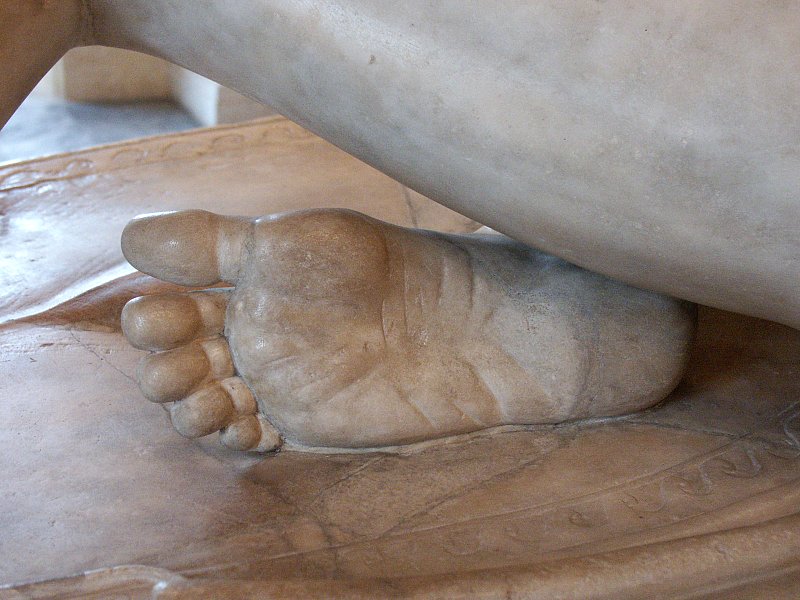
https://homepages.bluffton.edu/~sulliva ... o/0100.jpg
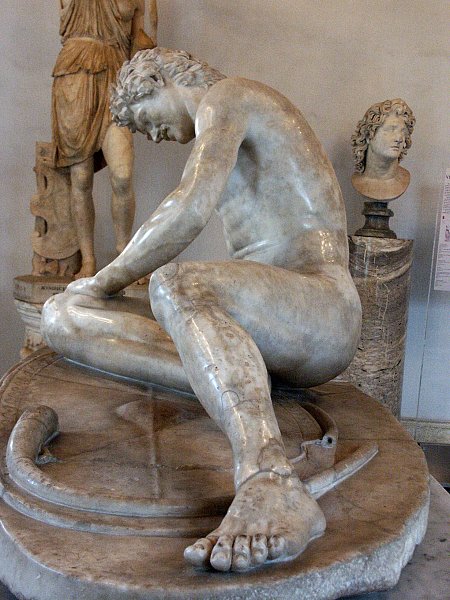
They are clearly clipping their nails:
https://upload.wikimedia.org/wikipedia/ ... lipper.jpg

Added in 1 hour 26 minutes 40 seconds:
"
Croatians: The most prevalent haplogroup is I2a (around 39-40%), followed by R1a (around 22-24%).
Irish: The vast majority of Irish males predominantly carry the R1b haplogroup (especially R1b-M269), with frequencies ranging upwards of 81% in some studies, which is one of the highest frequencies in Western Europe.
"
"
In the case of the present-day Croatian nation, several components or phases influenced its ethnogenesis:
the indigenous prehistoric component which dates from Stone Age, before 40,000 years, and the younger Neolithic culture like Danilo dated 4700–3900 BC, and Eneolithic culture like Vučedol dated 3000 and 2200 BC.[4]
the protohistoric component, which includes ancient people like Illyrians (including the Dalmatae and Liburnians in coastal Croatia, and the Pannonii in continental Croatia); Celtic or mixed Celtic-Illyrian people, such as the Iapodes, Taurisci and Scordisci also existed for a time in continental Croatia.[4] In the 4th century BC there also existed a few Greek colonies on the Adriatic islands and coast.[4]
the classical antiquity component caused by the Roman conquest, which included a mixture of ancient Illyrian people and Rome's colonists and legionaries;[5] there was also a temporary presence of Iranian-speaking Iazyges on the border of Roman Dalmatia at this time.[6]
the Late Antiquity-Early Middle Ages component from the Migration Period, started by the Huns, and which in Croatia included in the first phase Visigoths and Suebi, who didn't stay for a long period of time, and Ostrogoths, Gepids and Langobards, who formed the brief Ostrogothic Kingdom (493-553 AD).[7] In the second phase occurred the Slavic migrations to the Balkans, often associated with the Pannonian Avars' activity.[7]
the final Middle Ages-Modern Age component, which included the presence of Magyars/Hungarians, Italians/Venetians, Germans/Saxons and others.[7] After the 14th century, because of the black death, and the late 15th century, because of Ottoman invasion, the Croatian ethnonym expanded from the historic Croatian lands to Western Slavonia, which caused Zagreb to become capital city of the Croatian Kingdom, and to become incorporated with the population ethnogenesis of that territory.[7] The Ottoman invasion caused many migrations of the people within the Balkans and in Croatia, like those of the Serbs and Vlachs,[8] but the upcoming world wars and social events also influenced the Croatian ethnogenesis.[8]
"
"
The Iranian, also known as Iranian-Caucasian theory, dates to the 1797 and the doctoral dissertation by Josip Mikoczy-Blumenthal who, as the dissertation mysteriously disappeared in 1918 and was preserved only a short review, considered that Croats originated from Sarmatians who were descending from Medes in North-Western Iran.[78] In 1853 were discovered the two Tanais Tablets.[79] They are written in Greek, and were founded in the Greek colony of Tanais in the late 2nd and early 3rd century AD, at the time when the colony was surrounded by Sarmatians.[80][81] On the larger inscription is written the father of the devotional assembly Horouathon and the son of Horoathu, while on the smaller inscription Horoathos, the son of Sandarz, the archons of the Tanaisians,[79] which resembles the usual variation of Croatian ethnonym Hrvat - Horvat.[79] Some scholars use these tablets only to explain the etymology, and not necessarily the ethnogenesis.[82][72]
The Iranian theory entered the historical science from three, initially independent ways, from historical-philological, art history, and religion history, in the first half of the 20th century.[83] The last two were supported by art historian scholars (Luka Jelić, Josef Strzygowski, Ugo Monneret de Villard),[84] and religion historian scholars (Johann Peisker, Milan Šufflay, Ivo Pilar).[85] The Slavic-Iranian cultural interrelation was pointed out by modern ethnologists, like Marijana Gušić who in the ritual Ljelje noticed the influence from Pontic-Caucasian-Iranian sphere,[86][87] Branimir Gušić,[87] and archaeologists Zdenko Vinski and Ksenija Vinski-Gasparini.[88] However, the cultural and artistic indicators of Iranian origin, including indications in the religious sphere, is somehow difficult to determine.[81] It is mostly Sassanian (224-651 AD) influences that were felt in the steppe regions.[81]
The first scholar who connected the tablets' names with Croatian ethnonym was A. L. Pogodin in 1902.[89][81] First who considered such a thesis and Iranian origin was Konstantin Josef Jireček in 1911.[83] Ten years later, Al. I. Sobolevski gave the first systematic theory about the Iranian origin which until today did not change in basic lines.[83] In the same year, independently Fran Ramovš, with reference to the Iranian interpretation of the name Horoathos by Max Vasmer, concluded that the early Croats were one of the Sarmatian tribes which during the great migration advanced along the outer edge of Carpathians (Galicia) to the Vistula and Elbe rivers.[83] The almost final, and more in detail picture was given by Slovenian academic Ljudmil Hauptmann in 1935.[83][34] He considered that Iranian Croats, after the Huns invasion around 370 when the Huns crossed the Volga river and attacked the Iranian Alans at the Don river, abandoned their initial Sarmatian lands and arrived among the Slavs at the waste lands north of Carpathians, where they gradually Slavicized.[90] There they belonged to the Antes tribal polity until the Antes were attacked by the Avars in 560, and the polity was finally destroyed 602 by the same Avars.[90] The thesis was subsequently supported by Francis Dvornik, George Vernadsky, Roman Jakobson, Tadeusz Sulimirski, and Oleg Trubachyov.[91] Omeljan Pritsak considered early Croats a clan of Alan-Iranian origin which during the "Avarian pax" had frontiersman-merchant social role,[92] while R. Katičić considered that there's not enough evidence that the non-Slavic Croats ruled as an elite class over Slavs who were under the rule of Avars.[33][93]
The personal names on the Tanais Tablets are considered as a prototype of a certain ethnonym of a Sarmatian tribe those persons did descend from,[80][94] and as well today is generally accepted that the Croatian name is of Iranian origin and that can be traced to the Tanais Tablets.[94][95] However, the etymology itself is not enough strong evidence.[80] The theory is further explained with the Avar's destruction of Antes tribal polity in 602, and that the early Croats migration and subsequent war with Avars in Dalmatia (during the reign of Heraclius 610-641) can be seen as a continuation of the war between Antes and Avars.[89] That the early Croats marked the cardinal directions with colors, hence White Croats and White Croatia (Western) and Red Croatia (Southern),[89] but the cardinal color designation, in general, indicates remnants of the widespread steppe peoples tradition.[96] The heterogeneous composition of the Croatian legend in which are unusually mentioned two women leaders Touga and Bouga, which indicates to what the actual archaeological findings confirmed - the existence of "warrior women" known as Amazons among the Sarmatians and Scythians.[89] As such, Trubachyov tried to explain the original proto-type of the ethnonym from adjectives *xar-va(n)t (feminine, rich in women), which derives from the etymology of Sarmatians, the Indo-Aryan *sar-ma(n)t (feminine), in both Indo-Iran adjective suffix -ma(n)t/wa(n)t, and Indo-Aryan and Indo-Iranian word *sar- (woman), which in Iranian gives *har.[94]
Another interpretation was given by the scholar Jevgenij Paščenko; he considered that the Croats were a heterogeneous group of people belonging to the Chernyakhov culture, a poly-ethnic cultural mélange of mostly Slavs and Sarmatians, but also Goths, Getae and Dacians.[97] There was happening an interrelation between Slavic and Iranian language and culture, seen for example in the toponymy.[97] As such, under the ethnonym Hrvati should not be necessary seen a specific or even homogeneous tribe, yet archaic religion and mythology of a heterogeneous group of people of Iranian origin or influence who worshiped the solar deity Hors, from which possibly originates the Croatian ethnonym.[98]
Persian theory
edit
Another known more radical thesis, Iranian-Persian, of the Iranian theory was by Stjepan Krizin Sakač, who although gave insights on some issues, tried to follow the Croatian ethnonym as far the region Arachosia (Harahvaiti, Harauvatiš) and its people (Harahuvatiya) of the Achaemenid Empire (550–330 BC).[99][89][100]
"
"
However, in the first and second Yugoslavia, the Pan-Slavic (pure-Slavic) theory was particularly emphasized because of the political context and was the only officially accepted theory by the regime,[25][26][27] while other theories which attributed non-Slavic origin and components were ignored and not accepted,[26][27] and even their supporters, because of also political reasons, were persecuted (Milan Šufflay, Kerubin Šegvić, Ivo Pilar).[28][27] The official theory also ignored some historical sources, like the account of Constantine VII, and considered that the Croats and Serbs were the same Slavic people who arrived in one and the same migration, and unwilling to consider foreign elements in those separate societies.[29]
"
"
There were many supporters of the thesis and further tried to develop it, but the actual arguments are considered far-fetched, unscientific, and also with Anti-Slavic sentiment.[33][89][85][102][103]
"
Political and modern Nationalist junk keeps poisoning everything.
"
Genetically, on the Y chromosome line, a majority (65%) of male Croats from Croatia belong to haplogroups I2 (39%-40%) and R1a (22%-24%), while a minority (35%) belongs to haplogroups E (10%), R1b (6%-7%), J (6%-7%), I1 (5-8%), G (2%), and others in <2% traces.[143][144]
"
"
Genetically, on the paternal Y chromosome line and studies published between 2003 and 2008, a majority (>75%) of male Croats from Croatia belongs to one of the three major European Y-DNA haplogroups – I2 (32%[16][17][18]-34%[19]), R1a (27%[19]-34%[16][17][18]) and R1b (12%[19]-15%[16][17][18]), while a minority (>25%) belongs to haplogroups E (9%[19]), I1 (5%[17]-9%[19]), J (4%[19]), N (2%[19]), and G (1%[19]). According to recent and more extensive studies published between 2012 and 2022, a majority (65%) of male Croats from Croatia belongs to haplogroups I2 (39%-40%) and R1a (22%-24%), while a minority (35%) belongs to haplogroups E (10%), R1b (6%-7%), J (6%-7%), I1 (5-8%), G (2%), Q (0-1.93%), H (0-1.8%), T (0.6%), N (0-0.6%) and L (0.2%).[20][21]
"
"
R1a1a1-M17 (22.1%-25.6%) is the second most prevailing haplogroup.[20][25] The haplogroup R-M17 in Croatia is mostly divided into two subclades, R-M558 which is predominant (19.2%), and R-M458 (4.9%), while R-Z282 is rare (1.2%).[25] It has highest frequency in northern (29.1%) and central (23.6%) region, and almost the same frequency in eastern (18.6%), southern (19.1%), and western (20%) region of Croatia.[20] The highest local frequency of R1a1a1-M17 was observed in the Croats from Varaždin (38%) and Osijek (26-39%),[19][21] Žumberak (34.1),[25] and in the middle-northern islands of Dugi Otok (34.1%), Krk (37%), Pašman (38%) and Cres (56.6%),[16][25] being similar to the values of the other Slavs, like Slovenes, Czechs and Slovaks. The frequency is lower in Šokci from eastern Croatia (16%),[22][23] in the city of Dubrovnik (13.4%) and Split (19%) in Dalmatia, as well on the southern islands of Hvar (8-10.58%) and Vis (17%).[16][25][21] In Bosnian Croats, the frequency is similar to those of other South Slavs (12%).[19][38] Considering subclades, the only outlier is island of Cres which had almost equal percentage of R1a-M558 (29.3%) and R1a-M458 (27.3%).[25] Based on 8 STR marker genetic distances closest are populations of near countries, but also depending on method, Belarus, Slovakia, Poland and Russia.[26] The R-M558 subclade is more frequent among East Slavs in Eastern Europe and Volga-Ural region, while R-M458 among West Slavs in Central and Eastern Europe. Both are present in "informative frequencies in Balkan populations with known Slavonic heritage".[39] R-M558 subclade CTS1211 was also found among Hungarian conquerors which indicates mixing and assimilation of the Slavs among the Hungarians.[40]
"
"
Haber et al. (2012) found R1a1a-M17 in 26.0% (53/204) of a set of samples from Afghanistan, including 60% (3/5) of a sample of Nuristanis, 51.0% (25/49) of a sample of Pashtuns, 30.4% (17/56) of a sample of Tajiks, 17.6% (3/17) of a sample of Uzbeks, 6.7% (4/60) of a sample of Hazaras, and in the only sampled Turkmen individual.[107]
Di Cristofaro et al. (2013) found R1a1a-M198/M17 in 56.3% (49/87) of a pair of samples of Pashtuns from Afghanistan (including 20/34 or 58.8% of a sample of Pashtuns from Baghlan and 29/53 or 54.7% of a sample of Pashtuns from Kunduz), 29.1% (37/127) of a pool of samples of Uzbeks from Afghanistan (including 28/94 or 29.8% of a sample of Uzbeks from Jawzjan, 8/28 or 28.6% of a sample of Uzbeks from Sar-e Pol, and 1/5 or 20% of a sample of Uzbeks from Balkh), 27.5% (39/142) of a pool of samples of Tajiks from Afghanistan (including 22/54 or 40.7% of a sample of Tajiks from Balkh, 9/35 or 25.7% of a sample of Tajiks from Takhar, 4/16 or 25.0% of a sample of Tajiks from Samangan, and 4/37 or 10.8% of a sample of Tajiks from Badakhshan), 16.2% (12/74) of a sample of Turkmens from Jawzjan, and 9.1% (7/77) of a pair of samples of Hazara from Afghanistan (including 7/69 or 10.1% of a sample of Hazara from Bamiyan and 0/8 or 0% of a sample of Hazara from Balkh).[108]
"
https://en.wikipedia.org/wiki/Haplogroup_R2
"
Haplogroup R1b is present in Pakistan, though less dominant than R1a, appearing in various ethnic groups like Pashtuns, Gujars, and Syeds, often indicating ancient connections to West Eurasia, the Near East, or steppe migrations, with some subclades potentially linked to Indo-Aryan movements or more recent admixture, though its specific deep roots in South Asia are still researched. It's found alongside indigenous South Asian haplogroups like L, showing complex genetic histories shaped by geography and history.
Where R1b Appears in Pakistan:
Pashtuns: R1b is present, though R1a is more common, appearing in groups like Mohmand Pashtuns alongside R1a and L lineages.
Gujars & Syeds: Show paternal links to Central Asian and Pakistani populations, with R1b contributing to their genetic makeup.
Tanolis: Have closer ties to Turkmen populations, suggesting Central Asian origins for some of their R1b.
Punjabis: Some Punjabi Rajput families who migrated during Partition carry R1b, showing historical movement.
Origins & Significance:
West Asian/Steppe Roots: R1b's origins are linked to West Eurasia (Near East, Caucasus) and the Pontic-Caspian Steppe, linked to large migrations that spread R1a and R1b.
Indo-Aryan Connection: Its presence in South Asia is often tied to early Indo-Aryan movements or ancient foreign admixture.
Indigenous vs. Migratory: Some R1b in Pakistan may represent older, deep-rooted lineages, while others reflect more recent migrations or mixing with West Eurasian populations.
"
https://www.wikitree.com/wiki/Space:Ire ... tudy_-_R1a
https://www.independent.co.uk/news/scie ... 89191.html
"
Just about all Irish men have R1b or R1a Y-DNA
"
Says:
https://www.reddit.com/user/Europe_is_white_land/
https://en.wikipedia.org/wiki/County_Armagh
https://en.wikipedia.org/wiki/Mars_of_Todi
https://upload.wikimedia.org/wikipedia/ ... helmet.jpg

https://ancientrome.ru/art/artworken/img.htm?id=317
https://www.eupedia.com/forum/threads/r ... ses.27006/
https://news.uchicago.edu/story/ancient ... lack-death
"
The Black Death (1346-1353) killed an estimated 75 to 200 million people across Eurasia and North Africa, with Europe losing 30% to 60% (25-50 million) of its population, making it one of history's deadliest pandemics, wiping out huge numbers in just a few years and reshaping society.
"
That is just part of the story of how other firmerly similar regions likely started looking different. It must have impscted the strength of certain communities speaking their own dialects and lamguages, creating more homogeinity among the survivors and ending huge amounts of future lines and various genes that could have become dominant otherwise.
https://www.theguardian.com/books/2020/ ... sham-matar
https://www.worldhistory.org/image/1203 ... -1346---1/
https://www.wikitree.com/photo.php/2/2d ... Plague.jpg
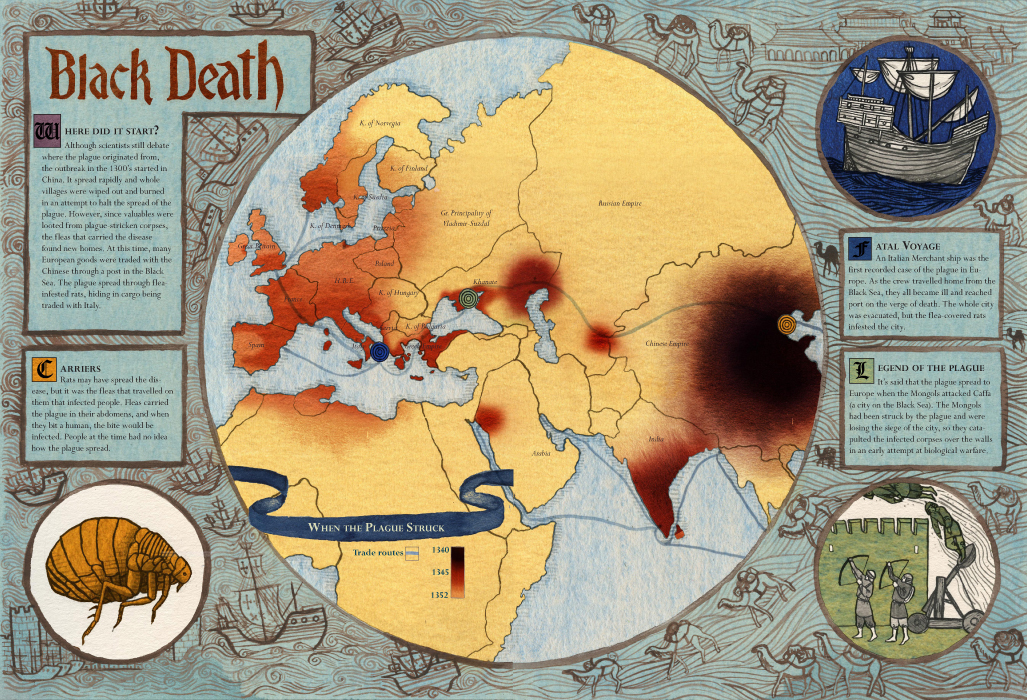
Supposedly China is where it started again.
"
541 A. D. - The first plague pandemic started and lasted 200 years. 100,000,000 people were killed in the Mediterranean basin region from 541 A.D. and lasted for over 200 years.
Middle Ages Black Death, or pandemic of the Middle Ages, began in China and made its way to Europe, causing the death of 60% of the entire population. This is the picture that is at the top of the page
Plague # 3 (or modern, pandemic) began again in China in the 19th century, spreading to port cities all over the world.
Cause each time is the same- a bacterium which is carried in the gut of the fleas. This bacterium traveled on the rats and then bit the people.
2016, there are antibiotics, and a plague vaccine. In the years when this occurred and killed so many both in the Orient, and Europe, there were no antibiotics or vaccines.
"
https://en.wikipedia.org/wiki/Black_Death_migration
"
While initial phylogenetic studies suggested that the plague bacillus evolved 2,000 years ago near China, specifically in the Tian Shan mountains on the border between modern-day China and Kyrgyzstan,[1][2][3] this view has been contested by recent molecular studies which have indicated that the plague was present in Scandinavia 3,000 years earlier.[4] Likewise, the immediate origins of the Black Death are also uncertain. The pandemic has often been assumed to have started in China, but lack of physical and specific textual evidence for it in 14th-century China has resulted in continued disputes on the origin to this day.[5]
"
Identity Politics and National Blame along with avoiding the associated blame and guilt.
"
For years it was common for Europeans to assume that the Black Death originated in China. Charles Creighton, in his History of Epidemics in Britain (1891), summarizes the tendency to retrospectively describe the origins of the Black Death in China despite lack of evidence for it: "In that nebulous and unsatisfactory state the old tradition of the Black Death originating in China has remained to the present hour".[16] There were records of epidemics from 1308 to 1347 but the loss of life is "clearly assigned to floods and famines, with their attendant sickness."[17] In 1308, there was a plague or malignant fever in Jiangxi and Zhejiang following floods, locusts, and failure of crops. In 1313 there was an epidemic in the capital.[18] According to Creighton, Chinese records of pestilence and epidemics in the 14th century suggest nothing more than typhus, and the dates of major Chinese outbreaks of epidemic disease, marked as "great pestilence" or "great plague" from 1352 to 1363, post-date the European epidemic by several years.[17]
The suggestion is that the soil of China may not have felt the full effects of the plague virus, originally engendered thereon, until some few years after the same had been carried to Europe, having produced there within a short space of time the stupendous phenomenon of the Black Death. If there be something of a paradox in that view, it is the facts themselves that refuse to fall into what might be thought the natural sequence.[17]
— Charles Creighton
Three waves of epidemics occurred in the last years of the Yuan dynasty: 1331-34 spreading from Hebei to Hunan, in 1344–46 in coastal Fujian and Shandong, and in the 1350s throughout northern and central China. The epidemic of 1331-34 recorded a death toll of 13 million people by 1333. The epidemic of 1344-46 was called a "great pestilence."[19] On the heels of the European epidemic, a widespread disaster occurred in China during 1353–1354. Chinese accounts of this wave of the disease record a spread to eight distinct areas: Hubei, Jiangxi, Shanxi, Hunan, Guangdong, Guangxi, Henan, and Suiyuan.[a] More than two thirds of the population in part of Shanxi died and six or seven out of ten in Hubei died. Epidemics afflicted various provinces from 1356 to 1360. In 1358, over 200,000 in Shanxi and Hubei died.[20] In Hebei and Shandong, the population fell from 3.3 million in 1207 to 1.1 million in 1393, however the population in the southern Yangzi region continued to grow from 1210 to the mid-1350s and only fell by less than 10 percent by 1381.[21]
Research on the Delhi Sultanate and the Yuan dynasty shows no evidence of any serious epidemic in fourteenth-century India and no specific evidence of plague in fourteenth-century China, suggesting that the Black Death may not have reached these regions.[11]
One, it did not seem to spread throughout all of China but only in certain provinces and regions, unlike in Europe, despite its relatively dense population and integrated economy. Two, there are no descriptions of the symptoms of the Black Death. Three, the timing does not seem to coincide with the spread of the Black Death elsewhere.[11]
What we know, then, is that major, highly lethal epidemics afflicted China in the 1330s–50s and undoubtedly contributed to a catastrophic population collapse that began in the thirteenth century and continued, or perhaps rebounded, in the mid-fourteenth century. Although we know nothing of the clinical details of the disease or diseases behind the epidemics, we do know that they began in the northeast (Hebei and Shandong) and spread down the coast and inland to the central provinces. We hear only scant references to these epidemics in the south and none in the southwest or west. Of course, that may be because those areas were remote from the capital and sparsely populated compared to the northeastern and central provinces. If the disease afflicting China in the mid-fourteenth century was the plague, which was ravaging the Middle East and Europe from 1347 onward, it probably entered China from the Mongolian steppes north of Hebei and not from the Yunnan focus in the far southwest.[11]
— George Sussman
Bubonic plague in its endemic form was mentioned for the first time in Chinese sources in 610 and 652, which if presumed to be in connection to the first plague pandemic, would have required human spread for a realistic spread rate from west to east over 5,500 km. In 610, Chao Yuanfang mentioned a "malignant bubo" "coming on abruptly with high fever together with the appearance of a bundle of nodes beneath the tissues."[23] Sun Simo, who died in 652, also mentioned a "malignant bubo" and plague that was common in Guangdong but was rare in interior provinces. Benedictow believes this indicates the spread of an offshoot of the first plague pandemic which reached Chinese territory by 600.[24]
The earliest Chinese description of the Black Death comes from a local gazetteer from Shanxi in 1644: "In the autumn there was a great epidemic. The victim first developed a hard lump below the armpits or between the thighs or else coughed thin blood and died before they had time to take medicine. Even friends and relations did not dare to ask after the sick or come with their condolences. There were whole families wiped out with none to bury them."[11] The Customs Service list described it as a "Great pestilence in Lu-an" where "Those attacked had hard lumps grow on the neck or arm, like clotted blood. Whole families perished. In some cases the victims spat blood suddenly, and expired."[11] This coincided with two epidemics from 1586 to 1589 and 1639–44 that have been characterized as the most deadly in Chinese history.[11] Even then the epidemics do not seem to have behaved the same as in Europe. The epidemics in 17th century China were preceded by huge die offs in the rodent population and took decades to spread from province to province and never spread throughout the whole country, ultimately killing less than 5% of the population.[11]
"
https://www.astmh.org/news-events/in-th ... fographics
https://www.sciencenorway.no/black-deat ... on/1995492
"
Researchers from several European countries were involved in this new, original approach to estimate how serious the Black Death really was for Europe's population in the period from 1346 to 1353.
About 670 years ago, a clear majority of Europe’s population supported themselves by agriculture. Between 75 and 90 per cent of the population at that time lived in villages.
If many of these people died at the same time, it should be possible to see clear traces of this, in the form of reduced amounts of agriculture-related pollen, especially cereal pollen.
Instead, the researchers predicted that birch and other tree pollen would appear as these species recolonized the formerly cultivated landscape.
This is exactly what the researchers found. But they didn’t find it everywhere.
Just seven of the 21 areas in Europe surveyed by the researchers showed clear evidence of this shift. Norway was one of them.
In some parts of Europe — such as Eastern Europe, Spain, Ireland and parts of Central Europe — researchers hardly found any evidence in the form of agricultural declines from history's worst pandemic.
In some places, agriculture even flourished during the Black Death, the researchers found.
In large parts of Norway and the rest of Scandinavia, however, many farms were probably abandoned and the land was no longer cultivated.
This international study is the first time the discipline of paleoecology has been used to say something about a dramatic historical event such as the Black Death.
"
The immigrants from Ireland were also of different classes that had likely not mingled, so upper classes and lower classes, land owners and farmers, all having differences developed due to not being able to participate in the same groups together.
This class differentiation changing genetics and appearances may have been widespread across the world, and a variety of factors may contribute to the appearance of people with Northern Irish and Scots-Irish ancestry looking similar to some Croats, Bosnians, and Serbs.
https://encrypted-tbn0.gstatic.com/imag ... jVcb16KQ&s
https://encrypted-tbn0.gstatic.com/imag ... iz15r5Ww&s
Many Irish Americans from upper or upper middle class backgrounds and ancestry, who were not from the poor farmer backgrounds or the people moved in to work new crops, look like these two Serbian examples.
Last edited by kFoyauextlH on Sat Mar 21, 2026 8:47 pm, edited 1 time in total.