This now removed song has background music reminiscent of some old anime music.
Added in 2 minutes 4 seconds:
Added in 5 hours 13 minutes 53 seconds:
I was looking online if anyone had collected any evidence pointing to Christopher Nolan being a eurocentrist white supremacist fascist type, which I am pretty confident that he really is, as well as Kenneth Branagh perhaps somewhat less obviously, and it came up with this instead:
https://www.bbc.com/future/article/2023 ... upremacist
The Thor film that Branagh directed was full of stuff that came off as white supremacist anxieties, concerns, and pandering that only an actual racist would have even thought of and emphasized. I think these pretty powerful and influential people are pretty blatant even and not "accidentally" depicting these things the way that they do, they are full blown racist freaks, probably similar to whatever creature Douglas Murray is as a demographic:
There is this whole strain of these sadistic authoritarian types in Europe and particularly with British type backgrounds.
https://theanarchistlibrary.org/library ... gy-of-love
https://scholarworks.smith.edu/cgi/view ... sy_facpubs
https://www.cbc.ca/radio/ideas/who-s-dr ... -1.6403074
https://bigtallwords.com/2015/04/27/the ... t-trilogy/
"
In his dual roles as Bruce Wayne, postmodern aristocrat, and Batman, urban warlord, the lead character embodies the fascist mythology, where good citizens behave, criminals are punished, and everyone has their place. The mythology of meritocracy and of order are portrayed as the naturalized social standard and the films validate the status quo while simultaneously presenting themselves as apolitical entertainment products.
"
Its basically rich white Europeans obsessed with beating the sh*t out of those outside their class and crying if anything happens to their elite group and allies.
https://www.newstatesman.com/the-weeken ... -parallels
"
Christopher Nolan: the last Tory
The director is a mass entertainer with an elitist disdain for the masses. In his films, order and hierarchy reign supreme.
"
"
Nolan is stood utterly still, wearing a shirt and a blazer, arms fixed tight down his sides, as the actress Brittany Murphy gyrates next to him. He looks like a Victorian scientist, defrosted after a deep sleep, realising with horror that modernity has become more deranged than he could possibly have imagined.
"
"
Nolan believes in deadlines and careful resource allocation. He considers efficiency “a form of control”. No sentiment. No treaties with fashion or whimsy or freedom. “I have to do the best with what I have,” says Jim Gordon, the harried cop in The Dark Knight. Every Nolan hero is a confounded realist.
Realism underlines everything Nolan creates. Studio executives praise him, not for his artistry, but for his sense of “fiscal responsibility”. When they visit his sets, they find miniature recreations of 19th-century England. “Everyone was in suits and ties,” said Brad Grey, then the chairman of Paramount Pictures, when he inspected the set of Interstellar. He might have been a parent visiting Haileybury to find that the masters and the prefects were firmly in control of the place. “I thought, ‘Who are these folks,’ everyone talking very nicely to each other, all civilised?”
Like at Haileybury, the ordered, civilised environments Nolan creates around himself, and his own tidy, collected, buttoned-up mien, are inspired by fear. The boys must be in bed at a precise time. The showers must be freezing. The movie must come in under budget. Decorum must reign. Fiscal responsibility for ever and ever. What happens if the rules disappear? What is the underbelly of realism and rationality? He sees the answer in the work of Francis Bacon, whose art echoes throughout Nolan’s films: “It’s this idea of barely contained horror, this idea of the primal barely held in by the structures of society.” The opposite of order is anarchy.
"
It is all there, this is what he is.
"
Nolan’s heroes are solitary, languid, self-punishing rationalists who must be destroyed before they can be redeemed. They are never hedonists. (There is one scene set in a nightclub in the entire Nolan oeuvre: it involves Batman ruthlessly beating anybody there who might be having a good time.)
"
"
Christopher Nolan is an auteur who claims to be a craftsman, an engineer who despises new technology, a starkly conservative Englishman who lives and works in the most liberal city in the United States. Above all, Nolan is a mass entertainer with an elitist disdain for the masses.
Aggregations of human beings in a Nolan movie are usually a bad sign. In the Batman trilogy they mass only as gangsters, or anarchists, or filthy, deluded revolutionaries. In Interstellar the people are reduced to yokels, who no longer have the vision to save themselves from a dusty environmental apocalypse. The one major crowd scene in Oppenheimer, when the scientist receives the acclaim of his colleagues, degenerates into grotesque bacchanal, where people vomit and scream and fondle each other. Nolan is terrified of the masses because he is terrified of himself, and his lucrative ability to tell them stories. “Who are the people?” Elliot Page’s Ariadne asks Leonardo di Caprio’s Cobb in Inception. “They’re projections of my subconscious,” he replies.
Without rules, human beings are nasty and brutish. This lofty insight leads Nolan to believe that the filmmaker and the audience can never be equally matched. He does not do traditional scored research screenings or focus groups. He forced through the cinematic release of Tenet in September 2020 during the pandemic, seemingly unconcerned by Covid circulating in enclosed spaces among herds of unvaccinated people.
The epic scenery of his films – Nolan keeps returning to glaciers, huge, empty glittering cities, and the fizzing, baffling matter of particle physics – feel like intimidation devices. So too do his incomprehensible multi-timeline plots, the insanely loud scores of these pictures, and his delight in forcing actors into masks and helmets and cockpits, where their dialogue can barely be understood. All the fear and flight and anger inside Nolan is contained in these attempts to dominate his audience. If he can dominate us, he can dominate those feelings too.
Haileybury might have been “Darwinian”, but Nolan also happily told Shone that he “enjoyed my time there”. The reconciliation of brutality and cruelty with order and hierarchy is what Nolan always hopes to achieve. The dormitory room might be bleak, but it will always shelter us. Horror is necessary to prevent greater horror. This is Tory propaganda on the grandest possible scale. Distracted by explosions and Batmobiles and wormholes and magic puzzles, Christopher Nolan’s audiences never quite realise what he is whispering to them. They don’t want to.
As Michael Caine’s cockney trickster says in The Prestige: “Now you’re looking for the secret. But you won’t find it. Because you don’t really want to know. You want to be fooled.”
"
There is just no way for me to reconcile what these people seem to doend every waking moment of their lives on and their somehow secretly not being fanatical fascist elitist modern aristocrat people who love chokeholding people and traps and catch 22 type locks.
https://en.wikipedia.org/wiki/Lock_and_key
"
Locks have been in use for over 6000 years, with one early example discovered in the ruins of Nineveh, the capital of ancient Assyria.[1] Locks such as this were developed into the Egyptian wooden pin lock, which consisted of a bolt, door fixture or attachment, and key. When the key was inserted, pins within the fixture were lifted out of drilled holes within the bolt, allowing it to move. When the key was removed, the pins fell part-way into the bolt, preventing movement.[2]
The warded lock was also present from antiquity and remains the most recognizable lock and key design in the Western world. The first all-metal locks appeared between the years 870 and 900, and are attributed to English craftsmen.[3] It is also said that the key was invented by Theodorus of Samos in the 6th century BC.[1]
The Romans invented metal locks and keys and the system of security provided by wards.[4]
Affluent Romans often kept their valuables in secure locked boxes within their households, and wore the keys as rings on their fingers. The practice had two benefits: It kept the key handy at all times, while signaling that the wearer was wealthy and important enough to have money and jewellery worth securing.[5]
"
https://en.wikipedia.org/wiki/Warded_lock
https://en.wikipedia.org/wiki/Imprisonment
"
Imprisonment or incarceration is the restraint of a person's liberty for any cause whatsoever, whether by authority of the government, or by a person acting without such authority. In the latter case it is considered "false imprisonment". Imprisonment does not necessarily imply a place of confinement with bolts and bars, but may be exercised by any use or display of force (such as placing one in handcuffs), lawfully or unlawfully, wherever displayed, even in the open street. People become prisoners, wherever they may be, by the mere word or touch of a duly authorized officer directed to that end. Usually, however, imprisonment is understood to imply actual confinement against one's will in a prison employed for the purpose according to the provisions of the law.[1] Generally gender imbalances occur in imprisonment rates, with incarceration of males proportionately more likely than incarceration of females.[2]
"
https://en.wikipedia.org/wiki/False_imprisonment
https://polarjournal.org/wp-content/upl ... ericas.pdf
These people get off on such things, their only pleasure is the hubristic joy they feel when those they dominate snd thus think they prove their superiority over suffer.
https://en.wikipedia.org/wiki/Everyday_sadism
https://en.wikipedia.org/wiki/Sadistic_ ... y_disorder
https://en.wikipedia.org/wiki/Sadomasochism
https://en.wikipedia.org/wiki/Sexual_sadism_disorder
https://en.wikipedia.org/wiki/Sexual_repression
https://crisismagazine.com/opinion/doug ... -about-sex
"
Barbarism is not clamoring at the gates: it’s within the walls.
I know it’s hard to talk about these things. No one in their right mind has the slightest inclination to do so. However, we cannot ignore the situation at hand. We as Catholics have an especial obligation always to proclaim the truth. It’s now our role to be countercultural. It was ever thus and always will be. We must have the courage always to say that buggery is disgusting and bears no resemblance to the marital embrace, no matter the pedigree of the conservative making that case.
Douglas Murray may be right on Brexit, or Islam, or any number of topical issues. But he sure does have some queer ideas about sex.
"
Other fascists will be tolerant of some kind of monstrous figure so long as he produces hateful materials for them to cheer on, even if he fails to meet their standards or preferences in other ways.
https://en.wikipedia.org/wiki/National_ ... ed_States)
https://en.wikipedia.org/wiki/Racism_in ... _community
https://en.wikipedia.org/wiki/Gay_Nazis_myth
https://read.dukeupress.edu/glq/article ... m=fulltext
https://www.cbc.ca/news/canada/active-c ... -1.7586641
https://www.huffingtonpost.co.uk/jacob- ... 25772.html
Added in 15 minutes 14 seconds:
https://en.wikipedia.org/wiki/Haileybur ... ce_College
Added in 14 hours 2 minutes 12 seconds:
This seemed more relaxed than the comments everywhere with their outrage.
Added in 2 minutes 30 seconds:
This was mentioned in the video:
https://en.wikipedia.org/wiki/Warrior_Vase
Do you think that these ancient prople had a craving like modern people towards fascistic authoritarian oppression and violence or does that come from different conditions that are from a later time?
Added in 4 days 10 hours 33 minutes 11 seconds:
Added in 11 hours 52 minutes 22 seconds:
This guy looks like a Roman soldier:
https://images.axios.com/j23BWp_q8CPpX- ... 77034.jpeg
https://media.cnn.com/api/v1/images/ste ... c=original
https://en.wikipedia.org/wiki/Gregory_Bovino
"
Bovino grew up in an Italian American family in North Carolina. His great-grandparents emigrated from Calabria to Pennsylvania in 1909, becoming naturalized citizens in 1927. Bovino was inspired to join the Border Patrol after seeing the 1982 film The Border as a child.[1]
In 1981, his father Mike, a bar owner, killed a 26 year old woman in a drunk driving accident in Blowing Rock, North Carolina, and was sentenced to 18 months in prison.[1] His parents divorced soon after.
Bovino graduated from Watauga High School in 1988.[2] He attended Western Carolina University, appearing on the dean's list in 1991.[3] That year, Bovino began the Leader Development and Assessment Course at Fort Lewis.[2] He graduated from Western Carolina in 1993.[4] Bovino attended Appalachian State University for graduate school.[5]
"
https://en.wikipedia.org/wiki/Fort_Lewis_(Washington)
https://en.wikipedia.org/wiki/Leader_De ... ent_Course
https://en.wikipedia.org/wiki/Calabria
https://en.wikipedia.org/wiki/Name_of_Italy
https://en.wikipedia.org/wiki/Loaded_march
"
A loaded march is known as a forced foot march in the US Army. Less formally, it is a ruck march or rucking in the Canadian Armed Forces and the US Army (in reference to a carried rucksack), a tab in British Army slang, a yomp in Royal Marines slang, stomping in Australian Army slang, and a hump in the slang of the United States Marine Corps.
As a civilian exercise, loaded marching comes under the category of hiking, although this includes activities not vigorous enough to be compared to loaded marching. Civilian activities analogous to loaded marches are quite popular in New Zealand, where they are organised by "tramping clubs".
In many countries, the ability to complete loaded marches is a core military skill, especially for infantry and special forces. Loaded marching is particularly important in Britain, where all soldiers must complete annual loaded march tests.
In certain climates, the use of loaded marches is limited, since they would result in high casualty rates through heat exhaustion.
According to Vegetius, during the four-month initial training of a Roman legionary, loaded marches were taught before recruits ever handled a weapon, since any formation would be split up by stragglers at the back or soldiers trundling along at differing speeds.[1] Standards varied over time, but normally recruits were first required to complete 20 Roman miles (29.62 km or 18.405 modern miles) with 20.5 kg in five summer hours,[2] which was known as "the regular step" or "military pace". (The Romans divided daylight time into twelve equal hours. Depending on the exact day of the year and the latitude, the length of a "summer hour" would vary. Five summer hours is therefore not exact, but could indicate a time of approximately six modern hours.) They then progressed to the "faster step" or "full pace"[2] and were required to complete 24 Roman miles (35.544 km or 22.086 modern miles) in five summer hours loaded with 20.5 kilograms (45 lb). Training also included some forced marches of 20–30 miles, often followed by the construction of basic defences for an overnight position.
In some cases, each member of a Roman unit marched with a sudis, to aid the construction of defences.
"
https://en.wikipedia.org/wiki/Vegetius
https://en.wikipedia.org/wiki/Legionary
https://en.wikipedia.org/wiki/Lorica_segmentata
https://upload.wikimedia.org/wikipedia/ ... _01%29.jpg
https://upload.wikimedia.org/wikipedia/ ... mbMdCR.jpg
https://carpediemtours.com/blog/trajans ... itary-tomb
https://www.nationalgeographic.com/trajan-column/
https://www.nationalgeographic.com/traj ... ic_web.jpg
https://www.trajans-column.org/?page_id=38
https://www.trajans-column.org/?page_id=107
https://www.trajans-column.org/?page_id=578
https://en.wikipedia.org/wiki/Dacians
https://en.wikipedia.org/wiki/Dacia
https://upload.wikimedia.org/wikipedia/ ... _Prado.jpg
"
The name Daci, or "Dacians" is a collective ethnonym.[31] Dio Cassius reported that the Dacians themselves used that name, and the Romans so called them, while the Greeks called them Getae.[32][33][34] Opinions on the origins of the name Daci are divided. Some scholars consider it to originate in the Indo-European *dha-k-, with the stem *dhe- 'to put, to place', while others think that the name Daci originates in *daca 'knife, dagger' or in a word similar to dáos, meaning 'wolf' in the related language of the Phrygians.[35][36]
Another hypothesis is that the name Getae originates in Indo-European *guet- 'to utter, to talk'.[37][35]
"
Probably associated eith the wolf totem and other things like the wild boar, bear, and fox, and a similar word to "Goths" who later came from the same area.
"
In the 1st century AD, Strabo suggested that its stem formed a name previously borne by slaves: Greek Daos, Latin Davus (-k- is a known suffix in Indo-European ethnic names).[38] In the 18th century, Grimm proposed the Gothic dags or "day" that would give the meaning of "light, brilliant". Yet dags belongs to the Sanskrit word-root dah-, and a derivation from Dah to Δάσαι "Daci" is difficult.[20] In the 19th century, Tomaschek (1883) proposed the form "Dak", meaning those who understand and can speak, by considering "Dak" as a derivation of the root da ("k" being a suffix); cf. Sanskrit dasa, Bactrian daonha.[39] Tomaschek also proposed the form "Davus", meaning "members of the clan/countryman" cf. Bactrian daqyu, danhu "canton".[39]
Since the 19th century, many scholars have proposed an etymological link between the endonym of the Dacians and wolves.
A possible connection with the Phrygians was proposed by Dimitar Dechev (in a work not published until 1957).[citation needed] The Phrygian language word daos meant "wolf",[citation needed] and Daos was also a Phrygian deity.[40] In later times, Roman auxiliaries recruited from the Dacian area were also known as Phrygi.[citation needed] Such a connection was supported by material from Hesychius of Alexandria (5th/6th century),[41][42] as well as by the 20th century historian Mircea Eliade.[40]
The German linguist Paul Kretschmer linked daos to wolves via the root dhau, meaning to press, to gather, or to strangle – i.e. it was believed that wolves would often use a neck bite to kill their prey.[43][44]
Endonyms linked to wolves have been demonstrated or proposed for other Indo-European tribes, including the Luvians, Lycians, Lucanians, Hyrcanians and, in particular, the Dahae (of the south-east Caspian region),[45][46] who were known in Old Persian as Daos.[40]
The Draco, a standard flown by the Dacians, also prominently featured a wolf head.
However, according to Romanian historian and archaeologist Alexandru Vulpe, the Dacian etymology explained by daos ("wolf") has little plausibility, as the transformation of daos into dakos is phonetically unlikely and the Draco standard was not unique to Dacians. He thus dismisses it as folk etymology.[47]
Another etymology, linked to the Proto-Indo-European language roots *dhe- meaning "to set, place" and dheua → dava ("settlement") and dhe-k → daci is supported by Romanian historian Ioan I. Russu (1967).[48]
Mircea Eliade attempted, in his book From Zalmoxis to Genghis Khan, to give a mythological foundation to an alleged special relation between Dacians and the wolves:[49]
Dacians might have called themselves "wolves" or "ones the same with wolves",[50][49] suggesting religious significance.[51]
Dacians draw their name from a god or a legendary ancestor who appeared as a wolf.[51]
Dacians had taken their name from a group of fugitive immigrants arrived from other regions or from their own young outlaws, who acted similarly to the wolves circling villages and living from looting. As was the case in other societies, those young members of the community went through an initiation, perhaps up to a year, during which they lived as a "wolf".[52][51] Comparatively, Hittite laws referred to fugitive outlaws as "wolves".[53]
The existence of a ritual that provides one with the ability to turn into a wolf.[54] Such a transformation may be related either to lycanthropy itself, a widespread phenomenon, but attested especially in the Balkans-Carpathian region,[53] or a ritual imitation of the behavior and appearance of the wolf.[54] Such a ritual was presumably a military initiation, potentially reserved to a secret brotherhood of warriors (or Männerbünde).[54] To become formidable warriors they would assimilate behavior of the wolf, wearing wolf skins during the ritual.[51] Traces related to wolves as a cult or as totems were found in this area since the Neolithic period, including the Vinča culture artifacts: wolf statues and fairly rudimentary figurines representing dancers with a wolf mask.[55][56] The items could indicate warrior initiation rites, or ceremonies in which young people put on their seasonal wolf masks.[56] The element of unity of beliefs about werewolves and lycanthropy exists in the magical-religious experience of mystical solidarity with the wolf by whatever means used to obtain it. But all have one original myth, a primary event.[57][58]
"
https://en.wikipedia.org/wiki/Proto-Ind ... n_homeland
https://romaniadacia.wordpress.com/wp-c ... .jpg?w=529
https://encrypted-tbn0.gstatic.com/imag ... Y1jNY&s=10
https://en.wikipedia.org/wiki/Gurjar
https://en.wikipedia.org/wiki/Patka
"
Patka is a Sikh headgear in lieu of the full Sikh turban. It is commonly worn by Sikh sportsmen and young Sikh boys.[1][2] Patka is a square piece of cotton, usually with four strings (one attached to each corner) for tying.[2]
"
https://i.pinimg.com/564x/a1/05/fb/a105 ... 5ab0e3.jpg
https://c8.alamy.com/comp/CC0WK2/dacian ... CC0WK2.jpg
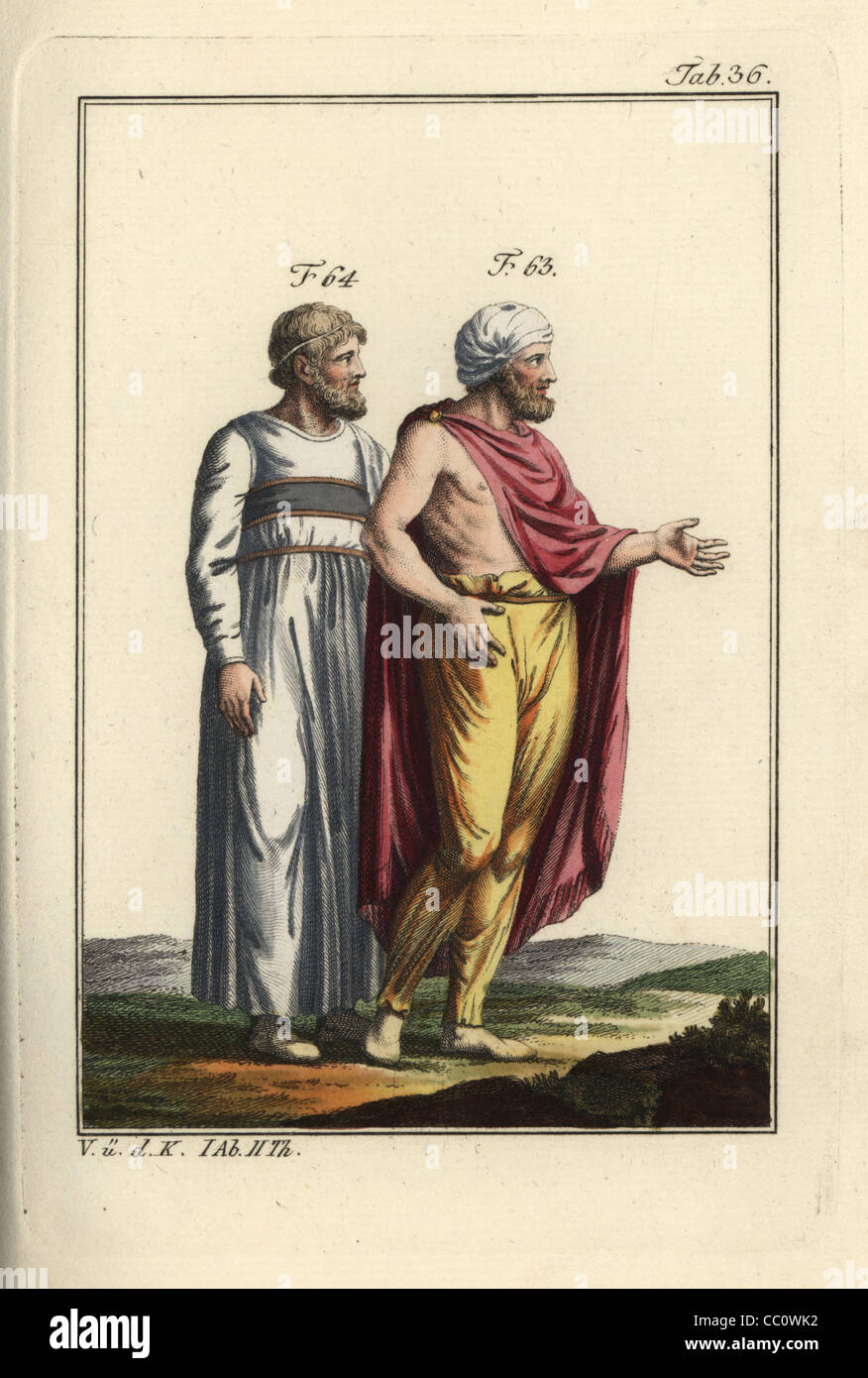
A turban attributed to the Sarmatians or Dacians.
https://www.ancient-origins.net/news/de ... ead-002840
https://en.wikipedia.org/wiki/Romani_language
"
The Romani language has considerable influence from Persian, Armenian and Byzantine Greek.[28][29] South Slavic influence is also notable, but is principally limited to grammar and phonology.[30]
Romani is sometimes classified in the Central Zone or Northwestern Zone Indo-Aryan languages, and sometimes treated as a group of its own.[31][32] Romani shares a number of features with the Central Zone languages.[33] The most significant isoglosses are the shift of Old Indo-Aryan r̥ to u or i (Sanskrit śr̥ṇ-, Romani šun- 'to hear') and kṣ- to kh (Sanskrit akṣi, Romani j-akh 'eye').[33] However, unlike other Central Zone languages, Romani preserves many dental clusters (Romani trin 'three', phral 'brother', compare Hindi tīn, bhāi).[33] This implies that Romani split from the Central Zone languages before the Middle Indo-Aryan period.[33] However, Romani shows some features of New Indo-Aryan, such as erosion of the original nominal case system towards a nominative/oblique dichotomy, with new grammaticalized case suffixes added on.[33] This means that the Romani exodus from India could not have happened until late in the first millennium.[33]
Many words are similar to the Marwari and Lambadi languages spoken in large parts of India. Romani also shows some similarity to the Northwestern Zone languages.[33] In particular, the grammaticalization of enclitic pronouns as person markers on verbs (kerdo 'done' + me 'me' → kerdjom 'I did') is also found in languages such as Kashmiri and Shina.[33] This evidences a northwest migration during the split from the Central Zone languages consistent with a later migration to Europe.[33]
Based on these data, Yaron Matras[34] views Romani as "kind of Indian hybrid: a central Indic dialect that had undergone partial convergence with northern Indic languages."[33]
In terms of its grammatical structures, Romani is conservative in maintaining almost intact the Middle Indo-Aryan present-tense person concord markers, and in maintaining consonantal endings for nominal case – both features that have been eroded in most other modern Indo-Aryan languages.[33]
Romani shows a number of phonetic changes that distinguish it from other Indo-Aryan languages – in particular, the devoicing of voiced aspirates (bh dh gh > ph th kh), shift of medial t d to l, of short a to e, initial kh to x, rhoticization of retroflex ḍ, ṭ, ḍḍ, ṭṭ, ḍh etc. to r and ř, and shift of inflectional -a to -o.[33]
After leaving the Indian subcontinent, Romani was heavily affected by contact with European languages.[33] The most significant of these was Medieval Greek, which contributed lexically, phonemically, and grammatically to Early Romani (10th–13th centuries).[33] This includes inflectional affixes for nouns, and verbs that are still productive with borrowed vocabulary, the shift to VO word order, and the adoption of a preposed definite article.[33] Early Romani also borrowed from Armenian and Persian.[33]
Romani and Domari share some similarities: agglutination of postpositions of the second layer (or case marking clitics) to the nominal stem, concord markers for the past tense, the neutralisation of gender marking in the plural, and the use of the oblique case as an accusative.[35][36] This has prompted much discussion about the relationships between these two languages. Domari was once thought to be the "sister language" of Romani, the two languages having split after the departure from the Indian subcontinent, but more recent research suggests that the differences between them are significant enough to treat them as two separate languages within the Central Zone (Hindustani) group of languages. The Dom and the Rom therefore likely descend from two different migration waves out of India, separated by several centuries.[37][38]
The following table presents the numerals in the Romani, Domari and Lomavren languages, with the corresponding terms in Sanskrit, Hindi, Odia, and Sinhala to demonstrate the similarities.[39] Note that the Romani numerals 7 through 9 have been borrowed from Greek.
"
https://external-preview.redd.it/NU1Ik3 ... 82f6e0742f
This shows one of the migration paths followed later, but likely showing a stream that was regular prior also.
"
yodatsracist
•
10y ago
Gypsies, or Roma/Romani as they're more often called in academic literature today, played specific social functions within wider European societies. Some academics have argued that they form the ideotypical case of "service nomads" (academic paper on it, though the term was introduced almost a decade earlier by Robert Hayden).
The Rroma historically earned their living by a few "service" professions, rather than as merchants or farmers or employees of the state. They worked as entertainers and fortune-tellers, certainly, but they were also well-known as tinsmiths ("tinkers", which is how they're frequently referred to in older literature). They could go around repair metal devices. Similarly, they used to arbitrage horse worn out horses into productive uses, be it glue or animal feed. Like Tinkers, this occupational name became an ethnic nickname in some places, and in some older works you'll see Roma and similar groups referred to as "Knackers" broadly.
Many nomadic groups in India historical did similar things. To quote from Wikipedia:
Nomads are known as a group of communities who travel from place to place for their livelihood. Some are salt traders, fortune-tellers, conjurers, ayurvedic healers, jugglers, acrobats, story tellers, snake charmers, animal doctors, tattooists, grindstone makers, or basketmakers. All told, anthropologists have identified about 500 nomadic groups in India, numbering perhaps 80 million people—around 7 percent of the country's billion-plus population.[1]
The nomadic communities in India can be broadly divided into three groups hunter gatherers, pastoralists and the peripatetic or non-food producing groups. Among these, peripatetic nomads are the most neglected and discriminated social group in India.[2] They have lost their livelihood niche because of drastic changes in transport, industries, production, entertainment and distribution systems.
But they're not alone. We normally think of nomads as the first two categories mentioned, either hunter-gatherers (like the San "Bushmen" of the Khalahari or many of the Plains Indians) or herdsmen (like the Arab Bedouins, the Masai in East Africa, or many of the Steppe societies). We're much less likely to think of nomads who exist in direct relationship with settled societies and fill a clear social niche providing services or access to trade goods or both. Even in Europe, you find several groups occupying the same social niche as the Roma without actually being Roma: Irish Travelers, the Yenish, Scottish Travelers, Norwegian Travelers, etc. The various "Sea Gypsy" groups of Southeast Asia fill a roughly analogous social niche. These groups sometimes overlap with the idea of "Middleman Minorities", also sometimes called market dominant minorities.
All these groups rely on extensive intraethnic networks and large intraethnic trust. In economic theory, one way that trust is generated within groups is if people have to give off "costly signals" that they are trustworthy. Maintaining the "strange customs" of one of these groups (be they Roma, or any of the other service nomad groups) was one of the standard ways to show you were trustworthy to other members of the group, and that therefore they can safely start up trade relationships with you. Additionally, groups tended to have strong internal norms that would generate sanctions for people who violated them, again strengthening intragroup unity and letting strangers within the group more easily trust one another. These groups also tended to have long distance relationships so that there were fewer degrees of separation between people which also benefited intragroup trust.
Keep in mind this is quite different from the mostly peasant societies that these service nomads lived among--one of the most striking things about peasant societies is that people are very tied to the land, and tend to have very geographically restricted networks with high amounts of trust within a village and less trust as one moves further away. I don't mean to say that all this cultural stuff was purely functional, and that we can just ignore its content (self identification removed), but just as these groups filled niches in agricultural peasant-based societies and fulfilled some social functions, their own norms and social patterns also had social functions. Unfortunately, as societies change, particularly in the transition from agricultural to industrial society, social patterns that were once advantageous--like nomadism and high degrees of in-group solidarity and out-group distrust--can end up arguably being disadvantages.
421
"
https://rroma.org/roma-history/migration-map/
https://en.wikipedia.org/wiki/Trajan%27s_Dacian_Wars
https://en.wikipedia.org/wiki/Sarmizegetusa_Regia
"
‘City of the warm river’ from zarmi ‘warm’ (cognate with Sanskrit gharma ‘warm’) and zeget ‘flow’ (cognate with Sanskrit sarj- in sarjana- ‘flow’ and Bactrian harez- in harezâna ‘id.’), the city being named after the nearby river Sargetia[8]
"
According to that, the Dacians were wearing something similar to a patka cap and speaking a language dimilar to or identical to sanskrit from around the Northern Indus, modern day Punjab and The Northwestern Frontier Provinces, Arya, Bactria, and places like that.
"
The conclusion of the Dacian Wars marked a triumph for Rome and its armies. Trajan announced 123 days of celebrations throughout the Empire. Dacia's rich gold mines were secured and it is estimated that Dacia then contributed 700 million Denarii per annum to the Roman economy, providing finance for Rome's future campaigns and assisting with the rapid expansion of Roman towns throughout Europe.[12]: 8 The remains of the mining activities are still visible, especially at Roșia Montană. One hundred thousand male slaves were sent back to Rome; and to discourage future revolts, legions XIII Gemina and V Macedonica were permanently posted in Dacia. The conquered half (southern) of Dacia was annexed, becoming a province while the northern part remained free but never formed a state.
The two wars were notable victories in Rome's extensive expansionist campaigns, gaining Trajan the people's admiration and support. The conclusion of the Dacian Wars marked the beginning of a period of sustained growth and relative peace in Rome. Trajan began extensive building projects and was so prolific in claiming credit that he was given the nickname Ivy.
As a consequence of the war, Dacia went through a huge demographic change. In the province of Dacia, out of 3000 identified personal names only 60 were of Dacian, while 2200 were of Roman origin.[18]
...Trajan, after he had subdued Dacia, had transplanted thither an infinite number of men from the whole Roman world, to people the country and the cities; as the land had been exhausted of inhabitants in the long war maintained by Decebalus.
— Eutropius: Abridgement of Roman History[19]
Most of the Dacian population was from now outside Transylvania, known as the Free Dacians, who continuously raided the province allying themselves with the Sarmatians, while the insiders (who were divided up by the Romans to tribes[18]) made at least two rebellions against Roman authority.[20][21]
"
https://en.wikipedia.org/wiki/Free_Dacians
"
There is substantial evidence that large numbers of ethnic Dacians continued to exist on the fringes of the Roman province of Dacia. During Trajan's Dacian Wars in AD 102 and AD 106, enormous numbers of Dacians were killed or taken into slavery. It also appears that many indigenous Dacians were expelled from, or emigrated from, the occupied zone. Two panels of Trajan's Column depict lines of Dacian peasants leaving with their families and animals at the end of each war. [5] The theory that Dacians were entirely killed or enslaved is debatable. The most plausible scenario is that after the conquest, the Dacians were largely tolerated by the Romans, and their relationship was growing relatively positive, which played a significant role in the rapid Romanization of the Dacians. The Romans brought colonists into the province and introduced Christianity to the Dacians around the 3rd to 4th century AD. Many Dacians also joined the Roman army, supporting Roman military campaigns. While some Dacians fled or migrated to the Free Dacian territories, the Free Dacians continued to maintain their independence, conducting raids on Roman territories until around the 4th century AD.
Furthermore, it appears that the Romans did not permanently occupy the entirety of Decebal's kingdom. The latter's borders, as many scholars believe, are described in Ptolemy's Geographia: the Siret river in the east, Danube in the south, Thibiscum (Timiş) river in the west and the northern Carpathian Mountains in the north.[6] But the eastern border of the Roman province was by AD 120 set at the Limes Transalutanus ("Trans-Olt Frontier"), a line to the just east of the river Aluta (Olt), thus excluding the Wallachian plain between the limes and the river Siret. In Transylvania, the line of Roman border-forts suggests that the eastern and northern Carpathians were outside the Roman province.[7]
The unoccupied sections of Decebal's kingdom are likely to have been inhabited predominantly by ethnic Dacians, although according to Ptolemy, the northernmost part of the kingdom (northern Carpathians/Bukovina) was shared by non-Dacian tribes: the Anartes and the Taurisci, who were probably Celtic,[8] and the Germanic Bastarnae are also attested in this region.[7] Furthermore, some areas were occupied after 106 by nomadic Sarmatian tribesmen, most likely a minority ruling over the sedentary Geto-Dacian majority e.g. Muntenia (eastern Wallachia), which was ruled by the Roxolani Sarmatians and possibly also northern Moldavia, which was under the Costoboci, a dacian tribe.[9] But there are no reports of Sarmatians controlling the remaining unoccupied region of Decebal's kingdom between the Transylvanian border of the Roman province and the Siret, i.e. the eastern Carpathians, and it is therefore in these mountain valleys and foothills that the politically independent Free Dacians were most likely concentrated, and presumably where most of the refugees from the Roman conquest escaped to.[citation needed]
Free Dacians are reported to have invaded and ravaged the Roman province in 214 and 218.[10][11] Several emperors after Trajan, as late as AD 336, assumed the victory title of Dacicus Maximus (" Grand Dacian "): Antoninus Pius (157),[12] Maximinus I (238),[13] Decius (250)[14] Gallienus (257),[15] Aurelian (272)[16] and Constantine I the Great (336).[17] Since such victory-titles always indicated peoples defeated, not geographical regions, the repeated use of Dacicus Maximus implies the existence of ethnic Dacians outside the Roman province in sufficient numbers to warrant major military operations into the early 4th century.[18] The permanent deployment of a massive Roman military garrison, normally of 2 legions and over 40 auxiliary regiments (totaling ca. 35,000 troops, or about 10% of the imperial army's total regular effectives), also implies a grave threat to Roman Dacia throughout its history, between 106 and 275.[19] There is substantial archaeological evidence of major and devastating incursions into Roman Dacia: clusters of coin-hoards and evidence of the destruction and abandonment of Roman forts.[20][full citation needed] Since these episodes coincide with occasions when emperors assumed the title Dacicus Maximus, it is reasonable to suppose that the Free Dacians were primarily responsible for these raids. [citation needed]
In 180, the emperor Commodus, whose reign lasted from 180 to 192, is recorded as having admitted 12,000 "neighbouring Daci", who had been driven out of their own territory by hostile tribes, for settlement in the Roman province.[21] Some scholars believe that the presence of the free Dacians is attested by the Puchov Culture in Slovakia and of the Lipiţa culture to the northeast of the Carpathians.[22] However, the identification of these cultures with ethnic Dacians is controversial, as mainstream scholarship considers Puchov as a Celtic culture. Other scholars have identified Lipiţa as Celtic, Germanic or Slavic. In any case, according to modern archaeological theory, material cultures cannot reliably prove ethnicity.[citation needed]
However, the identification of the Costoboci and Carpi as ethnic Dacian is far from secure.[23][24] Unlike the Dacians proper, neither group is attested in Moldavia before Ptolemy (i.e. before about. 140).[25] The Costoboci are, according to Mommsen, classified as a Sarmatian tribe by Pliny the Elder, who locates them near the river Tanais (southern river Don) in ca. AD 60, in the Sarmatian heartland of modern-day southern Russia, far to the east of Moldavia.[9] The ethno-linguistic affiliation of the Carpi is uncertain.[23] It has also been variously suggested that they were a Sarmatian, Germanic or Proto-Slavic group.[26] The contemporaneous existence, alongside Dacicus Maximus, of the victory-title Carpicus Maximus - claimed by the emperors Philip the Arab (247),[27] Aurelian (273),[16] Diocletian (297)[28] and Constantine I (317/8)[29] - suggests that the Carpi may have been considered ethnically distinct from the Free Dacians by the Romans.[citation needed]
The traditional paradigm is also open to challenge in other respects. There is no evidence that the peoples outside the province were Romanised to any greater extent than their non-Dacian neighbours, since the archaeological remains of their putative zone of occupation show no greater Roman influence than do other Chernyakhov culture sites elsewhere in the northern Pontic region; nor that the Free Dacians gave up their native tongue and became Latin-speakers.[30] In 271-5, when the Roman emperor Aurelian decided to evacuate Roman Dacia, its Roman residents are reported by ancient sources to have been deported en masse to the province of Moesia Inferior, a Roman territory south of the Danube.[31][32] These reports have been challenged by some modern scholars who, based primarily on archaeological finds, argue that many rural inhabitants of the Roman province, and even part of the urban population, with few links to the Roman administration or army, remained behind.[33] However, leaving behind the Romano-Dacian peasantry would have defeated the main purpose of the evacuation, which was to repopulate the Roman provinces south of the Danube, whose inhabitants had been decimated by plague and barbarians invasions,[31] and to bring back into cultivation the extensive abandoned lands (terrae desertae) in those provinces. These were also presumably the aims of Aurelian's contemporaneous resettlement in Roman Pannonia of a substantial section of the Carpi people that he defeated in 273.[32]
"
https://en.wikipedia.org/wiki/Fascism
"
The Italian term fascismo is derived from fascio, meaning 'bundle of sticks', ultimately from the Latin word fasces.[4] This was the name given to political organizations in Italy known as fasci, groups similar to guilds or syndicates. According to Italian fascist dictator Benito Mussolini's own account, the Fasces of Revolutionary Action were founded in Italy in 1915.[21] In 1919, Mussolini founded the Italian Fasces of Combat in Milan, which became the National Fascist Party two years later. The fascists came to associate the term with the ancient Roman fasces or fascio littorio,[22] a bundle of rods tied around an axe,[23] an ancient Roman symbol of the authority of the civic magistrate,[24] carried by his lictors.[25] The symbolism of the fasces suggested strength through unity: a single rod is easily broken, while the bundle is difficult to break.[26]
Prior to 1914, the fasces symbol was widely employed by various political movements, often of a left-wing or liberal persuasion. For instance, according to Robert Paxton, "Marianne, symbol of the French Republic, was often portrayed in the nineteenth century carrying the fasces to represent the force of Republican solidarity against her aristocratic and clerical enemies."[20] The symbol often appeared as an architectural motif, for instance on the Sheldonian Theater at Oxford University and on the Lincoln Memorial in Washington, D.C.[20]
One of the schools of fascism studies understands fascism as a movement based on the myth of national rebirth, called palingenesis.[30] Prominent members of the school include Stanley G. Payne, Roger Griffin, and Roger Eatwell, who defined their theories as the "new consensus".[31] Payne's definition of fascism focuses on three concepts:[32]
"Fascist negations" – anti-liberalism, anti-communism, and anti-conservatism.
"Fascist goals" – the creation of a nationalist dictatorship to regulate economic structure and to transform social relations within a modern, self-determined culture, and the expansion of the nation into an empire.
"Fascist style" – a political aesthetic of romantic symbolism, mass mobilization, a positive view of violence, and promotion of masculinity, youth, and charismatic authoritarian leadership.[33]
Eatwell defines fascism as "an ideology that strives to forge social rebirth based on a holistic-national radical Third Way".[34] Roger Griffin follows the description of Payne, calling fascism "a genuinely revolutionary, trans-class form of anti-liberal, and in the last analysis, anti-conservative nationalism", and adds an emphasis[35][31] on the "mythic core" of fascism which he defines as a "palingenetic form of populist ultranationalism".[36] According to Griffin, fascism as an ideology includes: "(i) the rebirth myth, (ii) populist ultra-nationalism, and (iii) the myth of decadence".[37] Thus, palingenetic ultranationalism constitutes the minimum, without which a "genuine fascism" is not possible according to Griffin,[38][39] and fascism draws on ancient and arcane myths of racial, cultural, ethnic, and national origins to develop the fascist "new man";[40] and acts as a "political religion" seeking to establish a community based on a new culture.[39] Griffin explored this 'mythic' or 'eliminable' core of fascism with his concept of post-fascism to explore the continuation of Nazism in the modern era.[41] Additionally, other historians[which?] have applied this minimalist core to explore proto-fascist movements.[42][43]
"
https://en.wikipedia.org/wiki/Fascio
https://en.wikipedia.org/wiki/Fasci_Siciliani
"
The Fasci Siciliani (Italian: [ˈfaʃʃi sitʃiˈljaːni]), short for Fasci Siciliani dei Lavoratori ('Sicilian Workers Leagues'), were a popular movement of democratic and socialist inspiration that arose in Sicily in the years between 1889 and 1894.[2] The Fasci gained the support of the poorest and most exploited classes of the island by channeling their frustration and discontent into a coherent programme based on the establishment of new rights. Consisting of a jumble of traditionalist sentiment, religiosity, and socialist consciousness, the movement reached its apex in the summer of 1893, when new conditions were presented to the landowners and mine owners of Sicily concerning the renewal of sharecropping and rental contracts.
"
Why are there so many fascists?
Moderator: atreestump
Forum rules
No Abusive Behavior. No Spam. No Porn. No Gore. It's that simple.
No Abusive Behavior. No Spam. No Porn. No Gore. It's that simple.
-
kFoyauextlH
- Posts: 1983
- Joined: Sun Jun 15, 2025 3:53 pm
Re: Why are there so many fascists?



Last edited by kFoyauextlH on Sat Mar 21, 2026 4:39 am, edited 2 times in total.
-
kFoyauextlH
- Posts: 1983
- Joined: Sun Jun 15, 2025 3:53 pm
Re: Why are there so many fascists?
"
On January 3, 1894, Crispi declared a state of siege throughout Sicily. Army reservists were recalled and General Roberto Morra di Lavriano was dispatched with 40,000 troops.[45][46] The old order was restored through the use of extreme force, including summary executions.[33] The Fasci were outlawed, the army and the police killed scores of protesters, and wounded hundreds. Thousands of militants, including all the leaders, were put in jail or sent into internal exile.[3] Some 1,000 persons were deported to the penal islands without trial. All working-class societies and cooperatives were dissolved and the freedom of the press, meeting and association were suspended. A solidarity revolt of anarchists and republicans in the Lunigiana was crushed as well.[33] The government also seized the opportunity to 'revise' the electoral registers. In Catania 5,000 of the 9,000 electors were struck off.[47]
In the early days of January, 1894 a meeting of the Central Committee of the Fasci took place in Palermo to discuss the position of the movement. Two sharply contrasting positions emerged. De Felice Giuffrida, known for his anarchist tendencies, supported the need to take advantage of the situation of unrest to provoke a revolution on the island. However, the majority took an opposite view, arguing the need to proceed peacefully. A revolt was not only inappropriate, but it would be detrimental to the movement. The meeting condemned the violent incidents in various parts of the island, and launched an appeal to stay calm and not to retaliate. In the end De Felice Giuffrida accepted the position of the majority. But the die was cast for the authorities to arrest De Felice, Montalto, Petrina, and others. Garibaldi Bosco, Barbato and Verro were arrested on board the steamship Bagnara that was about to leave for Tunis.[33][20]
On February 28, 1894, Crispi presented the "evidence" for a widespread conspiracy in parliament: the so-called "International Treaty of Bisacquino", signed by the French Government, the Czar of Russia, Giuseppe De Felice, the anarchists and the Vatican, with the goal to detach Sicily from the rest of the country and put it under a Franco-Russian protectorate.[48] The Radical deputy Felice Cavallotti ridiculed the conspiracy of Crispi, poking fun at "the famous treaty between the Emperor of Russia, the President of the French Republic, and Mr De Felice". The so-called "Treaty of Bisacquino" was so named not because it was signed in the Sicilian town, but because it had been invented by the Director of Public Safety of Bisacquino, the Neapolitan Sessi.[49]
"
"
According to Hobsbawm, the Fasci were a prime example of primitive agrarian movement that became modern by aligning itself with socialism and communism. Many of its leaders continued in the Socialist Party and continued the struggle for land rights and land reform once they were released. Despite the 1894 defeat, permanent movements were set up in some areas of Sicily using modern socialist models of organisation.[57]
With the dissolution of the Fasci, the unrest on Sicily did not subside. In January 1898, peasants demanding work and bread ransacked the town hall in Siculiana.[58] In the fall of 1901, Sicilian peasants – following the example of numerous agrarian strikes that were affecting the whole of Italy – again set off a wave of agrarian unrest, conscious of the fact that in a way they resumed "the march abruptly interrupted in 1894 by the repression of the Fasci". Just as the Fasci movement, one of the main goals of the 1901 strikes and was a revision of the land leases to undermine the economic power of the gabellotti.
"
https://en.wikipedia.org/wiki/Gabellotto
https://en.wikipedia.org/wiki/Francesco_Crispi
"
In 1849, he moved to Turin, the capital of the Kingdom of Sardinia, where he worked as a journalist. During this period he became a friend of Giuseppe Mazzini, a republican politician, journalist and activist. In 1853 Crispi was implicated in the Mazzini conspiracy and was arrested by the Piedmontese policy and sent to Malta. Here, on 27 December 1854, he married Rose Montmasson.
Then he moved to London where he became a revolutionary conspirator and continued his close friendship with Mazzini, involving himself in the exile politics of the national movement, abandoning Sicilian separatism.[22]
On 10 January 1856, he moved to Paris, where he continued his work as a journalist. On 22 August, he was informed that his father had died and that three years earlier also his mother had died, but that news had been hidden by his father who did not want to increase his sorrows.[23]
"
"
On the evening of 14 January 1858, as the Emperor Napoleon III and the Empress Eugénie de Montijo were on their way to the theatre in the Rue Le Peletier, the precursor of the Opera Garnier, to see, rather ironically, Rossini's William Tell, the Italian revolutionary Felice Orsini and his accomplices threw three bombs at the imperial carriage. The first bomb landed among the horsemen in front of the carriage. The second bomb wounded the animals and smashed the carriage glass. The third bomb landed under the carriage and seriously wounded a policeman who was hurrying to protect the occupants. Eight people were killed and 142 wounded, though the emperor and empress were unhurt.
Orsini himself was wounded on the right temple and stunned. He tended his wounds and returned to his lodgings, where police found him the next day.
Of the five conspirators, only one remained unidentified. In 1908 (seven years after Crispi's death) one of them, Charles DeRudio, claimed to have seen, half an hour before the attack, a man approaching and talking with Orsini, and recognized him as Crispi.[24] But no evidence has ever been found regarding Crispi's role in the attack. Anyway on 7 August 1858, he was expelled from France.[25]
"
"
He helped persuade Giuseppe Garibaldi to sail with his Expedition of the Thousand, which disembarked on Sicily on 11 May 1860. The Expedition was formed by a corps of volunteers led by Garibaldi, who landed in Sicily in order to conquer the Kingdom of the Two Sicilies, ruled by the Bourbons. The project was an ambitious and risky venture aiming to conquer, with a thousand men, a kingdom with a larger regular army and a more powerful navy. The expedition was a success and concluded with a plebiscite that brought Naples and Sicily into the Kingdom of Sardinia, the last territorial conquest before the creation of the Kingdom of Italy on 17 March 1861.
The sea venture was the only desired action that was jointly decided by the "four fathers of the nation" Giuseppe Mazzini, Giuseppe Garibaldi, Victor Emmanuel II, and Camillo Cavour, pursuing divergent goals. Crispi utilized his political influence to bolster the Italian unification project.[27]
The various groups participated in the expedition for a variety of reasons: for Garibaldi, it was to achieve a united Italy; for the Sicilian bourgeoisie, an independent Sicily as part of the kingdom of Italy, and for the mass farmers, land distribution and the end of oppression.
"
https://en.wikipedia.org/wiki/Dictators ... _Garibaldi
"
First Secretary of State
edit
Francesco Crispi (17 May – 18 July 1860)
Giuseppe Sirtori (18 – 22 July 1860), pro-dictator
Agostino Depretis (22 July – 14 September 1860), pro-dictator
Antonio Mordini (17 September – 2 December 1860), pro-dictator
"
"
On 2 March 1862, Mordini was initiated in the Loggia "Dante Alighieri" of Turin and in 1864, he was elected member of the Grand Orient of Italy by the Masonic Constituent Assembly of Florence, reached the 33rd and last degree of the Ancient Scottish Rite and accepted and he was a member of the Grand Consistory for the Po Valley.[43]
"
https://www.universalfreemasonry.org/en ... fa-ataturk
http://www.themasonictrowel.com/masonic ... /40-01.htm
https://en.wikipedia.org/wiki/Ant%C3%B3 ... ra_Salazar
"
Salazar was twenty-one years old at the time of the revolution of 5 October 1910, which overthrew the Portuguese monarchy and instituted the First Portuguese Republic. The political institutions of the First Republic lasted until 1926, when it was replaced by a military dictatorship. This was first known as the "Ditadura Militar" (Military Dictatorship) and then, from 1928, as the "Ditadura Nacional" (National Dictatorship).
The era of the First Republic has been described as one of "continual anarchy, government corruption, rioting and pillage, assassinations, arbitrary imprisonment and religious persecution".[22] It witnessed the inauguration of eight presidents, 44 cabinet re-organisations and 21 revolutions.[23][22] The first government of the Republic lasted less than 10 weeks and the longest-ruling government lasted little over a year. Revolution in Portugal became a byword in Europe. The cost of living increased twenty-fivefold, while the currency fell to a 1⁄33 part of its gold value. Portugal's public finances entered a critical phase, having been under imminent threat of default since at least the 1890s.[24][25] The gaps between the rich and the poor continued to widen. The regime led Portugal to enter World War I in 1916, a move that only aggravated the perilous state of affairs in the country. Concurrently, the Catholic Church was hounded by the anti-clerical Freemasons of the Republic and political assassination and terrorism became commonplace. Between 1920 and 1925, according to official police figures, 325 bombs were detonated in the streets of Lisbon.[26] The British diplomat Sir George Rendel said that he could not describe the "political background as anything but deplorable ... very different from the orderly, prosperous and well-managed country that it later became under the government of Senhor Salazar".[11] Salazar would keep in mind the political chaos of this time when he later ruled Portugal.
Public discontent led to the 28 May 1926 coup d'état, which was welcomed by most civilian classes.[27] At the time, the prevailing view in Portugal was that political parties were elements of division and that parliamentarianism was in crisis. This led to general support, or at least tolerance, of an authoritarian regime.[28]
"
https://en.wikipedia.org/wiki/First_Portuguese_Republic
"
The First Republic was intensely anti-clerical. Historian Stanley Payne points out, "The majority of Republicans took the position that Catholicism was the number one enemy of individualist middle-class radicalism and must be completely broken as a source of influence in Portugal."[3] Under the leadership of Afonso Costa, the Minister of Justice, the revolution immediately targeted the Catholic Church; the provisional government began devoting its entire attention to an anti-religious policy, in spite of the disastrous economic situation. On 8 October the religious orders in Portugal were expelled, and their property was confiscated.[4] On 10 October – five days after the inauguration of the Republic – the new government decreed that all convents, monasteries and religious orders were to be suppressed. All residents of religious institutions were expelled and their goods were confiscated. The Jesuits were forced to forfeit their Portuguese citizenship. A series of anti-Catholic laws and decrees followed each other in rapid succession. On 3 November, a law legalizing divorce was passed as well as laws to recognize the legitimacy of children born outside wedlock, authorize cremation, secularize cemeteries, suppress religious teaching in the schools and prohibit the wearing of the cassock. In addition, the ringing of church bells to signal times of worship was subjected to certain restraints, and the public celebration of religious feasts was suppressed. The government also interfered in the running of seminaries, reserving the right to appoint professors and determine curricula. This whole series of laws authored by Afonso Costa culminated in the law of Separation of Church and State, which was passed on 20 April 1911.
The republicans were anticlerical and had a "hostile" approach to the issue of church and state separation, like that of the French Revolution, and the future Mexican Constitution of 1917 and the Spanish Constitution of 1931.[5] On 24 May 1911, Pope Pius X issued the encyclical Iamdudum which condemned the anticlericalism of the new republic for its deprivation of religious civil liberties and the "incredible series of excesses and crimes which has been enacted in Portugal for the oppression of the Church."[6]
The Republic repelled a royalist attack on Chaves in 1912.
"
https://en.wikipedia.org/wiki/Anti-cler ... reemasonry
"
According to historians Christopher Clark and Wolfram Kaiser, Freemasonry was not anticlerical from the outset. They state that this changed in the 19th century (in part because of measures by the Catholic Church) and that Freemasonry (mostly continental Freemasonry), developed an anticlerical outlook.[5] They note, however, that the influence of freemasonry should not be given too much weight; even in Italy it was eclipsed in influence by non-Masonic groups such as the Carbonari.[6] They also note that lodges did not hold one consistent political line, many being completely apolitical.[7]
Meanwhile, historians such as Pere Sánchez have described Freemasonry as anti-clerical. "At one level, Freemasonry had spiritually disavowed Catholicism, seeming to be a surrogate religion, without dogmas, which would replace Catholicism. If that were not enough to ensure enmity, it called for concordats, secular education, public cemeteries, abolition of regular clergy and Jesuits, political liberty, etc. For Freemasonry anticlericalism became one of the basic pillars of its engagement in politics and society."[8]
"
https://en.wikipedia.org/wiki/Carbonari
"
The Carbonari (lit. 'charcoal burners') was an informal network of secret revolutionary societies active in Italy from about 1800 to 1831. The Carbonari may have further influenced other revolutionary groups in France, Portugal, Spain, Brazil, Uruguay, the Ottoman Empire, and Russia.[1] Although their goals often had a patriotic and liberal basis, they lacked a clear immediate political agenda.[2] They were a focus for those unhappy with the repressive political situation in Italy following 1815, especially in the south of the Italian peninsula.[2][3] Members of the Carbonari, and those influenced by them, took part in important events in the process of Italian unification (called the Risorgimento), especially the failed Revolution of 1820, and in the further development of Italian nationalism. The chief purpose was to defeat tyranny and establish a constitutional government. In the north of Italy, other groups, such as the Adelfia and the Filadelfia, were associated organizations.[2][3]
"
https://en.wikipedia.org/wiki/Luigi_Mangione
https://dukespace.lib.duke.edu/server/a ... ce/content
https://academic.oup.com/princeton-scho ... m=fulltext
"
This chapter defends the following thesis: the promulgation of the Eretrian tyrant-killing law played an important role in defending Eretria's newly reinstated democratic regime against internal subversion during the years immediately following the Athenian led liberation of 341. The arguments in support of that thesis are presented in three sections. The first section argues that the Eretrian pro-democrats quite likely would have lost control of their polis shortly after the Athenian-led liberation, if no serious attempt were made to facilitate their efforts to mobilize in defense of their regime (i.e., to solve a revolutionary coordination problem). Next, it argues that, by promulgating their tyrant-killing law, the Eretrian democrats greatly increased the likelihood that they would successfully mobilize in defense of their regime (i.e., overcome a potential revolutionary coordination problem) and thus likely would have deterred anti-democrats from attempting a coup. The final section argues that the Eretrian democrats maintained secure control of their polis, under very difficult circumstances, for several years after they promulgated their tyrant-killing law.
"
"
This chapter focuses on the Ilian tyrant-killing law. The law is long and complex, its extant portions alone contain roughly twice the number of words as the Eretrian tyrant-killing law and 4.5 times as many words as the law of Eukrates (Ilion: 1,078; Eretria: 534; Eukrates: 227). This chapter first examines the provisions in order to ensure that we know what the Ilian pro-democrats actually promulgated. The second section presents the law's likely historical context. It considers both the circumstances within which the law was promulgated and the nature of tyrannical threat that confronted the Ilians at that time. The third and final section determines whether or not the law was effective.
"
https://en.wikipedia.org/wiki/Thirty_Tyrants
https://classics-at.chs.harvard.edu/1-t ... o-tyranny/
"
This text is an excerpt from the
Oath of the Rütli, also known as the Eternal Alliance, a foundational document of Swiss history signed in 1291 [1, 2].
The full passage in question, as translated from the original Latin and German, declares:
"The tyrant, his offspring, and whoever makes an attempt at tyranny shall be without rights. And whoever kills a member of the tyrant's faction or the tyrant, or whoever makes an attempt at tyranny, or whoever helps the tyrant in any way, shall be considered to have done a good deed" [1].
"
Added in 14 minutes 1 second:
https://www.yorku.ca/comninel/courses/3 ... diciae.pdf
https://dukespace.lib.duke.edu/server/a ... ce/content
They had installed the Tyrant "Shah" in Iran.
https://en.wikipedia.org/wiki/1953_Iran ... 7%C3%A9tat
https://www.cbc.ca/news/world/iran-u-s- ... -1.7568828
https://nsarchive2.gwu.edu/NSAEBB/NSAEBB435/
https://en.wikipedia.org/wiki/U.S._poli ... itarianism
"
Throughout its history and up to the present day, the United States has had close ties with authoritarian governments.[1][2] During the Cold War, the U.S. backed anti-communist governments that were authoritarian, and were often unable or unwilling to promote modernization.[3] U.S. officials have been accused of collaborating with oppressive and anti-democratic governments to secure their military bases in Central America, Africa, Asia, and the Middle East. The Economist Democracy Index classifies many of the forty-five currently non-democratic U.S. military base host countries as "authoritarian governments".[4]
During the Cold War, the U.S. provided support for state terrorism and anti-communist mass killings, including Operation Condor in South America and the Indonesian mass killings of 1965–66.[5][6] In cases like the 1953 Iranian, 1954 Guatemalan, and 1973 Chilean coup d'états, the United States participated in the overthrow of democratically elected governments in favor of dictators who aligned with the United States. The U.S.' claimed justification for support of authoritarian right-wing governments was the resulting stability that would facilitate economic progress and the idea that democratic institutions could be encouraged and built.[4] Some critical scholars and journalists argue that it was intended to reinforce American business interests and to expand capitalism into countries of the Global South who were attempting to pursue alternative paths.[5][7][8]
In her essay "Dictatorships and Double Standards", Kirkpatrick says although the U.S. should encourage democracy, it should be understood premature reforms may cause a backlash that could give communists an opportunity to take over. For this reason, she considered it legitimate to support non-communist dictatorships, saying a successful, sustainable democratic process is likely to be a long-term process in many cases in the Third World. The essence of the Kirkpatrick Doctrine is the use of selective methods to advance democracy and contain the wave of communism.[45][46]
David Vine believe locating military bases in repressive nations is critical to deterring "bad actors" and advancing U.S. interests.[10] According to Andrew Yeo, foreign bases contribute to the general good by ensuring security or financial stability, and support local economies by creating jobs.[47] Bradley Bowman, a former professor at the United States Military Academy, said these facilities and the forces stationed there serve as a "major catalyst for anti-Americanism and radicalization". Other studies have found a link between the presence of the U.S. bases and al-Qaeda recruitment.
"
They are the same:
https://en.wikipedia.org/wiki/Operation_Gladio
https://www.iranicaonline.org/articles/ ... vi-period/
https://en.wikipedia.org/wiki/Faramosh_Khaneh
Added in 4 days 9 hours 19 minutes 38 seconds:
Removed
Added in 1 hour 41 minutes 44 seconds:
According to this video they were being told amongst themselves to purposefully put themselves in situations where they could claim justification for killing people.
Added in 19 hours 22 minutes 16 seconds:
Removed content
Meanwhile these same types are making indestructible weapons to break the bones of the people. I don't think talking or yelling at them is ever going to get much of anything done, especially in a real war as this is. The war is against the vast majority of humanity by a tiny fraction of people who act like overlords. They and their weapon facilities and all their scientists aimed towards creating devestating evil to unleash against the populace need to be made no longer legal or existent anywhere, and dealt with in a very serious and conclusive manner by the general populace who are their true targets and enemies, as they will never stop so long as they are around to work their evil aims.
The above are lines for a fictional screenplay idea and have nothing to do with anything real.
Added in 2 minutes 42 seconds:
All my statements and sentimrnts are in regard to fiction and fictions. A disclaimer.
Added in 19 seconds:
sentiments! Srtrmrtrs
On January 3, 1894, Crispi declared a state of siege throughout Sicily. Army reservists were recalled and General Roberto Morra di Lavriano was dispatched with 40,000 troops.[45][46] The old order was restored through the use of extreme force, including summary executions.[33] The Fasci were outlawed, the army and the police killed scores of protesters, and wounded hundreds. Thousands of militants, including all the leaders, were put in jail or sent into internal exile.[3] Some 1,000 persons were deported to the penal islands without trial. All working-class societies and cooperatives were dissolved and the freedom of the press, meeting and association were suspended. A solidarity revolt of anarchists and republicans in the Lunigiana was crushed as well.[33] The government also seized the opportunity to 'revise' the electoral registers. In Catania 5,000 of the 9,000 electors were struck off.[47]
In the early days of January, 1894 a meeting of the Central Committee of the Fasci took place in Palermo to discuss the position of the movement. Two sharply contrasting positions emerged. De Felice Giuffrida, known for his anarchist tendencies, supported the need to take advantage of the situation of unrest to provoke a revolution on the island. However, the majority took an opposite view, arguing the need to proceed peacefully. A revolt was not only inappropriate, but it would be detrimental to the movement. The meeting condemned the violent incidents in various parts of the island, and launched an appeal to stay calm and not to retaliate. In the end De Felice Giuffrida accepted the position of the majority. But the die was cast for the authorities to arrest De Felice, Montalto, Petrina, and others. Garibaldi Bosco, Barbato and Verro were arrested on board the steamship Bagnara that was about to leave for Tunis.[33][20]
On February 28, 1894, Crispi presented the "evidence" for a widespread conspiracy in parliament: the so-called "International Treaty of Bisacquino", signed by the French Government, the Czar of Russia, Giuseppe De Felice, the anarchists and the Vatican, with the goal to detach Sicily from the rest of the country and put it under a Franco-Russian protectorate.[48] The Radical deputy Felice Cavallotti ridiculed the conspiracy of Crispi, poking fun at "the famous treaty between the Emperor of Russia, the President of the French Republic, and Mr De Felice". The so-called "Treaty of Bisacquino" was so named not because it was signed in the Sicilian town, but because it had been invented by the Director of Public Safety of Bisacquino, the Neapolitan Sessi.[49]
"
"
According to Hobsbawm, the Fasci were a prime example of primitive agrarian movement that became modern by aligning itself with socialism and communism. Many of its leaders continued in the Socialist Party and continued the struggle for land rights and land reform once they were released. Despite the 1894 defeat, permanent movements were set up in some areas of Sicily using modern socialist models of organisation.[57]
With the dissolution of the Fasci, the unrest on Sicily did not subside. In January 1898, peasants demanding work and bread ransacked the town hall in Siculiana.[58] In the fall of 1901, Sicilian peasants – following the example of numerous agrarian strikes that were affecting the whole of Italy – again set off a wave of agrarian unrest, conscious of the fact that in a way they resumed "the march abruptly interrupted in 1894 by the repression of the Fasci". Just as the Fasci movement, one of the main goals of the 1901 strikes and was a revision of the land leases to undermine the economic power of the gabellotti.
"
https://en.wikipedia.org/wiki/Gabellotto
https://en.wikipedia.org/wiki/Francesco_Crispi
"
In 1849, he moved to Turin, the capital of the Kingdom of Sardinia, where he worked as a journalist. During this period he became a friend of Giuseppe Mazzini, a republican politician, journalist and activist. In 1853 Crispi was implicated in the Mazzini conspiracy and was arrested by the Piedmontese policy and sent to Malta. Here, on 27 December 1854, he married Rose Montmasson.
Then he moved to London where he became a revolutionary conspirator and continued his close friendship with Mazzini, involving himself in the exile politics of the national movement, abandoning Sicilian separatism.[22]
On 10 January 1856, he moved to Paris, where he continued his work as a journalist. On 22 August, he was informed that his father had died and that three years earlier also his mother had died, but that news had been hidden by his father who did not want to increase his sorrows.[23]
"
"
On the evening of 14 January 1858, as the Emperor Napoleon III and the Empress Eugénie de Montijo were on their way to the theatre in the Rue Le Peletier, the precursor of the Opera Garnier, to see, rather ironically, Rossini's William Tell, the Italian revolutionary Felice Orsini and his accomplices threw three bombs at the imperial carriage. The first bomb landed among the horsemen in front of the carriage. The second bomb wounded the animals and smashed the carriage glass. The third bomb landed under the carriage and seriously wounded a policeman who was hurrying to protect the occupants. Eight people were killed and 142 wounded, though the emperor and empress were unhurt.
Orsini himself was wounded on the right temple and stunned. He tended his wounds and returned to his lodgings, where police found him the next day.
Of the five conspirators, only one remained unidentified. In 1908 (seven years after Crispi's death) one of them, Charles DeRudio, claimed to have seen, half an hour before the attack, a man approaching and talking with Orsini, and recognized him as Crispi.[24] But no evidence has ever been found regarding Crispi's role in the attack. Anyway on 7 August 1858, he was expelled from France.[25]
"
"
He helped persuade Giuseppe Garibaldi to sail with his Expedition of the Thousand, which disembarked on Sicily on 11 May 1860. The Expedition was formed by a corps of volunteers led by Garibaldi, who landed in Sicily in order to conquer the Kingdom of the Two Sicilies, ruled by the Bourbons. The project was an ambitious and risky venture aiming to conquer, with a thousand men, a kingdom with a larger regular army and a more powerful navy. The expedition was a success and concluded with a plebiscite that brought Naples and Sicily into the Kingdom of Sardinia, the last territorial conquest before the creation of the Kingdom of Italy on 17 March 1861.
The sea venture was the only desired action that was jointly decided by the "four fathers of the nation" Giuseppe Mazzini, Giuseppe Garibaldi, Victor Emmanuel II, and Camillo Cavour, pursuing divergent goals. Crispi utilized his political influence to bolster the Italian unification project.[27]
The various groups participated in the expedition for a variety of reasons: for Garibaldi, it was to achieve a united Italy; for the Sicilian bourgeoisie, an independent Sicily as part of the kingdom of Italy, and for the mass farmers, land distribution and the end of oppression.
"
https://en.wikipedia.org/wiki/Dictators ... _Garibaldi
"
First Secretary of State
edit
Francesco Crispi (17 May – 18 July 1860)
Giuseppe Sirtori (18 – 22 July 1860), pro-dictator
Agostino Depretis (22 July – 14 September 1860), pro-dictator
Antonio Mordini (17 September – 2 December 1860), pro-dictator
"
"
On 2 March 1862, Mordini was initiated in the Loggia "Dante Alighieri" of Turin and in 1864, he was elected member of the Grand Orient of Italy by the Masonic Constituent Assembly of Florence, reached the 33rd and last degree of the Ancient Scottish Rite and accepted and he was a member of the Grand Consistory for the Po Valley.[43]
"
https://www.universalfreemasonry.org/en ... fa-ataturk
http://www.themasonictrowel.com/masonic ... /40-01.htm
https://en.wikipedia.org/wiki/Ant%C3%B3 ... ra_Salazar
"
Salazar was twenty-one years old at the time of the revolution of 5 October 1910, which overthrew the Portuguese monarchy and instituted the First Portuguese Republic. The political institutions of the First Republic lasted until 1926, when it was replaced by a military dictatorship. This was first known as the "Ditadura Militar" (Military Dictatorship) and then, from 1928, as the "Ditadura Nacional" (National Dictatorship).
The era of the First Republic has been described as one of "continual anarchy, government corruption, rioting and pillage, assassinations, arbitrary imprisonment and religious persecution".[22] It witnessed the inauguration of eight presidents, 44 cabinet re-organisations and 21 revolutions.[23][22] The first government of the Republic lasted less than 10 weeks and the longest-ruling government lasted little over a year. Revolution in Portugal became a byword in Europe. The cost of living increased twenty-fivefold, while the currency fell to a 1⁄33 part of its gold value. Portugal's public finances entered a critical phase, having been under imminent threat of default since at least the 1890s.[24][25] The gaps between the rich and the poor continued to widen. The regime led Portugal to enter World War I in 1916, a move that only aggravated the perilous state of affairs in the country. Concurrently, the Catholic Church was hounded by the anti-clerical Freemasons of the Republic and political assassination and terrorism became commonplace. Between 1920 and 1925, according to official police figures, 325 bombs were detonated in the streets of Lisbon.[26] The British diplomat Sir George Rendel said that he could not describe the "political background as anything but deplorable ... very different from the orderly, prosperous and well-managed country that it later became under the government of Senhor Salazar".[11] Salazar would keep in mind the political chaos of this time when he later ruled Portugal.
Public discontent led to the 28 May 1926 coup d'état, which was welcomed by most civilian classes.[27] At the time, the prevailing view in Portugal was that political parties were elements of division and that parliamentarianism was in crisis. This led to general support, or at least tolerance, of an authoritarian regime.[28]
"
https://en.wikipedia.org/wiki/First_Portuguese_Republic
"
The First Republic was intensely anti-clerical. Historian Stanley Payne points out, "The majority of Republicans took the position that Catholicism was the number one enemy of individualist middle-class radicalism and must be completely broken as a source of influence in Portugal."[3] Under the leadership of Afonso Costa, the Minister of Justice, the revolution immediately targeted the Catholic Church; the provisional government began devoting its entire attention to an anti-religious policy, in spite of the disastrous economic situation. On 8 October the religious orders in Portugal were expelled, and their property was confiscated.[4] On 10 October – five days after the inauguration of the Republic – the new government decreed that all convents, monasteries and religious orders were to be suppressed. All residents of religious institutions were expelled and their goods were confiscated. The Jesuits were forced to forfeit their Portuguese citizenship. A series of anti-Catholic laws and decrees followed each other in rapid succession. On 3 November, a law legalizing divorce was passed as well as laws to recognize the legitimacy of children born outside wedlock, authorize cremation, secularize cemeteries, suppress religious teaching in the schools and prohibit the wearing of the cassock. In addition, the ringing of church bells to signal times of worship was subjected to certain restraints, and the public celebration of religious feasts was suppressed. The government also interfered in the running of seminaries, reserving the right to appoint professors and determine curricula. This whole series of laws authored by Afonso Costa culminated in the law of Separation of Church and State, which was passed on 20 April 1911.
The republicans were anticlerical and had a "hostile" approach to the issue of church and state separation, like that of the French Revolution, and the future Mexican Constitution of 1917 and the Spanish Constitution of 1931.[5] On 24 May 1911, Pope Pius X issued the encyclical Iamdudum which condemned the anticlericalism of the new republic for its deprivation of religious civil liberties and the "incredible series of excesses and crimes which has been enacted in Portugal for the oppression of the Church."[6]
The Republic repelled a royalist attack on Chaves in 1912.
"
https://en.wikipedia.org/wiki/Anti-cler ... reemasonry
"
According to historians Christopher Clark and Wolfram Kaiser, Freemasonry was not anticlerical from the outset. They state that this changed in the 19th century (in part because of measures by the Catholic Church) and that Freemasonry (mostly continental Freemasonry), developed an anticlerical outlook.[5] They note, however, that the influence of freemasonry should not be given too much weight; even in Italy it was eclipsed in influence by non-Masonic groups such as the Carbonari.[6] They also note that lodges did not hold one consistent political line, many being completely apolitical.[7]
Meanwhile, historians such as Pere Sánchez have described Freemasonry as anti-clerical. "At one level, Freemasonry had spiritually disavowed Catholicism, seeming to be a surrogate religion, without dogmas, which would replace Catholicism. If that were not enough to ensure enmity, it called for concordats, secular education, public cemeteries, abolition of regular clergy and Jesuits, political liberty, etc. For Freemasonry anticlericalism became one of the basic pillars of its engagement in politics and society."[8]
"
https://en.wikipedia.org/wiki/Carbonari
"
The Carbonari (lit. 'charcoal burners') was an informal network of secret revolutionary societies active in Italy from about 1800 to 1831. The Carbonari may have further influenced other revolutionary groups in France, Portugal, Spain, Brazil, Uruguay, the Ottoman Empire, and Russia.[1] Although their goals often had a patriotic and liberal basis, they lacked a clear immediate political agenda.[2] They were a focus for those unhappy with the repressive political situation in Italy following 1815, especially in the south of the Italian peninsula.[2][3] Members of the Carbonari, and those influenced by them, took part in important events in the process of Italian unification (called the Risorgimento), especially the failed Revolution of 1820, and in the further development of Italian nationalism. The chief purpose was to defeat tyranny and establish a constitutional government. In the north of Italy, other groups, such as the Adelfia and the Filadelfia, were associated organizations.[2][3]
"
https://en.wikipedia.org/wiki/Luigi_Mangione
https://dukespace.lib.duke.edu/server/a ... ce/content
https://academic.oup.com/princeton-scho ... m=fulltext
"
This chapter defends the following thesis: the promulgation of the Eretrian tyrant-killing law played an important role in defending Eretria's newly reinstated democratic regime against internal subversion during the years immediately following the Athenian led liberation of 341. The arguments in support of that thesis are presented in three sections. The first section argues that the Eretrian pro-democrats quite likely would have lost control of their polis shortly after the Athenian-led liberation, if no serious attempt were made to facilitate their efforts to mobilize in defense of their regime (i.e., to solve a revolutionary coordination problem). Next, it argues that, by promulgating their tyrant-killing law, the Eretrian democrats greatly increased the likelihood that they would successfully mobilize in defense of their regime (i.e., overcome a potential revolutionary coordination problem) and thus likely would have deterred anti-democrats from attempting a coup. The final section argues that the Eretrian democrats maintained secure control of their polis, under very difficult circumstances, for several years after they promulgated their tyrant-killing law.
"
"
This chapter focuses on the Ilian tyrant-killing law. The law is long and complex, its extant portions alone contain roughly twice the number of words as the Eretrian tyrant-killing law and 4.5 times as many words as the law of Eukrates (Ilion: 1,078; Eretria: 534; Eukrates: 227). This chapter first examines the provisions in order to ensure that we know what the Ilian pro-democrats actually promulgated. The second section presents the law's likely historical context. It considers both the circumstances within which the law was promulgated and the nature of tyrannical threat that confronted the Ilians at that time. The third and final section determines whether or not the law was effective.
"
https://en.wikipedia.org/wiki/Thirty_Tyrants
https://classics-at.chs.harvard.edu/1-t ... o-tyranny/
"
This text is an excerpt from the
Oath of the Rütli, also known as the Eternal Alliance, a foundational document of Swiss history signed in 1291 [1, 2].
The full passage in question, as translated from the original Latin and German, declares:
"The tyrant, his offspring, and whoever makes an attempt at tyranny shall be without rights. And whoever kills a member of the tyrant's faction or the tyrant, or whoever makes an attempt at tyranny, or whoever helps the tyrant in any way, shall be considered to have done a good deed" [1].
"
Added in 14 minutes 1 second:
https://www.yorku.ca/comninel/courses/3 ... diciae.pdf
https://dukespace.lib.duke.edu/server/a ... ce/content
They had installed the Tyrant "Shah" in Iran.
https://en.wikipedia.org/wiki/1953_Iran ... 7%C3%A9tat
https://www.cbc.ca/news/world/iran-u-s- ... -1.7568828
https://nsarchive2.gwu.edu/NSAEBB/NSAEBB435/
https://en.wikipedia.org/wiki/U.S._poli ... itarianism
"
Throughout its history and up to the present day, the United States has had close ties with authoritarian governments.[1][2] During the Cold War, the U.S. backed anti-communist governments that were authoritarian, and were often unable or unwilling to promote modernization.[3] U.S. officials have been accused of collaborating with oppressive and anti-democratic governments to secure their military bases in Central America, Africa, Asia, and the Middle East. The Economist Democracy Index classifies many of the forty-five currently non-democratic U.S. military base host countries as "authoritarian governments".[4]
During the Cold War, the U.S. provided support for state terrorism and anti-communist mass killings, including Operation Condor in South America and the Indonesian mass killings of 1965–66.[5][6] In cases like the 1953 Iranian, 1954 Guatemalan, and 1973 Chilean coup d'états, the United States participated in the overthrow of democratically elected governments in favor of dictators who aligned with the United States. The U.S.' claimed justification for support of authoritarian right-wing governments was the resulting stability that would facilitate economic progress and the idea that democratic institutions could be encouraged and built.[4] Some critical scholars and journalists argue that it was intended to reinforce American business interests and to expand capitalism into countries of the Global South who were attempting to pursue alternative paths.[5][7][8]
In her essay "Dictatorships and Double Standards", Kirkpatrick says although the U.S. should encourage democracy, it should be understood premature reforms may cause a backlash that could give communists an opportunity to take over. For this reason, she considered it legitimate to support non-communist dictatorships, saying a successful, sustainable democratic process is likely to be a long-term process in many cases in the Third World. The essence of the Kirkpatrick Doctrine is the use of selective methods to advance democracy and contain the wave of communism.[45][46]
David Vine believe locating military bases in repressive nations is critical to deterring "bad actors" and advancing U.S. interests.[10] According to Andrew Yeo, foreign bases contribute to the general good by ensuring security or financial stability, and support local economies by creating jobs.[47] Bradley Bowman, a former professor at the United States Military Academy, said these facilities and the forces stationed there serve as a "major catalyst for anti-Americanism and radicalization". Other studies have found a link between the presence of the U.S. bases and al-Qaeda recruitment.
"
They are the same:
https://en.wikipedia.org/wiki/Operation_Gladio
https://www.iranicaonline.org/articles/ ... vi-period/
https://en.wikipedia.org/wiki/Faramosh_Khaneh
Added in 4 days 9 hours 19 minutes 38 seconds:
Removed
Added in 1 hour 41 minutes 44 seconds:
According to this video they were being told amongst themselves to purposefully put themselves in situations where they could claim justification for killing people.
Added in 19 hours 22 minutes 16 seconds:
Removed content
Meanwhile these same types are making indestructible weapons to break the bones of the people. I don't think talking or yelling at them is ever going to get much of anything done, especially in a real war as this is. The war is against the vast majority of humanity by a tiny fraction of people who act like overlords. They and their weapon facilities and all their scientists aimed towards creating devestating evil to unleash against the populace need to be made no longer legal or existent anywhere, and dealt with in a very serious and conclusive manner by the general populace who are their true targets and enemies, as they will never stop so long as they are around to work their evil aims.
The above are lines for a fictional screenplay idea and have nothing to do with anything real.
Added in 2 minutes 42 seconds:
All my statements and sentimrnts are in regard to fiction and fictions. A disclaimer.
Added in 19 seconds:
sentiments! Srtrmrtrs
Last edited by kFoyauextlH on Sat Mar 21, 2026 4:16 am, edited 3 times in total.
-
kFoyauextlH
- Posts: 1983
- Joined: Sun Jun 15, 2025 3:53 pm
Re: Why are there so many fascists?
https://en.wikipedia.org/wiki/Sturmabteilung
https://www.mcsweeneys.net/articles/ice ... themselves
https://www.theholocaustexplained.org/t ... a-and-ss/1
100 year anniversary for this stuff.
https://robertreich.substack.com/p/trum ... own-shirts
Meanwhile Z freaks full involved in all this are silent about the same behaviour and the promotion of it, the double standards being ridiculous. They are fine when all the same occurs to their whipping boy, the Muslims:
https://en.wikipedia.org/wiki/Whipping_boy
https://www.historyextra.com/period/med ... they-real/
-
kFoyauextlH
- Posts: 1983
- Joined: Sun Jun 15, 2025 3:53 pm
Re: Why are there so many fascists?
People seem to feel so comfortable around this guy.
-
kFoyauextlH
- Posts: 1983
- Joined: Sun Jun 15, 2025 3:53 pm
Re: Why are there so many fascists?
Removed
Well, soon things like this will be wiped out from the internet if certsin people are able to continue and succeed on their current course.
Well, soon things like this will be wiped out from the internet if certsin people are able to continue and succeed on their current course.
Last edited by kFoyauextlH on Fri Mar 20, 2026 9:55 am, edited 1 time in total.
-
kFoyauextlH
- Posts: 1983
- Joined: Sun Jun 15, 2025 3:53 pm
Re: Why are there so many fascists?
This, most likely a non-English origin channel using A.I., is making money off of being so insanely racist:
The video ends with saying "shut the f*ck up n*gg*r" as the character of African descent is stabbed, which is just insane. Even during the heights of racism in the past it never seemed quite as hate-filled and crude as this.
He is also obsessed with bringing up and making fun of Hitler, which is very typical of extremely racist modern N*z* people who are around these days. I've seen a great deal of insane levels of racist hate of this nature coming from them, coupled with joking about Hitler otherwise and specific obsessions, it is really sickening and despicable, and especially that like with so many things currently they just do it all openly and no one does a thing about it, but anything else and far less horrific gets attacked viciously, or if anyone else were to even try such things without bring under whatever protection they are currently.
They are behind this manipulation also, funding all kinds of projects for spreading hatred.
The video ends with saying "shut the f*ck up n*gg*r" as the character of African descent is stabbed, which is just insane. Even during the heights of racism in the past it never seemed quite as hate-filled and crude as this.
He is also obsessed with bringing up and making fun of Hitler, which is very typical of extremely racist modern N*z* people who are around these days. I've seen a great deal of insane levels of racist hate of this nature coming from them, coupled with joking about Hitler otherwise and specific obsessions, it is really sickening and despicable, and especially that like with so many things currently they just do it all openly and no one does a thing about it, but anything else and far less horrific gets attacked viciously, or if anyone else were to even try such things without bring under whatever protection they are currently.
They are behind this manipulation also, funding all kinds of projects for spreading hatred.